PAIN AND TASTE PATHWAY
Presented by ,
ZUNAIDHA
CONTENTS
Introduction
Definition
Types of Pain
Factors affecting pain
Structure of neuron
Nerve conduction
Types of sensory receptors and stimuli
Pain theories
Neural pathways of pain
Measurement of Pain
Management
Introduction
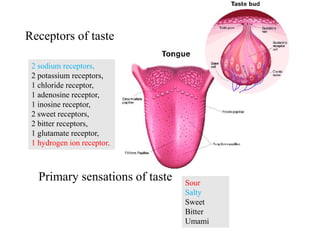
Receptors of taste
Primary sensations of taste
Taste buds and its function
Taste threshold
Mechanism of stimulation
Transmission of taste signals to CNS
Classification of taste disorders
Dental causes of taste disorders
Clinical evaluation and diagnosis
Management
Conclusion
References
Introduction
• Pain is one of the most commonly experienced symptoms in dentistry, as such , is a major
concern to the dentist.
• It is an intensely subjective experience, and is therefore difficult to describe. But it has two
features which are nearly universal. First, it is an unpleasant experience; and secondly, it is
evoked by a stimulus which is potentially damaging to living tissues.
• Although it is unpleasant, pain serves a protective function by making us aware of actual or
impending damage to the body.
• Furthermore,the ability to diagnose different diseases depends to a great extent on a doctors
knowledge of different qualities of pain.
What is pain ?
International association for the study of pain (IASP) - 1979
“An unpleasant sensory and emotional experience associated with actual or
potential tissue damage, or described in terms of tissue damage or both.”
Monheim
An un pleasant emotional experience usually initiated by noxious stimulus and
transmitted over specialized neural network to CNS where it is interpreted as such.
Bell
The subject’s conscious perception of modulated nociceptive impulses that generate
an unpleasant sensory and emotional experiences associated with actual of potential
tissue damage or describe in terms of such damage.
Allodynia pain resulting from a stimulus (such as a light touch of the skin) which
would not normally provoke pain
Hyperalgesia increased sensitivity to pain or enhanced intensity of pain sensation
Hyperesthesia is a condition that involves an abnormal increase in sensitivity to
stimuli of the sense.
"When a non-noxious stimulus causes the sensation of pain the area will be termed
hyperaesthetic".
Causalgia a constant usually burning pain that results from injury to a peripheral
nerve and is often considered a type of complex regional pain syndrome
Neuralgia is a stabbing, burning, and often severe pain due to an irritated or
damaged nerve.
Anesthesia Dolorosa (AD) is one of the most dreaded complications of the treatment of
trigeminal neuralgia. It occurs when the trigeminal nerve is damaged by surgery or physical
trauma, resulting in numbness in the face, with pain present within the numb area
TYPES OF PAIN
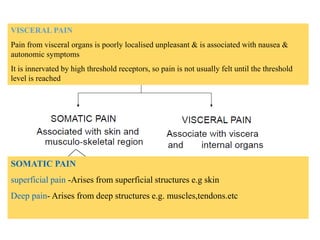
Based on the level of stimulation
VISCERAL PAIN
Pain from visceral organs is poorly localised unpleasant & is associated with nausea &
autonomic symptoms
It is innervated by high threshold receptors, so pain is not usually felt until the threshold
level is reached
SOMATIC PAIN
superficial pain -Arises from superficial structures e.g skin
Deep pain- Arises from deep structures e.g. muscles,tendons.etc
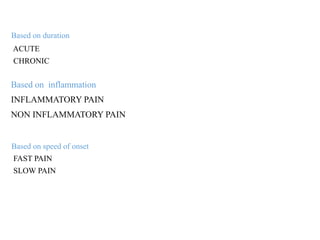
Based on duration
7
ACUTE
CHRONIC
Based on speed of onset
FAST PAIN
SLOW PAIN
Based on inflammation
INFLAMMATORY PAIN
NON INFLAMMATORY PAIN
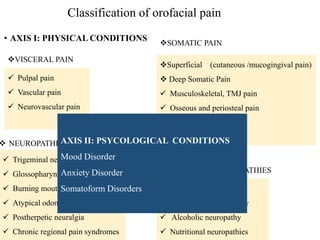
Classification of orofacial pain
• AXIS I: PHYSICAL CONDITIONS
Superficial (cutaneous /mucogingival pain)
 Deep Somatic Pain
 Musculoskeletal, TMJ pain
 Osseous and periosteal pain
 Connective tissue pain
 Periodontal pain
METABOLIC POLYNEUROPATHIES
SOMATIC PAIN
VISCERAL PAIN
 Pulpal pain
 Vascular pain
 Neurovascular pain
 NEUROPATHIC PAIN
 Trigeminal neuralgia
 Glossopharyngeal neuralgia
 Burning mouth syndrome
 Atypical odontalgia
 Postherpetic neuralgia
 Chronic regional pain syndromes
 Diabetic neuropathy
 Hypothyroid neuropathy
 Alcoholic neuropathy
 Nutritional neuropathies
AXIS II: PSYCOLOGICAL CONDITIONS
Mood Disorder
Anxiety Disorder
Somatoform Disorders
Nature of periodontal pain
• Deep somatic pain of musculoskeletal type. More localized than pulpal pain. (visceral
pain)
• Responds to provocation proportionately and is graduated increments rather than as a
threshold response like pulpal pain.
• Receptors of periodontal ligament are capable of precise localization of the stimulus.
Such localization is identified by applying pressure to the tooth laterally or axially.
FACTORS AFFECTING PAIN :
1. Emotional status :
The pain threshold depends greatly on attitude towards the procedure. In case of
emotionally unstable and anxiety patient, the pain threshold is low but reaction is high.
2. Fatigue :
Pain reaction threshold is high in subjects who has good night sleep and relaxed state of
mind, than those persons who are tired.
3. Age :
Older individuals tend to tolerate pain and thus have higher pain reaction threshold than
young individuals. Perhaps their philosophy of living or the realization that unpleasant
experiences are a part of life may account for this fact.
4. Sex :
Men have higher pain threshold than women. This may be a reflection of man’s
desire to maintain his feeling of superiority and this is exhibited in his pre
determined effort to tolerate pain.
5. Fear and apprehension :
Most cases, pain threshold is lowered as fear and apprehension increases.
Individuals who are extremely fearful tend to magnify their experiences.
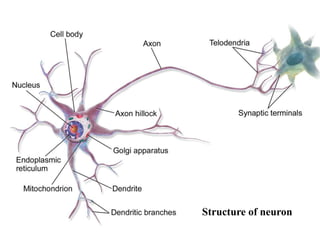
Structure of neuron
Myelin sheath
• Each peripheral nerve fiber is covered by a cellular nerve tissue sheath called neurolemma
( primary sheath of Shwann)
• Some fibres also have a layer of fatty nerve tissue called the myelin sheath.
(medullary sheath or white substance of Shwann).
• Constrictions called nodes of Ranvier occur in myelinated nerves at intervals of about 1mm.
These nodes are caused by the absence of myelin material so that only neurolemma covers
the nerve fibre.
Myelinated / Unmyelinated nerves
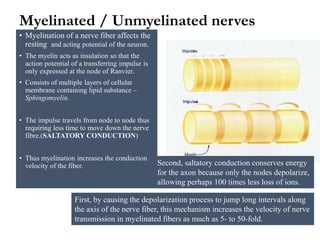
• Myelination of a nerve fiber affects the
resting and acting potential of the neuron.
• The myelin acts as insulation so that the
action potential of a transferring impulse is
only expressed at the node of Ranvier.
• Consists of multiple layers of cellular
membrane containing lipid substance –
Sphingomyelin.
• The impulse travels from node to node thus
requiring less time to move down the nerve
fibre.(SALTATORY CONDUCTION)
• Thus myelination increases the conduction
velocity of the fiber.
First, by causing the depolarization process to jump long intervals along
the axis of the nerve fiber, this mechanism increases the velocity of nerve
transmission in myelinated fibers as much as 5- to 50-fold.
Second, saltatory conduction conserves energy
for the axon because only the nodes depolarize,
allowing perhaps 100 times less loss of ions.
Nerve conduction
• Nerve conduction - Self propagated passage of an electrical current along nerve fibres.
• Conduction of impulse by a nerve depends on the electrical potential that exists across
the nerve membrane.
• This conduction occurs when the nerve fibers undergo transition from the resting state to
active state.
• The nerve cell membrane composed with minute pores through which ions can diffuse.
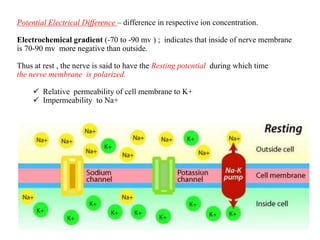
Potential Electrical Difference – difference in respective ion concentration.
Electrochemical gradient (-70 to -90 mv ) ; indicates that inside of nerve membrane
is 70-90 mv more negative than outside.
Thus at rest , the nerve is said to have the Resting potential during which time
the nerve membrane is polarized.
 Relative permeability of cell membrane to K+
 Impermeability to Na+
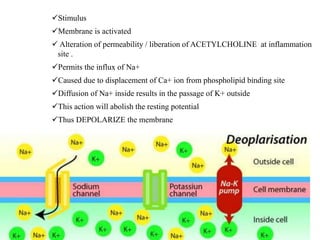
Stimulus
Membrane is activated
 Alteration of permeability / liberation of ACETYLCHOLINE at inflammation
site .
Permits the influx of Na+
Caused due to displacement of Ca+ ion from phospholipid binding site
Diffusion of Na+ inside results in the passage of K+ outside
This action will abolish the resting potential
Thus DEPOLARIZE the membrane
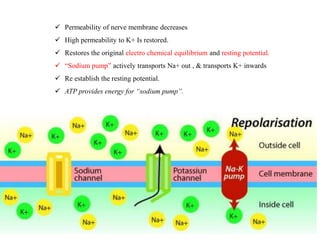
 Permeability of nerve membrane decreases
 High permeability to K+ Is restored.
 Restores the original electro chemical equilibrium and resting potential.
 “Sodium pump” actively transports Na+ out , & transports K+ inwards
 Re establish the resting potential.
 ATP provides energy for “sodium pump”.
Refractory period
Cell membrane goes through a cycle of depolarisation and repolarisation
. If another stimulus arrives at the membrane during this cycle, the area cannot
depolarise again.
The current cycle has to finish before it is capable of depolarising.
The refractory period refers to this time when the membrane is not susceptible
to depolarising.
The return of the resting potential occurs within 3-4 msec after the initial
stimulation.
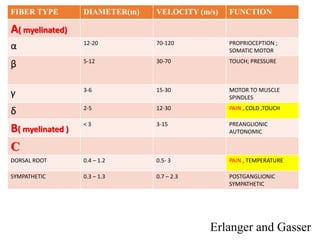
Erlanger and Gasser
FIBER TYPE DIAMETER(m) VELOCITY (m/s) FUNCTION
A( myelinated)
α 12-20 70-120 PROPRIOCEPTION ;
SOMATIC MOTOR
β 5-12 30-70 TOUCH; PRESSURE
γ 3-6 15-30 MOTOR TO MUSCLE
SPINDLES
δ 2-5 12-30 PAIN , COLD ,TOUCH
B( myelinated )
< 3 3-15 PREANGLIONIC
AUTONOMIC
C
DORSAL ROOT 0.4 – 1.2 0.5- 3 PAIN , TEMPERATURE
SYMPATHETIC 0.3 – 1.3 0.7 – 2.3 POSTGANGLIONIC
SYMPATHETIC
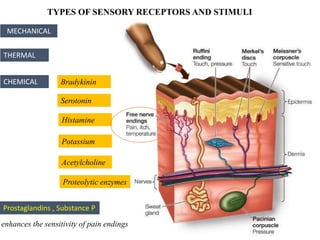
TYPES OF SENSORY RECEPTORS AND STIMULI
MECHANICAL
CHEMICAL
THERMAL
Bradykinin
Serotonin
Histamine
Potassium
Acetylcholine
Proteolytic enzymes
Prostaglandins , Substance P
enhances the sensitivity of pain endings
Nociceptors
• Pain receptors in the skin and other tissues
• Widespread in superficial areas and in certain internal tissues like periosteum ,
the arterial walls ,the joint suraces and falx and tentorium of cranial vault.
• Rarely present in deep tissues
• Extensive tissue damage can cause slow aching pain in most of the areas.
Nociception refers to the process by which information about tissue damage is
conveyed to the central nervous system (CNS)
Theories of Pain
 Specificity Theory
 Intensity Theory
 Pattern Theory
 Gate control Theory
Specificity Theory
 Proposed by Descartes in 1644.
• MAX VON FREY indicated that there were four somatosensory modalities:
cold, heat, pain, and touch and that all of the other skin senses were derivatives of
these four modalities
 Free nerve endings were implicated as pain receptors.
• Pain center was responsible for manifestation of unpleasant experience.
Stated pain system as a straight channel from the skin to the brain.
concept of specific cutaneous receptors for the mediation of touch , cold and
pain -SHERRINGTON
This theory states that a direct line from the receptor to the brain exist and the
stimulus at the receptor is necessarily followed by pain sensation.
DRAWBACK
Specificity Theory appropriately described sensory receptors that are specific to
nociceptive stimuli and primary afferents that show responses only to
suprathreshold stimuli, it did not account for neurons in the central nervous system
(CNS) that respond to both non-nociceptive and nociceptive stimuli.
Intensity Theory Of Pain
• the theory defines pain, not as a unique sensory experience but rather, as an
emotion that occurs when a stimulus is stronger than usual.
• Arthur Goldscheider further advanced the Intensity Theory, based on an
experiment performed by Bernhard Naunyn in 1859.
• It was concluded that there must be some form of summation that occurs for the
subthreshold stimuli to become unbearably painful.
• He suggested further that the increased sensory input would converge and
summate in the gray matter of the spinal cord.
Disadvantages
• Trigeminal neuralgia – gentle touch in trigger zone results in excruciating pain.
• The theory lost support with Sherrington’s evolutionary framework for the
Specificity Theory and postulated the existence of sensory receptors that are
specialized to respond to noxious stimuli, for which he coined the term
“nociceptor”.
Pattern Theory
• The theory suggest that particular patterns of nerve impulses that evoke pain are
produced by summation of sensory input within the dorsal horn of the spinal column.
• Pain results when total output of cells exceeds a critical level.
For example ,touch plus pressure plus heat might add up in such a manner that pain was
the modality experienced.
Gate Control Theory
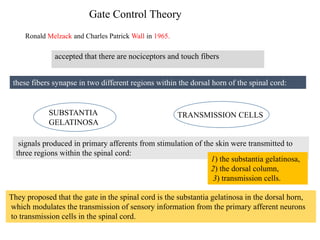
Ronald Melzack and Charles Patrick Wall in 1965.
accepted that there are nociceptors and touch fibers
these fibers synapse in two different regions within the dorsal horn of the spinal cord:
SUBSTANTIA
GELATINOSA
TRANSMISSION CELLS
signals produced in primary afferents from stimulation of the skin were transmitted to
three regions within the spinal cord:
1) the substantia gelatinosa,
2) the dorsal column,
3) transmission cells.
They proposed that the gate in the spinal cord is the substantia gelatinosa in the dorsal horn,
which modulates the transmission of sensory information from the primary afferent neurons
to transmission cells in the spinal cord.
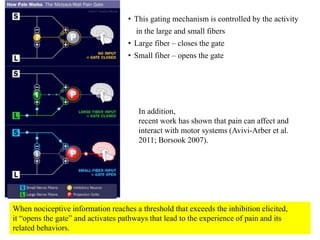
• This gating mechanism is controlled by the activity
in the large and small fibers
• Large fiber – closes the gate
• Small fiber – opens the gate
When nociceptive information reaches a threshold that exceeds the inhibition elicited,
it “opens the gate” and activates pathways that lead to the experience of pain and its
related behaviors.
In addition,
recent work has shown that pain can affect and
interact with motor systems (Avivi-Arber et al.
2011; Borsook 2007).
DUAL TRANSMISSION OF PAIN SIGNALS INTO CNS
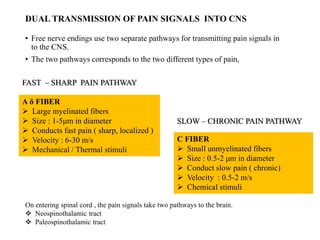
• Free nerve endings use two separate pathways for transmitting pain signals in
to the CNS.
• The two pathways corresponds to the two different types of pain,
A δ FIBER
 Large myelinated fibers
 Size : 1-5μm in diameter
 Conducts fast pain ( sharp, localized )
 Velocity : 6-30 m/s
 Mechanical / Thermal stimuli
C FIBER
 Small unmyelinated fibers
 Size : 0.5-2 μm in diameter
 Conduct slow pain ( chronic)
 Velocity : 0.5-2 m/s
 Chemical stimuli
FAST – SHARP PAIN PATHWAY
SLOW – CHRONIC PAIN PATHWAY
On entering spinal cord , the pain signals take two pathways to the brain.
 Neospinothalamic tract
 Paleospinothalamic tract
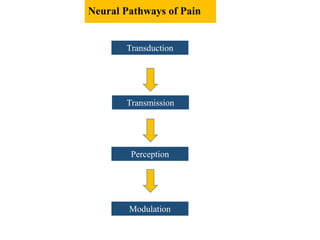
Neural Pathways of Pain
Transduction
Transmission
Perception
Modulation
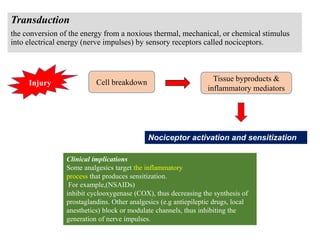
Transduction
the conversion of the energy from a noxious thermal, mechanical, or chemical stimulus
into electrical energy (nerve impulses) by sensory receptors called nociceptors.
Nociceptor activation and sensitization
Injury Cell breakdown Tissue byproducts &
inflammatory mediators
Clinical implications
Some analgesics target the inflammatory
process that produces sensitization.
For example,(NSAIDs)
inhibit cyclooxygenase (COX), thus decreasing the synthesis of
prostaglandins. Other analgesics (e.g antiepileptic drugs, local
anesthetics) block or modulate channels, thus inhibiting the
generation of nerve impulses.
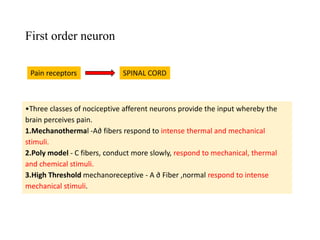
First order neuron
Pain receptors SPINAL CORD
•Three classes of nociceptive afferent neurons provide the input whereby the
brain perceives pain.
1.Mechanothermal -A∂ fibers respond to intense thermal and mechanical
stimuli.
2.Poly model - C fibers, conduct more slowly, respond to mechanical, thermal
and chemical stimuli.
3.High Threshold mechanoreceptive - A ∂ Fiber ,normal respond to intense
mechanical stimuli.
Transmission
the transmission of these neural signals from the site of transduction (periphery) to
the spinal cord and brain.
 Periphery to spinal cord
sensory nerve impulses travel via axons dorsal horn
propagate nerve impulses
release of excitatory amino acids (EAAs)
at synapse
Activated DH projection neurons
forward nociceptive impulses toward the brain
Spinal interneurons
release inhibitory amino acids (e.g.,
$-aminobutyric acid [GABA] &
neuropeptides (endogenous opioids)
bind to receptors on primary afferent and DH
neurons
inhibit nociceptive transmission
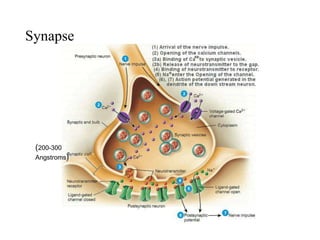
Synapse
(200-300
Angstroms)
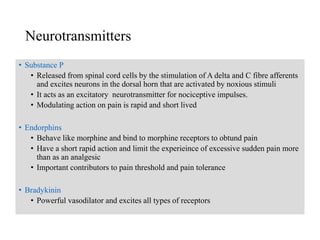
Neurotransmitters
• The neurochemicals that transmit impulses across the synaptic cleft.
• Substance P
• Released from spinal cord cells by the stimulation of A delta and C fibre afferents
and excites neurons in the dorsal horn that are activated by noxious stimuli
• It acts as an excitatory neurotransmitter for nociceptive impulses.
• Modulating action on pain is rapid and short lived
• Endorphins
• Behave like morphine and bind to morphine receptors to obtund pain
• Have a short rapid action and limit the experieince of excessive sudden pain more
than as an analgesic
• Important contributors to pain threshold and pain tolerance
• Bradykinin
• Powerful vasodilator and excites all types of receptors
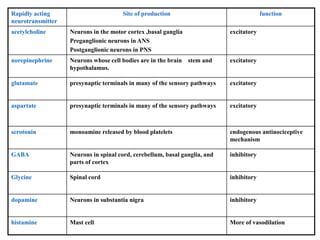
Rapidly acting
neurotransmitter
Site of production function
acetylcholine Neurons in the motor cortex ,basal ganglia
Preganglionic neurons in ANS
Postganglionic neurons in PNS
excitatory
norepinephrine Neurons whose cell bodies are in the brain stem and
hypothalamus.
excitatory
glutamate presynaptic terminals in many of the sensory pathways excitatory
aspartate presynaptic terminals in many of the sensory pathways excitatory
serotonin monoamine released by blood platelets endogenous antinociceptive
mechanism
GABA Neurons in spinal cord, cerebellum, basal ganglia, and
parts of cortex
inhibitory
Glycine Spinal cord inhibitory
dopamine Neurons in substantia nigra inhibitory
histamine Mast cell More of vasodilation
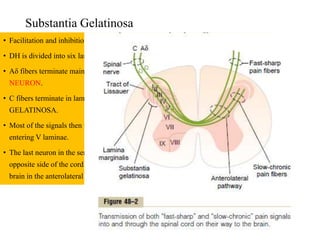
Substantia Gelatinosa
• Facilitation and inhibition occurs within the dorsal horn of spinal cord.
• DH is divided into six laminae based on the synaptic connection of afferent neurons.
• Aδ fibers terminate mainly in lamina 1 of DH and excites SECOND ORDER
NEURON.
• C fibers terminate in lamina 2 and 3 together knows as – SUBSTANTIA
GELATINOSA.
• Most of the signals then pass through one or more additional short fibers before
entering V laminae.
• The last neuron in the series gives rise to long axon which cross immediately to the
opposite side of the cord through anterior commissure ,then passes upwards to the
brain in the anterolateral pathway
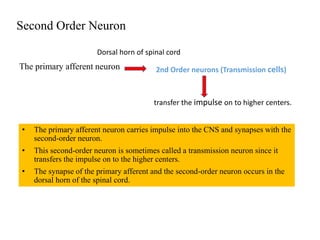
Second Order Neuron
• The primary afferent neuron carries impulse into the CNS and synapses with the
second-order neuron.
• This second-order neuron is sometimes called a transmission neuron since it
transfers the impulse on to the higher centers.
• The synapse of the primary afferent and the second-order neuron occurs in the
dorsal horn of the spinal cord.
The primary afferent neuron 2nd Order neurons (Transmission cells)
Dorsal horn of spinal cord
transfer the impulse on to higher centers.
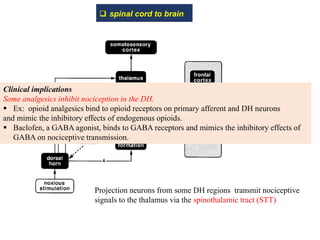
 spinal cord to brain
Projection neurons from some DH regions transmit nociceptive
signals to the thalamus via the spinothalamic tract (STT)
Clinical implications
Some analgesics inhibit nociception in the DH.
 Ex: opioid analgesics bind to opioid receptors on primary afferent and DH neurons
and mimic the inhibitory effects of endogenous opioids.
 Baclofen, a GABA agonist, binds to GABA receptors and mimics the inhibitory effects of
GABA on nociceptive transmission.
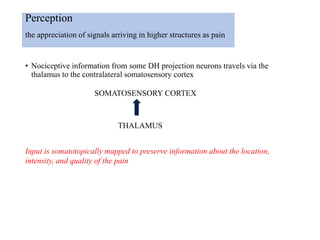
Perception
the appreciation of signals arriving in higher structures as pain
• Nociceptive information from some DH projection neurons travels via the
thalamus to the contralateral somatosensory cortex
SOMATOSENSORY CORTEX
THALAMUS
Input is somatotopically mapped to preserve information about the location,
intensity, and quality of the pain
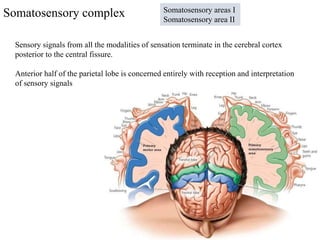
Somatosensory complex
Sensory signals from all the modalities of sensation terminate in the cerebral cortex
posterior to the central fissure.
Anterior half of the parietal lobe is concerned entirely with reception and interpretation
of sensory signals
Somatosensory areas I
Somatosensory area II
Modulation
Descending inhibitory and facilitory input from the brain that influences
(modulates) nociceptive transmission at the level of the spinal cord.
Descending pathways
 Modulation of nociceptive transmission occurs at multiple (peripheral, spinal,
supraspinal) levels.
 The attenuation of DH transmission by descending inhibitory input from the brain.
 Inhibitory and Facilitatory Descending Pathways. Nerve fibers from these pathways release inhibitory substances (e.g.,
endogenous opioids, serotonin, norepinephrine, GABA) at synapses with other
neurons in the DH.
 These substances bind to receptors on primary afferent and/or DH neurons and
inhibit nociceptive transmission.
 Such endogenous modulation may contribute to the wide variations in pain
perception observed among patients with similar injuries
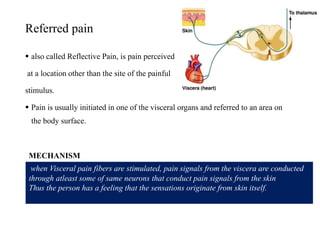
Referred pain
 also called Reflective Pain, is pain perceived
at a location other than the site of the painful
stimulus.
 Pain is usually initiated in one of the visceral organs and referred to an area on
the body surface.
MECHANISM
when Visceral pain fibers are stimulated, pain signals from the viscera are conducted
through atleast some of same neurons that conduct pain signals from the skin
Thus the person has a feeling that the sensations originate from skin itself.
MEASUREMENT OF PAIN :
COMMON ASSESSMENT TOOLS
1. Unidimensional Scales
Visual Analogue Scale
Numeric Rating Scale
Categorical Scale
2. Multidimensional Scales
Initial Pain Assessment Tool
Brief Pain Inventory
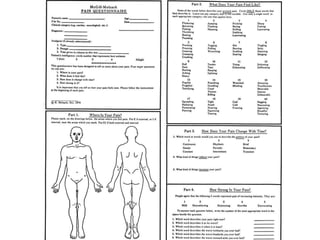
McGill Pain Quessionare
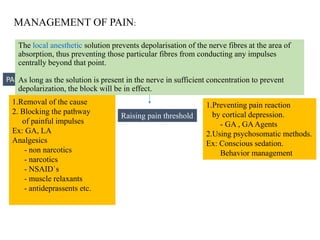
MANAGEMENT OF PAIN:
1.Removal of the cause
2. Blocking the pathway
of painful impulses
Ex: GA, LA
Analgesics
- non narcotics
- narcotics
- NSAID`s
- muscle relaxants
- antideprassents etc.
1.Preventing pain reaction
by cortical depression.
- GA , GAAgents
2.Using psychosomatic methods.
Ex: Conscious sedation.
Behavior management
Management of pain should encompass two essential elements
PAIN PERCEPTION CONTROL PAIN REACTION CONTROL
Raising pain threshold
The local anesthetic solution prevents depolarisation of the nerve fibres at the area of
absorption, thus preventing those particular fibres from conducting any impulses
centrally beyond that point.
As long as the solution is present in the nerve in sufficient concentration to prevent
depolarization, the block will be in effect.
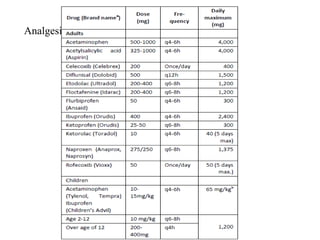
Analgesics used in periodontal surgery
CLINICAL ABNORMALITIES OF PAIN
• Hyperalgesia
• Trigeminal neuralgia
• Brown sequard syndrome
HYPERLGESIA
A pain nervous pathway sometimes becomes excessively excitable; this gives rise to
hyperalgesia, which means hypersensitivity to pain.
Causes
(1) excessive sensitivity of the pain receptors (primary hyperalgesia)
EXAMPLE: Extreme sensitivity of sunburned skin, which results from sensitization of
the skin pain endings by local tissue products from the burn.
(2) facilitation of sensory transmission (secondary hyperalgesia)
Lesions in the spinal cord or the thalamus.
TIC DOULOUREUX
Lancinating pain occasionally occurs in some people over one side of the face in
the sensory distribution area (or part of the area) of the fifth or ninth nerves; this
phenomenon is called tic douloureux.
BROWN-SÉQUARD SYNDROME
If the spinal cord is transected entirely, all sensations and motor functions distal to
the segment of transection are blocked, but if the spinal cord is transected on only
one side, the Brown-Séquard syndrome occurs.
TASTE
PATHWAY
Introduction
Taste or gustation is one of the 5 traditional senses including hearing, sight, touch,
and smell.
The sense of taste has classically been limited to the 5 basic taste qualities: sweet,
salty, sour, bitter, and umami or savory
The senses of taste and smell allow us to separate undesirable or even lethal foods from
those that are pleasant to eat and nutritious.
Taste is mainly a function of the taste buds in the mouth, but it is common experience
that one’s sense of smell also contributes strongly to taste perception.
The importance of taste lies in the fact that it allows a person to select food in accord
with desires and often in accord with the body tissues’metabolic need for specific
substances
Receptors of taste
2 sodium receptors,
2 potassium receptors,
1 chloride receptor,
1 adenosine receptor,
1 inosine receptor,
2 sweet receptors,
2 bitter receptors,
1 glutamate receptor,
1 hydrogen ion receptor.
Primary sensations of taste Sour
Salty
Sweet
Bitter
Umami
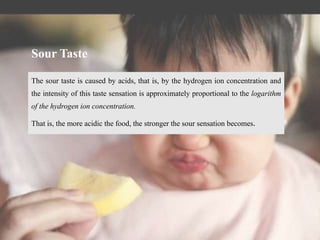
The sour taste is caused by acids, that is, by the hydrogen ion concentration and
the intensity of this taste sensation is approximately proportional to the logarithm
of the hydrogen ion concentration.
That is, the more acidic the food, the stronger the sour sensation becomes.
Sour Taste
 The sweet taste is not caused by any single class of chemicals.
 Some of the types of chemicals that cause this taste include sugars, glycols,
alcohols, aldehydes, ketones, amides, esters, some amino acids, some small
proteins, sulfonic acids, halogenated acids, and inorganic salts of lead and
beryllium.
 Most of the substances that cause a sweet taste are organic chemicals.
 It is especially interesting that slight changes in the chemical structure, such as
addition of a simple radical, can often change the substance from sweet to bitter
SWEET
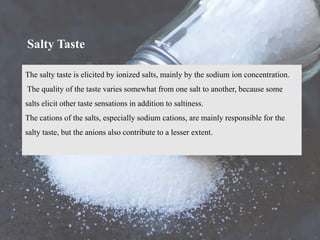
The salty taste is elicited by ionized salts, mainly by the sodium ion concentration.
The quality of the taste varies somewhat from one salt to another, because some
salts elicit other taste sensations in addition to saltiness.
The cations of the salts, especially sodium cations, are mainly responsible for the
salty taste, but the anions also contribute to a lesser extent.
Salty Taste
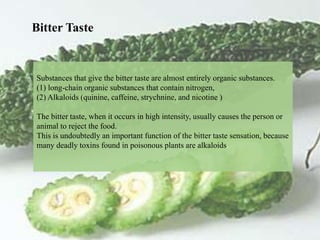
Substances that give the bitter taste are almost entirely organic substances.
(1) long-chain organic substances that contain nitrogen,
(2) Alkaloids (quinine, caffeine, strychnine, and nicotine )
The bitter taste, when it occurs in high intensity, usually causes the person or
animal to reject the food.
This is undoubtedly an important function of the bitter taste sensation, because
many deadly toxins found in poisonous plants are alkaloids.
Bitter Taste
Umami is a Japanese word (meaning “delicious”) designating a pleasant taste
sensation that is qualitatively different from sour, salty, sweet, or bitter.
Umami is the dominant taste of food containing L-glutamate, such as meat extracts
and cheese.
Physiologists consider it to be a separate, fifth category of primary taste stimuli.
A taste receptor for L-glutamate may be related to one of the glutamate receptors
expressed in neuronal synapses of the brain.
Umami Taste
TASTE BUD AND ITS FUNCTION
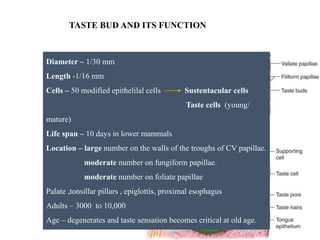
Diameter – 1/30 mm
Length -1/16 mm
Cells – 50 modified epithelilal cells Sustentacular cells
Taste cells (young/
mature)
Life span – 10 days in lower mammals
Location – large number on the walls of the troughs of CV papillae.
moderate number on fungiform papillae.
moderate number on foliate papillae
Palate ,tonsillar pillars , epiglottis, proximal esophagus
Adults – 3000 to 10,000
Age – degenerates and taste sensation becomes critical at old age.
Microelectrode studies from single taste buds show that each taste bud usually
responds mostly to one of the five primary taste stimuli when the taste substance is
in low concentration. But at high concentration, most buds can be excited by two
or more of the primary taste stimuli, as well as by a few other taste stimuli that do
not fit into the “primary” categories.
Specificity of Taste Buds for a Primary Taste Stimulus.
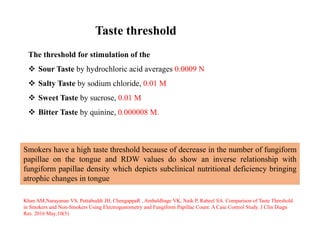
Taste threshold
Smokers have a high taste threshold because of decrease in the number of fungiform
papillae on the tongue and RDW values do show an inverse relationship with
fungiform papillae density which depicts subclinical nutritional deficiency bringing
atrophic changes in tongue
Khan AM,Narayanan VS, Puttabuddi JH, ChengappaR , Ambaldhage VK, Naik P, Raheel SA. Comparison of Taste Threshold
in Smokers and Non-Smokers Using Electrogustometry and Fungiform Papillae Count: A Case Control Study. J Clin Diagn
Res. 2016 May;10(5)
The threshold for stimulation of the
 Sour Taste by hydrochloric acid averages 0.0009 N
 Salty Taste by sodium chloride, 0.01 M
 Sweet Taste by sucrose, 0.01 M
 Bitter Taste by quinine, 0.000008 M.
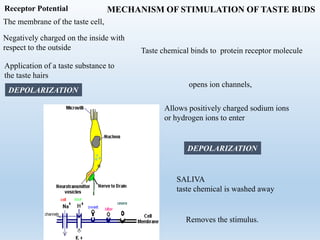
MECHANISM OF STIMULATION OF TASTE BUDS
The membrane of the taste cell,
Negatively charged on the inside with
respect to the outside
Application of a taste substance to
the taste hairs
DEPOLARIZATION
Receptor Potential
Taste chemical binds to protein receptor molecule
opens ion channels,
SALIVA
taste chemical is washed away
Allows positively charged sodium ions
or hydrogen ions to enter
DEPOLARIZATION
Removes the stimulus.
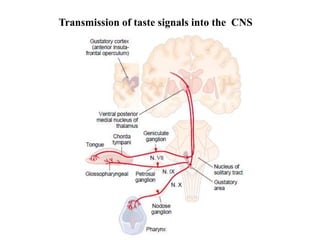
Transmission of taste signals into the CNS
From the tractus solitarius, many taste signals are transmitted within the brain stem
itself directly into the superior and inferior salivatory nuclei, and these areas transmit
signals to the submandibular, sublingual, and parotid glands to help control the
secretion of saliva during the ingestion and digestion of food.
Taste Reflexes Integrated in the Brain Stem.
ROLE OF SALIVA IN TASTE
Taste sensitivity is affected by the interaction between the taste substance and saliva.
Saliva helps in the perception of taste by the following mechanisms;
 Solubilization of the tastants in the saliva.
 Possible chemical interactions with the various components of saliva.
 Diffusion and dilution of the tastants in the saliva.
• Salivary secretion plays a key role in taste, including the transport of taste substances
and the protection of taste receptors.
• It protects the taste receptor from damage by dryness, infection, and from disuse
atrophy.
EFFECT OF REDUCED SALIVATION
• Head and Neck radiation – taste disturbances
• Affect turn over of taste buds
• Damage nerve terminals
• xerostomia- altered taste perception
ROLE OF ZINC
Zinc is a vital constituent in both the repair and maintenance of taste buds.
It helps in the synthesis of the protein gustin, which is linked to the building of taste
buds.
 Decrease in the salivary gustin/carbonic anhydrase VI causes taste and smell
disorders.
 It is a cofactor for alkaline phosphatase, an important enzyme in the taste bud
membrane.
Thus, taste disorders can be treated using zinc
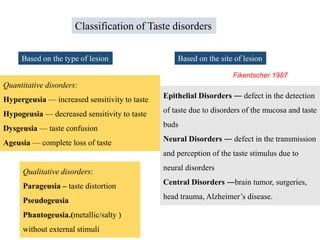
Classification of Taste disorders
Based on the type of lesion Based on the site of lesion
Quantitative disorders:
Hypergeusia — increased sensitivity to taste
Hypogeusia — decreased sensitivity to taste
Dysgeusia — taste confusion
Ageusia — complete loss of taste
Qualitative disorders:
Parageusia – taste distortion
Pseudogeusia
Phantogeusia.(metallic/salty )
without external stimuli
Fikentscher 1987
Epithelial Disorders ― defect in the detection
of taste due to disorders of the mucosa and taste
buds
Neural Disorders ― defect in the transmission
and perception of the taste stimulus due to
neural disorders
Central Disorders ―brain tumor, surgeries,
head trauma, Alzheimer’s disease.
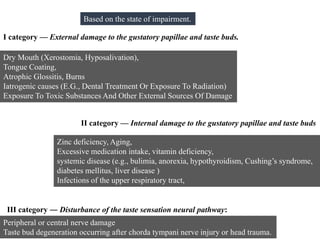
Based on the state of impairment.
I category — External damage to the gustatory papillae and taste buds.
Dry Mouth (Xerostomia, Hyposalivation),
Tongue Coating,
Atrophic Glossitis, Burns
Iatrogenic causes (E.G., Dental Treatment Or Exposure To Radiation)
Exposure To Toxic Substances And Other External Sources Of Damage
II category — Internal damage to the gustatory papillae and taste buds
Zinc deficiency, Aging,
Excessive medication intake, vitamin deficiency,
systemic disease (e.g., bulimia, anorexia, hypothyroidism, Cushing’s syndrome,
diabetes mellitus, liver disease )
Infections of the upper respiratory tract,
Peripheral or central nerve damage
Taste bud degeneration occurring after chorda tympani nerve injury or head trauma.
III category ― Disturbance of the taste sensation neural pathway:
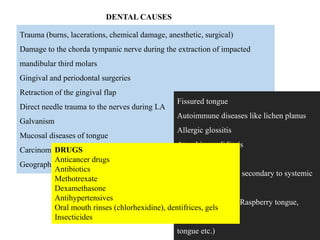
Trauma (burns, lacerations, chemical damage, anesthetic, surgical)
Damage to the chorda tympanic nerve during the extraction of impacted
mandibular third molars
Gingival and periodontal surgeries
Retraction of the gingival flap
Direct needle trauma to the nerves during LA
Galvanism
Mucosal diseases of tongue
Carcinoma of tongue
Geographic tongue
Fissured tongue
Autoimmune diseases like lichen planus
Allergic glossitis
Atrophic candidiasis
Hairy tongue
Atrophy of papillae secondary to systemic
diseases
(Hunter’s glossitis, Raspberry tongue,
Strawberry
tongue etc.)
DENTAL CAUSES
DRUGS
Anticancer drugs
Antibiotics
Methotrexate
Dexamethasone
Antihypertensives
Oral mouth rinses (chlorhexidine), dentifrices, gels
Insecticides
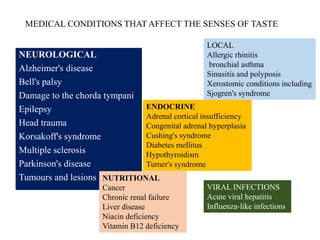
MEDICAL CONDITIONS THAT AFFECT THE SENSES OF TASTE
NEUROLOGICAL
Alzheimer's disease
Bell's palsy
Damage to the chorda tympani
Epilepsy
Head trauma
Korsakoff's syndrome
Multiple sclerosis
Parkinson's disease
Tumours and lesions NUTRITIONAL
Cancer
Chronic renal failure
Liver disease
Niacin deficiency
Vitamin B12 deficiency
ENDOCRINE
Adrenal cortical insufficiency
Congenital adrenal hyperplasia
Cushing's syndrome
Diabetes mellitus
Hypothyroidism
Turner's syndrome
LOCAL
Allergic rhinitis
bronchial asthma
Sinusitis and polyposis
Xerostomic conditions including
Sjogren's syndrome
VIRAL INFECTIONS
Acute viral hepatitis
Influenza‐like infections
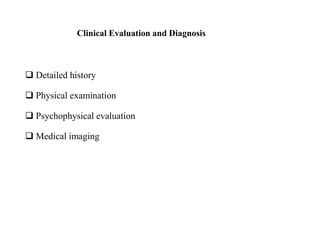
Clinical Evaluation and Diagnosis
 Detailed history
 Physical examination
 Psychophysical evaluation
 Medical imaging
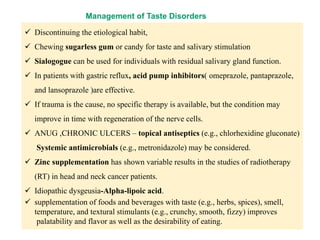
Management of Taste Disorders
 Discontinuing the etiological habit,
 Chewing sugarless gum or candy for taste and salivary stimulation
 Sialogogue can be used for individuals with residual salivary gland function.
 In patients with gastric reflux, acid pump inhibitors( omeprazole, pantaprazole,
and lansoprazole )are effective.
 If trauma is the cause, no specific therapy is available, but the condition may
improve in time with regeneration of the nerve cells.
 ANUG ,CHRONIC ULCERS – topical antiseptics (e.g., chlorhexidine gluconate)
Systemic antimicrobials (e.g., metronidazole) may be considered.
 Zinc supplementation has shown variable results in the studies of radiotherapy
(RT) in head and neck cancer patients.
 Idiopathic dysgeusia-Alpha-lipoic acid.
 supplementation of foods and beverages with taste (e.g., herbs, spices), smell,
temperature, and textural stimulants (e.g., crunchy, smooth, fizzy) improves
palatability and flavor as well as the desirability of eating.
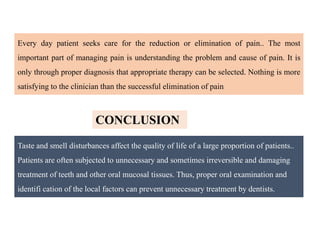
Taste and smell disturbances affect the quality of life of a large proportion of patients..
Patients are often subjected to unnecessary and sometimes irreversible and damaging
treatment of teeth and other oral mucosal tissues. Thus, proper oral examination and
identifi cation of the local factors can prevent unnecessary treatment by dentists.
CONCLUSION
Every day patient seeks care for the reduction or elimination of pain.. The most
important part of managing pain is understanding the problem and cause of pain. It is
only through proper diagnosis that appropriate therapy can be selected. Nothing is more
satisfying to the clinician than the successful elimination of pain
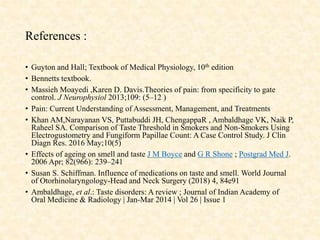
References :
• Guyton and Hall; Textbook of Medical Physiology, 10th edition
• Bennetts textbook.
• Massieh Moayedi ,Karen D. Davis.Theories of pain: from specificity to gate
control. J Neurophysiol 2013;109: (5–12 )
• Pain: Current Understanding of Assessment, Management, and Treatments
• Khan AM,Narayanan VS, Puttabuddi JH, ChengappaR , Ambaldhage VK, Naik P,
Raheel SA. Comparison of Taste Threshold in Smokers and Non-Smokers Using
Electrogustometry and Fungiform Papillae Count: A Case Control Study. J Clin
Diagn Res. 2016 May;10(5)
• Effects of ageing on smell and taste J M Boyce and G R Shone ; Postgrad Med J.
2006 Apr; 82(966): 239–241
• Susan S. Schiffman. Influence of medications on taste and smell. World Journal
of Otorhinolaryngology-Head and Neck Surgery (2018) 4, 84e91
• Ambaldhage, et al.: Taste disorders: A review ; Journal of Indian Academy of
Oral Medicine & Radiology | Jan-Mar 2014 | Vol 26 | Issue 1

pain and taste pathway

  • 1.
    PAIN AND TASTEPATHWAY Presented by , ZUNAIDHA
  • 2.
    CONTENTS Introduction Definition Types of Pain Factorsaffecting pain Structure of neuron Nerve conduction Types of sensory receptors and stimuli Pain theories Neural pathways of pain Measurement of Pain Management Introduction Receptors of taste Primary sensations of taste Taste buds and its function Taste threshold Mechanism of stimulation Transmission of taste signals to CNS Classification of taste disorders Dental causes of taste disorders Clinical evaluation and diagnosis Management Conclusion References
  • 3.
    Introduction • Pain isone of the most commonly experienced symptoms in dentistry, as such , is a major concern to the dentist. • It is an intensely subjective experience, and is therefore difficult to describe. But it has two features which are nearly universal. First, it is an unpleasant experience; and secondly, it is evoked by a stimulus which is potentially damaging to living tissues. • Although it is unpleasant, pain serves a protective function by making us aware of actual or impending damage to the body. • Furthermore,the ability to diagnose different diseases depends to a great extent on a doctors knowledge of different qualities of pain.
  • 4.
    What is pain? International association for the study of pain (IASP) - 1979 “An unpleasant sensory and emotional experience associated with actual or potential tissue damage, or described in terms of tissue damage or both.” Monheim An un pleasant emotional experience usually initiated by noxious stimulus and transmitted over specialized neural network to CNS where it is interpreted as such. Bell The subject’s conscious perception of modulated nociceptive impulses that generate an unpleasant sensory and emotional experiences associated with actual of potential tissue damage or describe in terms of such damage.
  • 5.
    Allodynia pain resultingfrom a stimulus (such as a light touch of the skin) which would not normally provoke pain Hyperalgesia increased sensitivity to pain or enhanced intensity of pain sensation Hyperesthesia is a condition that involves an abnormal increase in sensitivity to stimuli of the sense. "When a non-noxious stimulus causes the sensation of pain the area will be termed hyperaesthetic". Causalgia a constant usually burning pain that results from injury to a peripheral nerve and is often considered a type of complex regional pain syndrome Neuralgia is a stabbing, burning, and often severe pain due to an irritated or damaged nerve. Anesthesia Dolorosa (AD) is one of the most dreaded complications of the treatment of trigeminal neuralgia. It occurs when the trigeminal nerve is damaged by surgery or physical trauma, resulting in numbness in the face, with pain present within the numb area
  • 6.
    TYPES OF PAIN Basedon the level of stimulation VISCERAL PAIN Pain from visceral organs is poorly localised unpleasant & is associated with nausea & autonomic symptoms It is innervated by high threshold receptors, so pain is not usually felt until the threshold level is reached SOMATIC PAIN superficial pain -Arises from superficial structures e.g skin Deep pain- Arises from deep structures e.g. muscles,tendons.etc
  • 7.
    Based on duration 7 ACUTE CHRONIC Basedon speed of onset FAST PAIN SLOW PAIN Based on inflammation INFLAMMATORY PAIN NON INFLAMMATORY PAIN
  • 8.
    Classification of orofacialpain • AXIS I: PHYSICAL CONDITIONS Superficial (cutaneous /mucogingival pain)  Deep Somatic Pain  Musculoskeletal, TMJ pain  Osseous and periosteal pain  Connective tissue pain  Periodontal pain METABOLIC POLYNEUROPATHIES SOMATIC PAIN VISCERAL PAIN  Pulpal pain  Vascular pain  Neurovascular pain  NEUROPATHIC PAIN  Trigeminal neuralgia  Glossopharyngeal neuralgia  Burning mouth syndrome  Atypical odontalgia  Postherpetic neuralgia  Chronic regional pain syndromes  Diabetic neuropathy  Hypothyroid neuropathy  Alcoholic neuropathy  Nutritional neuropathies AXIS II: PSYCOLOGICAL CONDITIONS Mood Disorder Anxiety Disorder Somatoform Disorders
  • 9.
    Nature of periodontalpain • Deep somatic pain of musculoskeletal type. More localized than pulpal pain. (visceral pain) • Responds to provocation proportionately and is graduated increments rather than as a threshold response like pulpal pain. • Receptors of periodontal ligament are capable of precise localization of the stimulus. Such localization is identified by applying pressure to the tooth laterally or axially.
  • 10.
    FACTORS AFFECTING PAIN: 1. Emotional status : The pain threshold depends greatly on attitude towards the procedure. In case of emotionally unstable and anxiety patient, the pain threshold is low but reaction is high. 2. Fatigue : Pain reaction threshold is high in subjects who has good night sleep and relaxed state of mind, than those persons who are tired. 3. Age : Older individuals tend to tolerate pain and thus have higher pain reaction threshold than young individuals. Perhaps their philosophy of living or the realization that unpleasant experiences are a part of life may account for this fact. 4. Sex : Men have higher pain threshold than women. This may be a reflection of man’s desire to maintain his feeling of superiority and this is exhibited in his pre determined effort to tolerate pain. 5. Fear and apprehension : Most cases, pain threshold is lowered as fear and apprehension increases. Individuals who are extremely fearful tend to magnify their experiences.
  • 11.
  • 12.
    Myelin sheath • Eachperipheral nerve fiber is covered by a cellular nerve tissue sheath called neurolemma ( primary sheath of Shwann) • Some fibres also have a layer of fatty nerve tissue called the myelin sheath. (medullary sheath or white substance of Shwann). • Constrictions called nodes of Ranvier occur in myelinated nerves at intervals of about 1mm. These nodes are caused by the absence of myelin material so that only neurolemma covers the nerve fibre.
  • 13.
    Myelinated / Unmyelinatednerves • Myelination of a nerve fiber affects the resting and acting potential of the neuron. • The myelin acts as insulation so that the action potential of a transferring impulse is only expressed at the node of Ranvier. • Consists of multiple layers of cellular membrane containing lipid substance – Sphingomyelin. • The impulse travels from node to node thus requiring less time to move down the nerve fibre.(SALTATORY CONDUCTION) • Thus myelination increases the conduction velocity of the fiber. First, by causing the depolarization process to jump long intervals along the axis of the nerve fiber, this mechanism increases the velocity of nerve transmission in myelinated fibers as much as 5- to 50-fold. Second, saltatory conduction conserves energy for the axon because only the nodes depolarize, allowing perhaps 100 times less loss of ions.
  • 14.
    Nerve conduction • Nerveconduction - Self propagated passage of an electrical current along nerve fibres. • Conduction of impulse by a nerve depends on the electrical potential that exists across the nerve membrane. • This conduction occurs when the nerve fibers undergo transition from the resting state to active state. • The nerve cell membrane composed with minute pores through which ions can diffuse.
  • 15.
    Potential Electrical Difference– difference in respective ion concentration. Electrochemical gradient (-70 to -90 mv ) ; indicates that inside of nerve membrane is 70-90 mv more negative than outside. Thus at rest , the nerve is said to have the Resting potential during which time the nerve membrane is polarized.  Relative permeability of cell membrane to K+  Impermeability to Na+
  • 16.
    Stimulus Membrane is activated Alteration of permeability / liberation of ACETYLCHOLINE at inflammation site . Permits the influx of Na+ Caused due to displacement of Ca+ ion from phospholipid binding site Diffusion of Na+ inside results in the passage of K+ outside This action will abolish the resting potential Thus DEPOLARIZE the membrane
  • 17.
     Permeability ofnerve membrane decreases  High permeability to K+ Is restored.  Restores the original electro chemical equilibrium and resting potential.  “Sodium pump” actively transports Na+ out , & transports K+ inwards  Re establish the resting potential.  ATP provides energy for “sodium pump”.
  • 18.
    Refractory period Cell membranegoes through a cycle of depolarisation and repolarisation . If another stimulus arrives at the membrane during this cycle, the area cannot depolarise again. The current cycle has to finish before it is capable of depolarising. The refractory period refers to this time when the membrane is not susceptible to depolarising. The return of the resting potential occurs within 3-4 msec after the initial stimulation.
  • 19.
    Erlanger and Gasser FIBERTYPE DIAMETER(m) VELOCITY (m/s) FUNCTION A( myelinated) α 12-20 70-120 PROPRIOCEPTION ; SOMATIC MOTOR β 5-12 30-70 TOUCH; PRESSURE γ 3-6 15-30 MOTOR TO MUSCLE SPINDLES δ 2-5 12-30 PAIN , COLD ,TOUCH B( myelinated ) < 3 3-15 PREANGLIONIC AUTONOMIC C DORSAL ROOT 0.4 – 1.2 0.5- 3 PAIN , TEMPERATURE SYMPATHETIC 0.3 – 1.3 0.7 – 2.3 POSTGANGLIONIC SYMPATHETIC
  • 20.
    TYPES OF SENSORYRECEPTORS AND STIMULI MECHANICAL CHEMICAL THERMAL Bradykinin Serotonin Histamine Potassium Acetylcholine Proteolytic enzymes Prostaglandins , Substance P enhances the sensitivity of pain endings
  • 21.
    Nociceptors • Pain receptorsin the skin and other tissues • Widespread in superficial areas and in certain internal tissues like periosteum , the arterial walls ,the joint suraces and falx and tentorium of cranial vault. • Rarely present in deep tissues • Extensive tissue damage can cause slow aching pain in most of the areas. Nociception refers to the process by which information about tissue damage is conveyed to the central nervous system (CNS)
  • 22.
    Theories of Pain Specificity Theory  Intensity Theory  Pattern Theory  Gate control Theory
  • 23.
    Specificity Theory  Proposedby Descartes in 1644. • MAX VON FREY indicated that there were four somatosensory modalities: cold, heat, pain, and touch and that all of the other skin senses were derivatives of these four modalities  Free nerve endings were implicated as pain receptors. • Pain center was responsible for manifestation of unpleasant experience. Stated pain system as a straight channel from the skin to the brain. concept of specific cutaneous receptors for the mediation of touch , cold and pain -SHERRINGTON This theory states that a direct line from the receptor to the brain exist and the stimulus at the receptor is necessarily followed by pain sensation.
  • 24.
    DRAWBACK Specificity Theory appropriatelydescribed sensory receptors that are specific to nociceptive stimuli and primary afferents that show responses only to suprathreshold stimuli, it did not account for neurons in the central nervous system (CNS) that respond to both non-nociceptive and nociceptive stimuli.
  • 25.
    Intensity Theory OfPain • the theory defines pain, not as a unique sensory experience but rather, as an emotion that occurs when a stimulus is stronger than usual. • Arthur Goldscheider further advanced the Intensity Theory, based on an experiment performed by Bernhard Naunyn in 1859. • It was concluded that there must be some form of summation that occurs for the subthreshold stimuli to become unbearably painful. • He suggested further that the increased sensory input would converge and summate in the gray matter of the spinal cord.
  • 26.
    Disadvantages • Trigeminal neuralgia– gentle touch in trigger zone results in excruciating pain. • The theory lost support with Sherrington’s evolutionary framework for the Specificity Theory and postulated the existence of sensory receptors that are specialized to respond to noxious stimuli, for which he coined the term “nociceptor”.
  • 27.
    Pattern Theory • Thetheory suggest that particular patterns of nerve impulses that evoke pain are produced by summation of sensory input within the dorsal horn of the spinal column. • Pain results when total output of cells exceeds a critical level. For example ,touch plus pressure plus heat might add up in such a manner that pain was the modality experienced.
  • 28.
    Gate Control Theory RonaldMelzack and Charles Patrick Wall in 1965. accepted that there are nociceptors and touch fibers these fibers synapse in two different regions within the dorsal horn of the spinal cord: SUBSTANTIA GELATINOSA TRANSMISSION CELLS signals produced in primary afferents from stimulation of the skin were transmitted to three regions within the spinal cord: 1) the substantia gelatinosa, 2) the dorsal column, 3) transmission cells. They proposed that the gate in the spinal cord is the substantia gelatinosa in the dorsal horn, which modulates the transmission of sensory information from the primary afferent neurons to transmission cells in the spinal cord.
  • 29.
    • This gatingmechanism is controlled by the activity in the large and small fibers • Large fiber – closes the gate • Small fiber – opens the gate When nociceptive information reaches a threshold that exceeds the inhibition elicited, it “opens the gate” and activates pathways that lead to the experience of pain and its related behaviors. In addition, recent work has shown that pain can affect and interact with motor systems (Avivi-Arber et al. 2011; Borsook 2007).
  • 30.
    DUAL TRANSMISSION OFPAIN SIGNALS INTO CNS • Free nerve endings use two separate pathways for transmitting pain signals in to the CNS. • The two pathways corresponds to the two different types of pain, A δ FIBER  Large myelinated fibers  Size : 1-5μm in diameter  Conducts fast pain ( sharp, localized )  Velocity : 6-30 m/s  Mechanical / Thermal stimuli C FIBER  Small unmyelinated fibers  Size : 0.5-2 μm in diameter  Conduct slow pain ( chronic)  Velocity : 0.5-2 m/s  Chemical stimuli FAST – SHARP PAIN PATHWAY SLOW – CHRONIC PAIN PATHWAY On entering spinal cord , the pain signals take two pathways to the brain.  Neospinothalamic tract  Paleospinothalamic tract
  • 31.
    Neural Pathways ofPain Transduction Transmission Perception Modulation
  • 32.
    Transduction the conversion ofthe energy from a noxious thermal, mechanical, or chemical stimulus into electrical energy (nerve impulses) by sensory receptors called nociceptors. Nociceptor activation and sensitization Injury Cell breakdown Tissue byproducts & inflammatory mediators Clinical implications Some analgesics target the inflammatory process that produces sensitization. For example,(NSAIDs) inhibit cyclooxygenase (COX), thus decreasing the synthesis of prostaglandins. Other analgesics (e.g antiepileptic drugs, local anesthetics) block or modulate channels, thus inhibiting the generation of nerve impulses.
  • 33.
    First order neuron Painreceptors SPINAL CORD •Three classes of nociceptive afferent neurons provide the input whereby the brain perceives pain. 1.Mechanothermal -A∂ fibers respond to intense thermal and mechanical stimuli. 2.Poly model - C fibers, conduct more slowly, respond to mechanical, thermal and chemical stimuli. 3.High Threshold mechanoreceptive - A ∂ Fiber ,normal respond to intense mechanical stimuli.
  • 34.
    Transmission the transmission ofthese neural signals from the site of transduction (periphery) to the spinal cord and brain.  Periphery to spinal cord sensory nerve impulses travel via axons dorsal horn propagate nerve impulses release of excitatory amino acids (EAAs) at synapse Activated DH projection neurons forward nociceptive impulses toward the brain Spinal interneurons release inhibitory amino acids (e.g., $-aminobutyric acid [GABA] & neuropeptides (endogenous opioids) bind to receptors on primary afferent and DH neurons inhibit nociceptive transmission
  • 35.
  • 36.
    Neurotransmitters • The neurochemicalsthat transmit impulses across the synaptic cleft. • Substance P • Released from spinal cord cells by the stimulation of A delta and C fibre afferents and excites neurons in the dorsal horn that are activated by noxious stimuli • It acts as an excitatory neurotransmitter for nociceptive impulses. • Modulating action on pain is rapid and short lived • Endorphins • Behave like morphine and bind to morphine receptors to obtund pain • Have a short rapid action and limit the experieince of excessive sudden pain more than as an analgesic • Important contributors to pain threshold and pain tolerance • Bradykinin • Powerful vasodilator and excites all types of receptors
  • 37.
    Rapidly acting neurotransmitter Site ofproduction function acetylcholine Neurons in the motor cortex ,basal ganglia Preganglionic neurons in ANS Postganglionic neurons in PNS excitatory norepinephrine Neurons whose cell bodies are in the brain stem and hypothalamus. excitatory glutamate presynaptic terminals in many of the sensory pathways excitatory aspartate presynaptic terminals in many of the sensory pathways excitatory serotonin monoamine released by blood platelets endogenous antinociceptive mechanism GABA Neurons in spinal cord, cerebellum, basal ganglia, and parts of cortex inhibitory Glycine Spinal cord inhibitory dopamine Neurons in substantia nigra inhibitory histamine Mast cell More of vasodilation
  • 38.
    Substantia Gelatinosa • Facilitationand inhibition occurs within the dorsal horn of spinal cord. • DH is divided into six laminae based on the synaptic connection of afferent neurons. • Aδ fibers terminate mainly in lamina 1 of DH and excites SECOND ORDER NEURON. • C fibers terminate in lamina 2 and 3 together knows as – SUBSTANTIA GELATINOSA. • Most of the signals then pass through one or more additional short fibers before entering V laminae. • The last neuron in the series gives rise to long axon which cross immediately to the opposite side of the cord through anterior commissure ,then passes upwards to the brain in the anterolateral pathway
  • 39.
    Second Order Neuron •The primary afferent neuron carries impulse into the CNS and synapses with the second-order neuron. • This second-order neuron is sometimes called a transmission neuron since it transfers the impulse on to the higher centers. • The synapse of the primary afferent and the second-order neuron occurs in the dorsal horn of the spinal cord. The primary afferent neuron 2nd Order neurons (Transmission cells) Dorsal horn of spinal cord transfer the impulse on to higher centers.
  • 40.
     spinal cordto brain Projection neurons from some DH regions transmit nociceptive signals to the thalamus via the spinothalamic tract (STT) Clinical implications Some analgesics inhibit nociception in the DH.  Ex: opioid analgesics bind to opioid receptors on primary afferent and DH neurons and mimic the inhibitory effects of endogenous opioids.  Baclofen, a GABA agonist, binds to GABA receptors and mimics the inhibitory effects of GABA on nociceptive transmission.
  • 41.
    Perception the appreciation ofsignals arriving in higher structures as pain • Nociceptive information from some DH projection neurons travels via the thalamus to the contralateral somatosensory cortex SOMATOSENSORY CORTEX THALAMUS Input is somatotopically mapped to preserve information about the location, intensity, and quality of the pain
  • 42.
    Somatosensory complex Sensory signalsfrom all the modalities of sensation terminate in the cerebral cortex posterior to the central fissure. Anterior half of the parietal lobe is concerned entirely with reception and interpretation of sensory signals Somatosensory areas I Somatosensory area II
  • 43.
    Modulation Descending inhibitory andfacilitory input from the brain that influences (modulates) nociceptive transmission at the level of the spinal cord. Descending pathways  Modulation of nociceptive transmission occurs at multiple (peripheral, spinal, supraspinal) levels.  The attenuation of DH transmission by descending inhibitory input from the brain.  Inhibitory and Facilitatory Descending Pathways. Nerve fibers from these pathways release inhibitory substances (e.g., endogenous opioids, serotonin, norepinephrine, GABA) at synapses with other neurons in the DH.  These substances bind to receptors on primary afferent and/or DH neurons and inhibit nociceptive transmission.  Such endogenous modulation may contribute to the wide variations in pain perception observed among patients with similar injuries
  • 44.
    Referred pain  alsocalled Reflective Pain, is pain perceived at a location other than the site of the painful stimulus.  Pain is usually initiated in one of the visceral organs and referred to an area on the body surface. MECHANISM when Visceral pain fibers are stimulated, pain signals from the viscera are conducted through atleast some of same neurons that conduct pain signals from the skin Thus the person has a feeling that the sensations originate from skin itself.
  • 45.
    MEASUREMENT OF PAIN: COMMON ASSESSMENT TOOLS 1. Unidimensional Scales Visual Analogue Scale Numeric Rating Scale Categorical Scale 2. Multidimensional Scales Initial Pain Assessment Tool Brief Pain Inventory McGill Pain Quessionare
  • 46.
    MANAGEMENT OF PAIN: 1.Removalof the cause 2. Blocking the pathway of painful impulses Ex: GA, LA Analgesics - non narcotics - narcotics - NSAID`s - muscle relaxants - antideprassents etc. 1.Preventing pain reaction by cortical depression. - GA , GAAgents 2.Using psychosomatic methods. Ex: Conscious sedation. Behavior management Management of pain should encompass two essential elements PAIN PERCEPTION CONTROL PAIN REACTION CONTROL Raising pain threshold The local anesthetic solution prevents depolarisation of the nerve fibres at the area of absorption, thus preventing those particular fibres from conducting any impulses centrally beyond that point. As long as the solution is present in the nerve in sufficient concentration to prevent depolarization, the block will be in effect.
  • 47.
    Analgesics used inperiodontal surgery
  • 48.
    CLINICAL ABNORMALITIES OFPAIN • Hyperalgesia • Trigeminal neuralgia • Brown sequard syndrome HYPERLGESIA A pain nervous pathway sometimes becomes excessively excitable; this gives rise to hyperalgesia, which means hypersensitivity to pain. Causes (1) excessive sensitivity of the pain receptors (primary hyperalgesia) EXAMPLE: Extreme sensitivity of sunburned skin, which results from sensitization of the skin pain endings by local tissue products from the burn. (2) facilitation of sensory transmission (secondary hyperalgesia) Lesions in the spinal cord or the thalamus.
  • 49.
    TIC DOULOUREUX Lancinating painoccasionally occurs in some people over one side of the face in the sensory distribution area (or part of the area) of the fifth or ninth nerves; this phenomenon is called tic douloureux. BROWN-SÉQUARD SYNDROME If the spinal cord is transected entirely, all sensations and motor functions distal to the segment of transection are blocked, but if the spinal cord is transected on only one side, the Brown-Séquard syndrome occurs.
  • 50.
  • 51.
    Introduction Taste or gustationis one of the 5 traditional senses including hearing, sight, touch, and smell. The sense of taste has classically been limited to the 5 basic taste qualities: sweet, salty, sour, bitter, and umami or savory The senses of taste and smell allow us to separate undesirable or even lethal foods from those that are pleasant to eat and nutritious. Taste is mainly a function of the taste buds in the mouth, but it is common experience that one’s sense of smell also contributes strongly to taste perception. The importance of taste lies in the fact that it allows a person to select food in accord with desires and often in accord with the body tissues’metabolic need for specific substances
  • 52.
    Receptors of taste 2sodium receptors, 2 potassium receptors, 1 chloride receptor, 1 adenosine receptor, 1 inosine receptor, 2 sweet receptors, 2 bitter receptors, 1 glutamate receptor, 1 hydrogen ion receptor. Primary sensations of taste Sour Salty Sweet Bitter Umami
  • 53.
    The sour tasteis caused by acids, that is, by the hydrogen ion concentration and the intensity of this taste sensation is approximately proportional to the logarithm of the hydrogen ion concentration. That is, the more acidic the food, the stronger the sour sensation becomes. Sour Taste
  • 54.
     The sweettaste is not caused by any single class of chemicals.  Some of the types of chemicals that cause this taste include sugars, glycols, alcohols, aldehydes, ketones, amides, esters, some amino acids, some small proteins, sulfonic acids, halogenated acids, and inorganic salts of lead and beryllium.  Most of the substances that cause a sweet taste are organic chemicals.  It is especially interesting that slight changes in the chemical structure, such as addition of a simple radical, can often change the substance from sweet to bitter SWEET
  • 55.
    The salty tasteis elicited by ionized salts, mainly by the sodium ion concentration. The quality of the taste varies somewhat from one salt to another, because some salts elicit other taste sensations in addition to saltiness. The cations of the salts, especially sodium cations, are mainly responsible for the salty taste, but the anions also contribute to a lesser extent. Salty Taste
  • 56.
    Substances that givethe bitter taste are almost entirely organic substances. (1) long-chain organic substances that contain nitrogen, (2) Alkaloids (quinine, caffeine, strychnine, and nicotine ) The bitter taste, when it occurs in high intensity, usually causes the person or animal to reject the food. This is undoubtedly an important function of the bitter taste sensation, because many deadly toxins found in poisonous plants are alkaloids. Bitter Taste
  • 57.
    Umami is aJapanese word (meaning “delicious”) designating a pleasant taste sensation that is qualitatively different from sour, salty, sweet, or bitter. Umami is the dominant taste of food containing L-glutamate, such as meat extracts and cheese. Physiologists consider it to be a separate, fifth category of primary taste stimuli. A taste receptor for L-glutamate may be related to one of the glutamate receptors expressed in neuronal synapses of the brain. Umami Taste
  • 58.
    TASTE BUD ANDITS FUNCTION Diameter – 1/30 mm Length -1/16 mm Cells – 50 modified epithelilal cells Sustentacular cells Taste cells (young/ mature) Life span – 10 days in lower mammals Location – large number on the walls of the troughs of CV papillae. moderate number on fungiform papillae. moderate number on foliate papillae Palate ,tonsillar pillars , epiglottis, proximal esophagus Adults – 3000 to 10,000 Age – degenerates and taste sensation becomes critical at old age.
  • 59.
    Microelectrode studies fromsingle taste buds show that each taste bud usually responds mostly to one of the five primary taste stimuli when the taste substance is in low concentration. But at high concentration, most buds can be excited by two or more of the primary taste stimuli, as well as by a few other taste stimuli that do not fit into the “primary” categories. Specificity of Taste Buds for a Primary Taste Stimulus.
  • 60.
    Taste threshold Smokers havea high taste threshold because of decrease in the number of fungiform papillae on the tongue and RDW values do show an inverse relationship with fungiform papillae density which depicts subclinical nutritional deficiency bringing atrophic changes in tongue Khan AM,Narayanan VS, Puttabuddi JH, ChengappaR , Ambaldhage VK, Naik P, Raheel SA. Comparison of Taste Threshold in Smokers and Non-Smokers Using Electrogustometry and Fungiform Papillae Count: A Case Control Study. J Clin Diagn Res. 2016 May;10(5) The threshold for stimulation of the  Sour Taste by hydrochloric acid averages 0.0009 N  Salty Taste by sodium chloride, 0.01 M  Sweet Taste by sucrose, 0.01 M  Bitter Taste by quinine, 0.000008 M.
  • 61.
    MECHANISM OF STIMULATIONOF TASTE BUDS The membrane of the taste cell, Negatively charged on the inside with respect to the outside Application of a taste substance to the taste hairs DEPOLARIZATION Receptor Potential Taste chemical binds to protein receptor molecule opens ion channels, SALIVA taste chemical is washed away Allows positively charged sodium ions or hydrogen ions to enter DEPOLARIZATION Removes the stimulus.
  • 62.
    Transmission of tastesignals into the CNS
  • 63.
    From the tractussolitarius, many taste signals are transmitted within the brain stem itself directly into the superior and inferior salivatory nuclei, and these areas transmit signals to the submandibular, sublingual, and parotid glands to help control the secretion of saliva during the ingestion and digestion of food. Taste Reflexes Integrated in the Brain Stem.
  • 64.
    ROLE OF SALIVAIN TASTE Taste sensitivity is affected by the interaction between the taste substance and saliva. Saliva helps in the perception of taste by the following mechanisms;  Solubilization of the tastants in the saliva.  Possible chemical interactions with the various components of saliva.  Diffusion and dilution of the tastants in the saliva. • Salivary secretion plays a key role in taste, including the transport of taste substances and the protection of taste receptors. • It protects the taste receptor from damage by dryness, infection, and from disuse atrophy. EFFECT OF REDUCED SALIVATION • Head and Neck radiation – taste disturbances • Affect turn over of taste buds • Damage nerve terminals • xerostomia- altered taste perception
  • 65.
    ROLE OF ZINC Zincis a vital constituent in both the repair and maintenance of taste buds. It helps in the synthesis of the protein gustin, which is linked to the building of taste buds.  Decrease in the salivary gustin/carbonic anhydrase VI causes taste and smell disorders.  It is a cofactor for alkaline phosphatase, an important enzyme in the taste bud membrane. Thus, taste disorders can be treated using zinc
  • 66.
    Classification of Tastedisorders Based on the type of lesion Based on the site of lesion Quantitative disorders: Hypergeusia — increased sensitivity to taste Hypogeusia — decreased sensitivity to taste Dysgeusia — taste confusion Ageusia — complete loss of taste Qualitative disorders: Parageusia – taste distortion Pseudogeusia Phantogeusia.(metallic/salty ) without external stimuli Fikentscher 1987 Epithelial Disorders ― defect in the detection of taste due to disorders of the mucosa and taste buds Neural Disorders ― defect in the transmission and perception of the taste stimulus due to neural disorders Central Disorders ―brain tumor, surgeries, head trauma, Alzheimer’s disease.
  • 67.
    Based on thestate of impairment. I category — External damage to the gustatory papillae and taste buds. Dry Mouth (Xerostomia, Hyposalivation), Tongue Coating, Atrophic Glossitis, Burns Iatrogenic causes (E.G., Dental Treatment Or Exposure To Radiation) Exposure To Toxic Substances And Other External Sources Of Damage II category — Internal damage to the gustatory papillae and taste buds Zinc deficiency, Aging, Excessive medication intake, vitamin deficiency, systemic disease (e.g., bulimia, anorexia, hypothyroidism, Cushing’s syndrome, diabetes mellitus, liver disease ) Infections of the upper respiratory tract, Peripheral or central nerve damage Taste bud degeneration occurring after chorda tympani nerve injury or head trauma. III category ― Disturbance of the taste sensation neural pathway:
  • 68.
    Trauma (burns, lacerations,chemical damage, anesthetic, surgical) Damage to the chorda tympanic nerve during the extraction of impacted mandibular third molars Gingival and periodontal surgeries Retraction of the gingival flap Direct needle trauma to the nerves during LA Galvanism Mucosal diseases of tongue Carcinoma of tongue Geographic tongue Fissured tongue Autoimmune diseases like lichen planus Allergic glossitis Atrophic candidiasis Hairy tongue Atrophy of papillae secondary to systemic diseases (Hunter’s glossitis, Raspberry tongue, Strawberry tongue etc.) DENTAL CAUSES DRUGS Anticancer drugs Antibiotics Methotrexate Dexamethasone Antihypertensives Oral mouth rinses (chlorhexidine), dentifrices, gels Insecticides
  • 69.
    MEDICAL CONDITIONS THATAFFECT THE SENSES OF TASTE NEUROLOGICAL Alzheimer's disease Bell's palsy Damage to the chorda tympani Epilepsy Head trauma Korsakoff's syndrome Multiple sclerosis Parkinson's disease Tumours and lesions NUTRITIONAL Cancer Chronic renal failure Liver disease Niacin deficiency Vitamin B12 deficiency ENDOCRINE Adrenal cortical insufficiency Congenital adrenal hyperplasia Cushing's syndrome Diabetes mellitus Hypothyroidism Turner's syndrome LOCAL Allergic rhinitis bronchial asthma Sinusitis and polyposis Xerostomic conditions including Sjogren's syndrome VIRAL INFECTIONS Acute viral hepatitis Influenza‐like infections
  • 70.
    Clinical Evaluation andDiagnosis  Detailed history  Physical examination  Psychophysical evaluation  Medical imaging
  • 71.
    Management of TasteDisorders  Discontinuing the etiological habit,  Chewing sugarless gum or candy for taste and salivary stimulation  Sialogogue can be used for individuals with residual salivary gland function.  In patients with gastric reflux, acid pump inhibitors( omeprazole, pantaprazole, and lansoprazole )are effective.  If trauma is the cause, no specific therapy is available, but the condition may improve in time with regeneration of the nerve cells.  ANUG ,CHRONIC ULCERS – topical antiseptics (e.g., chlorhexidine gluconate) Systemic antimicrobials (e.g., metronidazole) may be considered.  Zinc supplementation has shown variable results in the studies of radiotherapy (RT) in head and neck cancer patients.  Idiopathic dysgeusia-Alpha-lipoic acid.  supplementation of foods and beverages with taste (e.g., herbs, spices), smell, temperature, and textural stimulants (e.g., crunchy, smooth, fizzy) improves palatability and flavor as well as the desirability of eating.
  • 72.
    Taste and smelldisturbances affect the quality of life of a large proportion of patients.. Patients are often subjected to unnecessary and sometimes irreversible and damaging treatment of teeth and other oral mucosal tissues. Thus, proper oral examination and identifi cation of the local factors can prevent unnecessary treatment by dentists. CONCLUSION Every day patient seeks care for the reduction or elimination of pain.. The most important part of managing pain is understanding the problem and cause of pain. It is only through proper diagnosis that appropriate therapy can be selected. Nothing is more satisfying to the clinician than the successful elimination of pain
  • 73.
    References : • Guytonand Hall; Textbook of Medical Physiology, 10th edition • Bennetts textbook. • Massieh Moayedi ,Karen D. Davis.Theories of pain: from specificity to gate control. J Neurophysiol 2013;109: (5–12 ) • Pain: Current Understanding of Assessment, Management, and Treatments • Khan AM,Narayanan VS, Puttabuddi JH, ChengappaR , Ambaldhage VK, Naik P, Raheel SA. Comparison of Taste Threshold in Smokers and Non-Smokers Using Electrogustometry and Fungiform Papillae Count: A Case Control Study. J Clin Diagn Res. 2016 May;10(5) • Effects of ageing on smell and taste J M Boyce and G R Shone ; Postgrad Med J. 2006 Apr; 82(966): 239–241 • Susan S. Schiffman. Influence of medications on taste and smell. World Journal of Otorhinolaryngology-Head and Neck Surgery (2018) 4, 84e91 • Ambaldhage, et al.: Taste disorders: A review ; Journal of Indian Academy of Oral Medicine & Radiology | Jan-Mar 2014 | Vol 26 | Issue 1

Editor's Notes

  • #6 Paresthesia an abnormal sensation, typically tingling or pricking (‘pins and needles’), caused chiefly by pressure on or damage to peripheral nerves. Dyesthesia an abnormal unpleasant sensation felt when touched, caused by damage to peripheral nerves.
  • #9 Based on two levels or axes. One axis represents the physical factors that are responsible for the nociceptive input; the other axis represents the psychologic factors that influence the pain experience. Some pain disorders are influenced by one axis more than the other: for example, acute pains are commonly related more to Axis I factors than Axis II factors. Therefore acute pains often respond well to therapies directed toward the somatosensory input. Chronic pains, however, often have significant Axis II factors, and therefore therapies directed only to somatosensory inputs will likely fail. This concept is essential to successful management of pain.
  • #12 Structural unit of the nervous system is the nerve cell / neuron Cell body Dendrites Axon Myelin sheath Nodes of Ranvier
  • #19 The refractory period So the cell membrane goes through a cycle of depolarisation and repolarisation. If another stimulus arrives at the membrane during this cycle, the area cannot depolarise again. The current cycle has to finish before it is capable of depolarising again.
  • #21 PGs and Substance P enhances the sensitivity of pain endings BUT DON’T EXCITE THEM Chemicals are responsible of slow suffering type of pain Types of receptors= mechanoreceptors ,thermorecptors, nociceptors, electromagnetic receptors ,chemoreceptors
  • #23 The four most influential theories of pain perception include the Specificity (or Labeled Line), Intensity, Pattern, and Gate Control Theories of Pain
  • #24  THIS CONCEPT CHANGED IN 19TH CENTURY WHEN MULLER POSTULATED THE THEORY OF INFORMATION TRANSMISSION ONLY BY SENSORY NERVES Between 1894 and 1896, Max von Frey carried out experiments that advanced the Specificity Theory This is the fundamental tenet of the Specificity Theory, which postulates that there is a dedicated fiber that leads to a dedicated pain pathway to the sensory modality’s region of the brain. This model, therefore, suggests that a pathway specific to pain exists
  • #29 In a landmark paper, Melzack and Wall (1965) carefully discussed the shortcomings of the Specificity and Pattern Theories—the two dominant theories of the era—and attempted to bridge the gap between these theories with a framework based on the aspects of each theory that had been corroborated by physiological data.
  • #31 Elicited by mechanical /thermal stimuli These pain fibers terminate on neurons in the dorsal horn.
  • #33 Injury to tissue causes cells to break down and release various tissue byproducts and mediators of inflammation (e.g., prostaglandins, substance P, bradykinin, histamine, serotonin, cytokines).24,25 Some of these substances activate nociceptors (i.e., cause them to generate nerve impulses) and most sensitize nociceptors (i.e., increase their excitability and discharge frequency).26,27 Ongoing activation of nociceptors may cause nociceptive pain (see I.B.9). Peripheral (nociceptor) sensitization amplifies signal transmission and thereby contributes to central sensitizationand clinical pain states
  • #35 Nerve impulses generated in the periphery are transmitted to the spinal cord and brain in several phases Most sensory nerve impulses travel via the nerve processes (axons) of primary afferent neurons to the dorsal horn (DH) of the spinal cord(Figure 2).32 There, primary afferent neurons propagate nerve impulses to DH neurons through the release of excitatory amino acids (EAAs) (e.g., glutamate, aspartate) and neuropeptides (e.g., substance P) at synapses (connections) betweencells.d,39 Activated DH projection neurons forward nociceptive impulses toward the brain .However, not all events in the DH facilitate nociception. Spinal interneurons release inhibitory amino acids (e.g., $-aminobutyric acid [GABA]) and neuropeptides (endogenous opioids) that bind to receptors on primary afferent and DH neurons Dand inhibit nociceptive transmission by presynaptic and postsynaptic mechanisms. 39-42 Descending inhibitory input from thebrain also modulates H nociceptive transmission(see I.B.6) (Figure 3). Thus, nociceptive traffic in the DH is not merely relayed to higher centers but rather is heavily modulated. These inhibitory events are part of a natural nociceptive- modulating system that counterbalances the activity of the nociceptive-signaling system.
  • #41 The nerve processes of DH projection neurons project to the brain in bundles called ascending tracts. Projection neurons from some DH regions transmit nociceptive signals to the thalamus via the spinothalamic tract (STT) (Figures 2, 4).39,43 Others transmit nociceptive information to the reticular formation, mesencephalon, and hypothalamus via the spinoreticular, spinomesencephalic, and spinohypothalamic tracts
  • #53 psychophysiologic and neurophysiologic studies have identified at least 13 possible or probable chemical receptors in the taste cells, as follows
  • #59 The taste cells are continually being replaced by mitotic division of surrounding epithelial cells, so that some taste cells are young cells. Others are mature cells that lie toward the center of the bud; The outer tips of the taste cells are arranged around a minute taste pore, From the tip of each taste cell, several microvilli, or taste hairs, protrude outward into the taste pore to approach the cavity of the mouth. These microvilli provide the receptor surface for taste. Interwoven around the bodies of the taste cells is a branching terminal network of taste nerve fibers that are stimulated by the taste receptor cells. Some of these fibers invaginate into folds of the taste cell membranes. Many vesicles form beneath the cell membrane near the fibers. It is believed that these vesicles contain a neurotransmitter substance that is released through the cell membrane to excite the nerve fiber endings in response to taste stimulation
  • #61 red cell volume distribution width (RDW). 
  • #62 The type of receptor protein in each taste villus determines the type of taste that will be percFor sodium ions and hydrogen ions, which elicit salty and sour taste sensations, respectively, the receptor proteins open specific ion channels in the apical membranes of the taste cells, thereby activating the receptors. However, for the sweet and bitter taste sensations, the portions of the receptor protein molecules that protrude through the apical membranes activate second-messenger transmitter substances inside the taste cells, and these second messengers cause intracellular chemical changes that elicit the taste signals.eived.
  • #63 Taste impulses from the anterior two thirds of the tongue pass first into the lingual nerve, then through the chorda tympani into the facial nerve, and finally into the tractus solitarius in the brain stem.Taste sensations from the circumvallate papillae on the back of the and throat are transmitted through the glossopharyngeal nerve also into the tractus solitarius, but at a slightly more posterior level. Finally, a few taste signals are transmitted into the tractus solitarius from the base of the tongue and other parts of the pharyngeal region by way of the vagus nerve. All taste fibers synapse in the posterior brain stem in the nuclei of the tractus solitarius. These nuclei send second-order neurons to a small area of the ventral posterior medial nucleus of the thalamus, located slightly medial to the thalamic terminations of the facial regions of the dorsal column–medial lemniscal system. From the thalamus, third-order neurons are transmitted to the lower tip of the postcentral gyrus in the parietal cerebral cortex, where it curls deep into the sylvian fissure, and into the adjacent opercular insular area. This lies slightly lateral, ventral, and rostral to the area for tongue tactile signals in cerebral somatic area I. From this description of the taste pathways, it is evident that they closely parallel the somatosensory pathways from the tongue.
  • #67 Pseudogeusia A disorder of the sense of taste in which tastes are perceived that are not produced by external stimuli. phantogeusia. : an often metallic or salty taste in the mouth for which no external stimulus can be found.
  • #68 Total Ageusia — complete lack of taste sensation to all types of tastes • Partial Ageusia — complete lack of taste sensation to few tastes • Total hypogeusia — decreased sensation to all types of tastes • Partial hypogeusia — decreased sensation to few tastes • Hypergeusia — increased sensitivity to taste • Dysgeusia — taste confusion or presence of a strange, distorted taste sensation
  • #71 The history plays a very important role in the etiological diagnosis. Often associated events with the onset of the gustatory complaint give the most important clue as to the cause of the disorder. A detailed history of changes in medication and dental procedures (e.g., extraction of teeth, surgeries, types of toothpaste, and oral rinses used) should also be taken into consideration.[2,19] The physical examination plays an important role in the etiological diagnosis. Abnormalities seen in the oral and nasal cavities may provide key etiological information and focus attention on a local factor in the nose or oral cavity, to explain the development of the gustatory disorder. In cases of phantom taste complaints, it is essential to rule out oral health problems that may contribute to these. A thorough oral examination should be performed, including assessment of the possible abnormalities in the microbial fl ora of the oral cavity.[2,16,2 The role of imaging is in many ways an extension of the physical examination and in the case of infl ammatory processes in the oral cavity, nose, and paranasal sinuses may provide anatomical and etiological diagnostic information. Examinations using imaging techniques to rule out or prove the presence of damage to central nervous structures and in particular to the brain stem, thalamus, and pons may be necessary.[ A psychophysical evaluation is essential to corroborate the patient’s complaints, determine the effi cacy of treatment, and measure the degree of permanent impairment. The practitioner should also be sensitive to the patient’s psychological state. Depression may be the result of a taste problem or contribute to a taste complaint. In either case, referral for psychological counseling should be considered, although not as a fi rst step.[2,20]
  • #72 GUSTATORY TESTING Whole-mouth test/sip and spit method Spatial taste test (tongue mapping) Filter-paper disk method Electrogustometry Edible taste strips Flavor discrimination test Olfactory testing