HYGIENE PRINCIPLES OF HEALTH
PROTECTION OF CHILDREN AND
ADOLESCENT
Hygiene of children and
adolescents - preventive medicine
that studies the conditions of the
environment and children's
activities and their impact on the
health and functional status of the
growing organism.
FEATURES OF NORMALIZATION
 The specificity of the norms
 The inconstancy of the norms
 Developing, the training orientation of
norms
 Differentiation hygienic norms by
gender and health state of the growing
organism
 The growth - the process of quantity
increasing the size and weight of
body
 The development - quality changes
associated with the processes of
differentiation and morphogenesis
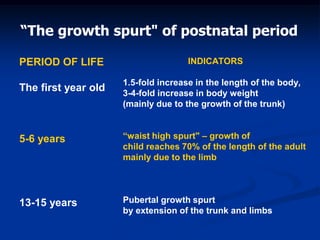
“The growth spurt" of postnatal period
PERIOD OF LIFE
The first year old
5-6 years
13-15 years
INDICATORS
1.5-fold increase in the length of the body,
3-4-fold increase in body weight
(mainly due to the growth of the trunk)
“waist high spurt" – growth of
child reaches 70% of the length of the adult
mainly due to the limb
Pubertal growth spurt
by extension of the trunk and limbs
LAWS OF GROWTH AND
DEVELOPMENT:
 The unevenness race of growth
and development
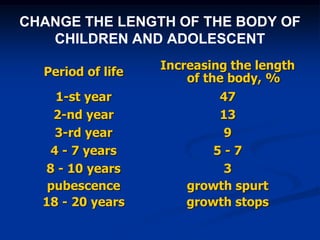
CHANGE THE LENGTH OF THE BODY OF
CHILDREN AND ADOLESCENT
Period of life
Increasing the length
of the body, %
1-st year 47
2-nd year 13
3-rd year 9
4 - 7 years 5 - 7
8 - 10 years 3
pubescence growth spurt
18 - 20 years growth stops
In the first years of life the body needs
in large amounts
• proteins - 4 g per 1 kg body weight,
including 65% of animal protein
• energy - 100 kcal per 1 kg of body
weight
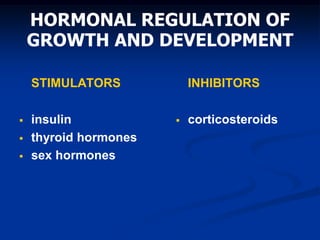
HORMONAL REGULATION OF
GROWTH AND DEVELOPMENT
STIMULATORS
 insulin
 thyroid hormones
 sex hormones
INHIBITORS
 corticosteroids
FORMATION OF BONE MASS
accumulation
of bone mass
endocrine
status
production
of estrogens
calcium
intake
healthy diet
growth
hormone
physical
activity
muscle
tissue
fatty tissue
adequate
body weight
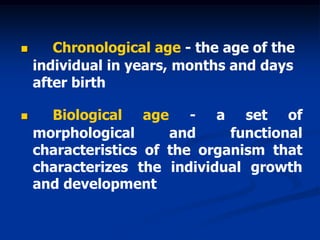
 Chronological age - the age of the
individual in years, months and days
after birth
 Biological age - a set of
morphological and functional
characteristics of the organism that
characterizes the individual growth
and development
CRITERIA FOR EVALUATION OF
BIOLOGICAL AGE
 The degree of ossification of the
skeleton
 Secondary teeth dentitation
(replacement primary teeth to permanent
teeth)
 Development of secondary sexual
characteristics
 Body length
 The annual increase in growth
 The degree of ossification of the
skeleton – the definition of ossification
points at X-ray examination
 For example, the iInformative indicator of
biological age of the child, 12 years old, is
ossification of the pisiform bone
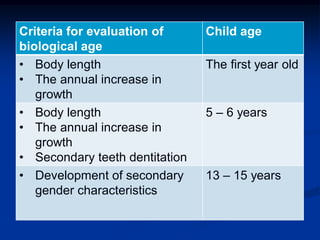
Criteria for evaluation of
biological age
Child age
• Body length
• The annual increase in
growth
The first year old
• Body length
• The annual increase in
growth
• Secondary teeth dentitation
5 – 6 years
• Development of secondary
gender characteristics
13 – 15 years
LAWS OF GROWTH AND
DEVELOPMENT:
 Non-simultaneity of the growth
and development of individual
organs and systems
(heterochrony)
Motor activity
Motor activity - a
natural stimulant
of growth and
development
Motor activity
 Morphological and functional development
 Contributes to the formation of adaptive
mechanisms
 Stimulates the activity of the immune
system
 Enhances mental and physical
performance
 Affect the development of an active
inhibitory process
 Contributes to building peak bone mass
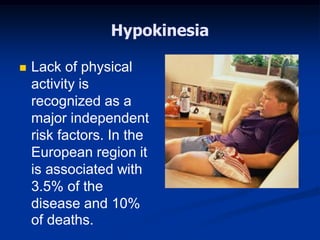
Hypokinesia
 Lack of physical
activity is
recognized as a
major independent
risk factors. In the
European region it
is associated with
3.5% of the
disease and 10%
of deaths.
HYPOKINESIA EFFECTS
 Delayed growth and development of the
child's body
 Reduced functionality and adaptive
capabilities
 Formation of asthenia
 The development of excessive neurological
disinhibition
 Metabolism disorders and function of the
musculoskeletal, cardiovascular and other
body systems disorders
HYPERKINESIA
HYPERKINESIA - A RISK FACTOR FOR
DISORDERS:
 CNS (neuroses, phobias, cardioneurosis)
 Sympathetic-adrenal and
hypothalamic-pituitary-adrenal system
 CVS (border hypertension, hypertension)
 The digestive system (gastritis, peptic ulcer,
chronic cholecystitis)
 Metabolism (protein deficiency)
 Resistance of the organism
 Physical development (somatic
disproportion)
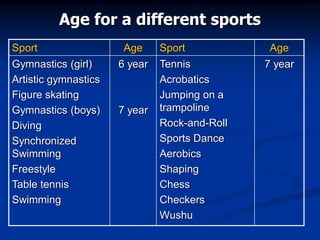
Age for a different sports
Sport Age Sport Age
Gymnastics (girl)
Artistic gymnastics
Figure skating
Gymnastics (boys)
Diving
Synchronized
Swimming
Freestyle
Table tennis
Swimming
6 year
7 year
Tennis
Acrobatics
Jumping on a
trampoline
Rock-and-Roll
Sports Dance
Aerobics
Shaping
Chess
Checkers
Wushu
7 year
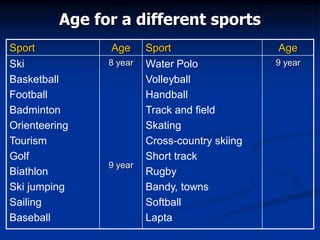
Age for a different sports
Sport Age Sport Age
Ski
Basketball
Football
Badminton
Orienteering
Tourism
Golf
Biathlon
Ski jumping
Sailing
Baseball
8 year
9 year
Water Polo
Volleyball
Handball
Track and field
Skating
Cross-country skiing
Short track
Rugby
Bandy, towns
Softball
Lapta
9 year
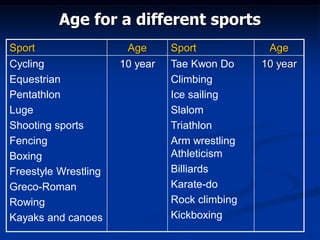
Sport Age Sport Age
Cycling
Equestrian
Pentathlon
Luge
Shooting sports
Fencing
Boxing
Freestyle Wrestling
Greco-Roman
Rowing
Kayaks and canoes
10 year Tae Kwon Do
Climbing
Ice sailing
Slalom
Triathlon
Arm wrestling
Athleticism
Billiards
Karate-do
Rock climbing
Kickboxing
10 year
Age for a different sports
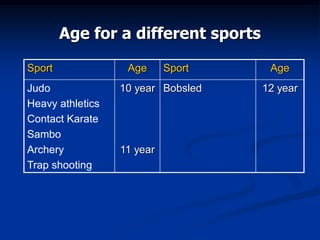
Sport Age Sport Age
Judo
Heavy athletics
Contact Karate
Sambo
Archery
Trap shooting
10 year
11 year
Bobsled 12 year
Age for a different sports
FUNCTIONAL MATURITY – THE
READY OF GROWING BODY TO
DIFFERENT TYPES OF TRAINING
LAWS OF GROWTH AND
DEVELOPMENT:
 Conditionality of the growth and
development by gender (gendering
dimorphism)
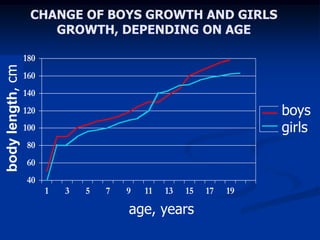
CHANGE OF BOYS GROWTH AND GIRLS
GROWTH, DEPENDING ON AGE
40
60
80
100
120
140
160
180
1 3 5 7 9 11 13 15 17 19
лет
возраст, годы
рост,см
мальчики
девочки
age, years
bodylength,cm
boys
girls
LAWS OF GROWTH AND
DEVELOPMENT:
 The biological
reliability of the
functional
systems and the
body in generally
LAWS OF GROWTH AND
DEVELOPMENT:
 Genetic
conditionality of the
growth and
development
it’s may a cause of the delay or the increase
of physical development
LAWS OF GROWTH AND DEVELOPMENT:
 Conditionality of the growth and
development by environmental factors
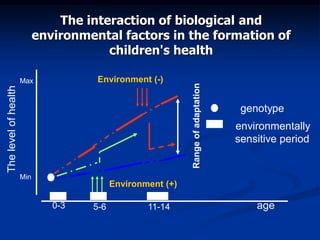
The interaction of biological and
environmental factors in the formation of
children's health
Rangeofadaptation
Environment (-)
Среда (+)
Max
Min
Thelevelofhealth
0-3 5-6 11-14 age
genotype
environmentally
sensitive period
Environment (+)
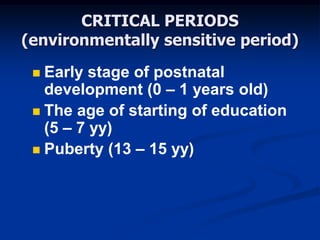
CRITICAL PERIODS
(environmentally sensitive period)
 Early stage of postnatal
development (0 – 1 years old)
 The age of starting of education
(5 – 7 yy)
 Puberty (13 – 15 yy)
LAWS OF GROWTH AND DEVELOPMENT:
 Epochal trend and
cyclical processes
of growth and
development of the
child population
(acceleration,
retardation)
Acceleration – the faster growth
and development
Deceleration = Retardation – the
slowdown of growth, development,
puberty
THEORIES OF ACCELERATION
Heliogenic
Radiowave
Cosmic radiation
Increased concentration of CO2
Alimentary
Enhanced information
Cyclical biological changes
Heterosis (mixed populations)
Urban influence
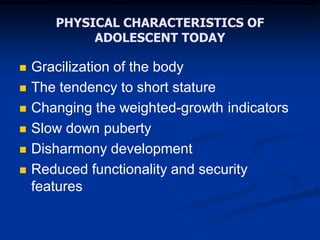
PHYSICAL CHARACTERISTICS OF
ADOLESCENT TODAY
 Gracilization of the body
 The tendency to short stature
 Changing the weighted-growth indicators
 Slow down puberty
 Disharmony development
 Reduced functionality and security
features
PHYSICAL DEVELOPMENT OF
CHILDREN AND ADOLESCENT
“Physical development” - a state of the
morphological and functional properties
and qualities, as well as the level
biological development - the biological
age.
PHYSICAL DEVELOPMENT
INDICATORS
 SOMATOMETRIC: body length and body
weight, chest circumference.
 PHYSIOMETRIC: vital lung capacity,
compression force of a hand.
 SOMATOSCOPIC: the state of the
musculoskeletal system/ musculature, the
degree of fat deposition, secondary signs
of puberty, the development of teeth, the
form of a chest/ legs/ feets.
.
The main purpose of determining
the physical development - to
determine the state of health.
CHILD AND ADOLESCENT HEALTH
- a state of life, corresponding to their
biological age, the harmonious unity of the
physical and intellectual characteristics,
the formation of adaptive and
compensatory reactions in the growth
process.
INDICATORS OF
INDIVIDUAL CHILDREN HEALTH
 Presence or absence of chronic diseases
 The level of functional state of the body
systems
 The degree of resistance to the adverse
effects (number and duration of acute
disease per year)
 The level of physical development and the
degree of harmonicity
GROUPS OF HEALTH
 I group - healthy children with normal
physical and mental development
GROUPS OF HEALTH
 II group - children with functional and
morphological and functional disorders and
lowered resistance of the body:
• low growth
• backlog of biological development
• underweight or excess of body weight
• if child is often ill (≥4 times per year), or long-
term ill (≥ 25 days in one disease proposal)
 It is risk group
GROUPS OF CHILD AND
ADOLESCENT HEALTH
 III group - children with chronic
diseases in clinical remission and the
absence of complications
GROUPS OF HEALTH
 IV group - children with chronic
diseases in the active stage with
frequent exacerbations
- children with some chronic diseases in
clinical remission + if child is often ill
(≥4 times per year), or long-term ill (≥
25 days in one disease proposal)
GROUPS OF HEALTH
 V group - children with severe chronic
diseases, frequent exacerbations with a
continuously recurrent course
 The aim of definition of the health
group - the definition of volume of
medical supervision and care.

Children Hygiene

  • 1.
    HYGIENE PRINCIPLES OFHEALTH PROTECTION OF CHILDREN AND ADOLESCENT
  • 2.
    Hygiene of childrenand adolescents - preventive medicine that studies the conditions of the environment and children's activities and their impact on the health and functional status of the growing organism.
  • 3.
    FEATURES OF NORMALIZATION The specificity of the norms  The inconstancy of the norms  Developing, the training orientation of norms  Differentiation hygienic norms by gender and health state of the growing organism
  • 4.
     The growth- the process of quantity increasing the size and weight of body  The development - quality changes associated with the processes of differentiation and morphogenesis
  • 5.
    “The growth spurt"of postnatal period PERIOD OF LIFE The first year old 5-6 years 13-15 years INDICATORS 1.5-fold increase in the length of the body, 3-4-fold increase in body weight (mainly due to the growth of the trunk) “waist high spurt" – growth of child reaches 70% of the length of the adult mainly due to the limb Pubertal growth spurt by extension of the trunk and limbs
  • 6.
    LAWS OF GROWTHAND DEVELOPMENT:  The unevenness race of growth and development
  • 7.
    CHANGE THE LENGTHOF THE BODY OF CHILDREN AND ADOLESCENT Period of life Increasing the length of the body, % 1-st year 47 2-nd year 13 3-rd year 9 4 - 7 years 5 - 7 8 - 10 years 3 pubescence growth spurt 18 - 20 years growth stops
  • 8.
    In the firstyears of life the body needs in large amounts • proteins - 4 g per 1 kg body weight, including 65% of animal protein • energy - 100 kcal per 1 kg of body weight
  • 9.
    HORMONAL REGULATION OF GROWTHAND DEVELOPMENT STIMULATORS  insulin  thyroid hormones  sex hormones INHIBITORS  corticosteroids
  • 10.
    FORMATION OF BONEMASS accumulation of bone mass endocrine status production of estrogens calcium intake healthy diet growth hormone physical activity muscle tissue fatty tissue adequate body weight
  • 11.
     Chronological age- the age of the individual in years, months and days after birth  Biological age - a set of morphological and functional characteristics of the organism that characterizes the individual growth and development
  • 12.
    CRITERIA FOR EVALUATIONOF BIOLOGICAL AGE  The degree of ossification of the skeleton  Secondary teeth dentitation (replacement primary teeth to permanent teeth)  Development of secondary sexual characteristics  Body length  The annual increase in growth
  • 13.
     The degreeof ossification of the skeleton – the definition of ossification points at X-ray examination  For example, the iInformative indicator of biological age of the child, 12 years old, is ossification of the pisiform bone
  • 14.
    Criteria for evaluationof biological age Child age • Body length • The annual increase in growth The first year old • Body length • The annual increase in growth • Secondary teeth dentitation 5 – 6 years • Development of secondary gender characteristics 13 – 15 years
  • 15.
    LAWS OF GROWTHAND DEVELOPMENT:  Non-simultaneity of the growth and development of individual organs and systems (heterochrony)
  • 16.
    Motor activity Motor activity- a natural stimulant of growth and development
  • 17.
    Motor activity  Morphologicaland functional development  Contributes to the formation of adaptive mechanisms  Stimulates the activity of the immune system  Enhances mental and physical performance  Affect the development of an active inhibitory process  Contributes to building peak bone mass
  • 18.
    Hypokinesia  Lack ofphysical activity is recognized as a major independent risk factors. In the European region it is associated with 3.5% of the disease and 10% of deaths.
  • 19.
    HYPOKINESIA EFFECTS  Delayedgrowth and development of the child's body  Reduced functionality and adaptive capabilities  Formation of asthenia  The development of excessive neurological disinhibition  Metabolism disorders and function of the musculoskeletal, cardiovascular and other body systems disorders
  • 20.
  • 21.
    HYPERKINESIA - ARISK FACTOR FOR DISORDERS:  CNS (neuroses, phobias, cardioneurosis)  Sympathetic-adrenal and hypothalamic-pituitary-adrenal system  CVS (border hypertension, hypertension)  The digestive system (gastritis, peptic ulcer, chronic cholecystitis)  Metabolism (protein deficiency)  Resistance of the organism  Physical development (somatic disproportion)
  • 22.
    Age for adifferent sports Sport Age Sport Age Gymnastics (girl) Artistic gymnastics Figure skating Gymnastics (boys) Diving Synchronized Swimming Freestyle Table tennis Swimming 6 year 7 year Tennis Acrobatics Jumping on a trampoline Rock-and-Roll Sports Dance Aerobics Shaping Chess Checkers Wushu 7 year
  • 23.
    Age for adifferent sports Sport Age Sport Age Ski Basketball Football Badminton Orienteering Tourism Golf Biathlon Ski jumping Sailing Baseball 8 year 9 year Water Polo Volleyball Handball Track and field Skating Cross-country skiing Short track Rugby Bandy, towns Softball Lapta 9 year
  • 24.
    Sport Age SportAge Cycling Equestrian Pentathlon Luge Shooting sports Fencing Boxing Freestyle Wrestling Greco-Roman Rowing Kayaks and canoes 10 year Tae Kwon Do Climbing Ice sailing Slalom Triathlon Arm wrestling Athleticism Billiards Karate-do Rock climbing Kickboxing 10 year Age for a different sports
  • 25.
    Sport Age SportAge Judo Heavy athletics Contact Karate Sambo Archery Trap shooting 10 year 11 year Bobsled 12 year Age for a different sports
  • 26.
    FUNCTIONAL MATURITY –THE READY OF GROWING BODY TO DIFFERENT TYPES OF TRAINING
  • 27.
    LAWS OF GROWTHAND DEVELOPMENT:  Conditionality of the growth and development by gender (gendering dimorphism)
  • 28.
    CHANGE OF BOYSGROWTH AND GIRLS GROWTH, DEPENDING ON AGE 40 60 80 100 120 140 160 180 1 3 5 7 9 11 13 15 17 19 лет возраст, годы рост,см мальчики девочки age, years bodylength,cm boys girls
  • 29.
    LAWS OF GROWTHAND DEVELOPMENT:  The biological reliability of the functional systems and the body in generally
  • 30.
    LAWS OF GROWTHAND DEVELOPMENT:  Genetic conditionality of the growth and development it’s may a cause of the delay or the increase of physical development
  • 31.
    LAWS OF GROWTHAND DEVELOPMENT:  Conditionality of the growth and development by environmental factors
  • 32.
    The interaction ofbiological and environmental factors in the formation of children's health Rangeofadaptation Environment (-) Среда (+) Max Min Thelevelofhealth 0-3 5-6 11-14 age genotype environmentally sensitive period Environment (+)
  • 33.
    CRITICAL PERIODS (environmentally sensitiveperiod)  Early stage of postnatal development (0 – 1 years old)  The age of starting of education (5 – 7 yy)  Puberty (13 – 15 yy)
  • 34.
    LAWS OF GROWTHAND DEVELOPMENT:  Epochal trend and cyclical processes of growth and development of the child population (acceleration, retardation)
  • 35.
    Acceleration – thefaster growth and development Deceleration = Retardation – the slowdown of growth, development, puberty
  • 36.
    THEORIES OF ACCELERATION Heliogenic Radiowave Cosmicradiation Increased concentration of CO2 Alimentary Enhanced information Cyclical biological changes Heterosis (mixed populations) Urban influence
  • 37.
    PHYSICAL CHARACTERISTICS OF ADOLESCENTTODAY  Gracilization of the body  The tendency to short stature  Changing the weighted-growth indicators  Slow down puberty  Disharmony development  Reduced functionality and security features
  • 38.
    PHYSICAL DEVELOPMENT OF CHILDRENAND ADOLESCENT “Physical development” - a state of the morphological and functional properties and qualities, as well as the level biological development - the biological age.
  • 39.
    PHYSICAL DEVELOPMENT INDICATORS  SOMATOMETRIC:body length and body weight, chest circumference.  PHYSIOMETRIC: vital lung capacity, compression force of a hand.  SOMATOSCOPIC: the state of the musculoskeletal system/ musculature, the degree of fat deposition, secondary signs of puberty, the development of teeth, the form of a chest/ legs/ feets. .
  • 40.
    The main purposeof determining the physical development - to determine the state of health.
  • 41.
    CHILD AND ADOLESCENTHEALTH - a state of life, corresponding to their biological age, the harmonious unity of the physical and intellectual characteristics, the formation of adaptive and compensatory reactions in the growth process.
  • 42.
    INDICATORS OF INDIVIDUAL CHILDRENHEALTH  Presence or absence of chronic diseases  The level of functional state of the body systems  The degree of resistance to the adverse effects (number and duration of acute disease per year)  The level of physical development and the degree of harmonicity
  • 43.
    GROUPS OF HEALTH I group - healthy children with normal physical and mental development
  • 44.
    GROUPS OF HEALTH II group - children with functional and morphological and functional disorders and lowered resistance of the body: • low growth • backlog of biological development • underweight or excess of body weight • if child is often ill (≥4 times per year), or long- term ill (≥ 25 days in one disease proposal)  It is risk group
  • 45.
    GROUPS OF CHILDAND ADOLESCENT HEALTH  III group - children with chronic diseases in clinical remission and the absence of complications
  • 46.
    GROUPS OF HEALTH IV group - children with chronic diseases in the active stage with frequent exacerbations - children with some chronic diseases in clinical remission + if child is often ill (≥4 times per year), or long-term ill (≥ 25 days in one disease proposal)
  • 47.
    GROUPS OF HEALTH V group - children with severe chronic diseases, frequent exacerbations with a continuously recurrent course
  • 48.
     The aimof definition of the health group - the definition of volume of medical supervision and care.