Submitted By:-
Suyash Jain
B Pharm(1st sem)
Department of Pharmaceutical Sciences
Dr. HariSingh Gour University Sagar(M.P.)
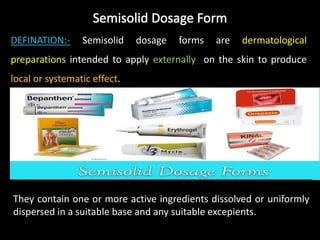
DEFINATION:- Semisolid dosage forms are dermatological
preparations intended to apply externally on the skin to produce
local or systematic effect.
They contain one or more active ingredients dissolved or uniformly
dispersed in a suitable base and any suitable excepients.
Site of Application
โ€ขIntended for tropical applications
โ€ขTreatment of Dermal disorders
โ€ข Applied as following:-
o To the skin
o Placed on eye surface
o Used nassaly
o Introduced into body cavities
Ideal properties Semisolid dosage forms
โ€ขPhysical Properties
๏ƒ˜Smooth texture
๏ƒ˜Elegant in apperance
๏ƒ˜Non dehydrating
๏ƒ˜Non gritty
๏ƒ˜Non greasy and non staining
๏ƒ˜Non hydroscopic
โ€ขPhysiological Properties
๏ƒ˜Non irritating
๏ƒ˜Do not alter membrane/skin functioning
๏ƒ˜Miscible with skin secretion
๏ƒ˜Have low sensitization index
โ€ขApplication Properties
๏ƒ˜Easily applicable with efficient drug release
๏ƒ˜Have aqueous wash ability
โ€ขUsed externally.
โ€ขProbability of side effect can
be reduce.
โ€ขLocal action and Site specific
action of drug on affected
area.
โ€ขConvenient for unconscious
patient or patient having
difficulty on oral
administration.
โ€ขSuitable dosage form for
bitter drugs.
โ€ขMore stable than liquid
dosage form.
โ€ขNo dosage accuracy in this
type of dosage form
โ€ขBase used can be easily
oxidized.
โ€ขMay cause staining.
โ€ขBulky to handle.
โ€ขApplication with finger may
cause contamination.
โ€ขLess stable than solid dosage
form.
โ€ขMay cause irritation or allergy
to some patients
Advantages Disadvantages
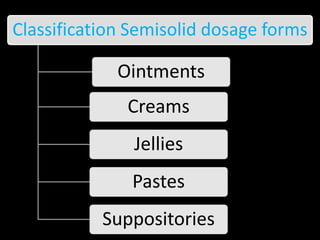
Classification Semisolid dosage forms
Ointments
Creams
Jellies
Pastes
Suppositories
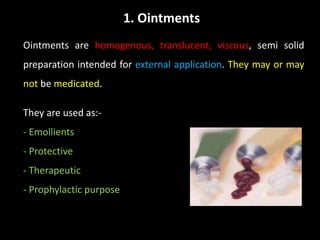
1. Ointments
Ointments are homogenous, translucent, viscous, semi solid
preparation intended for external application. They may or may
not be medicated.
They are used as:-
- Emollients
- Protective
- Therapeutic
- Prophylactic purpose
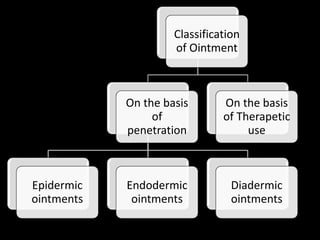
Classification
of Ointment
On the basis
of
penetration
Epidermic
ointments
Endodermic
ointments
Diadermic
ointments
On the basis
of Therapetic
use
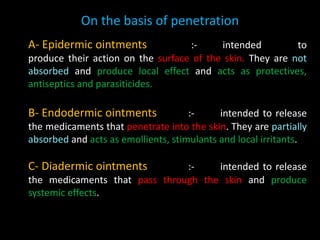
A- Epidermic ointments :- intended to
produce their action on the surface of the skin. They are not
absorbed and produce local effect and acts as protectives,
antiseptics and parasiticides.
B- Endodermic ointments :- intended to release
the medicaments that penetrate into the skin. They are partially
absorbed and acts as emollients, stimulants and local irritants.
C- Diadermic ointments :- intended to release
the medicaments that pass through the skin and produce
systemic effects.
On the basis of penetration
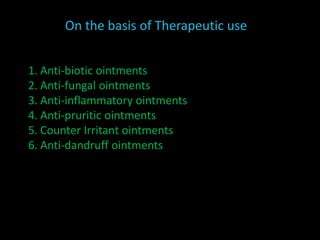
On the basis of Therapeutic use
1. Anti-biotic ointments
2. Anti-fungal ointments
3. Anti-inflammatory ointments
4. Anti-pruritic ointments
5. Counter Irritant ointments
6. Anti-dandruff ointments
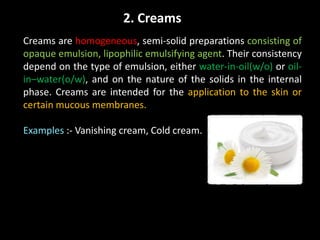
2. Creams
Creams are homogeneous, semi-solid preparations consisting of
opaque emulsion, lipophilic emulsifying agent. Their consistency
depend on the type of emulsion, either water-in-oil(w/o) or oil-
inโ€“water(o/w), and on the nature of the solids in the internal
phase. Creams are intended for the application to the skin or
certain mucous membranes.
Examples :- Vanishing cream, Cold cream.
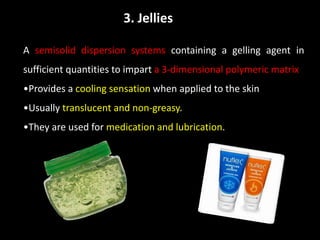
3. Jellies
A semisolid dispersion systems containing a gelling agent in
sufficient quantities to impart a 3-dimensional polymeric matrix
โ€ขProvides a cooling sensation when applied to the skin
โ€ขUsually translucent and non-greasy.
โ€ขThey are used for medication and lubrication.
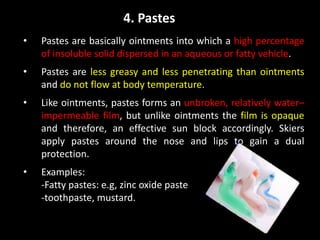
4. Pastes
โ€ข Pastes are basically ointments into which a high percentage
of insoluble solid dispersed in an aqueous or fatty vehicle.
โ€ข Pastes are less greasy and less penetrating than ointments
and do not flow at body temperature.
โ€ข Like ointments, pastes forms an unbroken, relatively waterโ€“
impermeable film, but unlike ointments the film is opaque
and therefore, an effective sun block accordingly. Skiers
apply pastes around the nose and lips to gain a dual
protection.
โ€ข Examples:
-Fatty pastes: e.g, zinc oxide paste
-toothpaste, mustard.
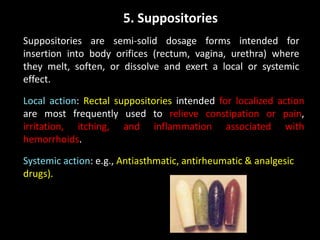
5. Suppositories
Suppositories are semi-solid dosage forms intended for
insertion into body orifices (rectum, vagina, urethra) where

they melt, soften, or dissolve and exert a local or systemic
effect.
Local action: Rectal suppositories intended for localized action
are most frequently used to relieve constipation or pain,
irritation, itching, and inflammation associated with
hemorrhoids.
Systemic action: e.g., Antiasthmatic, antirheumatic & analgesic
drugs).
THANK YOU
Made by-
Mr. Suyash Jain
B Pharm(1stsem)
Department of Pharmaceutical
Sciences
Dr. HariSingh Gour Vishwavidyala
Sagar(M.P.)
References
1. Jain NK,Sharma SK,โ€œA Textbook of Professional
Pharmacyโ€,Vallabh prakashan,Delhi,2016,edition-
6th,292-318.
2. Jones Dโ€œFASTtrack Pharmaceutics โ€“ Dosage Form
and Designโ€,Pharmaceutical Press London,
2008,edition- 1st ,75-88.

Semisolid dosage form

  • 1.
    Submitted By:- Suyash Jain BPharm(1st sem) Department of Pharmaceutical Sciences Dr. HariSingh Gour University Sagar(M.P.)
  • 3.
    DEFINATION:- Semisolid dosageforms are dermatological preparations intended to apply externally on the skin to produce local or systematic effect. They contain one or more active ingredients dissolved or uniformly dispersed in a suitable base and any suitable excepients.
  • 4.
    Site of Application โ€ขIntendedfor tropical applications โ€ขTreatment of Dermal disorders โ€ข Applied as following:- o To the skin o Placed on eye surface o Used nassaly o Introduced into body cavities
  • 5.
    Ideal properties Semisoliddosage forms โ€ขPhysical Properties ๏ƒ˜Smooth texture ๏ƒ˜Elegant in apperance ๏ƒ˜Non dehydrating ๏ƒ˜Non gritty ๏ƒ˜Non greasy and non staining ๏ƒ˜Non hydroscopic โ€ขPhysiological Properties ๏ƒ˜Non irritating ๏ƒ˜Do not alter membrane/skin functioning ๏ƒ˜Miscible with skin secretion ๏ƒ˜Have low sensitization index โ€ขApplication Properties ๏ƒ˜Easily applicable with efficient drug release ๏ƒ˜Have aqueous wash ability
  • 6.
    โ€ขUsed externally. โ€ขProbability ofside effect can be reduce. โ€ขLocal action and Site specific action of drug on affected area. โ€ขConvenient for unconscious patient or patient having difficulty on oral administration. โ€ขSuitable dosage form for bitter drugs. โ€ขMore stable than liquid dosage form. โ€ขNo dosage accuracy in this type of dosage form โ€ขBase used can be easily oxidized. โ€ขMay cause staining. โ€ขBulky to handle. โ€ขApplication with finger may cause contamination. โ€ขLess stable than solid dosage form. โ€ขMay cause irritation or allergy to some patients Advantages Disadvantages
  • 7.
    Classification Semisolid dosageforms Ointments Creams Jellies Pastes Suppositories
  • 8.
    1. Ointments Ointments arehomogenous, translucent, viscous, semi solid preparation intended for external application. They may or may not be medicated. They are used as:- - Emollients - Protective - Therapeutic - Prophylactic purpose
  • 9.
    Classification of Ointment On thebasis of penetration Epidermic ointments Endodermic ointments Diadermic ointments On the basis of Therapetic use
  • 10.
    A- Epidermic ointments:- intended to produce their action on the surface of the skin. They are not absorbed and produce local effect and acts as protectives, antiseptics and parasiticides. B- Endodermic ointments :- intended to release the medicaments that penetrate into the skin. They are partially absorbed and acts as emollients, stimulants and local irritants. C- Diadermic ointments :- intended to release the medicaments that pass through the skin and produce systemic effects. On the basis of penetration
  • 11.
    On the basisof Therapeutic use 1. Anti-biotic ointments 2. Anti-fungal ointments 3. Anti-inflammatory ointments 4. Anti-pruritic ointments 5. Counter Irritant ointments 6. Anti-dandruff ointments
  • 12.
    2. Creams Creams arehomogeneous, semi-solid preparations consisting of opaque emulsion, lipophilic emulsifying agent. Their consistency depend on the type of emulsion, either water-in-oil(w/o) or oil- inโ€“water(o/w), and on the nature of the solids in the internal phase. Creams are intended for the application to the skin or certain mucous membranes. Examples :- Vanishing cream, Cold cream.
  • 13.
    3. Jellies A semisoliddispersion systems containing a gelling agent in sufficient quantities to impart a 3-dimensional polymeric matrix โ€ขProvides a cooling sensation when applied to the skin โ€ขUsually translucent and non-greasy. โ€ขThey are used for medication and lubrication.
  • 14.
    4. Pastes โ€ข Pastesare basically ointments into which a high percentage of insoluble solid dispersed in an aqueous or fatty vehicle. โ€ข Pastes are less greasy and less penetrating than ointments and do not flow at body temperature. โ€ข Like ointments, pastes forms an unbroken, relatively waterโ€“ impermeable film, but unlike ointments the film is opaque and therefore, an effective sun block accordingly. Skiers apply pastes around the nose and lips to gain a dual protection. โ€ข Examples: -Fatty pastes: e.g, zinc oxide paste -toothpaste, mustard.
  • 15.
    5. Suppositories Suppositories aresemi-solid dosage forms intended for insertion into body orifices (rectum, vagina, urethra) where they melt, soften, or dissolve and exert a local or systemic effect. Local action: Rectal suppositories intended for localized action are most frequently used to relieve constipation or pain, irritation, itching, and inflammation associated with hemorrhoids. Systemic action: e.g., Antiasthmatic, antirheumatic & analgesic drugs).
  • 16.
  • 17.
    Made by- Mr. SuyashJain B Pharm(1stsem) Department of Pharmaceutical Sciences Dr. HariSingh Gour Vishwavidyala Sagar(M.P.)
  • 18.
    References 1. Jain NK,SharmaSK,โ€œA Textbook of Professional Pharmacyโ€,Vallabh prakashan,Delhi,2016,edition- 6th,292-318. 2. Jones Dโ€œFASTtrack Pharmaceutics โ€“ Dosage Form and Designโ€,Pharmaceutical Press London, 2008,edition- 1st ,75-88.