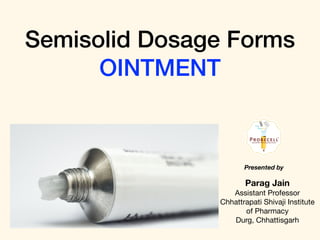
Semisolid Dosage Forms
OINTMENT
Parag Jain
Assistant Professor 

Chhattrapati Shivaji Institute
of Pharmacy

Durg, Chhattisgarh
Presented by
• Topical preparations are used for both local and
systemic effects.
• Systemic drug absorption should always be
considered when using topical products if the
patient is pregnant or nursing, because drugs
can enter the fetal blood supply and breast milk
and be transferred to the fetus or nursing infant.
Semisolid Dosage Forms
• A topical dermatological product is designed to
deliver drug into the skin in treating dermal
disorders, with the skin as the target organ.
• A transdermal product is designed to deliver
drugs through the skin (percutaneous
absorption) to the general circulation for
systemic effects, with the skin not being the
target organ
Semisolid Dosage Forms
• Ointments, creams, and gels are semisolid dosage forms
intended for topical application.
• They may be applied to the skin, placed on the surface
of the eye, or used nasally, vaginally, or rectally.
• Most of these preparations are used for the effects of
the therapeutic agents they contain.
• The unmediated ones are used for their physical effects
as protectants or lubricants.
Ointment
• Any greasy or oily semi-solid preparation, usually
medicated, that can be applied externally to the skin in
order to heal, soothe or protect it. 

• It is a viscous semisolid preparation used topically on a
variety of body surfaces.

• Drug ingredients can be dissolved, emulsified or
suspended in ointment base.
Types of ointments
The various types of ointments are: 

• Unmedicated ointments

• Medicated ointments
UNMEDICATED OINTMENTS
• These ointments do not contain any drugs. 

• They are useful as emollients, protectants. 

• Example: Petroleum jelly. 

MEDICATED OINTMENTS
• These ointments contain drugs which show local or systemic effects. 

• These are of several sub-types: 

• Dermatologic ointments 

• Opthalmic ointments 

• Rectal ointments 

• Vaginal ointments 

• Nasal ointments
DERMATOLOGIC OINTMENTS
• These ointments are applied topically on the external skin. The
ointment is applied to the affected area as a thin layer and spread
evenly using gentle pressure with the fingertips. These are of three
types: 

• Epidermic ointments: The drugs present in these type of
ointments exert their action on the epidermis of the skin. 

Example: Ketoconazole ointment. 

• Endodermic ointments: The drugs present in these types of
ointments exert their action on the deeper layers of cutaneous
tissue. 

Example: Demodex ointment. 

• Diadermic ointments: The drugs present in these types of
ointments enter into the deeper layers of skin and finally in the
systemic circulation and exert systemic effects. 

Example: Nitroglycerine ointment.
OPTHALMIC OINTMENTS
• These are sterile preparations which are applied inside
the lower eye lid. Only anhydrous bases are used in
their preparation. The ointment is applied as a narrow
band of approximately 0.25 - 0.5 inch. 

• Example: Sulfacetamide sodium ointment. 

RECTAL OINTMENTS
• These are the ointments to be applied to the peri- anal
or within the anal canal. The bases used are
combinations of PEG 300 and PEG 3350, cetyl alcohol
and cetyl esters, wax, liquid paraffin and white paraffin. 

• Example: Benzocaine ointment.
VAGINAL OINTMENTS
• These ointments are applied to the vulvo-vaginal area or
inside the vagina. As vagina is more susceptible to
infections, the ointment should be free from micro-
organisms, moulds and yeasts. 

• Example: Candicidin ointment. 

NASAL OINTMENTS
• These are used in the topical treatment of nasal mucosa.
Drugs get absorbed into the general circulation through
the rich blood supply of the nasal lining. 

• Example: Ipratropium bromide ointment.
Advantages
• Handling of ointments is easier than bulky liquid dosage
forms. 

• They are chemically more stable than liquid dosage forms. 

• They facilitate application of the directly to the effected body
part and avoid exposure of other parts to the drug. 

• They are suitable for patients who find it difficult to take the
drugs by parenteral and oral routes. 

• They prolong the contact time between the drug and effected
area. 

• The bioavailability of drugs administered as ointments is more
since it prevents passage through liver.
Disadvantages
• They are bulkier than solid dosage forms. 

• When applications of an exact quantity of ointment to
the affected area is required, it is difficult to ascertain
the same. 

• They are less stable than solid dosage forms.
Application of medicated ointment
• Ointments are used topically for several purposes, e.g., as
protectants, antiseptics, emollients, antipruritics, kerotolytics, and
astringents. 

• In the case of a protective ointment, it serves to protect the skin
against moisture, air, sun rays and other external factors. 

• It is necessary that the ointment neither penetrates the human skin
barriers nor facilitates the absorption of substances through this
barrier. 

• An antiseptic ointment is used to destroy or inhibit the growth of
bacteria. Frequently bacterial infections are deeply seated; a base
which has the capacity to either penetrate or dissolve and release
the medication effectively is therefore desired. 

• Ointments used for their emollient effect should be easy to apply, be
non-greasy and effectively penetrate the skin.
PREPARATION OF OINTMENT
INGREDIENTS USED IN PREPARATION:
• Bases
• Preservative
• Humectants
• Antioxidants
• Emulsifier
• Gelling agent
• Permeation enhancer
• Buffers
BASES
• It is one of the most important ingredient used
in formulation of semisolid dosage form.
Ointment bases do not merely act as the
carriers of the medicaments, but they also
control the extent of absorption of
medicaments incorporated in them.
• There are five (5) classes or types of ointment bases
which are differentiated on the basis of their physical
composition. These are: 

• Oleaginous bases. 

• Absorption bases. 

• Water in oil emulsion bases. 

• Oil in water emulsion bases. 

• Water soluble or water miscible bases.
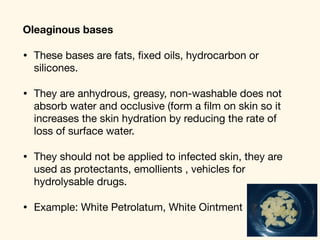
Oleaginous bases
• These bases are fats, fixed oils, hydrocarbon or
silicones. 

• They are anhydrous, greasy, non-washable does not
absorb water and occlusive (form a film on skin so it
increases the skin hydration by reducing the rate of
loss of surface water. 

• They should not be applied to infected skin, they are
used as protectants, emollients , vehicles for
hydrolysable drugs. 

• Example: White Petrolatum, White Ointment
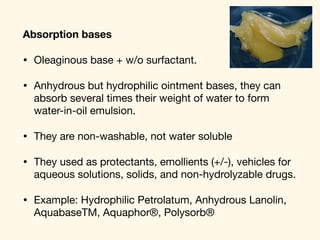
Absorption bases
• Oleaginous base + w/o surfactant. 

• Anhydrous but hydrophilic ointment bases, they can
absorb several times their weight of water to form
water-in-oil emulsion. 

• They are non-washable, not water soluble 

• They used as protectants, emollients (+/-), vehicles for
aqueous solutions, solids, and non-hydrolyzable drugs. 

• Example: Hydrophilic Petrolatum, Anhydrous Lanolin,
AquabaseTM, Aquaphor®, Polysorb®
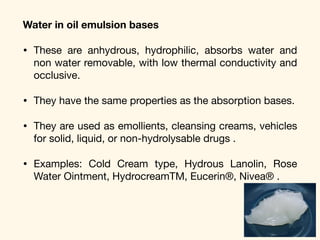
Water in oil emulsion bases
• These are anhydrous, hydrophilic, absorbs water and
non water removable, with low thermal conductivity and
occlusive. 

• They have the same properties as the absorption bases. 

• They are used as emollients, cleansing creams, vehicles
for solid, liquid, or non-hydrolysable drugs . 

• Examples: Cold Cream type, Hydrous Lanolin, Rose
Water Ointment, HydrocreamTM, Eucerin®, Nivea® .
Oil in water emulsion bases
• These bases are anhydrous, water soluble, absorb water
and water washable. 

• They are either carbowaxes Polyethylene Glycols (PEGs)
or hydrated gums (bentonite, gelatin, cellulose
derivatives). 

• They are used as drug vehicles.

• Examples: PEG Ointment, PolybaseTM
Water miscible bases
• These bases are anhydrous, water soluble, absorb
water and water washable. 

• They are either carbowaxes Polyethylene Glycols
(PEGs) or hydrated gums (bentonite, gelatin, cellulose
derivatives). 

• They are used as drug vehicles.

• Examples: PEG Ointment, Polybase TM
ANTIOXIDANTS
Oxygen is a highly reactive atom that is capable of
becoming part of potentially damaging molecules
commonly called “free radicals.”
Free radicals are capable of attacking the healthy
cells of the body, causing them to lose their
structure and function. To prevent this an
antioxidants are added.
E.g. Butylated hydroxy anisole, Butylated hydroxy
toluene
PERMEATION ENHANCERS
• Skin can act as a barrier. With the introduction
of various penetration enhancers, penetration
of the drug through the skin can be improved.
• E.g. Oleic Acid
EMULSIFIER
• An emulsifier (emulgent) is a substance that
stabilizes an emulsion by increasing its kinetic
stability.
- Must reduce surface tension for proper
emulsification.
- Prevents coalescence.
- Ability to increase the viscosity at low
concentration.
HUMECTANT
A humectant is a hygroscopic substance,
Humectants are used to :
the active• increase the solubility of
ingredient
• to elevate its skin penetration.
• elevate the hydration of the skin.
BUFFERS
Buffers are added for various purpose such as :
- Compatibility with skin.
- Drug solubility.
- Drug stability.
- E.g. sodium acetate, sodium citrate,
potassium metaphosphate.
Selection of Dermatological Vehicle
• Following are the factors which govern the selection
of an ideal bases for ointments:-
1. Dermatological factors
1. Pharmaceutical factors
Dermatological Factors
1. Absorption & penetration
2. Effect on skin function
3. Miscibility with skin secretions & serum
4. Compatibility with skin secretions
5. Freedom from irritant effect
6. Emollient properties
7. Ease of application & removal
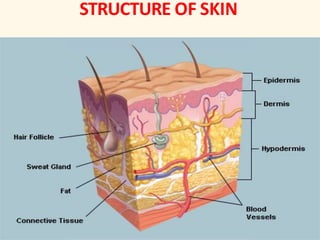
STRUCTURE OF SKIN
1. Absorption & penetration:
• Absorption means actual entry into the blood
stream & penetration means passes through the
skin.
• The skin has 3 main layers epidermis, dermis &
hypodermis.
• Scientifically proved that the animal fats like wool fat
& fixed oils penetrate more readily through the skin
in comparison to mineral oils (paraffin).
• The substance which are soluble in both oil & water
are most readily absorbed.
• The o/w emulsion bases release medicaments more
readily than oleaginous bases means w/o emulsion
bases.
2. Effect on skin function:
• Greasy bases may interfere with skin function like heat
radiation & sweat excretion & also they irritant to the
skin.
• The o/w bases means water soluble bases gives cooling
effect with healing effect & also they readily mix with
skin secretions.
3. Miscibility with skin secretions & serum:
• Emulsion bases are more readily miscible with skin
secretion compared to greasy material. For that reason
small amt of drug is needed when emulsion bases are
used.
• o/w type of emulsion bases are readily miscible with
serum & are very useful for ointment base for weeping
eczema.
4. Compatibility with skin secretion:
• Neutral pH ointments are compatible with majority
of the medicaments & also they do not cause
discomfort in use.
• The ointment bases should have a pH around 5.5
which is the average pH of the skin secretions.
5. Freedom from irritant effect:
• Ointment bases should be non-irritant.
• Greasy bases causes irritation & may cause oedema.
• The ointment used for eye ointments should be
non-irritant & free from foreign particles.
• Also all ointment bases should be high standards of
purity.
6. Emollient properties: The ointment bases should be
emollient properties that should be able to keep the
skin moist. The humectants like glycerin & propylene
glycol keep the skin surface moist & soft & wool fat,
paraffin used for the skin soft & preventing the loss of
moisture from the skin.
7. Ease of application & removal: Ointment bases
should be remove easily from the skin so, stiff &
sticky ointment suitable. Alsobases
ointment bases should
are not
be easily applicable &
should be spread on the skin surface.
Pharmaceutical Factors
1. Stability
2. Solvent properties
3. Emulsifying properties
4. Consistency
1. Stability:
- The fats & oil obtained from animal & vegetable
source have to undergo oxidation so antioxidants
are used.
- O/W type of emulsion ointment bases are liable to
microbial growth so need to a preservatives.
- Emulsified bases are liable to phase separation due
to improper formulation or under influence of
temperature so required to store in suitable
temperature.
2. Solvent properties:
- Most of the medicaments incorporated with
ointment bases are insoluble with it so, necessary to
mix finely powdered drug in ointment bases.
- If phenol used in solid form with ointment bases it
causes blisters. So, chose the suitable ointment base
which should keep phenol in solution form.
- Mixture of hard & soft paraffin, beeswax ointment
bases are used for phenol.
- Similarly, in the preparation of compound mercury
ointment, olive oil is used to keep camphor in
solution form.
3. Emulsifying properties:
- Hydrocarbon bases absorbs less amount of water
compare with animal fats, which can absorbs a large
quantity of water.
- E.g. wool fat can absorbs 50 % of water but when it
mixed with other fats can take up several times of
water or hydro-alcoholic liquids. So, wool fat is
included as base in the eye ointment preparation.
4. Consistency:
- The consistency of ointments should neither be too hard
or nor too soft.
- The consistency of an ointments can be adjusted in a
such way that, in soft ointments included have the high
melting point substance like hard paraffin, bees wax. So,
soft ointments must be stable in summer season.
- In hard ointments included the lower melting point
substance like liquid paraffin. so, hard ointments must
be stable in winter season.
Methods of Preparation of ointments
1. Trituration
2. Fusion
3. Chemical reaction
4. Emulsification
Objectives:
•Free from lumps of separated high M.P ingredients of the base
•No tendency of separation of liquid constituents from the bulk
•Even distribution of insoluble powders
•Toobtain ointment free from grittiness
•Toobtain uniform ointment
1. Trituration Method
Widely used method
For extemporaneous preparation of ointments.
When the base is soft and medicament is solid insoluble
Small amount of liquid to incorporated in the base
Advantage
Involves mixing as well as size reduction
Procedure:
1. Reduce the solid medicament to fine powder
2. Medicament is mixed with small amount of base on ointment slab
with a stainless steel spatula until a homogeneous product is
formed.
3. Add remaining quantities of base with uniform mixing
4. Incorporate any liquid ingredient if present
(mortar and pestle to be used in case of large quantity of liquid)
Eg: Prepare and dispense 100 g of sulphur ointment
Rx
Sublimed sulphur, finely sifted - 10 g
Simple ointment - 90g
Prepare an ointment
Direction - Apply the ointment to the affected area as directed.
2. Fusion method
• Fusion is the act or procedure of liquefying or melting
by the application of heat. 

• By the fusion method, all or some of the components
of an ointment are combined by melted together and
cooled with constant stirring until congealed. 

• Heat labile substances added last, when the
temperature of the mixture is low enough not to cause
decomposition of the ingredients.
2. Fusion method:
Suitable when ointment base contains number of solid ingredients
of different melting points.
Procedure:
1. Ointment base are melted in decreasing order of their melting
point.
2. Highest melting point should be melted first, low melting point
next.
3. This avoids over heating of substances of low melting point
4. Incorporate medicament slowly to the melted mass
5. Stir thoroughly until mass cools down and homogeneous
product is formed.
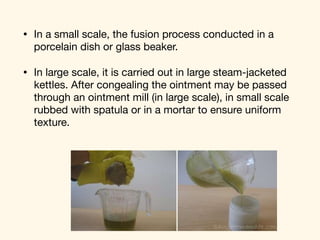
• In a small scale, the fusion process conducted in a
porcelain dish or glass beaker. 

• In large scale, it is carried out in large steam-jacketed
kettles. After congealing the ointment may be passed
through an ointment mill (in large scale), in small scale
rubbed with spatula or in a mortar to ensure uniform
texture.
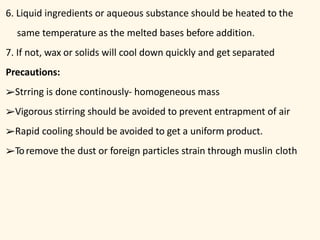
6. Liquid ingredients or aqueous substance should be heated to the
same temperature as the melted bases before addition.
7. If not, wax or solids will cool down quickly and get separated
Precautions:
➢Strring is done continously- homogeneous mass
➢Vigorous stirring should be avoided to prevent entrapment of air
➢Rapid cooling should be avoided to get a uniform product.
➢Toremove the dust or foreign particles strain through muslin cloth
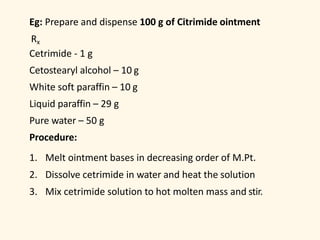
Eg: Prepare and dispense 100 g of Citrimide ointment
Rx
Cetrimide - 1 g
Cetostearyl alcohol – 10 g
White soft paraffin – 10 g
Liquid paraffin – 29 g
Pure water – 50 g
Procedure:
1. Melt ointment bases in decreasing order of M.Pt.
2. Dissolve cetrimide in water and heat the solution
3. Mix cetrimide solution to hot molten mass and stir.
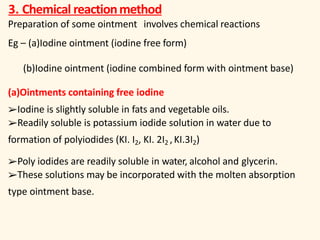
3. Chemical reactionmethod
Preparation of some ointment involves chemical reactions
Eg – (a)Iodine ointment (iodine free form)
(b)Iodine ointment (iodine combined form with ointment base)
(a)Ointments containing free iodine
➢Iodine is slightly soluble in fats and vegetable oils.
➢Readily soluble is potassium iodide solution in water due to
formation of polyiodides (KI. I2, KI. 2I2 ,KI.3I2)
➢Poly iodides are readily soluble in water, alcohol and glycerin.
➢These solutions may be incorporated with the molten absorption
type ointment base.
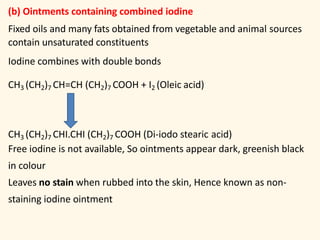
(b) Ointments containing combined iodine
Fixed oils and many fats obtained from vegetable and animal sources
contain unsaturated constituents
Iodine combines with double bonds
CH3 (CH2)7 CH=CH (CH2)7 COOH + I2 (Oleic acid)
CH3 (CH2)7 CHI.CHI (CH2)7 COOH (Di-iodo stearic acid)
Free iodine is not available, So ointments appear dark, greenish black
in colour
Leaves no stain when rubbed into the skin, Hence known as non-
staining iodine ointment
4. Emulsification method
1. Facts, oils and waxes an melted together to a temperature and 700c.
2. Aqueous solution of the heat stable, water soluble compounds
is also heated to the same temperature.
3. Solution is slowly added to the melted bases, with
continuous stirring until cool.
Emulsifying agent is needed to make a stable emulsion
Water soluble soaps are commonly used as emulsifier for semisolid o/
w emulsions.
Combination of triethanolamine stearate soap and cetyl alcohol is
used in o/w emulsion
Bees wax and divalent calcium ions used in w/o emulsion.
Website: www.probecell.com Email: probecellinfo@gmail.com
Ph: 7415211131
Office: Smriti Nagar, Bhilai, Chhattisgarh - 490020
https://youtube.com/c/ParagJainthunderpassionate https://www.facebook.com/thesisresearchwriting

Semisolid dosage forms: Ointments

  • 1.
    Semisolid Dosage Forms OINTMENT ParagJain Assistant Professor Chhattrapati Shivaji Institute of Pharmacy Durg, Chhattisgarh Presented by
  • 2.
    • Topical preparationsare used for both local and systemic effects. • Systemic drug absorption should always be considered when using topical products if the patient is pregnant or nursing, because drugs can enter the fetal blood supply and breast milk and be transferred to the fetus or nursing infant. Semisolid Dosage Forms
  • 3.
    • A topicaldermatological product is designed to deliver drug into the skin in treating dermal disorders, with the skin as the target organ. • A transdermal product is designed to deliver drugs through the skin (percutaneous absorption) to the general circulation for systemic effects, with the skin not being the target organ Semisolid Dosage Forms
  • 4.
    Semisolid Dosage Forms •Ointments, creams, and gels are semisolid dosage forms intended for topical application. • They may be applied to the skin, placed on the surface of the eye, or used nasally, vaginally, or rectally. • Most of these preparations are used for the effects of the therapeutic agents they contain. • The unmediated ones are used for their physical effects as protectants or lubricants.
  • 5.
    Ointment • Any greasyor oily semi-solid preparation, usually medicated, that can be applied externally to the skin in order to heal, soothe or protect it. • It is a viscous semisolid preparation used topically on a variety of body surfaces. • Drug ingredients can be dissolved, emulsified or suspended in ointment base.
  • 6.
    Types of ointments Thevarious types of ointments are: • Unmedicated ointments • Medicated ointments
  • 7.
    UNMEDICATED OINTMENTS • Theseointments do not contain any drugs. • They are useful as emollients, protectants. • Example: Petroleum jelly. MEDICATED OINTMENTS • These ointments contain drugs which show local or systemic effects. • These are of several sub-types: • Dermatologic ointments • Opthalmic ointments • Rectal ointments • Vaginal ointments • Nasal ointments
  • 8.
    DERMATOLOGIC OINTMENTS • Theseointments are applied topically on the external skin. The ointment is applied to the affected area as a thin layer and spread evenly using gentle pressure with the fingertips. These are of three types: • Epidermic ointments: The drugs present in these type of ointments exert their action on the epidermis of the skin. 
 Example: Ketoconazole ointment. • Endodermic ointments: The drugs present in these types of ointments exert their action on the deeper layers of cutaneous tissue. 
 Example: Demodex ointment. • Diadermic ointments: The drugs present in these types of ointments enter into the deeper layers of skin and finally in the systemic circulation and exert systemic effects. 
 Example: Nitroglycerine ointment.
  • 9.
    OPTHALMIC OINTMENTS • Theseare sterile preparations which are applied inside the lower eye lid. Only anhydrous bases are used in their preparation. The ointment is applied as a narrow band of approximately 0.25 - 0.5 inch. • Example: Sulfacetamide sodium ointment. RECTAL OINTMENTS • These are the ointments to be applied to the peri- anal or within the anal canal. The bases used are combinations of PEG 300 and PEG 3350, cetyl alcohol and cetyl esters, wax, liquid paraffin and white paraffin. • Example: Benzocaine ointment.
  • 10.
    VAGINAL OINTMENTS • Theseointments are applied to the vulvo-vaginal area or inside the vagina. As vagina is more susceptible to infections, the ointment should be free from micro- organisms, moulds and yeasts. • Example: Candicidin ointment. NASAL OINTMENTS • These are used in the topical treatment of nasal mucosa. Drugs get absorbed into the general circulation through the rich blood supply of the nasal lining. • Example: Ipratropium bromide ointment.
  • 11.
    Advantages • Handling ofointments is easier than bulky liquid dosage forms. • They are chemically more stable than liquid dosage forms. • They facilitate application of the directly to the effected body part and avoid exposure of other parts to the drug. • They are suitable for patients who find it difficult to take the drugs by parenteral and oral routes. • They prolong the contact time between the drug and effected area. • The bioavailability of drugs administered as ointments is more since it prevents passage through liver.
  • 12.
    Disadvantages • They arebulkier than solid dosage forms. • When applications of an exact quantity of ointment to the affected area is required, it is difficult to ascertain the same. • They are less stable than solid dosage forms.
  • 13.
    Application of medicatedointment • Ointments are used topically for several purposes, e.g., as protectants, antiseptics, emollients, antipruritics, kerotolytics, and astringents. • In the case of a protective ointment, it serves to protect the skin against moisture, air, sun rays and other external factors. • It is necessary that the ointment neither penetrates the human skin barriers nor facilitates the absorption of substances through this barrier. • An antiseptic ointment is used to destroy or inhibit the growth of bacteria. Frequently bacterial infections are deeply seated; a base which has the capacity to either penetrate or dissolve and release the medication effectively is therefore desired. • Ointments used for their emollient effect should be easy to apply, be non-greasy and effectively penetrate the skin.
  • 14.
    PREPARATION OF OINTMENT INGREDIENTSUSED IN PREPARATION: • Bases • Preservative • Humectants • Antioxidants • Emulsifier • Gelling agent • Permeation enhancer • Buffers
  • 15.
    BASES • It isone of the most important ingredient used in formulation of semisolid dosage form. Ointment bases do not merely act as the carriers of the medicaments, but they also control the extent of absorption of medicaments incorporated in them.
  • 16.
    • There arefive (5) classes or types of ointment bases which are differentiated on the basis of their physical composition. These are: • Oleaginous bases. • Absorption bases. • Water in oil emulsion bases. • Oil in water emulsion bases. • Water soluble or water miscible bases.
  • 17.
    Oleaginous bases • Thesebases are fats, fixed oils, hydrocarbon or silicones. • They are anhydrous, greasy, non-washable does not absorb water and occlusive (form a film on skin so it increases the skin hydration by reducing the rate of loss of surface water. • They should not be applied to infected skin, they are used as protectants, emollients , vehicles for hydrolysable drugs. • Example: White Petrolatum, White Ointment
  • 18.
    Absorption bases • Oleaginousbase + w/o surfactant. • Anhydrous but hydrophilic ointment bases, they can absorb several times their weight of water to form water-in-oil emulsion. • They are non-washable, not water soluble • They used as protectants, emollients (+/-), vehicles for aqueous solutions, solids, and non-hydrolyzable drugs. • Example: Hydrophilic Petrolatum, Anhydrous Lanolin, AquabaseTM, Aquaphor®, Polysorb®
  • 19.
    Water in oilemulsion bases • These are anhydrous, hydrophilic, absorbs water and non water removable, with low thermal conductivity and occlusive. • They have the same properties as the absorption bases. • They are used as emollients, cleansing creams, vehicles for solid, liquid, or non-hydrolysable drugs . • Examples: Cold Cream type, Hydrous Lanolin, Rose Water Ointment, HydrocreamTM, Eucerin®, Nivea® .
  • 20.
    Oil in wateremulsion bases • These bases are anhydrous, water soluble, absorb water and water washable. • They are either carbowaxes Polyethylene Glycols (PEGs) or hydrated gums (bentonite, gelatin, cellulose derivatives). • They are used as drug vehicles. • Examples: PEG Ointment, PolybaseTM
  • 21.
    Water miscible bases •These bases are anhydrous, water soluble, absorb water and water washable. • They are either carbowaxes Polyethylene Glycols (PEGs) or hydrated gums (bentonite, gelatin, cellulose derivatives). • They are used as drug vehicles. • Examples: PEG Ointment, Polybase TM
  • 22.
    ANTIOXIDANTS Oxygen is ahighly reactive atom that is capable of becoming part of potentially damaging molecules commonly called “free radicals.” Free radicals are capable of attacking the healthy cells of the body, causing them to lose their structure and function. To prevent this an antioxidants are added. E.g. Butylated hydroxy anisole, Butylated hydroxy toluene
  • 23.
    PERMEATION ENHANCERS • Skincan act as a barrier. With the introduction of various penetration enhancers, penetration of the drug through the skin can be improved. • E.g. Oleic Acid
  • 24.
    EMULSIFIER • An emulsifier(emulgent) is a substance that stabilizes an emulsion by increasing its kinetic stability. - Must reduce surface tension for proper emulsification. - Prevents coalescence. - Ability to increase the viscosity at low concentration.
  • 25.
    HUMECTANT A humectant isa hygroscopic substance, Humectants are used to : the active• increase the solubility of ingredient • to elevate its skin penetration. • elevate the hydration of the skin.
  • 26.
    BUFFERS Buffers are addedfor various purpose such as : - Compatibility with skin. - Drug solubility. - Drug stability. - E.g. sodium acetate, sodium citrate, potassium metaphosphate.
  • 27.
    Selection of DermatologicalVehicle • Following are the factors which govern the selection of an ideal bases for ointments:- 1. Dermatological factors 1. Pharmaceutical factors
  • 28.
    Dermatological Factors 1. Absorption& penetration 2. Effect on skin function 3. Miscibility with skin secretions & serum 4. Compatibility with skin secretions 5. Freedom from irritant effect 6. Emollient properties 7. Ease of application & removal
  • 29.
  • 30.
    1. Absorption &penetration: • Absorption means actual entry into the blood stream & penetration means passes through the skin. • The skin has 3 main layers epidermis, dermis & hypodermis. • Scientifically proved that the animal fats like wool fat & fixed oils penetrate more readily through the skin in comparison to mineral oils (paraffin). • The substance which are soluble in both oil & water are most readily absorbed. • The o/w emulsion bases release medicaments more readily than oleaginous bases means w/o emulsion bases.
  • 31.
    2. Effect onskin function: • Greasy bases may interfere with skin function like heat radiation & sweat excretion & also they irritant to the skin. • The o/w bases means water soluble bases gives cooling effect with healing effect & also they readily mix with skin secretions. 3. Miscibility with skin secretions & serum: • Emulsion bases are more readily miscible with skin secretion compared to greasy material. For that reason small amt of drug is needed when emulsion bases are used. • o/w type of emulsion bases are readily miscible with serum & are very useful for ointment base for weeping eczema.
  • 32.
    4. Compatibility withskin secretion: • Neutral pH ointments are compatible with majority of the medicaments & also they do not cause discomfort in use. • The ointment bases should have a pH around 5.5 which is the average pH of the skin secretions. 5. Freedom from irritant effect: • Ointment bases should be non-irritant. • Greasy bases causes irritation & may cause oedema. • The ointment used for eye ointments should be non-irritant & free from foreign particles. • Also all ointment bases should be high standards of purity.
  • 33.
    6. Emollient properties:The ointment bases should be emollient properties that should be able to keep the skin moist. The humectants like glycerin & propylene glycol keep the skin surface moist & soft & wool fat, paraffin used for the skin soft & preventing the loss of moisture from the skin. 7. Ease of application & removal: Ointment bases should be remove easily from the skin so, stiff & sticky ointment suitable. Alsobases ointment bases should are not be easily applicable & should be spread on the skin surface.
  • 34.
    Pharmaceutical Factors 1. Stability 2.Solvent properties 3. Emulsifying properties 4. Consistency
  • 35.
    1. Stability: - Thefats & oil obtained from animal & vegetable source have to undergo oxidation so antioxidants are used. - O/W type of emulsion ointment bases are liable to microbial growth so need to a preservatives. - Emulsified bases are liable to phase separation due to improper formulation or under influence of temperature so required to store in suitable temperature.
  • 36.
    2. Solvent properties: -Most of the medicaments incorporated with ointment bases are insoluble with it so, necessary to mix finely powdered drug in ointment bases. - If phenol used in solid form with ointment bases it causes blisters. So, chose the suitable ointment base which should keep phenol in solution form. - Mixture of hard & soft paraffin, beeswax ointment bases are used for phenol. - Similarly, in the preparation of compound mercury ointment, olive oil is used to keep camphor in solution form.
  • 37.
    3. Emulsifying properties: -Hydrocarbon bases absorbs less amount of water compare with animal fats, which can absorbs a large quantity of water. - E.g. wool fat can absorbs 50 % of water but when it mixed with other fats can take up several times of water or hydro-alcoholic liquids. So, wool fat is included as base in the eye ointment preparation.
  • 38.
    4. Consistency: - Theconsistency of ointments should neither be too hard or nor too soft. - The consistency of an ointments can be adjusted in a such way that, in soft ointments included have the high melting point substance like hard paraffin, bees wax. So, soft ointments must be stable in summer season. - In hard ointments included the lower melting point substance like liquid paraffin. so, hard ointments must be stable in winter season.
  • 39.
    Methods of Preparationof ointments 1. Trituration 2. Fusion 3. Chemical reaction 4. Emulsification Objectives: •Free from lumps of separated high M.P ingredients of the base •No tendency of separation of liquid constituents from the bulk •Even distribution of insoluble powders •Toobtain ointment free from grittiness •Toobtain uniform ointment
  • 40.
    1. Trituration Method Widelyused method For extemporaneous preparation of ointments. When the base is soft and medicament is solid insoluble Small amount of liquid to incorporated in the base Advantage Involves mixing as well as size reduction Procedure: 1. Reduce the solid medicament to fine powder 2. Medicament is mixed with small amount of base on ointment slab with a stainless steel spatula until a homogeneous product is formed.
  • 41.
    3. Add remainingquantities of base with uniform mixing 4. Incorporate any liquid ingredient if present (mortar and pestle to be used in case of large quantity of liquid) Eg: Prepare and dispense 100 g of sulphur ointment Rx Sublimed sulphur, finely sifted - 10 g Simple ointment - 90g Prepare an ointment Direction - Apply the ointment to the affected area as directed.
  • 42.
    2. Fusion method •Fusion is the act or procedure of liquefying or melting by the application of heat. • By the fusion method, all or some of the components of an ointment are combined by melted together and cooled with constant stirring until congealed. • Heat labile substances added last, when the temperature of the mixture is low enough not to cause decomposition of the ingredients.
  • 43.
    2. Fusion method: Suitablewhen ointment base contains number of solid ingredients of different melting points. Procedure: 1. Ointment base are melted in decreasing order of their melting point. 2. Highest melting point should be melted first, low melting point next. 3. This avoids over heating of substances of low melting point 4. Incorporate medicament slowly to the melted mass 5. Stir thoroughly until mass cools down and homogeneous product is formed.
  • 44.
    • In asmall scale, the fusion process conducted in a porcelain dish or glass beaker. • In large scale, it is carried out in large steam-jacketed kettles. After congealing the ointment may be passed through an ointment mill (in large scale), in small scale rubbed with spatula or in a mortar to ensure uniform texture.
  • 45.
    6. Liquid ingredientsor aqueous substance should be heated to the same temperature as the melted bases before addition. 7. If not, wax or solids will cool down quickly and get separated Precautions: ➢Strring is done continously- homogeneous mass ➢Vigorous stirring should be avoided to prevent entrapment of air ➢Rapid cooling should be avoided to get a uniform product. ➢Toremove the dust or foreign particles strain through muslin cloth
  • 46.
    Eg: Prepare anddispense 100 g of Citrimide ointment Rx Cetrimide - 1 g Cetostearyl alcohol – 10 g White soft paraffin – 10 g Liquid paraffin – 29 g Pure water – 50 g Procedure: 1. Melt ointment bases in decreasing order of M.Pt. 2. Dissolve cetrimide in water and heat the solution 3. Mix cetrimide solution to hot molten mass and stir.
  • 47.
    3. Chemical reactionmethod Preparationof some ointment involves chemical reactions Eg – (a)Iodine ointment (iodine free form) (b)Iodine ointment (iodine combined form with ointment base) (a)Ointments containing free iodine ➢Iodine is slightly soluble in fats and vegetable oils. ➢Readily soluble is potassium iodide solution in water due to formation of polyiodides (KI. I2, KI. 2I2 ,KI.3I2) ➢Poly iodides are readily soluble in water, alcohol and glycerin. ➢These solutions may be incorporated with the molten absorption type ointment base.
  • 48.
    (b) Ointments containingcombined iodine Fixed oils and many fats obtained from vegetable and animal sources contain unsaturated constituents Iodine combines with double bonds CH3 (CH2)7 CH=CH (CH2)7 COOH + I2 (Oleic acid) CH3 (CH2)7 CHI.CHI (CH2)7 COOH (Di-iodo stearic acid) Free iodine is not available, So ointments appear dark, greenish black in colour Leaves no stain when rubbed into the skin, Hence known as non- staining iodine ointment
  • 49.
    4. Emulsification method 1.Facts, oils and waxes an melted together to a temperature and 700c. 2. Aqueous solution of the heat stable, water soluble compounds is also heated to the same temperature. 3. Solution is slowly added to the melted bases, with continuous stirring until cool. Emulsifying agent is needed to make a stable emulsion Water soluble soaps are commonly used as emulsifier for semisolid o/ w emulsions. Combination of triethanolamine stearate soap and cetyl alcohol is used in o/w emulsion Bees wax and divalent calcium ions used in w/o emulsion.
  • 50.
    Website: www.probecell.com Email:probecellinfo@gmail.com Ph: 7415211131 Office: Smriti Nagar, Bhilai, Chhattisgarh - 490020 https://youtube.com/c/ParagJainthunderpassionate https://www.facebook.com/thesisresearchwriting