
STUDY OF TRADITIONAL AND NON
TRADITIONAL MACHINING OF
INCONEL718
Under Guidance of:- MR. Rakesh Chaudhari
Made By:- Parth Dasadiya
(14BME133D)
Introduction
• In the Traditional or conventional machining process,
machine tools such as lathes, milling machines, drill pressure
or others are used with sharp cutting tool to remove material
to achieve a desired geometry
• In traditional machining, tool is required harder than the work
piece
• Non traditional machining may not be a present physical tool
like EDM,EDM wire cut, ECM, and micro EDM
• In non traditional machining tool is not required harder than
the workpiece
Why Inconel
• Inconel is a family of austenitic nickel(50%)-chromium(21%)-
based super alloys. Inconel alloys are typically used in high
temperature applications.
• High Resistance to wear and corrosion and high creep
strength at elevated temperatures.
• Inconel-800,825,600,625,601,718 etc.
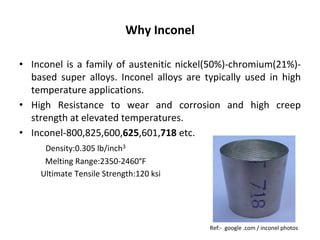
Density:0.305 lb/inch3
Melting Range:2350-2460°F
Ultimate Tensile Strength:120 ksi
Ref:- google .com / inconel photos
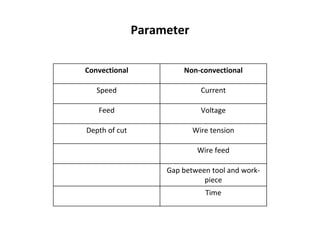
Convectional Non-convectional
Speed Current
Feed Voltage
Depth of cut Wire tension
Wire feed
Gap between tool and work-
piece
Time
Parameter
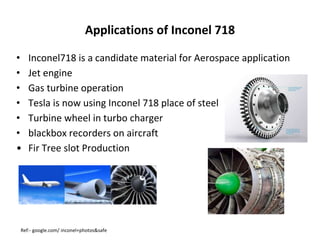
Applications of Inconel 718
Ref:- google.com/ inconel+photos&safe
• Inconel718 is a candidate material for Aerospace application
• Jet engine
• Gas turbine operation
• Tesla is now using Inconel 718 place of steel
• Turbine wheel in turbo charger
• blackbox recorders on aircraft
• Fir Tree slot Production
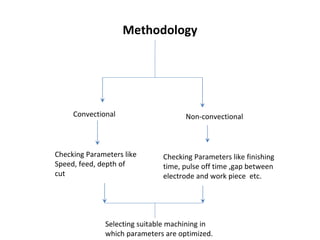
Methodology
Convectional Non-convectional
Selecting suitable machining in
which parameters are optimized.
Checking Parameters like
Speed, feed, depth of
cut
Checking Parameters like finishing
time, pulse off time ,gap between
electrode and work piece etc.
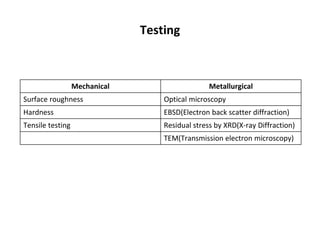
Testing
Mechanical Metallurgical
Surface roughness Optical microscopy
Hardness EBSD(Electron back scatter diffraction)
Tensile testing Residual stress by XRD(X-ray Diffraction)
TEM(Transmission electron microscopy)
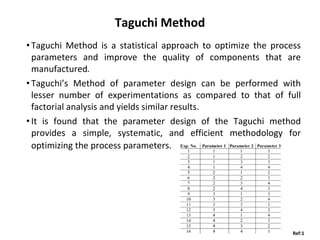
Taguchi Method
• Taguchi Method is a statistical approach to optimize the process
parameters and improve the quality of components that are
manufactured.
• Taguchi’s Method of parameter design can be performed with
lesser number of experimentations as compared to that of full
factorial analysis and yields similar results.
• It is found that the parameter design of the Taguchi method
provides a simple, systematic, and efficient methodology for
optimizing the process parameters.
Ref:1
literature Review
Sr.n
o
Researcher & Year Title Remark
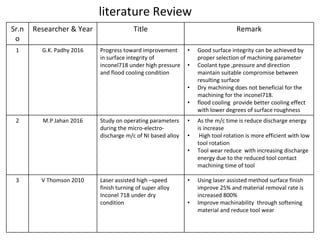
1 G.K. Padhy 2016 Progress toward improvement
in surface integrity of
inconel718 under high pressure
and flood cooling condition
• Good surface integrity can be achieved by
proper selection of machining parameter
• Coolant type ,pressure and direction
maintain suitable compromise between
resulting surface
• Dry machining does not beneficial for the
machining for the inconel718.
• flood cooling provide better cooling effect
with lower degrees of surface roughness
2 M.P Jahan 2016 Study on operating parameters
during the micro-electro-
discharge m/c of NI based alloy
• As the m/c time is reduce discharge energy
is increase
• High tool rotation is more efficient with low
tool rotation
• Tool wear reduce with increasing discharge
energy due to the reduced tool contact
machining time of tool
3 V Thomson 2010 Laser assisted high –speed
finish turning of super alloy
Inconel 718 under dry
condition
• Using laser assisted method surface finish
improve 25% and material removal rate is
increased 800%
• Improve machinability through softening
material and reduce tool wear
Sr.no Researcher & Year Title Remark
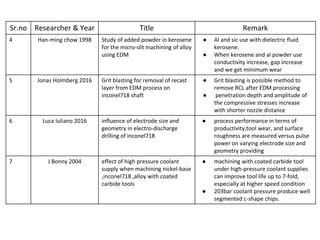
4 Han-ming chow 1998 Study of added powder in kerosene
for the micro-slit machining of alloy
using EDM
● Al and sic use with dielectric fluid
kerosene.
● When kerosene and al powder use
conductivity increase, gap increase
and we get minimum wear
5 Jonas Holmberg 2016 Grit blasting for removal of recast
layer from EDM process on
inconel718 shaft
● Grit blasting is possible method to
remove RCL after EDM processing
● penetration depth and amplitude of
the compressive stresses increase
with shorter nozzle distance
6 Luca Iuliano 2016 influence of electrode size and
geometry in electro-discharge
drilling of inconel718
● process performance in terms of
productivity,tool wear, and surface
roughness are measured versus pulse
power on varying electrode size and
geometry providing
7 J Bonny 2004 effect of high pressure coolant
supply when machining nickel-base
,inconel718 ,alloy with coated
carbide tools
● machining with coated carbide tool
under high-pressure coolant supplies
can improve tool life up to 7-fold,
especially at higher speed condition
● 203bar coolant pressure produce well
segmented c-shape chips.
Sr.no Researcher & Year Title Remark
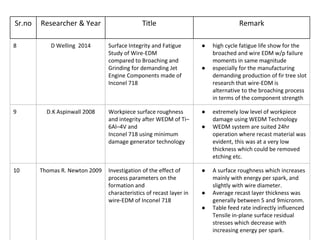
8 D Welling 2014 Surface Integrity and Fatigue
Study of Wire-EDM
compared to Broaching and
Grinding for demanding Jet
Engine Components made of
Inconel 718
● high cycle fatigue life show for the
broached and wire EDM w/p failure
moments in same magnitude
● especially for the manufacturing
demanding production of fir tree slot
research that wire-EDM is
alternative to the broaching process
in terms of the component strength
9 D.K Aspinwall 2008 Workpiece surface roughness
and integrity after WEDM of Ti–
6Al–4V and
Inconel 718 using minimum
damage generator technology
● extremely low level of workpiece
damage using WEDM Technology
● WEDM system are suited 24hr
operation where recast material was
evident, this was at a very low
thickness which could be removed
etching etc.
10 Thomas R. Newton 2009 Investigation of the effect of
process parameters on the
formation and
characteristics of recast layer in
wire-EDM of Inconel 718
● A surface roughness which increases
mainly with energy per spark, and
slightly with wire diameter.
● Average recast layer thickness was
generally between 5 and 9micronm.
● Table feed rate indirectly influenced
Tensile in-plane surface residual
stresses which decrease with
increasing energy per spark.
literature Review
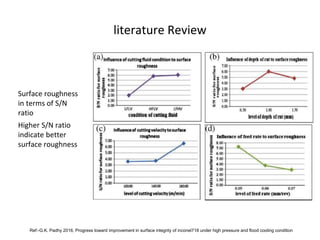
Surface roughness
in terms of S/N
ratio
Higher S/N ratio
indicate better
surface roughness
Ref:-G.K. Padhy 2016, Progress toward improvement in surface integrity of inconel718 under high pressure and flood cooling condition
Summary
• Surface roughness achieve in conventional method by selecting optimal
process parameter is not as good as that of obtained from non-
conventional machining.
• During the machining process, residual stresses are generated in the
machine component due to severe plastic deformation in conventional
machining methods
• MRR is higher in conventional machining with increase in the surface
roughness.
References
1. Dr.Y.D Venkatesh, International Refereed Journal of Engineering and Science (IRJES).
2. Han-ming chow 1998,Elsevier, Surface integrity characteristics in wire-EDM of inconel 718 at
different discharge energy,page-12
3. Jonas Holmberg 2016,Elsevier, Investigation of the effect of process parameters on the formation and
characteristics of recast layer in wire-EDM of Inconel 718
4. Luca Iuliano 2016, Springer, A review on the progress towards improvement in surface integrity of
Inconel 718 under high pressure and flood cooling conditions
5. J Bonny 2004, Elsevier, effect of high pressure coolant supply when machining nickel-base ,inconel718
,alloy with coated carbide tools ,page-22
6. G.K. Padhy 2016, Elsevier, Progress toward improvement in surface integrity of inconel718 under high
pressure and flood cooling condition,page-12-34
7. M.P Jahan 2016,Elsevier, Study on operating parameters during the micro-electro-discharge m/c of NI
based alloy
8. V Thomson 2010,Elsevier, Laser assisted high –speed finish turning of super alloy Inconel 718 under dry
condition,page-1-20
9. D Welling 2014,Springer, Surface Integrity and Fatigue Study of Wire-EDM
compared to Broaching and Grinding for demanding Jet Engine Components made of Inconel 718
10. Thomas R. Newton 2009 ,Elsevier, Investigation of the effect of process parameters on the formatio
and characteristics of recast layer in wire-EDM of Inconel 718,page-62-75
11. D.K Aspinwall 2008,Elsiever, Workpiece surface roughness and integrity after WEDM of Ti–6Al–4V and
Inconel 718 using minimum damage generator technology,page-45-65
Seminar on inconel718

Seminar on inconel718

  • 1.
    STUDY OF TRADITIONALAND NON TRADITIONAL MACHINING OF INCONEL718 Under Guidance of:- MR. Rakesh Chaudhari Made By:- Parth Dasadiya (14BME133D)
  • 2.
    Introduction • In theTraditional or conventional machining process, machine tools such as lathes, milling machines, drill pressure or others are used with sharp cutting tool to remove material to achieve a desired geometry • In traditional machining, tool is required harder than the work piece • Non traditional machining may not be a present physical tool like EDM,EDM wire cut, ECM, and micro EDM • In non traditional machining tool is not required harder than the workpiece
  • 3.
    Why Inconel • Inconelis a family of austenitic nickel(50%)-chromium(21%)- based super alloys. Inconel alloys are typically used in high temperature applications. • High Resistance to wear and corrosion and high creep strength at elevated temperatures. • Inconel-800,825,600,625,601,718 etc. Density:0.305 lb/inch3 Melting Range:2350-2460°F Ultimate Tensile Strength:120 ksi Ref:- google .com / inconel photos
  • 4.
    Convectional Non-convectional Speed Current FeedVoltage Depth of cut Wire tension Wire feed Gap between tool and work- piece Time Parameter
  • 5.
    Applications of Inconel718 Ref:- google.com/ inconel+photos&safe • Inconel718 is a candidate material for Aerospace application • Jet engine • Gas turbine operation • Tesla is now using Inconel 718 place of steel • Turbine wheel in turbo charger • blackbox recorders on aircraft • Fir Tree slot Production
  • 6.
    Methodology Convectional Non-convectional Selecting suitablemachining in which parameters are optimized. Checking Parameters like Speed, feed, depth of cut Checking Parameters like finishing time, pulse off time ,gap between electrode and work piece etc.
  • 7.
    Testing Mechanical Metallurgical Surface roughnessOptical microscopy Hardness EBSD(Electron back scatter diffraction) Tensile testing Residual stress by XRD(X-ray Diffraction) TEM(Transmission electron microscopy)
  • 8.
    Taguchi Method • TaguchiMethod is a statistical approach to optimize the process parameters and improve the quality of components that are manufactured. • Taguchi’s Method of parameter design can be performed with lesser number of experimentations as compared to that of full factorial analysis and yields similar results. • It is found that the parameter design of the Taguchi method provides a simple, systematic, and efficient methodology for optimizing the process parameters. Ref:1
  • 9.
    literature Review Sr.n o Researcher &Year Title Remark 1 G.K. Padhy 2016 Progress toward improvement in surface integrity of inconel718 under high pressure and flood cooling condition • Good surface integrity can be achieved by proper selection of machining parameter • Coolant type ,pressure and direction maintain suitable compromise between resulting surface • Dry machining does not beneficial for the machining for the inconel718. • flood cooling provide better cooling effect with lower degrees of surface roughness 2 M.P Jahan 2016 Study on operating parameters during the micro-electro- discharge m/c of NI based alloy • As the m/c time is reduce discharge energy is increase • High tool rotation is more efficient with low tool rotation • Tool wear reduce with increasing discharge energy due to the reduced tool contact machining time of tool 3 V Thomson 2010 Laser assisted high –speed finish turning of super alloy Inconel 718 under dry condition • Using laser assisted method surface finish improve 25% and material removal rate is increased 800% • Improve machinability through softening material and reduce tool wear
  • 10.
    Sr.no Researcher &Year Title Remark 4 Han-ming chow 1998 Study of added powder in kerosene for the micro-slit machining of alloy using EDM ● Al and sic use with dielectric fluid kerosene. ● When kerosene and al powder use conductivity increase, gap increase and we get minimum wear 5 Jonas Holmberg 2016 Grit blasting for removal of recast layer from EDM process on inconel718 shaft ● Grit blasting is possible method to remove RCL after EDM processing ● penetration depth and amplitude of the compressive stresses increase with shorter nozzle distance 6 Luca Iuliano 2016 influence of electrode size and geometry in electro-discharge drilling of inconel718 ● process performance in terms of productivity,tool wear, and surface roughness are measured versus pulse power on varying electrode size and geometry providing 7 J Bonny 2004 effect of high pressure coolant supply when machining nickel-base ,inconel718 ,alloy with coated carbide tools ● machining with coated carbide tool under high-pressure coolant supplies can improve tool life up to 7-fold, especially at higher speed condition ● 203bar coolant pressure produce well segmented c-shape chips.
  • 11.
    Sr.no Researcher &Year Title Remark 8 D Welling 2014 Surface Integrity and Fatigue Study of Wire-EDM compared to Broaching and Grinding for demanding Jet Engine Components made of Inconel 718 ● high cycle fatigue life show for the broached and wire EDM w/p failure moments in same magnitude ● especially for the manufacturing demanding production of fir tree slot research that wire-EDM is alternative to the broaching process in terms of the component strength 9 D.K Aspinwall 2008 Workpiece surface roughness and integrity after WEDM of Ti– 6Al–4V and Inconel 718 using minimum damage generator technology ● extremely low level of workpiece damage using WEDM Technology ● WEDM system are suited 24hr operation where recast material was evident, this was at a very low thickness which could be removed etching etc. 10 Thomas R. Newton 2009 Investigation of the effect of process parameters on the formation and characteristics of recast layer in wire-EDM of Inconel 718 ● A surface roughness which increases mainly with energy per spark, and slightly with wire diameter. ● Average recast layer thickness was generally between 5 and 9micronm. ● Table feed rate indirectly influenced Tensile in-plane surface residual stresses which decrease with increasing energy per spark.
  • 12.
    literature Review Surface roughness interms of S/N ratio Higher S/N ratio indicate better surface roughness Ref:-G.K. Padhy 2016, Progress toward improvement in surface integrity of inconel718 under high pressure and flood cooling condition
  • 13.
    Summary • Surface roughnessachieve in conventional method by selecting optimal process parameter is not as good as that of obtained from non- conventional machining. • During the machining process, residual stresses are generated in the machine component due to severe plastic deformation in conventional machining methods • MRR is higher in conventional machining with increase in the surface roughness.
  • 14.
    References 1. Dr.Y.D Venkatesh,International Refereed Journal of Engineering and Science (IRJES). 2. Han-ming chow 1998,Elsevier, Surface integrity characteristics in wire-EDM of inconel 718 at different discharge energy,page-12 3. Jonas Holmberg 2016,Elsevier, Investigation of the effect of process parameters on the formation and characteristics of recast layer in wire-EDM of Inconel 718 4. Luca Iuliano 2016, Springer, A review on the progress towards improvement in surface integrity of Inconel 718 under high pressure and flood cooling conditions 5. J Bonny 2004, Elsevier, effect of high pressure coolant supply when machining nickel-base ,inconel718 ,alloy with coated carbide tools ,page-22 6. G.K. Padhy 2016, Elsevier, Progress toward improvement in surface integrity of inconel718 under high pressure and flood cooling condition,page-12-34 7. M.P Jahan 2016,Elsevier, Study on operating parameters during the micro-electro-discharge m/c of NI based alloy 8. V Thomson 2010,Elsevier, Laser assisted high –speed finish turning of super alloy Inconel 718 under dry condition,page-1-20 9. D Welling 2014,Springer, Surface Integrity and Fatigue Study of Wire-EDM compared to Broaching and Grinding for demanding Jet Engine Components made of Inconel 718 10. Thomas R. Newton 2009 ,Elsevier, Investigation of the effect of process parameters on the formatio and characteristics of recast layer in wire-EDM of Inconel 718,page-62-75 11. D.K Aspinwall 2008,Elsiever, Workpiece surface roughness and integrity after WEDM of Ti–6Al–4V and Inconel 718 using minimum damage generator technology,page-45-65