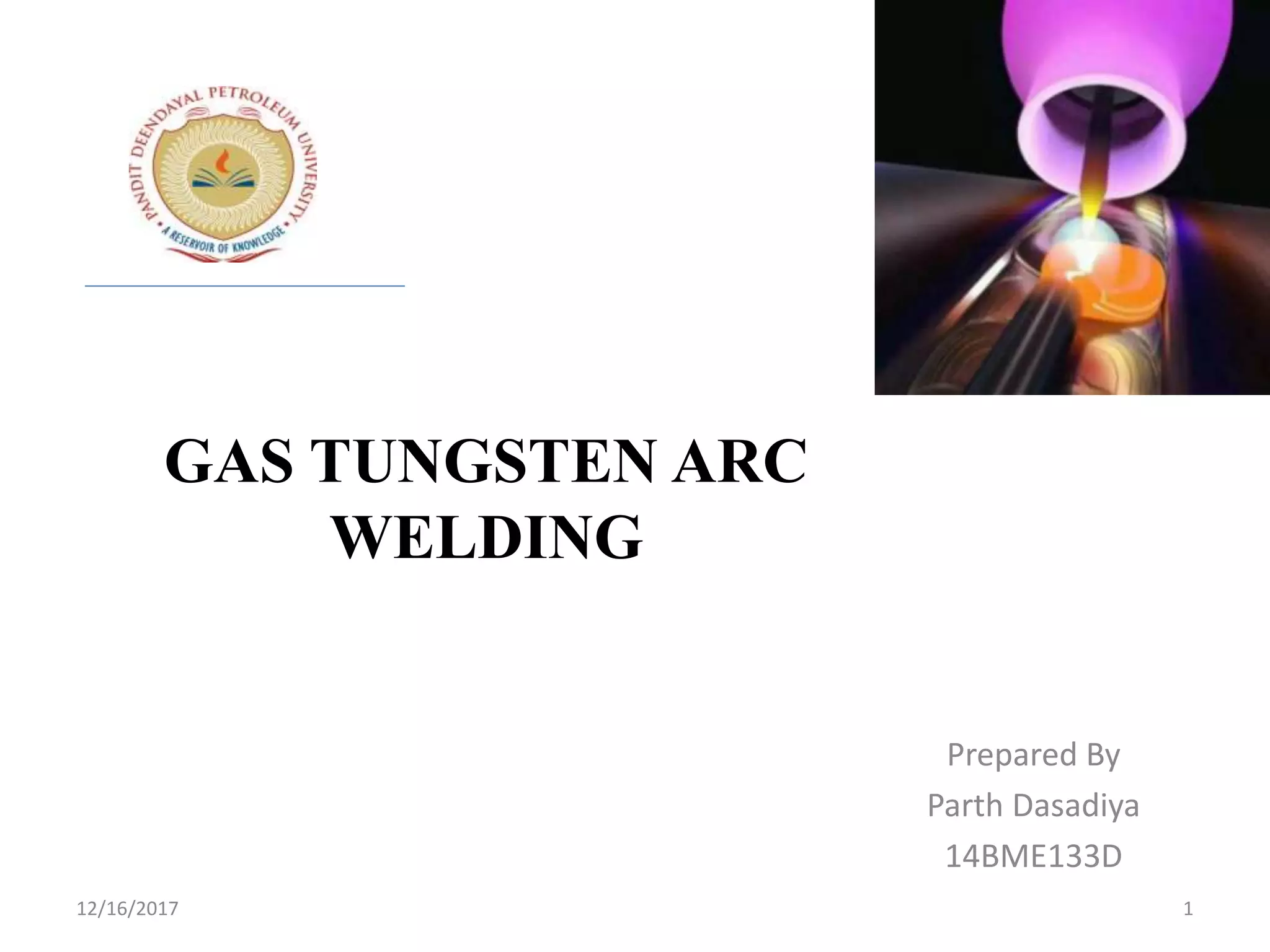

GAS TUNGSTEN ARC
WELDING
Prepared By
Parth Dasadiya
14BME133D
12/16/2017 1
Content
 Introduction
 Principle of Operation
 Application
 Limitation
 Arc Polarity
 Rectification and cleaning Action with Alternating Current
 Power Supplies
 Electrode selection
 Shielding gas
 Filer metals for GTAW
 GTAW Welding Procedures
 Safety
12/16/2017 2
Introduction
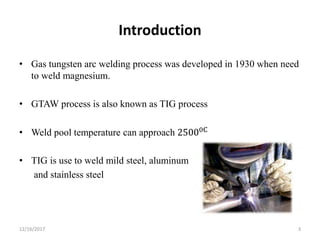
• Gas tungsten arc welding process was developed in 1930 when need
to weld magnesium.
• GTAW process is also known as TIG process
• Weld pool temperature can approach 25000C
• TIG is use to weld mild steel, aluminum
and stainless steel
12/16/2017 3
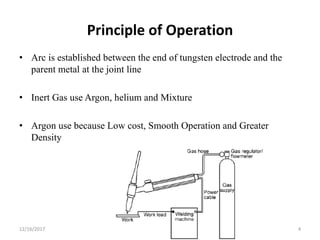
• Arc is established between the end of tungsten electrode and the
parent metal at the joint line
• Inert Gas use Argon, helium and Mixture
• Argon use because Low cost, Smooth Operation and Greater
Density
Principle of Operation
12/16/2017 4
Applications
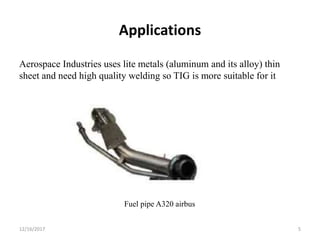
Aerospace Industries uses lite metals (aluminum and its alloy) thin
sheet and need high quality welding so TIG is more suitable for it
Fuel pipe A320 airbus
12/16/2017 5
Application
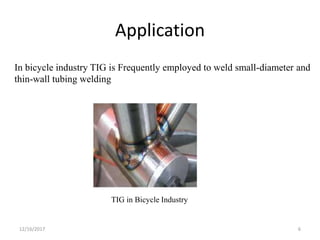
TIG in Bicycle Industry
In bicycle industry TIG is Frequently employed to weld small-diameter and
thin-wall tubing welding
12/16/2017 6
Application
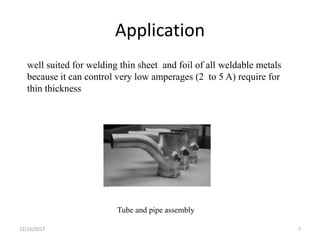
well suited for welding thin sheet and foil of all weldable metals
because it can control very low amperages (2 to 5 A) require for
thin thickness
Tube and pipe assembly
12/16/2017 7
Limitation
Lower deposition rates than consumable electrode arc welding
processes
Less economical than consumable electrode arc welding for thick
sections greater than 9.5 mm (0.38 in.)
In steel Welding operation, TIG is slower and the most costly one
Lower melting point material we can not weld by this method
12/16/2017 8
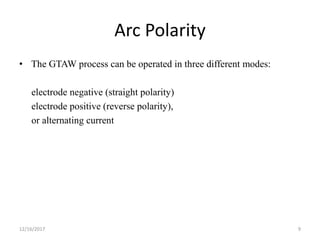
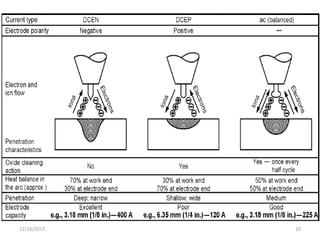
Arc Polarity
• The GTAW process can be operated in three different modes:
electrode negative (straight polarity)
electrode positive (reverse polarity),
or alternating current
12/16/2017 9
12/16/2017 10
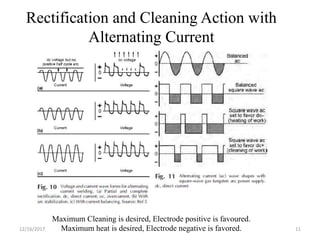
Rectification and Cleaning Action with
Alternating Current
Maximum Cleaning is desired, Electrode positive is favoured.
Maximum heat is desired, Electrode negative is favored.12/16/2017 11
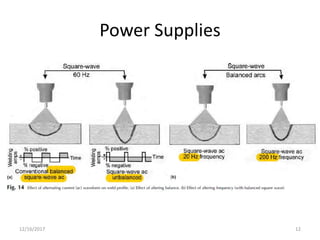
Power Supplies
12/16/2017 12
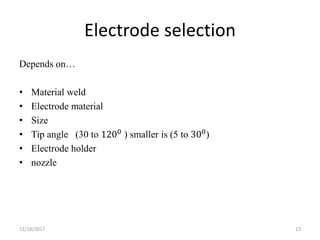
Electrode selection
Depends on…
• Material weld
• Electrode material
• Size
• Tip angle (30 to 1200
) smaller is (5 to 300
)
• Electrode holder
• nozzle
12/16/2017 13
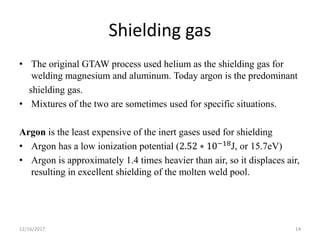
Shielding gas
• The original GTAW process used helium as the shielding gas for
welding magnesium and aluminum. Today argon is the predominant
shielding gas.
• Mixtures of the two are sometimes used for specific situations.
Argon is the least expensive of the inert gases used for shielding
• Argon has a low ionization potential (2.52 ∗ 10−18
J, or 15.7eV)
• Argon is approximately 1.4 times heavier than air, so it displaces air,
resulting in excellent shielding of the molten weld pool.
12/16/2017 14
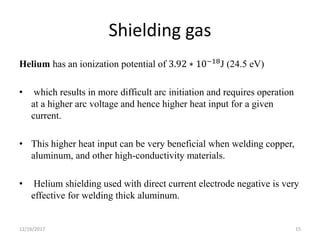
Shielding gas
Helium has an ionization potential of 3.92 ∗ 10−18J (24.5 eV)
• which results in more difficult arc initiation and requires operation
at a higher arc voltage and hence higher heat input for a given
current.
• This higher heat input can be very beneficial when welding copper,
aluminum, and other high-conductivity materials.
• Helium shielding used with direct current electrode negative is very
effective for welding thick aluminum.
12/16/2017 15
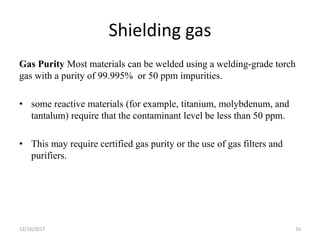
Shielding gas
Gas Purity Most materials can be welded using a welding-grade torch
gas with a purity of 99.995% or 50 ppm impurities.
• some reactive materials (for example, titanium, molybdenum, and
tantalum) require that the contaminant level be less than 50 ppm.
• This may require certified gas purity or the use of gas filters and
purifiers.
12/16/2017 16
Filer metals for GTAW
• When we want to weld high thickness then need to add filler metal
• Properly designed and prepared, lap welds, butt welds, and edge
welds on material thinner than 2 mm may be autogenously welded
without filler-metal additions.
• Autogenous welding of aluminum and magnesium is not generally
recommended because there is a possibility of cracking, especially
crater cracking.
• The filler metal normally cold added. may also be added by hot wire
addition with automatic applications
12/16/2017 17
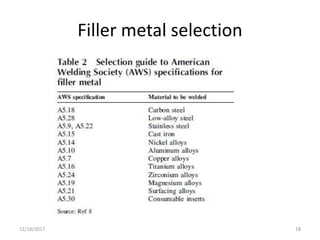
Filler metal selection
12/16/2017 18
GTAW Welding Procedures
• Type and thickness of material
• Service requirement
• Joint design
• Position in which weld will be made
• Cleanliness of material to be welded
• Filler metal required if the weld is not
• autogenous
• Filler-metal diameter
• Tungsten type and diameter
• End shape of tungsten and end diameter
• Current type and amperes
• Arc voltage
• Composition of shielding gas
• Gas cup diameter
• Shielding gas flow rate12/16/2017 19
Safety when using GTAW
• There are three basic safety documents, and all personnel, welders,
and supervisors alike should understand and be familiar with the
safe practices discussed in these documents. These documents are
• “Safety in Welding and Cutting,” ANSIZ49.1 (Ref 8)
• “Fire Prevention in the Use of Welding and Cutting Processes,”
ANSI Z49.2 (Ref 8)
• “Safe Handling of Compressed Gases in Containers,” 11th ed.,
Compressed Gas Association (CGA) P-1 (Ref 9)
12/16/2017 20
Possible Hazards
• Electrical shock
• Fumes and gases
• Arc radiation
• Fire and explosion
12/16/2017 21
Referances
• ASM handbook volume06A
• wikipedia.org/wiki/Gas_tungsten_arc_welding
12/16/2017 22
12/16/2017 23

Gas Tungsten Arc Welding (ASM Handbook)

  • 1.
    GAS TUNGSTEN ARC WELDING PreparedBy Parth Dasadiya 14BME133D 12/16/2017 1
  • 2.
    Content  Introduction  Principleof Operation  Application  Limitation  Arc Polarity  Rectification and cleaning Action with Alternating Current  Power Supplies  Electrode selection  Shielding gas  Filer metals for GTAW  GTAW Welding Procedures  Safety 12/16/2017 2
  • 3.
    Introduction • Gas tungstenarc welding process was developed in 1930 when need to weld magnesium. • GTAW process is also known as TIG process • Weld pool temperature can approach 25000C • TIG is use to weld mild steel, aluminum and stainless steel 12/16/2017 3
  • 4.
    • Arc isestablished between the end of tungsten electrode and the parent metal at the joint line • Inert Gas use Argon, helium and Mixture • Argon use because Low cost, Smooth Operation and Greater Density Principle of Operation 12/16/2017 4
  • 5.
    Applications Aerospace Industries useslite metals (aluminum and its alloy) thin sheet and need high quality welding so TIG is more suitable for it Fuel pipe A320 airbus 12/16/2017 5
  • 6.
    Application TIG in BicycleIndustry In bicycle industry TIG is Frequently employed to weld small-diameter and thin-wall tubing welding 12/16/2017 6
  • 7.
    Application well suited forwelding thin sheet and foil of all weldable metals because it can control very low amperages (2 to 5 A) require for thin thickness Tube and pipe assembly 12/16/2017 7
  • 8.
    Limitation Lower deposition ratesthan consumable electrode arc welding processes Less economical than consumable electrode arc welding for thick sections greater than 9.5 mm (0.38 in.) In steel Welding operation, TIG is slower and the most costly one Lower melting point material we can not weld by this method 12/16/2017 8
  • 9.
    Arc Polarity • TheGTAW process can be operated in three different modes: electrode negative (straight polarity) electrode positive (reverse polarity), or alternating current 12/16/2017 9
  • 10.
  • 11.
    Rectification and CleaningAction with Alternating Current Maximum Cleaning is desired, Electrode positive is favoured. Maximum heat is desired, Electrode negative is favored.12/16/2017 11
  • 12.
  • 13.
    Electrode selection Depends on… •Material weld • Electrode material • Size • Tip angle (30 to 1200 ) smaller is (5 to 300 ) • Electrode holder • nozzle 12/16/2017 13
  • 14.
    Shielding gas • Theoriginal GTAW process used helium as the shielding gas for welding magnesium and aluminum. Today argon is the predominant shielding gas. • Mixtures of the two are sometimes used for specific situations. Argon is the least expensive of the inert gases used for shielding • Argon has a low ionization potential (2.52 ∗ 10−18 J, or 15.7eV) • Argon is approximately 1.4 times heavier than air, so it displaces air, resulting in excellent shielding of the molten weld pool. 12/16/2017 14
  • 15.
    Shielding gas Helium hasan ionization potential of 3.92 ∗ 10−18J (24.5 eV) • which results in more difficult arc initiation and requires operation at a higher arc voltage and hence higher heat input for a given current. • This higher heat input can be very beneficial when welding copper, aluminum, and other high-conductivity materials. • Helium shielding used with direct current electrode negative is very effective for welding thick aluminum. 12/16/2017 15
  • 16.
    Shielding gas Gas PurityMost materials can be welded using a welding-grade torch gas with a purity of 99.995% or 50 ppm impurities. • some reactive materials (for example, titanium, molybdenum, and tantalum) require that the contaminant level be less than 50 ppm. • This may require certified gas purity or the use of gas filters and purifiers. 12/16/2017 16
  • 17.
    Filer metals forGTAW • When we want to weld high thickness then need to add filler metal • Properly designed and prepared, lap welds, butt welds, and edge welds on material thinner than 2 mm may be autogenously welded without filler-metal additions. • Autogenous welding of aluminum and magnesium is not generally recommended because there is a possibility of cracking, especially crater cracking. • The filler metal normally cold added. may also be added by hot wire addition with automatic applications 12/16/2017 17
  • 18.
  • 19.
    GTAW Welding Procedures •Type and thickness of material • Service requirement • Joint design • Position in which weld will be made • Cleanliness of material to be welded • Filler metal required if the weld is not • autogenous • Filler-metal diameter • Tungsten type and diameter • End shape of tungsten and end diameter • Current type and amperes • Arc voltage • Composition of shielding gas • Gas cup diameter • Shielding gas flow rate12/16/2017 19
  • 20.
    Safety when usingGTAW • There are three basic safety documents, and all personnel, welders, and supervisors alike should understand and be familiar with the safe practices discussed in these documents. These documents are • “Safety in Welding and Cutting,” ANSIZ49.1 (Ref 8) • “Fire Prevention in the Use of Welding and Cutting Processes,” ANSI Z49.2 (Ref 8) • “Safe Handling of Compressed Gases in Containers,” 11th ed., Compressed Gas Association (CGA) P-1 (Ref 9) 12/16/2017 20
  • 21.
    Possible Hazards • Electricalshock • Fumes and gases • Arc radiation • Fire and explosion 12/16/2017 21
  • 22.
    Referances • ASM handbookvolume06A • wikipedia.org/wiki/Gas_tungsten_arc_welding 12/16/2017 22
  • 23.