
NASIR AZMI
MECHANICAL DEPARTMENT
ROLL-NO 7071113121
DIPLAST LTD
               Diplast Plastic Ltd. is
                considered to be one of the
                top ten companies of India due
                to its quality, technology,
                turnover, production capacity
                and various types of quality
                products. Many new
                innovations in plastics are
                being brought to India by
                Diplast Plastics Ltd.
               The Unit was set up in the year
                1972 and was inaugurated by
                none other than the Honorable
                ex-president of India - Mr. Giani
                Zail Singh Ji.
INTRODUCTION
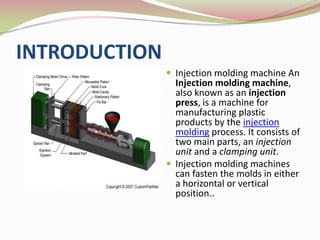
                Injection molding machine An
                 Injection molding machine,
                 also known as an injection
                 press, is a machine for
                 manufacturing plastic
                 products by the injection
                 molding process. It consists of
                 two main parts, an injection
                 unit and a clamping unit.
                Injection molding machines
                 can fasten the molds in either
                 a horizontal or vertical
                 position..
INJECTION MOLDING MACHINE
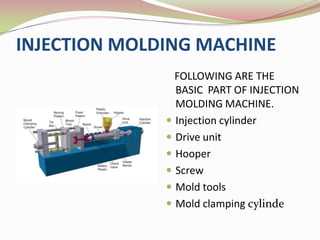
                FOLLOWING ARE THE
                BASIC PART OF INJECTION
                MOLDING MACHINE.
               Injection cylinder
               Drive unit
               Hooper
               Screw
               Mold tools
               Mold clamping cylinde
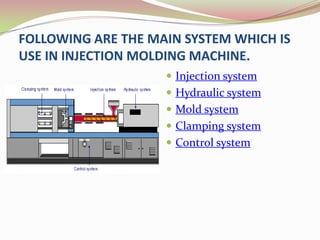
FOLLOWING ARE THE MAIN SYSTEM WHICH IS
USE IN INJECTION MOLDING MACHINE.
                     Injection system
                     Hydraulic system
                     Mold system
                     Clamping system
                     Control system
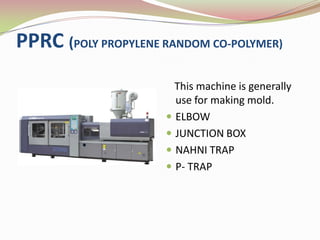
PPRC (POLY PROPYLENE RANDOM CO-POLYMER)
                       This machine is generally
                       use for making mold.
                      ELBOW
                      JUNCTION BOX
                      NAHNI TRAP
                      P- TRAP
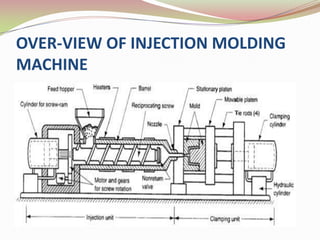
OVER-VIEW OF INJECTION MOLDING
MACHINE
DUTIES $ RESPONSIBLITIES
Instruction for the assistant supervisor of injection molding
  machine.
1.  Minimize the scrap and use the scrap simultaneously within 2-3 days when
    it is produce.
2. Check quality and printing of fitting good.
3. Man power handling and optimum utilization.
4. Order execution in time.
5. Check availability of raw material and to arrange for any short material.
6. Arrangement of packing boxes whenever required.
7. To check the insert availability and order well in advance.
8. To absorbed the mold change time and reduce the mold change time as far
    as possible.
9. In mold section maximum attention is to be paid to check efficiency of the
    worker.
10. To make drawing of mold. so it can be use be use whenever in future.
APPLICATION OF INJECTION MOLDING
MACHINE
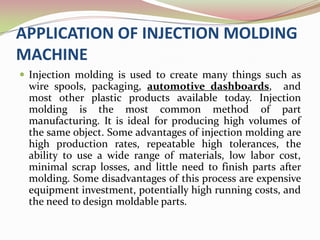
 Injection molding is used to create many things such as
 wire spools, packaging, automotive dashboards, and
 most other plastic products available today. Injection
 molding is the most common method of part
 manufacturing. It is ideal for producing high volumes of
 the same object. Some advantages of injection molding are
 high production rates, repeatable high tolerances, the
 ability to use a wide range of materials, low labor cost,
 minimal scrap losses, and little need to finish parts after
 molding. Some disadvantages of this process are expensive
 equipment investment, potentially high running costs, and
 the need to design moldable parts.
MOLD DRAWING
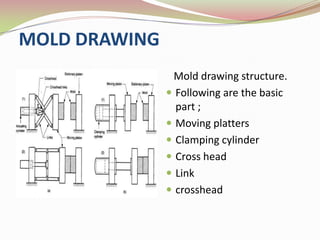
                Mold drawing structure.
                Following are the basic
                 part ;
                Moving platters
                Clamping cylinder
                Cross head
                Link
                crosshead
MOLD OR DIA
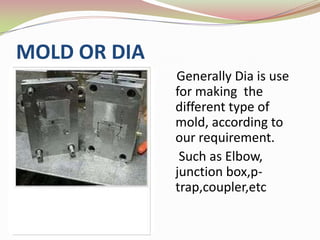
              Generally Dia is use
              for making the
              different type of
              mold, according to
              our requirement.
               Such as Elbow,
              junction box,p-
              trap,coupler,etc
ORGANIC STRUCTURE
POLYVINYL CHLORIDE
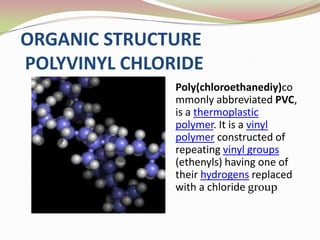
               Poly(chloroethanediy)co
               mmonly abbreviated PVC,
               is a thermoplastic
               polymer. It is a vinyl
               polymer constructed of
               repeating vinyl groups
               (ethenyls) having one of
               their hydrogens replaced
               with a chloride group
ADVANTAGE $ DISADVANTAGE
 The greatest advantage of this process is its ability to produce single-
    piece injection moldings with highly complex interior geometries
    without secondary operations. Similarly shaped objects are usually
    made from aluminum castings, which can weigh 45% to 75% more
    than a comparable molding. The tooling also lasts longer than metal
    casting tooling due to the lack of chemical corrosion and wear. Other
    advantages include.
   Very good surface quality with no weak areas due to joints or welds
   High dimensional accuracy and structural integrity
   Not labor intensive due to the few secondary operations required
   Little waste
   Inserts can be incorporated
MOLDING DEFECTS
 Molding defects
 Injection molding is a complex technology with possible
    production problems. They can be caused either by defects
    in the molds or more often by part processing (molding)
   Once the equipment is set to successfully create the
    molded part, modern monitoring systems can save a
    reference curve of the cavity pressure.
    Molding Defects
   Ununiformly
   Burn mark
   Colour less
END OF PRESENTATION
THANK YOU FOR YOUR VALUABLE TIME

My project slide ( PRODUCTION DEPT)

  • 1.
  • 2.
    DIPLAST LTD  Diplast Plastic Ltd. is considered to be one of the top ten companies of India due to its quality, technology, turnover, production capacity and various types of quality products. Many new innovations in plastics are being brought to India by Diplast Plastics Ltd.  The Unit was set up in the year 1972 and was inaugurated by none other than the Honorable ex-president of India - Mr. Giani Zail Singh Ji.
  • 3.
    INTRODUCTION  Injection molding machine An Injection molding machine, also known as an injection press, is a machine for manufacturing plastic products by the injection molding process. It consists of two main parts, an injection unit and a clamping unit.  Injection molding machines can fasten the molds in either a horizontal or vertical position..
  • 4.
    INJECTION MOLDING MACHINE FOLLOWING ARE THE BASIC PART OF INJECTION MOLDING MACHINE.  Injection cylinder  Drive unit  Hooper  Screw  Mold tools  Mold clamping cylinde
  • 5.
    FOLLOWING ARE THEMAIN SYSTEM WHICH IS USE IN INJECTION MOLDING MACHINE.  Injection system  Hydraulic system  Mold system  Clamping system  Control system
  • 6.
    PPRC (POLY PROPYLENERANDOM CO-POLYMER) This machine is generally use for making mold.  ELBOW  JUNCTION BOX  NAHNI TRAP  P- TRAP
  • 7.
    OVER-VIEW OF INJECTIONMOLDING MACHINE
  • 8.
    DUTIES $ RESPONSIBLITIES Instructionfor the assistant supervisor of injection molding machine. 1. Minimize the scrap and use the scrap simultaneously within 2-3 days when it is produce. 2. Check quality and printing of fitting good. 3. Man power handling and optimum utilization. 4. Order execution in time. 5. Check availability of raw material and to arrange for any short material. 6. Arrangement of packing boxes whenever required. 7. To check the insert availability and order well in advance. 8. To absorbed the mold change time and reduce the mold change time as far as possible. 9. In mold section maximum attention is to be paid to check efficiency of the worker. 10. To make drawing of mold. so it can be use be use whenever in future.
  • 9.
    APPLICATION OF INJECTIONMOLDING MACHINE  Injection molding is used to create many things such as wire spools, packaging, automotive dashboards, and most other plastic products available today. Injection molding is the most common method of part manufacturing. It is ideal for producing high volumes of the same object. Some advantages of injection molding are high production rates, repeatable high tolerances, the ability to use a wide range of materials, low labor cost, minimal scrap losses, and little need to finish parts after molding. Some disadvantages of this process are expensive equipment investment, potentially high running costs, and the need to design moldable parts.
  • 10.
    MOLD DRAWING Mold drawing structure.  Following are the basic part ;  Moving platters  Clamping cylinder  Cross head  Link  crosshead
  • 11.
    MOLD OR DIA Generally Dia is use for making the different type of mold, according to our requirement. Such as Elbow, junction box,p- trap,coupler,etc
  • 12.
    ORGANIC STRUCTURE POLYVINYL CHLORIDE Poly(chloroethanediy)co mmonly abbreviated PVC, is a thermoplastic polymer. It is a vinyl polymer constructed of repeating vinyl groups (ethenyls) having one of their hydrogens replaced with a chloride group
  • 13.
    ADVANTAGE $ DISADVANTAGE The greatest advantage of this process is its ability to produce single- piece injection moldings with highly complex interior geometries without secondary operations. Similarly shaped objects are usually made from aluminum castings, which can weigh 45% to 75% more than a comparable molding. The tooling also lasts longer than metal casting tooling due to the lack of chemical corrosion and wear. Other advantages include.  Very good surface quality with no weak areas due to joints or welds  High dimensional accuracy and structural integrity  Not labor intensive due to the few secondary operations required  Little waste  Inserts can be incorporated
  • 14.
    MOLDING DEFECTS  Moldingdefects  Injection molding is a complex technology with possible production problems. They can be caused either by defects in the molds or more often by part processing (molding)  Once the equipment is set to successfully create the molded part, modern monitoring systems can save a reference curve of the cavity pressure.  Molding Defects  Ununiformly  Burn mark  Colour less
  • 15.
    END OF PRESENTATION THANKYOU FOR YOUR VALUABLE TIME