Carcinoma PenisCarcinoma Penis
Dr. Manan Shah R3 S/E
Dr. Rushabh Shah R3 S/E
Epidemiology
• Incidence of Ca penis
– 1 case per 1,00,000
– Higher incidence in South America (Brazil), East Africa
and South East Asia (10% of all male malignancy)
– no racial difference between black and white in US
– But poor prognostic factor if African American ethnicity
Benign penile lesion
• Non cutaneous:
– Congenital and acquire inclusion cyst
– Retention cyst
– Angioma , lipoma
– Pyogenic granuloma
– Peyronie’s plaque
• Cutaneous:
– Pearly Penile papules (PPP)
• White, dome-shaped, closely spaced small papules at
glans penis
• Arranged circumferentially at corona
• 25% of young adults (uncircumcised)
• NO association with HPV infection
• Mx: Reassurance
• Local destruction: CO2 laser, cryotherapy
– Zoon balanitis: shinny , erythematous plaque on glans or
prepuce
– Lichen Planus : flat-topped violacious papule
PPP
Zoon balanitis
Lichen Planus
6
Viral related lesions
1. Condyloma Acuminatum:
– Genital warts related to HPV infection (16,18)
– Asso with SCC
– Soft, multiple lesion on glans, prepuce and shaft
– Rx: popdophyllin , diathermy , imiquimod cream.
1. Bowenoid papulosis:
– Resemble CIS , but with benign course
– Muliple papules or flat glanular lesion
1. Kaposi’s sarcoma :
– 2nd
commonest penile tumor, reticulo-epithelial tumor
– Raised , painful , bleeding, violacious papule
– Or bluish ulcer with local edema
– Asso with HIV infection
– Rx: palliative ,
Pre-Malignant Lesions
• Cutaneous horn:
– extreme hyperkeratosis with base malignant Rx with
wide local excision
• Leukoplakia:
– Whitish glanular plaque, often involve meatus
– Asso with CIS
– Rx: Excision and 5FU
• Giant condyloma acuminata or Buschke-Löwenstein
tumor or verrucous carcinoma
– Displaces, invades, and destroys adjacent structures by
compression, whereas the standard condyloma remains
superficial and never invades
– Does not metastasize
– Treat with excision and recurrence is common
• Erythroplasia of Queyrat: [non keratinising CIS]
– Red velvety circumscribed painless lesion , may ulcerate and
painful
– Histology:
• Atypical hyperplastic mucosal cell with malignant features
• Hyperchromatic nuclei & multi-level mitotic figures
• Submucosa : proliferation of capillaries & inflammatory
infiltrate of plasma cell
– 10x more likely to progress then Bowen’s disease
– Treatment
– Penile preserving:
• Topical 5-FU or imiquimod
• Laser (CO2) , photodynamic therapy , cryotherapy , Mohs MS
• Bowen’s disease: [Keratinising CIS ]
– CIS in the genital and perineal skin
– Rx : WLE , laser, cryoablation
Balanitis Xerotica Obliterans (BXO)
– Lichen sclerosis or atrophicus
– >10% asso with future Ca penis
– Location: White patch on Glans and prepuce, may affect
meatus or fossa navicularis
– Aetiology: Infection, phimosis
– Histology :
1. epidermal atrophy,
2. loss of rete pegs,
3. chronic inflammatory change,
4. hyperkeratosis with collagenized dermis
5. perivascular infiltration of dermis
– Treatment:
• Steroid cream for mild scarring and retractable foreskin
• Surgical excision (circumcision), reconstruct if stricture.
• Remember not to use genital skin for reconstruction
(recurrence)
Risk factors
1. Smoking
2. UV radiation
3. Foreskin: phimosis , poor hygiene
• neonatal circumcision eliminate risk
• But not circumcision in adult
1. HPV infection (16, 18): asso in 50%
• Sexual transmission causing genital warts, condyloma
acuminata
• HPV infects the basal epithelial cell that proliferates
• HPV DNA was detected in 80 % of tumor specimens
1. Penile trauma
2. 8 – methoxypsoralen
3. Balanoposthitis
4. Paget’s disease
Pathology
• SCC (95%)
1. Usual type (60-70%)
2. Papillary (7%)
3. Condylomatous (7%)
4. Verrucous (7%)
5. Basaloid (4%)
6. Sarcomatoid (4%)
• Malignant Melanoma (2%)
• Basal cell carcinoma (2%)
• Extra-mammary Paget’s disease (adenoCa from penile skin)
• Sarcoma
Spread
• Direct – slow growing, prevented by Buck’s fascia.
• Lymphatic – first to superficial and deep inguinal lymph nodes
and then to iliac group of lymph nodes.
• Blood – rare and commonly involves liver, lung and bones.
Growth patterns and differentiation grading systems
Distribution of Ca penis
• Glans (50%)
• Prepuce (21%)
– May be related to constant exposure to irritants within the
prepuce
• Glans and prepuce (9%)
• Coronal sulcus (6%)
• Shaft (less than 2%)
Risk factor for metastasis
1. Growth pattern
– Superficially spreading, LN met in 42%
– Vertical growth, LN met in 82%
1. Basaloid and sarcomatous histologic pattern
2. Stage
3. Grade
4. Status of vascular invasion
Presentation:
•A sore that has failed to heal
•A subtle induration in the skin, flat ulcerative to a large exophytic
growth.
•A phimosis may obscure the tumor and allows it to grow
undetected.
•Rarely, a mass, ulceration, suppuration, or hemorrhage may
manifest in the inguinal area because of nodal metastases. Anorexia,
weight loss, malase, cachexia.
•Delay presentation (50%) due to
• Embarrassment, guilt, fear, ignorance, and neglect
• Self treatment with various skin creams and lotions.
• Doctor: confuse with other benign penile lesions
•Metastasis :
• hypercalcemia in 20% on presentation (PTH like)
Cause of death – Invasion of femoral and external iliac vessels
resulting in torrential haemorrhage.
Invesigations
• CBC with ESR, RBS, BU, S. Creat, LFT’s
• ECG
• Chest X-ray
• S. VDRL, HIV
• Wedge Biopsy - Most penile tumors are SCC demonstrating
keratinization, epithelial pearl formation and various degree of
mitotic activity.
• Penile USG – 100% sensitive for detecting corpus cavernosum
invasion.
• USG abdomen to look for external iliac lymph nodes.
• CT scan – for inguinal and pelvic areas as well as to rule out
distant metastasis.
• Radionucleotide bone scan.
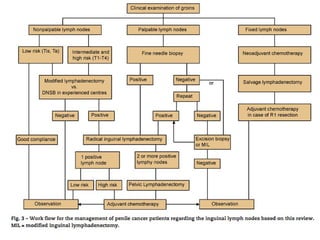
Dynamic sentinel node biopsy (DSNB)
• Identification of the LN in pt which is the first drainage node
• Usage: in non palpable LN
• Method:
– Technetium-99m nanocolloid injection around the penile
tumor intradermally 1day before surgery
– Shortly before OT: 1ml of methylene blue dye injection
intradermally
– Sentinel LN indentify by lymphoscintigraphy & area marked
on skin
– Dissection: sentinel LN identify by intra-op gamma-ray
detection probe + methylene blue dye staining
– LN then isolated and removed for FZ
– If FZ +ve  formal inguinal LND performed
• Result:
– With improved technique (combine with USG FNAC): false
negative rate of 5% achieved (vs 25%)
– Specificity : 95%, sensitivity : 95%
American Joint Committee on Cancer (AJCC)
TNM Staging
Primary Tumor (T)
Tx – Tumor cannot be assessed
T0 – No evidence of primary tumor
Ta – Non invasive verrucous carcinoma
Tis – Carcinoma insitu
T1a – Tumor invades subepithelial connective tissue without
lymph vascular invasion and is not poorly
differentiated
T1b - Tumor invades subepithelial connective tissue with lymph
vascular invasion or is poorly differentiated
T2 - Tumor invades corpus spongiosum or cavernosum
T3 – Tumor invades urethra
T4 – Tumor invades other adjacent stuctures
Regional Lymph Nodes (N)
Nx – Regional LN cannot be assessed
N0 – No LN metastasis
N1 – Palpable mobile unilateral inguinal LN
N2 - Palpable mobile multiple or bilateral inguinal LN
N3 – Palpable fixed inguinal LN or pelvic lymphadenopathy
Distant Metastasis (M)
M0 – No distant metastasis
M1 – Distant metastasis
Jackson’s staging
Stage 1 – Tumor confined to glans or prepuce
Stage 2 – Tumor extending into shaft but no palpable LN
Stage 3 – Palpable and mobile inguinal LN resectable
Stage 4 – Tumor involving adjacent structures like srotum,
perineum or fixed inguinal LN non resectable or distant
metastasis
Basic principles of treatment
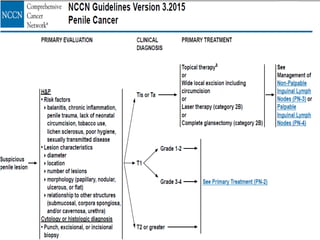
• Carcinoma insitu lesions – 5FU, NdYAG Laser
• Goal of treatment in penile ca – complete excision with
adequate tumor free margins
• For lesions involving prepuce – Circumcision
• For lesions involving glans or distal shaft – Partial penectomy
with 2cms tumor free margins
• For lesions involving proximal shaft or when partial
penectomy results in penile stump of insufficient length for
sexual function or directing urinary stream – Total penectomy
with perineal urethrostomy
Organ preserving therapy
• Circumcision
– Small tumors confined to the prepuce
– But with recurrence 40%
• Local wedge excision
– Margin of 5mm
– 50% recurrence rate
• Glansectomy : T1 (not involving the CC)
– Tourniquet control
– subcoronal incision down to Buck’s fascia
– proximal margin at least 5mm
– the glans cap is mobilized off the head of the corpora
cavernosa
– Urethra is transected and split and fixed
– Shaft skin is anchored to the new corona
– Raw surface is covered with partial thickness skin graft
• Mohs micrographic surgery (MMS)
– “ shaving “ the tumour mass by excising thin layers of tissue
and examining them microscopically till clear deep resection
margin is confirmed by frozen section
– Adv :
• With a surgeon experienced in MMS, it is able to remove
the cancerous tissue while preserving normal structures
– Disadv :
• Messy and bloody and time consuming
• Required expert technique
• Experienced pathologist is needed to confirm clear
margin by frozen section
• Wound may healed with scarring result in disfiguration
• Urethra is sometime involved and required urethroplasty
• Recurrence rate was high at 30%
• Laser surgery
– For local and limited invasive disease
– Four types of lasers have been used
1. Carbon dioxide
2. Neodymium:yttrium-aluminum-garnet (ND:YAG)
3. Argon
4. Potassium-titanyl-phosphate (KTP) lasers
– The carbon dioxide laser
• vaporizes tissue
• penetrates only to a depth of 1mm
• coagulate blood vessels less than 0.5 mm
– The ND:YAG laser
• penetrate 5 mm depending on the power
• Can coagulate vessels up to 5 mm
– The argon and KTP lasers have less tissue penetration than
the carbon dioxide laser and are rarely used
Partial Penectomy
• When the cancer involves the glans and distal shaft
• T1a to T2 (not for T3 !!!!)
• Traditionally, partial amputation has required removal of 2-cm
tumour-free margins, to lower risk of local recurrence T (50%
reduced to 6%)
• Pathological confirmation a surgical margin of 5-10 mm is safe
• There should be atleast 2cm penile functioning length and 2cm
clear margin before consideration of partial penectomy.
• Young’s operation : partial penectmy + bilateral inguinal LN
block dissection.
Total Penectomy
• Sir Piersey Gold opeation : Total amputation of penis +
excision of scrotum and its content + Formation of perineal
urethrostomy
• It prevents frequent dermatitis of scrotal skin because of
perineal urethrostomy and also reduces the sexual desire.
Radiotherapy
• Indications:
1. Organ-preserving treatment in young pt with T1-2 lesions <
4 cm
– EBRT: Response rate: 50% Local failure rate: 40%
– Brachytherapy: response rate 70%, failure 16%.
1. Alternative to chemo + surgery in T4 diseas
2. Those who have metastatic disease and need some form of
palliative therapy.
• Procedure:
– High dose: 60cGy during 3 weeks
– Circumcision prior to initiating radiation therapy
• Prepuce will fuse with the glans
• Allows better evaluation of the tumor stage
• Minimizes the morbidity associated with the therapy,
includes swelling, irritation, moist desquamation and
infection
• Neo adjuvant
– can render fixed nodes operable.
• Adjuvant
– may be used to reduce local recurrence.
Adv
– Avoid the psychological trauma associated with partial or
complete penectomy
– Potential to maintain potency
– Local control rate 60-90%
Complication:
1.Meatal stenosis + urethral stricture (30%)
2.glans necrosis
3.Telangiectasia (90%)
4.Late fibrosis of the corpora cavernosa
5.Late fistula and pain
6.Testicular damage
7.Secondary neoplasia
– Disfiguration and associated pain
– Difficulty in distinguishing tumour recurrence and post –
RT fibrosis / scarring making multiple Bx necessary
– Local recurrence rate – 40% (EBRT), 16%
(Brachytherapy)
Chemotherapy
Preferred combination chemotherapy regimens
Paclitaxel 175 mg/m2 IV over 3 hours on Day 1
Ifosfamide 1200 mg/m2 IV over 2 hours on Days 1-3
Cisplatin 25 mg/m2 IV over 2 hours on Days 1-3
Repeat every 21 days
5-FU + cisplatin
Continuous infusion 5-FU 1000 mg/m2/d IV on Days 1-5
Cisplatin 100 mg/m2 IV on Day 1
Repeat every 3 to 4 weeks
Neo-adjuvant chemotherapy
• Neoadjuvant cisplatin-based chemotherapy should be
considered the standard (prior to ILND) in patients with ≥4 cm
inguinal lymph nodes (fixed or mobile), if FNA is positive for
metastatic penile cancer.
• Patients with initially unresectable (T4) primary tumors may
be downstaged by response to chemotherapy.
Adjuvant chemotherapy
Patients with high-risk features, which include any of the
following:
• Pelvic lymph node metastases
• Extranodal extension
• Bilateral inguinal lymph nodes involved
• 4 cm tumor in lymph nodes
LN spread in Ca Penis
• Regional LN of penis are located in inguinal region : superficial or
deep
• Then drain to 2nd line LN: Iliac & pelvic group
• Most constant node:
– Cloquet’s (or Rosenmuller’s)
– Medial side of the femoral vein
• Superficial: under subcutaneous fascia and above fascia lata, 25
LN on the muscle of the upper thigh.
• Deep: region of fossa ovalis where greater saphenous vein drain
into femoral vein through an opening of the fascia lata
• Most mets found in medial superior Daseler group
• Sentinel LN of Ca penis only found in superior and central zones
of the inguinal region
Daseler region
• Inguinal region is divided into four sections by a horizontal and a vertical
line drawn through the fossa ovalis
• Five anatomical subgroups with the central zone being located at the
confluence of the greater saphenous vein and the femoral vein. The four
other zones are described as lateral superior, lateral inferior, medial
superior, and medial inferior
Radical inguinal lymphadenectomy
Margin :
• Upper : ASIS to pubic tubercle
• Lateral : a vertical line of 20 cm from the ASIS
• Medial : a vertical line of 15 cm from the pubic tubercle
• Lower : joining the lateral and medial border
Content :
• Superficial inguinal LN deep to the Scarpa fascia
• Deep inguinal LN deep to the fascia lata
• LN remove: all 5 Daseler region + deep inguinal LN
• Saphenous vein is ligated and divided
• Femoral artery and vein are skeletonized
• dissection posterior to the femoral vessel is not required
• Sartorius is divided at the origin and transposed to cover the
femoral vessel
• Skin rotation flaps + MC flaps for primary wound closure
Morbidity:
• wound infection , skin necrosis , wound dehiscence , lymph
edema, lymphocele
Modified inguinal lymphadenectomy
•Proposed by Catalona
•Exclusion of area lateral to femoral artery & caudal to fossa
ovalis
Margin :
•Upper : inguinal ligament
•Medial : margin of adductor longus muscle
•Lateral : lateral border of the femoral artery
•Lower : apex of the femoral triangle
Content :
•The superficial LN deep to the Scarpa fascia, superficial to the
fascia lata
•But should dissect central and superior zones
•If + ve LN is identified on modified approach, formal radical
lymphadenectomy is proceeded.
•Morbidity reduced : Skin necrosis, lymphoedema, DVT
Difference between radical vs modified inguinal
lymphadenectomy
1. Shorter skin incision
2. Limitation of the dissection by excluding the area lateral to
the femoral artery and caudal to the fossa ovalis
3. Femoral vessel need not be skeletonised deep to fascia lata
4. Preservation of the saphenous vein (less edema)
5. Elimination of the need to transpose the sartorius muscle
Complications
• Early minor complications :40%
– Hemorrhage
– Wound infection
– Flap necrosis
• Major complications: 15%
– Debilitating lymphedema
– Lymphocele
– Prolong lymph drainage
– Patchy sensory loss of thigh
40
41
42
43
44
45
46
48
Prognosis of Ca penis
• 5 Yr Survival
– Localized disease 70-95%
– LN met 50%
– Metastasis SCC <10%
• Poor prognostic factors to survival:
– presence of +ve LN
– no. & site of +ve nodes
– extracapsular nodal involvement
Thank You….

Seminar ca penis

  • 1.
    Carcinoma PenisCarcinoma Penis Dr.Manan Shah R3 S/E Dr. Rushabh Shah R3 S/E
  • 2.
    Epidemiology • Incidence ofCa penis – 1 case per 1,00,000 – Higher incidence in South America (Brazil), East Africa and South East Asia (10% of all male malignancy) – no racial difference between black and white in US – But poor prognostic factor if African American ethnicity
  • 3.
    Benign penile lesion •Non cutaneous: – Congenital and acquire inclusion cyst – Retention cyst – Angioma , lipoma – Pyogenic granuloma – Peyronie’s plaque
  • 4.
    • Cutaneous: – PearlyPenile papules (PPP) • White, dome-shaped, closely spaced small papules at glans penis • Arranged circumferentially at corona • 25% of young adults (uncircumcised) • NO association with HPV infection • Mx: Reassurance • Local destruction: CO2 laser, cryotherapy – Zoon balanitis: shinny , erythematous plaque on glans or prepuce – Lichen Planus : flat-topped violacious papule
  • 5.
  • 6.
    6 Viral related lesions 1.Condyloma Acuminatum: – Genital warts related to HPV infection (16,18) – Asso with SCC – Soft, multiple lesion on glans, prepuce and shaft – Rx: popdophyllin , diathermy , imiquimod cream. 1. Bowenoid papulosis: – Resemble CIS , but with benign course – Muliple papules or flat glanular lesion 1. Kaposi’s sarcoma : – 2nd commonest penile tumor, reticulo-epithelial tumor – Raised , painful , bleeding, violacious papule – Or bluish ulcer with local edema – Asso with HIV infection – Rx: palliative ,
  • 7.
    Pre-Malignant Lesions • Cutaneoushorn: – extreme hyperkeratosis with base malignant Rx with wide local excision • Leukoplakia: – Whitish glanular plaque, often involve meatus – Asso with CIS – Rx: Excision and 5FU • Giant condyloma acuminata or Buschke-Löwenstein tumor or verrucous carcinoma – Displaces, invades, and destroys adjacent structures by compression, whereas the standard condyloma remains superficial and never invades – Does not metastasize – Treat with excision and recurrence is common
  • 8.
    • Erythroplasia ofQueyrat: [non keratinising CIS] – Red velvety circumscribed painless lesion , may ulcerate and painful – Histology: • Atypical hyperplastic mucosal cell with malignant features • Hyperchromatic nuclei & multi-level mitotic figures • Submucosa : proliferation of capillaries & inflammatory infiltrate of plasma cell – 10x more likely to progress then Bowen’s disease – Treatment – Penile preserving: • Topical 5-FU or imiquimod • Laser (CO2) , photodynamic therapy , cryotherapy , Mohs MS • Bowen’s disease: [Keratinising CIS ] – CIS in the genital and perineal skin – Rx : WLE , laser, cryoablation
  • 9.
    Balanitis Xerotica Obliterans(BXO) – Lichen sclerosis or atrophicus – >10% asso with future Ca penis – Location: White patch on Glans and prepuce, may affect meatus or fossa navicularis – Aetiology: Infection, phimosis – Histology : 1. epidermal atrophy, 2. loss of rete pegs, 3. chronic inflammatory change, 4. hyperkeratosis with collagenized dermis 5. perivascular infiltration of dermis – Treatment: • Steroid cream for mild scarring and retractable foreskin • Surgical excision (circumcision), reconstruct if stricture. • Remember not to use genital skin for reconstruction (recurrence)
  • 10.
    Risk factors 1. Smoking 2.UV radiation 3. Foreskin: phimosis , poor hygiene • neonatal circumcision eliminate risk • But not circumcision in adult 1. HPV infection (16, 18): asso in 50% • Sexual transmission causing genital warts, condyloma acuminata • HPV infects the basal epithelial cell that proliferates • HPV DNA was detected in 80 % of tumor specimens 1. Penile trauma 2. 8 – methoxypsoralen 3. Balanoposthitis 4. Paget’s disease
  • 11.
    Pathology • SCC (95%) 1.Usual type (60-70%) 2. Papillary (7%) 3. Condylomatous (7%) 4. Verrucous (7%) 5. Basaloid (4%) 6. Sarcomatoid (4%) • Malignant Melanoma (2%) • Basal cell carcinoma (2%) • Extra-mammary Paget’s disease (adenoCa from penile skin) • Sarcoma
  • 12.
    Spread • Direct –slow growing, prevented by Buck’s fascia. • Lymphatic – first to superficial and deep inguinal lymph nodes and then to iliac group of lymph nodes. • Blood – rare and commonly involves liver, lung and bones.
  • 13.
    Growth patterns anddifferentiation grading systems
  • 14.
    Distribution of Capenis • Glans (50%) • Prepuce (21%) – May be related to constant exposure to irritants within the prepuce • Glans and prepuce (9%) • Coronal sulcus (6%) • Shaft (less than 2%)
  • 15.
    Risk factor formetastasis 1. Growth pattern – Superficially spreading, LN met in 42% – Vertical growth, LN met in 82% 1. Basaloid and sarcomatous histologic pattern 2. Stage 3. Grade 4. Status of vascular invasion
  • 16.
    Presentation: •A sore thathas failed to heal •A subtle induration in the skin, flat ulcerative to a large exophytic growth. •A phimosis may obscure the tumor and allows it to grow undetected. •Rarely, a mass, ulceration, suppuration, or hemorrhage may manifest in the inguinal area because of nodal metastases. Anorexia, weight loss, malase, cachexia. •Delay presentation (50%) due to • Embarrassment, guilt, fear, ignorance, and neglect • Self treatment with various skin creams and lotions. • Doctor: confuse with other benign penile lesions •Metastasis : • hypercalcemia in 20% on presentation (PTH like) Cause of death – Invasion of femoral and external iliac vessels resulting in torrential haemorrhage.
  • 17.
    Invesigations • CBC withESR, RBS, BU, S. Creat, LFT’s • ECG • Chest X-ray • S. VDRL, HIV
  • 18.
    • Wedge Biopsy- Most penile tumors are SCC demonstrating keratinization, epithelial pearl formation and various degree of mitotic activity. • Penile USG – 100% sensitive for detecting corpus cavernosum invasion. • USG abdomen to look for external iliac lymph nodes. • CT scan – for inguinal and pelvic areas as well as to rule out distant metastasis. • Radionucleotide bone scan.
  • 19.
    Dynamic sentinel nodebiopsy (DSNB) • Identification of the LN in pt which is the first drainage node • Usage: in non palpable LN • Method: – Technetium-99m nanocolloid injection around the penile tumor intradermally 1day before surgery – Shortly before OT: 1ml of methylene blue dye injection intradermally – Sentinel LN indentify by lymphoscintigraphy & area marked on skin – Dissection: sentinel LN identify by intra-op gamma-ray detection probe + methylene blue dye staining – LN then isolated and removed for FZ – If FZ +ve  formal inguinal LND performed • Result: – With improved technique (combine with USG FNAC): false negative rate of 5% achieved (vs 25%) – Specificity : 95%, sensitivity : 95%
  • 20.
    American Joint Committeeon Cancer (AJCC) TNM Staging Primary Tumor (T) Tx – Tumor cannot be assessed T0 – No evidence of primary tumor Ta – Non invasive verrucous carcinoma Tis – Carcinoma insitu T1a – Tumor invades subepithelial connective tissue without lymph vascular invasion and is not poorly differentiated T1b - Tumor invades subepithelial connective tissue with lymph vascular invasion or is poorly differentiated T2 - Tumor invades corpus spongiosum or cavernosum T3 – Tumor invades urethra T4 – Tumor invades other adjacent stuctures
  • 21.
    Regional Lymph Nodes(N) Nx – Regional LN cannot be assessed N0 – No LN metastasis N1 – Palpable mobile unilateral inguinal LN N2 - Palpable mobile multiple or bilateral inguinal LN N3 – Palpable fixed inguinal LN or pelvic lymphadenopathy Distant Metastasis (M) M0 – No distant metastasis M1 – Distant metastasis
  • 22.
    Jackson’s staging Stage 1– Tumor confined to glans or prepuce Stage 2 – Tumor extending into shaft but no palpable LN Stage 3 – Palpable and mobile inguinal LN resectable Stage 4 – Tumor involving adjacent structures like srotum, perineum or fixed inguinal LN non resectable or distant metastasis
  • 23.
    Basic principles oftreatment • Carcinoma insitu lesions – 5FU, NdYAG Laser • Goal of treatment in penile ca – complete excision with adequate tumor free margins • For lesions involving prepuce – Circumcision • For lesions involving glans or distal shaft – Partial penectomy with 2cms tumor free margins • For lesions involving proximal shaft or when partial penectomy results in penile stump of insufficient length for sexual function or directing urinary stream – Total penectomy with perineal urethrostomy
  • 24.
    Organ preserving therapy •Circumcision – Small tumors confined to the prepuce – But with recurrence 40% • Local wedge excision – Margin of 5mm – 50% recurrence rate • Glansectomy : T1 (not involving the CC) – Tourniquet control – subcoronal incision down to Buck’s fascia – proximal margin at least 5mm – the glans cap is mobilized off the head of the corpora cavernosa – Urethra is transected and split and fixed – Shaft skin is anchored to the new corona – Raw surface is covered with partial thickness skin graft
  • 25.
    • Mohs micrographicsurgery (MMS) – “ shaving “ the tumour mass by excising thin layers of tissue and examining them microscopically till clear deep resection margin is confirmed by frozen section – Adv : • With a surgeon experienced in MMS, it is able to remove the cancerous tissue while preserving normal structures – Disadv : • Messy and bloody and time consuming • Required expert technique • Experienced pathologist is needed to confirm clear margin by frozen section • Wound may healed with scarring result in disfiguration • Urethra is sometime involved and required urethroplasty • Recurrence rate was high at 30%
  • 26.
    • Laser surgery –For local and limited invasive disease – Four types of lasers have been used 1. Carbon dioxide 2. Neodymium:yttrium-aluminum-garnet (ND:YAG) 3. Argon 4. Potassium-titanyl-phosphate (KTP) lasers – The carbon dioxide laser • vaporizes tissue • penetrates only to a depth of 1mm • coagulate blood vessels less than 0.5 mm – The ND:YAG laser • penetrate 5 mm depending on the power • Can coagulate vessels up to 5 mm – The argon and KTP lasers have less tissue penetration than the carbon dioxide laser and are rarely used
  • 27.
    Partial Penectomy • Whenthe cancer involves the glans and distal shaft • T1a to T2 (not for T3 !!!!) • Traditionally, partial amputation has required removal of 2-cm tumour-free margins, to lower risk of local recurrence T (50% reduced to 6%) • Pathological confirmation a surgical margin of 5-10 mm is safe • There should be atleast 2cm penile functioning length and 2cm clear margin before consideration of partial penectomy. • Young’s operation : partial penectmy + bilateral inguinal LN block dissection.
  • 28.
    Total Penectomy • SirPiersey Gold opeation : Total amputation of penis + excision of scrotum and its content + Formation of perineal urethrostomy • It prevents frequent dermatitis of scrotal skin because of perineal urethrostomy and also reduces the sexual desire.
  • 29.
    Radiotherapy • Indications: 1. Organ-preservingtreatment in young pt with T1-2 lesions < 4 cm – EBRT: Response rate: 50% Local failure rate: 40% – Brachytherapy: response rate 70%, failure 16%. 1. Alternative to chemo + surgery in T4 diseas 2. Those who have metastatic disease and need some form of palliative therapy.
  • 30.
    • Procedure: – Highdose: 60cGy during 3 weeks – Circumcision prior to initiating radiation therapy • Prepuce will fuse with the glans • Allows better evaluation of the tumor stage • Minimizes the morbidity associated with the therapy, includes swelling, irritation, moist desquamation and infection • Neo adjuvant – can render fixed nodes operable. • Adjuvant – may be used to reduce local recurrence.
  • 31.
    Adv – Avoid thepsychological trauma associated with partial or complete penectomy – Potential to maintain potency – Local control rate 60-90% Complication: 1.Meatal stenosis + urethral stricture (30%) 2.glans necrosis 3.Telangiectasia (90%) 4.Late fibrosis of the corpora cavernosa 5.Late fistula and pain 6.Testicular damage 7.Secondary neoplasia – Disfiguration and associated pain – Difficulty in distinguishing tumour recurrence and post – RT fibrosis / scarring making multiple Bx necessary – Local recurrence rate – 40% (EBRT), 16% (Brachytherapy)
  • 32.
    Chemotherapy Preferred combination chemotherapyregimens Paclitaxel 175 mg/m2 IV over 3 hours on Day 1 Ifosfamide 1200 mg/m2 IV over 2 hours on Days 1-3 Cisplatin 25 mg/m2 IV over 2 hours on Days 1-3 Repeat every 21 days 5-FU + cisplatin Continuous infusion 5-FU 1000 mg/m2/d IV on Days 1-5 Cisplatin 100 mg/m2 IV on Day 1 Repeat every 3 to 4 weeks
  • 33.
    Neo-adjuvant chemotherapy • Neoadjuvantcisplatin-based chemotherapy should be considered the standard (prior to ILND) in patients with ≥4 cm inguinal lymph nodes (fixed or mobile), if FNA is positive for metastatic penile cancer. • Patients with initially unresectable (T4) primary tumors may be downstaged by response to chemotherapy. Adjuvant chemotherapy Patients with high-risk features, which include any of the following: • Pelvic lymph node metastases • Extranodal extension • Bilateral inguinal lymph nodes involved • 4 cm tumor in lymph nodes
  • 34.
    LN spread inCa Penis • Regional LN of penis are located in inguinal region : superficial or deep • Then drain to 2nd line LN: Iliac & pelvic group • Most constant node: – Cloquet’s (or Rosenmuller’s) – Medial side of the femoral vein • Superficial: under subcutaneous fascia and above fascia lata, 25 LN on the muscle of the upper thigh. • Deep: region of fossa ovalis where greater saphenous vein drain into femoral vein through an opening of the fascia lata • Most mets found in medial superior Daseler group • Sentinel LN of Ca penis only found in superior and central zones of the inguinal region
  • 35.
    Daseler region • Inguinalregion is divided into four sections by a horizontal and a vertical line drawn through the fossa ovalis • Five anatomical subgroups with the central zone being located at the confluence of the greater saphenous vein and the femoral vein. The four other zones are described as lateral superior, lateral inferior, medial superior, and medial inferior
  • 36.
    Radical inguinal lymphadenectomy Margin: • Upper : ASIS to pubic tubercle • Lateral : a vertical line of 20 cm from the ASIS • Medial : a vertical line of 15 cm from the pubic tubercle • Lower : joining the lateral and medial border Content : • Superficial inguinal LN deep to the Scarpa fascia • Deep inguinal LN deep to the fascia lata • LN remove: all 5 Daseler region + deep inguinal LN • Saphenous vein is ligated and divided • Femoral artery and vein are skeletonized • dissection posterior to the femoral vessel is not required • Sartorius is divided at the origin and transposed to cover the femoral vessel • Skin rotation flaps + MC flaps for primary wound closure Morbidity: • wound infection , skin necrosis , wound dehiscence , lymph edema, lymphocele
  • 37.
    Modified inguinal lymphadenectomy •Proposedby Catalona •Exclusion of area lateral to femoral artery & caudal to fossa ovalis Margin : •Upper : inguinal ligament •Medial : margin of adductor longus muscle •Lateral : lateral border of the femoral artery •Lower : apex of the femoral triangle Content : •The superficial LN deep to the Scarpa fascia, superficial to the fascia lata •But should dissect central and superior zones •If + ve LN is identified on modified approach, formal radical lymphadenectomy is proceeded. •Morbidity reduced : Skin necrosis, lymphoedema, DVT
  • 38.
    Difference between radicalvs modified inguinal lymphadenectomy 1. Shorter skin incision 2. Limitation of the dissection by excluding the area lateral to the femoral artery and caudal to the fossa ovalis 3. Femoral vessel need not be skeletonised deep to fascia lata 4. Preservation of the saphenous vein (less edema) 5. Elimination of the need to transpose the sartorius muscle
  • 39.
    Complications • Early minorcomplications :40% – Hemorrhage – Wound infection – Flap necrosis • Major complications: 15% – Debilitating lymphedema – Lymphocele – Prolong lymph drainage – Patchy sensory loss of thigh
  • 40.
  • 41.
  • 42.
  • 43.
  • 44.
  • 45.
  • 46.
  • 48.
  • 49.
    Prognosis of Capenis • 5 Yr Survival – Localized disease 70-95% – LN met 50% – Metastasis SCC <10% • Poor prognostic factors to survival: – presence of +ve LN – no. & site of +ve nodes – extracapsular nodal involvement
  • 50.