Management of Carcinoma
Oesophagus
By – Dr. Satyajeet Rath
Moderator – Prof. Kamal Sahni
Date - 24/01/17
AJCC TNM classification
Staging : Squamous cell carcinoma
Group T N M Grade
0 Tis (HGD)
N0
M0
1, X
IA T1 1-2, X
IB T1 3
T2 1-2, X
IIA T2 3
IIB T3
Any
T1-2 N1
IIIA T1-2 N2
T3 N1
T4a N0
IIIB T3 N2
IIIC T4a N1-2
T4b Any
Any N3
IV Any Any M1
Staging : Adenocarcinoma
AJCC 8th Edition, TNM 8 Classification
• A tumour the epicenter of
which is within 2 cm of the
oesophagogastric junction
and also extends into the
oesophagus is classified and
staged using the oesophageal
scheme.
• Cancers involving the
oesophagogastric junction
(OGJ) whose epicenter is
within the proximal 2 cm of
the cardia (Siewert types I/II)
are to be staged as oesophageal
• The AJCC also publish
pathological staging for
adenocarcinoma and squamous
cell carcinoma
Pathological Stage (SCC)
Stage 0 Tis N0 M0
Stage IA T1a N0 M0
Stage IB T1b N0 M0
T2 N0 M0
Stage II T3 N0 M0
T1 N1 M0
Stage IIIA T1 N2 M0
T2 N1 M0
Stage IIIB T2 N2 M0
T3 N1, N2 M0
T4a N0, N1 M0
Stage IVA T4a N2 M0
T4b Any N M0
Any T N3 M0
Stage IVB Any T Any N M1
Pathological Stage (Adeno ca)
Stage 0 Tis N0 M0
Stage IA T1a N0 M0
Stage IB T1b N0 M0
Stage IIA T2 N0 M0
Stage IIB T1a,T1b N1 M0
Stage IIIA T1 N2 M0
T2 N1 M0
T3, T4a N0 M0
Stage IIIB T2 N2 M0
T3 N1, N2 M0
T4a N1 M0
Stage IVA T4a N2 M0
T4b Any N M0
Any T N3 M0
Stage IVB Any T Any N M1
•
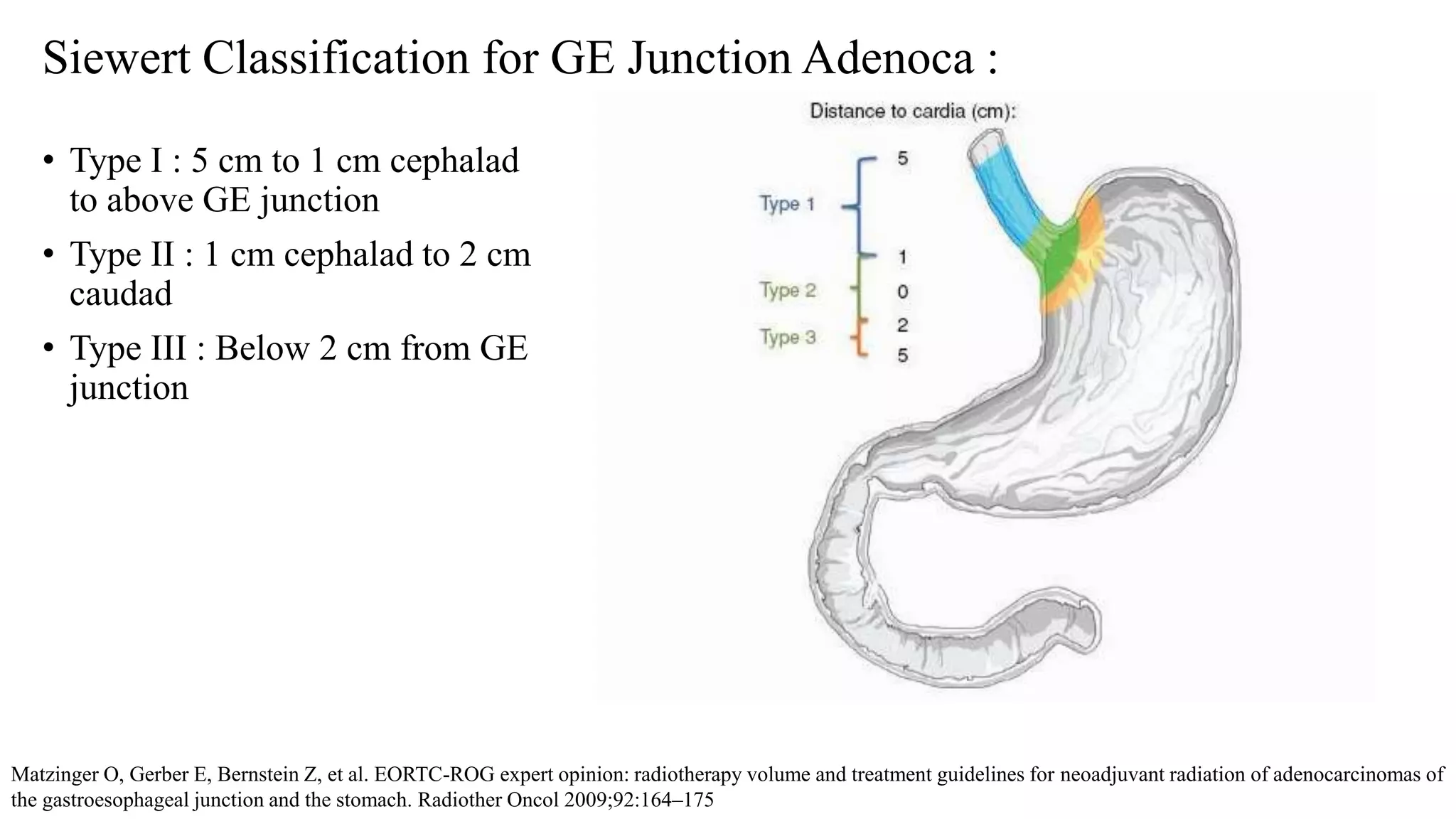
Siewert Classification for GE Junction Adenoca :
• Type I : 5 cm to 1 cm cephalad
to above GE junction
• Type II : 1 cm cephalad to 2 cm
caudad
• Type III : Below 2 cm from GE
junction
Matzinger O, Gerber E, Bernstein Z, et al. EORTC-ROG expert opinion: radiotherapy volume and treatment guidelines for neoadjuvant radiation of adenocarcinomas of
the gastroesophageal junction and the stomach. Radiother Oncol 2009;92:164–175
Evolution of treatment
Non surgical treatment
• Radiation therapy alone
• Combined modality therapy(CT+RT)
• Intensification of the radiation dose
Surgical treatment
• Sx alone
• Sx+adjuvant
• Preop CT + Sx
Surgical options
Conservative Esophagectomy
• Mucosal
Ablation
• Endoscopic
Mucosal
resection
• Transthoracic
• Transhiatal
• Minimally
invasive
Conservative procedures
• Mucosal Ablative techniques
• Photodynamic therapy (PDT)
• Laser ablation
• Multipolar electrocoagulation
• Argon plasma coagulation
• Radiofrequency ablation (RFA)
Pacifico et al, Surg Oncol Clin North Am 2002
• Endoscopic Mucosal Resection (EMR)
• EMR is now considered an essential diagnostic, staging, and therapeutic
option for patients with HGD or superficial disease (T1a).
• Involves either
• (a) a submucosal injection of fluid to lift and separate the lesion from the
underlying muscular layer or
• (b) the use of suction to trap the lesion into a cylinder. This then allows a
full resection and tissue retrieval.
• These results and similar findings in smaller series1 examining EMR confirm
that use of this technique is feasible for the treatment of high-grade dysplasia
and carcinoma limited to the mucosa (T1a) and provides an alternative to
esophagectomy.
1. Nijhawan K et al, Gastrointest Endosc 2000
Conservative procedures
• Criteria for EMR
• Lesions with
• No ulceration
• T1 N0
• No LVI
• <2 cm
• Wd-md
Esophagectomy: Broad Principles
• Depends on
• Site of disease
• Extent of disease involvement
• Co-morbid conditions
• Patient preference
• (May depend on) Histology
• Mainstay of treatment for all resectable disease
• T4b disease is non resectable disease.
• A 5 cm margin cranio-caudally should be obtained to ensure negative final
microscopic margins.
• Thus not performed for cervical esophagus.
• May be performed for primaries of the upper-third thoracic esophagus depending
on location.
• The stomach is considered by the replacement conduit of choice for the resected
esophagus.
Esophagectomy: Broad Principles
• An abdominal and a cervical incision
with blunt mediastinal dissection
through the esophageal hiatus (i.e.
Transhiatal esophagectomy [THE])
• An abdominal and a thoracic incision
(i.e. Transthoracic esophagectomy
[TTE])
Open Esophagectomy
Approaches TTE
McKneown
Approaches TTE
Ivor Lewis
Transhiatal Esophagectomy (THE)
• 2 incisions:
• Upper midline
• Left side of neck (6cms)
• Disadvantages of the transhiatal approach
• Poor visualization of upper and middle
thoracic esophageal tumors
• Increased anastomotic leak rate with
subsequent stricture formation
• Possibility of chylothorax, recurrent
laryngeal nerve injury
Transthoracic Esophagectomy(TTE)
• 2 incisions:
• Upper midline
• Right posterolateral (5th or 6th ICS)
• The greatest advantage of the
transthoracic approach is that it provides
direct visualization and exposure of the
intrathoracic esophagus, allowing wider
dissection to achieve adequate margins
around the primary tumor, and more
thorough lymph node dissection.
• Its disadvantages (reasons for the
emergence of transhiatal approach)
• The combined effects of an abdominal
and thoracic incision may compromise
cardiorespiratory function.
• An intrathoracic anastomotic leak can
lead to mediastinitis and sepsis.
• More perioperative pain
• Longer duration of surgery
Meta analyses comparing TTE and THE
Rindani et al, Aust N Z J Surg 1999
• Other meta analyses have found similar outcomes with both
procedures while showing variable outcomes in terms of
patient morbidity.
• Chemotherapy
• Regimens
• Perioperative / NACT / ACT
• Radiotherapy (with or without chemotherapy)
• Neoadjuvant
• Postoperative
• Definitive
• Palliative
Non-Surgical treatment
Radiotherapy and/or Chemotherapy
Rationale of neo-adjuvant treatment
• Downstage the disease:- Enhances resectability
• Drugs enhances radiosensitivity
• Reduced dissemination of tumor cells during surgery :- Hence reduces distant
metastasis
• Remove microscopic persistent disease
RT alone
• No randomized studies comparing surgery alone with radiation alone,
and radiation therapy alone has been usually delivered when lesions
are deemed inoperable because of tumor extent, medical
contraindications, and/or palliative treatment is indicated
Pre-op RT - Cochrane Review 2005
• Median follow-up 9 years
• Mostly squamous carcinomas
• Hazard ratio (HR) of 0.89 (95% CI 0.78-1.01)
• Overall reduction in the risk of death of 11%
• Absolute survival benefit of 3% at 2 years and
4% at 5 years. (p-0.06)
Post-op RT
• 3 studies
• French
• Hong Kong
• Xiao
• Postoperative radiation therapy may decrease local recurrence,
particularly in the setting of involved margins, although the impact of
this adjuvant treatment on overall survival remains less clear.
• Platinum doublet is preferred over single agents
• Cisplatin plus 5-FU are commonly used combinations
Regimens:
• Paclitaxel and carboplatin
• Cisplatin and 5-FU or capecitabine
• Oxaliplatin and 5-FU or capecitabine
• Paclitaxel or docetaxel and cisplatin
• Carboplatin and 5-FU
• Irinotecan and cisplatin
• Oxaliplatin, docetaxel and capecitabine
• Epirubicin, cisplatin and 5-FU (Only for adenocarcinoma)
Chemotherapy agents
Pre-op Chemotherapy
• 4 RCTs
Study Authors/
Year
Pts
No
HPE/Site Treatment arms Results
US Intergroup
trial/INT 133
Kelsen et al.
1998
440 53% adenoca
47% SCC
3 5FU/Cis -> Sx ->3
5FU/Cis vs. Sx alone
3 yr OS - 26% vs
23%
MRC MRC 2002 802 66% adenoca
31% scc
2 Cis/5FU -> Sx
vs Sx alone
2 yr OS - 43% vs
34%
5 yr OS - 23% vs
17%
MAGIC Cunningham
2008
503 Lower esophag
GEJ
Stomach
3 ECF -> Sx -> 3ECF
vs Sx alone
5 yr OS - 36% vs
23%
(p-0.009)
PFS – (P – 0.001)
FNCLCC/FFCD Ychou
JCO 2011
224 Lower esophag
GEJ
Stomach
2 Cis/5FU -> Sx ->3
5FU/Cis
vs Sx alone
5 yr OS 38% vs 24%
(p – 0.02)
5 yr DFS 34% vs 19%
(p – 0.003)
• N = 503 (Chemotherapy 250, Surgery 253; 26% esophageal tumors)
• Chemotherapy: epirubicin (50 mg) and cisplatin (60 mg/m2) on d1, and a 5FU CI (200 mg/m2/day for 21
days): 3 cycles each pre and post operatively.
• Surgery: 3-6 weeks after NACT/within 6 weeks for controls. ACT was started 6-12 weeks after surgery.
• The primary end point was overall survival.
• ECF-related adverse effects were similar to those previously reported among patients with advanced gastric
cancer. Rates of postoperative complications were similar in both arms (46% and 45% respectively), as was the
postop 1 month mortality. The resected tumors were significantly smaller and less advanced in the
chemotherapy group.
Cunningham et al. N Engl J Med. 2005;355(1):877–89.
MAGIC Trial
• At a median follow-up of 4 years, 149 patients in the chemotherapy group and 170 in the
surgery group had died.
• Adjusted HR for death, 0.74; 95% CI 0.59 to 0.93; p = 0.008
• HR for progression 0.66; 95% CI 0.53 to 0.81; p<0.001)
• 5-year survival 36% vs. 23%
• Limitations:
• Only 42% of patients in the test group completed all protocol treatment.
• 5 year survival data with a median survival of 4 years is questionable.
• Conclusion: Perioperative chemotherapy with a regimen of ECF improves OS
and PFS among patients with resectable adenocarcinoma of the stomach, lower
esophagus, or GE junction, as compared with surgery alone.
Cunningham et al. N Engl J Med. 2005;355(1):877–89.
AUTHOR MEDIAN
FOLLOW
UP
REGIMEN NO OF
PTS
Ro resection/
Dist Met
PATH CR LOCOREG
FAILURE
3-Yr
Survival
SURVIVAL
DIFF
Urba et al 8.2 5fu+cddp+Vbl+RT+S
S
50
50
90 60%
90 65%
28
-
19%
42%
P=0.02
30
16
p=0.15
Boset et al 4.6 Cddp+RT+S
S
143
138
81
69
26
---
34
36
NS
Walsh et al 1.5 5fu+cddp+RT+S
S
58
58
NR
NR
25 32
6
P=0.01
Burmeister et
al
5.4 5fu+cddp+RT+S
S
128
128
80
59
16
---
35
30
NS
Tepper et al
(CALGB
9781)
6.0 5fu+cddp+RT+S
S
30
26
NR
NR
33 13
15
39
16
P=0.008
Pre op CRT f/b Sx vs Sx alone
Cross Trial – Hagen,2012
• Esophagus or esophago-gastric junction
• 368 pts , Median FU -45 mnths
• 5 cycles of neoadjuvant chemoradiotherapy (intravenous
carboplatin [AUC 2 mg/mL per min] and intravenous
paclitaxel [50 mg/m2 of body-surface area]) with
concurrent radiotherapy
• RT - 41·4 Gy, given in 23 fractions of 1·8 Gy
• Median overall survival was 49.4 months in the CRT– Sx
group versus 24.0 months in the Sx group.
• Overall survival was significantly better in the CRT– Sx
group (hazard ratio, 0.657; 95% confidence interval,
0.495 to 0.871; P=0.003).
• Long-term results after a minimum follow-up of 5 years
• OS and PFS benefit were confirmed for both histological subtypes
• LC and distant disease control also improved
CRT f/b Sx Sx alone P value
5-yr OS 58% 33% 0.003
5-yr PFS 44% 27% 0.000217
Cross Trial –updated by Shapiro,2015
Urschel Meta-analysis - 2002
• 9 RCT
• 1116 patients
• Compared with Sx, NA CTRT
• Improved 3 yr OS
• Reduced LRF
• Higher R0 rates
• pCR in 21% pts
• Survival benefit was most
pronounced when CT+RT
were given concurrently
instead of sequentially
Three-year survival (odds ratio 0.66,
95% confidence interval 0.47
to 0.92; P - 0.016).
Rate of complete resection (odds ratio
0.53, 95% confidence interval
0.33 to 0.84; P - 0.007).
• 6 RCTs
• 764 pts
• In resectable oesophageal cancer,
preoperative CRT significantly
improves three year survival
versus surgery alone (NNT=10)
• Reduction in the rate of advanced
oesophageal cancer (stages IIb
and III) was observed in almost
all trials at the time of surgery
(down- staging) (NNT = 5).
Florica Meta-analysis - 2004
OR and CI for the effect of treatment on three year overall mortality
Gebski Meta-analysis 2007, Updated by Sjoquist, 2011
• NA CTRT – 10 trials, 1209 pts
• NA Chemo – 8 trials, 1724 pts
• Updated analysis – 4188 pts
• Local operable oesophageal carcinoma
• Neo adjuvant chemo increases
• Absolute 2 yr survival – 7%
• Absolute 5 yr survival – 4%
• Neo adjuvant CRT increases
• Absolute 2 yr survival – 13%
• Absolute 5 yr survival – 6.5%
Provides strong evidence for a survival benefit of neoadjuvant chemoradiotherapy
or chemotherapy over surgery alone in patients with oesophageal carcinoma.
Clear advantage of neoadjuvant chemoradiotherapy over neoadjuvant
chemotherapy has not been established.
SCC Adenocarcinoma
HR 95% CI P value HR 95% CI P value
CRT 0.80 0.68 – 0.93 0.004 0.75 0.59 – 0.95 0.02
CT 0.92 0.81 – 1.04 0.18 0.83 0.71 – 0.95 0.01
Pre op CRT vs Pre op Chemo
• German Trial , JCO Stahl 2009
• IC + Sx vs IC + CRT + Sx
• locally advanced (uT3-4NXM0) adenocarcinoma of the lower esophagus or gastric cardia
• 46 mnths FU, Study closed prematurely
• Preoperative radiation therapy improved 3-year survival rate from 27.7% to 47.4%
RT alone vs CRT as Definitive Therapy
• RTOG 85-01
• Herskovic 1992, Al sarraf 1997, Cooper 1999
R
A
N
D
O
M
I
S
E
Wk 1
50Gy/25
fractions
Wk 5 Wk 11
CDDP 75mg/m2 Day 1 and 5-FU
1gm/m2 C.I. day 1- 4
CT+RT
RT
Wk 8
64Gy/32 fractions
Comp-
liance
Gr III
toxicity
Gr IV Gr V Local
failure
Dist
failure
Median
and 5yr
survival
CT+RT
(n=61)
54% 44% 20% 3% 43% 22% 12.5 mo,
27%
RT
(n=60)
83% 25% 3% 0 64% 38% 8.9 mo,
0%
P-value Sig Sig Sig Sig Sig Sig
p<0.0001
All patients who received RT alone were dead of disease by 3 years.
Established chemoradiation as the conventional nonsurgical treatment for esophageal cancer
RT dose escalation during Definitive CRT
• RTOG 94-05, INT 0123
• Minsky et al , JCO 2002
• CRT 50.4 Gy vs
• CRT 64.8 Gy (Chemo Cis/5FU x 4
cycles)
• The trial was stopped after an
interim analysis. The median
follow-up was 16.4 months for
all patients and 29.5 months for
patients still alive.
No significant difference in
survival(p=NS)
MS-18 v/s 13 months
2 yr survival—40% v/s 31%
No significant difference in time to first
failure(52% v/s 56%)
(local /regional failure or locoregional
persistance of cancer)
This trial demonstrated that for patients who receive concurrent chemotherapy with radiation, higher
doses of radiation therapy do not offer a local/regional control or survival advantage.
Bedenne FFCD 9102 JCO 2007
• In patients with locally advanced thoracic esophageal cancers, especially SCC,
who respond to chemoradiation, there is no benefit for the addition of surgery after
chemoradiation compared with the continuation of additional chemoradiation
Stahl JCO 2005 , 2008
Conclusion
• Adding surgery to chemoradiotherapy improves local
tumor control but does not increase survival of
patients with locally advanced esophageal SCC.
• Tumor response to induction chemotherapy identifies
a favorable prognostic group within these high-risk
patients, regardless of the treatment group.
Is Surgery after chemoradiation a must?
• Conclusion
Selective surgery after chemoradiation is an evolving concept; effect on ultimate survival
is unclear and the standard remains Neoadjuvant CRT followed by surgery.
Bedenne et al
JCO 2007
Adding surgery to CRT improves local control but does not
increase survival in locally advanced esophageal SCC.
Stahl et al
JCO 2005
Improvement in local controls, but similar 3 year survivals in
esophageal SCCs.
Berger et al, JCO 2005, Rohatgi et al Cancer 2005:
Patients who achieve a pCR had an improvement in survival compared to those who
do not. Surgical resection may not be necessary and has led to the concept of selective
surgery after preoperative chemoradiation.
Indications for Post-op Chemo RT :
• Unfavourable T2 N0
• T3/T4
• LN +ve
• Close/+ve margin
R0 resection Surveillance
R1 resection
Chemoradiation
(if no neoadjuvant therapy)
Observation till progression
or
Chemotherapy + Radiation
R2 resection
Chemoradiation (if not given before)
or
Palliative Management
• For R0 resections, may consider chemotherapy alone as adjuvant treatment if
Node positive.
Postoperative Management - SCC
NCCN 2016
Postoperative Management - Adenocarcinomas
R0 resection
R1 resection
R2 resection
Chemoradiation
or
Palliative Management
N0
N+
Upto T1 Surveillance
> T2
Surveillance
or
Chemotherapy + Radiation
(No neoadjuvant therapy) Chemoradiation
Observation
or
Chemotherapy + Radiation
Observation
or
Chemotherapy + Radiation
NCCN 2016
Radiotherapy Techniques
Radiotherapy
Curative
Dose-
50.4 Gy/28#
41.4 Gy/23#
39 Gy/13#
25 Gy/5#
Conventional
Conformal
• 3 D CRT
• IMRT
• IGRT
• Arc
Respiratory gating
Proton
Palliative
EBRT
Dose-30 Gy/10#
Brachytherapy
12 Gy/#
15 Gy/3#
Techniques of radiation therapy
• External beam radiotherapy
• Important considerations for RT
• Nearby vital structures: spinal cord. lungs, heart
• Movement in target tissue and vital structures: lungs, heart
• Variable density of tissues: lungs
• Dose limitations
• Spinal cord Dmax:45 Gy at 1.8 Gy/fx
• Lung: Limit 70% of both lungs <20 Gy
• Heart: Limit 50% of ventricles <25 Gy
EBRT
• Patient Positioning:
• Cervical and upper thoracic Esophagus: Supine, arms by the side
• Middle and Lower third:
• Supine with arms above their head if AP – PA portals are being planned
• Prone position may be considered if posterior obliques are being included.
Esophagus is pulled anteriorly and spinal cord can be spared.
• Immobilization:
• Vertebral column should be as parallel to couch as possible.
• Image acquisition: Preferably with iv contrast; oral contrast may also be used for better
visualization of the lumen.
• A 3 cm margin proximally and distally would cover microscopic disease in 94% of
all SCCs.
• For GE junction tumors, a 3cm margin proximally and 5cm distally would allow
similar coverage.
• Most contemporary radiation trials used margins of 3 to 5 cm cranially and
caudally on the GTV, along with a 2-2.5cm radial margin.
Gao et al, IJROBP 2007
Treatment Fields
Treatment volume
• The radiation field should include
• the primary tumor
• 5-cm cranial
• 5 cm caudal margins
• 2-cm lateral margins.
Lymph nodes
• The primary local/regional lymph nodes should receive the same dose. For
cervical (proximal) primary tumors (defined as at or proximal to the carina)
the treatment volume includes the bilateral supraclavicular nodes
• GE junction (distal) primaries the celiac axis nodes need to be included.
EBRT – Cervical Esophagus
• 2 anterior obliques and 1 posterior OR
• 2 posterior obliques and 1 anterior field
• AP – PA followed by opposed oblique pair.
• T-shaped AP-PA Field :
• Superior Border: C7
• Inferior Border: T4 (carina)
• 2 cm lateral margins.
• Supraclavivular nodes irradiated electively; can be boosted by
a separate field if required.
EBRT – Middle and Lower Third
• Superior Border: 5 cm proximal to superior extent of disease.
• Inferior Border:
• Middle third - GEJ as visualised by Barium swallow
• Lower third - Coeliac plexus (L1) to be included.
• AP - PA followed by 1 Anterior and 2 Posterior oblique pairs
• 4 Field: AP - PA & opposed laterals – for mid 1/3rd lesions. May
consider prone position.
• AP - PA to deliver 36-44 Gy followed by posterior obliques to reach
the full dose.
Initial phase (39.6-41.4 Gy)
Parallel opposed AP-PA fields
- 5cm prox and distal margins
- 2 cm lateral margins
Off cord Boost: After 40-44Gy
3 field technique -- one direct anterior
and two lateral/ posterior oblique
Advantages
- Homogeneous dose distribution
- Tumor better covered
- Critical organs are out of the field
Current approach
• EBRT using 3D-CRT to a total dose of 50.4 Gy (1.8 Gy per daily
fraction) is standard.
• IMRT is often utilized to minimize exposure to adjacent structures.
• Proton beam in combination with chemotherapy is being explored.
• Targeted biologic agents added to standard cytotoxic chemotherapy is
being explored
Brachytherapy
• Gaspar, 2000
• RTOG 9207
• The cumulative incidence of fistula was 18%/year and the crude incidence was 14%.
• Esophageal fistulas were treatment-related rather than tumor-related of the six treatment-related
fistulas, three were fatal .
• Occurred in the region of the brachytherapy.
• Five of the six patients developing fistulas received 15 Gy brachytherapy dose. (median-3.9 months)
• The other patient received just one fraction of 5 Gy and developed a fistula within 0.5 months.
American Brachytherapy Society Guidelines
• Active length: visible tumor by UGIE + 1 - 2 cm margins both
ways.
• External diameter of applicator must be 6 – 10 mm.
• Dose is prescribed 1 cm from mid source or mid dwell position.
Staging
Upto T1a N0
Upto T4N0
or T3N+
Stage IV
Surgcal
candidate?
Surgical
candidate?Yes
Yes
No
1. EMR
2. Esophagectomy
(?MIE ?Open)
3. Ablative procedures
Early
stage?
Palliative management
• Chemotherapy
• Radiotherapy
• Stenting/dilatation
No
Surgery
Yes
CRT
CRT Surgery
Post op
HPE
Adj if locally
advanced
No
RT
Summary :-
• Stg I – IIIA resectable medically fit :
• Pre-op CRT (Cis/5FU + 50 Gy) f/b Sx
• Definitive CRT (Definitive mngmt for Cervical Oesophagus)
• Sx alone – preferred for non-cervical T1 N0
• Inoperable I – IIIA :
• Definitive CRT (Cis/5FU + 50 Gy) [RTOG 85-01, INT 0123]
• Stg IV Palliative :
• CRT (Cis/5FU + 50 Gy)
• RT alone
• Stenting for obstruction
Site-wise management :
• Cervical Oesophagus SCC :
• Definitive CRT (Cis/5FU + 50 Gy)
• Thoracic Oesophagus SCC/Adenoca:
• Pre op CRT(Cis/5FU + 50 Gy) f/b Sx
• Definitive CRT
• Lower esophagus and GE Junction Adenoca :
• Peri op Chemo with Sx
• Pre op Chemo f/b Sx f/b Post op RT
Thank You

Satyajeet oesophagus management

  • 1.
    Management of Carcinoma Oesophagus By– Dr. Satyajeet Rath Moderator – Prof. Kamal Sahni Date - 24/01/17
  • 2.
  • 3.
    Staging : Squamouscell carcinoma Group T N M Grade 0 Tis (HGD) N0 M0 1, X IA T1 1-2, X IB T1 3 T2 1-2, X IIA T2 3 IIB T3 Any T1-2 N1 IIIA T1-2 N2 T3 N1 T4a N0 IIIB T3 N2 IIIC T4a N1-2 T4b Any Any N3 IV Any Any M1 Staging : Adenocarcinoma
  • 4.
    AJCC 8th Edition,TNM 8 Classification • A tumour the epicenter of which is within 2 cm of the oesophagogastric junction and also extends into the oesophagus is classified and staged using the oesophageal scheme. • Cancers involving the oesophagogastric junction (OGJ) whose epicenter is within the proximal 2 cm of the cardia (Siewert types I/II) are to be staged as oesophageal • The AJCC also publish pathological staging for adenocarcinoma and squamous cell carcinoma Pathological Stage (SCC) Stage 0 Tis N0 M0 Stage IA T1a N0 M0 Stage IB T1b N0 M0 T2 N0 M0 Stage II T3 N0 M0 T1 N1 M0 Stage IIIA T1 N2 M0 T2 N1 M0 Stage IIIB T2 N2 M0 T3 N1, N2 M0 T4a N0, N1 M0 Stage IVA T4a N2 M0 T4b Any N M0 Any T N3 M0 Stage IVB Any T Any N M1 Pathological Stage (Adeno ca) Stage 0 Tis N0 M0 Stage IA T1a N0 M0 Stage IB T1b N0 M0 Stage IIA T2 N0 M0 Stage IIB T1a,T1b N1 M0 Stage IIIA T1 N2 M0 T2 N1 M0 T3, T4a N0 M0 Stage IIIB T2 N2 M0 T3 N1, N2 M0 T4a N1 M0 Stage IVA T4a N2 M0 T4b Any N M0 Any T N3 M0 Stage IVB Any T Any N M1 •
  • 5.
    Siewert Classification forGE Junction Adenoca : • Type I : 5 cm to 1 cm cephalad to above GE junction • Type II : 1 cm cephalad to 2 cm caudad • Type III : Below 2 cm from GE junction Matzinger O, Gerber E, Bernstein Z, et al. EORTC-ROG expert opinion: radiotherapy volume and treatment guidelines for neoadjuvant radiation of adenocarcinomas of the gastroesophageal junction and the stomach. Radiother Oncol 2009;92:164–175
  • 6.
    Evolution of treatment Nonsurgical treatment • Radiation therapy alone • Combined modality therapy(CT+RT) • Intensification of the radiation dose Surgical treatment • Sx alone • Sx+adjuvant • Preop CT + Sx
  • 7.
    Surgical options Conservative Esophagectomy •Mucosal Ablation • Endoscopic Mucosal resection • Transthoracic • Transhiatal • Minimally invasive
  • 8.
    Conservative procedures • MucosalAblative techniques • Photodynamic therapy (PDT) • Laser ablation • Multipolar electrocoagulation • Argon plasma coagulation • Radiofrequency ablation (RFA) Pacifico et al, Surg Oncol Clin North Am 2002
  • 9.
    • Endoscopic MucosalResection (EMR) • EMR is now considered an essential diagnostic, staging, and therapeutic option for patients with HGD or superficial disease (T1a). • Involves either • (a) a submucosal injection of fluid to lift and separate the lesion from the underlying muscular layer or • (b) the use of suction to trap the lesion into a cylinder. This then allows a full resection and tissue retrieval. • These results and similar findings in smaller series1 examining EMR confirm that use of this technique is feasible for the treatment of high-grade dysplasia and carcinoma limited to the mucosa (T1a) and provides an alternative to esophagectomy. 1. Nijhawan K et al, Gastrointest Endosc 2000 Conservative procedures • Criteria for EMR • Lesions with • No ulceration • T1 N0 • No LVI • <2 cm • Wd-md
  • 10.
    Esophagectomy: Broad Principles •Depends on • Site of disease • Extent of disease involvement • Co-morbid conditions • Patient preference • (May depend on) Histology • Mainstay of treatment for all resectable disease • T4b disease is non resectable disease.
  • 11.
    • A 5cm margin cranio-caudally should be obtained to ensure negative final microscopic margins. • Thus not performed for cervical esophagus. • May be performed for primaries of the upper-third thoracic esophagus depending on location. • The stomach is considered by the replacement conduit of choice for the resected esophagus. Esophagectomy: Broad Principles
  • 12.
    • An abdominaland a cervical incision with blunt mediastinal dissection through the esophageal hiatus (i.e. Transhiatal esophagectomy [THE]) • An abdominal and a thoracic incision (i.e. Transthoracic esophagectomy [TTE]) Open Esophagectomy
  • 13.
  • 14.
    Transhiatal Esophagectomy (THE) •2 incisions: • Upper midline • Left side of neck (6cms) • Disadvantages of the transhiatal approach • Poor visualization of upper and middle thoracic esophageal tumors • Increased anastomotic leak rate with subsequent stricture formation • Possibility of chylothorax, recurrent laryngeal nerve injury Transthoracic Esophagectomy(TTE) • 2 incisions: • Upper midline • Right posterolateral (5th or 6th ICS) • The greatest advantage of the transthoracic approach is that it provides direct visualization and exposure of the intrathoracic esophagus, allowing wider dissection to achieve adequate margins around the primary tumor, and more thorough lymph node dissection. • Its disadvantages (reasons for the emergence of transhiatal approach) • The combined effects of an abdominal and thoracic incision may compromise cardiorespiratory function. • An intrathoracic anastomotic leak can lead to mediastinitis and sepsis. • More perioperative pain • Longer duration of surgery
  • 15.
    Meta analyses comparingTTE and THE Rindani et al, Aust N Z J Surg 1999 • Other meta analyses have found similar outcomes with both procedures while showing variable outcomes in terms of patient morbidity.
  • 16.
    • Chemotherapy • Regimens •Perioperative / NACT / ACT • Radiotherapy (with or without chemotherapy) • Neoadjuvant • Postoperative • Definitive • Palliative Non-Surgical treatment Radiotherapy and/or Chemotherapy
  • 17.
    Rationale of neo-adjuvanttreatment • Downstage the disease:- Enhances resectability • Drugs enhances radiosensitivity • Reduced dissemination of tumor cells during surgery :- Hence reduces distant metastasis • Remove microscopic persistent disease
  • 18.
    RT alone • Norandomized studies comparing surgery alone with radiation alone, and radiation therapy alone has been usually delivered when lesions are deemed inoperable because of tumor extent, medical contraindications, and/or palliative treatment is indicated
  • 19.
    Pre-op RT -Cochrane Review 2005 • Median follow-up 9 years • Mostly squamous carcinomas • Hazard ratio (HR) of 0.89 (95% CI 0.78-1.01) • Overall reduction in the risk of death of 11% • Absolute survival benefit of 3% at 2 years and 4% at 5 years. (p-0.06)
  • 20.
    Post-op RT • 3studies • French • Hong Kong • Xiao • Postoperative radiation therapy may decrease local recurrence, particularly in the setting of involved margins, although the impact of this adjuvant treatment on overall survival remains less clear.
  • 21.
    • Platinum doubletis preferred over single agents • Cisplatin plus 5-FU are commonly used combinations Regimens: • Paclitaxel and carboplatin • Cisplatin and 5-FU or capecitabine • Oxaliplatin and 5-FU or capecitabine • Paclitaxel or docetaxel and cisplatin • Carboplatin and 5-FU • Irinotecan and cisplatin • Oxaliplatin, docetaxel and capecitabine • Epirubicin, cisplatin and 5-FU (Only for adenocarcinoma) Chemotherapy agents
  • 22.
    Pre-op Chemotherapy • 4RCTs Study Authors/ Year Pts No HPE/Site Treatment arms Results US Intergroup trial/INT 133 Kelsen et al. 1998 440 53% adenoca 47% SCC 3 5FU/Cis -> Sx ->3 5FU/Cis vs. Sx alone 3 yr OS - 26% vs 23% MRC MRC 2002 802 66% adenoca 31% scc 2 Cis/5FU -> Sx vs Sx alone 2 yr OS - 43% vs 34% 5 yr OS - 23% vs 17% MAGIC Cunningham 2008 503 Lower esophag GEJ Stomach 3 ECF -> Sx -> 3ECF vs Sx alone 5 yr OS - 36% vs 23% (p-0.009) PFS – (P – 0.001) FNCLCC/FFCD Ychou JCO 2011 224 Lower esophag GEJ Stomach 2 Cis/5FU -> Sx ->3 5FU/Cis vs Sx alone 5 yr OS 38% vs 24% (p – 0.02) 5 yr DFS 34% vs 19% (p – 0.003)
  • 23.
    • N =503 (Chemotherapy 250, Surgery 253; 26% esophageal tumors) • Chemotherapy: epirubicin (50 mg) and cisplatin (60 mg/m2) on d1, and a 5FU CI (200 mg/m2/day for 21 days): 3 cycles each pre and post operatively. • Surgery: 3-6 weeks after NACT/within 6 weeks for controls. ACT was started 6-12 weeks after surgery. • The primary end point was overall survival. • ECF-related adverse effects were similar to those previously reported among patients with advanced gastric cancer. Rates of postoperative complications were similar in both arms (46% and 45% respectively), as was the postop 1 month mortality. The resected tumors were significantly smaller and less advanced in the chemotherapy group. Cunningham et al. N Engl J Med. 2005;355(1):877–89. MAGIC Trial
  • 24.
    • At amedian follow-up of 4 years, 149 patients in the chemotherapy group and 170 in the surgery group had died. • Adjusted HR for death, 0.74; 95% CI 0.59 to 0.93; p = 0.008 • HR for progression 0.66; 95% CI 0.53 to 0.81; p<0.001) • 5-year survival 36% vs. 23% • Limitations: • Only 42% of patients in the test group completed all protocol treatment. • 5 year survival data with a median survival of 4 years is questionable. • Conclusion: Perioperative chemotherapy with a regimen of ECF improves OS and PFS among patients with resectable adenocarcinoma of the stomach, lower esophagus, or GE junction, as compared with surgery alone. Cunningham et al. N Engl J Med. 2005;355(1):877–89.
  • 25.
    AUTHOR MEDIAN FOLLOW UP REGIMEN NOOF PTS Ro resection/ Dist Met PATH CR LOCOREG FAILURE 3-Yr Survival SURVIVAL DIFF Urba et al 8.2 5fu+cddp+Vbl+RT+S S 50 50 90 60% 90 65% 28 - 19% 42% P=0.02 30 16 p=0.15 Boset et al 4.6 Cddp+RT+S S 143 138 81 69 26 --- 34 36 NS Walsh et al 1.5 5fu+cddp+RT+S S 58 58 NR NR 25 32 6 P=0.01 Burmeister et al 5.4 5fu+cddp+RT+S S 128 128 80 59 16 --- 35 30 NS Tepper et al (CALGB 9781) 6.0 5fu+cddp+RT+S S 30 26 NR NR 33 13 15 39 16 P=0.008 Pre op CRT f/b Sx vs Sx alone
  • 26.
    Cross Trial –Hagen,2012 • Esophagus or esophago-gastric junction • 368 pts , Median FU -45 mnths • 5 cycles of neoadjuvant chemoradiotherapy (intravenous carboplatin [AUC 2 mg/mL per min] and intravenous paclitaxel [50 mg/m2 of body-surface area]) with concurrent radiotherapy • RT - 41·4 Gy, given in 23 fractions of 1·8 Gy • Median overall survival was 49.4 months in the CRT– Sx group versus 24.0 months in the Sx group. • Overall survival was significantly better in the CRT– Sx group (hazard ratio, 0.657; 95% confidence interval, 0.495 to 0.871; P=0.003).
  • 27.
    • Long-term resultsafter a minimum follow-up of 5 years • OS and PFS benefit were confirmed for both histological subtypes • LC and distant disease control also improved CRT f/b Sx Sx alone P value 5-yr OS 58% 33% 0.003 5-yr PFS 44% 27% 0.000217 Cross Trial –updated by Shapiro,2015
  • 28.
    Urschel Meta-analysis -2002 • 9 RCT • 1116 patients • Compared with Sx, NA CTRT • Improved 3 yr OS • Reduced LRF • Higher R0 rates • pCR in 21% pts • Survival benefit was most pronounced when CT+RT were given concurrently instead of sequentially Three-year survival (odds ratio 0.66, 95% confidence interval 0.47 to 0.92; P - 0.016). Rate of complete resection (odds ratio 0.53, 95% confidence interval 0.33 to 0.84; P - 0.007).
  • 29.
    • 6 RCTs •764 pts • In resectable oesophageal cancer, preoperative CRT significantly improves three year survival versus surgery alone (NNT=10) • Reduction in the rate of advanced oesophageal cancer (stages IIb and III) was observed in almost all trials at the time of surgery (down- staging) (NNT = 5). Florica Meta-analysis - 2004 OR and CI for the effect of treatment on three year overall mortality
  • 30.
    Gebski Meta-analysis 2007,Updated by Sjoquist, 2011 • NA CTRT – 10 trials, 1209 pts • NA Chemo – 8 trials, 1724 pts • Updated analysis – 4188 pts • Local operable oesophageal carcinoma • Neo adjuvant chemo increases • Absolute 2 yr survival – 7% • Absolute 5 yr survival – 4% • Neo adjuvant CRT increases • Absolute 2 yr survival – 13% • Absolute 5 yr survival – 6.5%
  • 32.
    Provides strong evidencefor a survival benefit of neoadjuvant chemoradiotherapy or chemotherapy over surgery alone in patients with oesophageal carcinoma. Clear advantage of neoadjuvant chemoradiotherapy over neoadjuvant chemotherapy has not been established. SCC Adenocarcinoma HR 95% CI P value HR 95% CI P value CRT 0.80 0.68 – 0.93 0.004 0.75 0.59 – 0.95 0.02 CT 0.92 0.81 – 1.04 0.18 0.83 0.71 – 0.95 0.01
  • 33.
    Pre op CRTvs Pre op Chemo • German Trial , JCO Stahl 2009 • IC + Sx vs IC + CRT + Sx • locally advanced (uT3-4NXM0) adenocarcinoma of the lower esophagus or gastric cardia • 46 mnths FU, Study closed prematurely • Preoperative radiation therapy improved 3-year survival rate from 27.7% to 47.4%
  • 34.
    RT alone vsCRT as Definitive Therapy • RTOG 85-01 • Herskovic 1992, Al sarraf 1997, Cooper 1999 R A N D O M I S E Wk 1 50Gy/25 fractions Wk 5 Wk 11 CDDP 75mg/m2 Day 1 and 5-FU 1gm/m2 C.I. day 1- 4 CT+RT RT Wk 8 64Gy/32 fractions
  • 35.
    Comp- liance Gr III toxicity Gr IVGr V Local failure Dist failure Median and 5yr survival CT+RT (n=61) 54% 44% 20% 3% 43% 22% 12.5 mo, 27% RT (n=60) 83% 25% 3% 0 64% 38% 8.9 mo, 0% P-value Sig Sig Sig Sig Sig Sig p<0.0001 All patients who received RT alone were dead of disease by 3 years. Established chemoradiation as the conventional nonsurgical treatment for esophageal cancer
  • 36.
    RT dose escalationduring Definitive CRT • RTOG 94-05, INT 0123 • Minsky et al , JCO 2002 • CRT 50.4 Gy vs • CRT 64.8 Gy (Chemo Cis/5FU x 4 cycles) • The trial was stopped after an interim analysis. The median follow-up was 16.4 months for all patients and 29.5 months for patients still alive.
  • 37.
    No significant differencein survival(p=NS) MS-18 v/s 13 months 2 yr survival—40% v/s 31% No significant difference in time to first failure(52% v/s 56%) (local /regional failure or locoregional persistance of cancer) This trial demonstrated that for patients who receive concurrent chemotherapy with radiation, higher doses of radiation therapy do not offer a local/regional control or survival advantage.
  • 38.
    Bedenne FFCD 9102JCO 2007 • In patients with locally advanced thoracic esophageal cancers, especially SCC, who respond to chemoradiation, there is no benefit for the addition of surgery after chemoradiation compared with the continuation of additional chemoradiation
  • 39.
    Stahl JCO 2005, 2008 Conclusion • Adding surgery to chemoradiotherapy improves local tumor control but does not increase survival of patients with locally advanced esophageal SCC. • Tumor response to induction chemotherapy identifies a favorable prognostic group within these high-risk patients, regardless of the treatment group.
  • 41.
    Is Surgery afterchemoradiation a must? • Conclusion Selective surgery after chemoradiation is an evolving concept; effect on ultimate survival is unclear and the standard remains Neoadjuvant CRT followed by surgery. Bedenne et al JCO 2007 Adding surgery to CRT improves local control but does not increase survival in locally advanced esophageal SCC. Stahl et al JCO 2005 Improvement in local controls, but similar 3 year survivals in esophageal SCCs. Berger et al, JCO 2005, Rohatgi et al Cancer 2005: Patients who achieve a pCR had an improvement in survival compared to those who do not. Surgical resection may not be necessary and has led to the concept of selective surgery after preoperative chemoradiation.
  • 42.
    Indications for Post-opChemo RT : • Unfavourable T2 N0 • T3/T4 • LN +ve • Close/+ve margin
  • 43.
    R0 resection Surveillance R1resection Chemoradiation (if no neoadjuvant therapy) Observation till progression or Chemotherapy + Radiation R2 resection Chemoradiation (if not given before) or Palliative Management • For R0 resections, may consider chemotherapy alone as adjuvant treatment if Node positive. Postoperative Management - SCC NCCN 2016
  • 44.
    Postoperative Management -Adenocarcinomas R0 resection R1 resection R2 resection Chemoradiation or Palliative Management N0 N+ Upto T1 Surveillance > T2 Surveillance or Chemotherapy + Radiation (No neoadjuvant therapy) Chemoradiation Observation or Chemotherapy + Radiation Observation or Chemotherapy + Radiation NCCN 2016
  • 45.
  • 46.
    Radiotherapy Curative Dose- 50.4 Gy/28# 41.4 Gy/23# 39Gy/13# 25 Gy/5# Conventional Conformal • 3 D CRT • IMRT • IGRT • Arc Respiratory gating Proton Palliative EBRT Dose-30 Gy/10# Brachytherapy 12 Gy/# 15 Gy/3#
  • 47.
    Techniques of radiationtherapy • External beam radiotherapy • Important considerations for RT • Nearby vital structures: spinal cord. lungs, heart • Movement in target tissue and vital structures: lungs, heart • Variable density of tissues: lungs • Dose limitations • Spinal cord Dmax:45 Gy at 1.8 Gy/fx • Lung: Limit 70% of both lungs <20 Gy • Heart: Limit 50% of ventricles <25 Gy
  • 48.
    EBRT • Patient Positioning: •Cervical and upper thoracic Esophagus: Supine, arms by the side • Middle and Lower third: • Supine with arms above their head if AP – PA portals are being planned • Prone position may be considered if posterior obliques are being included. Esophagus is pulled anteriorly and spinal cord can be spared. • Immobilization: • Vertebral column should be as parallel to couch as possible. • Image acquisition: Preferably with iv contrast; oral contrast may also be used for better visualization of the lumen.
  • 49.
    • A 3cm margin proximally and distally would cover microscopic disease in 94% of all SCCs. • For GE junction tumors, a 3cm margin proximally and 5cm distally would allow similar coverage. • Most contemporary radiation trials used margins of 3 to 5 cm cranially and caudally on the GTV, along with a 2-2.5cm radial margin. Gao et al, IJROBP 2007 Treatment Fields
  • 50.
    Treatment volume • Theradiation field should include • the primary tumor • 5-cm cranial • 5 cm caudal margins • 2-cm lateral margins. Lymph nodes • The primary local/regional lymph nodes should receive the same dose. For cervical (proximal) primary tumors (defined as at or proximal to the carina) the treatment volume includes the bilateral supraclavicular nodes • GE junction (distal) primaries the celiac axis nodes need to be included.
  • 52.
    EBRT – CervicalEsophagus • 2 anterior obliques and 1 posterior OR • 2 posterior obliques and 1 anterior field • AP – PA followed by opposed oblique pair. • T-shaped AP-PA Field : • Superior Border: C7 • Inferior Border: T4 (carina) • 2 cm lateral margins. • Supraclavivular nodes irradiated electively; can be boosted by a separate field if required.
  • 53.
    EBRT – Middleand Lower Third • Superior Border: 5 cm proximal to superior extent of disease. • Inferior Border: • Middle third - GEJ as visualised by Barium swallow • Lower third - Coeliac plexus (L1) to be included. • AP - PA followed by 1 Anterior and 2 Posterior oblique pairs • 4 Field: AP - PA & opposed laterals – for mid 1/3rd lesions. May consider prone position. • AP - PA to deliver 36-44 Gy followed by posterior obliques to reach the full dose. Initial phase (39.6-41.4 Gy) Parallel opposed AP-PA fields - 5cm prox and distal margins - 2 cm lateral margins Off cord Boost: After 40-44Gy 3 field technique -- one direct anterior and two lateral/ posterior oblique Advantages - Homogeneous dose distribution - Tumor better covered - Critical organs are out of the field
  • 55.
    Current approach • EBRTusing 3D-CRT to a total dose of 50.4 Gy (1.8 Gy per daily fraction) is standard. • IMRT is often utilized to minimize exposure to adjacent structures. • Proton beam in combination with chemotherapy is being explored. • Targeted biologic agents added to standard cytotoxic chemotherapy is being explored
  • 56.
    Brachytherapy • Gaspar, 2000 •RTOG 9207 • The cumulative incidence of fistula was 18%/year and the crude incidence was 14%. • Esophageal fistulas were treatment-related rather than tumor-related of the six treatment-related fistulas, three were fatal . • Occurred in the region of the brachytherapy. • Five of the six patients developing fistulas received 15 Gy brachytherapy dose. (median-3.9 months) • The other patient received just one fraction of 5 Gy and developed a fistula within 0.5 months.
  • 57.
    American Brachytherapy SocietyGuidelines • Active length: visible tumor by UGIE + 1 - 2 cm margins both ways. • External diameter of applicator must be 6 – 10 mm. • Dose is prescribed 1 cm from mid source or mid dwell position.
  • 58.
    Staging Upto T1a N0 UptoT4N0 or T3N+ Stage IV Surgcal candidate? Surgical candidate?Yes Yes No 1. EMR 2. Esophagectomy (?MIE ?Open) 3. Ablative procedures Early stage? Palliative management • Chemotherapy • Radiotherapy • Stenting/dilatation No Surgery Yes CRT CRT Surgery Post op HPE Adj if locally advanced No RT
  • 59.
    Summary :- • StgI – IIIA resectable medically fit : • Pre-op CRT (Cis/5FU + 50 Gy) f/b Sx • Definitive CRT (Definitive mngmt for Cervical Oesophagus) • Sx alone – preferred for non-cervical T1 N0 • Inoperable I – IIIA : • Definitive CRT (Cis/5FU + 50 Gy) [RTOG 85-01, INT 0123] • Stg IV Palliative : • CRT (Cis/5FU + 50 Gy) • RT alone • Stenting for obstruction
  • 60.
    Site-wise management : •Cervical Oesophagus SCC : • Definitive CRT (Cis/5FU + 50 Gy) • Thoracic Oesophagus SCC/Adenoca: • Pre op CRT(Cis/5FU + 50 Gy) f/b Sx • Definitive CRT • Lower esophagus and GE Junction Adenoca : • Peri op Chemo with Sx • Pre op Chemo f/b Sx f/b Post op RT
  • 61.

Editor's Notes

  • #9 Pacifico RJ, Want KK. Nonsurgical management of Barrett’s esophagus with high-grade dysplasia. Surg Oncol Clin North Am 2002;11:321–336.
  • #10 Nijhawan K, Wang KK. Endoscopic mucosal resection for lesions with endoscopic features suggestive of malignancy and high-grade dysplasia within Barrett’s esophagus. Gastrointest Endosc 2000;52:328–332
  • #11 T4a: Pleura, Pericardium and Diaphragm
  • #16 Rindani R, Martin CJ, Cox MR. Transhiatal versus Ivor-Lewis oesophagectomy: is there a difference? Aust N Z J Surg 1999;69:187–194
  • #42 Bedenne L, Michel P, Bouche O, et al. Chemoradiation followed by surgery compared to chemoradiation alone in squamous cancer of the esophagus: FFCD 9102. J Clin Oncol 2007;25:1160–1168. Stahl M, Stuschke M, Lehmann N, et al. Chemoradiation with and without surgery in patients with locally advanced squamous cell carcinoma of the esophagus. J Clin Oncol 2005;23:2310–2317. Berger AC, Farma J, Scott WJ, et al. Complete response to neoadjuvant chemoradiotherapy in esophageal carcinoma is associated with significantly improved survival. J Clin Oncol 2005;23:4330–4337. Rohatgi R, Swisher SG, Correa AM, et al. Histologic subtypes as determinants of outcome in esophageal carcinoma patients with pathologic complete response after preoperative chemoradiotherapy. Cancer 2005;106:552–558.
  • #50 Gao XS, Qiao X, Wu F, et al. Pathological analysis of clinical target volume margin for radiotherapy in patients with esophageal and gastroesophageal junction carcinoma. Int J Radiat Oncol Biol Phys 2007;67:389–396.
  • #53 For cervical primaries, patients are placed supine. Various field designs are possible and their choice depends on the geometry of the primary tumor in relation to the spinal cord. The ideal design is a three-field technique (two anterior obliques and a posterior). However, since the primary tumor is rarely limited to the midline, the most common approach is anteroposterior (AP)/posteroanterior (PA) to 39.6 to 41.4 Gy (Fig. 36-3) followed by a left or right opposed oblique pair with photons to 50.4 Gy (Fig. 36-4A-C). Since this technique will exclude the ipsilateral supraclavicular fossa, a separate electron field is added (commonly to a depth of 2 to 3 cm depending on the patient's anatomy) thereby bringing the total dose to 50.4 Gy. For cervical primaries, patients are placed supine. Various field designs are possible and their choice depends on the geometry of the primary tumor in relation to the spinal cord. The ideal design is a three-field technique (two anterior obliques and a posterior). However, since the primary tumor is rarely limited to the midline, the most common approach is anteroposterior (AP)/posteroanterior (PA) to 39.6 to 41.4 Gy (Fig. 36-3) followed by a left or right opposed oblique pair with photons to 50.4 Gy (Fig. 36-4A-C). Since this technique will exclude the ipsilateral supraclavicular fossa, a separate electron field is added (commonly to a depth of 2 to 3 cm depending on the patient's anatomy) thereby bringing the total dose to 50.4 Gy.