Ca penis
Edmond Wong


              1
Ca Penis
•   Epidemiology
•   Risk factor
•   Pathology
•   Premalignant lesion & Mx
•   Investigation and dx
•   Staging
•   Mx of local tumor according to stage
•   Mx of LN
•   Metastasis

                                           2
Epidemiology
• What is the incidence of Ca penis?
  – 1 case per 100 000
  – ~ 0.5 % of all malignancies Western World (decreasing)
  – Higher incidence in South America (Brazil), East Africa
    and South East Asia (10% of all male malignancy)
  – SEER database: no racial difference between black
    and white in US
  – But poor prognostic factor if African American
    ethnicity (Rippentrop et al, 2004)
  – Overall incidence is decreasing


                                              3
Risk factors
• What are the risk factors?
   1. Smoking
   2. UV radiation
   3. Foreskin: phimosis , poor hygiene
       • neonatal circumcision eliminate risk by 5x [Daling 2005]
       • But not circumcision in adult (Maden 1993)
   4. HPV infection (16, 18): asso in 50%
       •   Sexual transmission causing genital warts, condyloma acuminate
       •   HPV infects the basal epithelial cell that proliferates
       •   Daling (2005) HPV DNA was detected in 80 % of tumor specimens
       •   Carcinogenesis : interfering with p53 & pRB
       •   Role in prognosis is unclear
       •   Verrucous carcinoma is not related to HPV infection
   5. Penile trauma
• Prognostic makers:
   – p53, SCC antigen, P16, Ki-67m E-cadherin and MMP-2

                                                          4
Pathology
•    SCC (95%)
    1.   Usual type (60-70%)
    2.   Papillary (7%)
    3.   Condylomatous (7%)
    4.   Verrucous (7%)
    5.   Basaloid (4%)
    6.   Sarcomatoid (4%)
•    Malignant Melanoma (2%)
•    Basal cell carcinoma (2%)
•    Extra-mammary Paget’s disease (adenoCa from penile
     skin)
•    Sarcoma

                                         5
What are the growth patterns and
differentiation grading systems?


                        6
What is Broders’ & Maiche
                 classification?
• Broders’ grading :Divided into 4 grade (1921)
   – Define the level of differentiation based on
       •   Keratinization
       •   Nuclear pleomorphism
       •   Number of mitosis
       •   + other factors
   – 80 % of the Ca penis is low grade lesion ( Gd 1 and 2 )
   – 20% Gd 3 and 4
• Maiche grading : divided into 3 grade Maiche          1991
   – Correlate with 5 year survival
      Grade 1          80%
      Grade 2,3         50%
      Grade 4          30%

                                                    7
What is the distribution of Ca
             penis?
• Glans (50%)
• Prepuce (21%)
  – May be related to constant exposure to
    irritants within the prepuce
• Glans and prepuce (9%)
• Coronal sulcus (6%)
• Shaft (less than 2%)

                                     8
Risk factor for metastasis
1. Growth pattern (Cubilla 1993)
  – Superficiallly spreading, LN met in 42%
  – Vertical growth, LN met in 82%
1. Basaloid and sarcomatous histologic
   pattern [MSKCC review (Cubilla 2001)]
2. Stage
3. Grade
4. Status of vascular invasion (Slaton 2001)
                                     9
How do they present ?
Presentation:
• a sore that has failed to heal
• a subtle induration in the skin, to a large exophytic growth.
• a phimosis may obscures the tumor and allows it to grow undetected.
• Rarely, a mass, ulceration, suppuration, or hemorrhage may manifest in the
   inguinal area because of nodal metastases.
• Pain is infrequent.
•   Buck fascia, which surrounds the corpora, acts as a temporary barrier.
•   Eventually, the cancer penetrates the Buck fascia and the tunica albuginea,
    where the cancer has access to the vasculature and systemic spread is
    possible
•   Delay presentation (50%) due to
     – Embarrassment, guilt, fear, ignorance, and neglect
     – Self treatment with various skin creams and lotions.
     – Doctor: confuse with other benign penile lesions
• Metastasis :
     – Dehydration : hypecalcemia in 20% on presentation (PTH like) [MSKCC]
     – SOB

                                                              10
Natural History
• Begins as small lesion, papillary & exophytic or
  flat & ulcerative.
• Flat & ulcerative lesions >5cm and extending
  >75% of the shaft have higher incidence of
  metastasis and poor survival.
• Pattern in lymphatic spread.
• Metastatic nodes cause erosion into vessels,
  skin necrosis & chronic infection.
• Distant metastasis uncommon 1 – 10%
• Death within 2 years for most untreated cases.


                                       11
Premalignant lesions


                 12
What are the benign penile lesion?
• Non cutaneous:
  –   Congenital and acquire inclusion cyst
  –   Retention cyst
  –   Angioma , lipoma
  –   Pyogenic granuloma
  –   Peyronies plaque
• Cutaneous:
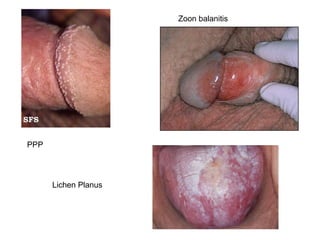
  – Pearly Penile papules (PPP)
       •   White, dome-shaped, closely spaced small papules at glans penis
       •   Arranged circumferentially at corona
       •   Histology : angiofibromas similar to lesion TS
       •   25% of young adults (uncircumcised)
       •   NO association with HPV infection/ cervical CIN
       •   Mx: Reassurance
       •   Local destruction: CO2 laser, cryotherapy
  – Zoon balanitis: shinny , erythematous plaque on glans or prepuce
  – Lichen Planus :flat-topped violacious papule
                                                          13
Zoon balanitis


PPP


      Lichen Planus


                                       14
Viral related lesions
1. Condyloma Acuminatum:
   –   Genital warts related to HPV infection (16,18)
   –   Asso with SCC
   –   Soft, multiple lesion on glans, prepuce and shaft
   –   Dx: biopsy
   –   Txn: popdophyllin , diathermy if urethral involvement
2. Bowenoid papulosis:
   –   Resemble CIS , but with benign course
   –   Muliple papules or flat glanular lesion
   –   Dx: bx
3. Kaposi’s sarcoma :
   –   2nd commonest penile tumor, reticulo-epithelial tumor
   –   Raised , painful , bleeding, violacious papule urethral obstruction
   –   Or bluish ulcer with local edema
   –   Asso with HIV infection
   –   Txn: palliative , intralesional chemo ,
   –   laser or cryo-ablation, RT


                                                               15
What are the premalignant lesions?


                         16
•       Cutaneous horn:
    –      extreme hyperkeratosis with base malignant txn with wide local excision

•       Pseudo-epitheliomatous micaceous and keratotic balanitis (PEMKB)
    –      Unusual hyperkeratotic gorwth of the glans
    –      Txn: Excision , may recur

•       Leukoplakia:
    –      Whitish glanular plaque involve meatus
    –      Asso with CIS
    –      Txn: Excision and FU

•       Bowenoid papulosis have high risk of progression to SCC (90% long
        term)

•       Giant condyloma acuminata or Buschke-Löwenstein tumor
    –      Displaces, invades, and destroys adjacent structures by compression,
           whereas the standard condyloma remains superficial and never invades
    –      Does not metastasis
    –      Treat with excision and recurrence is common

                                                              17
Premalignant lesion: CIS
•   Erythroplasia of Queyrat: [non keratinising CIS]
    – CIS: as oppose to Bowen’s disease, occur in glans or inner part of prepuce
    – Red velvety circumscribed painless lesion , may ulcerate and painful
    – Histology:
        •   Atypical hyperplastic mucosal cell with malignant features
        •   Hyperchromatic nuclei & multi-level mitotic figures
        •   Submucosa : proliferation of capillaries & inflammatory infiltrate of plasma cell
    – 10x more likely to progress then Bowen’s disease
    – Treatment
    – Penile preserving:
        •   Topical 5-FU or imiquimod
             – 5-FU: block DNA synthesis (structure similar to thymine) SE: erythema , weeping
             – 5% Imiquimod (imidazoguinonin tetracyclicamine): induce IF-alfa
        •   Laser (CO2) , photodynamic therapy , cryotherapy , Mohs MS
        •   If affect large area or recurrence: Total glans resurfacing + skin graft + deep biopsy
    – High risk of local recurrence in penile preserving txn

•   Bowen’s disease: [Keratinising CIS ]
    – CIS in the genital and perineal skin
    – Txn : WLE , laser, cryoablation
                                                                            18
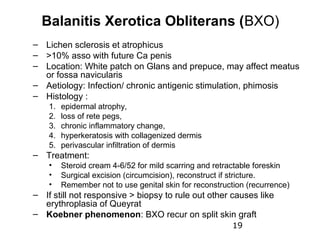
Balanitis Xerotica Obliterans (BXO)
– Lichen sclerosis et atrophicus
– >10% asso with future Ca penis
– Location: White patch on Glans and prepuce, may affect meatus
  or fossa navicularis
– Aetiology: Infection/ chronic antigenic stimulation, phimosis
– Histology :
    1.   epidermal atrophy,
    2.   loss of rete pegs,
    3.   chronic inflammatory change,
    4.   hyperkeratosis with collagenized dermis
    5.   perivascular infiltration of dermis
– Treatment:
    •    Steroid cream 4-6/52 for mild scarring and retractable foreskin
    •    Surgical excision (circumcision), reconstruct if stricture.
    •    Remember not to use genital skin for reconstruction (recurrence)
– If still not responsive > biopsy to rule out other causes like
  erythroplasia of Queyrat
– Koebner phenomenon: BXO recur on split skin graft
                                                         19
Circumcision
• Consent:
  –   Bleeding (2%)
  –   Infection (2%)
  –   Altered sensitivity of glans
  –   Meatal stenosis (10%)
  –   Need of further bx of suspicious lesion
  –   Unsatisfactory cosmetic result (4%)
• Procedure:
  –   Penile block
  –   Midline dorsal slit
  –   Inspect meatus (no hypospadias) & look for lesion
  –   Circumcoronal incision of inner prepuce and outer skin
  –   Meticulous hemostasis (bipolar diathermy)
  –   Skin closed with interrupted undyed absorbable suture

                                                     20
Q14


      Diagnosis? EPQ
      Premalignant? Yes
      If occurs on the shaft, what is it called? Bowens disease
                                                           21
Diagnostic schedule for penile
           cancer


                       22
What is diagnostic schedule for
        penile cancer?


                        23
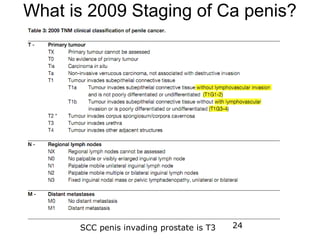
What is 2009 Staging of Ca penis?


      SCC penis invading prostate is T3   24
What is the shortcoming of the
              staging?
• Prognosis of patients with tumour invasion of the
  corpus spongiosum is much better than invasion
  of the corpus cavernosum in terms of local
  recurrence and mortality
  – Rees et al
• Authors proposed defining
  – T2a patients by spongiosum-only invasion
  – T2b patients by involvement of tunica or corpus
    cavernosum
• No differences in long-term survival between T2
  and T3
• No differences between N1 and N2
                                           25
What is the proposed modification to 2009 TNM
                classification?


                                    26
Jackson’s staging system,
         1966.


                    27
Case:
•   Patient present with a penile mass
•   Painless
•   Not affecting urination
•   P/E:
    – 1.5cm solid growth at glans of penis
    – 1cm Right groin LN
• What is your approach?

                                       28
History
•   Age
•   Previous duration of phimosis
•   LUTS
•   Smoking history
•   Sexual history: HPV infection
•   Exposure to UV radiation


                                    29
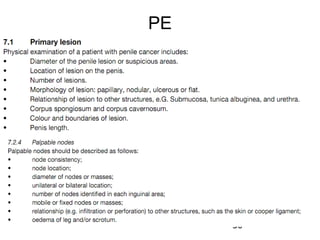
PE


     30
Penile biopsy
• The most important diagnostic test
• Circumcision and excisional biopsy if the cancer
  is small
• Incisional biopsy should contain tissue beneath
  and beside the tumor in order to help stage the
  disease
  –   Confirm histological diagnosis
  –   Determine the depth of invasion
  –   Detect the presence of vascular invasion
  –   Evaluate the grading of the tumour ( Broders’
      classification )                        31
How would you stage the
Local staging
                tumor?
1. USG, 7.5 MHz
   – Tumor appear as hypoechoic
   – Adv : detect corpus cavernosal invasion with sensitivity of 100 %
   – Disadv: Could not differentiate Ta from T1
2. MRI penis with intracavernosal prostaglandin
   – Accurate in demonstrating invasion of the corpora,
     and the extent of the cancer
3. CT:
   – Not useful in local tumour staging because of poor
     soft tissue resolution
   – For LN status

                                                    32
LNs staging


              33
What is the lymphatic drainage
            of penis?
• First to the inguinal LN and then to the pelvic LN
• Bilateral drainage of the penis to the LN
• The inguinal LN
  – Superficial group that lie deep to the Scarpa’s fascia
    but superficial to the fascia lata (8-25 LNs)
  – The deep group (deep to the fascia lata) is a smaller
    group that lie around the junction of the long
    saphenous and femoral veins
• The commonest detected group of LN which
  include the LN of cloquet lies cranimedial to the
  junction between the long saphenous and
  femoral veins
                                             34
What is the accuracy of P/E of
       lymadenopathy?
• High (90%) sensitivity but a low specificity (20%)
  of clinical examination detecting pathologically
  positive inguinal lymphadenopathy
• 50% of patients with penile cancer will have
  clinically palpable inguinal LN at presentation
• 50% of patients with pathologically positive
  unilateral inguinal LN will have contralateral
  metastatic disease


                                       35
What is the imaging
        investigation for LN?
• CT / MRI
  – Predict LN involvement by size only
  – Sensitivity : 35 %, specificity : 100 %
• Strongest predictor for survival is the
  presence or absence of nodal metastases


                                        36
Treatment strategies for penile
           cancer


                       37
38
What are options of organ
             preserving therapy?
• Circumcision
   – Small tumors confined to the prepuce
   – But with recurrence 40%
• Local wedge excision
   – Margin of 5 mm
   – 50% recurrence rate
• Glansectomy : T1 (not involving the CC)
   – Tourniquet control
   – subcoronal incision down to Buck’s fascia
   – proximal margin at least 5mm
   – the glans cap is mobilized off the head of the corpora cavernosa
   – Urethra is transected and split and fixed
   – Shaft skin is anchored to the new corona
   – Raw surface is covered with partial thickness skin graft
   – T1G3 - lowest recurrence rate of 2%

                                                      39
What is organ preserving therapy?
• Mohs micrographic surgery (MMS)
   – “ shaving “ the tumour mass by excising thin layers of tissue and
     examining them microscopically till clear deep resection margin is
     confirmed by frozen section
   – Adv :
       • With a surgeon experienced in MMS, it is able to remove the cancerous
         tissue while preserving normal structures
   – Disadv :
       • Messy and bloody and time consuming
       • Required expert technique
       • Experienced pathologist is needed to confirm clear margin by frozen
         section
       • Wound may healed with scarring result in disfiguration
       • Urethra is sometime involved and required urethroplasty
       • Recurrence rate was high at 30%


                                                             40
What is organ preserving therapy?
•    Laser surgery
    –   For local and limited invasive disease
    –   Four types of lasers have been used
        1.   Carbon dioxide
        2.   Neodymium:yttrium-aluminum-garnet (ND:YAG)
        3.   Argon
        4.   Potassium-titanyl-phosphate (KTP) lasers
    –   The carbon dioxide laser
        •    vaporizes tissue
        •    penetrates only to a depth of 1mm
        •    coagulate blood vessels less than 0.5 mm
    –   The ND:YAG laser
        •    penetrate 5 mm depending on the power
        •    Can coagulate vessels up to 5 mm
    –   The argon and KTP lasers have less tissue penetration than the
        carbon dioxide laser and are rarely used
    –   Result : 7% recurrence in 4yr FU [Frimberger 2002]
                                                          41
What are the problems of
      conservative treatment?
• Not be suitable in cases of multifocal
  lesions
• Mohs’ micrographic surgery,
  photodynamic and topical therapy with 5-
  fluorouracil ( 5-FU) or 5% imiquimod
  cream have been reported for superficial
  lesions with relatively high recurrence rate
• Best results are achieved with laser
  surgery
                                     42
What is Partial penectomy?
•   When the cancer involves the glans and distal shaft
•   T1a to T2 (not for T3 !!!!)
•   Traditionally, partial amputation has required removal of 2-cm tumour-free
    margins, to lower risk of local recurrence T (50% reduced to 6%)
•   Pathological confirmation a surgical margin of 5-10 mm is safe
•   Frozen sections at the time of surgery are often helpful, and a careful review
    of the specimen and permanent sections with the pathologist help to
    determine if the resection has been adequate
•   If margin + ve: local recurrence in 10%
•   Patient should be counsell about poor cosmetic and functional result
     – He will need to sit to void
     – He cannot have sexual intercourse
•   If surgical resection by either wedge or partial penectomy does not provide an
    adequate margin, a total penectomy should be considered
•   If the amount of residual penis and urethra is inadequate to allow the patient
    to urinate while standing, a perineal urethrostomy can be performed
•   Berry suggested to have 3cm penile functioning length and 2cm clear margin before
    consideration of partial penectomy
•   Recurrence of partial or total penectomy: 0-8%
                                                                   43
How to perform partial
              penectomy?
• Tourniquet control, cover tumor with glove finger
• Deglove the penis
• Mark the extent of tumor free margin
• Mobolise the neurovascular bundle and ligated
• Mobolise the urethra
• Send the proximal margin for frozen-section
• Oversew the corpora and Buck’s fascia and cover the corpora
  with penile skin or skin graft
• Spatulate the urethra, creation of neoglan with split skin graft
• Further lengthening can be achieved by dividing suspensory
  ligament +/- full thickness SG
• Foley to BSB


                                                  44
What is total Penectomy ?
• Total amputation of penis + excision of
  scrotum and its content
• Formation of perineal urethrostomy
• Complication:
  – Urethral meatal stenosis


                                  45
• CIS, Ta-1 G1-2 (i.e T1a)
   – Penis-preserving strategy for those guarantee regular FU (70%)
       • local excision + reconstructive syrgery / glansectomy (depend on
         size and location of tumor)
       • Laser , cryoablation, RT & brachytherapy
       • Moh’s MS or photodynamic therapy for (CIS, TaG1)
       • Local 5-FU (for CIS only)
   – No difference in local recurrence rate between micrographic
     surgery, EBRT, insterstitial brachy and laser
   – Overall recurrence 15-20%
   – Partial amputation for those who don’t comply with regular FU.

• T1b G3, T2 (glans only)
   – V. carefully selected patients with tumour less than half of glans
     & close FU can be carried out → conservative strategy
   – Glansectomy +/- Tip amputation or reconstruction
   – Margin 3mm is consider safe


                                                          46
• T2 (invasion to copora)
   – Partial amputation
   – Margin 5-10mm
   – If no LN on presenstation  5yr survival 66%

• T3 (invasion to urethra)
   – Total amputation with perineal urethrostomy

• T4 (invasion to other structure)
   – Neo-adj chemo + surgery in responsive patient (selected)
   – Others: RT

• Local disease recurrence
   – 2nd conservative procedure if < T2
   – If large or deep infiltrating recurrence → partial / total amputation
   – External beam radiotherapy / brachytherapy for lesions < 4cm diameter

                                                        47
What are treatment strategies
     for penile cancer?


                      48
What are treatment strategies
     for penile cancer?


                      49
RT?
•    Indications:
    1. Organ-preserving treatment in young pt with T1-2 lesions < 4 cm
         – EBRT: Response rate: 50% Local failure rate: 40%
         – Brachytherapy: response rate 70%, failure 16%.
    2. Alternative to chemo + surgery in T4 diseas
    3. Those who have metastatic disease and need some form of palliative therapy

•    Procedure:
    –   High dose: 60cGy during 3 weeks
    –   Circumcision prior to initiating radiation therapy
        •   Prepuce will fuse with the glan
        •   Allows better evaluation of the tumor stage
        •   Minimizes the morbidity associated with the therapy, includes swelling,
            irritation, moist desquamation, phimosis, and infection

•    Prophylaxis
    –   NOT recommended. (fails to prevent mets, morbidity, difficult to follow)
•    Neo adjuvant
    –   can render fixed nodes operable.
•    Adjuvant
    –   may be used to reduce local recurrence.
                                                                    50
Radiotherapy?
•   Adv
     – Avoid the psychological trauma associated with partial or complete penectomy
     – Potential to maintain potency
     – Local control rate 60-90%

•   Disadv
     – Squamous cell carcinomas tend to be resistant
     – High tumor dose (ie, 60 cGy) required
     – Complication:
          1.   Meatal stenosis + urethral stricture (30%)
          2.   glans necrosis
          3.   Telangiectasia (90%)
          4.   Late fibrosis of the corpora cavernosa
          5.   Late fistula and pain
          6.   Testicular damage
          7.   Secondary neoplasia
     – Disfiguration and associated pain may in fact make the phallus practically
       useless
     – Close FU is necessary
     – Difficulty in distinguishing tumour recurrence and post – RT fibrosis / scarring
       making multiple Bx necessary
     – Local recurrence rate – 40% (EBRT), 16% (Brachytherapy)

                                                                     51
Mx of LNs in Ca Penis


                  52
What is the draining LNs of Ca
                penis?
•   Femoral and inguinal lymph nodes are the earliest path for tumor
    dissemination
•   The lymphatics of the prepuce join with those from the shaft. These
    drain into the
       sentinal LN ( superomedial to the saphenofemoral junction )
       other superficial inguinal nodes. ( superficial to the fascia lata )
       deep inguinal nodes, which are beneath the fascia lata.
       to the pelvic nodes
•   Multiple cross connections exist at all levels, permitting penile
    lymphatic drainage to proceed bilaterally (80%)
•   Untreated, metastatic enlargement of the regional nodes leads to skin
    necrosis, chronic infection, and, eventually, death from sepsis or
    hemorrhage secondary to erosion into the femoral vessels
•   No lymphatic drainage was observed from the penis to the inferior two
    regions of the groin and no direct drainage to the pelvic nodes
                                                          53
LN spread in Ca Penis
• Regional LN of penis are located in inguinal region :
  superficial or deep
• Then drain to 2nd line LN: Iliac & obturator fossa
• Most constant node:
   – Cloquet’s (or Rosenmuller’s)
   – Medial side of the femoral vein
   – Mark the transition btw inguinal and pelvic region
• Superficial: under subcutaneous fascia and above fascia
  lata, 25 LN on the muscle of the upper thigh in Scarpa’s
  triangle
• Deep: region of fossa ovalis where greater saphenous vein
  drain into femoral vein through an opening of the fascia lata
• Most met found in medial superior Daseler group
• Sentinel LN of Ca penis only found in superior and central
  zones of the inguinal region (by SPECT-CT)
                                                          54
Daseler region


•   Inguinal region is divided into four sections by a horizontal and a vertical line drawn through the
    fossa ovalis
•   Five anatomical subgroups with the central zone being located at the confluence of the greater
    saphenous vein and the femoral vein. The four other zones are described as lateral superior,
    lateral inferior, medial superior, and medial inferior

                                                                              55
Incidence
• Depends on:
  – Tumor grade: 30% G1 vs 40% G3
  – Local stage : 60% in pT2 & 75% in pT3-4
  – T1G2: 50% [Naumann BJU 2008]
  – Type of local tumor: Basoloid vs Classic


                                    56
Prognostic significant of LN met
•   Presence and extent of inguinal LN metastasis
    are the most important factors for the
    prognosis of the pt
•   Pelvic LN worse then inguinal LN
•   Predictor of DFS:
    –   Extra capsular growth in met node
    –   Bilateral inguinal LN met
    –   Pelvic nodal disease
•   3yr Cancer specific survival:
    –   Inguinal LN –ve or pN1: ~ 100%
    –   pN2 : 70%
                                            57
Predictor of LN met
• Variable if only take primary tumor into
  account (pT stage, grade , depth of
  invasion & histological subtype)
• Lymphovascular and vascular invasion
  was reported to predict LN met
• Risk scoring system: Solsona
• Ficarra nomogram (2006)


                                58
What are the risk factors for LN
                  metstasis ?
•    Risk factors
    1. Lymphovascular invasion & Perineural invasion(5x risk, Ficarra)
    2. Histology Grade 3 (75% LN+, EAU)
    3. ≥ pT2 (75% LN+, EAU)
    4. Histological subtypes :
        – Sarcomatoid (75% LN+), adenosquamous (50%), basaloid (50%)
    5. Tumour thickness >5mm (2x risk, Ficarra)
    6. Infiltrating growth pattern (4x risk)
    7. Molecular markers: p53, E-cadherin
    8.   Nomograms to predict pathological inguinal LN involvement
•   Ficarra (accuracy 88%)
•   Bhagat (accuracy 75%)


                                                                59
60
61
62
63
Molecular marker
• HPV DNA status: conflicting results
• Ki-67: conflicting result on LN met
• Reduce KAI1/CD82 expression: predictive
  on LN involvement in one study
• P53 –ve: better survival & less LN +ve
• Conclusion: no tissue parameter is
  sufficiently validated as a prognostic
  marker for LN involvement to be used as a
  bssis for clinical decisions
                                64
What is the approach for non-
                palpable nodes?
•   Explained :
     – 25% risk of lymph node metastases
     – Radical LND for all will result in > 75% of over treatment

•   Any investigation suitable ?
     – No value in dx of inguinal LN met
     – Ultrasound + FNAC
          • may reveal abnormal nodes & guide for fine-needle aspiration biopsy
           • Non palpable LN: SV 40% , SP 100%
     –   Sentinel node Bx not recommended due to high false –ve rate (25%)
     –   Dynamic SNB - 100% specificity and 95% sensitivity, false negative rate 5%
     –   CT/MRI groin cannot detect micrometastasis
     –   Pelvic CT/MRI scan is not necessary in patients with no inguinal node metastases
         (SV 40%)
     – Nanoparticle-enhance MRI :SV 100%, SP 97% , PPV 80%
     – 18FDG PET/CT: SV 80% , SP 100%


•   Thus: risk adapted approach is more appropriate
                                                                           65
Non-palpable LN : by pT stage
•   Low risk gp: pTis, pTaG1/2, pT1 G1 (LN met < 17%)
     – Active surveillance
     – Optional: modified inguinal LND

•   Intermediate risk gp: pT1G2 or higher (LN met 50%)
     – DSNB , follow by complete LND if tumor +ve
     – If DSNB not available  base on risk factor + nomogram
          • Superficial growth + no vascular invasion: Active surveillance
          • vascular or lymphatic invasion OR infiltrating growth pattern: modified LND  radical if tumor
            +ve

•   High risk gp: pT2-4 , any G3 (LN met 70%)
     – Active surveillance is not appropriate:
          • Higher risk of recurrence [Leijte]
     – Immediate LN staging
          • DSN  then LND if +ve
          • 3 yr DSS: 91% vs 80% (surveillance) [Lont]
     – Modified  radical inguinal LND (if FZ +ve in MILND)
     – Immediate vs delay LND:
          • 3yr survival: 84% vs 35%


•   Which side? Both side
                                                                              66
67
What is the approach for palpable LN ?
•   Explained:
     –   Palpable LN present at diagnosis in 58% patients
     –   Traditional : 50% +ve for metastasis, 50% inflammatory [Brazil]
     –   Today’s thinking: > 90% palpable LN are met
     –   If LN +ve on one side there is 50% chance to be +ve on the other side

•   Any investigation suitable ?
     – No value in dx of inguinal LN met
     – Ultrasound + FNAC
          • may reveal abnormal nodes & guide for fine-needle aspiration biopsy
          • Palpable LN: SV 93% , SP 91%
          • If negative  repeat biopxy
     – Dynamic SNB – No role is palpable LN
     – Pelvic CT/MRI scan are widely done but with low SV/SP
     – Nanoparticle-enhance MRI :SV 100%, SP 97% , PPV 80%
     – 18FDG PET/CT: SV 80% , SP 100%

•   But since LND is going to be perform irrespective of FNA result , FNA
    may not be useful
•   Thus early & bilateral radical LND is the standard procedure
                                                                          68
Palpable mobile LN
• If T1 & G1 & no vascular invasion, mobile LN
   – Antibiotics for 4 weeks & reassess (50% inflammatory)
• USG guide FNAC: may not be necessary
• +ve 
   – Ipsilateral radical inguinal LN dissection
   – Contralateral superficial inguinal LN dissection & frozen section-> proceed to
     radical LN dissection if FZ +ve (Pompeo)
   – Pelvic LND if
       • Cloquet LN+, or ≥2 inguinal LN+, or extracapsular involvement
       • To be done on the side (uni or bi) whenever the above criteria is reach
• -ve :
   – Repeat bx
   – Excised suspicious LN
   – Proceed to LND

                                                             69
Summary
• Whenever there is palpable LN  RLND
• Whenever FZ show LN +ve  RLND


                              70
Pelvic LND
•   Incase of uninvolved inguinal LN, pelvic LND not indicated
•   Risk of +ve pelvic LN: Culkin J Urol 2003;170:359-365
     – 23% if < 2 inguinal LN involved
     – 56% if > 3 inguinal LN involved or 1 with extracapsular spread
•   Indication of pelvic LND:
     – Extracapsular spread
     – Cloquet node invovled
     – > 2 inguinal LN metastases
•   Consider if basaloid subtype or strong expresssion of p53
•   Approach: Extraperitoneal , midline incision
•   Includes external iliac lymphatic chain and ilio-obturator chain with the
    following borders:
     – proximal boundary:     iliac bifurcation
     – lateral boundary:      ilio-inguinal nerve
     – medial boundary:       obturator nerve
•   Provide cure rate: 14-54%
•   Unanswered questions:
     – If extensive unilateral inguinal LN involvement , should pelvic LND be unilateral or
       bilateral?
     – When is the most suitable timing of pelvic LND?

                                                                        71
Fixed inguinal LN
• Neo-adjuvnat chemotherapy (response rate 20-60%)
   –   [Pizzocaro’s series]
   –   3-4 courses of cisplatin & 5FU in 16 patients for fixed LN
   –   60% could be radically resected following primary chemoTx
   –   30% have probably cured
   –   Survival rate 25%
• Subsequent radical ilio-inguinal LNectomy strongly
  recommended
• Should be used as part of a clinical trial
• Or Radiotherapy followed by lymphadenectomy but
  higher morbidity
• Problem: high toxicity + high number of non responder
                                                     72
73
Surgical LN staging
• Direct histological examination of inguinal
  LN is the most reliable method of
  assessing their involvement by metastses
• Approach:
  – Radical inguinal LND
  – Modified inguinal LND
  – Sentinel node biopsy
  – Video endoscopic LND

                                  74
75
76
SEV, superficial epigastric; SEPV, superficial external
                                                           Deep inguinal lymph nodes
pudendal; MCV, medial cutaneous; LCV, lateral cutaneous;              77
SCIV, superficial circumflex iliac.
What is the boundary of femoral
               triangle?
•   Superior: Inguinal ligament
•   Lateral: Medial border of sartorius
•   Medial: lateral border of adductor longus
•   Floor:
    – Medial: Pectineus muscle
    – Lateral: iliopsoas muscle
    – Femoral A & V


                                    78
Radical inguinal                                   Modified inguinal
  lymphadenectomy                                    lymphadenectomy
Margin :                                           •   Proposed by Catalona
•  Upper : anterior superior iliac spine to        •   Exclusion of area lateral to femoral artery &
   superior margin of external iliac ring              caudal to fossa ovalis
•  Lateral : a vertical line of 20 cm from the     •   Boundary reduced by 1-2cm
   anterior superior spine
•  Medial : a vertical line of 15 cm from the
   pubic tubercle                                  Margin :
•  Lower : joining the lateral and medial border   •  Upper : inguinal ligament
Content :                                          •  Medial : margin of adductor longus muscle
•  Superficiall inguinal LN deep to the Scarpa     •  Lateral : lateral border of the femoral artery
   fascia                                          •  Lower : apex of the femoral triangle
•  Deep inguinal LN deep to the fascia lata
•  LN remove: all 5 Daseler region + deep
   inguinal LN                                     Content :
•  Saphenous vein is ligated and divided           •  The superficial LN deep to the Scarpa fascia,
•  Femoral artery and vein are skeletonized           superficial to the fascia lata
•  dissection posterior to the femoral vessel is   •  But should dissect central and superior zones
   not required                                    •  If + ve LN is identified on modified approach,
•  Sartorius is divided at the origin and             formal radical lymphadenectomy is
   transposed to cover the femoral vessel             proceeded.

•  Skin rotation flaps + MC flaps for primary      •   Complications: early (7%) , late (3.4%)
   wound closure                                   •   Morbidity reduced : Skin necrosis (2.5% vs
Morbidity:                                             8%) , lymphoedema (3% vs 20%) , DVT
•  wound infection , skin necrosis , wound             (none vs 12%)
   dehiscence , lymph edema, lymphocele            •   False –ve rate increase
                                                                             79
Describe the difference between radical vs
   modified inguinal lymphadenectomy
1. Shorter skin incision
2. Limitation of the dissection by excluding the
   area lateral to the femoral artery and caudal to
   the fossa ovalis
3. Femoral vessel need not skeletonised deep to
   fascia lata
4. Preservation of the saphenous vein (less
   edema)
5. Elimination of the need to transpose the
   sartorius muscle

                                       80
Complications
• Early minor complications :40%
  – Hemorrhage
  – Wound infection
  – Flap necrosis
• Major complications: 15%
  – Debilitating lymphedema
  – Lymphocele
  – Prolong lymph drainage
  – Patchy sensory loss of thigh
                                   81
How to decrease morbidity of LND?
• Prevention:
  –   Prophylatic antibiotic
  –   Care and diligent tissue handling
  –   Use of vacuum drain
  –   Elastic stocking +/- pneumatic stocking
  –   Early ambulation & anticoagulant (controversial)
• Treatment of lymphedema:
  – Supporting underwear
  – Avoid trauma to skin
  – Scrotoplasty

                                             82
Dynamic sentinel node biopsy
                 (DSNB)
•   Identification of the LN in pt which is the first drainage node
•   Assumption: there is stepwise and orderly progression of lymphatic
    metastatic spread from the sentinel node to secondary LN
•   Usage: in non palpable LN met (> pT1G2)
•   Method:
     – Technetium-99m nanocolloid injection around the penile tumor
       intradermally 1d before surgery
     – Shortly before OT: 1ml of patent blue dye injection intradermally
     – Sentinel LN indentify by lymphoscintigraphy , & area marked on skin
     – Dissection: sentinel LN identify by intra-op gamma-ray detection probe +
       patent blue dye staining
     – LN then isolated and removed for FZ
     – If FZ +ve  formal inguinal LND perform
•   Result:
     – With improved technique (combine with USG FNAC): false negative rate of
       5% achieved (vs 25%)
     – Specificity : 95%, sensitivity : 95%
     – Netherlands Cancer Institute
                                                         83
How was the FN rate of DSNB
            improved?
• Before : FN rate of DSNB is 25%
• Now: 5%
• This is achieved by combination of USG guided
  FNAC before OT
• Reasons:
  – LN with extensive tumor does not have normal lymph
    drainage and TF not detect by DSNB
  – However, they are shown by USG + FNAC
  – Thus USG improved detection of extensive tumor
    involved LN which are clinical not palpable and not
    detected by DSNB
• Thus reduced the FN rate of DSNB
                                          84
Video endoscopic LND
•   Recently described technique
•   Lower risk of skin complication
•   Higher risk of lymphocele (23%)
•   Reliability is not yet possible


                                  85
86
Treatment for local recurrence


                       87
What is the treatment for local
          recurrence?
• For local recurrence after conservative therapy,
  a second conservative procedure is strongly
  advised if there is no corpora cavernosa
  invasion
• Palpable inguinal nodes on FU - Nearly 100% is
  metastatic
• Local recurrence at groin after penile amputation
  – Poor prognosis
  – Bilateral inguinal LND
  – If more then 2 node  combined chemotherapy and
    radiotherapy
                                       88
Chemotherapy


               89
How about chemotherapy?
• For distant metastasis disease
• Drugs :
   – cisplatin, bleomycin, methotrexate (CBM), and fluorouracil
   – Cisplatin monotherapy
       • Partial short duration response rate15-23%,
   – Bleomycin +/- radiation or vincristine and methotrexate
       • Partial and/or complete response rate of 45%
   – Overall response is partial and short live (20-60%)
• Adjuvant setting in high risk gp
   – 3 course Cipslatin + 5-FU in pN2-N3 patients with relapses
     (<10%) & survival benefit


                                                        90
Chemotherapy
• cis platin +/- 5FU, VMB, CMB.
• Adjuvant following RLND, 82% 5 yr survival.
                                       Pizzocaro Acta Oncol 1988;27:823-4

• Neo adjuvant, fixed inguinal nodes, 56%
  resectable & 31% cured. Pizzocaro J Urol 1995;153:246
• Advanced disease, 32% response rate, 12% Rx
  related deaths.
  Haas J Urol 1999;161:1823-1825, Kattan Urol 1993;42:559-62


                                                               91
Neo-adj chemo
• Neoadjuvant chemotherapy for high risk groups :
  – extranodal extension
  – pelvic LN
  – bilateral metastasis
• combination regimen :
  – vincristine
  – bleomycin
  – methotrexate ( VBM )
• improve 5- years survival of the high risk group
  from 40 % to 80 %
• ( Milan National Tumour Institute )

                                       92
Follow-up schedule for penile
             cancer
• Most relapses in first 2 years.
• 0-7% chance of relapse after partial / total
  penectomy.
• Development of palpable nodes with non
  palpable nodes initially means metastasis ~
  100%.
• Physical exam, CT & CXR.


                                      93
94
Prognosis


            95
What is the prognosis of Ca
             penis?
• 5 Yr Survival
  – Localized disease           70-95%
     • T2 – 70%
  – LN met                      50%
  – Metastasis SCC              <10%
• Poor prognostic factors to survival:
  – presence of +ve LN
  – no. & site of +ve nodes
  – extracapsular nodal involvement

                                      96
Primary urethral tumor


                    97
•   SCC (80%) Bulbomembranous urethra (60%)
•   Risk factors – HPV, UV, chronic inflammatory or stricture condition, STD
•   Presentation
     –     Late with metastasis
     –     Bloody urethral discharge or painless hematuria (initial/end)
     –     LUTS or perineal pain
     –     Peri-urethral abscess or UC fistula
•   P/E:
     –     Palpable mass at female urethral meatus or along course of male urethra
     –     LN: pelvic LN (posterior) , inguinal LN (ant)
•   Ix
     –     FC + biopsy first
     –     EUA
     –     MRI scan for local staging
     –     CT abdomen and pelvis for LN
•   Tx
     –     Localized anterior urethral Ca
             •   Wide local excision with adjacent tunica albuginea,
             •   Urethral recontstruction either perineal urethrostomy or hypospadiac urethra if adequate length
             •   Total penectomy if advanced disease
     –     Posterior or prostatic urethral Ca
             •   Cystogrostatourethrectomy in men
             •   Anterior pelvic exenteration in women (PLND, bladder , urethra, ureterus , ovaries, vagina)
     –     For LN > same as CA penis
     –     Locally advance: RT + surgery
     –     Met : Chemo
•   5-yr survival:
     –     Surgery ant urethra          50%
     –     Surgery post urethra         15%
           RT                           30%
     –     RT + surgery                 50%
                                                                                                 98
Ca scrotum
• SCC, < 50yr
• Chimmey worker: chronic exposure to
  soot , tar or oil
• Presentation: painless lump or ulcer in
  scrotal wall, inguinal LN
• Txn: Wide local excision +/- LND
• Adj chemo
• Poor prognosis in metastatic disease
                                  99

Ca penis [edmond]

  • 1.
  • 2.
    Ca Penis • Epidemiology • Risk factor • Pathology • Premalignant lesion & Mx • Investigation and dx • Staging • Mx of local tumor according to stage • Mx of LN • Metastasis 2
  • 3.
    Epidemiology • What isthe incidence of Ca penis? – 1 case per 100 000 – ~ 0.5 % of all malignancies Western World (decreasing) – Higher incidence in South America (Brazil), East Africa and South East Asia (10% of all male malignancy) – SEER database: no racial difference between black and white in US – But poor prognostic factor if African American ethnicity (Rippentrop et al, 2004) – Overall incidence is decreasing 3
  • 4.
    Risk factors • Whatare the risk factors? 1. Smoking 2. UV radiation 3. Foreskin: phimosis , poor hygiene • neonatal circumcision eliminate risk by 5x [Daling 2005] • But not circumcision in adult (Maden 1993) 4. HPV infection (16, 18): asso in 50% • Sexual transmission causing genital warts, condyloma acuminate • HPV infects the basal epithelial cell that proliferates • Daling (2005) HPV DNA was detected in 80 % of tumor specimens • Carcinogenesis : interfering with p53 & pRB • Role in prognosis is unclear • Verrucous carcinoma is not related to HPV infection 5. Penile trauma • Prognostic makers: – p53, SCC antigen, P16, Ki-67m E-cadherin and MMP-2 4
  • 5.
    Pathology • SCC (95%) 1. Usual type (60-70%) 2. Papillary (7%) 3. Condylomatous (7%) 4. Verrucous (7%) 5. Basaloid (4%) 6. Sarcomatoid (4%) • Malignant Melanoma (2%) • Basal cell carcinoma (2%) • Extra-mammary Paget’s disease (adenoCa from penile skin) • Sarcoma 5
  • 6.
    What are thegrowth patterns and differentiation grading systems? 6
  • 7.
    What is Broders’& Maiche classification? • Broders’ grading :Divided into 4 grade (1921) – Define the level of differentiation based on • Keratinization • Nuclear pleomorphism • Number of mitosis • + other factors – 80 % of the Ca penis is low grade lesion ( Gd 1 and 2 ) – 20% Gd 3 and 4 • Maiche grading : divided into 3 grade Maiche 1991 – Correlate with 5 year survival Grade 1 80% Grade 2,3 50% Grade 4 30% 7
  • 8.
    What is thedistribution of Ca penis? • Glans (50%) • Prepuce (21%) – May be related to constant exposure to irritants within the prepuce • Glans and prepuce (9%) • Coronal sulcus (6%) • Shaft (less than 2%) 8
  • 9.
    Risk factor formetastasis 1. Growth pattern (Cubilla 1993) – Superficiallly spreading, LN met in 42% – Vertical growth, LN met in 82% 1. Basaloid and sarcomatous histologic pattern [MSKCC review (Cubilla 2001)] 2. Stage 3. Grade 4. Status of vascular invasion (Slaton 2001) 9
  • 10.
    How do theypresent ? Presentation: • a sore that has failed to heal • a subtle induration in the skin, to a large exophytic growth. • a phimosis may obscures the tumor and allows it to grow undetected. • Rarely, a mass, ulceration, suppuration, or hemorrhage may manifest in the inguinal area because of nodal metastases. • Pain is infrequent. • Buck fascia, which surrounds the corpora, acts as a temporary barrier. • Eventually, the cancer penetrates the Buck fascia and the tunica albuginea, where the cancer has access to the vasculature and systemic spread is possible • Delay presentation (50%) due to – Embarrassment, guilt, fear, ignorance, and neglect – Self treatment with various skin creams and lotions. – Doctor: confuse with other benign penile lesions • Metastasis : – Dehydration : hypecalcemia in 20% on presentation (PTH like) [MSKCC] – SOB 10
  • 11.
    Natural History • Beginsas small lesion, papillary & exophytic or flat & ulcerative. • Flat & ulcerative lesions >5cm and extending >75% of the shaft have higher incidence of metastasis and poor survival. • Pattern in lymphatic spread. • Metastatic nodes cause erosion into vessels, skin necrosis & chronic infection. • Distant metastasis uncommon 1 – 10% • Death within 2 years for most untreated cases. 11
  • 12.
  • 13.
    What are thebenign penile lesion? • Non cutaneous: – Congenital and acquire inclusion cyst – Retention cyst – Angioma , lipoma – Pyogenic granuloma – Peyronies plaque • Cutaneous: – Pearly Penile papules (PPP) • White, dome-shaped, closely spaced small papules at glans penis • Arranged circumferentially at corona • Histology : angiofibromas similar to lesion TS • 25% of young adults (uncircumcised) • NO association with HPV infection/ cervical CIN • Mx: Reassurance • Local destruction: CO2 laser, cryotherapy – Zoon balanitis: shinny , erythematous plaque on glans or prepuce – Lichen Planus :flat-topped violacious papule 13
  • 14.
    Zoon balanitis PPP Lichen Planus 14
  • 15.
    Viral related lesions 1.Condyloma Acuminatum: – Genital warts related to HPV infection (16,18) – Asso with SCC – Soft, multiple lesion on glans, prepuce and shaft – Dx: biopsy – Txn: popdophyllin , diathermy if urethral involvement 2. Bowenoid papulosis: – Resemble CIS , but with benign course – Muliple papules or flat glanular lesion – Dx: bx 3. Kaposi’s sarcoma : – 2nd commonest penile tumor, reticulo-epithelial tumor – Raised , painful , bleeding, violacious papule urethral obstruction – Or bluish ulcer with local edema – Asso with HIV infection – Txn: palliative , intralesional chemo , – laser or cryo-ablation, RT 15
  • 16.
    What are thepremalignant lesions? 16
  • 17.
    Cutaneous horn: – extreme hyperkeratosis with base malignant txn with wide local excision • Pseudo-epitheliomatous micaceous and keratotic balanitis (PEMKB) – Unusual hyperkeratotic gorwth of the glans – Txn: Excision , may recur • Leukoplakia: – Whitish glanular plaque involve meatus – Asso with CIS – Txn: Excision and FU • Bowenoid papulosis have high risk of progression to SCC (90% long term) • Giant condyloma acuminata or Buschke-Löwenstein tumor – Displaces, invades, and destroys adjacent structures by compression, whereas the standard condyloma remains superficial and never invades – Does not metastasis – Treat with excision and recurrence is common 17
  • 18.
    Premalignant lesion: CIS • Erythroplasia of Queyrat: [non keratinising CIS] – CIS: as oppose to Bowen’s disease, occur in glans or inner part of prepuce – Red velvety circumscribed painless lesion , may ulcerate and painful – Histology: • Atypical hyperplastic mucosal cell with malignant features • Hyperchromatic nuclei & multi-level mitotic figures • Submucosa : proliferation of capillaries & inflammatory infiltrate of plasma cell – 10x more likely to progress then Bowen’s disease – Treatment – Penile preserving: • Topical 5-FU or imiquimod – 5-FU: block DNA synthesis (structure similar to thymine) SE: erythema , weeping – 5% Imiquimod (imidazoguinonin tetracyclicamine): induce IF-alfa • Laser (CO2) , photodynamic therapy , cryotherapy , Mohs MS • If affect large area or recurrence: Total glans resurfacing + skin graft + deep biopsy – High risk of local recurrence in penile preserving txn • Bowen’s disease: [Keratinising CIS ] – CIS in the genital and perineal skin – Txn : WLE , laser, cryoablation 18
  • 19.
    Balanitis Xerotica Obliterans(BXO) – Lichen sclerosis et atrophicus – >10% asso with future Ca penis – Location: White patch on Glans and prepuce, may affect meatus or fossa navicularis – Aetiology: Infection/ chronic antigenic stimulation, phimosis – Histology : 1. epidermal atrophy, 2. loss of rete pegs, 3. chronic inflammatory change, 4. hyperkeratosis with collagenized dermis 5. perivascular infiltration of dermis – Treatment: • Steroid cream 4-6/52 for mild scarring and retractable foreskin • Surgical excision (circumcision), reconstruct if stricture. • Remember not to use genital skin for reconstruction (recurrence) – If still not responsive > biopsy to rule out other causes like erythroplasia of Queyrat – Koebner phenomenon: BXO recur on split skin graft 19
  • 20.
    Circumcision • Consent: – Bleeding (2%) – Infection (2%) – Altered sensitivity of glans – Meatal stenosis (10%) – Need of further bx of suspicious lesion – Unsatisfactory cosmetic result (4%) • Procedure: – Penile block – Midline dorsal slit – Inspect meatus (no hypospadias) & look for lesion – Circumcoronal incision of inner prepuce and outer skin – Meticulous hemostasis (bipolar diathermy) – Skin closed with interrupted undyed absorbable suture 20
  • 21.
    Q14 Diagnosis? EPQ Premalignant? Yes If occurs on the shaft, what is it called? Bowens disease 21
  • 22.
    Diagnostic schedule forpenile cancer 22
  • 23.
    What is diagnosticschedule for penile cancer? 23
  • 24.
    What is 2009Staging of Ca penis? SCC penis invading prostate is T3 24
  • 25.
    What is theshortcoming of the staging? • Prognosis of patients with tumour invasion of the corpus spongiosum is much better than invasion of the corpus cavernosum in terms of local recurrence and mortality – Rees et al • Authors proposed defining – T2a patients by spongiosum-only invasion – T2b patients by involvement of tunica or corpus cavernosum • No differences in long-term survival between T2 and T3 • No differences between N1 and N2 25
  • 26.
    What is theproposed modification to 2009 TNM classification? 26
  • 27.
  • 28.
    Case: • Patient present with a penile mass • Painless • Not affecting urination • P/E: – 1.5cm solid growth at glans of penis – 1cm Right groin LN • What is your approach? 28
  • 29.
    History • Age • Previous duration of phimosis • LUTS • Smoking history • Sexual history: HPV infection • Exposure to UV radiation 29
  • 30.
    PE 30
  • 31.
    Penile biopsy • Themost important diagnostic test • Circumcision and excisional biopsy if the cancer is small • Incisional biopsy should contain tissue beneath and beside the tumor in order to help stage the disease – Confirm histological diagnosis – Determine the depth of invasion – Detect the presence of vascular invasion – Evaluate the grading of the tumour ( Broders’ classification ) 31
  • 32.
    How would youstage the Local staging tumor? 1. USG, 7.5 MHz – Tumor appear as hypoechoic – Adv : detect corpus cavernosal invasion with sensitivity of 100 % – Disadv: Could not differentiate Ta from T1 2. MRI penis with intracavernosal prostaglandin – Accurate in demonstrating invasion of the corpora, and the extent of the cancer 3. CT: – Not useful in local tumour staging because of poor soft tissue resolution – For LN status 32
  • 33.
  • 34.
    What is thelymphatic drainage of penis? • First to the inguinal LN and then to the pelvic LN • Bilateral drainage of the penis to the LN • The inguinal LN – Superficial group that lie deep to the Scarpa’s fascia but superficial to the fascia lata (8-25 LNs) – The deep group (deep to the fascia lata) is a smaller group that lie around the junction of the long saphenous and femoral veins • The commonest detected group of LN which include the LN of cloquet lies cranimedial to the junction between the long saphenous and femoral veins 34
  • 35.
    What is theaccuracy of P/E of lymadenopathy? • High (90%) sensitivity but a low specificity (20%) of clinical examination detecting pathologically positive inguinal lymphadenopathy • 50% of patients with penile cancer will have clinically palpable inguinal LN at presentation • 50% of patients with pathologically positive unilateral inguinal LN will have contralateral metastatic disease 35
  • 36.
    What is theimaging investigation for LN? • CT / MRI – Predict LN involvement by size only – Sensitivity : 35 %, specificity : 100 % • Strongest predictor for survival is the presence or absence of nodal metastases 36
  • 37.
    Treatment strategies forpenile cancer 37
  • 38.
  • 39.
    What are optionsof organ preserving therapy? • Circumcision – Small tumors confined to the prepuce – But with recurrence 40% • Local wedge excision – Margin of 5 mm – 50% recurrence rate • Glansectomy : T1 (not involving the CC) – Tourniquet control – subcoronal incision down to Buck’s fascia – proximal margin at least 5mm – the glans cap is mobilized off the head of the corpora cavernosa – Urethra is transected and split and fixed – Shaft skin is anchored to the new corona – Raw surface is covered with partial thickness skin graft – T1G3 - lowest recurrence rate of 2% 39
  • 40.
    What is organpreserving therapy? • Mohs micrographic surgery (MMS) – “ shaving “ the tumour mass by excising thin layers of tissue and examining them microscopically till clear deep resection margin is confirmed by frozen section – Adv : • With a surgeon experienced in MMS, it is able to remove the cancerous tissue while preserving normal structures – Disadv : • Messy and bloody and time consuming • Required expert technique • Experienced pathologist is needed to confirm clear margin by frozen section • Wound may healed with scarring result in disfiguration • Urethra is sometime involved and required urethroplasty • Recurrence rate was high at 30% 40
  • 41.
    What is organpreserving therapy? • Laser surgery – For local and limited invasive disease – Four types of lasers have been used 1. Carbon dioxide 2. Neodymium:yttrium-aluminum-garnet (ND:YAG) 3. Argon 4. Potassium-titanyl-phosphate (KTP) lasers – The carbon dioxide laser • vaporizes tissue • penetrates only to a depth of 1mm • coagulate blood vessels less than 0.5 mm – The ND:YAG laser • penetrate 5 mm depending on the power • Can coagulate vessels up to 5 mm – The argon and KTP lasers have less tissue penetration than the carbon dioxide laser and are rarely used – Result : 7% recurrence in 4yr FU [Frimberger 2002] 41
  • 42.
    What are theproblems of conservative treatment? • Not be suitable in cases of multifocal lesions • Mohs’ micrographic surgery, photodynamic and topical therapy with 5- fluorouracil ( 5-FU) or 5% imiquimod cream have been reported for superficial lesions with relatively high recurrence rate • Best results are achieved with laser surgery 42
  • 43.
    What is Partialpenectomy? • When the cancer involves the glans and distal shaft • T1a to T2 (not for T3 !!!!) • Traditionally, partial amputation has required removal of 2-cm tumour-free margins, to lower risk of local recurrence T (50% reduced to 6%) • Pathological confirmation a surgical margin of 5-10 mm is safe • Frozen sections at the time of surgery are often helpful, and a careful review of the specimen and permanent sections with the pathologist help to determine if the resection has been adequate • If margin + ve: local recurrence in 10% • Patient should be counsell about poor cosmetic and functional result – He will need to sit to void – He cannot have sexual intercourse • If surgical resection by either wedge or partial penectomy does not provide an adequate margin, a total penectomy should be considered • If the amount of residual penis and urethra is inadequate to allow the patient to urinate while standing, a perineal urethrostomy can be performed • Berry suggested to have 3cm penile functioning length and 2cm clear margin before consideration of partial penectomy • Recurrence of partial or total penectomy: 0-8% 43
  • 44.
    How to performpartial penectomy? • Tourniquet control, cover tumor with glove finger • Deglove the penis • Mark the extent of tumor free margin • Mobolise the neurovascular bundle and ligated • Mobolise the urethra • Send the proximal margin for frozen-section • Oversew the corpora and Buck’s fascia and cover the corpora with penile skin or skin graft • Spatulate the urethra, creation of neoglan with split skin graft • Further lengthening can be achieved by dividing suspensory ligament +/- full thickness SG • Foley to BSB 44
  • 45.
    What is totalPenectomy ? • Total amputation of penis + excision of scrotum and its content • Formation of perineal urethrostomy • Complication: – Urethral meatal stenosis 45
  • 46.
    • CIS, Ta-1G1-2 (i.e T1a) – Penis-preserving strategy for those guarantee regular FU (70%) • local excision + reconstructive syrgery / glansectomy (depend on size and location of tumor) • Laser , cryoablation, RT & brachytherapy • Moh’s MS or photodynamic therapy for (CIS, TaG1) • Local 5-FU (for CIS only) – No difference in local recurrence rate between micrographic surgery, EBRT, insterstitial brachy and laser – Overall recurrence 15-20% – Partial amputation for those who don’t comply with regular FU. • T1b G3, T2 (glans only) – V. carefully selected patients with tumour less than half of glans & close FU can be carried out → conservative strategy – Glansectomy +/- Tip amputation or reconstruction – Margin 3mm is consider safe 46
  • 47.
    • T2 (invasionto copora) – Partial amputation – Margin 5-10mm – If no LN on presenstation  5yr survival 66% • T3 (invasion to urethra) – Total amputation with perineal urethrostomy • T4 (invasion to other structure) – Neo-adj chemo + surgery in responsive patient (selected) – Others: RT • Local disease recurrence – 2nd conservative procedure if < T2 – If large or deep infiltrating recurrence → partial / total amputation – External beam radiotherapy / brachytherapy for lesions < 4cm diameter 47
  • 48.
    What are treatmentstrategies for penile cancer? 48
  • 49.
    What are treatmentstrategies for penile cancer? 49
  • 50.
    RT? • Indications: 1. Organ-preserving treatment in young pt with T1-2 lesions < 4 cm – EBRT: Response rate: 50% Local failure rate: 40% – Brachytherapy: response rate 70%, failure 16%. 2. Alternative to chemo + surgery in T4 diseas 3. Those who have metastatic disease and need some form of palliative therapy • Procedure: – High dose: 60cGy during 3 weeks – Circumcision prior to initiating radiation therapy • Prepuce will fuse with the glan • Allows better evaluation of the tumor stage • Minimizes the morbidity associated with the therapy, includes swelling, irritation, moist desquamation, phimosis, and infection • Prophylaxis – NOT recommended. (fails to prevent mets, morbidity, difficult to follow) • Neo adjuvant – can render fixed nodes operable. • Adjuvant – may be used to reduce local recurrence. 50
  • 51.
    Radiotherapy? • Adv – Avoid the psychological trauma associated with partial or complete penectomy – Potential to maintain potency – Local control rate 60-90% • Disadv – Squamous cell carcinomas tend to be resistant – High tumor dose (ie, 60 cGy) required – Complication: 1. Meatal stenosis + urethral stricture (30%) 2. glans necrosis 3. Telangiectasia (90%) 4. Late fibrosis of the corpora cavernosa 5. Late fistula and pain 6. Testicular damage 7. Secondary neoplasia – Disfiguration and associated pain may in fact make the phallus practically useless – Close FU is necessary – Difficulty in distinguishing tumour recurrence and post – RT fibrosis / scarring making multiple Bx necessary – Local recurrence rate – 40% (EBRT), 16% (Brachytherapy) 51
  • 52.
    Mx of LNsin Ca Penis 52
  • 53.
    What is thedraining LNs of Ca penis? • Femoral and inguinal lymph nodes are the earliest path for tumor dissemination • The lymphatics of the prepuce join with those from the shaft. These drain into the   sentinal LN ( superomedial to the saphenofemoral junction )   other superficial inguinal nodes. ( superficial to the fascia lata )   deep inguinal nodes, which are beneath the fascia lata.   to the pelvic nodes • Multiple cross connections exist at all levels, permitting penile lymphatic drainage to proceed bilaterally (80%) • Untreated, metastatic enlargement of the regional nodes leads to skin necrosis, chronic infection, and, eventually, death from sepsis or hemorrhage secondary to erosion into the femoral vessels • No lymphatic drainage was observed from the penis to the inferior two regions of the groin and no direct drainage to the pelvic nodes 53
  • 54.
    LN spread inCa Penis • Regional LN of penis are located in inguinal region : superficial or deep • Then drain to 2nd line LN: Iliac & obturator fossa • Most constant node: – Cloquet’s (or Rosenmuller’s) – Medial side of the femoral vein – Mark the transition btw inguinal and pelvic region • Superficial: under subcutaneous fascia and above fascia lata, 25 LN on the muscle of the upper thigh in Scarpa’s triangle • Deep: region of fossa ovalis where greater saphenous vein drain into femoral vein through an opening of the fascia lata • Most met found in medial superior Daseler group • Sentinel LN of Ca penis only found in superior and central zones of the inguinal region (by SPECT-CT) 54
  • 55.
    Daseler region • Inguinal region is divided into four sections by a horizontal and a vertical line drawn through the fossa ovalis • Five anatomical subgroups with the central zone being located at the confluence of the greater saphenous vein and the femoral vein. The four other zones are described as lateral superior, lateral inferior, medial superior, and medial inferior 55
  • 56.
    Incidence • Depends on: – Tumor grade: 30% G1 vs 40% G3 – Local stage : 60% in pT2 & 75% in pT3-4 – T1G2: 50% [Naumann BJU 2008] – Type of local tumor: Basoloid vs Classic 56
  • 57.
    Prognostic significant ofLN met • Presence and extent of inguinal LN metastasis are the most important factors for the prognosis of the pt • Pelvic LN worse then inguinal LN • Predictor of DFS: – Extra capsular growth in met node – Bilateral inguinal LN met – Pelvic nodal disease • 3yr Cancer specific survival: – Inguinal LN –ve or pN1: ~ 100% – pN2 : 70% 57
  • 58.
    Predictor of LNmet • Variable if only take primary tumor into account (pT stage, grade , depth of invasion & histological subtype) • Lymphovascular and vascular invasion was reported to predict LN met • Risk scoring system: Solsona • Ficarra nomogram (2006) 58
  • 59.
    What are therisk factors for LN metstasis ? • Risk factors 1. Lymphovascular invasion & Perineural invasion(5x risk, Ficarra) 2. Histology Grade 3 (75% LN+, EAU) 3. ≥ pT2 (75% LN+, EAU) 4. Histological subtypes : – Sarcomatoid (75% LN+), adenosquamous (50%), basaloid (50%) 5. Tumour thickness >5mm (2x risk, Ficarra) 6. Infiltrating growth pattern (4x risk) 7. Molecular markers: p53, E-cadherin 8. Nomograms to predict pathological inguinal LN involvement • Ficarra (accuracy 88%) • Bhagat (accuracy 75%) 59
  • 60.
  • 61.
  • 62.
  • 63.
  • 64.
    Molecular marker • HPVDNA status: conflicting results • Ki-67: conflicting result on LN met • Reduce KAI1/CD82 expression: predictive on LN involvement in one study • P53 –ve: better survival & less LN +ve • Conclusion: no tissue parameter is sufficiently validated as a prognostic marker for LN involvement to be used as a bssis for clinical decisions 64
  • 65.
    What is theapproach for non- palpable nodes? • Explained : – 25% risk of lymph node metastases – Radical LND for all will result in > 75% of over treatment • Any investigation suitable ? – No value in dx of inguinal LN met – Ultrasound + FNAC • may reveal abnormal nodes & guide for fine-needle aspiration biopsy • Non palpable LN: SV 40% , SP 100% – Sentinel node Bx not recommended due to high false –ve rate (25%) – Dynamic SNB - 100% specificity and 95% sensitivity, false negative rate 5% – CT/MRI groin cannot detect micrometastasis – Pelvic CT/MRI scan is not necessary in patients with no inguinal node metastases (SV 40%) – Nanoparticle-enhance MRI :SV 100%, SP 97% , PPV 80% – 18FDG PET/CT: SV 80% , SP 100% • Thus: risk adapted approach is more appropriate 65
  • 66.
    Non-palpable LN :by pT stage • Low risk gp: pTis, pTaG1/2, pT1 G1 (LN met < 17%) – Active surveillance – Optional: modified inguinal LND • Intermediate risk gp: pT1G2 or higher (LN met 50%) – DSNB , follow by complete LND if tumor +ve – If DSNB not available  base on risk factor + nomogram • Superficial growth + no vascular invasion: Active surveillance • vascular or lymphatic invasion OR infiltrating growth pattern: modified LND  radical if tumor +ve • High risk gp: pT2-4 , any G3 (LN met 70%) – Active surveillance is not appropriate: • Higher risk of recurrence [Leijte] – Immediate LN staging • DSN  then LND if +ve • 3 yr DSS: 91% vs 80% (surveillance) [Lont] – Modified  radical inguinal LND (if FZ +ve in MILND) – Immediate vs delay LND: • 3yr survival: 84% vs 35% • Which side? Both side 66
  • 67.
  • 68.
    What is theapproach for palpable LN ? • Explained: – Palpable LN present at diagnosis in 58% patients – Traditional : 50% +ve for metastasis, 50% inflammatory [Brazil] – Today’s thinking: > 90% palpable LN are met – If LN +ve on one side there is 50% chance to be +ve on the other side • Any investigation suitable ? – No value in dx of inguinal LN met – Ultrasound + FNAC • may reveal abnormal nodes & guide for fine-needle aspiration biopsy • Palpable LN: SV 93% , SP 91% • If negative  repeat biopxy – Dynamic SNB – No role is palpable LN – Pelvic CT/MRI scan are widely done but with low SV/SP – Nanoparticle-enhance MRI :SV 100%, SP 97% , PPV 80% – 18FDG PET/CT: SV 80% , SP 100% • But since LND is going to be perform irrespective of FNA result , FNA may not be useful • Thus early & bilateral radical LND is the standard procedure 68
  • 69.
    Palpable mobile LN •If T1 & G1 & no vascular invasion, mobile LN – Antibiotics for 4 weeks & reassess (50% inflammatory) • USG guide FNAC: may not be necessary • +ve  – Ipsilateral radical inguinal LN dissection – Contralateral superficial inguinal LN dissection & frozen section-> proceed to radical LN dissection if FZ +ve (Pompeo) – Pelvic LND if • Cloquet LN+, or ≥2 inguinal LN+, or extracapsular involvement • To be done on the side (uni or bi) whenever the above criteria is reach • -ve : – Repeat bx – Excised suspicious LN – Proceed to LND 69
  • 70.
    Summary • Whenever thereis palpable LN  RLND • Whenever FZ show LN +ve  RLND 70
  • 71.
    Pelvic LND • Incase of uninvolved inguinal LN, pelvic LND not indicated • Risk of +ve pelvic LN: Culkin J Urol 2003;170:359-365 – 23% if < 2 inguinal LN involved – 56% if > 3 inguinal LN involved or 1 with extracapsular spread • Indication of pelvic LND: – Extracapsular spread – Cloquet node invovled – > 2 inguinal LN metastases • Consider if basaloid subtype or strong expresssion of p53 • Approach: Extraperitoneal , midline incision • Includes external iliac lymphatic chain and ilio-obturator chain with the following borders: – proximal boundary: iliac bifurcation – lateral boundary: ilio-inguinal nerve – medial boundary: obturator nerve • Provide cure rate: 14-54% • Unanswered questions: – If extensive unilateral inguinal LN involvement , should pelvic LND be unilateral or bilateral? – When is the most suitable timing of pelvic LND? 71
  • 72.
    Fixed inguinal LN •Neo-adjuvnat chemotherapy (response rate 20-60%) – [Pizzocaro’s series] – 3-4 courses of cisplatin & 5FU in 16 patients for fixed LN – 60% could be radically resected following primary chemoTx – 30% have probably cured – Survival rate 25% • Subsequent radical ilio-inguinal LNectomy strongly recommended • Should be used as part of a clinical trial • Or Radiotherapy followed by lymphadenectomy but higher morbidity • Problem: high toxicity + high number of non responder 72
  • 73.
  • 74.
    Surgical LN staging •Direct histological examination of inguinal LN is the most reliable method of assessing their involvement by metastses • Approach: – Radical inguinal LND – Modified inguinal LND – Sentinel node biopsy – Video endoscopic LND 74
  • 75.
  • 76.
  • 77.
    SEV, superficial epigastric;SEPV, superficial external Deep inguinal lymph nodes pudendal; MCV, medial cutaneous; LCV, lateral cutaneous; 77 SCIV, superficial circumflex iliac.
  • 78.
    What is theboundary of femoral triangle? • Superior: Inguinal ligament • Lateral: Medial border of sartorius • Medial: lateral border of adductor longus • Floor: – Medial: Pectineus muscle – Lateral: iliopsoas muscle – Femoral A & V 78
  • 79.
    Radical inguinal Modified inguinal lymphadenectomy lymphadenectomy Margin : • Proposed by Catalona • Upper : anterior superior iliac spine to • Exclusion of area lateral to femoral artery & superior margin of external iliac ring caudal to fossa ovalis • Lateral : a vertical line of 20 cm from the • Boundary reduced by 1-2cm anterior superior spine • Medial : a vertical line of 15 cm from the pubic tubercle Margin : • Lower : joining the lateral and medial border • Upper : inguinal ligament Content : • Medial : margin of adductor longus muscle • Superficiall inguinal LN deep to the Scarpa • Lateral : lateral border of the femoral artery fascia • Lower : apex of the femoral triangle • Deep inguinal LN deep to the fascia lata • LN remove: all 5 Daseler region + deep inguinal LN Content : • Saphenous vein is ligated and divided • The superficial LN deep to the Scarpa fascia, • Femoral artery and vein are skeletonized superficial to the fascia lata • dissection posterior to the femoral vessel is • But should dissect central and superior zones not required • If + ve LN is identified on modified approach, • Sartorius is divided at the origin and formal radical lymphadenectomy is transposed to cover the femoral vessel proceeded. • Skin rotation flaps + MC flaps for primary • Complications: early (7%) , late (3.4%) wound closure • Morbidity reduced : Skin necrosis (2.5% vs Morbidity: 8%) , lymphoedema (3% vs 20%) , DVT • wound infection , skin necrosis , wound (none vs 12%) dehiscence , lymph edema, lymphocele • False –ve rate increase 79
  • 80.
    Describe the differencebetween radical vs modified inguinal lymphadenectomy 1. Shorter skin incision 2. Limitation of the dissection by excluding the area lateral to the femoral artery and caudal to the fossa ovalis 3. Femoral vessel need not skeletonised deep to fascia lata 4. Preservation of the saphenous vein (less edema) 5. Elimination of the need to transpose the sartorius muscle 80
  • 81.
    Complications • Early minorcomplications :40% – Hemorrhage – Wound infection – Flap necrosis • Major complications: 15% – Debilitating lymphedema – Lymphocele – Prolong lymph drainage – Patchy sensory loss of thigh 81
  • 82.
    How to decreasemorbidity of LND? • Prevention: – Prophylatic antibiotic – Care and diligent tissue handling – Use of vacuum drain – Elastic stocking +/- pneumatic stocking – Early ambulation & anticoagulant (controversial) • Treatment of lymphedema: – Supporting underwear – Avoid trauma to skin – Scrotoplasty 82
  • 83.
    Dynamic sentinel nodebiopsy (DSNB) • Identification of the LN in pt which is the first drainage node • Assumption: there is stepwise and orderly progression of lymphatic metastatic spread from the sentinel node to secondary LN • Usage: in non palpable LN met (> pT1G2) • Method: – Technetium-99m nanocolloid injection around the penile tumor intradermally 1d before surgery – Shortly before OT: 1ml of patent blue dye injection intradermally – Sentinel LN indentify by lymphoscintigraphy , & area marked on skin – Dissection: sentinel LN identify by intra-op gamma-ray detection probe + patent blue dye staining – LN then isolated and removed for FZ – If FZ +ve  formal inguinal LND perform • Result: – With improved technique (combine with USG FNAC): false negative rate of 5% achieved (vs 25%) – Specificity : 95%, sensitivity : 95% – Netherlands Cancer Institute 83
  • 84.
    How was theFN rate of DSNB improved? • Before : FN rate of DSNB is 25% • Now: 5% • This is achieved by combination of USG guided FNAC before OT • Reasons: – LN with extensive tumor does not have normal lymph drainage and TF not detect by DSNB – However, they are shown by USG + FNAC – Thus USG improved detection of extensive tumor involved LN which are clinical not palpable and not detected by DSNB • Thus reduced the FN rate of DSNB 84
  • 85.
    Video endoscopic LND • Recently described technique • Lower risk of skin complication • Higher risk of lymphocele (23%) • Reliability is not yet possible 85
  • 86.
  • 87.
    Treatment for localrecurrence 87
  • 88.
    What is thetreatment for local recurrence? • For local recurrence after conservative therapy, a second conservative procedure is strongly advised if there is no corpora cavernosa invasion • Palpable inguinal nodes on FU - Nearly 100% is metastatic • Local recurrence at groin after penile amputation – Poor prognosis – Bilateral inguinal LND – If more then 2 node  combined chemotherapy and radiotherapy 88
  • 89.
  • 90.
    How about chemotherapy? •For distant metastasis disease • Drugs : – cisplatin, bleomycin, methotrexate (CBM), and fluorouracil – Cisplatin monotherapy • Partial short duration response rate15-23%, – Bleomycin +/- radiation or vincristine and methotrexate • Partial and/or complete response rate of 45% – Overall response is partial and short live (20-60%) • Adjuvant setting in high risk gp – 3 course Cipslatin + 5-FU in pN2-N3 patients with relapses (<10%) & survival benefit 90
  • 91.
    Chemotherapy • cis platin+/- 5FU, VMB, CMB. • Adjuvant following RLND, 82% 5 yr survival. Pizzocaro Acta Oncol 1988;27:823-4 • Neo adjuvant, fixed inguinal nodes, 56% resectable & 31% cured. Pizzocaro J Urol 1995;153:246 • Advanced disease, 32% response rate, 12% Rx related deaths. Haas J Urol 1999;161:1823-1825, Kattan Urol 1993;42:559-62 91
  • 92.
    Neo-adj chemo • Neoadjuvantchemotherapy for high risk groups : – extranodal extension – pelvic LN – bilateral metastasis • combination regimen : – vincristine – bleomycin – methotrexate ( VBM ) • improve 5- years survival of the high risk group from 40 % to 80 % • ( Milan National Tumour Institute ) 92
  • 93.
    Follow-up schedule forpenile cancer • Most relapses in first 2 years. • 0-7% chance of relapse after partial / total penectomy. • Development of palpable nodes with non palpable nodes initially means metastasis ~ 100%. • Physical exam, CT & CXR. 93
  • 94.
  • 95.
  • 96.
    What is theprognosis of Ca penis? • 5 Yr Survival – Localized disease 70-95% • T2 – 70% – LN met 50% – Metastasis SCC <10% • Poor prognostic factors to survival: – presence of +ve LN – no. & site of +ve nodes – extracapsular nodal involvement 96
  • 97.
  • 98.
    SCC (80%) Bulbomembranous urethra (60%) • Risk factors – HPV, UV, chronic inflammatory or stricture condition, STD • Presentation – Late with metastasis – Bloody urethral discharge or painless hematuria (initial/end) – LUTS or perineal pain – Peri-urethral abscess or UC fistula • P/E: – Palpable mass at female urethral meatus or along course of male urethra – LN: pelvic LN (posterior) , inguinal LN (ant) • Ix – FC + biopsy first – EUA – MRI scan for local staging – CT abdomen and pelvis for LN • Tx – Localized anterior urethral Ca • Wide local excision with adjacent tunica albuginea, • Urethral recontstruction either perineal urethrostomy or hypospadiac urethra if adequate length • Total penectomy if advanced disease – Posterior or prostatic urethral Ca • Cystogrostatourethrectomy in men • Anterior pelvic exenteration in women (PLND, bladder , urethra, ureterus , ovaries, vagina) – For LN > same as CA penis – Locally advance: RT + surgery – Met : Chemo • 5-yr survival: – Surgery ant urethra 50% – Surgery post urethra 15% RT 30% – RT + surgery 50% 98
  • 99.
    Ca scrotum • SCC,< 50yr • Chimmey worker: chronic exposure to soot , tar or oil • Presentation: painless lump or ulcer in scrotal wall, inguinal LN • Txn: Wide local excision +/- LND • Adj chemo • Poor prognosis in metastatic disease 99