OVERVIEW OF THE
ADRENAL
INCIDENTALOMA
Incidentaloma
Definition
 Adrenal incidentalomas are unsuspected
adrenal masses greater than 1 cm in
diameter identified on cross-sectional
imaging performed for seemingly unrelated
causes
 Frequency of adrenal incidentalomas is
relatively high, with reporting an incidence
of approximately 5%
 Incidence of the incidental adrenal mass
increases with age,with a risk of less than
0.5% in individuals in their 20s and up to
7% in those 70 years of age or older
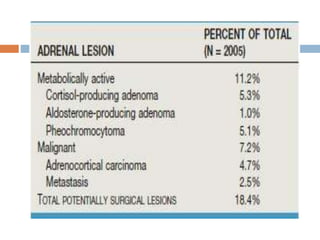
 Nearly 20% of adrenal incidentalomas are
found to be potential surgical lesions
 The two characteristics of primary clinical
relevance are imaging and metabolic activity
or functional status
Imaging of Adrenal Masses
 Ultrasonography is a suboptimal imaging
modality for detecting and fully
characterizing adrenal lesions
 Ultrasonography is responsible for identifying
individuals with adenomas, right-sided lesions
appear to be more common.
Computed Tomography and
Magnetic Resonance Imaging.
 CT and MRI permit cross-sectional and
reconstructed anatomic image
characterization of the adrenals and serve
as the cornerstone for adrenal evaluation.
 Most adrenal incidentalomas are small
homogeneous masses with regular
contours that cannot be immediately given
a pathologic label.
 An unenhanced CT scan is the first, and
perhaps single best, and most easily
interpreted test for intracellular lipid and
therefore can diagnose an adrenal
adenoma in more than 70% of cases.
 Low attenuation (<10 HU) on unenhanced
CT corresponds to high intracytoplasmic
lipid content and is diagnostic for an
adrenal adenoma
 Despite the high specificity of the 10-HU cutoff,
few low-density (<10 HU) pheochromocytomas
have been reported, underscoring the
importance of a metabolic workup for all
adrenal lesions
 CECT -Irregular margins and an enhancing rim
can be quite specific for malignancy
Computed Tomography Washout
Study
 Approximately 30% of adrenal adenomas
exhibit an attenuation of greater than 10 HU
on unenhanced CT owing to their lower
lipid content.
 These “atypical adenomas” are
indistinguishable from nonadenomas on
noncontrast CT density measurements
alone
 Fortunately, lipid-poor adenomas possess
identical properties to lipid-rich adenomas
regarding their rapid loss (washout) of
enhancement after CT contrast load
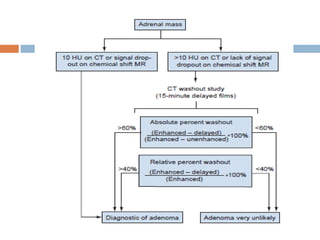
 An absolute percent washout (comparing
noncontrast values with 15-minute
postcontrast density values) of greater than
60%, or a relative percent washout (RPW)
(comparing arterial phase density
measurements with 15-minute postcontrast
density values) of greater than 40% on
delayed (washout) imaging, is indicative of
adenoma
MRI
 MRI harnesses the interference between
signal collected from fat and water tissue
to evaluate for intracellular lipid content
 On such opposed phase chemical shift
imaging, signal intensity loss on out-of-
phase sequences, when compared with in-
phase imaging, signifies the presence of
intracellular lipid and definitively identifies
the lesions in question is an adenoma
 Nevertheless, CT washout studies are
considered the gold standard and appear
to surpass opposed phase chemical shift
MRI in their sensitivity for identifying
adenomas
 MIBG imaging has a limited role in the routine
evaluation of adrenal incidentalomas.
 FDG PET is best reserved for cases in which
CT imaging and clinical data are inconclusive
Biopsy of Adrenal Masses
 The role of adrenal biopsy has been limited
for the followingreasons:
 (1) modern imaging in the context of
clinical characteristics affords superb
diagnostic capabilities,
 (2) histologically,adenomas cannot be
reliably differentiated from adrenal
carcinomas,
 (3) adrenal biopsy is not without risk
 Adrenal biopsy should be pursued only
when limitations of imaging have been
reached and when the physician and
patient are certain that the result of biopsy
will influence management.
 When used to differentiate benign from
metastatic disease, adrenal biopsy carries
favorable test characteristics.
Size and Growth
 A relationship does exist between the size
of an adrenal lesion and its malignant
potential, with larger masses more likely to
exhibit adverse clinical and pathologic
features
 Masses that exceed 6 cm should be
considered malignant until proven benign,
which usually requires definitive resection.
 Although management of masses between 4
cm and 6 cm is controversial, thought leaders
in the field advise that in otherwise healthy
individuals, masses 4 cm or larger should be
resected.
 Kinetics of growth should be followed. The
current recommendation is to resect masses
that grow over 1 cm;
Assessment of Function of
Adrenal Masses
 The NIH consensus statement
recommends metabolic testing for all
adrenal incidentalomas
 Current practice is to test all new adrenal
masses for cortisol and catecholamine
hypersecretion. In patients with a history of
hypertension, aldosterone hypersecretion
should also assessed
Testing for Cortisol
Hypersecretion
 Three first-line tests are available to screen
patients with incidentalomas for Cushing
syndrome:
 (1)LD-DST,
 (2) a late-night salivary cortisol test, and
 (3) a 24-hour UFC evaluation.
Testing for Aldosterone
Hypersecretion
 The screening test of choice for Conn
syndrome is the ratio of morning plasma
aldosterone (ng/dL) to renin (ng/mL/hr).
 An ARR of 20 (some suggest 30) along with
a concomitant aldosterone concentration
above 15 ng/mL is indicative of Conn
syndrome
Testing for Catecholamine
hypersecretion
 Free fractionated plasma metanephrines
and the 24-hour urinary fractionated
metanephrine test constitute the mainstay
for pheochromocytoma testing.
 Acetaminophen can produce a false-
positive result owing to cross reactivity in
the assay and should be stopped for at
least 5 days before testing
Testing for Adrenal Sex Steroid
Hypersecretion
 Hypersecretion of adrenal sex steroids by
adrenal masses, especially incidentalomas, is
exceedingly rare.
 The most common adrenal mass that
hypersecretes sex steroid is an adrenal
carcinoma that concomitantly exhibits cortisol
hypersecretion
 Routine testing of incidentalomas for sex
hormones is currently not recommended
Incidentaloma adrenal

Incidentaloma adrenal

  • 1.
  • 2.
    Incidentaloma Definition  Adrenal incidentalomasare unsuspected adrenal masses greater than 1 cm in diameter identified on cross-sectional imaging performed for seemingly unrelated causes  Frequency of adrenal incidentalomas is relatively high, with reporting an incidence of approximately 5%
  • 3.
     Incidence ofthe incidental adrenal mass increases with age,with a risk of less than 0.5% in individuals in their 20s and up to 7% in those 70 years of age or older  Nearly 20% of adrenal incidentalomas are found to be potential surgical lesions  The two characteristics of primary clinical relevance are imaging and metabolic activity or functional status
  • 5.
    Imaging of AdrenalMasses  Ultrasonography is a suboptimal imaging modality for detecting and fully characterizing adrenal lesions  Ultrasonography is responsible for identifying individuals with adenomas, right-sided lesions appear to be more common.
  • 6.
    Computed Tomography and MagneticResonance Imaging.  CT and MRI permit cross-sectional and reconstructed anatomic image characterization of the adrenals and serve as the cornerstone for adrenal evaluation.  Most adrenal incidentalomas are small homogeneous masses with regular contours that cannot be immediately given a pathologic label.
  • 7.
     An unenhancedCT scan is the first, and perhaps single best, and most easily interpreted test for intracellular lipid and therefore can diagnose an adrenal adenoma in more than 70% of cases.  Low attenuation (<10 HU) on unenhanced CT corresponds to high intracytoplasmic lipid content and is diagnostic for an adrenal adenoma
  • 8.
     Despite thehigh specificity of the 10-HU cutoff, few low-density (<10 HU) pheochromocytomas have been reported, underscoring the importance of a metabolic workup for all adrenal lesions  CECT -Irregular margins and an enhancing rim can be quite specific for malignancy
  • 9.
    Computed Tomography Washout Study Approximately 30% of adrenal adenomas exhibit an attenuation of greater than 10 HU on unenhanced CT owing to their lower lipid content.  These “atypical adenomas” are indistinguishable from nonadenomas on noncontrast CT density measurements alone  Fortunately, lipid-poor adenomas possess identical properties to lipid-rich adenomas regarding their rapid loss (washout) of enhancement after CT contrast load
  • 10.
     An absolutepercent washout (comparing noncontrast values with 15-minute postcontrast density values) of greater than 60%, or a relative percent washout (RPW) (comparing arterial phase density measurements with 15-minute postcontrast density values) of greater than 40% on delayed (washout) imaging, is indicative of adenoma
  • 11.
    MRI  MRI harnessesthe interference between signal collected from fat and water tissue to evaluate for intracellular lipid content  On such opposed phase chemical shift imaging, signal intensity loss on out-of- phase sequences, when compared with in- phase imaging, signifies the presence of intracellular lipid and definitively identifies the lesions in question is an adenoma
  • 13.
     Nevertheless, CTwashout studies are considered the gold standard and appear to surpass opposed phase chemical shift MRI in their sensitivity for identifying adenomas  MIBG imaging has a limited role in the routine evaluation of adrenal incidentalomas.  FDG PET is best reserved for cases in which CT imaging and clinical data are inconclusive
  • 14.
    Biopsy of AdrenalMasses  The role of adrenal biopsy has been limited for the followingreasons:  (1) modern imaging in the context of clinical characteristics affords superb diagnostic capabilities,  (2) histologically,adenomas cannot be reliably differentiated from adrenal carcinomas,  (3) adrenal biopsy is not without risk
  • 15.
     Adrenal biopsyshould be pursued only when limitations of imaging have been reached and when the physician and patient are certain that the result of biopsy will influence management.  When used to differentiate benign from metastatic disease, adrenal biopsy carries favorable test characteristics.
  • 16.
    Size and Growth A relationship does exist between the size of an adrenal lesion and its malignant potential, with larger masses more likely to exhibit adverse clinical and pathologic features  Masses that exceed 6 cm should be considered malignant until proven benign, which usually requires definitive resection.
  • 17.
     Although managementof masses between 4 cm and 6 cm is controversial, thought leaders in the field advise that in otherwise healthy individuals, masses 4 cm or larger should be resected.  Kinetics of growth should be followed. The current recommendation is to resect masses that grow over 1 cm;
  • 18.
    Assessment of Functionof Adrenal Masses  The NIH consensus statement recommends metabolic testing for all adrenal incidentalomas  Current practice is to test all new adrenal masses for cortisol and catecholamine hypersecretion. In patients with a history of hypertension, aldosterone hypersecretion should also assessed
  • 19.
    Testing for Cortisol Hypersecretion Three first-line tests are available to screen patients with incidentalomas for Cushing syndrome:  (1)LD-DST,  (2) a late-night salivary cortisol test, and  (3) a 24-hour UFC evaluation.
  • 20.
    Testing for Aldosterone Hypersecretion The screening test of choice for Conn syndrome is the ratio of morning plasma aldosterone (ng/dL) to renin (ng/mL/hr).  An ARR of 20 (some suggest 30) along with a concomitant aldosterone concentration above 15 ng/mL is indicative of Conn syndrome
  • 21.
    Testing for Catecholamine hypersecretion Free fractionated plasma metanephrines and the 24-hour urinary fractionated metanephrine test constitute the mainstay for pheochromocytoma testing.  Acetaminophen can produce a false- positive result owing to cross reactivity in the assay and should be stopped for at least 5 days before testing
  • 22.
    Testing for AdrenalSex Steroid Hypersecretion  Hypersecretion of adrenal sex steroids by adrenal masses, especially incidentalomas, is exceedingly rare.  The most common adrenal mass that hypersecretes sex steroid is an adrenal carcinoma that concomitantly exhibits cortisol hypersecretion  Routine testing of incidentalomas for sex hormones is currently not recommended