Ca Endometrium-II
By-Dr Satyajeet Rath
Moderator-Prof Kamal Sahni
Clinical Features
• Most common presentation - postmenopausal vaginal bleeding - in 80% to 90% of
patients
• Incidence of endometrial cancer in women presenting with postmenopausal
bleeding is only 10% to 15%
• Less than 5% diagnosed under 40 years of age
• Other patterns of presentations include
• vaginal discharge,
• abnormal Papanicolaou smear, or
• thickened endometrium on routine transvaginal ultrasound
• For patients with advanced disease, they may present with
• urinary or rectal bleeding,
• constipation,
• pain,
• lower-extremity lymphedema,
• abdominal distension due to ascites, and
• cough and/or or hemoptysis
Histopathology
• Endometrioid adenocarcinoma is the
most common endometrial carcinoma
– 75-80%
• Subtypes are
• endometrioid carcinoma not otherwise
specified (NOS) - MC
• squamous differentiation-adenocarcinoma
with squamous differentiation
• villoglandular endometrioid carcinoma,
• secretory carcinoma < 2%
• ciliated cell variant - characterized by the
presence of ciliated cells comprising
>75% of the tumor
• Serous carcinoma (5-10%)
• Uterine papillary serous cancer
• marked cellular atypia in addition to papilla distinguishes serous carcinoma
from others.
• aggressive subtype with a high propensity for early lymphatic and
intraperitoneal dissemination, often despite little myometrial penetration
• Mucinous Carcinoma (1-3%)
• Requires >50% of the tumor cells to be mucinous.
• Carcinoembryonic antigen positive
• Usually well-differentiated and have good prognosis
• Clear Cell Carcinoma (1-5%)
• Poor prognosis
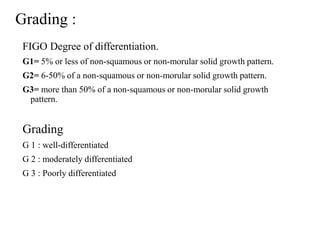
Grading :
FIGO Degree of differentiation.
G1= 5% or less of non-squamous or non-morular solid growth pattern.
G2= 6-50% of a non-squamous or non-morular solid growth pattern.
G3= more than 50% of a non-squamous or non-morular solid growth
pattern.
Grading
G 1 : well-differentiated
G 2 : moderately differentiated
G 3 : Poorly differentiated
2 forms of endometrial ca :
• Type I
• Estrogen dependent
• Endometriod type
• 80% cases
• Estrogen related
• slow-growing malignancy
• Better differentiated(grd 1/II)
• ER(+),PR(+)
• More favourable prognosis
• have a history of exposure to unopposed
estrogen
• PTEN mutation
• Type II
• Non-estrogen dependent
• Non-endometriod type
• Approximately 10% of cases
• Typically papillary,serous or clear cell
• High grade(grd III)
• Not estrogen related
• Aggressive clinical course
• Less differentiated
• ER(-)PR(-)
• Poor prognosis
• Arising in background of atrophic
endometrium
• Associated with prolonged Tamoxifen use
• a/w Lynch & Coden Syndrome
• P53 mutation
• Higher involvement of lymphatics and
extrauterine spread
Adverse Prognostic factors :
• Age > 60 years
• LVSI
• Grade 3 (poorly differentiated)
• Non-endometriod histology - serous,clear cell,undifferentiated,small
cell,anaplastic
• Deep myometrial invasion
• Tumour size
• Lower uterine segment involvement
• Poor KPS
Five prognostic factors
• age
• grade,
• histologic type,
• number of lymph nodes
removed,
• FIGO 1988 surgical
stage
Prognostic Factors
Abu-Rustum NR, Zhou Q, Gomez JD, et al. A nomogram for predicting overall survival of women with endometrial cancer
following primary therapy: toward improving individualized cancer care. Gynecol Oncol 2010;116(3):399–403/MKSCC
Corelation between depth , grade , LN Involvement
• According to GOG 33,
• Risk of LN involvement
• <5% - for tumour limited to
endometrium(all grades)
• 5-10% - for tumours
invading the inner and
middle 3rd of
myometrium(all grades)
• Around 10%- for tumours
invading outer 3rd of
myometrium
• LN Involvment Risk
• Grd 1 - 10%
• Grd 2 - 20%
• Grd 3 - 35%
Creasman WT et al.,Cancer 1987
Endometrial hyperplasia
• Premalignant potential
• Simple => 1%
• Complex => 3%
• Simple with atypia => 8%
• Complex with atypia => 29%
• The Gynecologic Oncology Group (GOG) conducted a prospective trial in
which all patients with atypical hyperplasia of the uterus underwent an
immediate hysterectomy.
• The rate of underlying concurrent endometrial carcinoma in women with a
biopsy diagnosis of atypical endometrial hyperplasia in the uterus was 42.6%
in these patients.
Trimble CL, Kauderer J, Zaino R, et al. Concurrent endometrial carcinoma in women with a biopsy diagnosis of atypical endometrial hyperplasia: a Gynecologic
Oncology Group study. Cancer 2006;106:812–819.
Lymphatic drainage
• Cervix and LUS – Pelvic LN (parametrialinternal and external
iliacs,obturator,common iliac,presacral)
• Fundus – direct drainage to paraaortic nodes
• Round ligament – can directly drain to inguinal nodes
• About 11% patients with stg 1 & II have Pelvic LN
• 33-50% pts with pelvic LN also have para-aortic nodes
• Isolated Para-aortic LNs in case of negative pelvic LN is 1%
• Most common site of metastasis :
• Vagina
• Lung
• Most common site of recurrence
• Vaginal
• Abdominal
• Pelvic
• Lung
• Pleura
• Bone
Diagnosis and assessement:
A-History:
• postmenopausal bleeding or staining( this symptom
should be assumed to be caused by carcinoma of the
endometrium until proved otherwise), only 10% of PMB
have endometrial carcinoma.
• Perimenopausal menstrual irregularities.
• Blood stained vaginal discharge.
• Heavy and irregular vaginal bleeding.
B-Examination:
• physical examination of the patient with endometrial
carcinoma is frequently entirely normal
• should include palpation of supraclavicular and inguinal
lymph nodes, abdominal palpation might be difficult due
to obesity.
• Gynaecological examination:
• inspection of vulva, vaginal skin in suburethral area and cervix.
• Bimanual vaginal examination assesses uterine size, and mobility,
state of parametria and adnexa.
• Bimanual recto-vaginal examination
C-Investigation:
• CBC.
• Liver function test.
• Renal function test.
• Chest X ray.
• Cytology brush from lower cervical canal and posterior fornix to
analyze the cells.
• As per the NCCN , cystoscopy or sigmoidoscopy is indicated only for
Sx or advanced lesions
• Endometrial sampling
• Endometrial Bx has 90-98% sensitivity & 85% specificity
Endometrial sampling
• Endometrial tissue sampling remains the gold standard by which the diagnosis of
endometrial cancer is established.
• Sensitivity in detecting endometrial cancer in postmenopausal women is 99.6%
compared to 91% in premenopausal women.
• Its specificity is >98% for both groups
• Pipelle endometrial biopsy is a cost-effective and safe procedure that is well
tolerated by patients.
• Pipelle is a flexible polypropylene suction cannula with an outer diameter of 3.1 mm
• If the patient is undergoing hysterectomy, routine D&C is not necessary after an
office Pipelle sampling has documented malignancy.
Diagnosis
• Hysteroscopy with
endometrial curettage or
endometrial sampling ,
curettage alone , or
outpatient endometrial
sampling alone , are
essential.
• Hysteroscopy , cervical
smear ( <1 % risk of
concurrent cervical
malignancy)and vaginal
or abdominal ultrasound
for ovarian pathology are
advised , when
endometrial malignancy
is found
Significance :
• Direct visualisation
• Taking sample correctly
• Identifying polyps and submucous myoma
Dilation and fractional curettage ( D & C)
• D & C is recommended if endometrial Bx is nondiagnostic
• Most effective ,definitive procedure and commonly used
• Diagnostic curettage
• requires cervical dilatation to >8 mm and the use of a small sharp curette for
systematic, thorough, gentle sampling of all parts of the uterine cavity,
including the tubal osteal areas.
• Fractional curettage
• uses endocervical curettage followed by endometrial curettage with two
samples examined separately.
• Significance :
• Established correct diagnosis, clinical stage
• differentiate from cervical cancer or cervical involvement
Method Advantage Disadvantage
Endometrial
biopsy
Outpatient procedure
Well tolerated
Blind sample
Not always possible
D&C Patient completely
relaxed
Requires anaesthesia
Blind sample
USG Painless
Reasonable resolution
Available at outpatient
Endometrial thickness
measured
endometrium not actually
visualized and no histology
Hysteroscopy Direct visualization
Guided biopsy possible
Invasive
Can be painful
USG
• The consensus statement from the Society of Radiologists in
Ultrasound defines an endometrial thickness of 5 mm or greater as
being abnormal.
• If the thickness of the endometrium is <5 mm, the risk of
endometrial cancer is minimal; the false-negative rate is about 4%.
• Recent meta-analysis seems to indicate that perhaps a cut-off of 3-
mm thickness rather than <5 mm provides even better diagnostic
accuracy.
• If the TVU is abnormal but the biopsy is negative/nondiagnostic or
the uterine cavity is inaccessible, then saline-infusion sonography
or hysteroscopy should be considered to help exclude intracavitary
lesions, especially polyps that might contain cancer.
• Goldstein RB, Bree RL, Benson CB, et al. Evaluation of the women with postmenopausal bleeding: Society of Radiologists in Ultrasound-Sponsored Consensus
Conference statement. J Ultrsound Med 2001;20:1025–1036
• Timmermans A, Opmeer BC, Khan KS, et al. Endometrial thickness measurement for detecting endometrial cancer in women with postmenopausal bleeding: a
systematic review and meta-analysis. Obstet Gynecol 2010;116:160–167
CT
• Extent of the endometrial tumor
• MRI & CT are equally good for detecting Lymph Node metastasis
MRI
• Most accurate imaging study to assess tumor extension in endometrial cancer,
especially myometrial invasion.
• Dynamic contrast-enhanced MRI is the optimal MRI method for detecting
myometrial invasion , with an accuracy of 85% to 93%.
• Sensitivity of MRI in detecting lymph node metastasis is 27% to 66% and the
specificity is 73% to 94% in surgically staged patients.
• Essential for the preoperative staging of endometrial cancer
Frei KA, Kinkel K, Bonél HM, et al. Prediction of deep myometrial invasion in patients with endometrial cancer: clinical utility of contrast-enhanced MR imaging-a
meta-analysis and Bayesian analysis. Radiology 2000;216(2):444–449.
PET
• little benefit in assessing the primary tumor extension.
• With regard to regional lymph node metastasis, the reported sensitivity is 50% to
100%, the specificity is 87% to 100%, and the accuracy is 78% to 100%.
• The main limitation of PET/CT is its inability to detect metastasis in lymph
nodes ≤5 mm in size.1
CA 125
• Cancer antigen 125 (CA 125) serum levels could be elevated in patients with
advanced endometrial cancer.
• Kim et al., in a review of 413 patients, found that 23.9% of patients had >35
U/mL serum CA 125 levels. 2
1. Kitajima K, Murakami K, Kaji Y, et al. Established, emerging and future applications of FDG-PET/CT in the uterine cancer. Clin Radiol 2011;66(4):297–307.
2.Kim HS, et al. Evaluation of serum CA-125 levels for preoperative counselling in endometrioid endometrial cancer. Gynecol Oncol 2010;118:282–288.
Screening
• The role of population screening for endometrial cancer remains low
• Certain high-risk groups such as those with Lynch type 2 syndrome can
undergo endometrial surveillance by biopsy, or transvaginal
ultrasonography if post menopausal.
• Transvaginal ultrasound is reasonably sensitive and specific but
screening of asymptomatic women has in general been recommended
only for those with Lynch syndrome
• According to ACOG , there is no appropriate cost-effective screening
test for endometrial carcinoma
FIGO Cancer Update October 2015
Staging :
• Staging was changed in 1988 from a clinical staging to a surgical staging
• Endometrial cancer is surgically staged, therefore procedures previously used
for determination of stage are no longer applicable (e.g. the findings of
fractional curettage to differentiate between Stage I and Stage II).
• The initial examination is clinical, aimed to take biopsy to diagnose and record
an initial staging to facilitate planning of the subsequent surgical procedure.
• Key changes incorporated into the 2009 FIGO staging system include
simplification of stage I disease and removal of cervical mucosal invasion as a
distinct stage.
• As a minimum, any enlarged or suspicious lymph nodes should be removed in
all patients.
FIGO Staging 2009
FIGO Cancer update 2015
Surgical staging for endometrial cancer :
• Vertical incision / or laparoscopy
• Peritoneal washing/cytology
• Exploration of all peritoneal surfaces with Bx of any lesions
• TAH/BSO
• Uterus bivalve in operating room
• Omental Bx ( omentectomy or uterine papillary serous carcinoma
/ clear cell carcinoma )
• Pelvic / Paraaortic LN sampling vs dissection
LN Assessment
• CT and MRI are equivalent in terms of evaluating nodal metastases, but neither
is good enough to replace surgical lymph node assessment, which provides
histological confirmation
• Although mandated through the staging system, lymphadenectomy of the
pelvic and para-aortic areas remains controversial.
• Selective node sampling is of dubious value as a routine and complete
lymphadenectomy should be reserved for cases with high-risk features
• Indications for aortic node sampling would include
• suspicious aortic or common iliac nodes
• grossly positive adnexae
• grossly positive pelvic nodes
• high-grade tumors showing full thickness myometrial invasion.
• Patients with clear cell, papillary serous, or carcinosarcoma histology
Role of Lymphadenectomy
• No lymphadenectomy - lack of documented survival advantage
• Full pelvic / paraaortic LN sampling – To be adequate five LN stations need to
removed or total of 10
• Paraaortic
• Common iliac
• Internal iliac
• External iliac
• Obturator
• Optimal Lmphadenectomy – combining preoperative tumour grading with
intraoperative assessment
• Pelvic lymphadenectomy significantly improved surgical staging, that is, it is a
good prognosticator, but it did not improve disease-free or overall survival
Perez & Brady’s , 6th edition
SLN Mapping
• As a trade-off between lymphadenectomy and no surgical assessment at all in
patients with endometrial cancer, there has been interest in adopting a sentinel
lymph node approach similar to that in breast cancer
• Results from these two studies ( MKSCC[226 patients] and French Trial[125
patients] ) suggest that SLN mapping is feasible and that adding SLN mapping
to surgical staging procedures seems to increase the likelihood of detecting
metastatic cancer cells in regional lymph nodes.
• Whether sentinel lymph node mapping will replace lymphadenectomy needs to
be determined
1988 FIGO Classification 2009 FIGO Classification
*Endocervical glandular involvement only should
be considered as stage I and not stage II.
• The FIGO staging for endometrial cancer is a surgical staging, and thus
preoperative imaging studies (except chest x-rays) are not part of the staging.
Molecular staging
• The 2013 TCGA cooperative study on endometrial carcinoma has expanded the
dualistic clinicopathologic classification (types I and II) to four molecular
genetic categories:
• (1) POLE ultramutated ( polymerase DNA ℇ endonuclease )
• (2) microsatellite instability hypermutated, corresponding to type I
• (3) copy-number low(CTNNB1 mutated) & (4) copy-number high (TP53
mutated) corresponding to type II
• In addition to a high frequency of mutations in PTEN, CTNNB1, KRAS,
FGFR-2, ARID1A, andPIK3CA, EECs often express estrogen and progesterone
receptors and have microsatellite instability
FIGO Cancer Update October 2015
• In addition to a high frequency of mutations in PTEN, CTNNB1, KRAS,
FGFR-2, ARID1A, andPIK3CA, EECs often express estrogen and
progesterone receptors and have microsatellite instability
FIGO Cancer Update October 2015
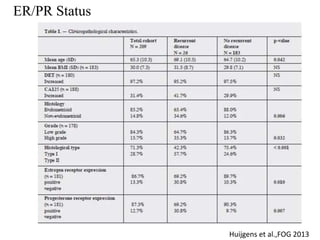
ER/PR Status
Huijgens et al.,FOG 2013
Uterine Sarcoma
Carcinosarcoma
• Malignant mixed
mullerian
tumour(MMMT)
• most commonly present
with vaginal bleeding
• 30% incidence of nodal
mets
• Epithelial component
dictates prognosis and
treatment
• Most have serous or
high grade endometriod
histology
Leimyosarcoma(LMS)
• similar signs and
symptoms as uterine
fibroids
• 8% incidence of
nodal mets, usually
a/w extrauterine
disease
Endometrial Stromal
Sarcoma(ESS)
• similar signs and
symptoms as uterine
fibroids
• 10% incidence of nodal
mets
• Lowest incidence of all
• Low grade-hormone
sensitive
• High grade – aggressive
course
• 4% of uterine malignancies
• Most common uterine sarcomas - Carcinosarcoma
• Uterine Sarcoma has a higher rate of metastatic disease than
endometrial ca
• Most common site of mets - lung
• Carcinosarcoma is still staged according to FIGO Staging for
endometrial adenoca
• LMS & ESS Staging :
• Stg I - Limited to uterus
• IA :<5cm
• IB : > 5 cm
• Stg II : extends to pelvis
• II A : adnexal involvement
• II B : Extends to extrauterine pelvic tissue
• Stg III : invades abdominal tissue(not just protruding into abdomen)
• III A : 1 abdominal site
• III B : >1 abdominal site
• III C : mets to pelvic LNs, Paraaortic LNs or both
• Stg IV A : invades bladder or rectum
• Stg IV B : Distant mets
• The initial work-up for uterine sarcoma is identical to endometrial
ca
• But it should include a CT Chest because of the increased risk of
Pulmonary mets
Thank You

Ca endometrium

  • 1.
    Ca Endometrium-II By-Dr SatyajeetRath Moderator-Prof Kamal Sahni
  • 2.
    Clinical Features • Mostcommon presentation - postmenopausal vaginal bleeding - in 80% to 90% of patients • Incidence of endometrial cancer in women presenting with postmenopausal bleeding is only 10% to 15% • Less than 5% diagnosed under 40 years of age • Other patterns of presentations include • vaginal discharge, • abnormal Papanicolaou smear, or • thickened endometrium on routine transvaginal ultrasound • For patients with advanced disease, they may present with • urinary or rectal bleeding, • constipation, • pain, • lower-extremity lymphedema, • abdominal distension due to ascites, and • cough and/or or hemoptysis
  • 3.
    Histopathology • Endometrioid adenocarcinomais the most common endometrial carcinoma – 75-80% • Subtypes are • endometrioid carcinoma not otherwise specified (NOS) - MC • squamous differentiation-adenocarcinoma with squamous differentiation • villoglandular endometrioid carcinoma, • secretory carcinoma < 2% • ciliated cell variant - characterized by the presence of ciliated cells comprising >75% of the tumor
  • 4.
    • Serous carcinoma(5-10%) • Uterine papillary serous cancer • marked cellular atypia in addition to papilla distinguishes serous carcinoma from others. • aggressive subtype with a high propensity for early lymphatic and intraperitoneal dissemination, often despite little myometrial penetration • Mucinous Carcinoma (1-3%) • Requires >50% of the tumor cells to be mucinous. • Carcinoembryonic antigen positive • Usually well-differentiated and have good prognosis • Clear Cell Carcinoma (1-5%) • Poor prognosis
  • 5.
    Grading : FIGO Degreeof differentiation. G1= 5% or less of non-squamous or non-morular solid growth pattern. G2= 6-50% of a non-squamous or non-morular solid growth pattern. G3= more than 50% of a non-squamous or non-morular solid growth pattern. Grading G 1 : well-differentiated G 2 : moderately differentiated G 3 : Poorly differentiated
  • 6.
    2 forms ofendometrial ca : • Type I • Estrogen dependent • Endometriod type • 80% cases • Estrogen related • slow-growing malignancy • Better differentiated(grd 1/II) • ER(+),PR(+) • More favourable prognosis • have a history of exposure to unopposed estrogen • PTEN mutation • Type II • Non-estrogen dependent • Non-endometriod type • Approximately 10% of cases • Typically papillary,serous or clear cell • High grade(grd III) • Not estrogen related • Aggressive clinical course • Less differentiated • ER(-)PR(-) • Poor prognosis • Arising in background of atrophic endometrium • Associated with prolonged Tamoxifen use • a/w Lynch & Coden Syndrome • P53 mutation • Higher involvement of lymphatics and extrauterine spread
  • 7.
    Adverse Prognostic factors: • Age > 60 years • LVSI • Grade 3 (poorly differentiated) • Non-endometriod histology - serous,clear cell,undifferentiated,small cell,anaplastic • Deep myometrial invasion • Tumour size • Lower uterine segment involvement • Poor KPS
  • 8.
    Five prognostic factors •age • grade, • histologic type, • number of lymph nodes removed, • FIGO 1988 surgical stage Prognostic Factors Abu-Rustum NR, Zhou Q, Gomez JD, et al. A nomogram for predicting overall survival of women with endometrial cancer following primary therapy: toward improving individualized cancer care. Gynecol Oncol 2010;116(3):399–403/MKSCC
  • 9.
    Corelation between depth, grade , LN Involvement • According to GOG 33, • Risk of LN involvement • <5% - for tumour limited to endometrium(all grades) • 5-10% - for tumours invading the inner and middle 3rd of myometrium(all grades) • Around 10%- for tumours invading outer 3rd of myometrium • LN Involvment Risk • Grd 1 - 10% • Grd 2 - 20% • Grd 3 - 35% Creasman WT et al.,Cancer 1987
  • 10.
    Endometrial hyperplasia • Premalignantpotential • Simple => 1% • Complex => 3% • Simple with atypia => 8% • Complex with atypia => 29% • The Gynecologic Oncology Group (GOG) conducted a prospective trial in which all patients with atypical hyperplasia of the uterus underwent an immediate hysterectomy. • The rate of underlying concurrent endometrial carcinoma in women with a biopsy diagnosis of atypical endometrial hyperplasia in the uterus was 42.6% in these patients. Trimble CL, Kauderer J, Zaino R, et al. Concurrent endometrial carcinoma in women with a biopsy diagnosis of atypical endometrial hyperplasia: a Gynecologic Oncology Group study. Cancer 2006;106:812–819.
  • 11.
    Lymphatic drainage • Cervixand LUS – Pelvic LN (parametrialinternal and external iliacs,obturator,common iliac,presacral) • Fundus – direct drainage to paraaortic nodes • Round ligament – can directly drain to inguinal nodes • About 11% patients with stg 1 & II have Pelvic LN • 33-50% pts with pelvic LN also have para-aortic nodes • Isolated Para-aortic LNs in case of negative pelvic LN is 1%
  • 12.
    • Most commonsite of metastasis : • Vagina • Lung • Most common site of recurrence • Vaginal • Abdominal • Pelvic • Lung • Pleura • Bone
  • 13.
    Diagnosis and assessement: A-History: •postmenopausal bleeding or staining( this symptom should be assumed to be caused by carcinoma of the endometrium until proved otherwise), only 10% of PMB have endometrial carcinoma. • Perimenopausal menstrual irregularities. • Blood stained vaginal discharge. • Heavy and irregular vaginal bleeding.
  • 14.
    B-Examination: • physical examinationof the patient with endometrial carcinoma is frequently entirely normal • should include palpation of supraclavicular and inguinal lymph nodes, abdominal palpation might be difficult due to obesity. • Gynaecological examination: • inspection of vulva, vaginal skin in suburethral area and cervix. • Bimanual vaginal examination assesses uterine size, and mobility, state of parametria and adnexa. • Bimanual recto-vaginal examination
  • 15.
    C-Investigation: • CBC. • Liverfunction test. • Renal function test. • Chest X ray. • Cytology brush from lower cervical canal and posterior fornix to analyze the cells. • As per the NCCN , cystoscopy or sigmoidoscopy is indicated only for Sx or advanced lesions • Endometrial sampling • Endometrial Bx has 90-98% sensitivity & 85% specificity
  • 16.
    Endometrial sampling • Endometrialtissue sampling remains the gold standard by which the diagnosis of endometrial cancer is established. • Sensitivity in detecting endometrial cancer in postmenopausal women is 99.6% compared to 91% in premenopausal women. • Its specificity is >98% for both groups • Pipelle endometrial biopsy is a cost-effective and safe procedure that is well tolerated by patients. • Pipelle is a flexible polypropylene suction cannula with an outer diameter of 3.1 mm • If the patient is undergoing hysterectomy, routine D&C is not necessary after an office Pipelle sampling has documented malignancy.
  • 17.
    Diagnosis • Hysteroscopy with endometrialcurettage or endometrial sampling , curettage alone , or outpatient endometrial sampling alone , are essential. • Hysteroscopy , cervical smear ( <1 % risk of concurrent cervical malignancy)and vaginal or abdominal ultrasound for ovarian pathology are advised , when endometrial malignancy is found Significance : • Direct visualisation • Taking sample correctly • Identifying polyps and submucous myoma
  • 18.
    Dilation and fractionalcurettage ( D & C) • D & C is recommended if endometrial Bx is nondiagnostic • Most effective ,definitive procedure and commonly used • Diagnostic curettage • requires cervical dilatation to >8 mm and the use of a small sharp curette for systematic, thorough, gentle sampling of all parts of the uterine cavity, including the tubal osteal areas. • Fractional curettage • uses endocervical curettage followed by endometrial curettage with two samples examined separately. • Significance : • Established correct diagnosis, clinical stage • differentiate from cervical cancer or cervical involvement
  • 19.
    Method Advantage Disadvantage Endometrial biopsy Outpatientprocedure Well tolerated Blind sample Not always possible D&C Patient completely relaxed Requires anaesthesia Blind sample USG Painless Reasonable resolution Available at outpatient Endometrial thickness measured endometrium not actually visualized and no histology Hysteroscopy Direct visualization Guided biopsy possible Invasive Can be painful
  • 20.
    USG • The consensusstatement from the Society of Radiologists in Ultrasound defines an endometrial thickness of 5 mm or greater as being abnormal. • If the thickness of the endometrium is <5 mm, the risk of endometrial cancer is minimal; the false-negative rate is about 4%. • Recent meta-analysis seems to indicate that perhaps a cut-off of 3- mm thickness rather than <5 mm provides even better diagnostic accuracy. • If the TVU is abnormal but the biopsy is negative/nondiagnostic or the uterine cavity is inaccessible, then saline-infusion sonography or hysteroscopy should be considered to help exclude intracavitary lesions, especially polyps that might contain cancer. • Goldstein RB, Bree RL, Benson CB, et al. Evaluation of the women with postmenopausal bleeding: Society of Radiologists in Ultrasound-Sponsored Consensus Conference statement. J Ultrsound Med 2001;20:1025–1036 • Timmermans A, Opmeer BC, Khan KS, et al. Endometrial thickness measurement for detecting endometrial cancer in women with postmenopausal bleeding: a systematic review and meta-analysis. Obstet Gynecol 2010;116:160–167
  • 21.
    CT • Extent ofthe endometrial tumor • MRI & CT are equally good for detecting Lymph Node metastasis
  • 22.
    MRI • Most accurateimaging study to assess tumor extension in endometrial cancer, especially myometrial invasion. • Dynamic contrast-enhanced MRI is the optimal MRI method for detecting myometrial invasion , with an accuracy of 85% to 93%. • Sensitivity of MRI in detecting lymph node metastasis is 27% to 66% and the specificity is 73% to 94% in surgically staged patients. • Essential for the preoperative staging of endometrial cancer Frei KA, Kinkel K, Bonél HM, et al. Prediction of deep myometrial invasion in patients with endometrial cancer: clinical utility of contrast-enhanced MR imaging-a meta-analysis and Bayesian analysis. Radiology 2000;216(2):444–449.
  • 23.
    PET • little benefitin assessing the primary tumor extension. • With regard to regional lymph node metastasis, the reported sensitivity is 50% to 100%, the specificity is 87% to 100%, and the accuracy is 78% to 100%. • The main limitation of PET/CT is its inability to detect metastasis in lymph nodes ≤5 mm in size.1 CA 125 • Cancer antigen 125 (CA 125) serum levels could be elevated in patients with advanced endometrial cancer. • Kim et al., in a review of 413 patients, found that 23.9% of patients had >35 U/mL serum CA 125 levels. 2 1. Kitajima K, Murakami K, Kaji Y, et al. Established, emerging and future applications of FDG-PET/CT in the uterine cancer. Clin Radiol 2011;66(4):297–307. 2.Kim HS, et al. Evaluation of serum CA-125 levels for preoperative counselling in endometrioid endometrial cancer. Gynecol Oncol 2010;118:282–288.
  • 24.
    Screening • The roleof population screening for endometrial cancer remains low • Certain high-risk groups such as those with Lynch type 2 syndrome can undergo endometrial surveillance by biopsy, or transvaginal ultrasonography if post menopausal. • Transvaginal ultrasound is reasonably sensitive and specific but screening of asymptomatic women has in general been recommended only for those with Lynch syndrome • According to ACOG , there is no appropriate cost-effective screening test for endometrial carcinoma FIGO Cancer Update October 2015
  • 25.
    Staging : • Stagingwas changed in 1988 from a clinical staging to a surgical staging • Endometrial cancer is surgically staged, therefore procedures previously used for determination of stage are no longer applicable (e.g. the findings of fractional curettage to differentiate between Stage I and Stage II). • The initial examination is clinical, aimed to take biopsy to diagnose and record an initial staging to facilitate planning of the subsequent surgical procedure. • Key changes incorporated into the 2009 FIGO staging system include simplification of stage I disease and removal of cervical mucosal invasion as a distinct stage. • As a minimum, any enlarged or suspicious lymph nodes should be removed in all patients. FIGO Staging 2009 FIGO Cancer update 2015
  • 26.
    Surgical staging forendometrial cancer : • Vertical incision / or laparoscopy • Peritoneal washing/cytology • Exploration of all peritoneal surfaces with Bx of any lesions • TAH/BSO • Uterus bivalve in operating room • Omental Bx ( omentectomy or uterine papillary serous carcinoma / clear cell carcinoma ) • Pelvic / Paraaortic LN sampling vs dissection
  • 27.
    LN Assessment • CTand MRI are equivalent in terms of evaluating nodal metastases, but neither is good enough to replace surgical lymph node assessment, which provides histological confirmation • Although mandated through the staging system, lymphadenectomy of the pelvic and para-aortic areas remains controversial. • Selective node sampling is of dubious value as a routine and complete lymphadenectomy should be reserved for cases with high-risk features • Indications for aortic node sampling would include • suspicious aortic or common iliac nodes • grossly positive adnexae • grossly positive pelvic nodes • high-grade tumors showing full thickness myometrial invasion. • Patients with clear cell, papillary serous, or carcinosarcoma histology
  • 28.
    Role of Lymphadenectomy •No lymphadenectomy - lack of documented survival advantage • Full pelvic / paraaortic LN sampling – To be adequate five LN stations need to removed or total of 10 • Paraaortic • Common iliac • Internal iliac • External iliac • Obturator • Optimal Lmphadenectomy – combining preoperative tumour grading with intraoperative assessment • Pelvic lymphadenectomy significantly improved surgical staging, that is, it is a good prognosticator, but it did not improve disease-free or overall survival Perez & Brady’s , 6th edition
  • 29.
    SLN Mapping • Asa trade-off between lymphadenectomy and no surgical assessment at all in patients with endometrial cancer, there has been interest in adopting a sentinel lymph node approach similar to that in breast cancer • Results from these two studies ( MKSCC[226 patients] and French Trial[125 patients] ) suggest that SLN mapping is feasible and that adding SLN mapping to surgical staging procedures seems to increase the likelihood of detecting metastatic cancer cells in regional lymph nodes. • Whether sentinel lymph node mapping will replace lymphadenectomy needs to be determined
  • 30.
    1988 FIGO Classification2009 FIGO Classification *Endocervical glandular involvement only should be considered as stage I and not stage II. • The FIGO staging for endometrial cancer is a surgical staging, and thus preoperative imaging studies (except chest x-rays) are not part of the staging.
  • 31.
    Molecular staging • The2013 TCGA cooperative study on endometrial carcinoma has expanded the dualistic clinicopathologic classification (types I and II) to four molecular genetic categories: • (1) POLE ultramutated ( polymerase DNA ℇ endonuclease ) • (2) microsatellite instability hypermutated, corresponding to type I • (3) copy-number low(CTNNB1 mutated) & (4) copy-number high (TP53 mutated) corresponding to type II • In addition to a high frequency of mutations in PTEN, CTNNB1, KRAS, FGFR-2, ARID1A, andPIK3CA, EECs often express estrogen and progesterone receptors and have microsatellite instability FIGO Cancer Update October 2015
  • 32.
    • In additionto a high frequency of mutations in PTEN, CTNNB1, KRAS, FGFR-2, ARID1A, andPIK3CA, EECs often express estrogen and progesterone receptors and have microsatellite instability FIGO Cancer Update October 2015
  • 33.
  • 34.
  • 35.
    Carcinosarcoma • Malignant mixed mullerian tumour(MMMT) •most commonly present with vaginal bleeding • 30% incidence of nodal mets • Epithelial component dictates prognosis and treatment • Most have serous or high grade endometriod histology Leimyosarcoma(LMS) • similar signs and symptoms as uterine fibroids • 8% incidence of nodal mets, usually a/w extrauterine disease Endometrial Stromal Sarcoma(ESS) • similar signs and symptoms as uterine fibroids • 10% incidence of nodal mets • Lowest incidence of all • Low grade-hormone sensitive • High grade – aggressive course • 4% of uterine malignancies • Most common uterine sarcomas - Carcinosarcoma • Uterine Sarcoma has a higher rate of metastatic disease than endometrial ca • Most common site of mets - lung
  • 36.
    • Carcinosarcoma isstill staged according to FIGO Staging for endometrial adenoca • LMS & ESS Staging : • Stg I - Limited to uterus • IA :<5cm • IB : > 5 cm • Stg II : extends to pelvis • II A : adnexal involvement • II B : Extends to extrauterine pelvic tissue • Stg III : invades abdominal tissue(not just protruding into abdomen) • III A : 1 abdominal site • III B : >1 abdominal site • III C : mets to pelvic LNs, Paraaortic LNs or both • Stg IV A : invades bladder or rectum • Stg IV B : Distant mets
  • 37.
    • The initialwork-up for uterine sarcoma is identical to endometrial ca • But it should include a CT Chest because of the increased risk of Pulmonary mets
  • 38.