Inguinal LND Techniques
LUCY S.
Outline
• Anatomy
• Indication
• Types of inguinal LND
• Complications
• SLNB
Anatomy
• Superficial and deep groups
• Anatomically separated by the
fascia lata of the thigh
Superficial Group
• 4 – 25 LNs
• Divided in to 5 anatomic groups
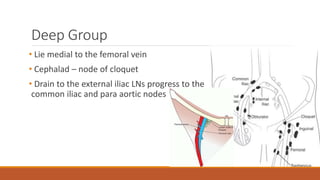
Deep Group
• Lie medial to the femoral vein
• Cephalad – node of cloquet
• Drain to the external iliac LNs progress to the
common iliac and para aortic nodes
Indications
• Penile carcinoma
• Vulvar carcinoma
• Anal cancers
• Melanoma with involvement of inguinal LNs
• Carcinoma affecting the lower limb
Controversies
• Low-volume nodal involvement in a sentinel lymph node
-----------------------------------------------------------------------------------
The Multicenter Selective Lymphadenectomy Trial-2 (MSLT-2 trial)
Incisions for Inguinal Lymphadenectomy
Classic Inguinal LND (Daseler)
• Landmarks
Techniques
• Incision (6-10cm), 2-4cm inferior & parallel to the inguinal ligament
• Carryout incision to the Scarpa’s fascia
• Raise skin flap
• Identify and ligate saphenous vein
• Mobilize superficial nodal tissue
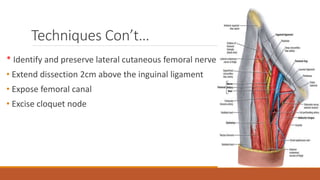
Techniques Con’t…
* Identify and preserve lateral cutaneous femoral nerve
• Extend dissection 2cm above the inguinal ligament
• Expose femoral canal
• Excise cloquet node
Techniques Con’t…
•
• Pelvic lymph node dissection
- Bulky disease in the superficial groin
- Four or more superficial inguinal nodes are positive
- Positive Cloquet node
- Evidence by PET/CT of disease
Modified Inguinal LND (Catalona)
 Key aspects
• Shorter skin incision
• Limited dissection
• Preservation of saphenous vein
• Eliminating the need to transpose the Sartorius muscle
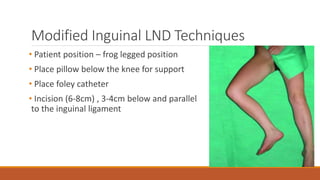
Modified Inguinal LND Techniques
• Patient position – frog legged position
• Place pillow below the knee for support
• Place foley catheter
• Incision (6-8cm) , 3-4cm below and parallel
to the inguinal ligament
Techniques Con’t…
• Incise down to the scarpa’s fascia
• Preserve subcutaneous tissue over the camper’s fascia
• Identify saphenous vein
• Dissect the superficial areolar and nodal tissue off the saphenous
vein to the fascia lata
• Ligate and divide venous branches contributing to saphenous vein
* Saphenous vein is preserved
Techniques Con’t…
• Dissection carried superiorly upto 2cm cephalad to the inguinal ligament
• Inferior dissection to ~4cm below the incision
• Specimen sent for frozen section evaluation
• wound irrigated and closed
• A closed suction drainage (5-7 days)
Enlarged or Ulcerated nodes
• Indurate skin
• Leave a 2cm margin
• Femoral vessel involvement – anterior
wall resection with reconstruction or
venous ligation
• Large skin defects – tensor fascia lata or
gracilis myocutanous flap
Videoscopic Inguinal Lymphadenectomy
• With laparoscopic equipment
• Lower wound complication
• Longer time
Videoscopic Inguinal Lymphadenectomy
Complications
• Skin flap necrosis
Complications Con’t…
• Lower limb lymphedema
Complications Con’t…
• Wound infection
• Tromboembolic problems
Sentinel Lymph Node Biopsy
• Standard of care for patients at high risk for nodal metastases
• In clinical stage I/II melanoma with tumor thickness from 1-4 mm
and clinically negative node basins
• 0.76-1.00 mm with specific features
• >4.00 mm tumors and clinically negative nodes
SLNB con’t…
• Preoperative lymphoscintigraphy
• Direct intraoperative visualization of
draining lymphatic patterns using a blue dye
• Identifies 15% to 20% of micrometastatic ds.
• Miss up to 12% of true-positive nodes
References
• UpToDate
Thank You!

Inguinal LND.pptx

  • 1.
  • 2.
    Outline • Anatomy • Indication •Types of inguinal LND • Complications • SLNB
  • 3.
    Anatomy • Superficial anddeep groups • Anatomically separated by the fascia lata of the thigh
  • 4.
    Superficial Group • 4– 25 LNs • Divided in to 5 anatomic groups
  • 5.
    Deep Group • Liemedial to the femoral vein • Cephalad – node of cloquet • Drain to the external iliac LNs progress to the common iliac and para aortic nodes
  • 6.
    Indications • Penile carcinoma •Vulvar carcinoma • Anal cancers • Melanoma with involvement of inguinal LNs • Carcinoma affecting the lower limb
  • 7.
    Controversies • Low-volume nodalinvolvement in a sentinel lymph node ----------------------------------------------------------------------------------- The Multicenter Selective Lymphadenectomy Trial-2 (MSLT-2 trial)
  • 8.
    Incisions for InguinalLymphadenectomy
  • 9.
    Classic Inguinal LND(Daseler) • Landmarks
  • 10.
    Techniques • Incision (6-10cm),2-4cm inferior & parallel to the inguinal ligament • Carryout incision to the Scarpa’s fascia • Raise skin flap • Identify and ligate saphenous vein • Mobilize superficial nodal tissue
  • 11.
    Techniques Con’t… * Identifyand preserve lateral cutaneous femoral nerve • Extend dissection 2cm above the inguinal ligament • Expose femoral canal • Excise cloquet node
  • 12.
  • 13.
  • 14.
    • Pelvic lymphnode dissection - Bulky disease in the superficial groin - Four or more superficial inguinal nodes are positive - Positive Cloquet node - Evidence by PET/CT of disease
  • 15.
    Modified Inguinal LND(Catalona)  Key aspects • Shorter skin incision • Limited dissection • Preservation of saphenous vein • Eliminating the need to transpose the Sartorius muscle
  • 16.
    Modified Inguinal LNDTechniques • Patient position – frog legged position • Place pillow below the knee for support • Place foley catheter • Incision (6-8cm) , 3-4cm below and parallel to the inguinal ligament
  • 17.
    Techniques Con’t… • Incisedown to the scarpa’s fascia • Preserve subcutaneous tissue over the camper’s fascia • Identify saphenous vein • Dissect the superficial areolar and nodal tissue off the saphenous vein to the fascia lata • Ligate and divide venous branches contributing to saphenous vein * Saphenous vein is preserved
  • 18.
    Techniques Con’t… • Dissectioncarried superiorly upto 2cm cephalad to the inguinal ligament • Inferior dissection to ~4cm below the incision • Specimen sent for frozen section evaluation • wound irrigated and closed • A closed suction drainage (5-7 days)
  • 19.
    Enlarged or Ulceratednodes • Indurate skin • Leave a 2cm margin • Femoral vessel involvement – anterior wall resection with reconstruction or venous ligation • Large skin defects – tensor fascia lata or gracilis myocutanous flap
  • 20.
    Videoscopic Inguinal Lymphadenectomy •With laparoscopic equipment • Lower wound complication • Longer time
  • 21.
  • 22.
  • 23.
  • 24.
    Complications Con’t… • Woundinfection • Tromboembolic problems
  • 25.
    Sentinel Lymph NodeBiopsy • Standard of care for patients at high risk for nodal metastases • In clinical stage I/II melanoma with tumor thickness from 1-4 mm and clinically negative node basins • 0.76-1.00 mm with specific features • >4.00 mm tumors and clinically negative nodes
  • 26.
    SLNB con’t… • Preoperativelymphoscintigraphy • Direct intraoperative visualization of draining lymphatic patterns using a blue dye • Identifies 15% to 20% of micrometastatic ds. • Miss up to 12% of true-positive nodes
  • 27.
  • 28.

Editor's Notes

  • #5 - Composed of 4 to 25 LNs that are situated in the deep membranous layer of the superficial fascia of the thigh (camper’s fascia) Superomedial nodes - around the superficial external pudendal and superficial epigastric veins Superolateral nodes - around the superficial circumflex vein Inferolateral nodes - around the lateral femoral cutaneous and superficial circumflex veins Inferomedial – around the greater saphenous vein Central nodes - around the saphinofemoral junction
  • #6 Fewer and lie primarily medial to the femoral vein in the femoral canal The node of cloquet is the most cephalad of this deep groups and is situated b/n the femoral vein and the inguinal ligament Common iliac LNs receive drainage from deep inguinal, obturator and hypogastric groups
  • #7 Dissection of the superficial inguinal lymph nodes is currently a recommended treatment for patients who have evidence of nodal metastatic disease from a variety of malignancies Generally, it is focused on patients who are presumed through staging to have stage III disease with tumor confined to the lymph node basin The goals of surgery are locoregional disease control with the possibility of long-term cure. The most common clinical scenarios for consideration of superficial inguinal lymph node dissection currently arise in patients with melanoma who have a positive sentinel lymph node biopsy (SLNB) some sarcomas like synovial cell sarcoma
  • #8 There are currently data from several retrospective studies and one prospective German study to suggest that for patients with low-volume nodal involvement in a sentinel lymph node, it may be unnecessary to perform a completion lymph node dissection The rationale is that the sentinel lymph node often is the only lymph node to contain tumor when a completion lymph node dissection is performed; and if the patient has additional lymph nodes involved, then he or she frequently will also harbor distant metastatic disease That randomized melanoma patients with a positive sentinel lymph node to completion lymphadenectomy surgery At the current time, most surgeons will still recommend a completion lymphadenectomy for patients with a positive SLNB in melanoma
  • #10 The boundaries of the femoral triangle Inguinal ligament superiorly, lateral border of the adductor muscle medially and medial border of the Sartorius muscle laterally In the operation of open inguinal lymphadenectomy, the fatty and lymphatic contents of the femoral triangle are cleared Next step is palpating the femoral artery and mark the femoral vessels To avoid wound breakdown and and skin edge necrosis we can resect the overlying skin with our dissection and make sure that the remaining skin can be closed primerly Infiltrate the incision site with adrenaline containing solution
  • #11 While a horizontal skin incision has the least morbidity associated with it, a vertical incision is also sometimes used if one is trying to incorporate a vertically placed SLNB incision With either incision, an attempt should be made to encompass the incision of any previous biopsy that was performed and to try and stay out of the biopsy cavity that may be present from a previous lymph node biopsy Skin incision is then made and carried out to the Scarpa’s fascia Flaps are raised from the skin edges deep to Scarpa fascia to the adductor longus medially and Sartorius muscles laterally The saphenous vein is identified at the junction of the sartorius and adductor muscles inferiorly and ligated Dissection is continued through the muscle aponeurosis The superficial nodal tissue is systematically mobilized, beginning in the superomedial quadrant, felling the tissue towards the junction of the saphenous vein with the femoral vein at the fossa ovalis Carry on from distal to proximal with removal of all the tissue along the vessel Meticulously ligate and divide any large lymphatics Visualize the neurovascular structures Identify the saphenous arch and ligate, preferably with 5-0 proline, and divide it
  • #12 Flaps are then raised superiorly to the inguinal ligament, and medial to the pubic tubercle The lateral cutaneous femoral nerve is identified at this point and preserved. It usually runs under the fascia of the sartorius muscle and becomes more superficial about 10 cm below the inguinal ligament where it divides into anterior and lateral branches Division of the saphenous vein from the femoral vein exposes the femoral sheath and scarpa’s triangle Femoral sheath is opened from the inguinal ligament to the apex of the femoral triangle, within the sheath are: the femoral vein, femoral artery lateral to it and fatty areolar tissue containing the deep inguinal nodes medially Dissection over the femoral triangle is accomplished in a lateral to medial direction clearing the lymph nodes from the femoral nerve and femoral artery All the fibrofatty tissues extending from the external oblique aponeurosis 2 cm above the inguinal ligament to the medial border of the adductor longus muscle medially and sartorius muscle laterally are removed The femoral canal is then explored to excise Cloquet node
  • #13 Cloquet node is the first node of the deep system, and to get to it one must tease apart the lacunar ligament that runs medially between the inguinal ligament and the pectineal (Cooper) ligament One needs to be careful to avoid injuring the femoral circumflex vessels as the node is being dissected out Once the node is removed, the defect in the lacunar ligament is repaired by using two simple 2-0 prolene stitches to pull the inguinal ligament down to the pectineal ligament. Care is taken not to close the space in a way that compresses the femoral vein If performing a sartorius flap, the sartorius muscle is divided in its superior aspect and transposed medially over the vessels and secured to the fascia of the external oblique. Care must be taken if doing this as the blood supply to the sartorius is segmental; and if one is not careful, devascularization of the muscle will occur. A closed suction drain is then placed within the femoral triangle.
  • #15 Iliac and hypogastric node dissections are generally performed for clinically or radiographically evident disease. Some individuals choose to perform a pelvic lymph node dissection if there is bulky disease in the superficial groin or four or more superficial inguinal nodes are positive due to the high incidence of pelvic nodal disease. preference is to only perform the deep nodal dissection if there is evidence by PET/CT of disease or Cloquet node is positive. There are several ways to approach the pelvic lymph nodes. One can extend the superficial skin incision by making a lazy-S type of incision Transecting the inguinal ligament is generally avoided because it increases morbidity and increases wound healing issues preferred approach to provide access to the retroperitoneal space is to make a separate incision in the lower abdominal musculature, leaving the inguinal ligament intact Dissect the external iliac and obturator nodes
  • #16 Limitation of dissection by excluding the area lateral to the femoral artery and caudal to the fossa ovalis
  • #17 - Retract scrotum and penis out of the field and draped off
  • #18 (gentle sponge traction is used to separate the skin edges) Subcutaneous tissue over the campers layer is carefully preserved and meticulous handling of this tissues and the skin edge must be observed throughout The saphenous vein and its tributes are identified and the superficial areolar and node bearing tissue is gently dissected off the vein downward to the fascia lata Large lymphatics and small venous branches must be ligated
  • #19 Dissection carried superiorly to approximately 2cm cephalad to the inguinal ligament where it is carried down to the fascia of the external oblique muscle In the catalona operation the lower limit of dissection is the lower border of the fossa ovalis Some surgeons carry out there dissections slightly lower, although there is not much superficial nodal tissue in this area FS – if nodes are negative the wound is thoroughly irrigated with sterile water and closed in layers. Taking care to eliminate any potential spaces A closed suction drainage system is placed and remains 5 to 7 days during which time the patient is maintained at complete bed rest
  • #20 Induration of skin is suggestive of such local invasion In this setting the tumor is excised leaving a 2cm margin of normal skin around the indurated or ulcerated area Involvement of the femoral vessels, particularly the vein. Resection of the anterior wall of the vein with reconstruction using a saphenous vein graft or Gore-tex patch maybe required In severe involvement the vein might be ligated and excised
  • #21 Recently a new technical way of preforming an inguinal lymphadenectomy has been described called a videoscopic inguinal lymphadenectomy This procedure uses laparoscopic equipment to dissect out the lymph node tissue and uses very small skin incisions that are much further from the inguinal crease than the open incision The initial studies suggest that there are significantly lower wound complications in these patients, but it comes at the expense of a longer operative procedure and longer lymphatic drainage postoperative We use three incisions at the apex of the femoral triangle – trocar entery
  • #22 positioning patients supine on a split-leg table The surgeon is positioned between the patient’s legs, and the assistant stands to the outside of the operative limb. Monitors are placed cephalad above each shoulder, with the laparoscopic tower strategically positioned on the side of the operative limb. Trocar placement for a three-incision
  • #23 Inguinal lymph node dissection is associated with moderate morbidity. Several large centers have reported morbidity of 50% or higher related mainly to wound healing issues in the inguinal area Skin edge necrosis can occur if skin flaps are made too thin Can be minimized with selecting the appropriate incision and by carful tissue handling Transposing the head of the Sartorius muscle to cover the defect left over the femoral vessels Use of intravenous fluorescein dye and a woods’ lamp intraoperatively to assess viability of wound edge
  • #24 Many techniques have been reported to reduce postoperative lymphedema, such as preserving the muscle fascia, pedicled omentoplasty, and saphenous vein sparing inguinal lymphadenectomy systematic reviews and meta-analysis appear to suggest that preserving the saphenous vein has the strongest evidence to help minimize leg edema and that a sartorius transposition does not prevent complications. Can be reduced by careful attention to intraoperative ligation of lymphatics By immobilization of the limb in the post operative period By suction drainage of the lymphedema Elastic support should be used in the immediate postoperative period and maybe required long term in many patients
  • #25 WI can be minimized intensive preoperative antibiotic therapy to reduce infection and inflammation from the primary and by the use of prophylactic antibiotics TE maybe avoided through the use of subcutaneous heparin in perioperative period, particularly when classical inguinal and pelvic dissection is combined with prolonged bed rest postoperatively
  • #26 The sentinel lymph node is the first lymph node in the drainage basin to receive afferent lymphatic communication from the primary tumor site, prior to spread to the other nodes in this region It was suggestedthat selective sampling of this important "marker" could serve as an accurate predictor of involvement of the rest of the nodal basin. Supported by numerous prospective randomized clinical trials, the feasibility and accuracy of sentinel lymph node biopsy has been definitively established 0.76-1.00 mm with features such as ulceration, lymphovascular invasion, age <40 years, significant vertical growth phase, and increased mitotic rate.
  • #27 The process of sentinel lymph node biopsy involves mapping the sentinel lymph node by two complementary techniques: preoperative lymphoscintigraphy and direct intraoperative visualization of draining lymphatic patterns using a blue dye. Typically on the morning of surgery, patients receive an injection of r-emitting radioactive colloid (commonly technetium-.99m) around the primary tumor site, followed by serial images of the r-emission pattern As the colloid enters the lymphatic channels surrounding the lesion, it travels to the first lymph node where it collects, forming a "hot spot" on the emission imaging FIGURE 14.7. Lymphoscintigraphy demonstrates localization of radioactive colloid to the sentinel lymph node. This identifies the anatomic location of the sentinel node, but gives no information as to whether it contains metastatic melanoma. This area is marked and the patient is sent to the operating suite with the images to guide the surgeon in identification of the sentinel node Following induction of general anesthesia, a second lymphatic mapping technique is used for intraoperative identification of the sentinel node Blue dye is injected intradermally around the primary melanoma and massaged for approximately 5 minutes to augment dye flow in the lymphatic channels Based on the post-emission imaging and marking, a limited incision is made over the site of the proposed sentinel node, and dissection into the lymphatic basin is guided by the use of a handheld y-probe and the presence of blue dye in lymphatic channels or nodes The ideal sentinel node identification would be a single blue lymph node with significant r-emission The sentinel node is then excised, taking care not to disturb the channels of the surrounding lymph node basin