CHANGING CONCEPT OF
CLASSROOM ENVIRONMENT
GAYATHRI DEVI A.J
B.ED NATURAL SCIENCE
GCTE, THYCAUD
PRESENTED BY:
CLASSROOM CLIMATE
● Identifies relationships among students with
each other, the teacher and how this translates
into learning.
● Includes a broad range of educational concepts,
including the physical setting, the psychological
and numerous instructional components
related to teacher characteristics and
behaviours.
CLASSROOM
CLIMATE
Physical
Setting
Instructional
Components
Classroom
Interaction
Psychological
Environment
TOOLS TO DETERMINE CLASSROOM
CLIMATE
OPINION
➢Generated from
information,
statistics on student
and teacher
performance
➢Opinion is generated
by reviewing student
PERCEPTION
➢Observation of the
behaviours in the
classroom
➢Analysis on the
attitude toward
student
achievement, toward
CONDUCIVE CLASSROOM
ENVIRONMENT
• Refers to the mood and atmosphere in the class
that motivates students to participate in active
learning and to be engaged in classroom
activities
CLASSROOM MANAGEMENT
STRATEGIES
FUNCTIONAL CLASSROOM ARRANGEMENT
• LIGHTING AND PROPER TEMPERATURE
PUNISHMENT AND REWARDS
• REMOVE TOXIC ELEMENTS
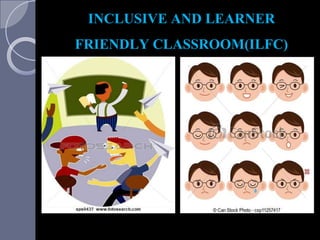
INCLUSIVE AND LEARNER
FRIENDLY CLASSROOM(ILFC)
INCLUSIVE AND LEARNER
FRIENDLY CLASSROOM(ILFC)
ies
Gifted children and children with
physical or learning disabilities
URCE WEB SERVICES
RIAL,SYLLABI,LESSON PLAN ETC.. .
CLASSROOM AS A SOCIAL LABORATORY
VIRTUAL LEARNING ENVIRONMENT
(VLE)
VIRTUAL LEARNING ENVIRONMENT
(VLE)
● A set of teaching and learning tools designed
to enhance a student's learning experience by
including computers and Internet in the
learning process.
● They can be accessed both on and off-
campus, meaning that they can support
students' learning outside the lecture hall 24
hours a day, seven days a week
DEFINITION: Virtual learning environment or
learning platform is an e-learning education system
based on the web that models conventional in-
person education by providing equivalent virtual
access to classes, class content, tests, homework,
grades, assessments and other resources such as
academic or museum links.
SYNCHRONOUS
• “Real time” live and online
teacher instruction and feedback
ASYNCHRONOUS
• “Self paced” independent online
lessons and assignments
Virtual learning can be :
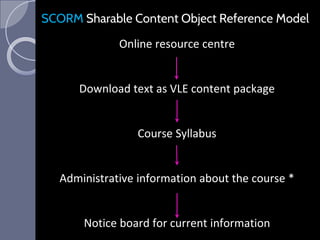
Online resource centre
Download text as VLE content package
Course Syllabus
Administrative information about the course *
Notice board for current information
SCORM Sharable Content Object Reference Model
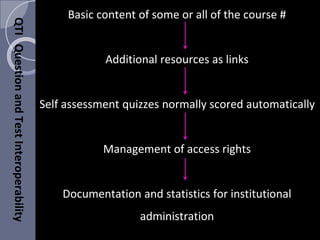
Basic content of some or all of the course #
Additional resources as links
Self assessment quizzes normally scored automatically
Management of access rights
Documentation and statistics for institutional
administration
QTIQuestionandTestInteroperability
A Higher Education institution is likely to have a licence for a
VLE that fits into any one of the following three categories:
• off-the-shelf, such as Blackboard or WebCT
• open source (often free to use and adapt but support is
charged for), such as Moodle
PURPOS
E OF
VLE
Content
management
– creation,
storage, access
to and use of
learning
resources
Curriculum
mapping and
planning –
lesson
planning,
assessment
and
personalisation
of the learning
experience
Learner
engagement
and
administratio
n – managed
access to
learner
information
Communicati
on and
collaboration
- emails,
Facilitate the
networking of
instruction
between
different
campuses or
even colleges
Economize on
the time of
teaching staff,
and the cost of
instruction.
Facilitate the
presentation of
online learning
by instructors
without web
authoring
experience
Provide
instruction to
students in a
flexible manner
to students
with varying
time and
location
constraints
Provide
instruction in a
manner
familiar to the
current web-
oriented
generation of
students
Provide for the
reuse of
common
material
In principle a learning platform is a safe and secure e
THANK YOU

Seminar 2 changing classroom environment

  • 2.
  • 3.
    GAYATHRI DEVI A.J B.EDNATURAL SCIENCE GCTE, THYCAUD PRESENTED BY:
  • 4.
    CLASSROOM CLIMATE ● Identifiesrelationships among students with each other, the teacher and how this translates into learning. ● Includes a broad range of educational concepts, including the physical setting, the psychological and numerous instructional components related to teacher characteristics and behaviours.
  • 5.
  • 6.
    TOOLS TO DETERMINECLASSROOM CLIMATE OPINION ➢Generated from information, statistics on student and teacher performance ➢Opinion is generated by reviewing student PERCEPTION ➢Observation of the behaviours in the classroom ➢Analysis on the attitude toward student achievement, toward
  • 7.
    CONDUCIVE CLASSROOM ENVIRONMENT • Refersto the mood and atmosphere in the class that motivates students to participate in active learning and to be engaged in classroom activities
  • 8.
    CLASSROOM MANAGEMENT STRATEGIES FUNCTIONAL CLASSROOMARRANGEMENT • LIGHTING AND PROPER TEMPERATURE PUNISHMENT AND REWARDS • REMOVE TOXIC ELEMENTS
  • 9.
  • 10.
  • 11.
    ies Gifted children andchildren with physical or learning disabilities
  • 12.
  • 13.
    CLASSROOM AS ASOCIAL LABORATORY
  • 14.
  • 15.
    VIRTUAL LEARNING ENVIRONMENT (VLE) ●A set of teaching and learning tools designed to enhance a student's learning experience by including computers and Internet in the learning process. ● They can be accessed both on and off- campus, meaning that they can support students' learning outside the lecture hall 24 hours a day, seven days a week
  • 16.
    DEFINITION: Virtual learningenvironment or learning platform is an e-learning education system based on the web that models conventional in- person education by providing equivalent virtual access to classes, class content, tests, homework, grades, assessments and other resources such as academic or museum links.
  • 17.
    SYNCHRONOUS • “Real time”live and online teacher instruction and feedback ASYNCHRONOUS • “Self paced” independent online lessons and assignments Virtual learning can be :
  • 19.
    Online resource centre Downloadtext as VLE content package Course Syllabus Administrative information about the course * Notice board for current information SCORM Sharable Content Object Reference Model
  • 20.
    Basic content ofsome or all of the course # Additional resources as links Self assessment quizzes normally scored automatically Management of access rights Documentation and statistics for institutional administration QTIQuestionandTestInteroperability
  • 21.
    A Higher Educationinstitution is likely to have a licence for a VLE that fits into any one of the following three categories: • off-the-shelf, such as Blackboard or WebCT • open source (often free to use and adapt but support is charged for), such as Moodle
  • 22.
    PURPOS E OF VLE Content management – creation, storage,access to and use of learning resources Curriculum mapping and planning – lesson planning, assessment and personalisation of the learning experience Learner engagement and administratio n – managed access to learner information Communicati on and collaboration - emails,
  • 23.
    Facilitate the networking of instruction between different campusesor even colleges Economize on the time of teaching staff, and the cost of instruction. Facilitate the presentation of online learning by instructors without web authoring experience Provide instruction to students in a flexible manner to students with varying time and location constraints Provide instruction in a manner familiar to the current web- oriented generation of students Provide for the reuse of common material
  • 24.
    In principle alearning platform is a safe and secure e
  • 25.