Online LearningOnline Learning
BY
Col Mukteshwar Prasad (Retd),
M Tech(IIT Delhi) ,
CE(I),FIE(I),FIETE,FISLE,FInstOD,AMCSI
Contact -+919007224278,
e-mail -muktesh_prasad@yahoo.co.in
Ref-Strategies for Virtual Learning Environments:
Focusing on Teaching Presence and Teaching
Immediacy
Misha Chakraborty
Definition
• Online learning is defined as a
medium where content is delivered
via the Internet. The terms online
learning, e-learning, computer-based
learning, distance learning and
virtual learning are used
synonymously
Definition…2
• Tudorache, Iordache and Iordache
(2012) portrayed e learning as “a
type of education where the
medium of instruction is
computer technology. No in-
person interaction may take place
in some instances. E-learning is
used interchangeably in a wide
variety of contexts”
Introduction
• Online student enrolment has
increased drastically in past few
years. More than 6.7 million
students took at least one online
course during 2011, an increase of
570,000 students compared to the
previous year” (Allen & Seaman,
2014, p. 7).
• 32% of students are taking at least
one online class
Introduction..2
• 77% of academic leaders rate online
learning outcomes as equal or superior
to that of a traditional class setting.
• “For the past eight years online
enrollments have been growing
substantially faster than overall higher
education enrollments”
• In organizational settings also online
training is becoming an integral part of
the success strategy (Fagan, 2014):
Introduction…3
• E-learning is part of the biggest change
in training since the invention of the
chalkboard or perhaps the alphabet.
• The development of computers and
electronic communications has removed
barriers of space and time. We can
obtain and deliver knowledge anytime
anywhere. (Horton, 2000, p. 6).
• Online classes are consistently imparting
and improving knowledge of learners
separated by geographical distances.
Introduction…4
• The limitless expansion beyond
geographical boundaries attract a large
pool of talent without incurring travel
and physical expenses related to
traditional face-to-face classes
• The increase in the number of people
using Internet is directly related to the
greater demand of online classes.
• The increasing demand by diverse learners
separated by geographic distances is
noticed by profit /non-profit org
Introduction…5
• Many institutions in the west offer almost
60% courses on line. Mgutshini (2012)
summarizes
• “Developments in computing, particularly with respect to the
use of the Internet, have fueled an unprecedented growth in the
use of technology-based environments within education.
Notably, both distance-learning institutions, as well as
conventional academic institutions have integrated a range of
electronic learning environments, such as virtual discussion
rooms, podcasts, virtual simulations and Twitter boards into
their curricula. A number of reasons for these developments
have been offered. Web-based strategies are seen as
representing a revolutionary progression in learning through
the flexibility of occurring anywhere, at any time and at a lesser
cost than face to- face alternatives “.
Introduction…6
• Rapidly changing nature of technological
innovation impacts the delivery of course
content, the face of content delivery also
changes
• Emerging technological innovations are
creating scope to create interactive and
flexible online learning environments.
Challenges & Oppertunities
• Shift from interactive and familiar,
traditional classroom settings to virtual
environments may be challenging to both
the instructor and the learner. The
challenges identified in the literature
include:
– Very limited supervision from the
instructor (Mgutshini, 2012);
– Inefficient use of technology (Bonk
&Graham 2006); and
– Lack of communication (Yang, Yeh &
Challenges & Oppertunities….2
• Online classes offer learners the unique opportunity
– To reflect and research before responding to issues
being discussed in class as against face-to-face
classes, where learners have to respond to issues
sometimes without much reflection and research.
– With the increased use of computers, cell phones, the
Internet, and other wireless devices, today’s learners
are more connected than ever before, yet
• disconnected at the same time--especially from the
interruptions created by mobile devise (La Roche
& Flanigan, 2012).
Challenges & Oppertunities…3
• Hence the course instructor must communicate
with the disconnected or distracted students to
increase their interaction with the course
content and give them a sense of community.
• As La Roche and Flanigan (2012) pointed out,
“The creation of a meaningful learning
environment is the key to enhancing the
educational experience. It is generally agreed
that engaged students learn more and retain
more of what they learn” .
The Value for Learner Engagement in
Virtual Learning Environments
• Important Factors in educational and
organizational setting for Online classes, online
learning and teaching professional development
– Engagement,
– Motivation
– Learning
– Formation of a positive environment, where
learners are capable of creating inclusive learning
experiences (Keller, 2008).
– Suitable teaching presence strategies and teaching
immediacy to help improve learning and
performance at the individual level so important in
traditional face-to-face class settings.
The Value for Learner Engagement in
Virtual Learning Environments
• Engagement
• La Roche and Flanigan (2012) defined student
engagement as activities that involve students’ ‘active
cognition processes’ .
• Hence, creating and delivering instruction and learning
activities and assignments aimed toward involving
learners in online class environments is required for
student engagement in an online class context.
• The challenge of keeping students engaged and
motivated for Online courses,
• present a special concern. With students and faculty in
contact only via the Internet several new challenges
arise
Overview: Community ofOverview: Community of
Inquiry FrameworkInquiry Framework
Community
• … community means meaningful
association, association based on
common interest and endeavor.
The essence of community is
communication, …
>>John Dewey
Inquiry
• Is problem or question driven
• Typically has a small-group
feature
• Includes critical discourse
• Is frequently multi-disciplinary
• Incorporates research methods
such as information gathering and
synthesis of ideas”
University
• The word university is derived
from the Latin universitas
magistrorum et scholarium,
roughly meaning "community of
masters and scholars”.
Community of Inquiry
• The importance of a community
of inquiry is that, while the
objective of critical reflection is
intellectual autonomy, in reality,
critical reflection is “thoroughly
social and communal”.
>>Lipman, 1991
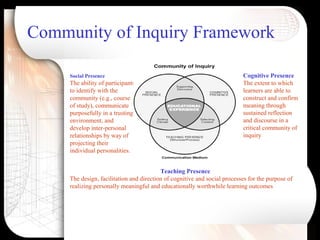
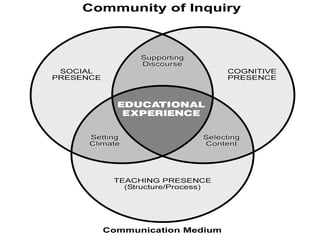
Community of Inquiry Framework
Social Presence
The ability of participants
to identify with the
community (e.g., course
of study), communicate
purposefully in a trusting
environment, and
develop inter-personal
relationships by way of
projecting their
individual personalities.
Cognitive Presence
The extent to which
learners are able to
construct and confirm
meaning through
sustained reflection
and discourse in a
critical community of
inquiry
Teaching Presence
The design, facilitation and direction of cognitive and social processes for the purpose of
realizing personally meaningful and educationally worthwhile learning outcomes
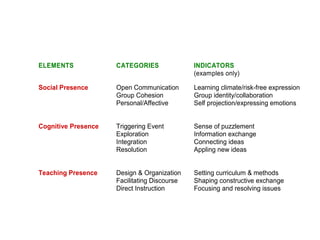
ELEMENTS CATEGORIES INDICATORS
(examples only)
Social Presence Open Communication Learning climate/risk-free expression
Group Cohesion Group identity/collaboration
Personal/Affective Self projection/expressing emotions
Cognitive Presence Triggering Event Sense of puzzlement
Exploration Information exchange
Integration Connecting ideas
Resolution Appling new ideas
Teaching Presence Design & Organization Setting curriculum & methods
Facilitating Discourse Shaping constructive exchange
Direct Instruction Focusing and resolving issues
Teaching Presence
• The design, facilitation, and
direction of cognitive and social
processes for the purpose of
realizing personally meaningful
and educationally worthwhile
learning outcomes.
TP Categories
• Design & Organization
• Facilitation
• Direct Instruction
Teaching presence or instructor’s presence
(Denoted by the role of instructors in online class environments. )
• Garrison and Archer (2001) defined teaching presence as “the
design, facilitation, and direction of cognitive and social
processes for the purpose of realizing personally meaningful and
educational worthwhile learning outcomes” .
– Designing and facilitating are ways to ensure cognitive and
social learning experiences .
• The consensus is that teaching presence is a significant determinate
of
– Student satisfaction,
– Perceived learning, and
– Sense of community
• Researchers acknowledge that teaching presence is positively
related to
– students’ success,
– students’ perceived learning and
– sense of community
Teaching immediacy
(An instructor’s availability as perceived by the learners.)
• Teaching immediacy is denoted through the
accessibility and availability of the instructor to the
students.
• Forming a learning community among emotional and
cognitive development
• This concept urges course design such that students can
contribute to the evolving knowledge base of the group,
while developing underlying social networks within their
course.
• Under mentioned terms are used interchangeably
– community of learners’,
– ‘knowledge-building communities’,
– ‘virtual learning communities’, or
Teaching Presence and immediacy
• We must answer following question
• 1. What role does teaching presence play
on online learners’ perceptions regarding
• virtual learning environments?
• Optimal Learning Experience
• 2. What role does instructors’ immediacy
play on online learners’ experience?
Latest Finding (Instructor’s Presence)
• In face-to-face classes instructors can interact with
students and receive verbal and Non verbal cues to
understand learners’ level of engagement.
• In online classes learners often look for a similar type of
‘virtual visibility’ from their instructors or facilitators
• Timely feedback enhances the student/Instructor
relationship and contributes to a healthy classroom
dynamic.
• The online student has an expectation of immediate
feedback for any and all concerns.
• They may feel isolated; therefore the Instructor has to
manage the online environment differently than a face-
to-face classroom
Latest Finding (Instructor’s Presence)
• Ways to denote teaching presence (to ensure a personal
touch from the teacher and enabling students to actually
relate to the teacher or the instructor.) in online class
environments.
– Paying attention to “creating or repurposing”
contents like
• lecture notes,
• adding teachers’ comments,
• posting video lectures,
• including personalized inputs etc.
Latest Finding (Instructor’s Presence)
• Teaching Presence play a role in creating online learning
Community
– This must also plt dual role of
• Moderating discourse
• Shaping the direction of discourse
• Instructors need to understand when they need to
facilitate or direct online discussions
• Depending upon the role they play in
classroomTeacher’s functions may be
– managerial,
– social,
– organizational or
– Technical
Latest Finding (Instructor’s Presence)
• The relation between teaching presence and students’
perceived learning may be
– To help students engage in learning-oriented online
discussions.
– To enhance critical thinking in students.
– The leadership role of in deciding cognitive content
quality in the class activities.
Latest Finding (Instructor’s Immediacy)
• Immediacy of a teacher affects students’ affective
learning and therefore, students’ achievement.
• Timely and constructive feedback can play significant
role in ensuring learners’ engagement. Hence verbally
explicit immediate feedback influenced learners’ self-
perceived cognitive and affective learning and therefore,
increased engagement in online class environment.
• The trend of offering online classes compels us to
explore strategies to engage learners in online class
environment.
• . The flexibility available in online classes is one of the
reasons for its increasing popularity in both educational
and professional settings.
Latest Finding (Instructor’s Immediacy)
• These interactions can be enhanced through the use of
innovative and appropriate technology.
• It is the responsibility of the online class provider to
offer interesting and engaging
• learning environments where the learners not only learn
the content, but also have a positive and safe experience.
• The online interaction is describes as sine qua non in
online class environment, however, interactions alone
cannot guarantee cognitive development and content
learning quality in online class environment
On Line Courses
• Motivation plays significant role in deciding whether s
student will succeed in a class environment. Therefore,
the instructors need to pay attention on students’
motivation.
• Motivation plays a vital role in online class environment
as it depends on learners’ self directed learning pace.
Role of Instructors in On Line Environment
• Unique roles of instructors are
• Course Facilitator. Clear instructions in facilitation
increase learner and instructor interactions. Instructor’s
presence and immediacy in providing feedback are also
capable of creating learner and instructor interactionsThe
concept of "Emergency help line" solely created to
address students’ concerns is one solution.
• Subject Matter Expert. In online classes instructors can
attempt to encourage creating information repository and
sharing information: “when managed effectively,
discussion forums can encourage learners to share
information, build on the ideas of others, and construct
understanding about the changing world of
technologyAccessibility to resources increases the
interactions between learners and content.
Role of Instructors in On Line Environment
• Manager. Students learn in different ways and therefore, online
class environments should
• consist of various measures like, lectures, videos, handouts,
graphics, and activities to satisfy
• learners with different learning style .The importance of social
interactions and learning by thinking and doing using Learners’
previous experiences can facilitate their learning.
• Course Designer. The importance of using technology effectively
to achieve learners’ engagement in online class environment should
not become the sole focus of the class. Technology in many cases,
acts as a medium to deliver content to the learners. It does not aid in
the content itself. “The concept of teaching and learning is driven
by the pedagogical principles of teaching and learning rather
than technology itself, which captures the principles of effective
e-learning” Hence, learners should be provided with clear
instructions and navigation guides to get them acquainted with the
learning management system that is used to deliver the course.
Role of Instructors in On Line Environment
• Offir, Barth and Shteinbok, (2003) included the following roles for
instructors:
• Social (positive environment through interactions),
• Procedural (addressing administrative and technical issues related
to the lesson or course),
• Expository (providing resources),
• Explanatory (answering questions),
• Cognitive task engagement (enabling learners to process content),
and
• Learning assistance interactions (ensuring retention) (p. 71).

Online Learning and courses

  • 1.
    Online LearningOnline Learning BY ColMukteshwar Prasad (Retd), M Tech(IIT Delhi) , CE(I),FIE(I),FIETE,FISLE,FInstOD,AMCSI Contact -+919007224278, e-mail -muktesh_prasad@yahoo.co.in Ref-Strategies for Virtual Learning Environments: Focusing on Teaching Presence and Teaching Immediacy Misha Chakraborty
  • 2.
    Definition • Online learningis defined as a medium where content is delivered via the Internet. The terms online learning, e-learning, computer-based learning, distance learning and virtual learning are used synonymously
  • 3.
    Definition…2 • Tudorache, Iordacheand Iordache (2012) portrayed e learning as “a type of education where the medium of instruction is computer technology. No in- person interaction may take place in some instances. E-learning is used interchangeably in a wide variety of contexts”
  • 4.
    Introduction • Online studentenrolment has increased drastically in past few years. More than 6.7 million students took at least one online course during 2011, an increase of 570,000 students compared to the previous year” (Allen & Seaman, 2014, p. 7). • 32% of students are taking at least one online class
  • 5.
    Introduction..2 • 77% ofacademic leaders rate online learning outcomes as equal or superior to that of a traditional class setting. • “For the past eight years online enrollments have been growing substantially faster than overall higher education enrollments” • In organizational settings also online training is becoming an integral part of the success strategy (Fagan, 2014):
  • 6.
    Introduction…3 • E-learning ispart of the biggest change in training since the invention of the chalkboard or perhaps the alphabet. • The development of computers and electronic communications has removed barriers of space and time. We can obtain and deliver knowledge anytime anywhere. (Horton, 2000, p. 6). • Online classes are consistently imparting and improving knowledge of learners separated by geographical distances.
  • 7.
    Introduction…4 • The limitlessexpansion beyond geographical boundaries attract a large pool of talent without incurring travel and physical expenses related to traditional face-to-face classes • The increase in the number of people using Internet is directly related to the greater demand of online classes. • The increasing demand by diverse learners separated by geographic distances is noticed by profit /non-profit org
  • 8.
    Introduction…5 • Many institutionsin the west offer almost 60% courses on line. Mgutshini (2012) summarizes • “Developments in computing, particularly with respect to the use of the Internet, have fueled an unprecedented growth in the use of technology-based environments within education. Notably, both distance-learning institutions, as well as conventional academic institutions have integrated a range of electronic learning environments, such as virtual discussion rooms, podcasts, virtual simulations and Twitter boards into their curricula. A number of reasons for these developments have been offered. Web-based strategies are seen as representing a revolutionary progression in learning through the flexibility of occurring anywhere, at any time and at a lesser cost than face to- face alternatives “.
  • 9.
    Introduction…6 • Rapidly changingnature of technological innovation impacts the delivery of course content, the face of content delivery also changes • Emerging technological innovations are creating scope to create interactive and flexible online learning environments.
  • 10.
    Challenges & Oppertunities •Shift from interactive and familiar, traditional classroom settings to virtual environments may be challenging to both the instructor and the learner. The challenges identified in the literature include: – Very limited supervision from the instructor (Mgutshini, 2012); – Inefficient use of technology (Bonk &Graham 2006); and – Lack of communication (Yang, Yeh &
  • 11.
    Challenges & Oppertunities….2 •Online classes offer learners the unique opportunity – To reflect and research before responding to issues being discussed in class as against face-to-face classes, where learners have to respond to issues sometimes without much reflection and research. – With the increased use of computers, cell phones, the Internet, and other wireless devices, today’s learners are more connected than ever before, yet • disconnected at the same time--especially from the interruptions created by mobile devise (La Roche & Flanigan, 2012).
  • 12.
    Challenges & Oppertunities…3 •Hence the course instructor must communicate with the disconnected or distracted students to increase their interaction with the course content and give them a sense of community. • As La Roche and Flanigan (2012) pointed out, “The creation of a meaningful learning environment is the key to enhancing the educational experience. It is generally agreed that engaged students learn more and retain more of what they learn” .
  • 13.
    The Value forLearner Engagement in Virtual Learning Environments • Important Factors in educational and organizational setting for Online classes, online learning and teaching professional development – Engagement, – Motivation – Learning – Formation of a positive environment, where learners are capable of creating inclusive learning experiences (Keller, 2008). – Suitable teaching presence strategies and teaching immediacy to help improve learning and performance at the individual level so important in traditional face-to-face class settings.
  • 14.
    The Value forLearner Engagement in Virtual Learning Environments • Engagement • La Roche and Flanigan (2012) defined student engagement as activities that involve students’ ‘active cognition processes’ . • Hence, creating and delivering instruction and learning activities and assignments aimed toward involving learners in online class environments is required for student engagement in an online class context. • The challenge of keeping students engaged and motivated for Online courses, • present a special concern. With students and faculty in contact only via the Internet several new challenges arise
  • 15.
    Overview: Community ofOverview:Community of Inquiry FrameworkInquiry Framework
  • 16.
    Community • … communitymeans meaningful association, association based on common interest and endeavor. The essence of community is communication, … >>John Dewey
  • 17.
    Inquiry • Is problemor question driven • Typically has a small-group feature • Includes critical discourse • Is frequently multi-disciplinary • Incorporates research methods such as information gathering and synthesis of ideas”
  • 18.
    University • The worduniversity is derived from the Latin universitas magistrorum et scholarium, roughly meaning "community of masters and scholars”.
  • 19.
    Community of Inquiry •The importance of a community of inquiry is that, while the objective of critical reflection is intellectual autonomy, in reality, critical reflection is “thoroughly social and communal”. >>Lipman, 1991
  • 20.
    Community of InquiryFramework Social Presence The ability of participants to identify with the community (e.g., course of study), communicate purposefully in a trusting environment, and develop inter-personal relationships by way of projecting their individual personalities. Cognitive Presence The extent to which learners are able to construct and confirm meaning through sustained reflection and discourse in a critical community of inquiry Teaching Presence The design, facilitation and direction of cognitive and social processes for the purpose of realizing personally meaningful and educationally worthwhile learning outcomes
  • 22.
    ELEMENTS CATEGORIES INDICATORS (examplesonly) Social Presence Open Communication Learning climate/risk-free expression Group Cohesion Group identity/collaboration Personal/Affective Self projection/expressing emotions Cognitive Presence Triggering Event Sense of puzzlement Exploration Information exchange Integration Connecting ideas Resolution Appling new ideas Teaching Presence Design & Organization Setting curriculum & methods Facilitating Discourse Shaping constructive exchange Direct Instruction Focusing and resolving issues
  • 23.
    Teaching Presence • Thedesign, facilitation, and direction of cognitive and social processes for the purpose of realizing personally meaningful and educationally worthwhile learning outcomes.
  • 24.
    TP Categories • Design& Organization • Facilitation • Direct Instruction
  • 25.
    Teaching presence orinstructor’s presence (Denoted by the role of instructors in online class environments. ) • Garrison and Archer (2001) defined teaching presence as “the design, facilitation, and direction of cognitive and social processes for the purpose of realizing personally meaningful and educational worthwhile learning outcomes” . – Designing and facilitating are ways to ensure cognitive and social learning experiences . • The consensus is that teaching presence is a significant determinate of – Student satisfaction, – Perceived learning, and – Sense of community • Researchers acknowledge that teaching presence is positively related to – students’ success, – students’ perceived learning and – sense of community
  • 26.
    Teaching immediacy (An instructor’savailability as perceived by the learners.) • Teaching immediacy is denoted through the accessibility and availability of the instructor to the students. • Forming a learning community among emotional and cognitive development • This concept urges course design such that students can contribute to the evolving knowledge base of the group, while developing underlying social networks within their course. • Under mentioned terms are used interchangeably – community of learners’, – ‘knowledge-building communities’, – ‘virtual learning communities’, or
  • 27.
    Teaching Presence andimmediacy • We must answer following question • 1. What role does teaching presence play on online learners’ perceptions regarding • virtual learning environments? • Optimal Learning Experience • 2. What role does instructors’ immediacy play on online learners’ experience?
  • 29.
    Latest Finding (Instructor’sPresence) • In face-to-face classes instructors can interact with students and receive verbal and Non verbal cues to understand learners’ level of engagement. • In online classes learners often look for a similar type of ‘virtual visibility’ from their instructors or facilitators • Timely feedback enhances the student/Instructor relationship and contributes to a healthy classroom dynamic. • The online student has an expectation of immediate feedback for any and all concerns. • They may feel isolated; therefore the Instructor has to manage the online environment differently than a face- to-face classroom
  • 30.
    Latest Finding (Instructor’sPresence) • Ways to denote teaching presence (to ensure a personal touch from the teacher and enabling students to actually relate to the teacher or the instructor.) in online class environments. – Paying attention to “creating or repurposing” contents like • lecture notes, • adding teachers’ comments, • posting video lectures, • including personalized inputs etc.
  • 31.
    Latest Finding (Instructor’sPresence) • Teaching Presence play a role in creating online learning Community – This must also plt dual role of • Moderating discourse • Shaping the direction of discourse • Instructors need to understand when they need to facilitate or direct online discussions • Depending upon the role they play in classroomTeacher’s functions may be – managerial, – social, – organizational or – Technical
  • 32.
    Latest Finding (Instructor’sPresence) • The relation between teaching presence and students’ perceived learning may be – To help students engage in learning-oriented online discussions. – To enhance critical thinking in students. – The leadership role of in deciding cognitive content quality in the class activities.
  • 33.
    Latest Finding (Instructor’sImmediacy) • Immediacy of a teacher affects students’ affective learning and therefore, students’ achievement. • Timely and constructive feedback can play significant role in ensuring learners’ engagement. Hence verbally explicit immediate feedback influenced learners’ self- perceived cognitive and affective learning and therefore, increased engagement in online class environment. • The trend of offering online classes compels us to explore strategies to engage learners in online class environment. • . The flexibility available in online classes is one of the reasons for its increasing popularity in both educational and professional settings.
  • 34.
    Latest Finding (Instructor’sImmediacy) • These interactions can be enhanced through the use of innovative and appropriate technology. • It is the responsibility of the online class provider to offer interesting and engaging • learning environments where the learners not only learn the content, but also have a positive and safe experience. • The online interaction is describes as sine qua non in online class environment, however, interactions alone cannot guarantee cognitive development and content learning quality in online class environment
  • 35.
    On Line Courses •Motivation plays significant role in deciding whether s student will succeed in a class environment. Therefore, the instructors need to pay attention on students’ motivation. • Motivation plays a vital role in online class environment as it depends on learners’ self directed learning pace.
  • 36.
    Role of Instructorsin On Line Environment • Unique roles of instructors are • Course Facilitator. Clear instructions in facilitation increase learner and instructor interactions. Instructor’s presence and immediacy in providing feedback are also capable of creating learner and instructor interactionsThe concept of "Emergency help line" solely created to address students’ concerns is one solution. • Subject Matter Expert. In online classes instructors can attempt to encourage creating information repository and sharing information: “when managed effectively, discussion forums can encourage learners to share information, build on the ideas of others, and construct understanding about the changing world of technologyAccessibility to resources increases the interactions between learners and content.
  • 37.
    Role of Instructorsin On Line Environment • Manager. Students learn in different ways and therefore, online class environments should • consist of various measures like, lectures, videos, handouts, graphics, and activities to satisfy • learners with different learning style .The importance of social interactions and learning by thinking and doing using Learners’ previous experiences can facilitate their learning. • Course Designer. The importance of using technology effectively to achieve learners’ engagement in online class environment should not become the sole focus of the class. Technology in many cases, acts as a medium to deliver content to the learners. It does not aid in the content itself. “The concept of teaching and learning is driven by the pedagogical principles of teaching and learning rather than technology itself, which captures the principles of effective e-learning” Hence, learners should be provided with clear instructions and navigation guides to get them acquainted with the learning management system that is used to deliver the course.
  • 38.
    Role of Instructorsin On Line Environment • Offir, Barth and Shteinbok, (2003) included the following roles for instructors: • Social (positive environment through interactions), • Procedural (addressing administrative and technical issues related to the lesson or course), • Expository (providing resources), • Explanatory (answering questions), • Cognitive task engagement (enabling learners to process content), and • Learning assistance interactions (ensuring retention) (p. 71).