Suresh Babu G
Resource centres for Educational Technology
Suresh Babu G
Assistant Professor
Suresh Babu G
Central Institute Of Educational
Technology (CIET)
• It is a constituent unit of NCERT
• Came into existence in the year 1984 with the
merger of Central for Educational Technology
and Department of Teaching Aids
• Its major aim is to promote utilization of
educational technologies viz. radio,TV, films,
Satellite communications and cyber media
either separately or in combinations
Suresh Babu G
Central Institute Of Educational Technology (CIET)
• The institute undertakes activities to widen
educational opportunities, promote equity and
improve quality of educational processes at
school level.
Suresh Babu G
Functions of CIET
• To design and produce media software
materials viz. television and radio (for both
broadcast as well as non-broadcast use) film,
graphics and other programs for strengthening the
transaction of curricular and co-curricular activities
at the school level.
• To create competencies in development and
use of educational software materials
mentioned above through training in areas such as
script development, media production, media
communication, media research, technical
operations, setting up studios and repair and
maintenance of equipment.
Suresh Babu G
• To develop plans for the use of Information
and Communication Technologies in
education.
• To train the faculty of Institutes of Advanced
Study in Education/Colleges of Teacher Education
and District Institutes of Education and Training in
the use of Educational Technology in their teacher
education programs.
• To undertake research, evaluation and
monitoring of the systems, programs and
materials with a view to improving the materials
and increasing their effectiveness.
Functions of CIET
Suresh Babu G
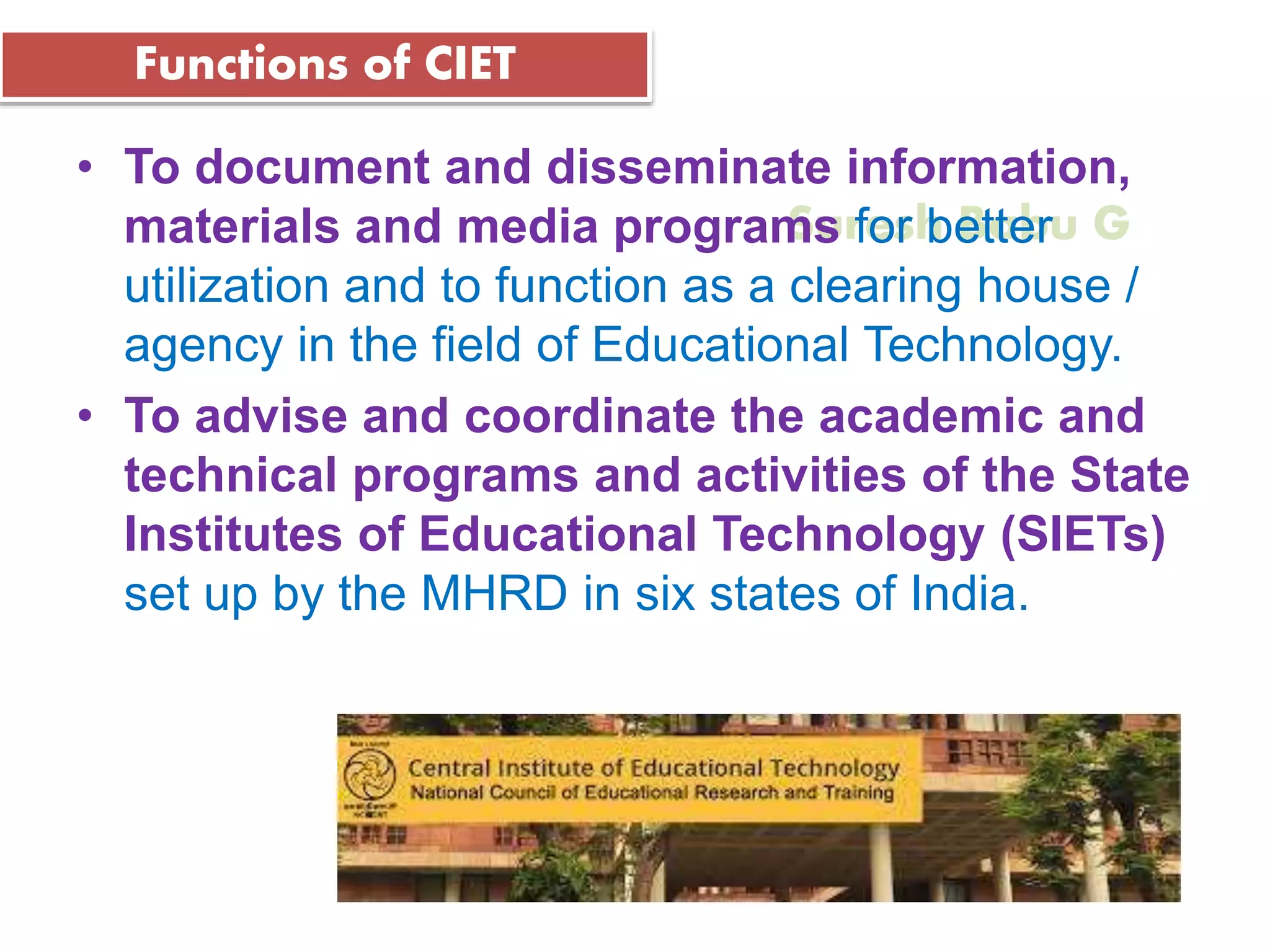
• To document and disseminate information,
materials and media programs for better
utilization and to function as a clearing house /
agency in the field of Educational Technology.
• To advise and coordinate the academic and
technical programs and activities of the State
Institutes of Educational Technology (SIETs)
set up by the MHRD in six states of India.
Functions of CIET
Suresh Babu G
State Institute of Educational
Technology (SIET) in India
• State Institute of Education Technology, Patna was
established on 10.9.1985 to promote quality in
primary education through INSAT-1B.
• State Institute of educational technology has been
set up in six states such as Andhra Pradesh, Bihar,
Gujarat, Maharashtra, Orissa and Uttar Pradesh in
order to implement the INSAT for education project
effectively. These institutes are functioning under
the administrative control of the SCERT in some
states and in the Directorate of Education in other
states.
Suresh Babu G
Functions of SIET
• Mainly expected to implement the educational
technology projects utilizing all kinds of modem
media, methods and materials.
• Now-a-days, more emphasis is given to the
production of ETV programmes for the children
in the age group 5-8 and 9-11 years and
teachers of primary schools.
Suresh Babu G
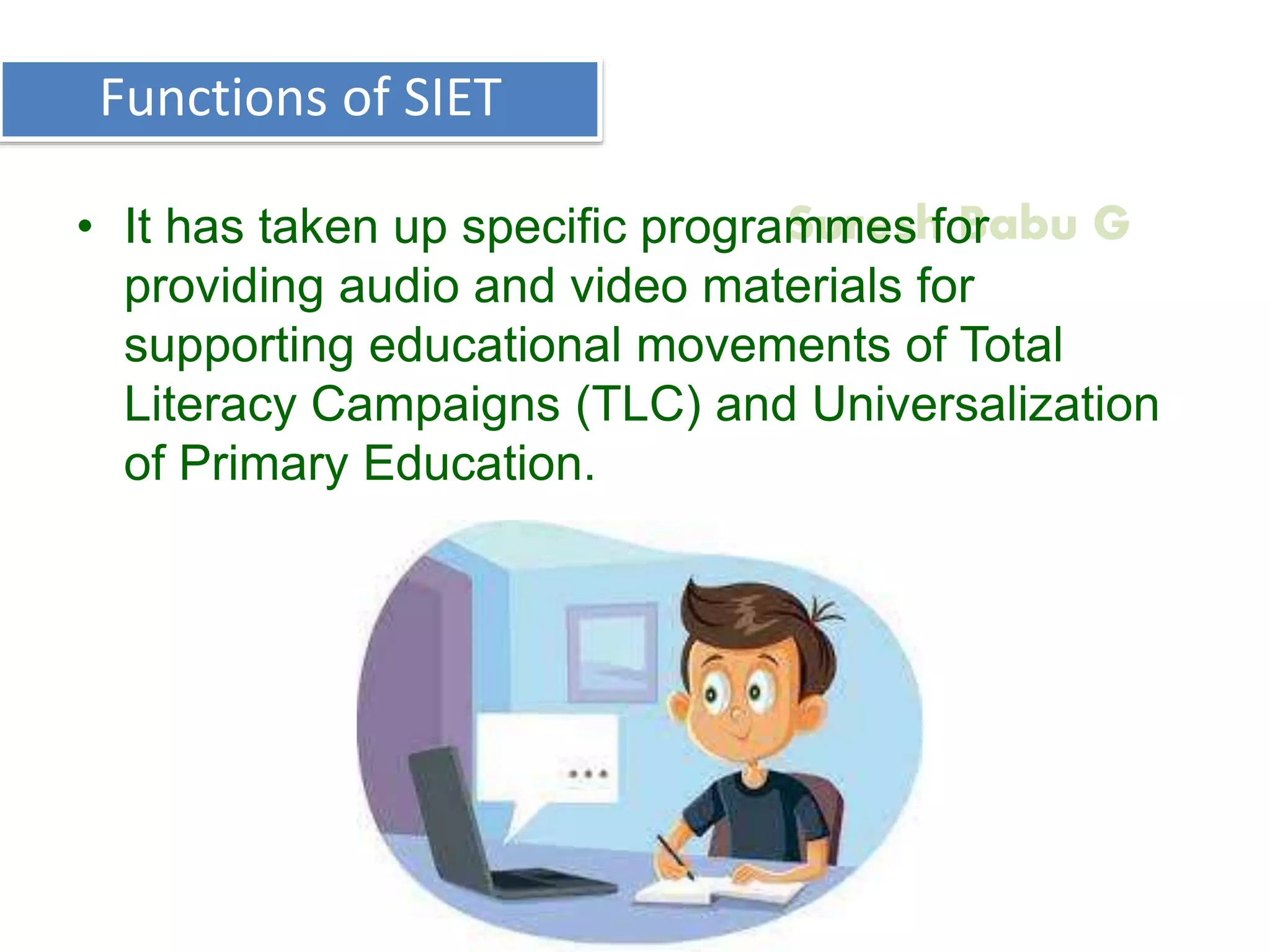
• It has taken up specific programmes for
providing audio and video materials for
supporting educational movements of Total
Literacy Campaigns (TLC) and Universalization
of Primary Education.
Functions of SIET
Suresh Babu G
Audio Visual Research Centre (AVRC)
Audio Visual Research Centre (AVRC) provides
valuable resource material for higher education
and mass communication. The programmes
produced at the centre are televised under
UGC/CEC countrywide classroom programme.
During 1996-97, the centre produced 16
educational programmes covering various
subjects.
Suresh Babu G
Functions
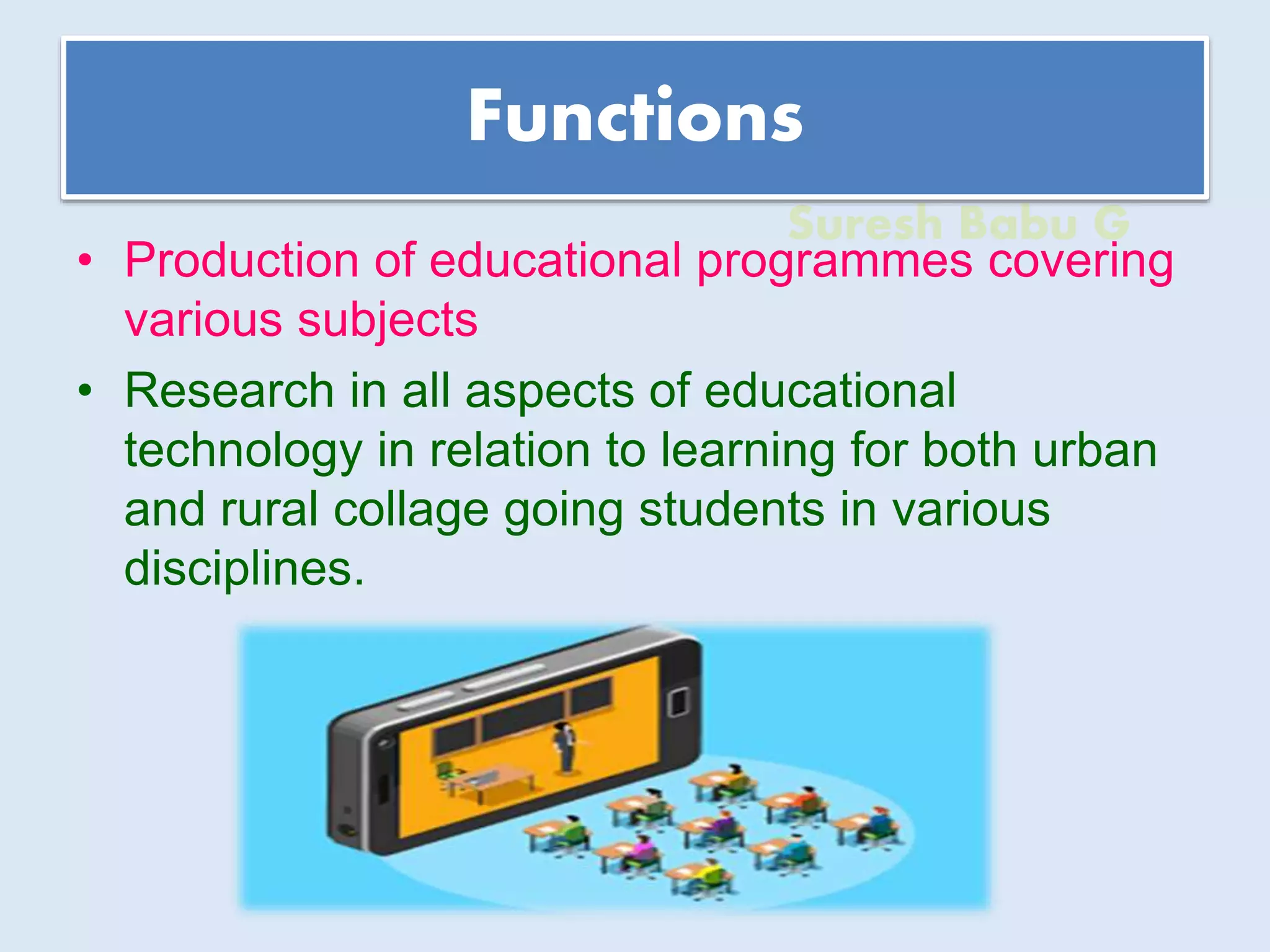
• Production of educational programmes covering
various subjects
• Research in all aspects of educational
technology in relation to learning for both urban
and rural collage going students in various
disciplines.
Suresh Babu G
EDUCATIONAL MULTIMEDIA RESEARCH
CENTRE (EMMRC)
The Educational Multimedia Research Centre
(EMMRC) was established as Audio Visual
Research Centre (AVRC) in 1989 by the UGC-
CEC at Punjabi University, Patiala under the
Country-Wide Classroom (CWC) Project, with
the following objectives for the pan-Indian and
global audience.
Suresh Babu G
Functions
• Production of educational programmes (especially
video and audio) and related support material and
setting up of appropriate facilities for this.
• Research related to optimizing the effectiveness of
the programmes.
• Providing a forum for the active involvement of
academic and other scholars in the creation of
appropriate educational programme.
• Studying, promoting and experimenting with new
techniques/technology that will increase the reach
and/or effectiveness of educational
communication.
Suresh Babu G
Society for Information Technology
and Teacher Education (SITE)
This society represents individual teacher
educators and affiliated organizations of teacher
educators in all disciplines, who are interested in
the creation and dissemination of knowledge
about the use of information technology in
teacher education and faculty/staff development.
Suresh Babu G
Role in education
• The use of information technology in teacher
education, and
• Instruction about information technology in
– Preservice
– Inservice
– Graduate Teacher Education
• Faculty & Staff Development
Suresh Babu G
UGC-CEC
(Consortium for Educational Communication)
The Consortium for Educational Communication
popularly known as CEC is one of the Inter
University Centres set up by the University
Grants Commission. It has been established
with the goal of addressing the needs of Higher
Education through the use of powerful medium
of Television along with the appropriate use of
emerging Information Communication
Technology (ICT).
Suresh Babu G
• Realizing the potential and power of television to
act as means of Educational Knowledge
dissemination, UGC started the Countrywide
Classroom Programmes in the year 1984. For
production of educational programmes, initially
Media Centres were set up at 6 Universities.
Subsequently CEC was setup in 1993 as a nodal
agency to coordinate, guide & facilitate such
educational programme production through its
Media Centres. Today 22 Media Centres now
known as Educational Multimedia Research
Centres (EMRCs) are working towards achieving
this goal under the umbrella of CEC
UGC-CEC
(Consortium for Educational Communication)
Suresh Babu G
EDUSAT
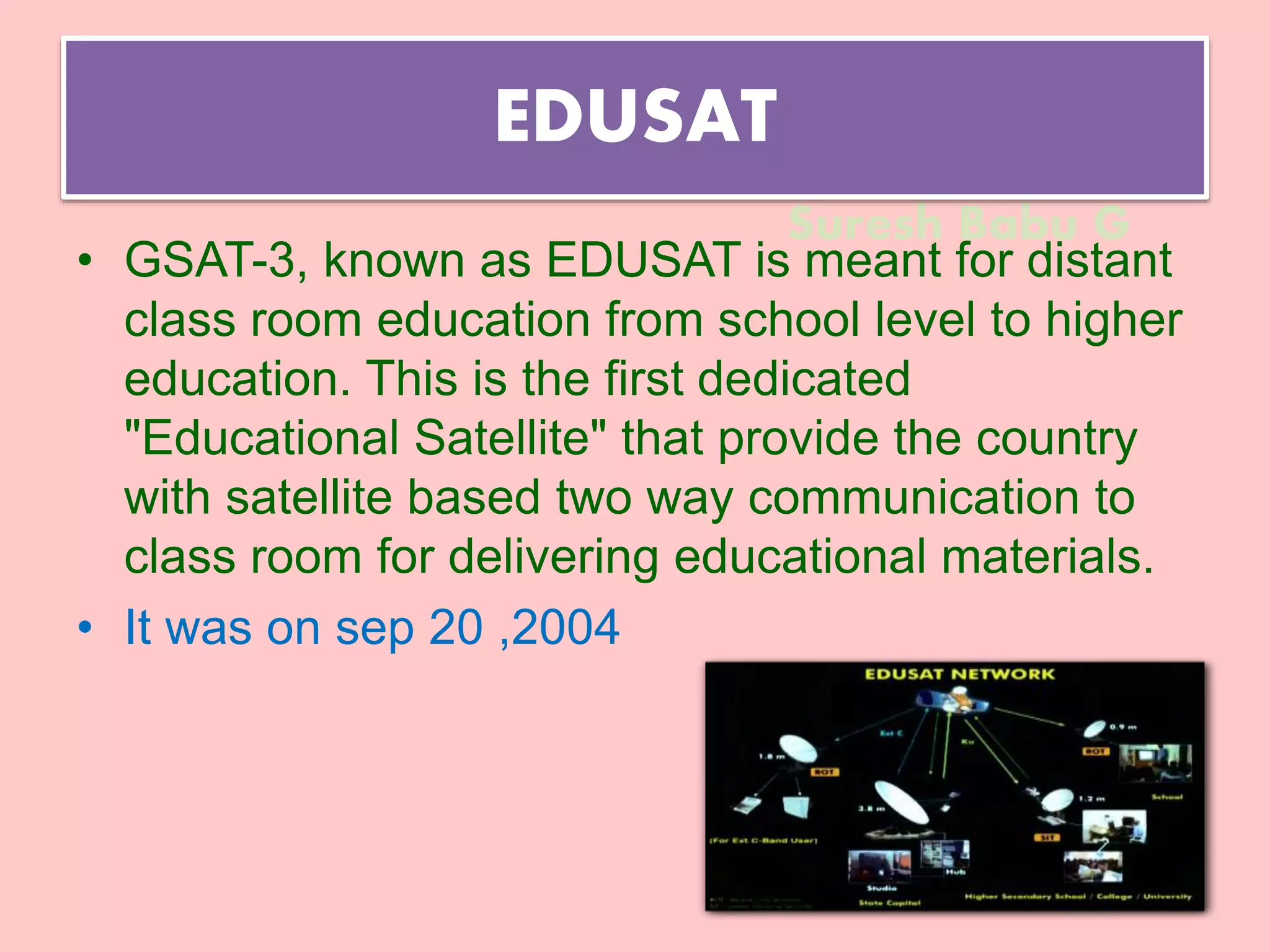
• GSAT-3, known as EDUSAT is meant for distant
class room education from school level to higher
education. This is the first dedicated
"Educational Satellite" that provide the country
with satellite based two way communication to
class room for delivering educational materials.
• It was on sep 20 ,2004
Suresh Babu G
Applications of EDUSAT
• New concept of education - with no classrooms ,
no teachers and no books would became reality
• Development of virtual classrooms
• A single lecturer can reach 10000 or more
students at the same time
• Lecturing can be stored
• Development of on-line education
• Development of interactive class.
Suresh Babu G
IT@SCHOOL
• IT@SCHOOL Project comes under the
Directorate of Public Instruction (DPI) of the
Kerala Government
• It is responsible for providing Information
Communication Technology (ICT) enabled
education to about 1.6 million students per year
in Kerala
Suresh Babu G
Role of IT@SCHOOL
• It had changed the traditional way of teaching to
the use of information technology for studies
there by improving the quality of learning system
• It help to increase the intellectual productivity of
teachers as well as the curricular
comprehension
• IT@SCHOOL is the main agency for
implementing EDUSAT network and runs a
special platform for education called VICTERS
(Versatile ICT Enabled Resource for Students)
Suresh Babu G

Resource Centers for Educational Technology - CIET,SIET, AVRC, EMRC, SITE, CEC, EDUSAT, IT@SCHOOL- their role in the improvement of teaching and learning.

  • 1.
    Suresh Babu G Resourcecentres for Educational Technology Suresh Babu G Assistant Professor
  • 2.
    Suresh Babu G CentralInstitute Of Educational Technology (CIET) • It is a constituent unit of NCERT • Came into existence in the year 1984 with the merger of Central for Educational Technology and Department of Teaching Aids • Its major aim is to promote utilization of educational technologies viz. radio,TV, films, Satellite communications and cyber media either separately or in combinations
  • 3.
    Suresh Babu G CentralInstitute Of Educational Technology (CIET) • The institute undertakes activities to widen educational opportunities, promote equity and improve quality of educational processes at school level.
  • 4.
    Suresh Babu G Functionsof CIET • To design and produce media software materials viz. television and radio (for both broadcast as well as non-broadcast use) film, graphics and other programs for strengthening the transaction of curricular and co-curricular activities at the school level. • To create competencies in development and use of educational software materials mentioned above through training in areas such as script development, media production, media communication, media research, technical operations, setting up studios and repair and maintenance of equipment.
  • 5.
    Suresh Babu G •To develop plans for the use of Information and Communication Technologies in education. • To train the faculty of Institutes of Advanced Study in Education/Colleges of Teacher Education and District Institutes of Education and Training in the use of Educational Technology in their teacher education programs. • To undertake research, evaluation and monitoring of the systems, programs and materials with a view to improving the materials and increasing their effectiveness. Functions of CIET
  • 6.
    Suresh Babu G •To document and disseminate information, materials and media programs for better utilization and to function as a clearing house / agency in the field of Educational Technology. • To advise and coordinate the academic and technical programs and activities of the State Institutes of Educational Technology (SIETs) set up by the MHRD in six states of India. Functions of CIET
  • 7.
    Suresh Babu G StateInstitute of Educational Technology (SIET) in India • State Institute of Education Technology, Patna was established on 10.9.1985 to promote quality in primary education through INSAT-1B. • State Institute of educational technology has been set up in six states such as Andhra Pradesh, Bihar, Gujarat, Maharashtra, Orissa and Uttar Pradesh in order to implement the INSAT for education project effectively. These institutes are functioning under the administrative control of the SCERT in some states and in the Directorate of Education in other states.
  • 8.
    Suresh Babu G Functionsof SIET • Mainly expected to implement the educational technology projects utilizing all kinds of modem media, methods and materials. • Now-a-days, more emphasis is given to the production of ETV programmes for the children in the age group 5-8 and 9-11 years and teachers of primary schools.
  • 9.
    Suresh Babu G •It has taken up specific programmes for providing audio and video materials for supporting educational movements of Total Literacy Campaigns (TLC) and Universalization of Primary Education. Functions of SIET
  • 10.
    Suresh Babu G AudioVisual Research Centre (AVRC) Audio Visual Research Centre (AVRC) provides valuable resource material for higher education and mass communication. The programmes produced at the centre are televised under UGC/CEC countrywide classroom programme. During 1996-97, the centre produced 16 educational programmes covering various subjects.
  • 11.
    Suresh Babu G Functions •Production of educational programmes covering various subjects • Research in all aspects of educational technology in relation to learning for both urban and rural collage going students in various disciplines.
  • 12.
    Suresh Babu G EDUCATIONALMULTIMEDIA RESEARCH CENTRE (EMMRC) The Educational Multimedia Research Centre (EMMRC) was established as Audio Visual Research Centre (AVRC) in 1989 by the UGC- CEC at Punjabi University, Patiala under the Country-Wide Classroom (CWC) Project, with the following objectives for the pan-Indian and global audience.
  • 13.
    Suresh Babu G Functions •Production of educational programmes (especially video and audio) and related support material and setting up of appropriate facilities for this. • Research related to optimizing the effectiveness of the programmes. • Providing a forum for the active involvement of academic and other scholars in the creation of appropriate educational programme. • Studying, promoting and experimenting with new techniques/technology that will increase the reach and/or effectiveness of educational communication.
  • 14.
    Suresh Babu G Societyfor Information Technology and Teacher Education (SITE) This society represents individual teacher educators and affiliated organizations of teacher educators in all disciplines, who are interested in the creation and dissemination of knowledge about the use of information technology in teacher education and faculty/staff development.
  • 15.
    Suresh Babu G Rolein education • The use of information technology in teacher education, and • Instruction about information technology in – Preservice – Inservice – Graduate Teacher Education • Faculty & Staff Development
  • 16.
    Suresh Babu G UGC-CEC (Consortiumfor Educational Communication) The Consortium for Educational Communication popularly known as CEC is one of the Inter University Centres set up by the University Grants Commission. It has been established with the goal of addressing the needs of Higher Education through the use of powerful medium of Television along with the appropriate use of emerging Information Communication Technology (ICT).
  • 17.
    Suresh Babu G •Realizing the potential and power of television to act as means of Educational Knowledge dissemination, UGC started the Countrywide Classroom Programmes in the year 1984. For production of educational programmes, initially Media Centres were set up at 6 Universities. Subsequently CEC was setup in 1993 as a nodal agency to coordinate, guide & facilitate such educational programme production through its Media Centres. Today 22 Media Centres now known as Educational Multimedia Research Centres (EMRCs) are working towards achieving this goal under the umbrella of CEC UGC-CEC (Consortium for Educational Communication)
  • 18.
    Suresh Babu G EDUSAT •GSAT-3, known as EDUSAT is meant for distant class room education from school level to higher education. This is the first dedicated "Educational Satellite" that provide the country with satellite based two way communication to class room for delivering educational materials. • It was on sep 20 ,2004
  • 19.
    Suresh Babu G Applicationsof EDUSAT • New concept of education - with no classrooms , no teachers and no books would became reality • Development of virtual classrooms • A single lecturer can reach 10000 or more students at the same time • Lecturing can be stored • Development of on-line education • Development of interactive class.
  • 20.
    Suresh Babu G IT@SCHOOL •IT@SCHOOL Project comes under the Directorate of Public Instruction (DPI) of the Kerala Government • It is responsible for providing Information Communication Technology (ICT) enabled education to about 1.6 million students per year in Kerala
  • 21.
    Suresh Babu G Roleof IT@SCHOOL • It had changed the traditional way of teaching to the use of information technology for studies there by improving the quality of learning system • It help to increase the intellectual productivity of teachers as well as the curricular comprehension • IT@SCHOOL is the main agency for implementing EDUSAT network and runs a special platform for education called VICTERS (Versatile ICT Enabled Resource for Students)
  • 22.