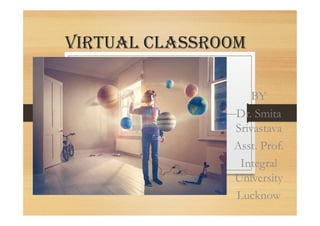
VIRTUAL CLASSROOM
BY
Dr. Smita
Srivastava
Asst. Prof.
Integral
University
Lucknow
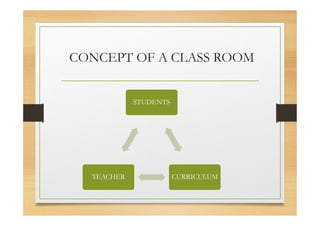
CONCEPT OF A CLASS ROOM
STUDENTS
CURRICULUM
TEACHER
• Basic aim of any teaching learning activities going inside the
classroom is to learn effectively. In the changing scenario of
society this triangular relationship include so many new aspects
such as new role of teacher , knowledge explosion, student’s
needs , available time etc.
• Hence advanced technologies like Internet, e-mail, website,
mobile phone, iPod etc may prove a quite effective tool and
technique for rendering valuable support , assistance and
alternative to the traditional system of school education.
• Now the question here may arise whether or not it has the power
and ability of replacing partially or totally the traditional mode of
classroom instruction or the school education . Lets have a look
of this kind of education
Professor Murray Turoff of new
jersey institute of technology,
USA(2007)
• “ Virtual classroom is a web based environment that
allows you to participate in live training events
without the need to travel. You listen to lectures ,
participate in lab exercises , ask questions and receive
feedback just as you would do in any conventional
classroom- except you do it from the convenience of
your desktop , or anywhere you have an internet and
phone connection. It saves the hassle , expense and
travel time to a training site”.
• So finally “ VIRTUAL CLASSROOM” as the name suggests, are
the classroom functioning in a system of virtual reality. These are
, in fact, the cyber classrooms, where the teacher and the students
can converse in real time. In every sense, a virtual classroom tries
to stimulate , in every way it can , the learning platform provided
by a conventional classroom.
THE FUNCTIONING
• 1- In its basic operation a system of virtual
classroom may allow the subjects experts or
experienced teachers to deliver instructions on one or
other topics of the school curriculum . These may be
telecast live with the help of satellite based
teleconferencing
• (as happening with the EDUSAT programme of
NCERT. )
• 2- In another mode , the study materials prepared by
the experts and experienced teachers may be
uploaded on the website of a virtual classroom or
campus and the students are allowed to download the
text and graphics for their study by issuing a
confidential password to the students registered with
the class or campus.
• 3- It is also possible on the part of the institutions to
provide CD-ROMs or DVDs with course content and
instructional guidance to be accessed by the students
through their laptops or computers.
• 4- There may be a number of appropriate options
available to the students for interacting with their teachers
and also with their colleagues through online chatting,
email or audio or video conferencing as permitted by a
organisational system of a virtual classroom or campus
• A virtual classroom system may evolve its own system for
assigning practice work , projects and questions/problems
foe re-enforcing , fixing and evaluating the progress of
the students.
• It can upload the needed material on its website for this
purpose at regular intervals and the students may than be
asked to do the desired work and send it back for te
needed checking , feedback and evaluation on the part of
teachers
• This system also takes care of the other essential
administrative and managerial requirements of the
students enrolled in this system like their online
admissions, information on the web about the type
of courses available with the school campus.
CHARACTERISTICS OF A
VIRTUAL CLASSROOM
• NON – Restricting : A virtual classroom allows both
learners and instructors around the world to participate in
live classes to collaborate and interact .MOOC programs
like Coursera are a great example of this concept in
action.
• Affordable: The low cost of virtual classroom are
considered to be a major advantage. Learners can save
money by not having to worry about travel expenses .
Participants also save time since all that is needed is an
internet connection.
• Flexible Learning: Online classes also allow for the ability
to record class as it happens , including any presentation
audio and visuals . This means that the content is
accessible even after being delivered , an added benefit for
those who want a quick refresher , or perhaps did not
fully understand the first time.
• Practical and Proven: Synchronous learning is a learning
environment where everyone takes part in the learning at
the same time. A traditional lecture is an example of this
type of learning , and has been used for hundreds of
years .
Online learning enables this same type of experience ,
but with far more conveniences and tools .
• Accessible: Virtual classrooms can be used to deliver
lectures , or even tutorials online . They are also great
options for impromptu meetings and group projects
where members need to check-in on progress and
bounce ideas of one-another. With the virtual
environment, ideas and collaborators are never far
away.
Advantages
• Providing flexibility to the learner in terms of time ,
pace and distance.
• Not coming in their way of doing a job or engaging
in other learning pursuits simultaneously at a time .
• Opening its door for the desired learning to the
learners during 24 hours of all the 7 week days
• Providing the services of the most experienced and
capable faculty belonging to any stream and discipline of
the school curriculum
• Providing the learners the joy and benefits of real time
learning
• Doing away the fear of criticism , snubbing and ridiculing
by the teachers or colleagues
• Saving the learners from the difficulties of administrative
and evaluative work
Limitations
• Possibilities of misutilization and misdirection of the freedom
and flexibility provide in the system by the learners
• Possibilities of being the organisation and working of a virtual
classroom quite hopeless in the terms of quality and delivery of
its instructions to the students
• Deficiency and limitations regarding its inability to provide real
time face to face interactive experiences to the students
• Its inability to help the students in development of their
wholesome personality .
Virtual classroom pdf

Virtual classroom pdf

  • 1.
    VIRTUAL CLASSROOM BY Dr. Smita Srivastava Asst.Prof. Integral University Lucknow
  • 2.
    CONCEPT OF ACLASS ROOM STUDENTS CURRICULUM TEACHER
  • 3.
    • Basic aimof any teaching learning activities going inside the classroom is to learn effectively. In the changing scenario of society this triangular relationship include so many new aspects such as new role of teacher , knowledge explosion, student’s needs , available time etc. • Hence advanced technologies like Internet, e-mail, website, mobile phone, iPod etc may prove a quite effective tool and technique for rendering valuable support , assistance and alternative to the traditional system of school education.
  • 4.
    • Now thequestion here may arise whether or not it has the power and ability of replacing partially or totally the traditional mode of classroom instruction or the school education . Lets have a look of this kind of education
  • 5.
    Professor Murray Turoffof new jersey institute of technology, USA(2007) • “ Virtual classroom is a web based environment that allows you to participate in live training events without the need to travel. You listen to lectures , participate in lab exercises , ask questions and receive feedback just as you would do in any conventional classroom- except you do it from the convenience of your desktop , or anywhere you have an internet and phone connection. It saves the hassle , expense and travel time to a training site”.
  • 7.
    • So finally“ VIRTUAL CLASSROOM” as the name suggests, are the classroom functioning in a system of virtual reality. These are , in fact, the cyber classrooms, where the teacher and the students can converse in real time. In every sense, a virtual classroom tries to stimulate , in every way it can , the learning platform provided by a conventional classroom.
  • 8.
    THE FUNCTIONING • 1-In its basic operation a system of virtual classroom may allow the subjects experts or experienced teachers to deliver instructions on one or other topics of the school curriculum . These may be telecast live with the help of satellite based teleconferencing • (as happening with the EDUSAT programme of NCERT. )
  • 9.
    • 2- Inanother mode , the study materials prepared by the experts and experienced teachers may be uploaded on the website of a virtual classroom or campus and the students are allowed to download the text and graphics for their study by issuing a confidential password to the students registered with the class or campus.
  • 10.
    • 3- Itis also possible on the part of the institutions to provide CD-ROMs or DVDs with course content and instructional guidance to be accessed by the students through their laptops or computers. • 4- There may be a number of appropriate options available to the students for interacting with their teachers and also with their colleagues through online chatting, email or audio or video conferencing as permitted by a organisational system of a virtual classroom or campus
  • 12.
    • A virtualclassroom system may evolve its own system for assigning practice work , projects and questions/problems foe re-enforcing , fixing and evaluating the progress of the students. • It can upload the needed material on its website for this purpose at regular intervals and the students may than be asked to do the desired work and send it back for te needed checking , feedback and evaluation on the part of teachers
  • 13.
    • This systemalso takes care of the other essential administrative and managerial requirements of the students enrolled in this system like their online admissions, information on the web about the type of courses available with the school campus.
  • 14.
    CHARACTERISTICS OF A VIRTUALCLASSROOM • NON – Restricting : A virtual classroom allows both learners and instructors around the world to participate in live classes to collaborate and interact .MOOC programs like Coursera are a great example of this concept in action. • Affordable: The low cost of virtual classroom are considered to be a major advantage. Learners can save money by not having to worry about travel expenses . Participants also save time since all that is needed is an internet connection.
  • 15.
    • Flexible Learning:Online classes also allow for the ability to record class as it happens , including any presentation audio and visuals . This means that the content is accessible even after being delivered , an added benefit for those who want a quick refresher , or perhaps did not fully understand the first time. • Practical and Proven: Synchronous learning is a learning environment where everyone takes part in the learning at the same time. A traditional lecture is an example of this type of learning , and has been used for hundreds of years .
  • 16.
    Online learning enablesthis same type of experience , but with far more conveniences and tools . • Accessible: Virtual classrooms can be used to deliver lectures , or even tutorials online . They are also great options for impromptu meetings and group projects where members need to check-in on progress and bounce ideas of one-another. With the virtual environment, ideas and collaborators are never far away.
  • 17.
    Advantages • Providing flexibilityto the learner in terms of time , pace and distance. • Not coming in their way of doing a job or engaging in other learning pursuits simultaneously at a time . • Opening its door for the desired learning to the learners during 24 hours of all the 7 week days
  • 18.
    • Providing theservices of the most experienced and capable faculty belonging to any stream and discipline of the school curriculum • Providing the learners the joy and benefits of real time learning • Doing away the fear of criticism , snubbing and ridiculing by the teachers or colleagues • Saving the learners from the difficulties of administrative and evaluative work
  • 19.
    Limitations • Possibilities ofmisutilization and misdirection of the freedom and flexibility provide in the system by the learners • Possibilities of being the organisation and working of a virtual classroom quite hopeless in the terms of quality and delivery of its instructions to the students • Deficiency and limitations regarding its inability to provide real time face to face interactive experiences to the students • Its inability to help the students in development of their wholesome personality .