THE ELEMENTS of TEACHING
and LEARNING
Yenna Monica D. P.
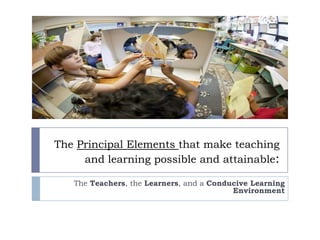
The Principal Elements that make teaching
and learning possible and attainable:
The Teachers, the Learners, and a Conducive Learning
Environment
Learners
 Prime mover of the educational wheel
 Key participants in the learning process
Favorable Environment
 Provides essential features and ingredients that
could make headway in guiding the processes and
methodologies needed for a smooth linkage of the
elements
Teachers
The Learner
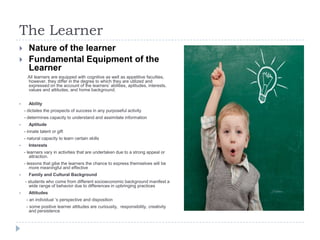
 Nature of the learner
 Fundamental Equipment of the
Learner
All learners are equipped with cognitive as well as appetitive faculties,
however, they differ in the degree to which they are utilized and
expressed on the account of the learners‟ abilities, aptitudes, interests,
values and attitudes, and home background.
 Ability
- dictates the prospects of success in any purposeful activity
- determines capacity to understand and assimilate information
 Aptitude
- innate talent or gift
- natural capacity to learn certain skills
 Interests
- learners vary in activities that are undertaken due to a strong appeal or
attraction.
- lessons that gibe the learners the chance to express themselves will be
more meaningful and effective
 Family and Cultural Background
- students who come from different socioeconomic background manifest a
wide range of behavior due to differences in upbringing practices
 Attitudes
- an individual „s perspective and disposition
- some positive learner attitudes are curiousity, responsibility, creativity
and persistence
The Learner
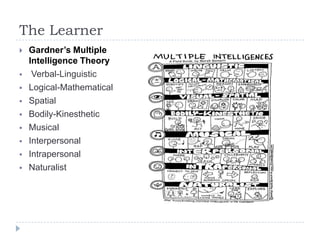
 Gardner’s Multiple
Intelligence Theory
 Verbal-Linguistic
 Logical-Mathematical
 Spatial
 Bodily-Kinesthetic
 Musical
 Interpersonal
 Intrapersonal
 Naturalist
The Learner
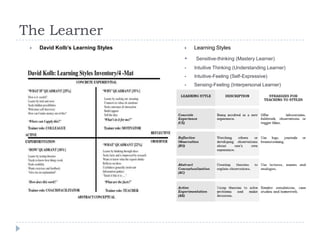
 Learning Styles
 Sensitive-thinking (Mastery Learner)
 Intuitive Thinking (Understanding Learner)
 Intuitive-Feeling (Self-Expressive)
 Sensing-Feeling (Interpersonal Learner)
 David Kolb’s Learning Styles
The Teacher
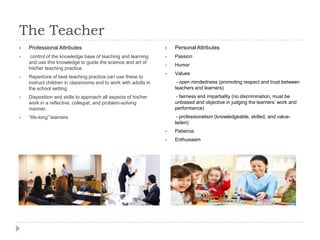
 Professional Attributes
 control of the knowledge base of teaching and learning
and use this knowledge to guide the science and art of
his/her teaching practice
 Repertoire of best teaching practice can use these to
instruct children in classrooms and to work with adults in
the school setting
 Disposition and skills to approach all aspects of his/her
work in a reflective, collegial, and problem-solving
manner.
 “life-long” learners
 Personal Attributes
 Passion
 Humor
 Values
- open mindedness (promoting respect and trust between
teachers and learners)
- fairness and impartiality (no discrimination, must be
unbiased and objective in judging the learners‟ work and
performance)
- professionalism (knowledgeable, skilled, and value-
laden)
 Patience
 Enthusiasm
The Learning Environment
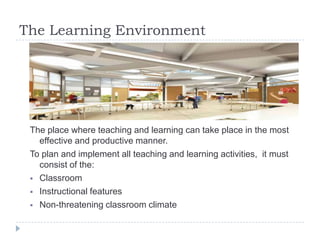
The place where teaching and learning can take place in the most
effective and productive manner.
To plan and implement all teaching and learning activities, it must
consist of the:
 Classroom
 Instructional features
 Non-threatening classroom climate
The Learning Environment
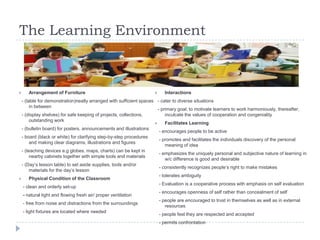
 Arrangement of Furniture
- (table for demonstration)neatly arranged with sufficient spaces
in between
- (display shelves) for safe keeping of projects, collections,
outstanding work
- (bulletin board) for posters, announcements and illustrations
- board (black or white) for clarifying step-by-step procedures
and making clear diagrams, illustrations and figures
- (teaching devices e.g globes, maps, charts) can be kept in
nearby cabinets together with simple tools and materials
- (Day‟s lesson table) to set aside supplies, tools and/or
materials for the day‟s lesson
 Physical Condition of the Classroom
- clean and orderly set-up
- natural light and flowing fresh air/ proper ventilation
- free from noise and distractions from the surroundings
- light fixtures are located where needed
 Interactions
- cater to diverse situations
- primary goal: to motivate learners to work harmoniously, thereafter,
inculcate the values of cooperation and congeniality
 Facilitates Learning
- encourages people to be active
- promotes and facilitates the individuals discovery of the personal
meaning of idea
- emphasizes the uniquely personal and subjective nature of learning in
w/c difference is good and desirable
- consistently recognizes people‟s right to make mistakes
- tolerates ambiguity
- Evaluation is a cooperative process with emphasis on self evaluation
- encourages openness of self rather than concealment of self
- people are encouraged to trust in themselves as well as in external
resources
- people feel they are respected and accepted
- permits confrontation
THE ELEMENTS of TEACHING
and LEARNING
Yenna Monica D. P.
END

The Elements of Teaching and Learning

  • 1.
    THE ELEMENTS ofTEACHING and LEARNING Yenna Monica D. P.
  • 2.
    The Principal Elementsthat make teaching and learning possible and attainable: The Teachers, the Learners, and a Conducive Learning Environment
  • 3.
    Learners  Prime moverof the educational wheel  Key participants in the learning process Favorable Environment  Provides essential features and ingredients that could make headway in guiding the processes and methodologies needed for a smooth linkage of the elements Teachers
  • 4.
    The Learner  Natureof the learner  Fundamental Equipment of the Learner All learners are equipped with cognitive as well as appetitive faculties, however, they differ in the degree to which they are utilized and expressed on the account of the learners‟ abilities, aptitudes, interests, values and attitudes, and home background.  Ability - dictates the prospects of success in any purposeful activity - determines capacity to understand and assimilate information  Aptitude - innate talent or gift - natural capacity to learn certain skills  Interests - learners vary in activities that are undertaken due to a strong appeal or attraction. - lessons that gibe the learners the chance to express themselves will be more meaningful and effective  Family and Cultural Background - students who come from different socioeconomic background manifest a wide range of behavior due to differences in upbringing practices  Attitudes - an individual „s perspective and disposition - some positive learner attitudes are curiousity, responsibility, creativity and persistence
  • 5.
    The Learner  Gardner’sMultiple Intelligence Theory  Verbal-Linguistic  Logical-Mathematical  Spatial  Bodily-Kinesthetic  Musical  Interpersonal  Intrapersonal  Naturalist
  • 6.
    The Learner  LearningStyles  Sensitive-thinking (Mastery Learner)  Intuitive Thinking (Understanding Learner)  Intuitive-Feeling (Self-Expressive)  Sensing-Feeling (Interpersonal Learner)  David Kolb’s Learning Styles
  • 7.
    The Teacher  ProfessionalAttributes  control of the knowledge base of teaching and learning and use this knowledge to guide the science and art of his/her teaching practice  Repertoire of best teaching practice can use these to instruct children in classrooms and to work with adults in the school setting  Disposition and skills to approach all aspects of his/her work in a reflective, collegial, and problem-solving manner.  “life-long” learners  Personal Attributes  Passion  Humor  Values - open mindedness (promoting respect and trust between teachers and learners) - fairness and impartiality (no discrimination, must be unbiased and objective in judging the learners‟ work and performance) - professionalism (knowledgeable, skilled, and value- laden)  Patience  Enthusiasm
  • 8.
    The Learning Environment Theplace where teaching and learning can take place in the most effective and productive manner. To plan and implement all teaching and learning activities, it must consist of the:  Classroom  Instructional features  Non-threatening classroom climate
  • 9.
    The Learning Environment Arrangement of Furniture - (table for demonstration)neatly arranged with sufficient spaces in between - (display shelves) for safe keeping of projects, collections, outstanding work - (bulletin board) for posters, announcements and illustrations - board (black or white) for clarifying step-by-step procedures and making clear diagrams, illustrations and figures - (teaching devices e.g globes, maps, charts) can be kept in nearby cabinets together with simple tools and materials - (Day‟s lesson table) to set aside supplies, tools and/or materials for the day‟s lesson  Physical Condition of the Classroom - clean and orderly set-up - natural light and flowing fresh air/ proper ventilation - free from noise and distractions from the surroundings - light fixtures are located where needed  Interactions - cater to diverse situations - primary goal: to motivate learners to work harmoniously, thereafter, inculcate the values of cooperation and congeniality  Facilitates Learning - encourages people to be active - promotes and facilitates the individuals discovery of the personal meaning of idea - emphasizes the uniquely personal and subjective nature of learning in w/c difference is good and desirable - consistently recognizes people‟s right to make mistakes - tolerates ambiguity - Evaluation is a cooperative process with emphasis on self evaluation - encourages openness of self rather than concealment of self - people are encouraged to trust in themselves as well as in external resources - people feel they are respected and accepted - permits confrontation
  • 10.
    THE ELEMENTS ofTEACHING and LEARNING Yenna Monica D. P. END

Editor's Notes

  • #5 The Learner is an embodies spirit, a union of a sentient body and rational soul. His body experiences sensations, and feels pleasure and pain. His soul is the principle of spiritual acts, the source of intellectual abstraction, self reflection and free rational volition.
  • #8 passion -exude spontaneity in ministering to the needs of the learners especially those experiencing learning difficultiesPatience – endure their student’s limitation and difficultiesUncomplaining nature, self-control and persistenceTeacher’s capacity to adjust his methodologies Enthusiasm – eagerness and excitement, full of energy and dynaminsm-student’s look forward to any activity theycan participate with themCommitment (solemn promise to perform the duties and responsibilities mandated by the laws and code of ethics of the profession)Unwavering pledge to perform all teaching and learning activities with consistency and selflessness to the best interest of the student under their care.
  • #10 students differ in abilities and interests and needs different strategies; teachers must be sensitive to positive or negative interactions and must immediately undertake an instant revision or adjustment In the methodology when necessary