Semiconductor
Manufacturing
Process
Agenda
1. Introduction to Semiconductor Manufacturing
2. Wafer Manufacturing
3. Oxidation Process
4. Photolithography
5. Etching and Deposition
6. Ion Implementation
7. Metal Wiring and EDS
8. Packaging Process
The semiconductor industry is a cornerstone of modern technology,
driving innovation and enabling advancements across various fields. This
industry is highly complex, characterized by its intricate processes and the
need for precision at every stage. It operates within a vast ecosystem that is
both interconnected and constantly evolving. Companies, suppliers, and
researchers collaborate globally to push the boundaries of what is possible,
ensuring that semiconductor technology continues to advance. From the
extraction of raw materials to the final packaging of semiconductor chips,
each step is crucial and meticulously controlled to maintain the highest
standards of quality and efficiency.
Introduction to
Semiconductor
Manufacturing
Overview
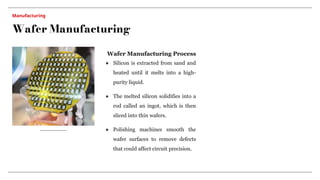
Wafer Manufacturing Process
● Silicon is extracted from sand and
heated until it melts into a high-
purity liquid.
● The melted silicon solidifies into a
rod called an ingot, which is then
sliced into thin wafers.
● Polishing machines smooth the
wafer surfaces to remove defects
that could affect circuit precision.
Wafer Manufacturing
Manufacturing
Purpose of Oxidation
● Forms a uniform oxide film on the wafer surface
● Protects the wafer during subsequent processes
● Prevents current leakage between circuits
● Oxygen or water vapor is sprayed on the wafer
● A uniform oxide film is formed
● The film acts as a protective shield
Oxidation Process
Processes
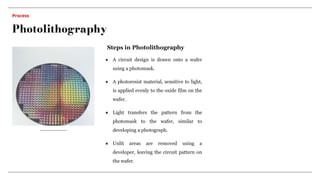
Steps in Photolithography
● A circuit design is drawn onto a wafer
using a photomask.
● A photoresist material, sensitive to light,
is applied evenly to the oxide film on the
wafer.
● Light transfers the pattern from the
photomask to the wafer, similar to
developing a photograph.
● Unlit areas are removed using a
developer, leaving the circuit pattern on
the wafer.
Photolithography
Process
Etching Process ● Carves out unnecessary materials to retain design patterns
● Wet etching uses chemical solutions to remove materials
● Dry etching employs gas or plasma for material removal
● Repeated multiple times to build complex circuit layers
Deposition Process ● Applies a thin insulating film on the wafer
● Thin film separates and protects stacked circuits
● Requires precise technology for uniform application
● Uses molecular or atomic-level coating techniques
Etching and Deposition
Manufacturing
Ion implementation is a critical step in semiconductor manufacturing where
impurities are deliberately added to a silicon wafer to modify its electrical
properties. This process involves bombarding the wafer with ions of dopant
materials such as boron, phosphorus, or arsenic. The ions penetrate the
wafer's surface and embed themselves into the silicon lattice, creating regions
of altered electrical characteristics. By precisely controlling the type and
concentration of these impurities, manufacturers can tailor the
semiconductor's conductivity and other electrical properties to meet specific
requirements.
Ion Implementation
Process
Metal Wiring Process ● Creates paths for electrical signals on the wafer
● Uses thin metal films such as aluminum, titanium, or tungsten
● Ensures electrical conductivity between circuits
● Deposits metal films with high precision to prevent short circuits
EDS Process ● Stands for Electrical Die Sorting
● Tests each chip for defects before packaging
● Measures electrical properties to ensure functionality
● Sorts out defective chips to improve yield
● Critical for ensuring high-quality semiconductor products
Metal Wiring and EDS
Manufacturing
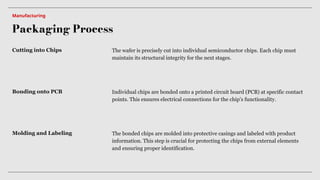
Cutting into Chips The wafer is precisely cut into individual semiconductor chips. Each chip must
maintain its structural integrity for the next stages.
Bonding onto PCB Individual chips are bonded onto a printed circuit board (PCB) at specific contact
points. This ensures electrical connections for the chip's functionality.
Molding and Labeling The bonded chips are molded into protective casings and labeled with product
information. This step is crucial for protecting the chips from external elements
and ensuring proper identification.
Packaging Process
Manufacturing
Thank you.

Semiconductor Manufacturing Process.pptx

  • 1.
  • 2.
    Agenda 1. Introduction toSemiconductor Manufacturing 2. Wafer Manufacturing 3. Oxidation Process 4. Photolithography 5. Etching and Deposition 6. Ion Implementation 7. Metal Wiring and EDS 8. Packaging Process
  • 3.
    The semiconductor industryis a cornerstone of modern technology, driving innovation and enabling advancements across various fields. This industry is highly complex, characterized by its intricate processes and the need for precision at every stage. It operates within a vast ecosystem that is both interconnected and constantly evolving. Companies, suppliers, and researchers collaborate globally to push the boundaries of what is possible, ensuring that semiconductor technology continues to advance. From the extraction of raw materials to the final packaging of semiconductor chips, each step is crucial and meticulously controlled to maintain the highest standards of quality and efficiency. Introduction to Semiconductor Manufacturing Overview
  • 4.
    Wafer Manufacturing Process ●Silicon is extracted from sand and heated until it melts into a high- purity liquid. ● The melted silicon solidifies into a rod called an ingot, which is then sliced into thin wafers. ● Polishing machines smooth the wafer surfaces to remove defects that could affect circuit precision. Wafer Manufacturing Manufacturing
  • 5.
    Purpose of Oxidation ●Forms a uniform oxide film on the wafer surface ● Protects the wafer during subsequent processes ● Prevents current leakage between circuits ● Oxygen or water vapor is sprayed on the wafer ● A uniform oxide film is formed ● The film acts as a protective shield Oxidation Process Processes
  • 6.
    Steps in Photolithography ●A circuit design is drawn onto a wafer using a photomask. ● A photoresist material, sensitive to light, is applied evenly to the oxide film on the wafer. ● Light transfers the pattern from the photomask to the wafer, similar to developing a photograph. ● Unlit areas are removed using a developer, leaving the circuit pattern on the wafer. Photolithography Process
  • 7.
    Etching Process ●Carves out unnecessary materials to retain design patterns ● Wet etching uses chemical solutions to remove materials ● Dry etching employs gas or plasma for material removal ● Repeated multiple times to build complex circuit layers Deposition Process ● Applies a thin insulating film on the wafer ● Thin film separates and protects stacked circuits ● Requires precise technology for uniform application ● Uses molecular or atomic-level coating techniques Etching and Deposition Manufacturing
  • 8.
    Ion implementation isa critical step in semiconductor manufacturing where impurities are deliberately added to a silicon wafer to modify its electrical properties. This process involves bombarding the wafer with ions of dopant materials such as boron, phosphorus, or arsenic. The ions penetrate the wafer's surface and embed themselves into the silicon lattice, creating regions of altered electrical characteristics. By precisely controlling the type and concentration of these impurities, manufacturers can tailor the semiconductor's conductivity and other electrical properties to meet specific requirements. Ion Implementation Process
  • 9.
    Metal Wiring Process● Creates paths for electrical signals on the wafer ● Uses thin metal films such as aluminum, titanium, or tungsten ● Ensures electrical conductivity between circuits ● Deposits metal films with high precision to prevent short circuits EDS Process ● Stands for Electrical Die Sorting ● Tests each chip for defects before packaging ● Measures electrical properties to ensure functionality ● Sorts out defective chips to improve yield ● Critical for ensuring high-quality semiconductor products Metal Wiring and EDS Manufacturing
  • 10.
    Cutting into ChipsThe wafer is precisely cut into individual semiconductor chips. Each chip must maintain its structural integrity for the next stages. Bonding onto PCB Individual chips are bonded onto a printed circuit board (PCB) at specific contact points. This ensures electrical connections for the chip's functionality. Molding and Labeling The bonded chips are molded into protective casings and labeled with product information. This step is crucial for protecting the chips from external elements and ensuring proper identification. Packaging Process Manufacturing
  • 11.