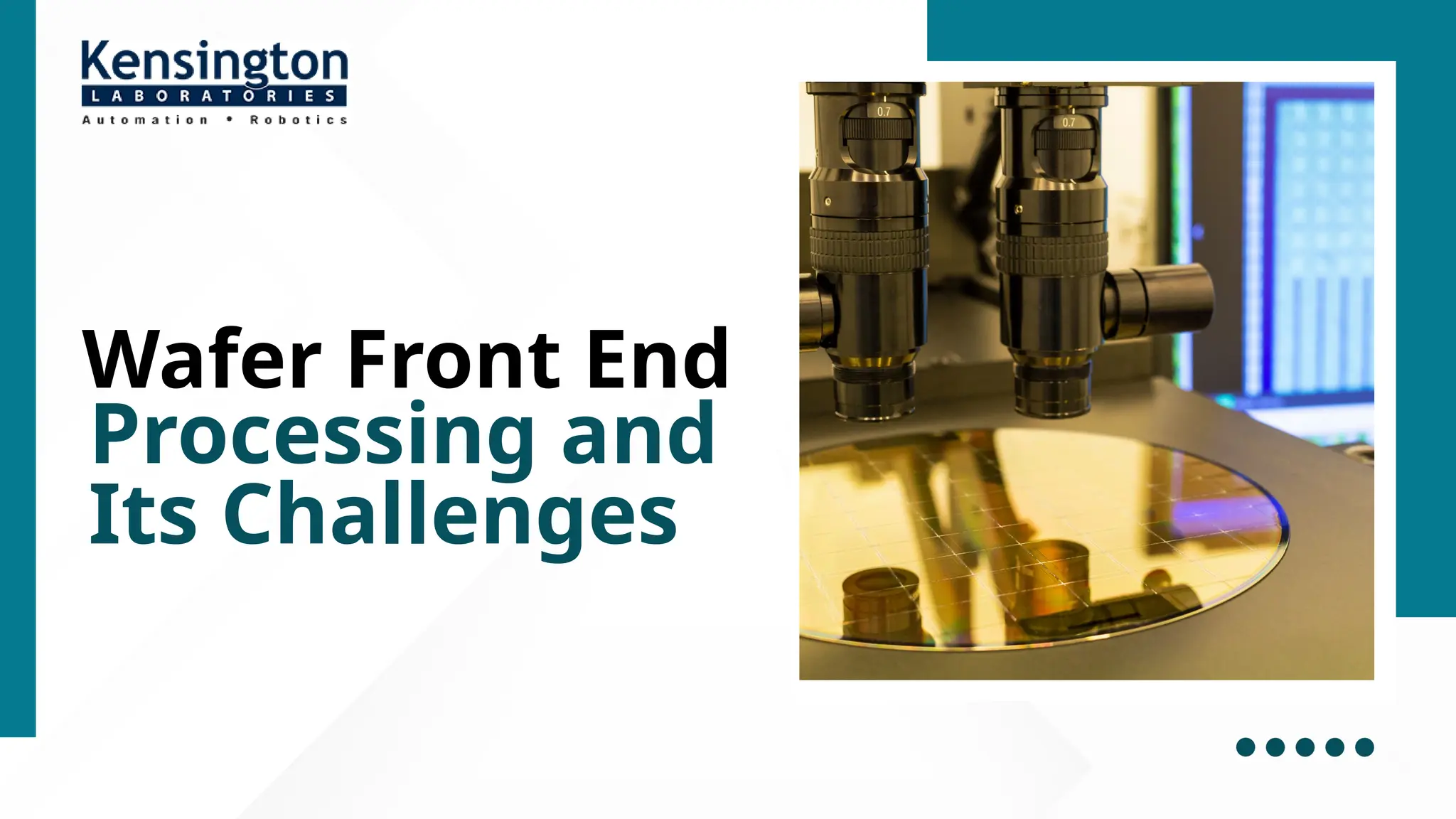
Wafer Front End
Processing and
Its Challenges
Understanding Wafer Front-
End Processes in
Semiconductor Manufacturing:
In the world of semiconductor manufacturing,
wafer front-end processes play a crucial role in
the creation of integrated circuits (ICs) that
power the technologies we use daily. From
smartphones and computers to medical
devices and automotive systems, the complex
microchips that run these devices are built
using wafers, which undergo various intricate
processes.
In this ppt, we’ll dive into what wafer front-end
processes are, how they work, and why they
are so essential to the semiconductor industry.
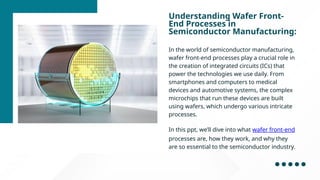
Wafer front-end processing refers to the initial stages in
semiconductor manufacturing where raw silicon wafers are
transformed into functioning microchips through a series of
chemical, physical, and mechanical steps. These processes take
place in cleanroom environments, ensuring the highest levels
of precision and contamination control.
A typical wafer front-end process includes steps such as wafer
fabrication, deposition, etching, doping, and photolithography,
each of which is essential to creating the intricate layers of
circuits that make up a microchip.
What is Wafer Front-
End Processing?
Key Steps in Wafer
Front-End Processing:
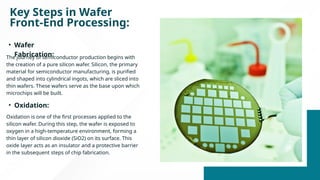
The journey of semiconductor production begins with
the creation of a pure silicon wafer. Silicon, the primary
material for semiconductor manufacturing, is purified
and shaped into cylindrical ingots, which are sliced into
thin wafers. These wafers serve as the base upon which
microchips will be built.
• Wafer
Fabrication:
• Oxidation:
Oxidation is one of the first processes applied to the
silicon wafer. During this step, the wafer is exposed to
oxygen in a high-temperature environment, forming a
thin layer of silicon dioxide (SiO2) on its surface. This
oxide layer acts as an insulator and a protective barrier
in the subsequent steps of chip fabrication.
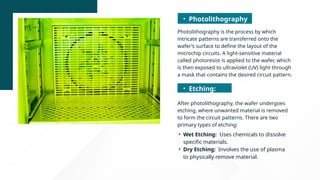
Photolithography is the process by which
intricate patterns are transferred onto the
wafer’s surface to define the layout of the
microchip circuits. A light-sensitive material
called photoresist is applied to the wafer, which
is then exposed to ultraviolet (UV) light through
a mask that contains the desired circuit pattern.
• Photolithography
:
• Etching:
After photolithography, the wafer undergoes
etching, where unwanted material is removed
to form the circuit patterns. There are two
primary types of etching:
• Wet Etching: Uses chemicals to dissolve
specific materials.
• Dry Etching: Involves the use of plasma
to physically remove material.
Challenges in Wafer
Front-End Processing
As chip designs shrink in
size (down to nanometers),
maintaining precision and
accuracy in processes like
photolithography and
etching becomes
increasingly difficult.
Miniaturization:
Even the smallest particle
of dust can ruin a wafer.
Cleanroom environments
must meet strict standards
to avoid contamination
that could degrade chip
performance.
Contamination Control:
Manufacturers aim to
produce as many
functional chips as
possible from each wafer,
but defects can reduce
yield.
Yield
Management:
THANK
YOU
OUR CONTACT
+1 9255480640
www.kensingtonlabs.com

Wafer Front-End Processing and Its Challenges

  • 1.
    Wafer Front End Processingand Its Challenges
  • 2.
    Understanding Wafer Front- EndProcesses in Semiconductor Manufacturing: In the world of semiconductor manufacturing, wafer front-end processes play a crucial role in the creation of integrated circuits (ICs) that power the technologies we use daily. From smartphones and computers to medical devices and automotive systems, the complex microchips that run these devices are built using wafers, which undergo various intricate processes. In this ppt, we’ll dive into what wafer front-end processes are, how they work, and why they are so essential to the semiconductor industry.
  • 3.
    Wafer front-end processingrefers to the initial stages in semiconductor manufacturing where raw silicon wafers are transformed into functioning microchips through a series of chemical, physical, and mechanical steps. These processes take place in cleanroom environments, ensuring the highest levels of precision and contamination control. A typical wafer front-end process includes steps such as wafer fabrication, deposition, etching, doping, and photolithography, each of which is essential to creating the intricate layers of circuits that make up a microchip. What is Wafer Front- End Processing?
  • 4.
    Key Steps inWafer Front-End Processing: The journey of semiconductor production begins with the creation of a pure silicon wafer. Silicon, the primary material for semiconductor manufacturing, is purified and shaped into cylindrical ingots, which are sliced into thin wafers. These wafers serve as the base upon which microchips will be built. • Wafer Fabrication: • Oxidation: Oxidation is one of the first processes applied to the silicon wafer. During this step, the wafer is exposed to oxygen in a high-temperature environment, forming a thin layer of silicon dioxide (SiO2) on its surface. This oxide layer acts as an insulator and a protective barrier in the subsequent steps of chip fabrication.
  • 5.
    Photolithography is theprocess by which intricate patterns are transferred onto the wafer’s surface to define the layout of the microchip circuits. A light-sensitive material called photoresist is applied to the wafer, which is then exposed to ultraviolet (UV) light through a mask that contains the desired circuit pattern. • Photolithography : • Etching: After photolithography, the wafer undergoes etching, where unwanted material is removed to form the circuit patterns. There are two primary types of etching: • Wet Etching: Uses chemicals to dissolve specific materials. • Dry Etching: Involves the use of plasma to physically remove material.
  • 6.
    Challenges in Wafer Front-EndProcessing As chip designs shrink in size (down to nanometers), maintaining precision and accuracy in processes like photolithography and etching becomes increasingly difficult. Miniaturization: Even the smallest particle of dust can ruin a wafer. Cleanroom environments must meet strict standards to avoid contamination that could degrade chip performance. Contamination Control: Manufacturers aim to produce as many functional chips as possible from each wafer, but defects can reduce yield. Yield Management:
  • 7.