Definition History Fabrication process Advantages Disadvantages Applications
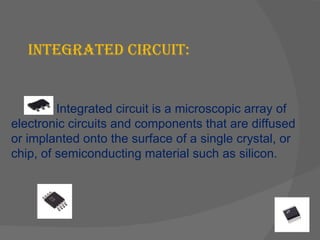
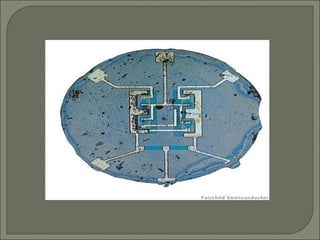
INTEGRATED CIRCUIT: Integrated circuit is a microscopic array of electronic circuits and components that are diffused or implanted onto the surface of a single crystal, or chip, of semiconducting material such as silicon.
Definition History Fabrication process Advantages Disadvantages Applications
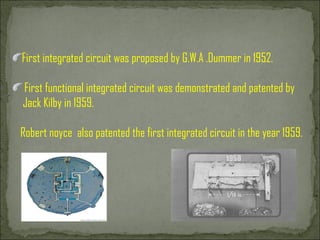
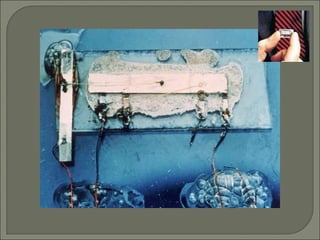
First integrated circuit was proposed by G.W.A .Dummer in 1952. First functional integrated circuit was demonstrated and patented by Jack Kilby in 1959. Robert noyce  also patented the first integrated circuit in the year 1959.
 
 
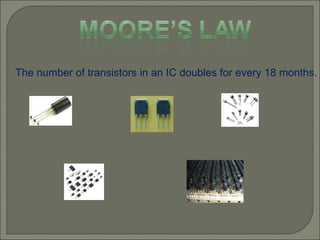
The number of transistors in an IC doubles for every 18 months.
Analog IC’s Ex: op-Amps, voltage regulators Digital IC’s Ex: Micro processors,Multiplexers,decoders Mixed  signal IC’s Ex: ADC,DAC
Small scale integration( SSI)  Medium scale integration( MSI)  Large scale integration( LSI)  Very large scale integration(VLSI) Ultra large scale integration(ULSI)
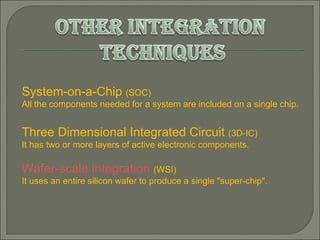
System-on-a-Chip  (SOC)  All the components needed for a system are included on a single chip.  Three Dimensional Integrated Circuit  (3D-IC) It has two or more layers of active electronic components. Wafer-scale integration   (WSI)  It uses an entire silicon wafer to produce a single "super-chip".
 
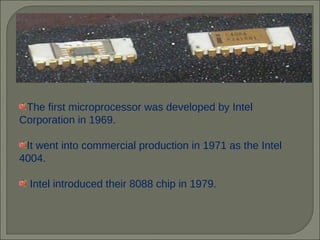
The first microprocessor was developed by Intel Corporation in 1969.  It went into commercial production in 1971 as the Intel 4004. Intel introduced their 8088 chip in 1979.
Definition History Fabrication process Advantages Disadvantages Applications
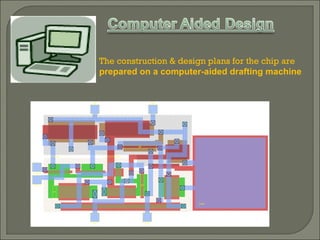
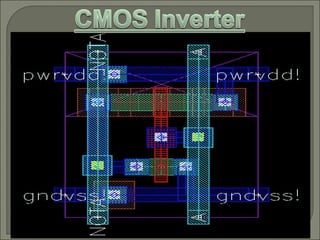
The construction & design plans for the chip are  prepared on a computer-aided drafting machine
 
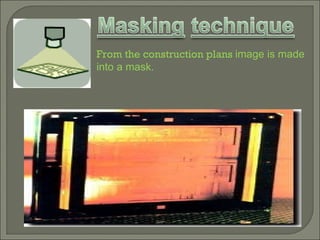
From the construction plans  image is made into a mask.
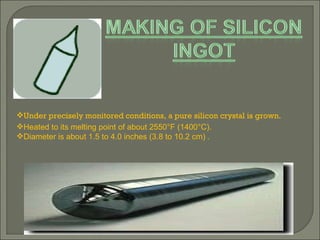
Under precisely monitored conditions, a pure silicon crystal is grown. Heated to its melting point of about 2550°F (1400°C). Diameter is about 1.5 to 4.0 inches (3.8 to 10.2 cm) .
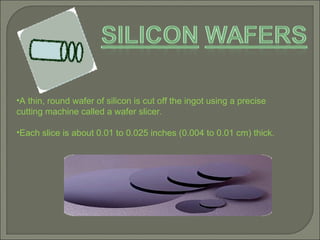
A thin, round wafer of silicon is cut off the ingot using a precise  cutting machine called a wafer slicer.  Each slice is about 0.01 to 0.025 inches (0.004 to 0.01 cm) thick.
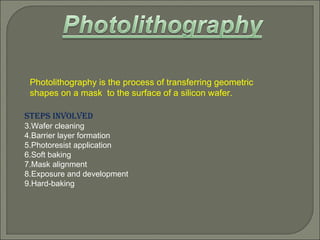
steps involved Wafer cleaning Barrier layer formation Photoresist application Soft baking Mask alignment Exposure and development  Hard-baking Photolithography is the process of transferring geometric shapes on a mask  to the surface of a silicon wafer.
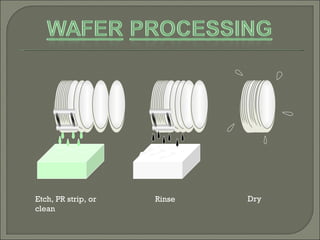
Dry Etch, PR strip, or clean Rinse
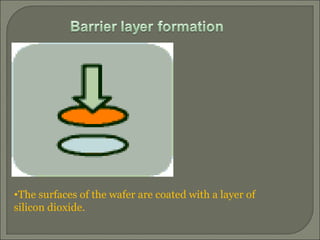
The surfaces of the wafer are coated with a layer of silicon dioxide.
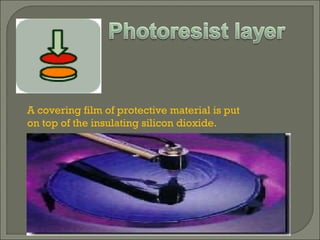
A covering film of protective material is put on top of the insulating silicon dioxide.
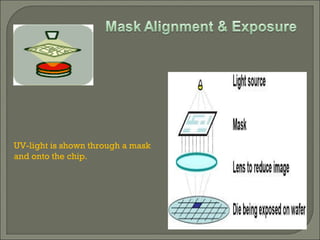
UV-light is shown through a mask and onto the chip.
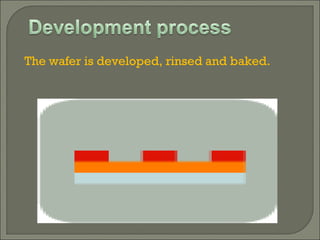
The wafer is developed, rinsed and baked.
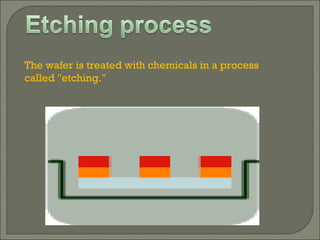
The wafer is treated with chemicals in a process called "etching."
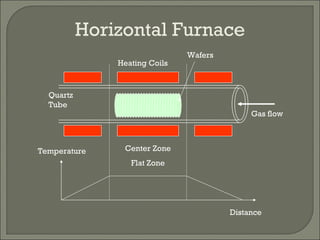
Horizontal Furnace Center Zone Flat Zone Distance Temperature Heating Coils Quartz Tube Gas flow Wafers
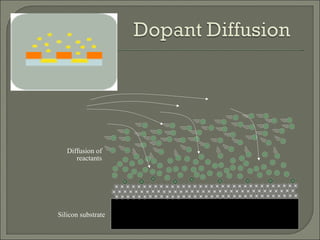
Silicon substrate Diffusion of reactants
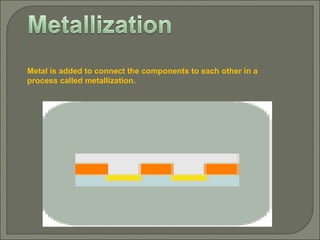
Metal is added to connect the components to each other in a process called metallization.
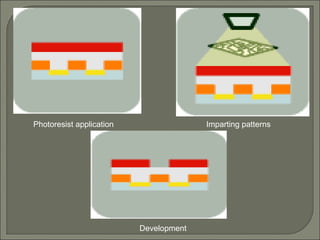
Photoresist application Imparting patterns Development
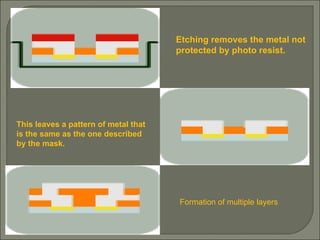
Etching removes the metal not protected by photo resist. This leaves a pattern of metal that is the same as the one described by the mask. Formation of multiple layers
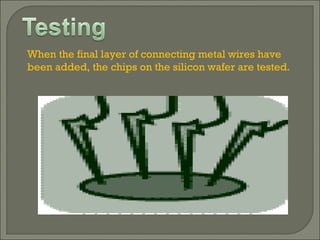
When the final layer of connecting metal wires have been added, the chips on the silicon wafer are tested.
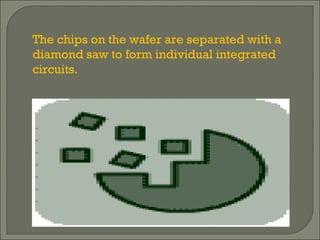
The chips on the wafer are separated with a diamond saw to form individual integrated circuits.
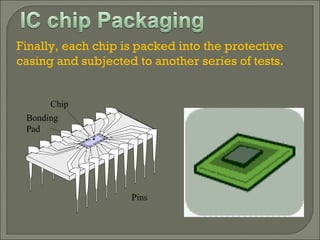
Finally, each chip is packed into the protective casing and subjected to another series of tests.
Low cost High reliability  Low power requirements  High processing speeds  Low power dissipation Less weight Less space
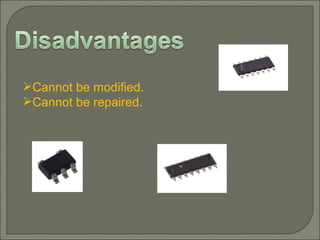
Cannot be modified. Cannot be repaired.


Integrated Circuits

  • 1.
  • 2.
    Definition History Fabricationprocess Advantages Disadvantages Applications
  • 3.
    Definition History Fabricationprocess Advantages Disadvantages Applications
  • 4.
    INTEGRATED CIRCUIT: Integratedcircuit is a microscopic array of electronic circuits and components that are diffused or implanted onto the surface of a single crystal, or chip, of semiconducting material such as silicon.
  • 5.
    Definition History Fabricationprocess Advantages Disadvantages Applications
  • 6.
    First integrated circuitwas proposed by G.W.A .Dummer in 1952. First functional integrated circuit was demonstrated and patented by Jack Kilby in 1959. Robert noyce also patented the first integrated circuit in the year 1959.
  • 7.
  • 8.
  • 9.
    The number oftransistors in an IC doubles for every 18 months.
  • 10.
    Analog IC’s Ex:op-Amps, voltage regulators Digital IC’s Ex: Micro processors,Multiplexers,decoders Mixed signal IC’s Ex: ADC,DAC
  • 11.
    Small scale integration(SSI) Medium scale integration( MSI) Large scale integration( LSI) Very large scale integration(VLSI) Ultra large scale integration(ULSI)
  • 12.
    System-on-a-Chip  (SOC) All the components needed for a system are included on a single chip. Three Dimensional Integrated Circuit  (3D-IC) It has two or more layers of active electronic components. Wafer-scale integration   (WSI) It uses an entire silicon wafer to produce a single "super-chip".
  • 13.
  • 14.
    The first microprocessorwas developed by Intel Corporation in 1969. It went into commercial production in 1971 as the Intel 4004. Intel introduced their 8088 chip in 1979.
  • 15.
    Definition History Fabricationprocess Advantages Disadvantages Applications
  • 16.
    The construction &design plans for the chip are prepared on a computer-aided drafting machine
  • 17.
  • 18.
    From the constructionplans image is made into a mask.
  • 19.
    Under precisely monitoredconditions, a pure silicon crystal is grown. Heated to its melting point of about 2550°F (1400°C). Diameter is about 1.5 to 4.0 inches (3.8 to 10.2 cm) .
  • 20.
    A thin, roundwafer of silicon is cut off the ingot using a precise cutting machine called a wafer slicer. Each slice is about 0.01 to 0.025 inches (0.004 to 0.01 cm) thick.
  • 21.
    steps involved Wafercleaning Barrier layer formation Photoresist application Soft baking Mask alignment Exposure and development Hard-baking Photolithography is the process of transferring geometric shapes on a mask to the surface of a silicon wafer.
  • 22.
    Dry Etch, PRstrip, or clean Rinse
  • 23.
    The surfaces ofthe wafer are coated with a layer of silicon dioxide.
  • 24.
    A covering filmof protective material is put on top of the insulating silicon dioxide.
  • 25.
    UV-light is shownthrough a mask and onto the chip.
  • 26.
    The wafer isdeveloped, rinsed and baked.
  • 27.
    The wafer istreated with chemicals in a process called "etching."
  • 28.
    Horizontal Furnace CenterZone Flat Zone Distance Temperature Heating Coils Quartz Tube Gas flow Wafers
  • 29.
  • 30.
    Metal is addedto connect the components to each other in a process called metallization.
  • 31.
  • 32.
    Etching removes themetal not protected by photo resist. This leaves a pattern of metal that is the same as the one described by the mask. Formation of multiple layers
  • 33.
    When the finallayer of connecting metal wires have been added, the chips on the silicon wafer are tested.
  • 34.
    The chips onthe wafer are separated with a diamond saw to form individual integrated circuits.
  • 35.
    Finally, each chipis packed into the protective casing and subjected to another series of tests.
  • 36.
    Low cost Highreliability Low power requirements High processing speeds Low power dissipation Less weight Less space
  • 37.
    Cannot be modified.Cannot be repaired.
  • 38.
  • 39.