Downloaded 11 times




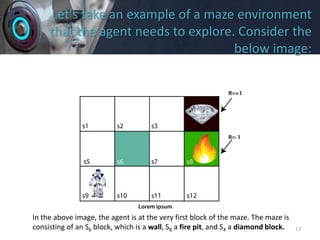
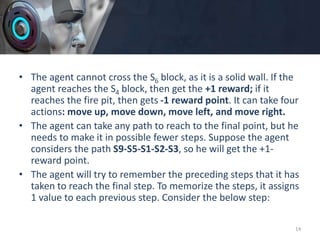
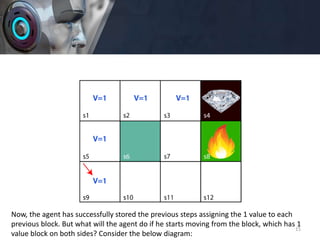
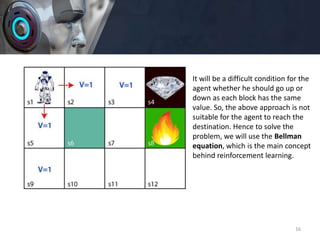


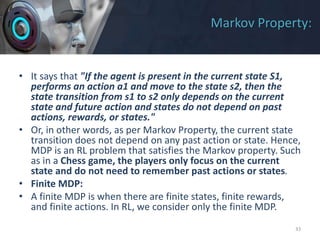
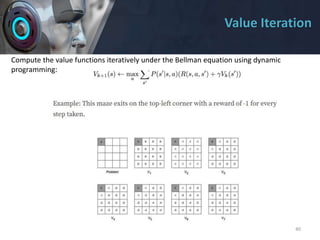
![For 1st block:
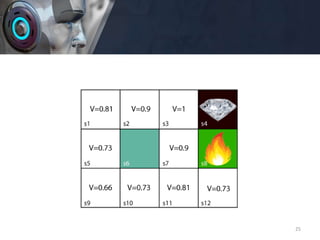
• V(s3) = max [R(s,a) + γV(s`)], here V(s')= 0 because
there is no further state to move.
• V(s3)= max[R(s,a)]=> V(s3)= max[1]=> V(s3)= 1.
For 2nd block:
• V(s2) = max [R(s,a) + γV(s`)], here γ= 0.9(lets), V(s')=
1, and R(s, a)= 0, because there is no reward at this
state.
• V(s2)= max[0.9(1)]=> V(s)= max[0.9]=> V(s2) =0.9
21](https://image.slidesharecdn.com/unit4semisupervisedlearningandreinforcementlearning1-231013153908-dbc0838d/85/semi-supervised-Learning-and-Reinforcement-learning-1-pptx-21-320.jpg)
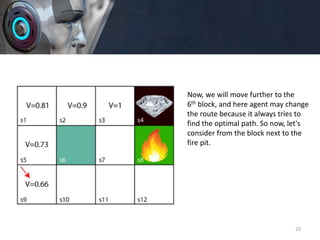
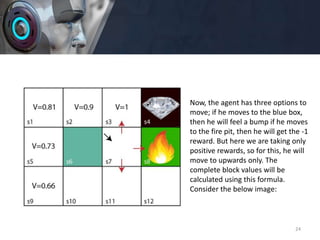
![• For 3rd block:
• V(s1) = max [R(s,a) + γV(s`)], here γ= 0.9(lets), V(s')= 0.9, and
R(s, a)= 0, because there is no reward at this state also.
• V(s1)= max[0.9(0.9)]=> V(s3)= max[0.81]=> V(s1) =0.81
• For 4th block:
• V(s5) = max [R(s,a) + γV(s`)], here γ= 0.9(lets), V(s')= 0.81, and
R(s, a)= 0, because there is no reward at this state also.
• V(s5)= max[0.9(0.81)]=> V(s5)= max[0.81]=> V(s5) =0.73
• For 5th block:
• V(s9) = max [R(s,a) + γV(s`)], here γ= 0.9(lets), V(s')= 0.73, and
R(s, a)= 0, because there is no reward at this state also.
• V(s9)= max[0.9(0.73)]=> V(s4)= max[0.81]=> V(s4) =0.66
22](https://image.slidesharecdn.com/unit4semisupervisedlearningandreinforcementlearning1-231013153908-dbc0838d/85/semi-supervised-Learning-and-Reinforcement-learning-1-pptx-22-320.jpg)


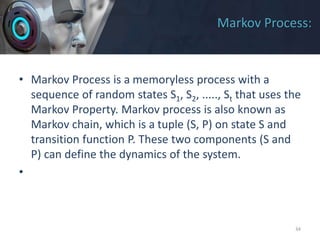
![How to represent the agent state?
• We can represent the agent state using the Markov
State that contains all the required information from the
history. The State St is Markov state if it follows the given
condition:
• P[St+1 | St ] = P[St +1 | S1,......, St]
• The Markov state follows the Markov property, which
says that the future is independent of the past and can
only be defined with the present. The RL works on fully
observable environments, where the agent can observe
the environment and act for the new state. The complete
process is known as Markov Decision process, which is
explained below:
29](https://image.slidesharecdn.com/unit4semisupervisedlearningandreinforcementlearning1-231013153908-dbc0838d/85/semi-supervised-Learning-and-Reinforcement-learning-1-pptx-29-320.jpg)

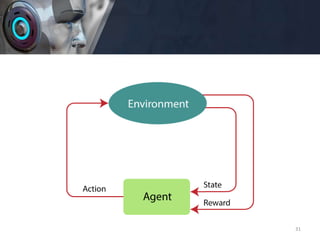

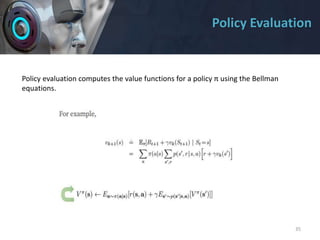
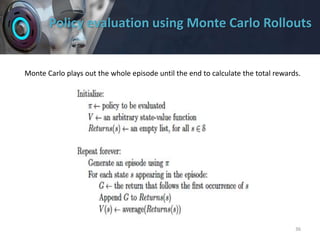

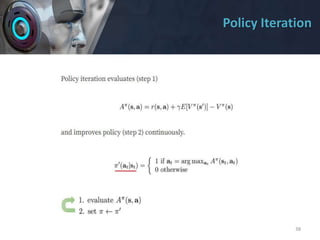

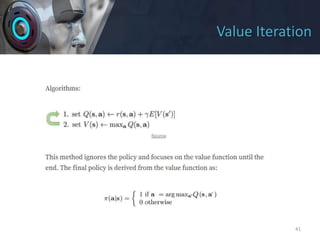
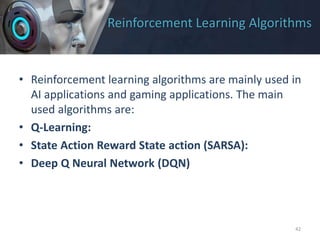
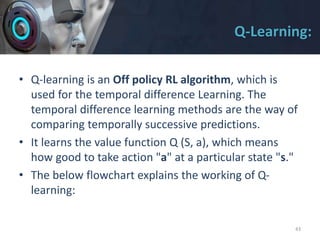


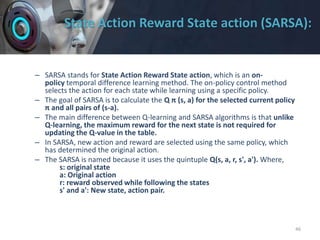


This document provides an overview of semi-supervised learning and reinforcement learning. Semi-supervised learning uses both labeled and unlabeled data for training, which is useful when large amounts of unlabeled data are available but fully labeling the data is difficult. Reinforcement learning involves an agent learning through trial-and-error interactions with an environment. The agent performs actions and receives rewards or penalties, allowing it to gradually improve its policies. Key concepts discussed include the Bellman equation, Markov decision processes, policy evaluation, value iteration, and popular algorithms like Q-learning and SARSA.


