MACHINE LEARNING (INTEGRATED)
(21ISE62)
Module 5
Dr. Shivashankar
Professor
Department of Information Science & Engineering
GLOBAL ACADEMY OF TECHNOLOGY-Bengaluru
8/20/2024 1
Dr. Shivashankar, ISE, GAT
GLOBAL ACADEMY OF TECHNOLOGY
Ideal Homes Township, Rajarajeshwari Nagar, Bengaluru – 560 098
Department of Information Science & Engineering
Course Outcomes
After Completion of the course, student will be able to:
 Illustrate Regression Techniques and Decision Tree Learning
Algorithm.
 Apply SVM, ANN and KNN algorithm to solve appropriate problems.
 Apply Bayesian Techniques and derive effective learning rules.
 Illustrate performance of AI and ML algorithms using evaluation
techniques.
 Understand reinforcement learning and its application in real world
problems.
Text Book:
1. Tom M. Mitchell, Machine Learning, McGraw Hill Education, India Edition 2013.
2. EthemAlpaydın, Introduction to machine learning, MIT press, Second edition.
3. Pang-Ning Tan, Michael Steinbach, Vipin Kumar, Introduction to Data Mining,
Pearson, First Impression, 2014.
8/20/2024 2
Dr. Shivashankar, ISE, GAT
Module 5: Reinforcement Learning
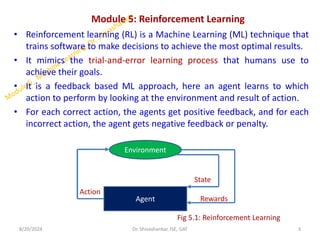
• Reinforcement learning (RL) is a Machine Learning (ML) technique that
trains software to make decisions to achieve the most optimal results.
• It mimics the trial-and-error learning process that humans use to
achieve their goals.
• It is a feedback based ML approach, here an agent learns to which
action to perform by looking at the environment and result of action.
• For each correct action, the agents get positive feedback, and for each
incorrect action, the agent gets negative feedback or penalty.
8/20/2024 3
Dr. Shivashankar, ISE, GAT
Agent
Environment
Action
State
Rewards
Fig 5.1: Reinforcement Learning
Learning to Optimize Rewards
• The agent interact with environment and identify the possible action he can
perform.
• The primary goal of an agent in reinforcement learning is to perform actions by
looking at the environment and get the maximum positive rewards.
• In reinforcement learning, the agent learns automatically using feedbacks
without any labelled data, unlike supervised learning.
• Since there is no labelled data, so the agent is bound to learn by its experience
only.
• There are two types of reinforcement learning: Positive and negative.
• Positive reinforcement learning is a recurrence behavior due to positive
rewards.
• Rewards increase strength and frequency of a specific behavior.
• This encourages to execute similar action that yield maximum rewards.
• Similarly in negative reinforcement learning, negative rewards are used as
deterrent to weaken the behavior and to avoid it.
• Rewards decrease the strength and the frequency of a specific behavior.
8/20/2024 4
Dr. Shivashankar, ISE, GAT
Cont…
• The agent can take any path to reach to the final point, but he needs to make
it in possible fewer steps. Suppose the agent considers the path S9-S5-S1-S2-
S3, so he will get the +1-reward point.
• Action performed by the agent is referred to as "a"
• State occurred by performing the action is "s."
• The reward/feedback obtained for each good and bad action is "R."
• A discount factor is Gamma "γ."
V(s) = max [R(s,a) + γV(s`)]
8/20/2024 5
Dr. Shivashankar, ISE, GAT
Cont…
• V(s)= value calculated at a particular point.
• R(s,a) = Reward at a particular state s by performing an action.
• γ = Discount factor
• V(s`) = The value at the previous state.
How to represent the agent state?
• We can represent the agent state using the Markov State that contains all
the required information from the history. The State St is Markov state if it
follows the given condition:
P[St+1 | St ] = P[St +1 | S1,......, St]
• tuple of four elements (S, A, Pa, Ra):
• A set of finite States S
• A set of finite Actions A
• Rewards received after transitioning from state S to state S', due to action
a.
• Probability Pa.
8/20/2024 6
Dr. Shivashankar, ISE, GAT
Reinforcement Learning Algorithms
• Reinforcement learning algorithms are mainly used in AI applications and gaming
applications. The main used algorithms are:
• Q-Learning:
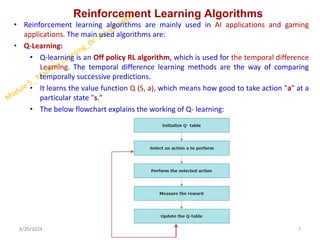
• Q-learning is an Off policy RL algorithm, which is used for the temporal difference
Learning. The temporal difference learning methods are the way of comparing
temporally successive predictions.
• It learns the value function Q (S, a), which means how good to take action "a" at a
particular state "s."
• The below flowchart explains the working of Q- learning:
8/20/2024 7
Dr. Shivashankar, ISE, GAT
Credit Assignment Problem
• The Credit Assignment Problem (CAP) is a fundamental challenge in
reinforcement learning.
• It arises when an agent receives a reward for a particular action, but the agent
must determine which of its previous actions led to the reward.
• In reinforcement learning, an agent applies a set of actions in an environment
to maximize the overall reward.
• The agent updates its policy based on feedback received from the
environment.
• The CAP refers to the problem of measuring the influence and impact of an
action taken by an agent on future rewards.
• The core aim is to guide the agents to take corrective actions which can
maximize the reward.
• This can make it difficult for the agent to build an effective policy.
• Additionally, there’re situations where the agent takes a sequence of actions,
and the reward signal is only received at the end of the sequence.
• In these cases, the agent must determine which of its previous actions
positively contributed to the final reward
8/20/2024 8
Dr. Shivashankar, ISE, GAT
Cont…
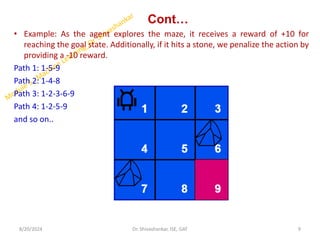
• Example: As the agent explores the maze, it receives a reward of +10 for
reaching the goal state. Additionally, if it hits a stone, we penalize the action by
providing a -10 reward.
Path 1: 1-5-9
Path 2: 1-4-8
Path 3: 1-2-3-6-9
Path 4: 1-2-5-9
and so on..
8/20/2024 9
Dr. Shivashankar, ISE, GAT
Temporal Difference Learning
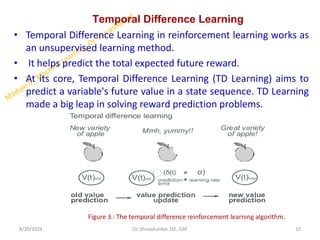
• Temporal Difference Learning in reinforcement learning works as
an unsupervised learning method.
• It helps predict the total expected future reward.
• At its core, Temporal Difference Learning (TD Learning) aims to
predict a variable's future value in a state sequence. TD Learning
made a big leap in solving reward prediction problems.
8/20/2024 10
Dr. Shivashankar, ISE, GAT
Figure 3 : The temporal difference reinforcement learning algorithm.
Cont…
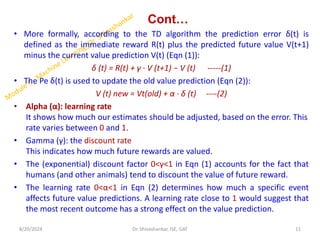
• More formally, according to the TD algorithm the prediction error δ(t) is
defined as the immediate reward R(t) plus the predicted future value V(t+1)
minus the current value prediction V(t) (Eqn (1)):
δ (t) = R(t) + γ · V (t+1) − V (t) -----(1)
• The Pe δ(t) is used to update the old value prediction (Eqn (2)):
V (t) new = Vt(old) + α · δ (t) ----(2)
• Alpha (α): learning rate
It shows how much our estimates should be adjusted, based on the error. This
rate varies between 0 and 1.
• Gamma (γ): the discount rate
This indicates how much future rewards are valued.
• The (exponential) discount factor 0<γ<1 in Eqn (1) accounts for the fact that
humans (and other animals) tend to discount the value of future reward.
• The learning rate 0<α<1 in Eqn (2) determines how much a specific event
affects future value predictions. A learning rate close to 1 would suggest that
the most recent outcome has a strong effect on the value prediction.
8/20/2024 11
Dr. Shivashankar, ISE, GAT
Q-learning
• Q-learning is a reinforcement learning algorithm that finds an
optimal action-selection policy for any finite Markov Decision
Process (MDP).
• It helps an agent learn to maximize the total reward over time
through repeated interactions with the environment, even when
the model of that environment is not known.
How Does Q-Learning Work
1. Learning and Updating Q-values:
• The algorithm maintains a table of Q-values for each state-action
pair.
• These Q-values represent the expected utility of taking a given
action in a given state and following the optimal policy after that.
• The Q-values are initialized arbitrarily and are updated iteratively
using the experiences gathered by the agent.
8/20/2024 12
Dr. Shivashankar, ISE, GAT
Q-learning
2. Q-value Update Rule:
The Q-values are updated using the formula:
𝑄(𝑠,𝑎)←𝑄(𝑠,𝑎)+𝛼[𝑟+𝛾max (𝑄(𝑠′,𝑎′)−𝑄(𝑠,𝑎))]
Q(s,a) = r(s,a) + 𝛼*max (𝑄(𝛿(s,a), ƴ
𝑎))
Where :
𝑠 is the current state,
𝑎 is the action taken,
r is the reward received after taking action 𝑎 in state 𝑠,
𝑠′ is the new state after action,
𝑎′ is any possible action from the new state 𝑠′,
𝛼 is the learning rate (0 < α ≤ 1),
𝛾 is the discount factor (0 ≤ γ < 1).
8/20/2024 13
Dr. Shivashankar, ISE, GAT
Cont…
3. Policy Derivation: The policy determines what action to take in
each state and can be derived from the Q-values.
Typically, the policy chooses the action with the highest Q-value in
each state.
4. Exploration vs. Exploitation: Q-learning manages the trade-off
between exploration (choosing random actions to discover new
strategies) and exploitation (choosing actions based on
accumulated knowledge).
5. Convergence: Under certain conditions, such as ensuring all
state-action pairs are visited an infinite number of times, Q-learning
converges to the optimal policy and Q-values that give the
maximum expected reward for any state under any conditions.
8/20/2024 14
Dr. Shivashankar, ISE, GAT
Q Learning Algorithm
For each s, a initialize the table entry ෡
𝑸(s,a) to zero.
Observe current state s.
Do forever:
 Select an action a and execute it.
 Receive immediate reward r
 Observe new state ƴ
𝒔
 Update the entry for ෡
𝑸(s,a) as follow:
Q(s,a) = r(s,a) + 𝛼*max (𝑄(𝛿(s,a), ƴ
𝑎))
෡
𝑸(s,a) ← 𝒓 + 𝜸 𝒎𝒂𝒙
ƴ
𝒂
෡
𝑸 ( ƴ
𝒔, ƴ
𝒂)
S ← ƴ
𝒔
8/20/2024 15
Dr. Shivashankar, ISE, GAT
Problem
Problem 1: Suppose there are 6 rooms in the given table, room 3 is the goal, have an
instant reward of 100, other rooms not directly connected to the target room have zero
reward. Each row contains an instant reward value. Construct a reward matrix, Q-learning
and calculate immediate reward value for each instant. Learning rate is 0.9.
Solution: Reward Matrix Q-learning Matrix
8/20/2024 16
Dr. Shivashankar, ISE, GAT
1 2 3 4 5 6
1 -1 0 -1 0 -1 -1
2 0 -1 100 -1 0 -1
3 -1 -1 0 -1 -1 -1
4 0 -1 -1 -1 0 -1
5 -1 0 -1 0 -1 0
6 -1 -1 100 -1 0 -1
1 2 3 4 5 6
1 0 0 0 0 0 0
2 0 0 0 0 0 0
3 0 0 0 0 0 0
4 0 0 0 0 0 0
5 0 0 0 0 0 0
6 0 0 0 0 0 0
R=
State
Action
Q=
Cont…
Q(state, action)= R(state, action) + Alpha * Max[Q(next state, all action)]
Q(s,a) = r(s,a) + 𝛼*max [𝑄(𝛿(s,a), ƴ
𝑎)]
At state 3: Q(2,3) = R(2,3) + 0.9 * max [Q(3,3)]
= 100 + 0.9 * max [0]
= 100 + 0 = 100
Q(6,3) = R(6,3) + 0.9 * max [Q(3,3)]
= 100 + 0.9 * max [0]
= 100 + 0 = 100
At state 2: Q(1,2) = R(1,2) + 0.9 * max [Q(2,3), Q(2,5)]
= 0 + 0.9 * max [100,0]
= 0.9*100 = 90
At state 1: Q(2,1) = R(2,1) + 0.9 * max [Q(1,2), Q(1,4)]
= 0 + 0.9 * max [90,0]
= 0.9*90 = 81
Q(4,1) = R(4,1) + 0.9 * max [Q(1,2), Q(1,4)]
= 0 + 0.9 * max [90,0]
= 0.9*90=81
8/20/2024 17
Dr. Shivashankar, ISE, GAT
Sate transition diagram
Cont…
At state 4: Q(1,4) = R(1,4) + 0.9 * max [Q(4,1), Q(4,5)]
= 0 + 0.9 * max [81,0]
= 0.9*81 = 72
At state 2: Q(5,2) = R(5,2) + 0.9 * max [Q(2,1), Q(2,3), Q(2,5)]
= 0 + 0.9 * max [81,100,0]
= 0.9*100 = 90
At state 4: Q(5,4) = R(5,4) + 0.9 * max [Q(4,1), Q(4,5)]
= 0 + 0.9 * max [81,0]
= 0.9*81 = 72
At state 5: Q(2,5) = R(2,5) + 0.9 * max [Q(5,2), Q(5,4), Q(5,6)]
= 0 + 0.9 * max [90, 72, 0]
= 0.9*90 = 81
Q(4,5) = R(4,5) + 0.9 * max [Q(5,2), Q(5,4), Q(5,6)]
= 0 + 0.9 * max [90, 72, 0]
= 0.9*90 = 81
8/20/2024 18
Dr. Shivashankar, ISE, GAT
Cont…
At state 5: Q(6,5) = R(6,5) + 0.9 * max [Q(5,2), Q(5,4), Q(5,6)]
= 0 + 0.9 * max [90, 72, 0]
= 0.9*90 = 81
At state 6: Q(5,6) = R(5,6) + 0.9 * max [Q(6,3), Q(6,5)]
= 0 + 0.9 * max [100,81]
= 0.9*100 = 90
8/20/2024 19
Dr. Shivashankar, ISE, GAT
Cont…
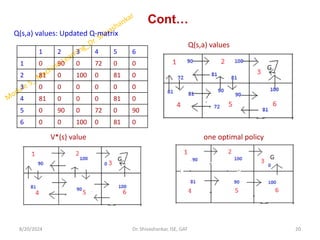
Q(s,a) values: Updated Q-matrix
Q(s,a) values
V*(s) value one optimal policy
8/20/2024 20
Dr. Shivashankar, ISE, GAT
1 2 3 4 5 6
1 0 90 0 72 0 0
2 81 0 100 0 81 0
3 0 0 0 0 0 0
4 81 0 0 0 81 0
5 0 90 0 72 0 90
6 0 0 100 0 81 0
Cont…
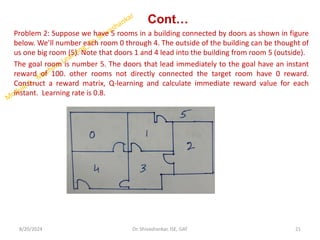
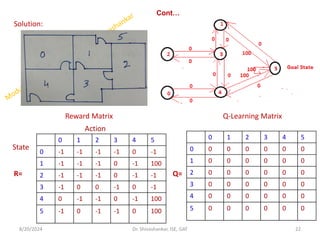
Problem 2: Suppose we have 5 rooms in a building connected by doors as shown in figure
below. We’ll number each room 0 through 4. The outside of the building can be thought of
us one big room (5). Note that doors 1 and 4 lead into the building from room 5 (outside).
The goal room is number 5. The doors that lead immediately to the goal have an instant
reward of 100. other rooms not directly connected the target room have 0 reward.
Construct a reward matrix, Q-learning and calculate immediate reward value for each
instant. Learning rate is 0.8.
8/20/2024 21
Dr. Shivashankar, ISE, GAT
Cont…
Solution:
Reward Matrix Q-Learning Matrix
R= Q=
8/20/2024 22
Dr. Shivashankar, ISE, GAT
0 1 2 3 4 5
0 -1 -1 -1 -1 0 -1
1 -1 -1 -1 0 -1 100
2 -1 -1 -1 0 -1 -1
3 -1 0 0 -1 0 -1
4 0 -1 -1 0 -1 100
5 -1 0 -1 -1 0 100
Action
State
0 1 2 3 4 5
0 0 0 0 0 0 0
1 0 0 0 0 0 0
2 0 0 0 0 0 0
3 0 0 0 0 0 0
4 0 0 0 0 0 0
5 0 0 0 0 0 0
Cont…
• Now let’s imagine what would happen if our agent were in state 5 (next state)
• Look at the 6th row of the reward matrix R(i.e. state 5)
• It has 3 possible actions: go to state 1,4, or 5.
Q(s,a) = r(s,a) + 𝛼*max [𝑄(𝛿(s,a), ƴ
𝑎)]
Q(state, action)= R(state, action) + Alpha * max[Q(next state, all action)]
At state 5:
Q(1,5) = R(1,5) + 0.8 * max [Q(5,1), Q(5,4)]
= 100 + 0.8 * max [Q(0,0)]
= 100 + 0.8*0 = 100
Q(4,5) = R(4,5) + 0.8 * max [Q(5,1), Q(5,4)]
= 100 + 0.8 * max [0,0]= 100
At state 1:
Now we imagine that we are in state 1(next state).
It has 2 possible actions: go to state 3 or state 5.
Then, we complete the Q value:
Q(3,1) = R(3,1) +0.8*Max(Q[1,3), Q(1,5)]
= 0 + 0.8 * max [0,100]
= 0 + 0.8*max(0,100) = 80
8/20/2024 23
Dr. Shivashankar, ISE, GAT
Cont…
Q(5,1) = R(5,1) + 0.8*max (Q(1,3), Q(1,5)]
= 0 + 0.8* max(64,100)]
0.8*100 = 80
At state 3:
Q(1,3) = R(1,3) + 0.8 * max [Q(3,1), Q(3,2), Q(3,4)]
= 0 + 0.8 * max [80, 0, 0]
= 0+ 0.8*80 = 64
Q(4,3) = R(4,3) + 0.8 * max [Q(3,4), Q(3,2), Q(3,1)]
= 0 + 0.8 * max [0, 0, 80]
= 0+ 0.8*80 = 64
Q(2,3) = R(2,3) + 0.8 * max [Q(3,2), Q(3,1), Q(3,4)]
= 0 + 0.8 * max [0, 80, 0]
= 0+ 0.8*80 = 64
At state 4:
Q(5, 4) = R(5, 4) + 0.8 * max [Q(4,5), Q(4,3), Q(4, 0)]
= 0 + 0.8 * max [100, 64, 0]
= 80
8/20/2024 24
Dr. Shivashankar, ISE, GAT
Cont…
Q(3, 4) = R(3, 4) + 0.8 * max [Q(4,3), Q(4,5), Q(4, 0)]
= 0 + 0.8 * max [64,100, 0]= 80
Q(0, 4) = R(0, 4) + 0.8 * max [Q(4,0), Q(4,3), Q(4,5)]
= 0 + 0.8 * max [0, 0, 100] = 80
At state 2:
Q(3,2) = R(3,2) + 0.8*max[ Q(2,3)]
= 0 + 0.8*max[64] = 51
At state 0:
Q(4, 0) = R(4,0) + 0.8*max[Q(0,4)]
= 0 + 0.8 * 80 = 64
8/20/2024 25
Dr. Shivashankar, ISE, GAT
0 1 2 3 4 5
0 0 0 0 0 80 0
1 0 0 0 64 0 100
2 0 0 0 64 0 0
3 0 80 51 0 80 0
4 64 0 0 64 0 100
5 0 80 0 0 80 100
Updated state diagram
Final Updated Q-Learning Matrix
Cont…
Case Study:
Artificial Intelligence Powering Google Products,
Recent AI Tools leveraged by Tesla, AI for
Facebook,
Robo-Banking: Artificial Intelligence at JPMorgan
Chase, Audio AI,
A Machine Learning Approach — Building a Hotel
Recommendation Engine
8/20/2024 26
Dr. Shivashankar, ISE, GAT

5th Module_Machine Learning_Reinforc.pdf

  • 1.
    MACHINE LEARNING (INTEGRATED) (21ISE62) Module5 Dr. Shivashankar Professor Department of Information Science & Engineering GLOBAL ACADEMY OF TECHNOLOGY-Bengaluru 8/20/2024 1 Dr. Shivashankar, ISE, GAT GLOBAL ACADEMY OF TECHNOLOGY Ideal Homes Township, Rajarajeshwari Nagar, Bengaluru – 560 098 Department of Information Science & Engineering
  • 2.
    Course Outcomes After Completionof the course, student will be able to:  Illustrate Regression Techniques and Decision Tree Learning Algorithm.  Apply SVM, ANN and KNN algorithm to solve appropriate problems.  Apply Bayesian Techniques and derive effective learning rules.  Illustrate performance of AI and ML algorithms using evaluation techniques.  Understand reinforcement learning and its application in real world problems. Text Book: 1. Tom M. Mitchell, Machine Learning, McGraw Hill Education, India Edition 2013. 2. EthemAlpaydın, Introduction to machine learning, MIT press, Second edition. 3. Pang-Ning Tan, Michael Steinbach, Vipin Kumar, Introduction to Data Mining, Pearson, First Impression, 2014. 8/20/2024 2 Dr. Shivashankar, ISE, GAT
  • 3.
    Module 5: ReinforcementLearning • Reinforcement learning (RL) is a Machine Learning (ML) technique that trains software to make decisions to achieve the most optimal results. • It mimics the trial-and-error learning process that humans use to achieve their goals. • It is a feedback based ML approach, here an agent learns to which action to perform by looking at the environment and result of action. • For each correct action, the agents get positive feedback, and for each incorrect action, the agent gets negative feedback or penalty. 8/20/2024 3 Dr. Shivashankar, ISE, GAT Agent Environment Action State Rewards Fig 5.1: Reinforcement Learning
  • 4.
    Learning to OptimizeRewards • The agent interact with environment and identify the possible action he can perform. • The primary goal of an agent in reinforcement learning is to perform actions by looking at the environment and get the maximum positive rewards. • In reinforcement learning, the agent learns automatically using feedbacks without any labelled data, unlike supervised learning. • Since there is no labelled data, so the agent is bound to learn by its experience only. • There are two types of reinforcement learning: Positive and negative. • Positive reinforcement learning is a recurrence behavior due to positive rewards. • Rewards increase strength and frequency of a specific behavior. • This encourages to execute similar action that yield maximum rewards. • Similarly in negative reinforcement learning, negative rewards are used as deterrent to weaken the behavior and to avoid it. • Rewards decrease the strength and the frequency of a specific behavior. 8/20/2024 4 Dr. Shivashankar, ISE, GAT
  • 5.
    Cont… • The agentcan take any path to reach to the final point, but he needs to make it in possible fewer steps. Suppose the agent considers the path S9-S5-S1-S2- S3, so he will get the +1-reward point. • Action performed by the agent is referred to as "a" • State occurred by performing the action is "s." • The reward/feedback obtained for each good and bad action is "R." • A discount factor is Gamma "γ." V(s) = max [R(s,a) + γV(s`)] 8/20/2024 5 Dr. Shivashankar, ISE, GAT
  • 6.
    Cont… • V(s)= valuecalculated at a particular point. • R(s,a) = Reward at a particular state s by performing an action. • γ = Discount factor • V(s`) = The value at the previous state. How to represent the agent state? • We can represent the agent state using the Markov State that contains all the required information from the history. The State St is Markov state if it follows the given condition: P[St+1 | St ] = P[St +1 | S1,......, St] • tuple of four elements (S, A, Pa, Ra): • A set of finite States S • A set of finite Actions A • Rewards received after transitioning from state S to state S', due to action a. • Probability Pa. 8/20/2024 6 Dr. Shivashankar, ISE, GAT
  • 7.
    Reinforcement Learning Algorithms •Reinforcement learning algorithms are mainly used in AI applications and gaming applications. The main used algorithms are: • Q-Learning: • Q-learning is an Off policy RL algorithm, which is used for the temporal difference Learning. The temporal difference learning methods are the way of comparing temporally successive predictions. • It learns the value function Q (S, a), which means how good to take action "a" at a particular state "s." • The below flowchart explains the working of Q- learning: 8/20/2024 7 Dr. Shivashankar, ISE, GAT
  • 8.
    Credit Assignment Problem •The Credit Assignment Problem (CAP) is a fundamental challenge in reinforcement learning. • It arises when an agent receives a reward for a particular action, but the agent must determine which of its previous actions led to the reward. • In reinforcement learning, an agent applies a set of actions in an environment to maximize the overall reward. • The agent updates its policy based on feedback received from the environment. • The CAP refers to the problem of measuring the influence and impact of an action taken by an agent on future rewards. • The core aim is to guide the agents to take corrective actions which can maximize the reward. • This can make it difficult for the agent to build an effective policy. • Additionally, there’re situations where the agent takes a sequence of actions, and the reward signal is only received at the end of the sequence. • In these cases, the agent must determine which of its previous actions positively contributed to the final reward 8/20/2024 8 Dr. Shivashankar, ISE, GAT
  • 9.
    Cont… • Example: Asthe agent explores the maze, it receives a reward of +10 for reaching the goal state. Additionally, if it hits a stone, we penalize the action by providing a -10 reward. Path 1: 1-5-9 Path 2: 1-4-8 Path 3: 1-2-3-6-9 Path 4: 1-2-5-9 and so on.. 8/20/2024 9 Dr. Shivashankar, ISE, GAT
  • 10.
    Temporal Difference Learning •Temporal Difference Learning in reinforcement learning works as an unsupervised learning method. • It helps predict the total expected future reward. • At its core, Temporal Difference Learning (TD Learning) aims to predict a variable's future value in a state sequence. TD Learning made a big leap in solving reward prediction problems. 8/20/2024 10 Dr. Shivashankar, ISE, GAT Figure 3 : The temporal difference reinforcement learning algorithm.
  • 11.
    Cont… • More formally,according to the TD algorithm the prediction error δ(t) is defined as the immediate reward R(t) plus the predicted future value V(t+1) minus the current value prediction V(t) (Eqn (1)): δ (t) = R(t) + γ · V (t+1) − V (t) -----(1) • The Pe δ(t) is used to update the old value prediction (Eqn (2)): V (t) new = Vt(old) + α · δ (t) ----(2) • Alpha (α): learning rate It shows how much our estimates should be adjusted, based on the error. This rate varies between 0 and 1. • Gamma (γ): the discount rate This indicates how much future rewards are valued. • The (exponential) discount factor 0<γ<1 in Eqn (1) accounts for the fact that humans (and other animals) tend to discount the value of future reward. • The learning rate 0<α<1 in Eqn (2) determines how much a specific event affects future value predictions. A learning rate close to 1 would suggest that the most recent outcome has a strong effect on the value prediction. 8/20/2024 11 Dr. Shivashankar, ISE, GAT
  • 12.
    Q-learning • Q-learning isa reinforcement learning algorithm that finds an optimal action-selection policy for any finite Markov Decision Process (MDP). • It helps an agent learn to maximize the total reward over time through repeated interactions with the environment, even when the model of that environment is not known. How Does Q-Learning Work 1. Learning and Updating Q-values: • The algorithm maintains a table of Q-values for each state-action pair. • These Q-values represent the expected utility of taking a given action in a given state and following the optimal policy after that. • The Q-values are initialized arbitrarily and are updated iteratively using the experiences gathered by the agent. 8/20/2024 12 Dr. Shivashankar, ISE, GAT
  • 13.
    Q-learning 2. Q-value UpdateRule: The Q-values are updated using the formula: 𝑄(𝑠,𝑎)←𝑄(𝑠,𝑎)+𝛼[𝑟+𝛾max (𝑄(𝑠′,𝑎′)−𝑄(𝑠,𝑎))] Q(s,a) = r(s,a) + 𝛼*max (𝑄(𝛿(s,a), ƴ 𝑎)) Where : 𝑠 is the current state, 𝑎 is the action taken, r is the reward received after taking action 𝑎 in state 𝑠, 𝑠′ is the new state after action, 𝑎′ is any possible action from the new state 𝑠′, 𝛼 is the learning rate (0 < α ≤ 1), 𝛾 is the discount factor (0 ≤ γ < 1). 8/20/2024 13 Dr. Shivashankar, ISE, GAT
  • 14.
    Cont… 3. Policy Derivation:The policy determines what action to take in each state and can be derived from the Q-values. Typically, the policy chooses the action with the highest Q-value in each state. 4. Exploration vs. Exploitation: Q-learning manages the trade-off between exploration (choosing random actions to discover new strategies) and exploitation (choosing actions based on accumulated knowledge). 5. Convergence: Under certain conditions, such as ensuring all state-action pairs are visited an infinite number of times, Q-learning converges to the optimal policy and Q-values that give the maximum expected reward for any state under any conditions. 8/20/2024 14 Dr. Shivashankar, ISE, GAT
  • 15.
    Q Learning Algorithm Foreach s, a initialize the table entry ෡ 𝑸(s,a) to zero. Observe current state s. Do forever:  Select an action a and execute it.  Receive immediate reward r  Observe new state ƴ 𝒔  Update the entry for ෡ 𝑸(s,a) as follow: Q(s,a) = r(s,a) + 𝛼*max (𝑄(𝛿(s,a), ƴ 𝑎)) ෡ 𝑸(s,a) ← 𝒓 + 𝜸 𝒎𝒂𝒙 ƴ 𝒂 ෡ 𝑸 ( ƴ 𝒔, ƴ 𝒂) S ← ƴ 𝒔 8/20/2024 15 Dr. Shivashankar, ISE, GAT
  • 16.
    Problem Problem 1: Supposethere are 6 rooms in the given table, room 3 is the goal, have an instant reward of 100, other rooms not directly connected to the target room have zero reward. Each row contains an instant reward value. Construct a reward matrix, Q-learning and calculate immediate reward value for each instant. Learning rate is 0.9. Solution: Reward Matrix Q-learning Matrix 8/20/2024 16 Dr. Shivashankar, ISE, GAT 1 2 3 4 5 6 1 -1 0 -1 0 -1 -1 2 0 -1 100 -1 0 -1 3 -1 -1 0 -1 -1 -1 4 0 -1 -1 -1 0 -1 5 -1 0 -1 0 -1 0 6 -1 -1 100 -1 0 -1 1 2 3 4 5 6 1 0 0 0 0 0 0 2 0 0 0 0 0 0 3 0 0 0 0 0 0 4 0 0 0 0 0 0 5 0 0 0 0 0 0 6 0 0 0 0 0 0 R= State Action Q=
  • 17.
    Cont… Q(state, action)= R(state,action) + Alpha * Max[Q(next state, all action)] Q(s,a) = r(s,a) + 𝛼*max [𝑄(𝛿(s,a), ƴ 𝑎)] At state 3: Q(2,3) = R(2,3) + 0.9 * max [Q(3,3)] = 100 + 0.9 * max [0] = 100 + 0 = 100 Q(6,3) = R(6,3) + 0.9 * max [Q(3,3)] = 100 + 0.9 * max [0] = 100 + 0 = 100 At state 2: Q(1,2) = R(1,2) + 0.9 * max [Q(2,3), Q(2,5)] = 0 + 0.9 * max [100,0] = 0.9*100 = 90 At state 1: Q(2,1) = R(2,1) + 0.9 * max [Q(1,2), Q(1,4)] = 0 + 0.9 * max [90,0] = 0.9*90 = 81 Q(4,1) = R(4,1) + 0.9 * max [Q(1,2), Q(1,4)] = 0 + 0.9 * max [90,0] = 0.9*90=81 8/20/2024 17 Dr. Shivashankar, ISE, GAT Sate transition diagram
  • 18.
    Cont… At state 4:Q(1,4) = R(1,4) + 0.9 * max [Q(4,1), Q(4,5)] = 0 + 0.9 * max [81,0] = 0.9*81 = 72 At state 2: Q(5,2) = R(5,2) + 0.9 * max [Q(2,1), Q(2,3), Q(2,5)] = 0 + 0.9 * max [81,100,0] = 0.9*100 = 90 At state 4: Q(5,4) = R(5,4) + 0.9 * max [Q(4,1), Q(4,5)] = 0 + 0.9 * max [81,0] = 0.9*81 = 72 At state 5: Q(2,5) = R(2,5) + 0.9 * max [Q(5,2), Q(5,4), Q(5,6)] = 0 + 0.9 * max [90, 72, 0] = 0.9*90 = 81 Q(4,5) = R(4,5) + 0.9 * max [Q(5,2), Q(5,4), Q(5,6)] = 0 + 0.9 * max [90, 72, 0] = 0.9*90 = 81 8/20/2024 18 Dr. Shivashankar, ISE, GAT
  • 19.
    Cont… At state 5:Q(6,5) = R(6,5) + 0.9 * max [Q(5,2), Q(5,4), Q(5,6)] = 0 + 0.9 * max [90, 72, 0] = 0.9*90 = 81 At state 6: Q(5,6) = R(5,6) + 0.9 * max [Q(6,3), Q(6,5)] = 0 + 0.9 * max [100,81] = 0.9*100 = 90 8/20/2024 19 Dr. Shivashankar, ISE, GAT
  • 20.
    Cont… Q(s,a) values: UpdatedQ-matrix Q(s,a) values V*(s) value one optimal policy 8/20/2024 20 Dr. Shivashankar, ISE, GAT 1 2 3 4 5 6 1 0 90 0 72 0 0 2 81 0 100 0 81 0 3 0 0 0 0 0 0 4 81 0 0 0 81 0 5 0 90 0 72 0 90 6 0 0 100 0 81 0
  • 21.
    Cont… Problem 2: Supposewe have 5 rooms in a building connected by doors as shown in figure below. We’ll number each room 0 through 4. The outside of the building can be thought of us one big room (5). Note that doors 1 and 4 lead into the building from room 5 (outside). The goal room is number 5. The doors that lead immediately to the goal have an instant reward of 100. other rooms not directly connected the target room have 0 reward. Construct a reward matrix, Q-learning and calculate immediate reward value for each instant. Learning rate is 0.8. 8/20/2024 21 Dr. Shivashankar, ISE, GAT
  • 22.
    Cont… Solution: Reward Matrix Q-LearningMatrix R= Q= 8/20/2024 22 Dr. Shivashankar, ISE, GAT 0 1 2 3 4 5 0 -1 -1 -1 -1 0 -1 1 -1 -1 -1 0 -1 100 2 -1 -1 -1 0 -1 -1 3 -1 0 0 -1 0 -1 4 0 -1 -1 0 -1 100 5 -1 0 -1 -1 0 100 Action State 0 1 2 3 4 5 0 0 0 0 0 0 0 1 0 0 0 0 0 0 2 0 0 0 0 0 0 3 0 0 0 0 0 0 4 0 0 0 0 0 0 5 0 0 0 0 0 0
  • 23.
    Cont… • Now let’simagine what would happen if our agent were in state 5 (next state) • Look at the 6th row of the reward matrix R(i.e. state 5) • It has 3 possible actions: go to state 1,4, or 5. Q(s,a) = r(s,a) + 𝛼*max [𝑄(𝛿(s,a), ƴ 𝑎)] Q(state, action)= R(state, action) + Alpha * max[Q(next state, all action)] At state 5: Q(1,5) = R(1,5) + 0.8 * max [Q(5,1), Q(5,4)] = 100 + 0.8 * max [Q(0,0)] = 100 + 0.8*0 = 100 Q(4,5) = R(4,5) + 0.8 * max [Q(5,1), Q(5,4)] = 100 + 0.8 * max [0,0]= 100 At state 1: Now we imagine that we are in state 1(next state). It has 2 possible actions: go to state 3 or state 5. Then, we complete the Q value: Q(3,1) = R(3,1) +0.8*Max(Q[1,3), Q(1,5)] = 0 + 0.8 * max [0,100] = 0 + 0.8*max(0,100) = 80 8/20/2024 23 Dr. Shivashankar, ISE, GAT
  • 24.
    Cont… Q(5,1) = R(5,1)+ 0.8*max (Q(1,3), Q(1,5)] = 0 + 0.8* max(64,100)] 0.8*100 = 80 At state 3: Q(1,3) = R(1,3) + 0.8 * max [Q(3,1), Q(3,2), Q(3,4)] = 0 + 0.8 * max [80, 0, 0] = 0+ 0.8*80 = 64 Q(4,3) = R(4,3) + 0.8 * max [Q(3,4), Q(3,2), Q(3,1)] = 0 + 0.8 * max [0, 0, 80] = 0+ 0.8*80 = 64 Q(2,3) = R(2,3) + 0.8 * max [Q(3,2), Q(3,1), Q(3,4)] = 0 + 0.8 * max [0, 80, 0] = 0+ 0.8*80 = 64 At state 4: Q(5, 4) = R(5, 4) + 0.8 * max [Q(4,5), Q(4,3), Q(4, 0)] = 0 + 0.8 * max [100, 64, 0] = 80 8/20/2024 24 Dr. Shivashankar, ISE, GAT
  • 25.
    Cont… Q(3, 4) =R(3, 4) + 0.8 * max [Q(4,3), Q(4,5), Q(4, 0)] = 0 + 0.8 * max [64,100, 0]= 80 Q(0, 4) = R(0, 4) + 0.8 * max [Q(4,0), Q(4,3), Q(4,5)] = 0 + 0.8 * max [0, 0, 100] = 80 At state 2: Q(3,2) = R(3,2) + 0.8*max[ Q(2,3)] = 0 + 0.8*max[64] = 51 At state 0: Q(4, 0) = R(4,0) + 0.8*max[Q(0,4)] = 0 + 0.8 * 80 = 64 8/20/2024 25 Dr. Shivashankar, ISE, GAT 0 1 2 3 4 5 0 0 0 0 0 80 0 1 0 0 0 64 0 100 2 0 0 0 64 0 0 3 0 80 51 0 80 0 4 64 0 0 64 0 100 5 0 80 0 0 80 100 Updated state diagram Final Updated Q-Learning Matrix
  • 26.
    Cont… Case Study: Artificial IntelligencePowering Google Products, Recent AI Tools leveraged by Tesla, AI for Facebook, Robo-Banking: Artificial Intelligence at JPMorgan Chase, Audio AI, A Machine Learning Approach — Building a Hotel Recommendation Engine 8/20/2024 26 Dr. Shivashankar, ISE, GAT