Data Structure & Algorithm
Unit 2: Queue and Linked List
by:
Dr. Shweta Saraswat
Contents
Part B : Linked Lists:
• Introduction,
• single linked list,
• representation of a linked list in memory,
• Different Operations on a Single linked list,
• Reversing a single linked list,
• Advantages and disadvantages of single linked
list, circular linked list, double linked list and
Header linked list.
What is Linked List
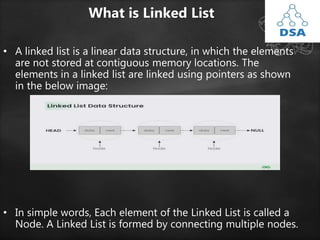
• A linked list is a linear data structure, in which the elements
are not stored at contiguous memory locations. The
elements in a linked list are linked using pointers as shown
in the below image:
• In simple words, Each element of the Linked List is called a
Node. A Linked List is formed by connecting multiple nodes.
A node consists of two parts,
• Data: It is the actual raw information that you
want to maintain. It can be a video object, a
number, a character, etc.
• Pointer to another node: It stores the link of the
adjacent node.
Introduction
• It is basically chains of nodes, each node
contains information such as data and a pointer
to the next node in the chain. In the linked list
there is a head pointer, which points to the first
element of the linked list, and if the list is empty
then it simply points to null or nothing.
Why linked list data structure needed?
Here are a few advantages of a linked list that is listed below, it will help
you understand why it is necessary to know.
• Dynamic Data structure: The size of memory can be allocated or
de-allocated at run time based on the operation insertion or
deletion.
• Ease of Insertion/Deletion: The insertion and deletion of elements
are simpler than arrays since no elements need to be shifted after
insertion and deletion, Just the address needed to be updated.
• Efficient Memory Utilization: As we know Linked List is a dynamic
data structure the size increases or decreases as per the requirement
so this avoids the wastage of memory.
• Implementation: Various advanced data structures can be
implemented using a linked list like a stack, queue, graph, hash
maps, etc.
How would have you maintained the
huge collection of images?
• The first thing that would have crossed your
mind is maintaining an array of all images, but
what if the number of images is ever increasing?
Soon you’ll realize that arrays are not suited for
this job, they don’t go very well with dynamic
size data.
• We need something better, we need a data
structure that can store a collection of objects
just like an array, but whose size can be
manipulated in real-time. This is where the
Linked List comes in.
Types of linked lists:
• There are mainly three types of linked lists:
• Single-linked list
• Double linked list
• Circular linked list
• Header linked list
1. Singly-linked list
• Traversal of items can be done in the forward
direction only due to the linking of every node to
its next node.
2. Doubly linked list
• Traversal of items can be done in both forward
and backward directions as every node contains
an additional prev pointer that points to the
previous node.
3. Circular linked lists
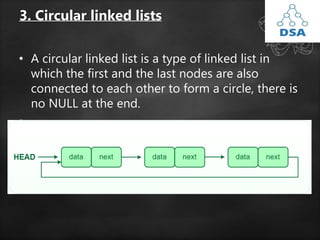
• A circular linked list is a type of linked list in
which the first and the last nodes are also
connected to each other to form a circle, there is
no NULL at the end.
•
4. Header Linked list
• Header Linked List is a modified version of Singly
Linked List. In Header linked list, we have a special
node, the Header Node present at the beginning of
the linked list. The Header Node is an extra node at
the front of the list storing meaningful information
about the list. Such a node is not similar in structure
to the other nodes in the list. It does not represent
any items of the list like other nodes rather than the
information present in the Header node is global for
all nodes such as Count of Nodes in a
List, Maximum among all Items, Minimum value
among all Items etc. This gives useful information
about the Linked list.
Single Linked List
Definition
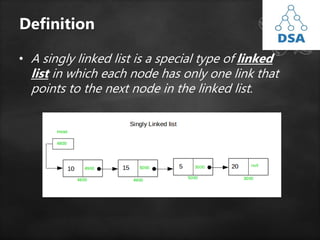
• A singly linked list is a special type of linked
list in which each node has only one link that
points to the next node in the linked list.
Characteristics of a Singly Linked List:
• Each node holds a single value and a reference
to the next node in the list.
• The list has a head, which is a reference to the
first node in the list, and a tail, which is a
reference to the last node in the list.
• The nodes are not stored in a contiguous block
of memory, but instead, each node holds the
address of the next node in the list.
• Accessing elements in a singly linked list requires
traversing the list from the head to the desired
node, as there is no direct access to a specific
node in memory.
Application of Singly Linked Lists:
• Memory management: Singly linked lists can be
used to implement memory pools, in which memory
is allocated and deallocated as needed.
• Database indexing: Singly linked lists can be used
to implement linked lists in databases, allowing for
fast insertion and deletion operations.
• Representing polynomials and sparse
matrices: Singly linked lists can be used to
efficiently represent polynomials and sparse
matrices, where most elements are zero.
• Operating systems: Singly linked lists are used in
operating systems for tasks such as scheduling
processes and managing system resources.
Advantages of Singly Linked Lists:
• Dynamic memory allocation: Singly linked lists
allow for dynamic memory allocation, meaning
that the size of the list can change at runtime as
elements are added or removed.
• Cache friendliness: Singly linked lists can be
cache-friendly as nodes can be stored in
separate cache lines, reducing cache misses and
improving performance.
• Space-efficient: Singly linked lists are space-
efficient, as they only need to store a reference
to the next node in each element, rather than a
large block of contiguous memory.
Disadvantages of Singly Linked Lists:
• Poor random access performance: Accessing an element in
a singly linked list requires traversing the list from the head to
the desired node, making it slow for random access
operations compared to arrays.
• Increased memory overhead: Singly linked lists require
additional memory for storing the pointers to the next node in
each element, resulting in increased memory overhead
compared to arrays.
• Vulnerability to data loss: Singly linked lists are vulnerable to
data loss if a node’s next pointer is lost or corrupted, as there
is no way to traverse the list and access other elements.
• Not suitable for parallel processing: Singly linked lists are
not suitable for parallel processing, as updating a node
requires exclusive access to its next pointer, which cannot be
easily done in a parallel environment.
• Backward traversing not possible: In singly linked list does
not support backward traversing.
representation of a linked list
in memory
Representation of a Linked List in
Memory
There are two ways to represent a linked list in
memory:
• 1. Static representation using array
• 2. Dynamic representation using free pool of
storage
Static representation
• In static representation of a single linked list, two
arrays are maintained: one array for data and the
other for links. The static representation of the
linked list in Figure 5.2 is shown in Figure 5.3.
Static representation
• Two parallel arrays of equal size are allocated
which should be sufficient to store the entire
linked list. Nevertheless this contradicts the idea
of the linked list (that is non-contagious location
of elements). But in some programming
languages, for example, ALGOL, FORTRAN,
BASIC, etc. such a representation is the only
representation to manage a linked list.
Dynamic representation
• The efficient way of representing a linked list is using the free
pool of storage.
• In this method, there is a memory bank (which is nothing but
a collection of free memory spaces) and a memory manager (a
program, in fact).
• During the creation of a linked list, whenever a node is
required the request is placed to the memory manager; the
memory manager will then search the memory bank for the
block requested and, if found, grants the desired block to the
caller.
• Again, there is also another program called the garbage
collector; it plays whenever a node is no more in use; it returns
the unused node to the memory bank.
• It may be noted that memory bank is basically a list of
memory spaces which is available to a programmer.
• Such a memory management is known as dynamic memory
management. The dynamic representation of linked list uses
the dynamic memory management policy.
Dynamic representation
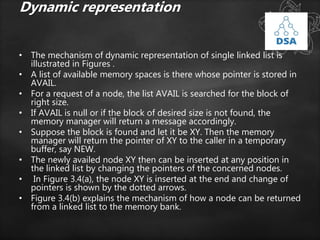
• The mechanism of dynamic representation of single linked list is
illustrated in Figures .
• A list of available memory spaces is there whose pointer is stored in
AVAIL.
• For a request of a node, the list AVAIL is searched for the block of
right size.
• If AVAIL is null or if the block of desired size is not found, the
memory manager will return a message accordingly.
• Suppose the block is found and let it be XY. Then the memory
manager will return the pointer of XY to the caller in a temporary
buffer, say NEW.
• The newly availed node XY then can be inserted at any position in
the linked list by changing the pointers of the concerned nodes.
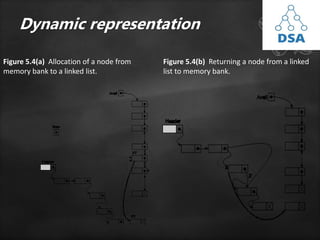
• In Figure 3.4(a), the node XY is inserted at the end and change of
pointers is shown by the dotted arrows.
• Figure 3.4(b) explains the mechanism of how a node can be returned
from a linked list to the memory bank.
Dynamic representation
Figure 5.4(a) Allocation of a node from
memory bank to a linked list.
Figure 5.4(b) Returning a node from a linked
list to memory bank.
Different Operations on a
Single linked list
Linked List operations
• There are various linked list operations that allow
us to perform different actions on linked lists.
• Here's a list of basic linked list operations:
• Traversal - access each element of the linked list
• Insertion - adds a new element to the linked list
• Deletion - removes the existing elements
• Search - find a node in the linked list
• Sort - sort the nodes of the linked list
1. Insertion
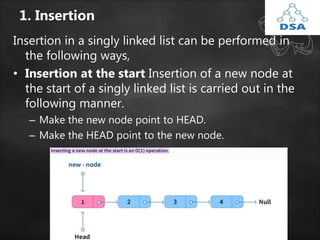
Insertion in a singly linked list can be performed in
the following ways,
• Insertion at the start Insertion of a new node at
the start of a singly linked list is carried out in the
following manner.
– Make the new node point to HEAD.
– Make the HEAD point to the new node.
Insertion after some Node
Insertion of a new node after some node in a singly
linked list is carried out in the following manner,
– Reach the desired node after which the new node is to be
inserted.
– Make the new node point to the next element of the
current node.
– Make the current node point to the new node. Inserting a
new node after some node is an O(N) operation.
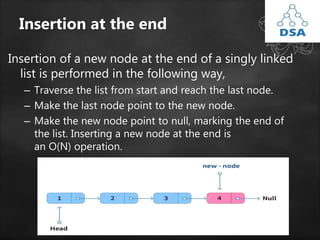
Insertion at the end
Insertion of a new node at the end of a singly linked
list is performed in the following way,
– Traverse the list from start and reach the last node.
– Make the last node point to the new node.
– Make the new node point to null, marking the end of
the list. Inserting a new node at the end is
an O(N) operation.
2. Deletion
• Deletion in a singly linked list can be performed
in the following ways,
• Deletion at the start
The first node of the singly linked list can be
deleted as follows,
– Make the HEAD point to its next element.
Deletion at the middle
• The deletion after a specific node can be formed
in the following way,
• Reach the desired node after which the node is
to be deleted.
• Make the current node point to the next of next
element.
Deletion at last
• The deletion of the last node is performed in the
following manner,
• Reach the second last node of th singly linke list.
• Make the second last node point null.
3. Traverse (Display)
• To display the entire singly linked list, we need to
traverse it from first to last.
• In contrast to arrays, linked list nodes cannot be
accessed randomly. Hence to reach the n-th
element, we are bound to traverse through
all (n-1) elements.
4. Search
• To search an element in the singly linked list, we
need to traverse the linked list right from the
start.
• At each node, we perform a lookup to determine
if the target has been found, if yes, then we
return the target node else we move to the next
element.
5. Sort
• We will use a simple sorting algorithm, Bubble
Sort, to sort the elements of a linked list in
ascending order.
Reversing a single linked list
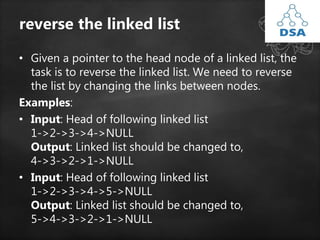
reverse the linked list
• Given a pointer to the head node of a linked list, the
task is to reverse the linked list. We need to reverse
the list by changing the links between nodes.
Examples:
• Input: Head of following linked list
1->2->3->4->NULL
Output: Linked list should be changed to,
4->3->2->1->NULL
• Input: Head of following linked list
1->2->3->4->5->NULL
Output: Linked list should be changed to,
5->4->3->2->1->NULL
Reverse a linked list by Iterative Method:
• The idea is to use three
pointers curr, prev, and next to keep track of
nodes to update reverse links.
Reverse a linked list by Iterative Method:
Reverse a linked list by Iterative Method
Follow the steps below to solve the problem:
• Initialize three pointers prev as
NULL, curr as head, and next as NULL.
• Iterate through the linked list. In a loop, do the
following:
– Before changing the next of curr, store
the next node
• next = curr -> next
– Now update the next pointer of curr to the prev
• curr -> next = prev
– Update prev as curr and curr as next
• prev = curr
• curr = next
Comparison
Thank you

LINKED LIST.pptx

  • 1.
    Data Structure &Algorithm Unit 2: Queue and Linked List by: Dr. Shweta Saraswat
  • 2.
    Contents Part B :Linked Lists: • Introduction, • single linked list, • representation of a linked list in memory, • Different Operations on a Single linked list, • Reversing a single linked list, • Advantages and disadvantages of single linked list, circular linked list, double linked list and Header linked list.
  • 3.
    What is LinkedList • A linked list is a linear data structure, in which the elements are not stored at contiguous memory locations. The elements in a linked list are linked using pointers as shown in the below image: • In simple words, Each element of the Linked List is called a Node. A Linked List is formed by connecting multiple nodes.
  • 4.
    A node consistsof two parts, • Data: It is the actual raw information that you want to maintain. It can be a video object, a number, a character, etc. • Pointer to another node: It stores the link of the adjacent node.
  • 5.
    Introduction • It isbasically chains of nodes, each node contains information such as data and a pointer to the next node in the chain. In the linked list there is a head pointer, which points to the first element of the linked list, and if the list is empty then it simply points to null or nothing.
  • 6.
    Why linked listdata structure needed? Here are a few advantages of a linked list that is listed below, it will help you understand why it is necessary to know. • Dynamic Data structure: The size of memory can be allocated or de-allocated at run time based on the operation insertion or deletion. • Ease of Insertion/Deletion: The insertion and deletion of elements are simpler than arrays since no elements need to be shifted after insertion and deletion, Just the address needed to be updated. • Efficient Memory Utilization: As we know Linked List is a dynamic data structure the size increases or decreases as per the requirement so this avoids the wastage of memory. • Implementation: Various advanced data structures can be implemented using a linked list like a stack, queue, graph, hash maps, etc.
  • 7.
    How would haveyou maintained the huge collection of images? • The first thing that would have crossed your mind is maintaining an array of all images, but what if the number of images is ever increasing? Soon you’ll realize that arrays are not suited for this job, they don’t go very well with dynamic size data. • We need something better, we need a data structure that can store a collection of objects just like an array, but whose size can be manipulated in real-time. This is where the Linked List comes in.
  • 8.
    Types of linkedlists: • There are mainly three types of linked lists: • Single-linked list • Double linked list • Circular linked list • Header linked list
  • 9.
    1. Singly-linked list •Traversal of items can be done in the forward direction only due to the linking of every node to its next node.
  • 10.
    2. Doubly linkedlist • Traversal of items can be done in both forward and backward directions as every node contains an additional prev pointer that points to the previous node.
  • 11.
    3. Circular linkedlists • A circular linked list is a type of linked list in which the first and the last nodes are also connected to each other to form a circle, there is no NULL at the end. •
  • 12.
    4. Header Linkedlist • Header Linked List is a modified version of Singly Linked List. In Header linked list, we have a special node, the Header Node present at the beginning of the linked list. The Header Node is an extra node at the front of the list storing meaningful information about the list. Such a node is not similar in structure to the other nodes in the list. It does not represent any items of the list like other nodes rather than the information present in the Header node is global for all nodes such as Count of Nodes in a List, Maximum among all Items, Minimum value among all Items etc. This gives useful information about the Linked list.
  • 13.
  • 14.
    Definition • A singlylinked list is a special type of linked list in which each node has only one link that points to the next node in the linked list.
  • 15.
    Characteristics of aSingly Linked List: • Each node holds a single value and a reference to the next node in the list. • The list has a head, which is a reference to the first node in the list, and a tail, which is a reference to the last node in the list. • The nodes are not stored in a contiguous block of memory, but instead, each node holds the address of the next node in the list. • Accessing elements in a singly linked list requires traversing the list from the head to the desired node, as there is no direct access to a specific node in memory.
  • 16.
    Application of SinglyLinked Lists: • Memory management: Singly linked lists can be used to implement memory pools, in which memory is allocated and deallocated as needed. • Database indexing: Singly linked lists can be used to implement linked lists in databases, allowing for fast insertion and deletion operations. • Representing polynomials and sparse matrices: Singly linked lists can be used to efficiently represent polynomials and sparse matrices, where most elements are zero. • Operating systems: Singly linked lists are used in operating systems for tasks such as scheduling processes and managing system resources.
  • 17.
    Advantages of SinglyLinked Lists: • Dynamic memory allocation: Singly linked lists allow for dynamic memory allocation, meaning that the size of the list can change at runtime as elements are added or removed. • Cache friendliness: Singly linked lists can be cache-friendly as nodes can be stored in separate cache lines, reducing cache misses and improving performance. • Space-efficient: Singly linked lists are space- efficient, as they only need to store a reference to the next node in each element, rather than a large block of contiguous memory.
  • 18.
    Disadvantages of SinglyLinked Lists: • Poor random access performance: Accessing an element in a singly linked list requires traversing the list from the head to the desired node, making it slow for random access operations compared to arrays. • Increased memory overhead: Singly linked lists require additional memory for storing the pointers to the next node in each element, resulting in increased memory overhead compared to arrays. • Vulnerability to data loss: Singly linked lists are vulnerable to data loss if a node’s next pointer is lost or corrupted, as there is no way to traverse the list and access other elements. • Not suitable for parallel processing: Singly linked lists are not suitable for parallel processing, as updating a node requires exclusive access to its next pointer, which cannot be easily done in a parallel environment. • Backward traversing not possible: In singly linked list does not support backward traversing.
  • 19.
    representation of alinked list in memory
  • 20.
    Representation of aLinked List in Memory There are two ways to represent a linked list in memory: • 1. Static representation using array • 2. Dynamic representation using free pool of storage
  • 21.
    Static representation • Instatic representation of a single linked list, two arrays are maintained: one array for data and the other for links. The static representation of the linked list in Figure 5.2 is shown in Figure 5.3.
  • 22.
    Static representation • Twoparallel arrays of equal size are allocated which should be sufficient to store the entire linked list. Nevertheless this contradicts the idea of the linked list (that is non-contagious location of elements). But in some programming languages, for example, ALGOL, FORTRAN, BASIC, etc. such a representation is the only representation to manage a linked list.
  • 23.
    Dynamic representation • Theefficient way of representing a linked list is using the free pool of storage. • In this method, there is a memory bank (which is nothing but a collection of free memory spaces) and a memory manager (a program, in fact). • During the creation of a linked list, whenever a node is required the request is placed to the memory manager; the memory manager will then search the memory bank for the block requested and, if found, grants the desired block to the caller. • Again, there is also another program called the garbage collector; it plays whenever a node is no more in use; it returns the unused node to the memory bank. • It may be noted that memory bank is basically a list of memory spaces which is available to a programmer. • Such a memory management is known as dynamic memory management. The dynamic representation of linked list uses the dynamic memory management policy.
  • 24.
    Dynamic representation • Themechanism of dynamic representation of single linked list is illustrated in Figures . • A list of available memory spaces is there whose pointer is stored in AVAIL. • For a request of a node, the list AVAIL is searched for the block of right size. • If AVAIL is null or if the block of desired size is not found, the memory manager will return a message accordingly. • Suppose the block is found and let it be XY. Then the memory manager will return the pointer of XY to the caller in a temporary buffer, say NEW. • The newly availed node XY then can be inserted at any position in the linked list by changing the pointers of the concerned nodes. • In Figure 3.4(a), the node XY is inserted at the end and change of pointers is shown by the dotted arrows. • Figure 3.4(b) explains the mechanism of how a node can be returned from a linked list to the memory bank.
  • 25.
    Dynamic representation Figure 5.4(a)Allocation of a node from memory bank to a linked list. Figure 5.4(b) Returning a node from a linked list to memory bank.
  • 26.
    Different Operations ona Single linked list
  • 27.
    Linked List operations •There are various linked list operations that allow us to perform different actions on linked lists. • Here's a list of basic linked list operations: • Traversal - access each element of the linked list • Insertion - adds a new element to the linked list • Deletion - removes the existing elements • Search - find a node in the linked list • Sort - sort the nodes of the linked list
  • 28.
    1. Insertion Insertion ina singly linked list can be performed in the following ways, • Insertion at the start Insertion of a new node at the start of a singly linked list is carried out in the following manner. – Make the new node point to HEAD. – Make the HEAD point to the new node.
  • 29.
    Insertion after someNode Insertion of a new node after some node in a singly linked list is carried out in the following manner, – Reach the desired node after which the new node is to be inserted. – Make the new node point to the next element of the current node. – Make the current node point to the new node. Inserting a new node after some node is an O(N) operation.
  • 30.
    Insertion at theend Insertion of a new node at the end of a singly linked list is performed in the following way, – Traverse the list from start and reach the last node. – Make the last node point to the new node. – Make the new node point to null, marking the end of the list. Inserting a new node at the end is an O(N) operation.
  • 31.
    2. Deletion • Deletionin a singly linked list can be performed in the following ways, • Deletion at the start The first node of the singly linked list can be deleted as follows, – Make the HEAD point to its next element.
  • 32.
    Deletion at themiddle • The deletion after a specific node can be formed in the following way, • Reach the desired node after which the node is to be deleted. • Make the current node point to the next of next element.
  • 33.
    Deletion at last •The deletion of the last node is performed in the following manner, • Reach the second last node of th singly linke list. • Make the second last node point null.
  • 34.
    3. Traverse (Display) •To display the entire singly linked list, we need to traverse it from first to last. • In contrast to arrays, linked list nodes cannot be accessed randomly. Hence to reach the n-th element, we are bound to traverse through all (n-1) elements.
  • 35.
    4. Search • Tosearch an element in the singly linked list, we need to traverse the linked list right from the start. • At each node, we perform a lookup to determine if the target has been found, if yes, then we return the target node else we move to the next element.
  • 36.
    5. Sort • Wewill use a simple sorting algorithm, Bubble Sort, to sort the elements of a linked list in ascending order.
  • 37.
    Reversing a singlelinked list
  • 38.
    reverse the linkedlist • Given a pointer to the head node of a linked list, the task is to reverse the linked list. We need to reverse the list by changing the links between nodes. Examples: • Input: Head of following linked list 1->2->3->4->NULL Output: Linked list should be changed to, 4->3->2->1->NULL • Input: Head of following linked list 1->2->3->4->5->NULL Output: Linked list should be changed to, 5->4->3->2->1->NULL
  • 39.
    Reverse a linkedlist by Iterative Method: • The idea is to use three pointers curr, prev, and next to keep track of nodes to update reverse links.
  • 40.
    Reverse a linkedlist by Iterative Method:
  • 41.
    Reverse a linkedlist by Iterative Method Follow the steps below to solve the problem: • Initialize three pointers prev as NULL, curr as head, and next as NULL. • Iterate through the linked list. In a loop, do the following: – Before changing the next of curr, store the next node • next = curr -> next – Now update the next pointer of curr to the prev • curr -> next = prev – Update prev as curr and curr as next • prev = curr • curr = next
  • 42.
  • 43.