The Semantic Web and The Web Of CommerceThe Semantic web has the potential be completely disruptive or completely opportune to online commerce.Barbara StarrEmail: bstarr@Ontologica.usTwitter: @BarbaraStarr
Disruptive InnovationA disruptive innovation is an innovation that disrupts an existing market. The term is used in business and technology literature to describe innovations that improve a product or service in ways that the market does not expect, typically by lowering price or designing for a different set of consumers.In contrast to "disruptive" innovation, a "sustaining" innovation does not have an effect on existing markets. Sustaining innovations may be either "discontinuous"[1] (i.e. "transformational") or "continuous" (i.e. "evolutionary"). Transformational innovations are not always disruptive. Although the automobile was a transformational innovation, it was not a disruptive innovation, because early automobiles were expensive luxury items that did not disrupt the market for horse-drawn vehicles. The market for transportation essentially remained intact until the debut of the lower priced Ford Model T in 1908 by making higher speed, motorized transportation available to the masses.[2]

Disruptive innovationThe TheoryChristensen defines a disruptive innovation as a product or service designed for a new set of customers.Christensen argues that disruptive innovations can hurt successful, well managed companies that are responsive to their customers and have excellent research and development. These companies tend to ignore the markets most susceptible to disruptive innovations, because the markets have very tight profit margins and are too small to represent significant growth.[5]
What is the Semantic WebSemantic web synonymous with  Web 3.0 ?SemanticmeaningPutting structured information into the web in some machine readable formatNot about the relationships between links, but about relationship between things, and the properties of those thingsA new form of Web content that is meaningful to computers will unleash a revolution of new possibilitiesBy Tim Berners-Lee, James Hendler and Ora Lassila   
What is the Semantic Web (cont)“The Semantic Web provides a common framework that allows data to be shared and reused across application, enterprise, and community boundaries. It is a collaborative effort led by W3C with participation from a large number of researchers and industrial partners. It is based on the Resource Description Framework (RDF)”World  Wide Web Consortiumhttp://www.w3.org/2001/sw/
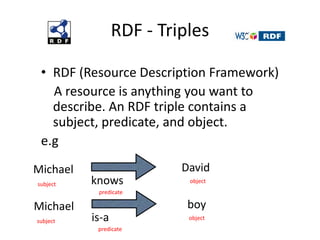
RDF - TriplesRDF (Resource Description Framework)    A resource is anything you want to describe. An RDF triple contains a subject, predicate, and object. e.gDavidMichaelknowsobjectsubjectpredicateboyMichaelis-aobjectsubjectpredicate
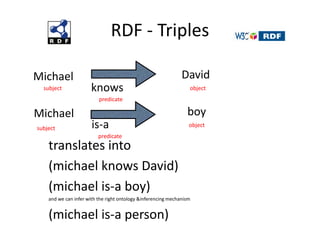
RDF - TriplesDavidMichaelknowsobjectsubjectpredicateboyMichaelis-aobjectsubjectpredicatetranslates into(michael knows David)(michael is-a boy)and we can infer with the right ontology & inferencing mechanism(michael is-a person)
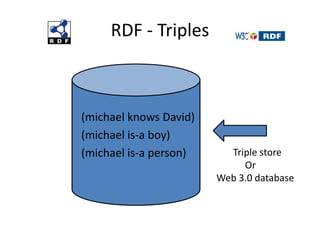
(michael knows David)(michael is-a boy)(michael is-a person)RDF - Triples       Triple store            OrWeb 3.0 database
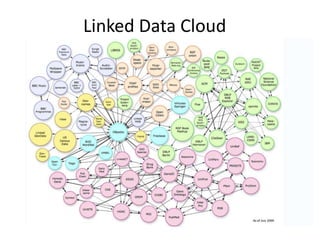
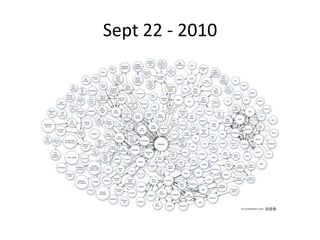
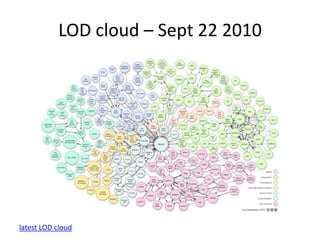
Linked Data Cloud
Wikipedia Definition of anOntologyIn computer science and information science, an ontology is a formal representation of the knowledge by a set of concepts within a domain and the relationships between those concepts. It is used to reason about the properties of that domain, and may be used to describe the domain.In theory, an ontology is a "formal, explicit specification of a shared conceptualization".[1] An ontology provides a shared vocabulary, which can be used to model a domain — that is, the type of objects and/or concepts that exist, and their properties and relations.[2]Ontologies are used in artificial intelligence, the Semantic Web, systems engineering, software engineering, biomedical informatics, library science, enterprise bookmarking, and information architecture as a form of knowledge representation about the world or some part of it. The creation of domain ontologies is also fundamental to the definition and use of an enterprise architecture framework.Not restricted to a hierarchical structure as with a taxonomy
OntologiesOWL – Web Ontology Language (OWL 2.0 released)RDFS – RDF SchemaSome existing standards ontologies:   FOAF - Friend of a Friend - for social networksSIOC - Semantically Interlinked Online CommunitiesGoodrelations for e-commerceGeodataUpper Level OntologyFOAF - Friend of a Friend - for social networksSIOC - Semantically Interlinked Online CommunitiesGoogle Ontology…..
13
RDFaRDFa is simply RDF in attributes. It adds a set of attribute level extensions to HTML, enabling rich metadata to be embedded within web pages. It not only enables triples to be embedded in web pages but also ultimately enables the extraction of triplesIn short, this is the means by which we add structured markup to web pages
SPARQLSPARQL is an RDF Query Language. It  is a recursive acronym and  stands for SPARQL Protocol And RDF Query Language. Information from linked Datasets can be accessed via SPARQL queries.Most linked data sources provide SPARQL ENDPOINTS to enable access.A SPARQL endpoint - provides access to its data via supported SPARQL protocol
To cut a loooong story short:We go from:  a web of documents or hyperlinks,to: a web of data or semantic linkswith: linked data and linked datasets.We use RDF to represent the data on the weband we use SPARQL to query the dataAnd RDFa is simply RDF in attributes.
Core Concepts:Not that we have forgotten about: RDFS (RDF Schema)OWL (Web Ontology Language)& then in summaryRDF (central to all)Linked DataSPARQLRDFa (simply stated as it is html markup)
So at this point either your head is spinningorYou are bored to death because you already know about the semantic webzzzzzzzzzzz
SO … - How is this being used?- What is the extent of adoption- Who is using it?- How can it be leveraged?
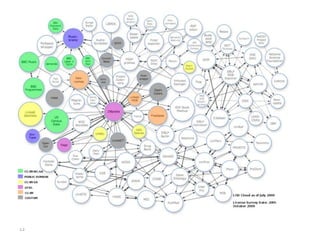
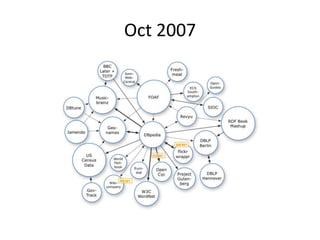
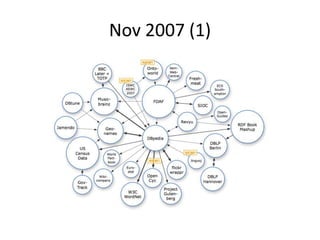
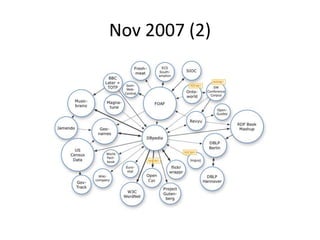
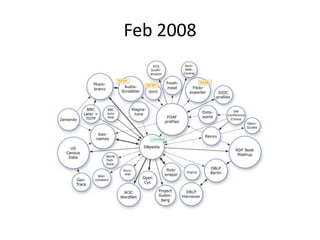
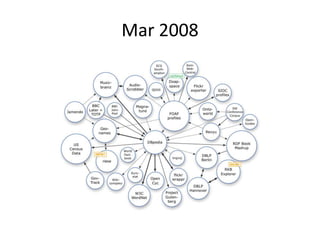
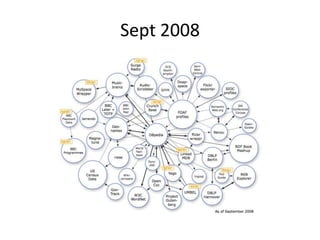
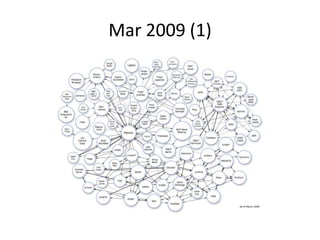
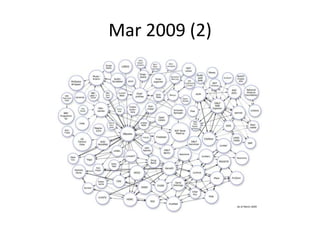
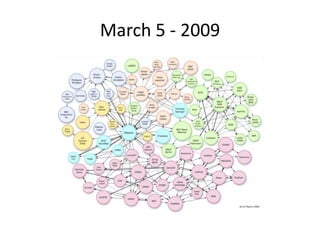
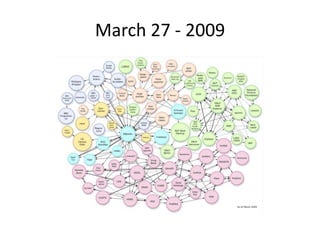
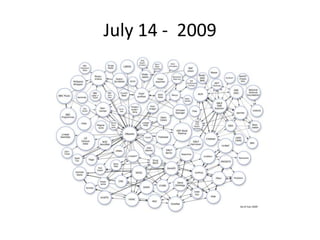
LOD Cloud EvolutionThe rate of growth has been remarkableSource maintained by: Richard Cygniak and AnjaJentsch. http://lod-cloud.net
Oct 2007
Nov 2007 (1)
Nov 2007 (2)
Feb 2008
Mar 2008
Sept 2008
Mar 2009 (1)
Mar 2009 (2)
March 5 - 2009
March 27 - 2009
July 14 -  2009
Sept 22 - 2010
LOD cloud – Sept 22 2010latest LOD cloud
Adopters?UK GovernmentUS GovernmentBBC (FIFA world cup site dynamically generated using linked data)Thomson ReutersFreebaseNY TimesBest BuyTescoGoogle (More to follow http://rdf.data-vocabulary.org/#)YahooFacebookOracleTons more – Just look at the diversity in the LOD data cloud…….
Semantic Web to DateSemantic Search
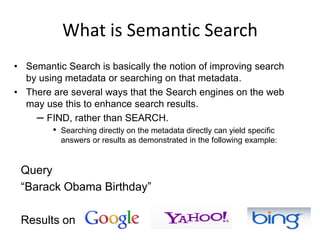
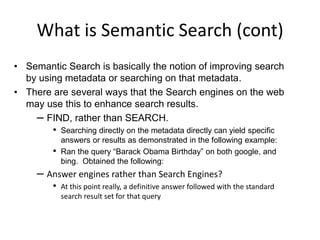
What is Semantic SearchSemantic Search is basically the notion of improving search by using metadata or searching on that metadata.There are several ways that the Search engines on the web may use this to enhance search results.FIND, rather than SEARCH. Searching directly on the metadata directly can yield specific answers or results as demonstrated in the following example:Query “Barack Obama Birthday”Results on
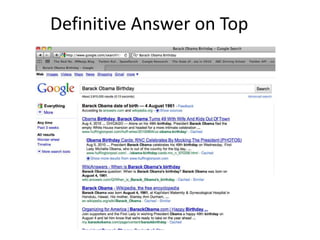
Definitive Answer on Top
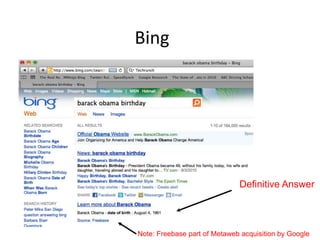
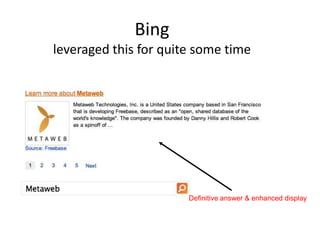
BingDefinitive AnswerNote: Freebase part of Metaweb acquisition by Google
Bingleveraged this for quite some timeDefinitive answer & enhanced display
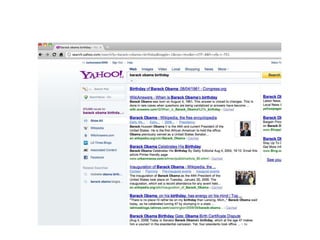
What is Semantic Search (cont)Semantic Search is basically the notion of improving search by using metadata or searching on that metadata.There are several ways that the Search engines on the web may use this to enhance search results.FIND, rather than SEARCH. Searching directly on the metadata directly can yield specific answers or results as demonstrated in the following example: Ran the query “Barack Obama Birthday” on both google, and bing.  Obtained the following:Answer engines rather than Search Engines?At this point really, a definitive answer followed with the standard search result set for that query
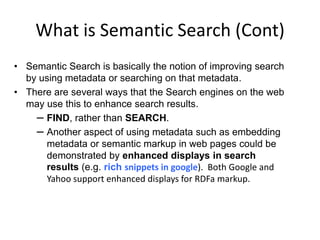
What is Semantic Search (Cont)Semantic Search is basically the notion of improving search by using metadata or searching on that metadata.There are several ways that the Search engines on the web may use this to enhance search results.FIND, rather than SEARCH. Another aspect of using metadata such as embedding metadata or semantic markup in web pages could be demonstrated by enhanced displays in search results (e.g. rich snippets in google).  Both Google and Yahoo support enhanced displays for RDFa markup.
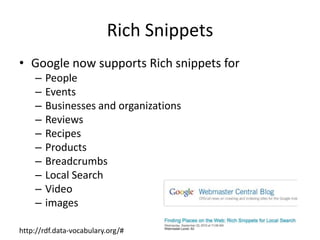
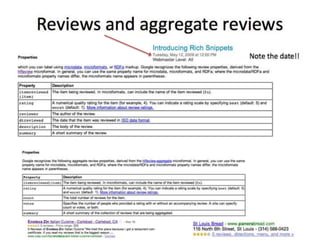
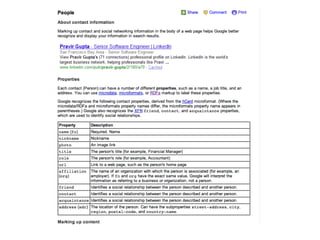
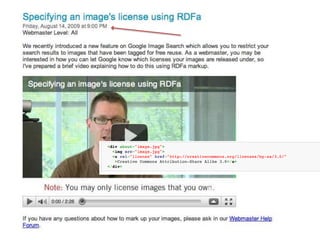
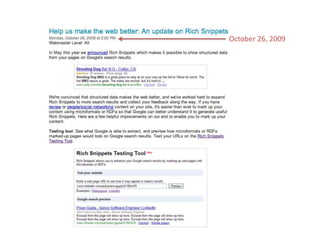
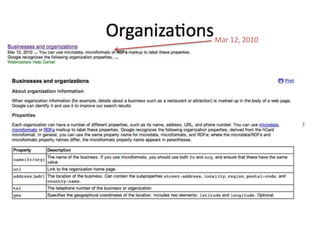
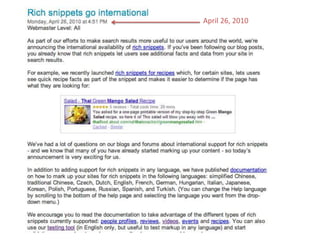
Rich SnippetsGoogle now supports Rich snippets forPeopleEventsBusinesses and organizationsReviewsRecipesProductsBreadcrumbsLocal SearchVideoimageshttp://rdf.data-vocabulary.org/#
Rich SnippetsGoogle now supports Rich snippets forPeopleEventsBusinesses and organizationsReviewsRecipesProductsBreadcrumbsLocal Searchhttp://rdf.data-vocabulary.org/#
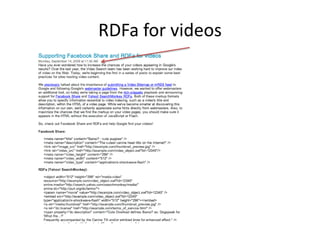
RDFa for videos
October 26, 2009
EventsMar 12, 2010
50RecipesApril 13, 2010
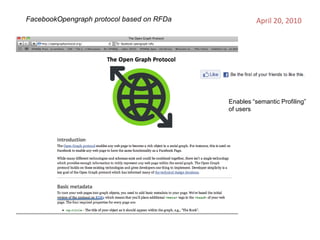
FacebookOpengraph protocol based on RFDaApril 20, 2010Enables “semantic Profiling” of users
April 26, 2010
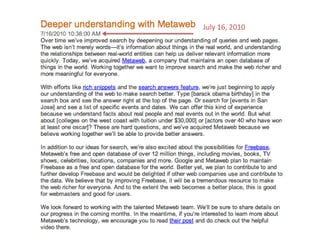
July 16, 2010
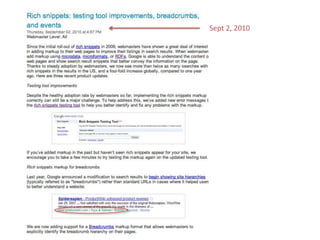
Sept 2, 2010
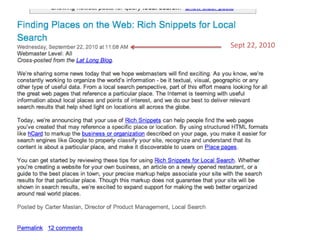
Sept 22, 2010
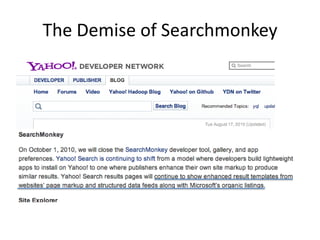
The Demise of Searchmonkey
57Nov 2, 2010Products now “findable”   (more to follow)
Google acquires Metaweb (freebase)
Google RefineNov, 2010
Yahoo fully supported RDFafor enhanced displays
Social NetworksWhile search engines can benefit from access to social networks, social networks can benefit from semantic metadata in web pagesExample is Facebook’s Open Graph Protocol (also supports RDFa) which allows users to share & like objects (such as products) as opposed to web pages. Enables “Semantic Profiling” of the users by facebook.
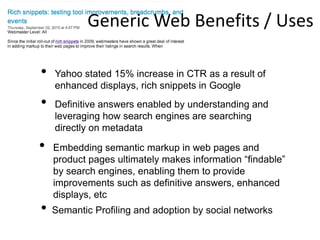
Generic Web Benefits / UsesYahoo stated 15% increase in CTR as a result of enhanced displays, rich snippets in Google
Definitive answers enabled by understanding and leveraging how search engines are searching directly on metadata
Embedding semantic markup in web pages and product pages ultimately makes information “findable” by search engines, enabling them to provide improvements such as definitive answers, enhanced displays, etc
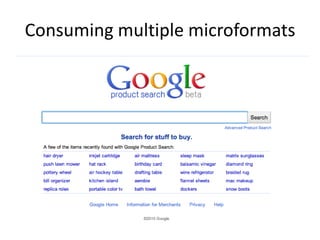
  Semantic Profiling and adoption by social networksGoogle supports 3 alternatives for microformats for productsGoogle formatHproductGoodrelationsWhich do we use &  why?
What can we do with RDFa?Produce RDFaConsume RDFaBuild smart applications with consumed RDFa as we now have a triple store and all the reasoning and decision making tools such as those provided by allegrograph
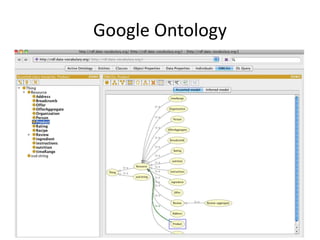
Google Ontology
Google Ontology
Facebook Ontology
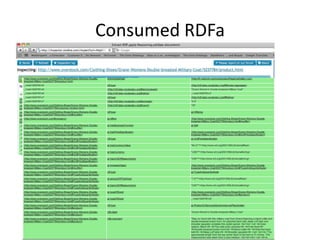
http://www.overstock.com/Clothing-Shoes/Grane-Womens-Double-breasted-Military-Coat/5237784/product.html
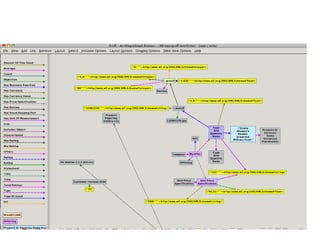
Consumed RDFa
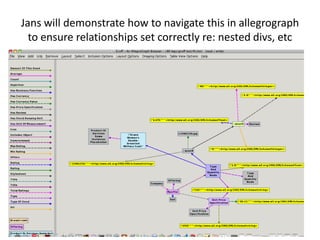
Jans will demonstrate how to navigate this in allegrograph to ensure relationships set correctly re: nested divs, etc
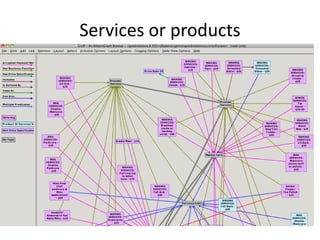
Services or products
Consuming multiple microformats
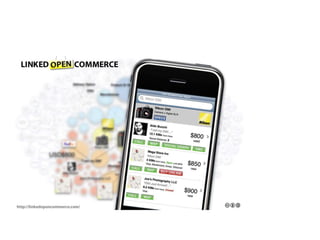
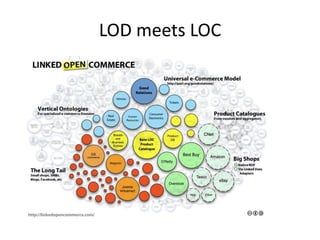
LOD meets LOC
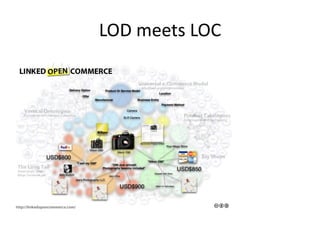
LOD meets LOC
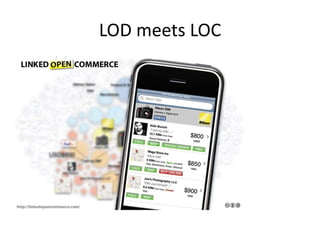
LOD meets LOC
1. Optimized RDFa in all pages that     -  serves Google Rich Snippets     -  serves Yahoo SearchMonkey     -  is GoodRelations valid     -  is accessible to all client-side browser extensions (there will be a lot of such services soon, believe me)    -  is perfect for any semantics-aware search engines so that overstock.com offers are visible
2. Novel recommender systems based on GoodRelations     I have quite a lot of novel approaches for GoodRelations-based recommender systems (in-site), which would be very useful for consumer electronics and fashion, in particular. 3. Precision E-Commerce Content Syndication      Soon, owners of small sites will be able to syndicate very specific e-commerce content based on GoodRelations (same as currently supported by eBay and Amazon, but then across the whole WWW).      We have a prototype for this already running, it could be a great new direction for overstock. (besides the positive buzz about it).
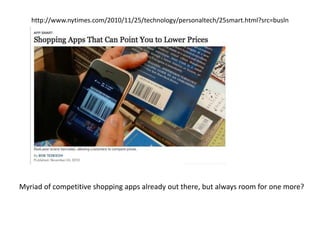
http://www.nytimes.com/2010/11/25/technology/personaltech/25smart.html?src=buslnMyriad of competitive shopping apps already out there, but always room for one more?
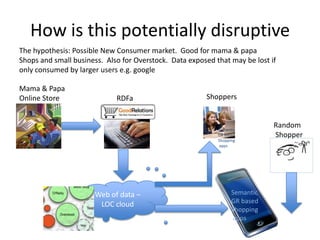
How is this potentially disruptiveThe hypothesis: Possible New Consumer market.  Good for mama & papaShops and small business.  Also for Overstock.  Data exposed that may be lost ifonly consumed by larger users e.g. googleMama & PapaOnline StoreShoppersRDFaRandom ShopperSemanticGR basedShopping  appsWeb of data – LOC cloudSemanticGR basedShopping  appsSemantic GRBased apps -
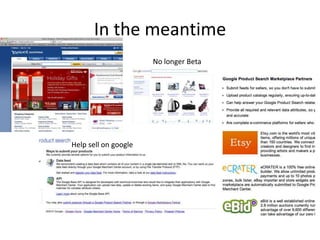
In the meantimeNo longer BetaHelp sell on google
Where do we go from here?Other means of supplying gr markuphttp://www.jarltech.de is exposing its full catalog with ca. 4,000 auto-ID products in RDF/XML (updated several times a week!) (not as silly as I first thought)http://www.jarltech.de/goodrelations.rdf
Other Verticals within retailNew Vertical MarketsAutomative(Large automotive manufacturer recently adopted GR :announcement coming soon)FinancialFashionReal EstateTicketsElectronics
BreakBarbara StarrEmail: bstarr@Ontologica.usTwitter: @BarbaraStarr
Fodder for further thoughtBBYOPEN API is primarily focused on delivering fairly unstructured XMLand JSON (not semantic) for developer consumption. My focus has beentaking those APIs and putting additional structure around them withvocabularies like GoodRelations. While my primary focus has been RDFa,I am pushing the project owners to also develop an RDF model andpublic facing SPARQL endpoint. :-)On Nov 23, 4:45 pm, Marco Neumann <marco.neum...@gmail.com> wrote:Last week at the Lotico Semantic Web event in New York Jay Myers gaveus an interesting glimpse into the world of enterprise softwaredevelopers and their application of Semantic Web technologies. And isindeed a very promising effort for a global retailer like Best Buy Ibelieve. You can find Jay's slides here:http://www.lotico.com/index.php/How_Best_Buy_is_using_the_Semantic_We...I would like to kick off the discussion with a question:Jay does the BBYOPEN API also support RDF or do you primarily focus on RDFa?Marco--Marco NeumannKONA
BrandGoodrelations version:<span rel="gr:hasManufacturer">       <span about="#canon” typeof="gr:BusinessEntity"><span property="gr:legalName">Canon Inc.</span></span>Google Version<span itemprop="brand">       <h1 class="productName">SanDisk 16GB Secure Digital SD/ SDHC Memory Card</h1></span>
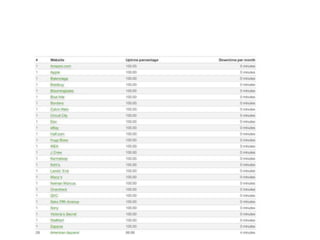
According to a recent report published by Forrester Research and Akamai, two seconds is the new threshold in terms of an average online shopper’s expectation for a web page to load. Other research conducted by Google and Microsoft revealed that a delay of only a half second can cause increased shopping cart abandonment rates, higher bounce rates, fewer pages per visit, and reduced revenue per site visitor.With consumers expected to spend $32.4 billion online this season, retailers are under even more pressure to ensure that their sites perform over the next few months.While more retailers were offering online deals this year on Black Friday, it should be interesting to see how retail sites perform on Cyber Monday, which is one of the most trafficked online spending days of the year.You can access WatchMouse’s full list here.
Semantic Web, e-commerce

Semantic Web, e-commerce

  • 1.
    The Semantic Weband The Web Of CommerceThe Semantic web has the potential be completely disruptive or completely opportune to online commerce.Barbara StarrEmail: bstarr@Ontologica.usTwitter: @BarbaraStarr
  • 3.
    Disruptive InnovationA disruptiveinnovation is an innovation that disrupts an existing market. The term is used in business and technology literature to describe innovations that improve a product or service in ways that the market does not expect, typically by lowering price or designing for a different set of consumers.In contrast to "disruptive" innovation, a "sustaining" innovation does not have an effect on existing markets. Sustaining innovations may be either "discontinuous"[1] (i.e. "transformational") or "continuous" (i.e. "evolutionary"). Transformational innovations are not always disruptive. Although the automobile was a transformational innovation, it was not a disruptive innovation, because early automobiles were expensive luxury items that did not disrupt the market for horse-drawn vehicles. The market for transportation essentially remained intact until the debut of the lower priced Ford Model T in 1908 by making higher speed, motorized transportation available to the masses.[2]
  • 4.
    Disruptive innovationThe TheoryChristensendefines a disruptive innovation as a product or service designed for a new set of customers.Christensen argues that disruptive innovations can hurt successful, well managed companies that are responsive to their customers and have excellent research and development. These companies tend to ignore the markets most susceptible to disruptive innovations, because the markets have very tight profit margins and are too small to represent significant growth.[5]
  • 5.
    What is theSemantic WebSemantic web synonymous with Web 3.0 ?SemanticmeaningPutting structured information into the web in some machine readable formatNot about the relationships between links, but about relationship between things, and the properties of those thingsA new form of Web content that is meaningful to computers will unleash a revolution of new possibilitiesBy Tim Berners-Lee, James Hendler and Ora Lassila   
  • 6.
    What is theSemantic Web (cont)“The Semantic Web provides a common framework that allows data to be shared and reused across application, enterprise, and community boundaries. It is a collaborative effort led by W3C with participation from a large number of researchers and industrial partners. It is based on the Resource Description Framework (RDF)”World Wide Web Consortiumhttp://www.w3.org/2001/sw/
  • 7.
    RDF - TriplesRDF(Resource Description Framework) A resource is anything you want to describe. An RDF triple contains a subject, predicate, and object. e.gDavidMichaelknowsobjectsubjectpredicateboyMichaelis-aobjectsubjectpredicate
  • 8.
    RDF - TriplesDavidMichaelknowsobjectsubjectpredicateboyMichaelis-aobjectsubjectpredicatetranslatesinto(michael knows David)(michael is-a boy)and we can infer with the right ontology & inferencing mechanism(michael is-a person)
  • 9.
    (michael knows David)(michaelis-a boy)(michael is-a person)RDF - Triples Triple store OrWeb 3.0 database
  • 10.
  • 11.
    Wikipedia Definition ofanOntologyIn computer science and information science, an ontology is a formal representation of the knowledge by a set of concepts within a domain and the relationships between those concepts. It is used to reason about the properties of that domain, and may be used to describe the domain.In theory, an ontology is a "formal, explicit specification of a shared conceptualization".[1] An ontology provides a shared vocabulary, which can be used to model a domain — that is, the type of objects and/or concepts that exist, and their properties and relations.[2]Ontologies are used in artificial intelligence, the Semantic Web, systems engineering, software engineering, biomedical informatics, library science, enterprise bookmarking, and information architecture as a form of knowledge representation about the world or some part of it. The creation of domain ontologies is also fundamental to the definition and use of an enterprise architecture framework.Not restricted to a hierarchical structure as with a taxonomy
  • 12.
    OntologiesOWL – WebOntology Language (OWL 2.0 released)RDFS – RDF SchemaSome existing standards ontologies: FOAF - Friend of a Friend - for social networksSIOC - Semantically Interlinked Online CommunitiesGoodrelations for e-commerceGeodataUpper Level OntologyFOAF - Friend of a Friend - for social networksSIOC - Semantically Interlinked Online CommunitiesGoogle Ontology…..
  • 13.
  • 14.
    RDFaRDFa is simplyRDF in attributes. It adds a set of attribute level extensions to HTML, enabling rich metadata to be embedded within web pages. It not only enables triples to be embedded in web pages but also ultimately enables the extraction of triplesIn short, this is the means by which we add structured markup to web pages
  • 15.
    SPARQLSPARQL is anRDF Query Language. It is a recursive acronym and stands for SPARQL Protocol And RDF Query Language. Information from linked Datasets can be accessed via SPARQL queries.Most linked data sources provide SPARQL ENDPOINTS to enable access.A SPARQL endpoint - provides access to its data via supported SPARQL protocol
  • 16.
    To cut aloooong story short:We go from: a web of documents or hyperlinks,to: a web of data or semantic linkswith: linked data and linked datasets.We use RDF to represent the data on the weband we use SPARQL to query the dataAnd RDFa is simply RDF in attributes.
  • 17.
    Core Concepts:Not thatwe have forgotten about: RDFS (RDF Schema)OWL (Web Ontology Language)& then in summaryRDF (central to all)Linked DataSPARQLRDFa (simply stated as it is html markup)
  • 18.
    So at thispoint either your head is spinningorYou are bored to death because you already know about the semantic webzzzzzzzzzzz
  • 19.
    SO … -How is this being used?- What is the extent of adoption- Who is using it?- How can it be leveraged?
  • 20.
    LOD Cloud EvolutionTherate of growth has been remarkableSource maintained by: Richard Cygniak and AnjaJentsch. http://lod-cloud.net
  • 21.
  • 22.
  • 23.
  • 24.
  • 25.
  • 26.
  • 27.
  • 28.
  • 29.
  • 30.
  • 31.
  • 32.
  • 33.
    LOD cloud –Sept 22 2010latest LOD cloud
  • 34.
    Adopters?UK GovernmentUS GovernmentBBC(FIFA world cup site dynamically generated using linked data)Thomson ReutersFreebaseNY TimesBest BuyTescoGoogle (More to follow http://rdf.data-vocabulary.org/#)YahooFacebookOracleTons more – Just look at the diversity in the LOD data cloud…….
  • 35.
    Semantic Web toDateSemantic Search
  • 36.
    What is SemanticSearchSemantic Search is basically the notion of improving search by using metadata or searching on that metadata.There are several ways that the Search engines on the web may use this to enhance search results.FIND, rather than SEARCH. Searching directly on the metadata directly can yield specific answers or results as demonstrated in the following example:Query “Barack Obama Birthday”Results on
  • 37.
  • 38.
    BingDefinitive AnswerNote: Freebasepart of Metaweb acquisition by Google
  • 40.
    Bingleveraged this forquite some timeDefinitive answer & enhanced display
  • 41.
    What is SemanticSearch (cont)Semantic Search is basically the notion of improving search by using metadata or searching on that metadata.There are several ways that the Search engines on the web may use this to enhance search results.FIND, rather than SEARCH. Searching directly on the metadata directly can yield specific answers or results as demonstrated in the following example: Ran the query “Barack Obama Birthday” on both google, and bing. Obtained the following:Answer engines rather than Search Engines?At this point really, a definitive answer followed with the standard search result set for that query
  • 42.
    What is SemanticSearch (Cont)Semantic Search is basically the notion of improving search by using metadata or searching on that metadata.There are several ways that the Search engines on the web may use this to enhance search results.FIND, rather than SEARCH. Another aspect of using metadata such as embedding metadata or semantic markup in web pages could be demonstrated by enhanced displays in search results (e.g. rich snippets in google). Both Google and Yahoo support enhanced displays for RDFa markup.
  • 43.
    Rich SnippetsGoogle nowsupports Rich snippets forPeopleEventsBusinesses and organizationsReviewsRecipesProductsBreadcrumbsLocal SearchVideoimageshttp://rdf.data-vocabulary.org/#
  • 44.
    Rich SnippetsGoogle nowsupports Rich snippets forPeopleEventsBusinesses and organizationsReviewsRecipesProductsBreadcrumbsLocal Searchhttp://rdf.data-vocabulary.org/#
  • 47.
  • 48.
  • 49.
  • 50.
  • 51.
    FacebookOpengraph protocol basedon RFDaApril 20, 2010Enables “semantic Profiling” of users
  • 52.
  • 53.
  • 54.
  • 55.
  • 56.
    The Demise ofSearchmonkey
  • 57.
    57Nov 2, 2010Productsnow “findable” (more to follow)
  • 58.
  • 59.
  • 60.
    Yahoo fully supportedRDFafor enhanced displays
  • 61.
    Social NetworksWhile searchengines can benefit from access to social networks, social networks can benefit from semantic metadata in web pagesExample is Facebook’s Open Graph Protocol (also supports RDFa) which allows users to share & like objects (such as products) as opposed to web pages. Enables “Semantic Profiling” of the users by facebook.
  • 62.
    Generic Web Benefits/ UsesYahoo stated 15% increase in CTR as a result of enhanced displays, rich snippets in Google
  • 63.
    Definitive answers enabledby understanding and leveraging how search engines are searching directly on metadata
  • 64.
    Embedding semantic markupin web pages and product pages ultimately makes information “findable” by search engines, enabling them to provide improvements such as definitive answers, enhanced displays, etc
  • 65.
    SemanticProfiling and adoption by social networksGoogle supports 3 alternatives for microformats for productsGoogle formatHproductGoodrelationsWhich do we use & why?
  • 66.
    What can wedo with RDFa?Produce RDFaConsume RDFaBuild smart applications with consumed RDFa as we now have a triple store and all the reasoning and decision making tools such as those provided by allegrograph
  • 67.
  • 68.
  • 69.
  • 70.
  • 71.
  • 73.
    Jans will demonstratehow to navigate this in allegrograph to ensure relationships set correctly re: nested divs, etc
  • 74.
  • 75.
  • 76.
  • 77.
  • 78.
  • 79.
    1. Optimized RDFain all pages that - serves Google Rich Snippets - serves Yahoo SearchMonkey - is GoodRelations valid - is accessible to all client-side browser extensions (there will be a lot of such services soon, believe me) - is perfect for any semantics-aware search engines so that overstock.com offers are visible
  • 80.
    2. Novel recommendersystems based on GoodRelations I have quite a lot of novel approaches for GoodRelations-based recommender systems (in-site), which would be very useful for consumer electronics and fashion, in particular. 3. Precision E-Commerce Content Syndication  Soon, owners of small sites will be able to syndicate very specific e-commerce content based on GoodRelations (same as currently supported by eBay and Amazon, but then across the whole WWW).  We have a prototype for this already running, it could be a great new direction for overstock. (besides the positive buzz about it).
  • 81.
  • 82.
    How is thispotentially disruptiveThe hypothesis: Possible New Consumer market. Good for mama & papaShops and small business. Also for Overstock. Data exposed that may be lost ifonly consumed by larger users e.g. googleMama & PapaOnline StoreShoppersRDFaRandom ShopperSemanticGR basedShopping appsWeb of data – LOC cloudSemanticGR basedShopping appsSemantic GRBased apps -
  • 83.
    In the meantimeNolonger BetaHelp sell on google
  • 84.
    Where do wego from here?Other means of supplying gr markuphttp://www.jarltech.de is exposing its full catalog with ca. 4,000 auto-ID products in RDF/XML (updated several times a week!) (not as silly as I first thought)http://www.jarltech.de/goodrelations.rdf
  • 85.
    Other Verticals withinretailNew Vertical MarketsAutomative(Large automotive manufacturer recently adopted GR :announcement coming soon)FinancialFashionReal EstateTicketsElectronics
  • 86.
  • 88.
    Fodder for furtherthoughtBBYOPEN API is primarily focused on delivering fairly unstructured XMLand JSON (not semantic) for developer consumption. My focus has beentaking those APIs and putting additional structure around them withvocabularies like GoodRelations. While my primary focus has been RDFa,I am pushing the project owners to also develop an RDF model andpublic facing SPARQL endpoint. :-)On Nov 23, 4:45 pm, Marco Neumann <marco.neum...@gmail.com> wrote:Last week at the Lotico Semantic Web event in New York Jay Myers gaveus an interesting glimpse into the world of enterprise softwaredevelopers and their application of Semantic Web technologies. And isindeed a very promising effort for a global retailer like Best Buy Ibelieve. You can find Jay's slides here:http://www.lotico.com/index.php/How_Best_Buy_is_using_the_Semantic_We...I would like to kick off the discussion with a question:Jay does the BBYOPEN API also support RDF or do you primarily focus on RDFa?Marco--Marco NeumannKONA
  • 89.
    BrandGoodrelations version:<span rel="gr:hasManufacturer"> <span about="#canon” typeof="gr:BusinessEntity"><span property="gr:legalName">Canon Inc.</span></span>Google Version<span itemprop="brand"> <h1 class="productName">SanDisk 16GB Secure Digital SD/ SDHC Memory Card</h1></span>
  • 90.
    According to arecent report published by Forrester Research and Akamai, two seconds is the new threshold in terms of an average online shopper’s expectation for a web page to load. Other research conducted by Google and Microsoft revealed that a delay of only a half second can cause increased shopping cart abandonment rates, higher bounce rates, fewer pages per visit, and reduced revenue per site visitor.With consumers expected to spend $32.4 billion online this season, retailers are under even more pressure to ensure that their sites perform over the next few months.While more retailers were offering online deals this year on Black Friday, it should be interesting to see how retail sites perform on Cyber Monday, which is one of the most trafficked online spending days of the year.You can access WatchMouse’s full list here.