Real Time Semantic
 Warehousing: Sindice.com
technology for the enterprise
 Giovanni Tummarello, Ph.D
 Data Intensive Infrastructure UNIT -
 DERI.ie

 CEO SindiceTech
How we started : Sindice.com


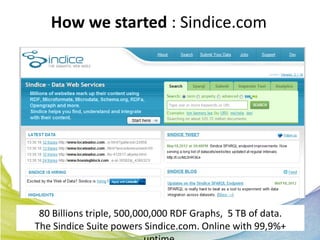
 80 Billions triple, 500,000,000 RDF Graphs, 5 TB of data.
The Sindice Suite powers Sindice.com. Online with 99,9%+
Semantic Sandboxes on: Sindice.com


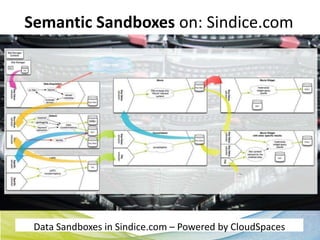
 Data Sandboxes in Sindice.com – Powered by CloudSpaces
And then we met people asking
      can you do it for us
Example story (Pharmaceutical company0
To stay competitive, Pharmaceutical companies need to leverage all the data available from
inside sources as well as from the increasingly many public HCLS data sources available. Due to
the diversity of this data with respect to nature, formats, quality, there are complex integration
issues. Traditional data warehousing technology require big upfront thinking and is handled
within a company in the “go via the IT department” approach. This does not meet the need of
data scientists who are the only ones that can do the complex cross-use case thinking required.
Via Real Time Semantic Data Warehousing (RETIS) data scientist expect to get:

•   The ability to speed up “In silico” scientific workflows (interrelation of diverse large
    datasets) by orders of magnitude by relying on a data warehousing approach.
•   The ability to create large scale “data maps” or “aggregated views” which would allow
    researchers to see “trends” and gather insights at high level which would not be possible by
    data accessed via single lookups.
•   The ability to receive recommendations and suggestions for new data connections based on
    an ever evolving ecosystem of available experimental datasets.
•   Provide their R&D departments with superior tools for investigating their internal
    knowledge; search engines and data browsing tools which provide unified views of multiple,
    evolving, live datasets without leakage of specific “queries” to the outside world which would
    reveal internal research trends
•   The ability to leverage the ever increasing body of public, crowd curated open data

5 of 16
Linked Data clouds for the Enterprise

  – Strategic knowledge spaces, where new
    databases can be added and “leveraged” with an
    unprecedented ease
  – Integration “Pay as you go” : explore now, fine
    tune later.
  – Its BigData (Cluster+Clouds) meets RDF and
    Semantic Technologies
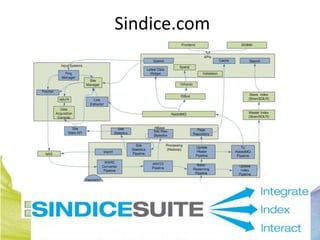
Sindice.com
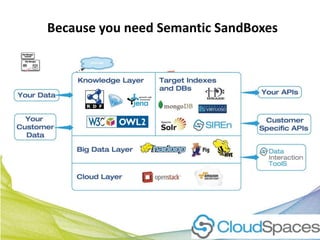
Because you need Semantic SandBoxes
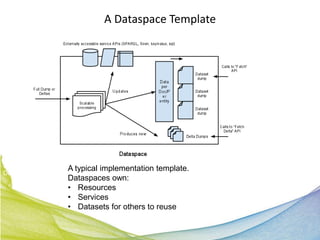
A Dataspace Template


Semantic Web
               A typical implementation template.
Data
               Dataspaces own:
               • Resources
               • Services
               • Datasets for others to reuse
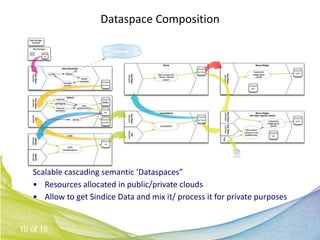
Dataspace Composition


   Scalable cascading semantic ‘Dataspaces”
   • Resources allocated in public/private clouds
   • Allow to get Sindice Data and mix it/ process it for private purposes


10 of 16
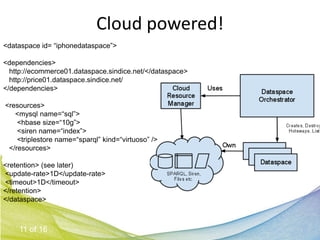
Cloud powered!
<dataspace id= “iphonedataspace”>

<dependencies>
  http://ecommerce01.dataspace.sindice.net/</dataspace>
  http://price01.dataspace.sindice.net/
</dependencies>

<resources>
   <mysql name=“sql”>
    <hbase size=“10g”>
    <siren name=“index”>
    <triplestore name=“sparql” kind=“virtuoso” />
 </resources>

<retention> (see later)
<update-rate>1D</update-rate>
<timeout>1D</timeout>
</retention>
</dataspace>


    11 of 16
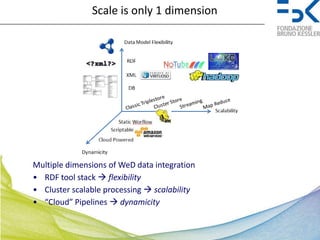
Scale is only 1 dimension


Multiple dimensions of WeD data integration
• RDF tool stack  flexibility
• Cluster scalable processing  scalability
• “Cloud” Pipelines  dynamicity
Full Json Like Search.
         On Solr.
All operators supported.
What is SIREn ?

• Plugin to Solr
• Built for searching and operating on
  semistructured data and relational
  datastructures
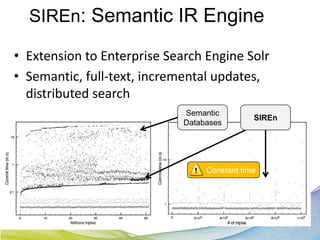
SIREn: Semantic IR Engine

• Extension to Enterprise Search Engine Solr
• Semantic, full-text, incremental updates,
  distributed search
                             Semantic
                                              SIREn
                             Databases


                                  Constant time
Limitations of Apache Solr

• Not efficient with highly heterogeneous
  structured data sources
  – Limitation on the number of attributes:
     Dictionary size explosion
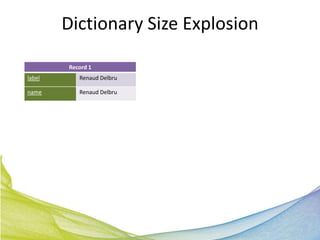
Dictionary Size Explosion

        Record 1
label      Renaud Delbru

name       Renaud Delbru
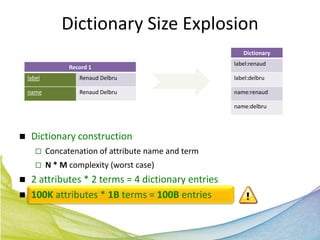
Dictionary Size Explosion
                                                          Dictionary
                                                       label:renaud
                  Record 1
    label            Renaud Delbru                     label:delbru

    name             Renaud Delbru                     name:renaud

                                                       name:delbru


    Dictionary construction
           Concatenation of attribute name and term
           N * M complexity (worst case)
    2 attributes * 2 terms = 4 dictionary entries
    100K attributes * 1B terms = 100B entries
Limitations of Apache Solr

• Not efficient with highly heterogeneous
  structured data sources
  – Limitation on the number of attributes:
     Dictionary size explosion
     Query clause explosion when searching across all
      attributes
Limitations of Apache Solr

• Not efficient with highly heterogeneous
  structured data sources
  – Limitation on the number of attributes:
     Dictionary size explosion
     Query clause explosion when searching across all
      attributes
• Limited support for structured query
  – Multi-valued attributes
Multi-valued attributes
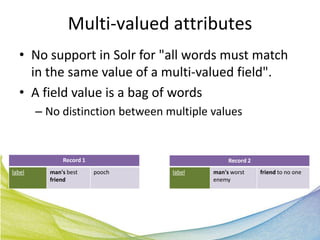
  • No support in Solr for "all words must match
    in the same value of a multi-valued field".
  • A field value is a bag of words
        – No distinction between multiple values


              Record 1                         Record 2
label     man's best     pooch    label   man's worst     friend to no one
          friend                          enemy
Multi-valued attributes
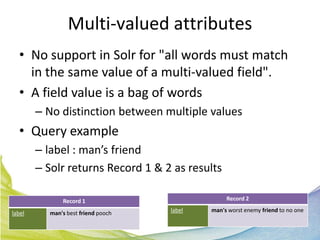
  • No support in Solr for "all words must match
    in the same value of a multi-valued field".
  • A field value is a bag of words
        – No distinction between multiple values
  • Query example
        – label : man’s friend
        – Solr returns Record 1 & 2 as results

               Record 1                           Record 2

label      man's best friend pooch   label   man's worst enemy friend to no one
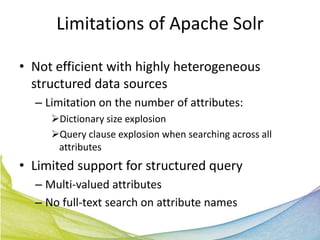
Limitations of Apache Solr

• Not efficient with highly heterogeneous
  structured data sources
  – Limitation on the number of attributes:
     Dictionary size explosion
     Query clause explosion when searching across all
      attributes
• Limited support for structured query
  – Multi-valued attributes
  – No full-text search on attribute names
Full-text search on attribute names
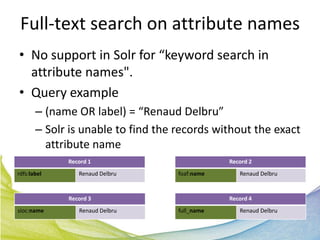
• No support in Solr for “keyword search in
  attribute names".
• Query example
       – (name OR label) = “Renaud Delbru”
       – Solr is unable to find the records without the exact
         attribute name
             Record 1                           Record 2
rdfs:label      Renaud Delbru       foaf:name      Renaud Delbru


             Record 3                           Record 4
sioc:name       Renaud Delbru       full_name      Renaud Delbru
Limitations of Apache Solr
• Not efficient with highly heterogeneous
  structured data sources
  – Limitation on the number of attributes:
     Dictionary size explosion
     Query clause explosion when searching across all
      attributes
• Limited support for structured query
  – Multi-valued attributes
  – No full-text search on attribute names
  – No 1:N relationship materialisation
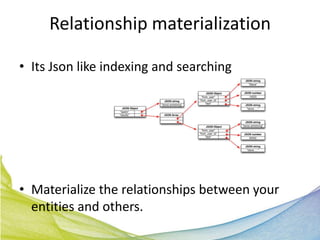
Relationship materialization

• Its Json like indexing and searching


• Materialize the relationships between your
  entities and others.
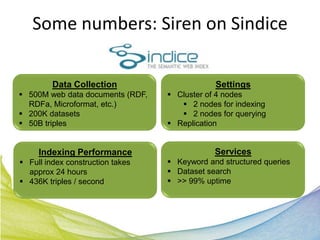
Some numbers: Siren on Sindice

         Data Collection                      Settings
 500M web data documents (RDF,    Cluster of 4 nodes
  RDFa, Microformat, etc.)            2 nodes for indexing
 200K datasets                       2 nodes for querying
 50B triples                      Replication


     Indexing Performance                     Services
 Full index construction takes    Keyword and structured queries
  approx 24 hours                  Dataset search
 436K triples / second            >> 99% uptime
Large scale RDF ‘Summaries”
Introducing large scale RDF ‘Summaries”

We do it for:
• Data exploration
  – How to find datasets about movies ?
• Assisted SPARQL Query Editor
  – What is the data structure ?
• Dataset Quality
  – How to differentiate relevant form irrelevant
    dataset ?
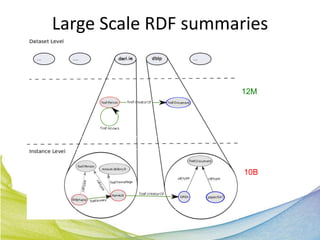
Large Scale RDF summaries

Class Level
                             12M relationships


                              10B relationships
Sindice Analytics Widget Demo

• http://test01.sindice.net:9001/sindice-stats-
  webapp/

• http://test01.sindice.net/szydan/dataset-
  view/dataset/default/www.bbc.co.uk
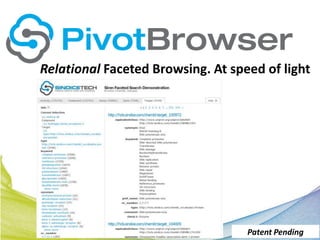
Relational Faceted Browsing. At speed of light


                                   Patent Pending
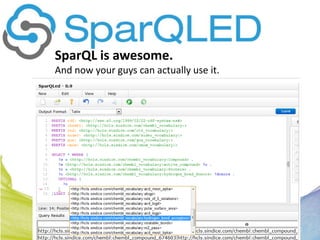
SparQL is awesome.
And now your guys can actually use it.
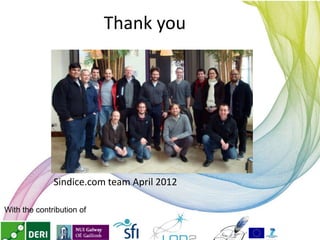
Thank you


              Sindice.com team April 2012

With the contribution of

Sindice warehousing meetup

  • 1.
    Real Time Semantic Warehousing: Sindice.com technology for the enterprise Giovanni Tummarello, Ph.D Data Intensive Infrastructure UNIT - DERI.ie CEO SindiceTech
  • 2.
    How we started: Sindice.com 80 Billions triple, 500,000,000 RDF Graphs, 5 TB of data. The Sindice Suite powers Sindice.com. Online with 99,9%+
  • 3.
    Semantic Sandboxes on:Sindice.com Data Sandboxes in Sindice.com – Powered by CloudSpaces
  • 4.
    And then wemet people asking can you do it for us
  • 5.
    Example story (Pharmaceuticalcompany0 To stay competitive, Pharmaceutical companies need to leverage all the data available from inside sources as well as from the increasingly many public HCLS data sources available. Due to the diversity of this data with respect to nature, formats, quality, there are complex integration issues. Traditional data warehousing technology require big upfront thinking and is handled within a company in the “go via the IT department” approach. This does not meet the need of data scientists who are the only ones that can do the complex cross-use case thinking required. Via Real Time Semantic Data Warehousing (RETIS) data scientist expect to get: • The ability to speed up “In silico” scientific workflows (interrelation of diverse large datasets) by orders of magnitude by relying on a data warehousing approach. • The ability to create large scale “data maps” or “aggregated views” which would allow researchers to see “trends” and gather insights at high level which would not be possible by data accessed via single lookups. • The ability to receive recommendations and suggestions for new data connections based on an ever evolving ecosystem of available experimental datasets. • Provide their R&D departments with superior tools for investigating their internal knowledge; search engines and data browsing tools which provide unified views of multiple, evolving, live datasets without leakage of specific “queries” to the outside world which would reveal internal research trends • The ability to leverage the ever increasing body of public, crowd curated open data 5 of 16
  • 6.
    Linked Data cloudsfor the Enterprise – Strategic knowledge spaces, where new databases can be added and “leveraged” with an unprecedented ease – Integration “Pay as you go” : explore now, fine tune later. – Its BigData (Cluster+Clouds) meets RDF and Semantic Technologies
  • 7.
  • 8.
    Because you needSemantic SandBoxes
  • 9.
    A Dataspace Template SemanticWeb A typical implementation template. Data Dataspaces own: • Resources • Services • Datasets for others to reuse
  • 10.
    Dataspace Composition Scalable cascading semantic ‘Dataspaces” • Resources allocated in public/private clouds • Allow to get Sindice Data and mix it/ process it for private purposes 10 of 16
  • 11.
    Cloud powered! <dataspace id=“iphonedataspace”> <dependencies> http://ecommerce01.dataspace.sindice.net/</dataspace> http://price01.dataspace.sindice.net/ </dependencies> <resources> <mysql name=“sql”> <hbase size=“10g”> <siren name=“index”> <triplestore name=“sparql” kind=“virtuoso” /> </resources> <retention> (see later) <update-rate>1D</update-rate> <timeout>1D</timeout> </retention> </dataspace> 11 of 16
  • 12.
    Scale is only1 dimension Multiple dimensions of WeD data integration • RDF tool stack  flexibility • Cluster scalable processing  scalability • “Cloud” Pipelines  dynamicity
  • 13.
    Full Json LikeSearch. On Solr. All operators supported.
  • 14.
    What is SIREn? • Plugin to Solr • Built for searching and operating on semistructured data and relational datastructures
  • 15.
    SIREn: Semantic IREngine • Extension to Enterprise Search Engine Solr • Semantic, full-text, incremental updates, distributed search Semantic SIREn Databases Constant time
  • 16.
    Limitations of ApacheSolr • Not efficient with highly heterogeneous structured data sources – Limitation on the number of attributes: Dictionary size explosion
  • 17.
    Dictionary Size Explosion Record 1 label Renaud Delbru name Renaud Delbru
  • 18.
    Dictionary Size Explosion Dictionary label:renaud Record 1 label Renaud Delbru label:delbru name Renaud Delbru name:renaud name:delbru  Dictionary construction  Concatenation of attribute name and term  N * M complexity (worst case)  2 attributes * 2 terms = 4 dictionary entries  100K attributes * 1B terms = 100B entries
  • 19.
    Limitations of ApacheSolr • Not efficient with highly heterogeneous structured data sources – Limitation on the number of attributes: Dictionary size explosion Query clause explosion when searching across all attributes
  • 20.
    Limitations of ApacheSolr • Not efficient with highly heterogeneous structured data sources – Limitation on the number of attributes: Dictionary size explosion Query clause explosion when searching across all attributes • Limited support for structured query – Multi-valued attributes
  • 21.
    Multi-valued attributes • No support in Solr for "all words must match in the same value of a multi-valued field". • A field value is a bag of words – No distinction between multiple values Record 1 Record 2 label man's best pooch label man's worst friend to no one friend enemy
  • 22.
    Multi-valued attributes • No support in Solr for "all words must match in the same value of a multi-valued field". • A field value is a bag of words – No distinction between multiple values • Query example – label : man’s friend – Solr returns Record 1 & 2 as results Record 1 Record 2 label man's best friend pooch label man's worst enemy friend to no one
  • 23.
    Limitations of ApacheSolr • Not efficient with highly heterogeneous structured data sources – Limitation on the number of attributes: Dictionary size explosion Query clause explosion when searching across all attributes • Limited support for structured query – Multi-valued attributes – No full-text search on attribute names
  • 24.
    Full-text search onattribute names • No support in Solr for “keyword search in attribute names". • Query example – (name OR label) = “Renaud Delbru” – Solr is unable to find the records without the exact attribute name Record 1 Record 2 rdfs:label Renaud Delbru foaf:name Renaud Delbru Record 3 Record 4 sioc:name Renaud Delbru full_name Renaud Delbru
  • 25.
    Limitations of ApacheSolr • Not efficient with highly heterogeneous structured data sources – Limitation on the number of attributes: Dictionary size explosion Query clause explosion when searching across all attributes • Limited support for structured query – Multi-valued attributes – No full-text search on attribute names – No 1:N relationship materialisation
  • 26.
    Relationship materialization • ItsJson like indexing and searching • Materialize the relationships between your entities and others.
  • 27.
    Some numbers: Sirenon Sindice Data Collection Settings  500M web data documents (RDF,  Cluster of 4 nodes RDFa, Microformat, etc.)  2 nodes for indexing  200K datasets  2 nodes for querying  50B triples  Replication Indexing Performance Services  Full index construction takes  Keyword and structured queries approx 24 hours  Dataset search  436K triples / second  >> 99% uptime
  • 28.
    Large scale RDF‘Summaries”
  • 29.
    Introducing large scaleRDF ‘Summaries” We do it for: • Data exploration – How to find datasets about movies ? • Assisted SPARQL Query Editor – What is the data structure ? • Dataset Quality – How to differentiate relevant form irrelevant dataset ?
  • 30.
    Large Scale RDFsummaries Class Level 12M relationships 10B relationships
  • 31.
    Sindice Analytics WidgetDemo • http://test01.sindice.net:9001/sindice-stats- webapp/ • http://test01.sindice.net/szydan/dataset- view/dataset/default/www.bbc.co.uk
  • 32.
    Relational Faceted Browsing.At speed of light Patent Pending
  • 33.
    SparQL is awesome. Andnow your guys can actually use it.
  • 34.
    Thank you Sindice.com team April 2012 With the contribution of

Editor's Notes

  • #16 Search record (instead of entity)Record-centric indexing model
  • #29 Use Case: Let’s index the entire web of dataDoc/s, lucene in action, uptime, etc.
  • #31 How important a dataset is to my information need ?How to help users to browse and filter irrelevant datasets ?How can I measure the quality of a dataset ? Data quality, objective measuresTwo datasets can overlap, provide similar information, but one dataset is providing more fresh information, is updated more frequently.Concrete scenarios to test such assumptionsData Quality can be also useful for improving data acquisition, optimising resources to retrieve only top quality data
  • #32 - Define “relationships” when introducing the graph, BEFORE talking about the numbers
  • #33 Number of entities per classNumber of relations of a certain predicateOther metadata can be added to a class, e.g., other predicates used with the entities of that class