Search Engines After The Semantic WebPresented by Samar HamedDamascus University
AgendaBasic Semantic Web PrinciplesFalcons Semantic Search EngineSearch Engine Giants Experience (Google, Yahoo, Microsoft)Kngine  New Promising Search EngineSummaryReferences
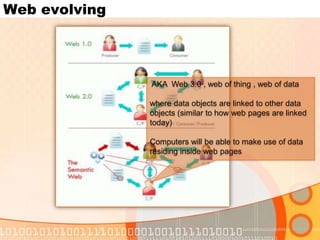
Web evolving AKA  Web 3.0 , web of thing , web of datawhere data objects are linked to other data objects (similar to how web pages are linked today)Computers will be able to make use of data residing inside web pages 
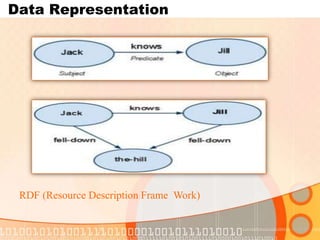
 Data Representation RDF (Resource Description Frame  Work)
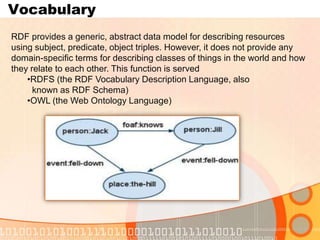
 VocabularyRDF provides a generic, abstract data model for describing resources using subject, predicate, object triples. However, it does not provide any domain-specific terms for describing classes of things in the world and how they relate to each other. This function is served RDFS (the RDF Vocabulary Description Language, also     known as RDF Schema) OWL (the Web Ontology Language) RDFs vs OWLwhile RDFs Is Light Weight Ontology OWL extends the        expressivity of RDFS with additional modeling primitives, For        example, OWL defines the primitives equivalentClassequivalentProperty,inverseOf allows the creator of a vocabulary to state that one property               I s the inverse of another, for example prod:directedis the owl:inverseOftv:director.   increase the  interoperability of data sets modeled using different vocabularies
RDFaRDFa is a way to express RDF data within XHTML by reusing the existing human-readable data without repeating content <div typeof="foaf:Person" xmlns:foaf="http://xmlns.com/foaf/0.1/"> <p property="foaf:name"> Alice Birpemswick </p><p>Email: <a rel="foaf:mbox”href="mailto:alice@example.com">alice@example.com</a> </p> <p> Phone: <a rel="foaf:phone" href="tel:+1-617-555-7332">+1 617.555.7332</a> </p> </div>
AgendaBasic Semantic Web PrinciplesFalcons Semantic Search EngineSearch Engine Giants experience (Google,Yahoo, Microsoft)Kgine  New Promising Search EngineSummaryReferences
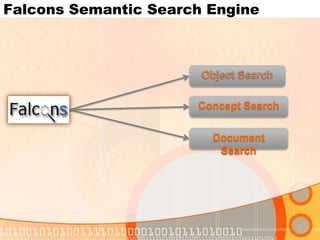
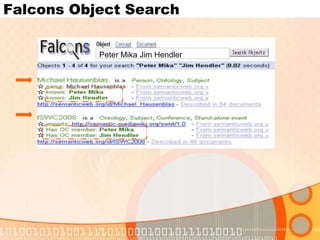
Falcons Semantic Search EngineObjectSearchConceptSearchDocumentSearch
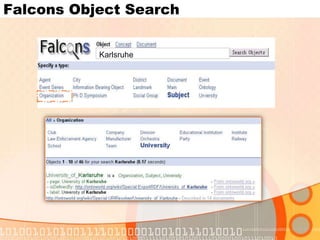
Falcons Object SearchKarlsruhe
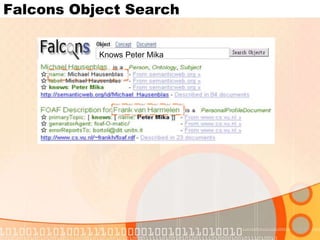
Falcons Object SearchKnows Peter Mika
Falcons Object SearchPeter Mika Jim Hendler
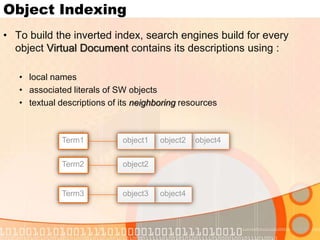
Object IndexingTo build the inverted index, search engines build for every object Virtual Document contains its descriptions using :local names associated literals of SW objectstextual descriptions of its neighboring resources Term1object4 object2 object1Term2 object2Term3  object4 object3
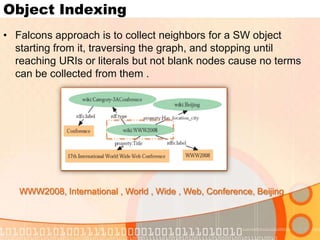
Object IndexingFalcons approach is to collect neighbors for a SW object starting from it, traversing the graph, and stopping until reaching URIs or literals but not blank nodes cause no terms can be collected from them .WWW2008, International , World , Wide , Web, Conference, Beijing
Weighting and SimilarityBoth virtual document and query are represented as term vector in term vector space,  The terms of the virtual document are weighted where term in the local name and labels are assigned a higher weighting coefficient than those in literal properties and neighbor's properties term , To calculate similarity between the object and query cosine measure is used, the result is ranked based on the combination of of their relevance to the query and their popularity, where: The relevance score is calculated based on the cosine similarity measure and The popularity score is evaluated according to the number of RDF documents that SW objects are used by.
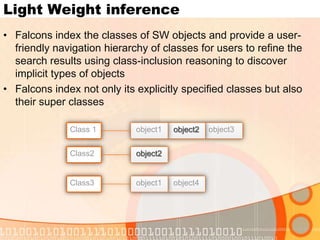
Light Weight inference Falcons index the classes of SW objects and provide a user-friendly navigation hierarchy of classes for users to refine the search results using class-inclusion reasoning to discover implicit types of objectsFalcons index not only its explicitly specified classes but also their super classes Class 1object3object2 object1Class2 object2Class3 object4 object1
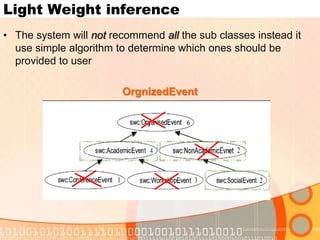
Light Weight inference The system will not recommend all the sub classes instead it use simple algorithm to determine which ones should be provided to userOrgnizedEvent
AgendaBasic Semantic Web PrinciplesFalcons Semantic Search EngineSearch Engine Giants Experience  (Google, Yahoo, Microsoft)Kngine  New Promising Search EngineSummaryReferences
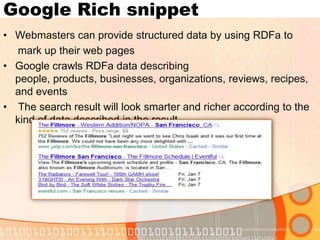
Google Rich snippetWebmasters can provide structured data by using RDFa to        mark up their web pages Google crawls RDFa data describing people, products, businesses, organizations, reviews, recipes, and events The search result will look smarter and richer according to the kind of data described in the result
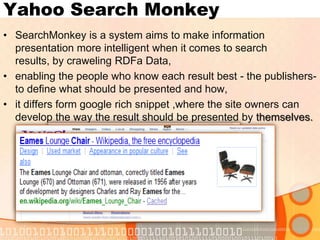
Yahoo Search MonkeySearchMonkey is a system aims to make information presentation more intelligent when it comes to search results, by crawelingRDFa Data,enabling the people who know each result best - the publishers- to define what should be presented and how,it differs form google rich snippet ,where the site owners can develop the way the result should be presented by themselves.
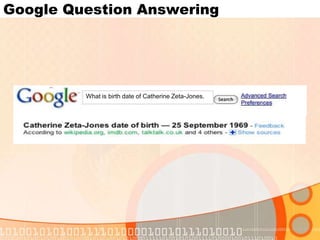
Google Question AnsweringWhat is birth date of Catherine Zeta-Jones. 
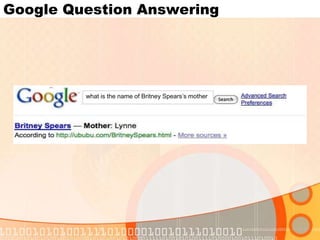
Google Question Answeringwhat is the name of Britney Spears’s mother
Schema.org:library of vocabularies Google, Microsoft, and Yahoo In early June 2011 announced schema.org, a new service intended to create and support a common vocabulary for structured data markup on web pages.The idea is to provide a library of vocabularies to embed machine-readable data into web pages in a manner that can be fully exploited across search engines. Schema.org appears to be Linked Data Lite with extremely     limited support for vocabularies available at chema.org/docs/full.html   |       
Extending Schema.org one can always create new schemas that are not at all  on schema.org, if the content of your domain is not covered by any of the schema.org types. If the schema gains search engines may start using this data.)     Extensions that gain significant adoption on the web may be moved into the core schema.org vocabularyIf you publish content of an unsupported type, you have these options:Use a less-specific markup type. For example, schema.org has no "Professor" type. However, if you have a directory of professors in your university department, you could use the "person" type to mark up the information for every professor in the directory.If you are feeling ambitious, use the schema.org extension system to define a new type
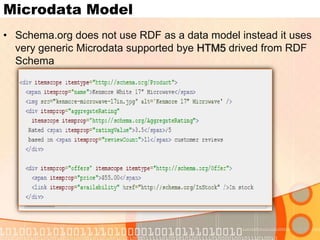
Microdata ModelSchema.org does not use RDF as a data model instead it uses very generic Microdata supported bye HTM5drived from RDF Schema
MicrodatavsRDFaMicrodata audience RDFa is extensible and very expressive, but the substantial complexity of the language has contributed to slower adoption. Schema.org vocabularies are search engine oriented more than domain specific like RDFMicrodata can be converted to RDFaThere is Schema.RDFS.org a site which is a complementary effort by people from the Linked Data community to express the terms provided by the Schema.org Vocabularies in RDF tagging information, Web page owners could improve the position of their site in search results—an  important source of traffic.
MicrodatavsRDFaRDFa audience All of the capabilities promised by schema.org are already fully supported in a richer more scalable manner in the form of RDFaThe entire Web community should decide which features should be supported – not just Microsoft or Google or YahooGoogle and Yahoo already support Microdata and RDFa in their advanced search services (Google Rich Snippets and Yahoo Search). So, why is it that we cannot continue to use
AgendaBasic Semantic Web PrinciplesFalcons Semantic Search EngineSearch Engine Giants Experience  (Google, Yahoo, Microsoft)KngineNew Promising Search EngineSummaryReferences
KngineNew Promising Search EngineEgyptian startup Kngine has announced that its new Kngine search engine has gone live in 2010. Most existing semantic search they draw their results from a limited number of sites such as Wikipedia and Freebase. Kngine, however, has expanded beyond those sources, and seeks to index structures information
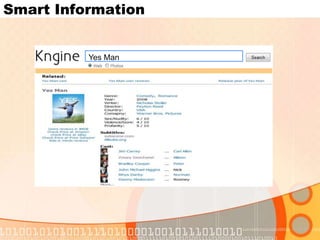
Smart InformationYes Man
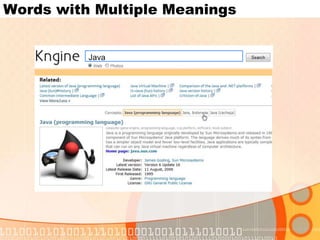
Words with Multiple MeaningsJava
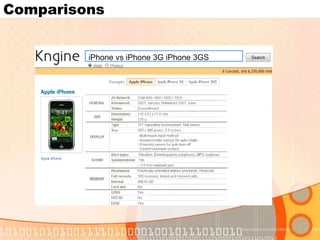
ComparisonsiPhonevsiPhone 3G iPhone 3GS
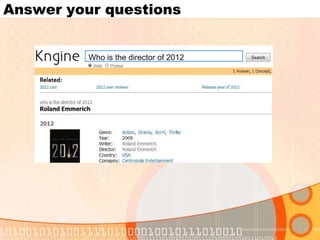
Answer your questionsWho is the director of 2012
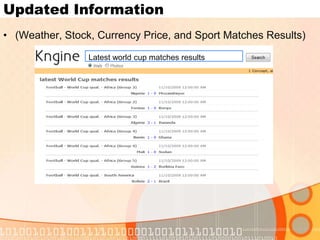
Updated Information(Weather, Stock, Currency Price, and Sport Matches Results)Latest world cup matches results
AgendaBasic Semantic Web PrinciplesFalcons Semantic Search EngineSearch Engine Giants Experience  (Google, Yahoo, Microsoft)Kngine  New Promising Search EngineReferences
Taha, E. Linked Data :State of The Art; Department of Software Engineering and Information System, 2010. 	Heath, T.; Bizer, C. Linked Data: Evolving the Web into a Global Data Space :Synthesis Lectures on the Semantic Web: Theory and Technology, 1st ed.; Morgan & Claypool, 2011. 	Cheng, G.; Qu, Y. Integrating Lightweight Reasoning into Class-Based Query Refinement for Object Search; Scientific papaer; Institute of Web Science, School of Computer Science and Engineering,Southeast University: Nanjing, 2008. 	Schema.org and the Semantic Web. prototypo.blogspot.com/2011/06/schemaorg-and-semantic-web.html (accessed June 3,2011). LUR, X. Kngine: The Smartest Search Engine Ever? http://www.techxav.com/2010/04/09/kngine-the-smartest-search-engine-ever (accessed APRIL 9, 2010). 	Shadbolt, N.; Hall, W.; Berners-Lee, T. The Semantic Web Revisited; IEEE Computer Society, 2006.
Thank You
Search Engines After The Semanatic Web

Search Engines After The Semanatic Web

  • 1.
    Search Engines AfterThe Semantic WebPresented by Samar HamedDamascus University
  • 2.
    AgendaBasic Semantic WebPrinciplesFalcons Semantic Search EngineSearch Engine Giants Experience (Google, Yahoo, Microsoft)Kngine New Promising Search EngineSummaryReferences
  • 3.
    Web evolving AKA Web 3.0 , web of thing , web of datawhere data objects are linked to other data objects (similar to how web pages are linked today)Computers will be able to make use of data residing inside web pages 
  • 4.
    Data RepresentationRDF (Resource Description Frame Work)
  • 5.
    VocabularyRDF providesa generic, abstract data model for describing resources using subject, predicate, object triples. However, it does not provide any domain-specific terms for describing classes of things in the world and how they relate to each other. This function is served RDFS (the RDF Vocabulary Description Language, also known as RDF Schema) OWL (the Web Ontology Language) RDFs vs OWLwhile RDFs Is Light Weight Ontology OWL extends the expressivity of RDFS with additional modeling primitives, For example, OWL defines the primitives equivalentClassequivalentProperty,inverseOf allows the creator of a vocabulary to state that one property I s the inverse of another, for example prod:directedis the owl:inverseOftv:director. increase the interoperability of data sets modeled using different vocabularies
  • 6.
    RDFaRDFa is away to express RDF data within XHTML by reusing the existing human-readable data without repeating content <div typeof="foaf:Person" xmlns:foaf="http://xmlns.com/foaf/0.1/"> <p property="foaf:name"> Alice Birpemswick </p><p>Email: <a rel="foaf:mbox”href="mailto:alice@example.com">alice@example.com</a> </p> <p> Phone: <a rel="foaf:phone" href="tel:+1-617-555-7332">+1 617.555.7332</a> </p> </div>
  • 7.
    AgendaBasic Semantic WebPrinciplesFalcons Semantic Search EngineSearch Engine Giants experience (Google,Yahoo, Microsoft)Kgine New Promising Search EngineSummaryReferences
  • 8.
    Falcons Semantic SearchEngineObjectSearchConceptSearchDocumentSearch
  • 9.
  • 10.
  • 11.
  • 12.
    Object IndexingTo buildthe inverted index, search engines build for every object Virtual Document contains its descriptions using :local names associated literals of SW objectstextual descriptions of its neighboring resources Term1object4 object2 object1Term2 object2Term3 object4 object3
  • 13.
    Object IndexingFalcons approachis to collect neighbors for a SW object starting from it, traversing the graph, and stopping until reaching URIs or literals but not blank nodes cause no terms can be collected from them .WWW2008, International , World , Wide , Web, Conference, Beijing
  • 14.
    Weighting and SimilarityBothvirtual document and query are represented as term vector in term vector space, The terms of the virtual document are weighted where term in the local name and labels are assigned a higher weighting coefficient than those in literal properties and neighbor's properties term , To calculate similarity between the object and query cosine measure is used, the result is ranked based on the combination of of their relevance to the query and their popularity, where: The relevance score is calculated based on the cosine similarity measure and The popularity score is evaluated according to the number of RDF documents that SW objects are used by.
  • 15.
    Light Weight inferenceFalcons index the classes of SW objects and provide a user-friendly navigation hierarchy of classes for users to refine the search results using class-inclusion reasoning to discover implicit types of objectsFalcons index not only its explicitly specified classes but also their super classes Class 1object3object2 object1Class2 object2Class3 object4 object1
  • 16.
    Light Weight inferenceThe system will not recommend all the sub classes instead it use simple algorithm to determine which ones should be provided to userOrgnizedEvent
  • 17.
    AgendaBasic Semantic WebPrinciplesFalcons Semantic Search EngineSearch Engine Giants Experience (Google, Yahoo, Microsoft)Kngine New Promising Search EngineSummaryReferences
  • 18.
    Google Rich snippetWebmasterscan provide structured data by using RDFa to mark up their web pages Google crawls RDFa data describing people, products, businesses, organizations, reviews, recipes, and events The search result will look smarter and richer according to the kind of data described in the result
  • 19.
    Yahoo Search MonkeySearchMonkeyis a system aims to make information presentation more intelligent when it comes to search results, by crawelingRDFa Data,enabling the people who know each result best - the publishers- to define what should be presented and how,it differs form google rich snippet ,where the site owners can develop the way the result should be presented by themselves.
  • 20.
    Google Question AnsweringWhatis birth date of Catherine Zeta-Jones. 
  • 21.
    Google Question Answeringwhatis the name of Britney Spears’s mother
  • 22.
    Schema.org:library of vocabulariesGoogle, Microsoft, and Yahoo In early June 2011 announced schema.org, a new service intended to create and support a common vocabulary for structured data markup on web pages.The idea is to provide a library of vocabularies to embed machine-readable data into web pages in a manner that can be fully exploited across search engines. Schema.org appears to be Linked Data Lite with extremely limited support for vocabularies available at chema.org/docs/full.html   |       
  • 23.
    Extending Schema.org one canalways create new schemas that are not at all on schema.org, if the content of your domain is not covered by any of the schema.org types. If the schema gains search engines may start using this data.) Extensions that gain significant adoption on the web may be moved into the core schema.org vocabularyIf you publish content of an unsupported type, you have these options:Use a less-specific markup type. For example, schema.org has no "Professor" type. However, if you have a directory of professors in your university department, you could use the "person" type to mark up the information for every professor in the directory.If you are feeling ambitious, use the schema.org extension system to define a new type
  • 24.
    Microdata ModelSchema.org doesnot use RDF as a data model instead it uses very generic Microdata supported bye HTM5drived from RDF Schema
  • 25.
    MicrodatavsRDFaMicrodata audience RDFais extensible and very expressive, but the substantial complexity of the language has contributed to slower adoption. Schema.org vocabularies are search engine oriented more than domain specific like RDFMicrodata can be converted to RDFaThere is Schema.RDFS.org a site which is a complementary effort by people from the Linked Data community to express the terms provided by the Schema.org Vocabularies in RDF tagging information, Web page owners could improve the position of their site in search results—an  important source of traffic.
  • 26.
    MicrodatavsRDFaRDFa audience Allof the capabilities promised by schema.org are already fully supported in a richer more scalable manner in the form of RDFaThe entire Web community should decide which features should be supported – not just Microsoft or Google or YahooGoogle and Yahoo already support Microdata and RDFa in their advanced search services (Google Rich Snippets and Yahoo Search). So, why is it that we cannot continue to use
  • 27.
    AgendaBasic Semantic WebPrinciplesFalcons Semantic Search EngineSearch Engine Giants Experience (Google, Yahoo, Microsoft)KngineNew Promising Search EngineSummaryReferences
  • 28.
    KngineNew Promising SearchEngineEgyptian startup Kngine has announced that its new Kngine search engine has gone live in 2010. Most existing semantic search they draw their results from a limited number of sites such as Wikipedia and Freebase. Kngine, however, has expanded beyond those sources, and seeks to index structures information
  • 29.
  • 30.
  • 31.
  • 32.
    Answer your questionsWhois the director of 2012
  • 33.
    Updated Information(Weather, Stock,Currency Price, and Sport Matches Results)Latest world cup matches results
  • 34.
    AgendaBasic Semantic WebPrinciplesFalcons Semantic Search EngineSearch Engine Giants Experience (Google, Yahoo, Microsoft)Kngine New Promising Search EngineReferences
  • 35.
    Taha, E. LinkedData :State of The Art; Department of Software Engineering and Information System, 2010. Heath, T.; Bizer, C. Linked Data: Evolving the Web into a Global Data Space :Synthesis Lectures on the Semantic Web: Theory and Technology, 1st ed.; Morgan & Claypool, 2011. Cheng, G.; Qu, Y. Integrating Lightweight Reasoning into Class-Based Query Refinement for Object Search; Scientific papaer; Institute of Web Science, School of Computer Science and Engineering,Southeast University: Nanjing, 2008. Schema.org and the Semantic Web. prototypo.blogspot.com/2011/06/schemaorg-and-semantic-web.html (accessed June 3,2011). LUR, X. Kngine: The Smartest Search Engine Ever? http://www.techxav.com/2010/04/09/kngine-the-smartest-search-engine-ever (accessed APRIL 9, 2010). Shadbolt, N.; Hall, W.; Berners-Lee, T. The Semantic Web Revisited; IEEE Computer Society, 2006.

  • 36.