
Semantic Search at Yahoo
P R E S E N T E D B Y P e t e r M i k a , S r . R e s e a r c h S c i e n t i s t , Y a h o o L a b s ⎪ A p r i l 1 6 , 2 0 1 4
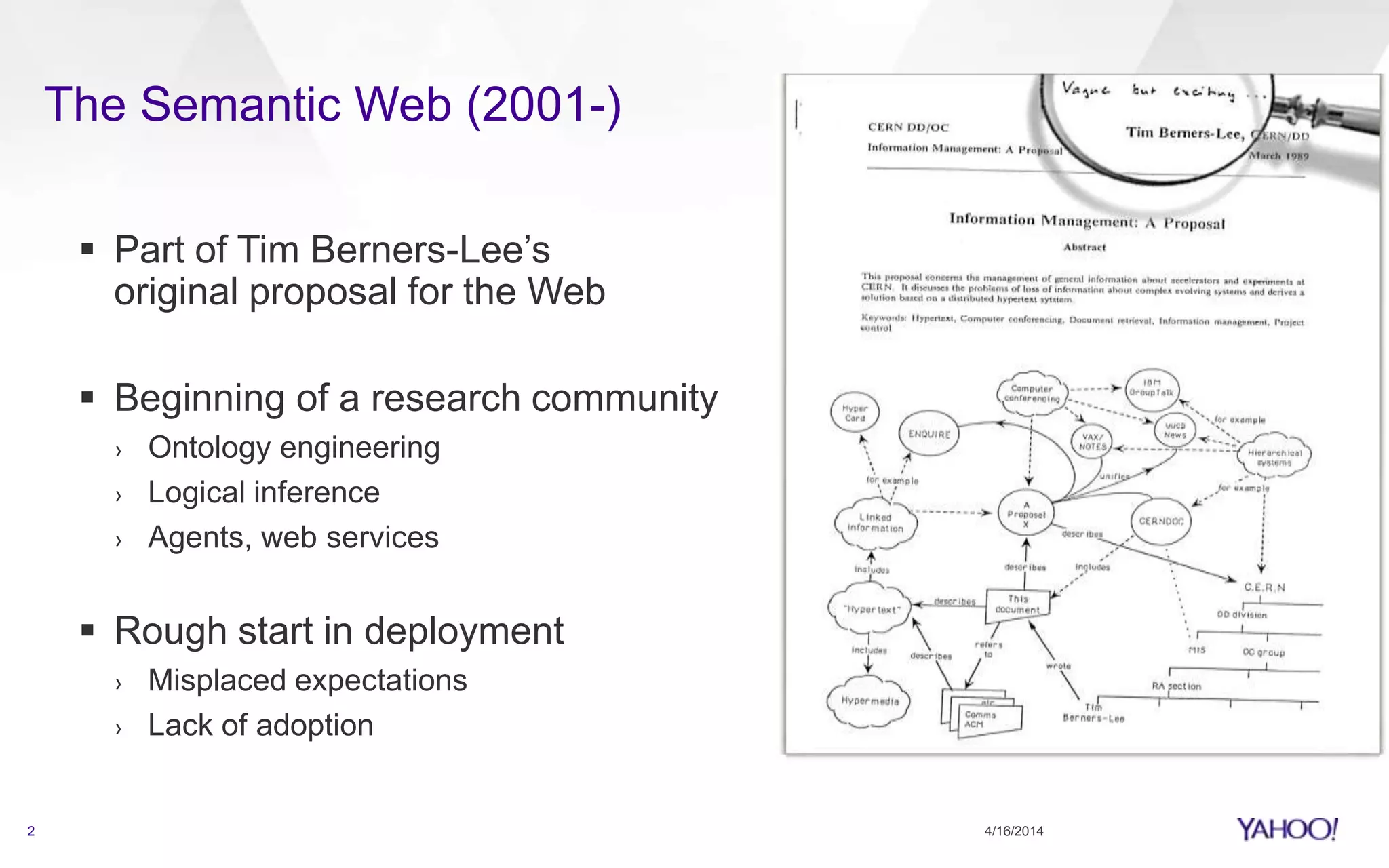
The Semantic Web (2001-)
4/16/20142
 Part of Tim Berners-Lee‟s
original proposal for the Web
 Beginning of a research community
› Ontology engineering
› Logical inference
› Agents, web services
 Rough start in deployment
› Misplaced expectations
› Lack of adoption
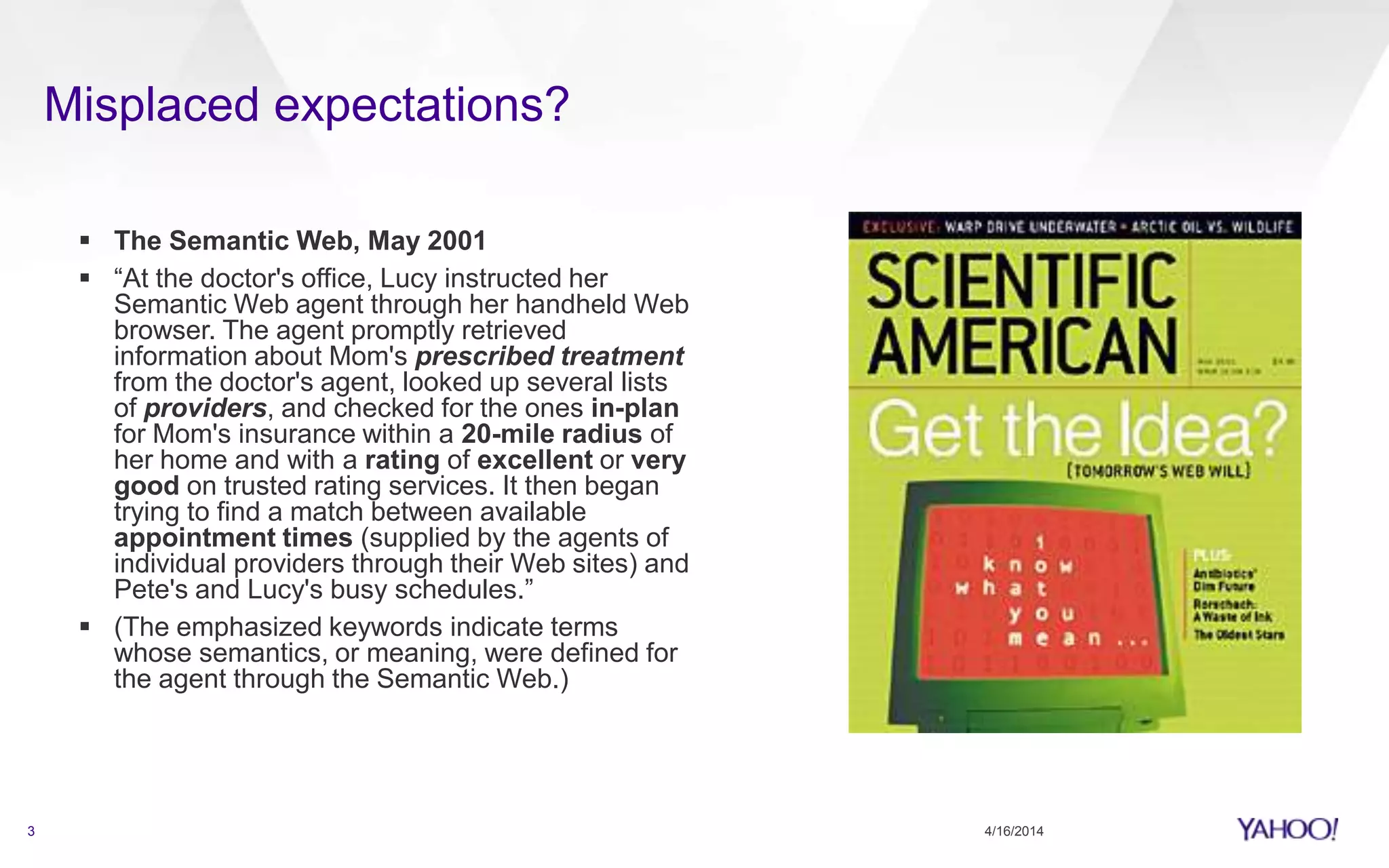
 The Semantic Web, May 2001
 “At the doctor's office, Lucy instructed her
Semantic Web agent through her handheld Web
browser. The agent promptly retrieved
information about Mom's prescribed treatment
from the doctor's agent, looked up several lists
of providers, and checked for the ones in-plan
for Mom's insurance within a 20-mile radius of
her home and with a rating of excellent or very
good on trusted rating services. It then began
trying to find a match between available
appointment times (supplied by the agents of
individual providers through their Web sites) and
Pete's and Lucy's busy schedules.”
 (The emphasized keywords indicate terms
whose semantics, or meaning, were defined for
the agent through the Semantic Web.)
4/16/20143
Misplaced expectations?
Lack of adoption
 Standardization ahead of adoption
› URI, RDF, RDF/XML, RDFa, JSON-LD,
OWL, RIF, SPARQL, OWL-S, POWDER …
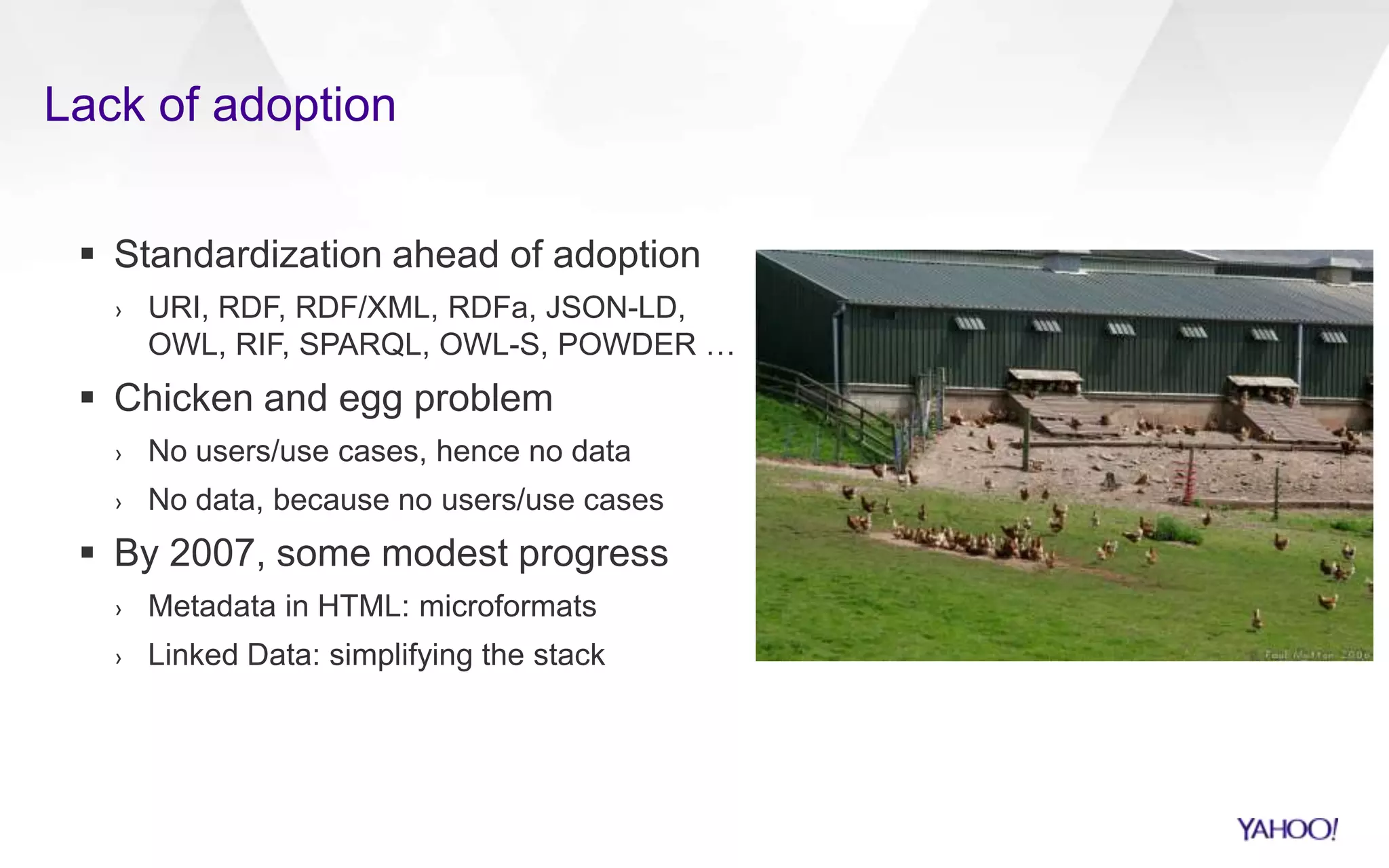
 Chicken and egg problem
› No users/use cases, hence no data
› No data, because no users/use cases
 By 2007, some modest progress
› Metadata in HTML: microformats
› Linked Data: simplifying the stack
Web search by 2007
5
 Large classes of queries are solved to perfection
 Improvements in web search are harder and harder to come by
› Relevance models, hyperlink structure and interaction data
› Combination of features using machine learning
› Heavy investment in computational power
• real-time indexing, instant search, datacenters and edge services
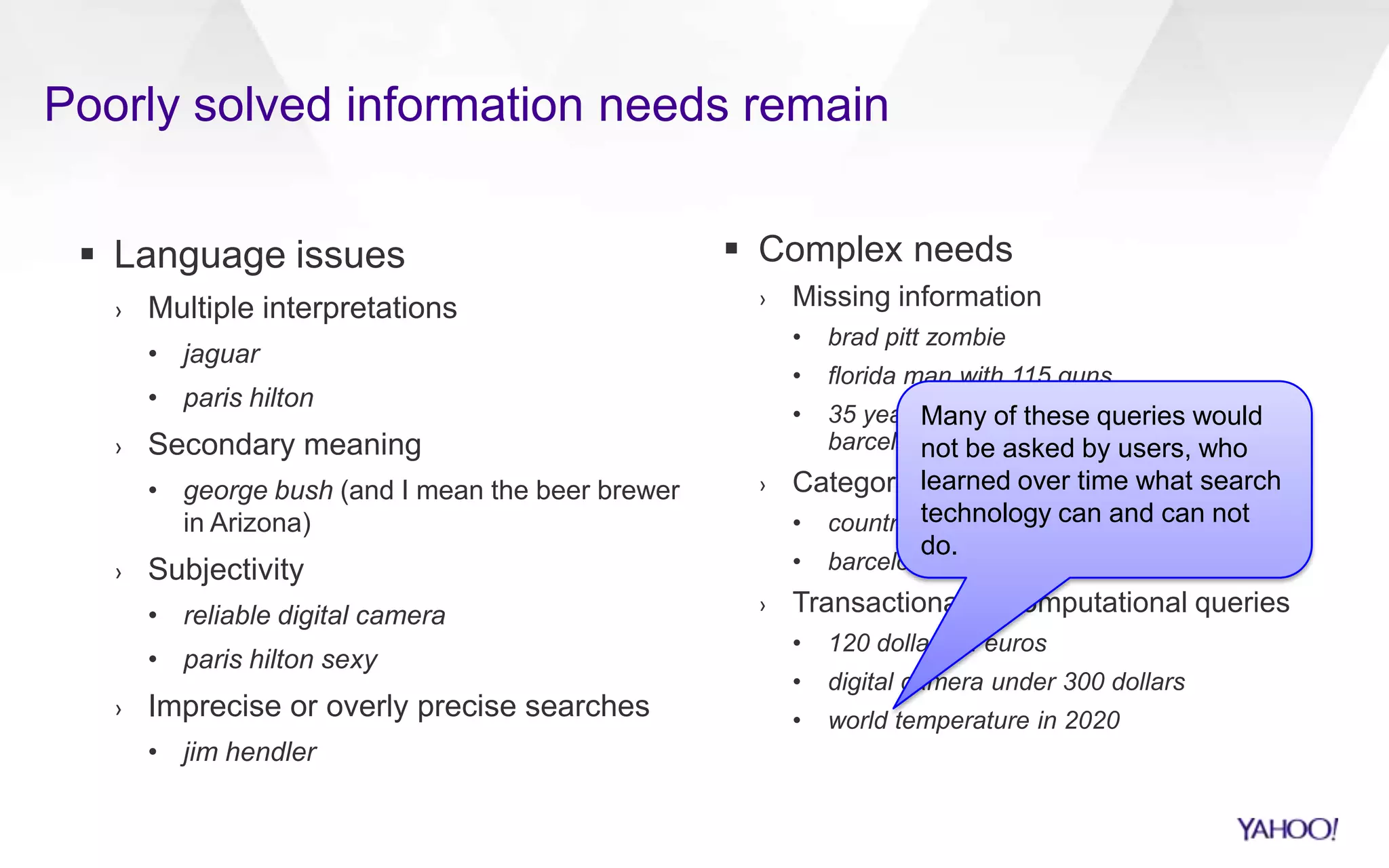
 Language issues
› Multiple interpretations
• jaguar
• paris hilton
› Secondary meaning
• george bush (and I mean the beer brewer
in Arizona)
› Subjectivity
• reliable digital camera
• paris hilton sexy
› Imprecise or overly precise searches
• jim hendler
 Complex needs
› Missing information
• brad pitt zombie
• florida man with 115 guns
• 35 year old computer scientist living in
barcelona
› Category queries
• countries in africa
• barcelona nightlife
› Transactional or computational queries
• 120 dollars in euros
• digital camera under 300 dollars
• world temperature in 2020
Poorly solved information needs remain
Many of these queries would
not be asked by users, who
learned over time what search
technology can and can not
do.
Web search by 2007
7
 Are there even any true keyword queries?
› Lyrics, quotes and bugs… anything else?
 Remaining challenges are not computational, but in modeling user
cognition
› Need a deeper understanding of the query, the content and/or the world at large
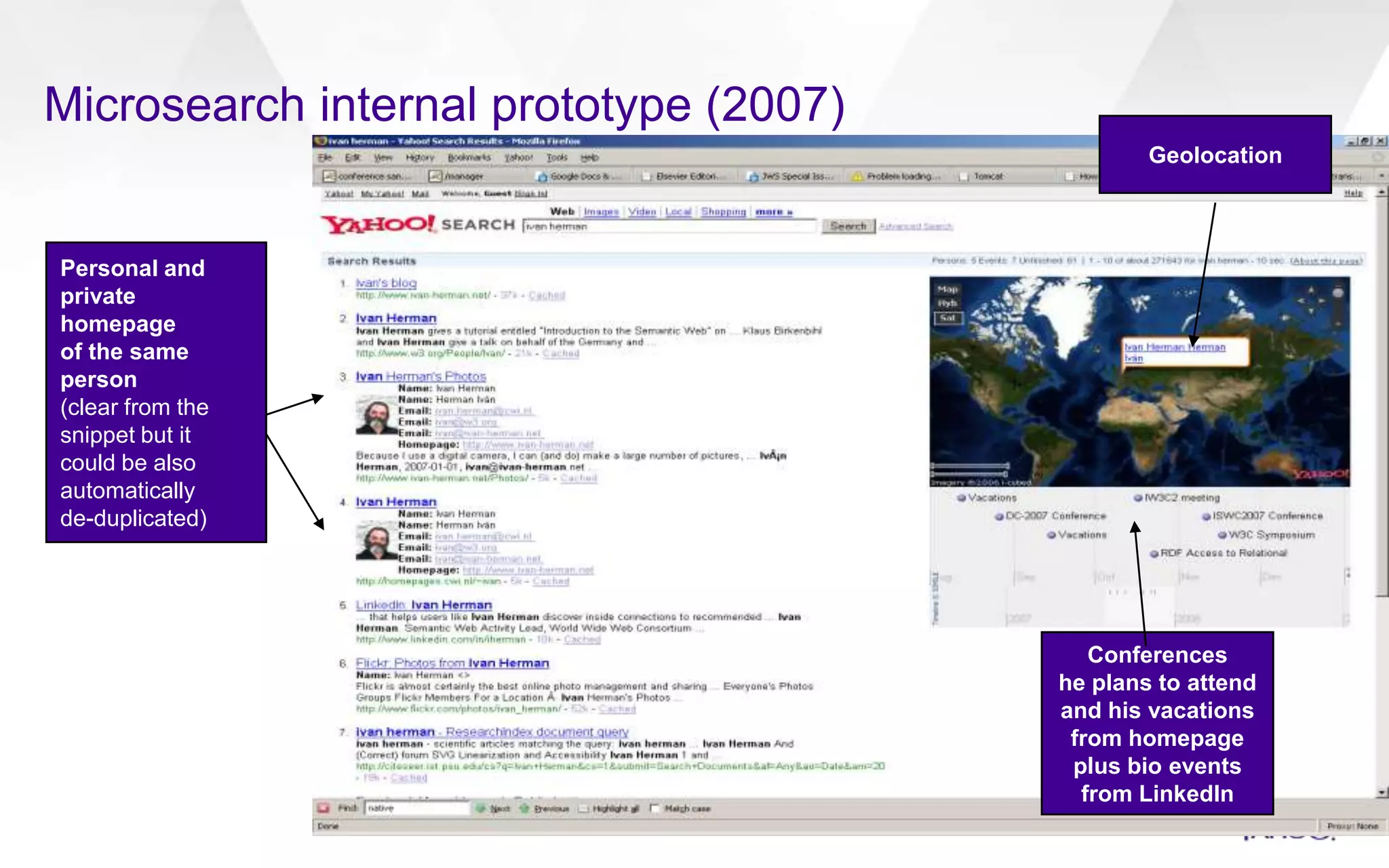
Microsearch internal prototype (2007)
Personal and
private
homepage
of the same
person
(clear from the
snippet but it
could be also
automatically
de-duplicated)
Conferences
he plans to attend
and his vacations
from homepage
plus bio events
from LinkedIn
Geolocation
Enhanced Results
 Computing abstracts is hard
› Summarization of HTML
• Template detection
• Selecting relevant snippets
• Composing readable text
› Efficiency constraints
 Structured data to replace or complement text summary
› Key/value pairs
› Deep links
› Image or Video
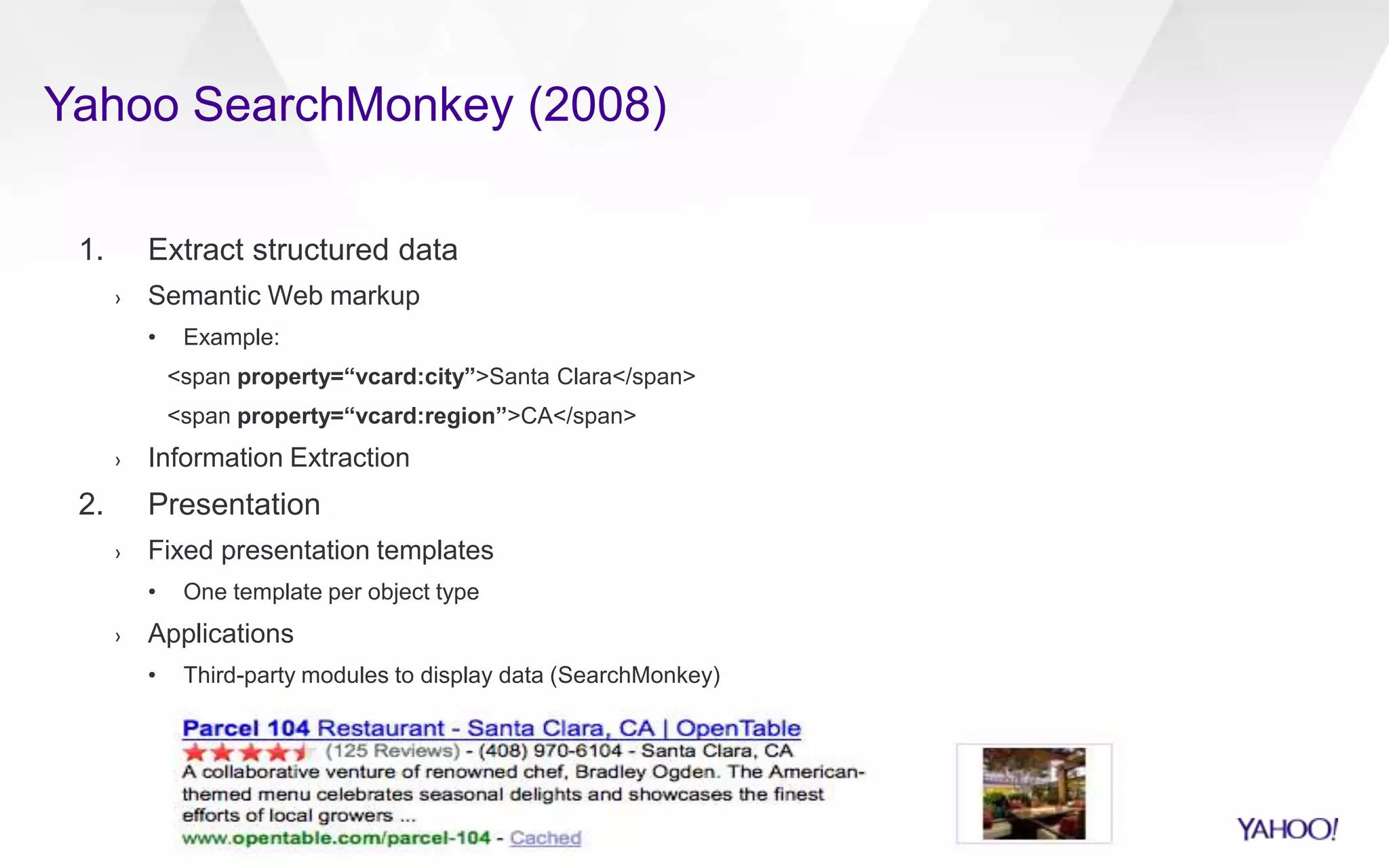
Yahoo SearchMonkey (2008)
1. Extract structured data
› Semantic Web markup
• Example:
<span property=“vcard:city”>Santa Clara</span>
<span property=“vcard:region”>CA</span>
› Information Extraction
2. Presentation
› Fixed presentation templates
• One template per object type
› Applications
• Third-party modules to display data (SearchMonkey)
Effectiveness of enhanced results
 Explicit user feedback
› Side-by-side editorial evaluation (A/B testing)
• Editors are shown a traditional search result and enhanced result for the same page
• Users prefer enhanced results in 84% of the cases and traditional results in 3% (N=384)
 Implicit user feedback
› Click-through rate analysis
• Long dwell time limit of 100s (Ciemiewicz et al. 2010)
• 15% increase in „good‟ clicks
› User interaction model
• Enhanced results lead users to relevant documents (IV) even though less likely to clicked than
textual (III)
• Enhanced results effectively reduce bad clicks!
 See
› Kevin Haas, Peter Mika, Paul Tarjan, Roi Blanco: Enhanced results for web search. SIGIR
2011: 725-734
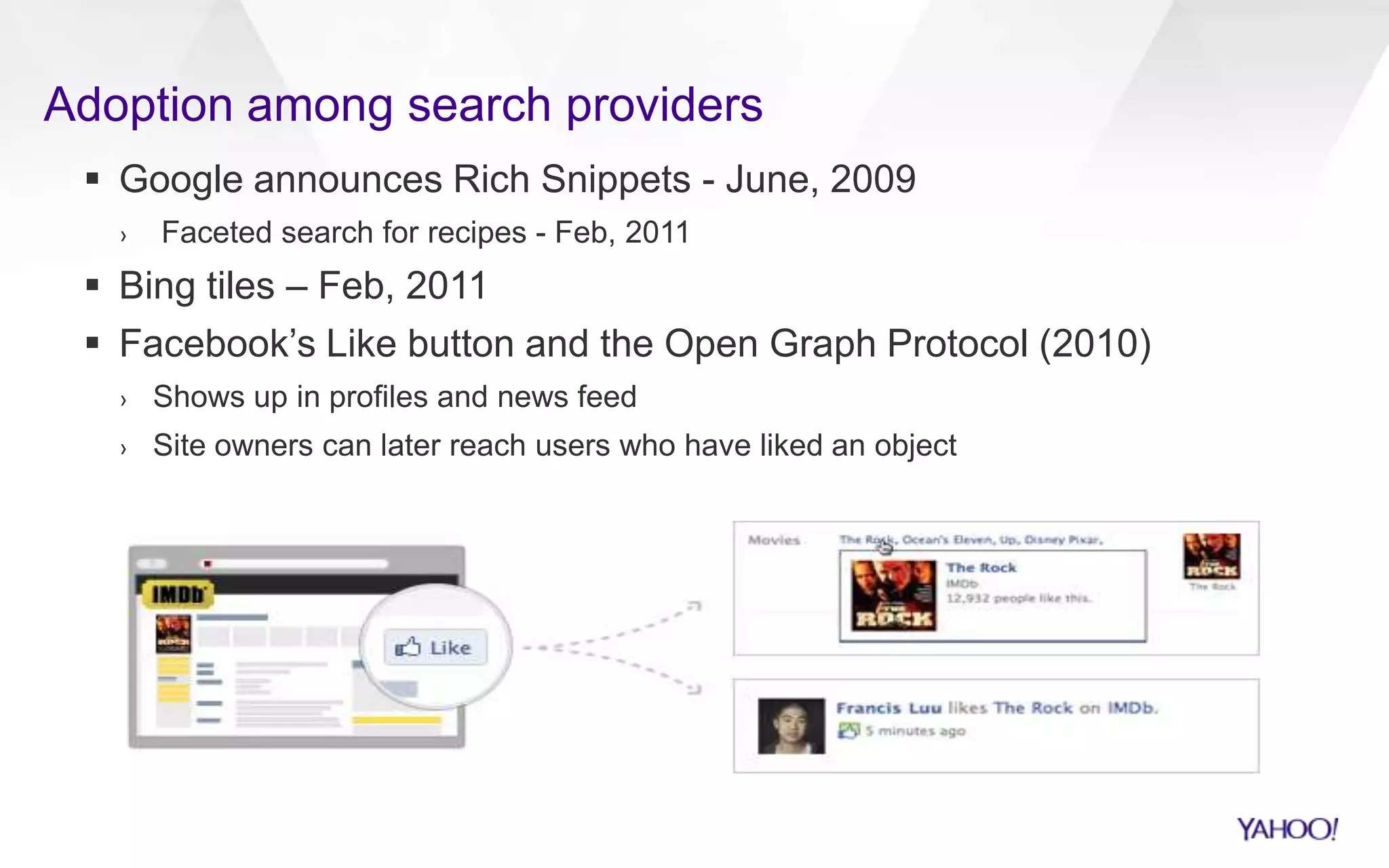
Adoption among search providers
 Google announces Rich Snippets - June, 2009
› Faceted search for recipes - Feb, 2011
 Bing tiles – Feb, 2011
 Facebook‟s Like button and the Open Graph Protocol (2010)
› Shows up in profiles and news feed
› Site owners can later reach users who have liked an object
schema.org
 Agreement on a shared set of schemas for common types of web
content
› Bing, Google, and Yahoo! as initial founders (June, 2011)
• Yandex joins schema.org in Nov, 2011
› Similar in intent to sitemaps.org
• Use a single format to communicate the same information to all three search engines
 schema.org covers areas of interest to all search engines
› Business listings (local), creative works (video), recipes, reviews and more
› Microdata, RDFa, JSON-LD syntax
 Collaborative effort
› Growing number of 3rd party contributions
› schema.org discussions at public-vocabs@w3.org
Adoption among publishers
 R.V. Guha: Light at the end of the tunnel (ISWC 2013 keynote)
› Over 15% of all pages now have schema.org markup
› Over 5 million sites, over 25 billion entity references
› In other words
• Same order of magnitude as the web
 See also
› P. Mika, T. Potter. Metadata Statistics for a Large Web Corpus, LDOW 2012
• Based on Bing US corpus
• 31% of webpages, 5% of domains contain some metadata
› WebDataCommons
• Based on CommonCrawl Nov 2013
• 26% of webpages, 14% of domains contain some metadata
Semantic Search
 Active research field at the intersection of IR, NLP, DB and SemWeb
› ESAIR at SIGIR, SemSearch at ESWC/WWW, EOS and JIWES at SIGIR, Semantic Search
at VLDB
 Exploiting semantic understanding in the retrieval process
› User intent and resources are represented using semantic models
• Not just symbolic representations
› Semantic models are exploited in the matching and ranking of resources
 Tasks
› information extraction
› information reconciliation/tracking
› query understanding
› retrieving/ranking entities/attributes/relations
› result presentation
Information extraction and reconciliation
 Ontology management
› Editorially maintained OWL ontology with 300+ classes
› Covering the domains of interest of Yahoo
 Information extraction
› Automated information extraction
• e.g. wrapper induction
› Metadata from HTML pages
• Focused crawler
› Public datasets (e.g. Dbpedia)
› Proprietary data
 Data fusion
› Manual mapping from the source schemas to the ontology
› Supervised entity reconciliation
• Kedar Bellare, Carlo Curino, Ashwin Machanavajihala, Peter Mika, Mandar Rahurkar, Aamod Sane:
WOO: A Scalable and Multi-tenant Platform for Continuous Knowledge Base Synthesis. PVLDB 2013
• Michael J. Welch, Aamod Sane, Chris Drome: Fast and accurate incremental entity resolution relative to an entity knowledge base. CIKM 2012
 Curation and quality assessment
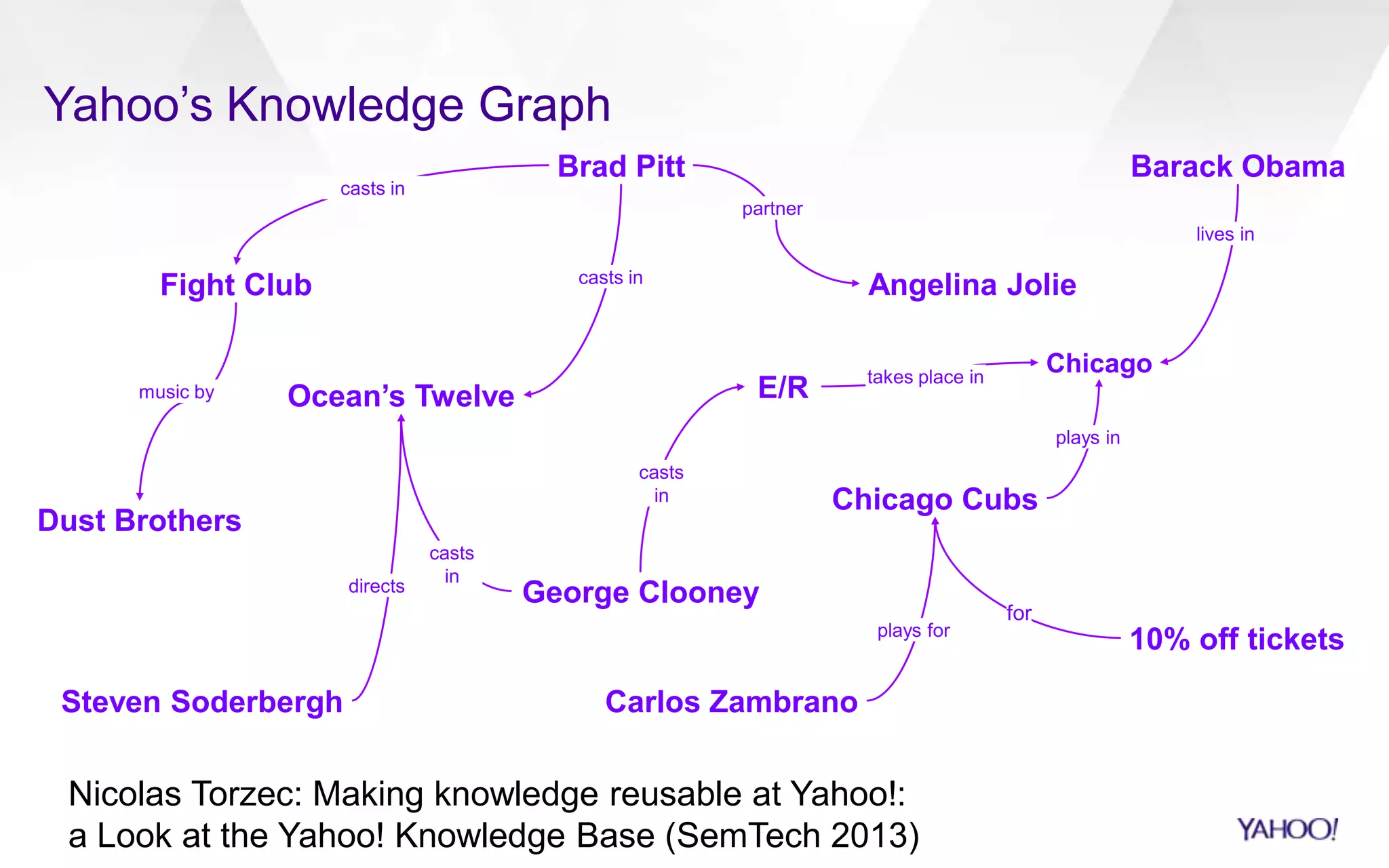
Yahoo‟s Knowledge Graph
Chicago Cubs
Chicago
Barack Obama
Carlos Zambrano
10% off tickets
for
plays for
plays in
lives in
Brad Pitt
Angelina Jolie
Steven Soderbergh
George Clooney
Ocean’s Twelve
partner
directs
casts in
E/R
casts
in
takes place in
Fight Club
casts in
Dust Brothers
casts
in
music by
Nicolas Torzec: Making knowledge reusable at Yahoo!:
a Look at the Yahoo! Knowledge Base (SemTech 2013)
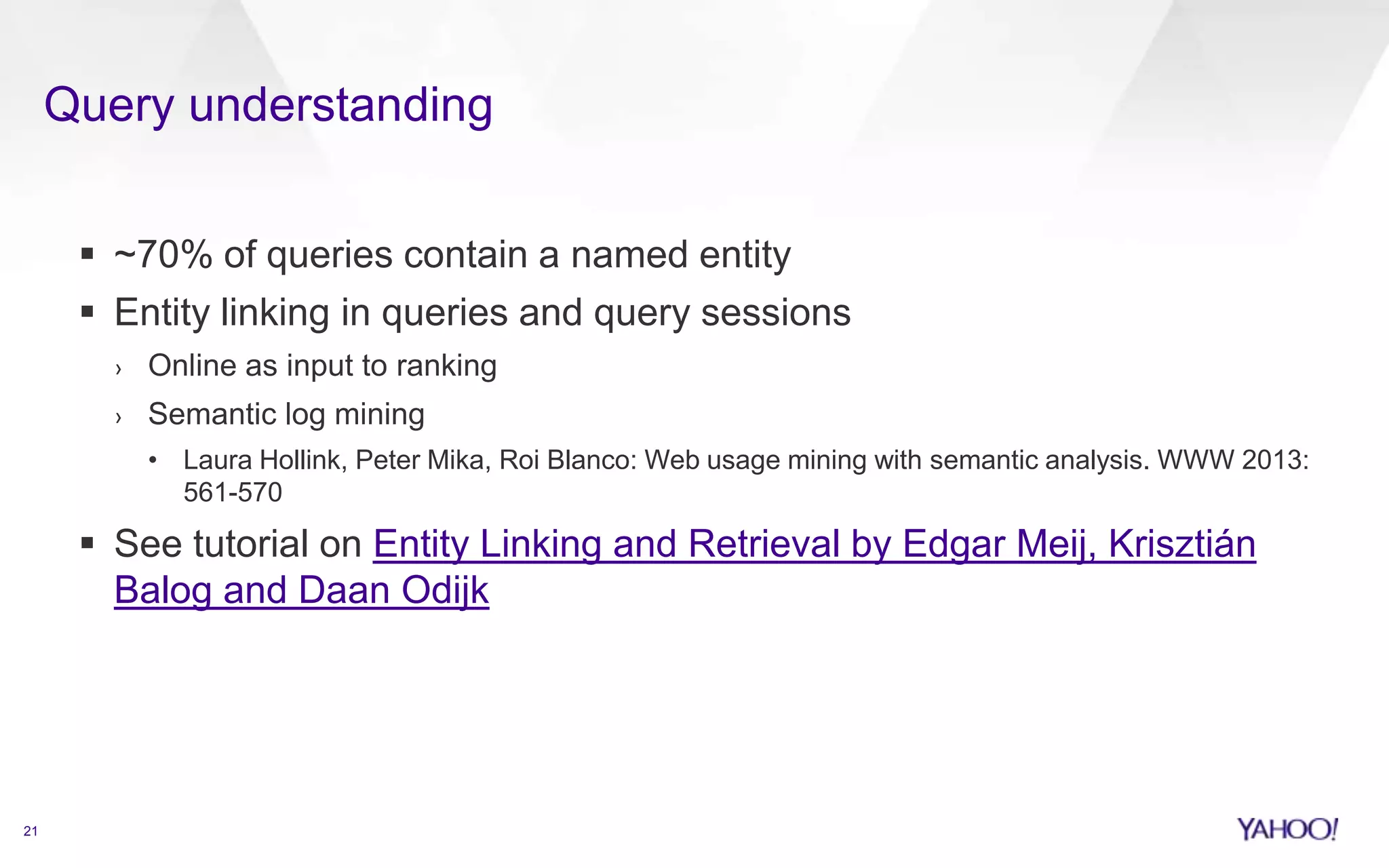
Query understanding
21
 ~70% of queries contain a named entity
 Entity linking in queries and query sessions
› Online as input to ranking
› Semantic log mining
• Laura Hollink, Peter Mika, Roi Blanco: Web usage mining with semantic analysis. WWW 2013:
561-570
 See tutorial on Entity Linking and Retrieval by Edgar Meij, Krisztián
Balog and Daan Odijk
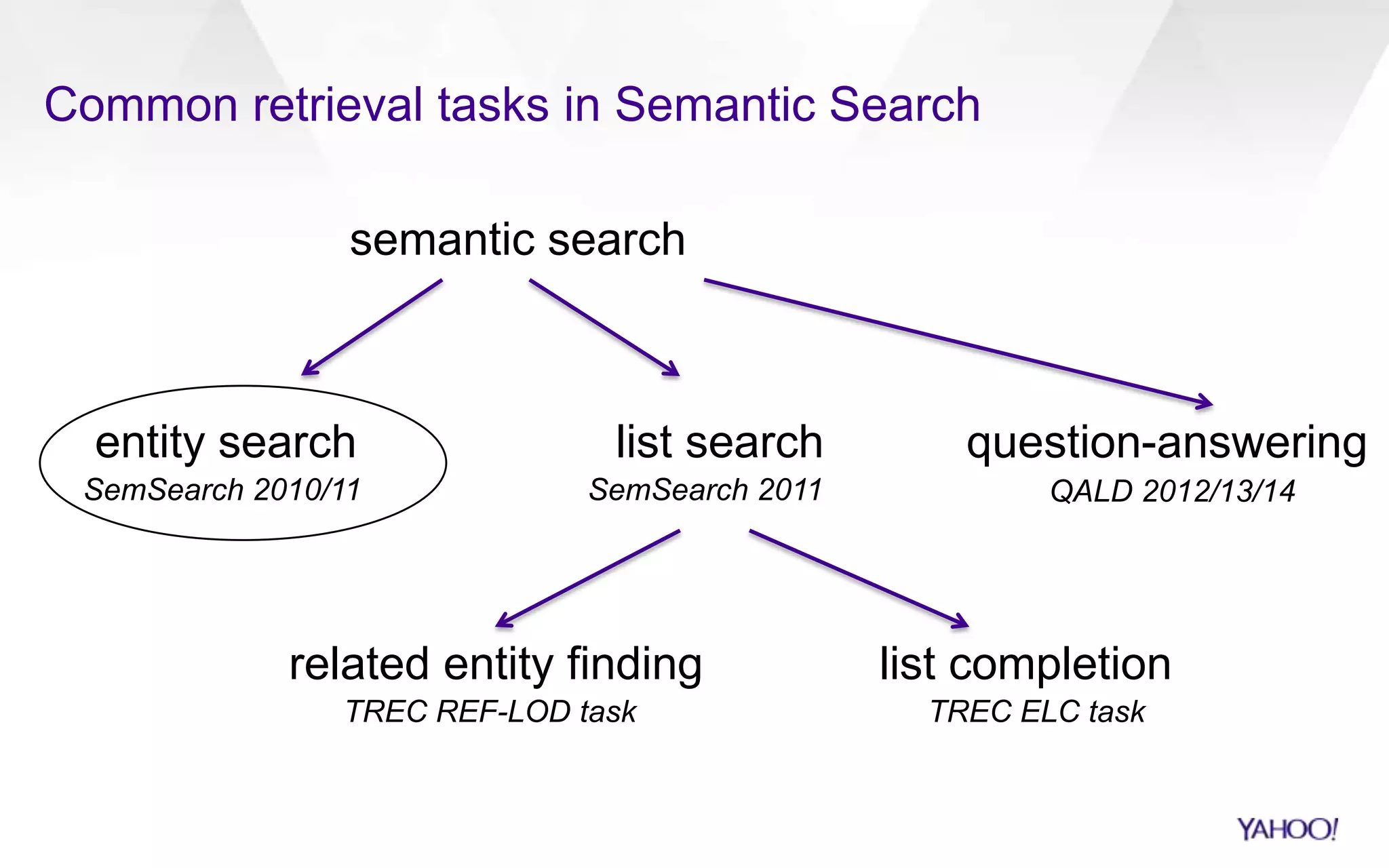
list search
related entity finding
entity search
SemSearch 2010/11
list completion
SemSearch 2011
TREC ELC taskTREC REF-LOD task
semantic search
Common retrieval tasks in Semantic Search
question-answering
QALD 2012/13/14
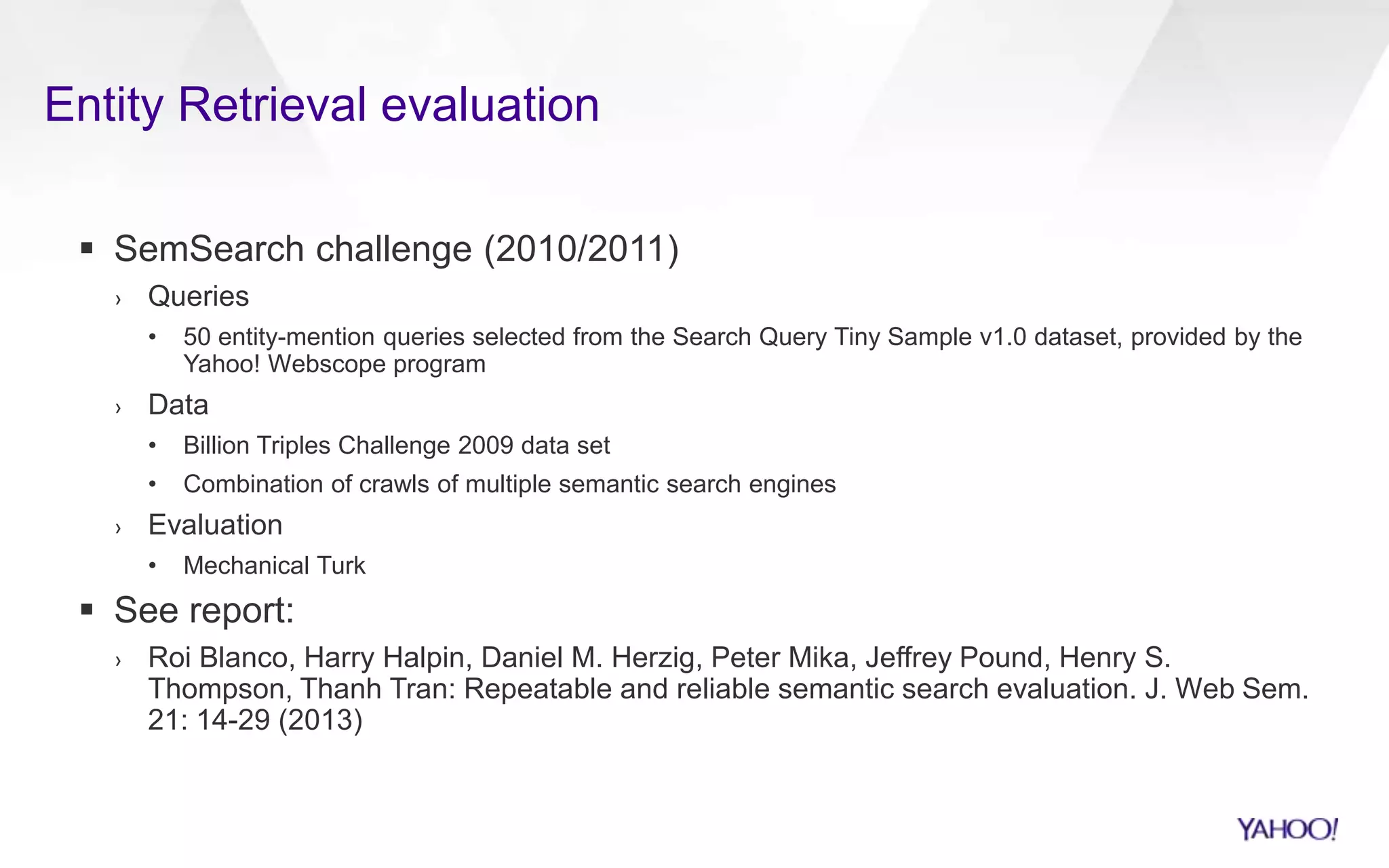
Entity Retrieval evaluation
 SemSearch challenge (2010/2011)
› Queries
• 50 entity-mention queries selected from the Search Query Tiny Sample v1.0 dataset, provided by the
Yahoo! Webscope program
› Data
• Billion Triples Challenge 2009 data set
• Combination of crawls of multiple semantic search engines
› Evaluation
• Mechanical Turk
 See report:
› Roi Blanco, Harry Halpin, Daniel M. Herzig, Peter Mika, Jeffrey Pound, Henry S.
Thompson, Thanh Tran: Repeatable and reliable semantic search evaluation. J. Web Sem.
21: 14-29 (2013)
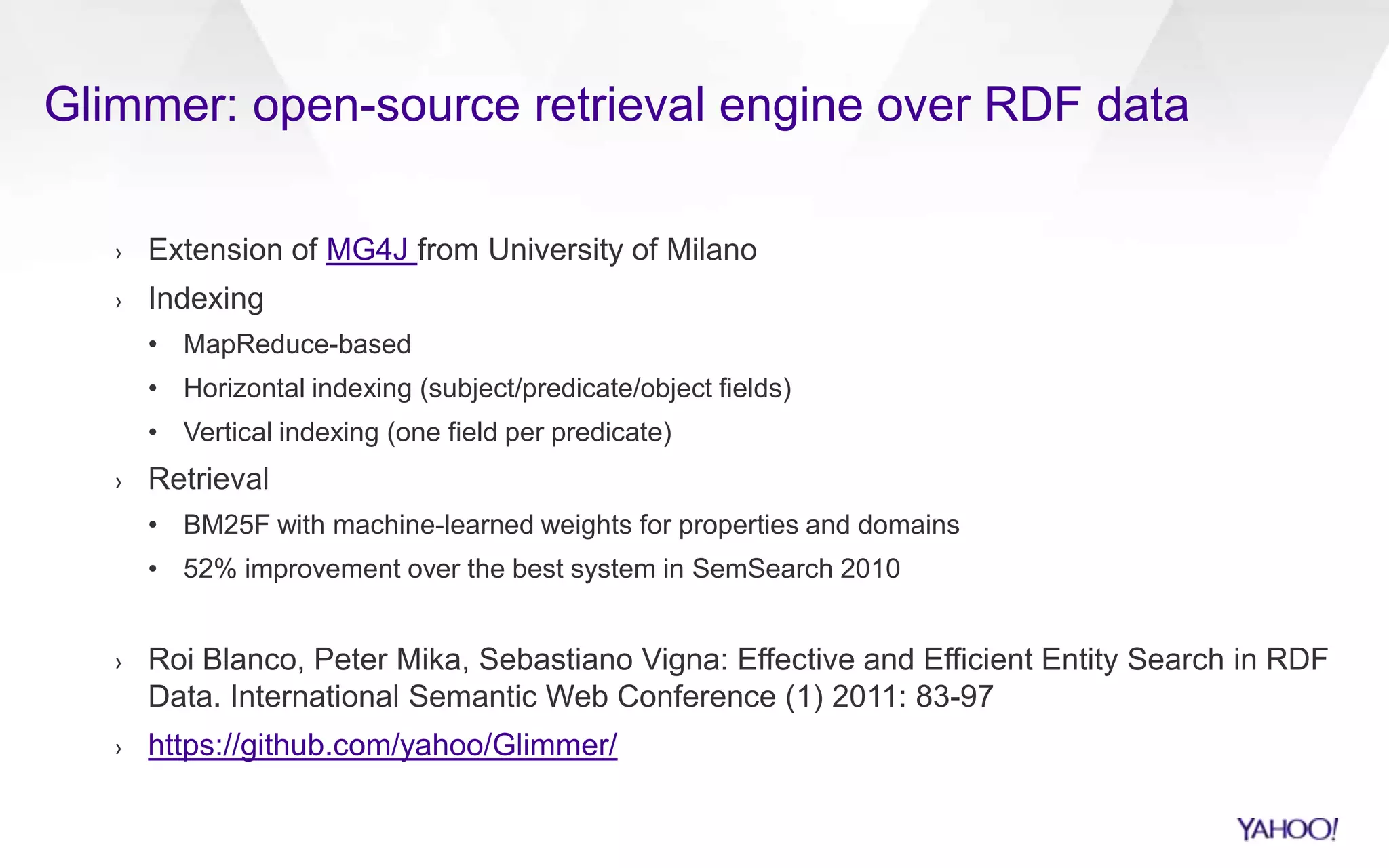
Glimmer: open-source retrieval engine over RDF data
› Extension of MG4J from University of Milano
› Indexing
• MapReduce-based
• Horizontal indexing (subject/predicate/object fields)
• Vertical indexing (one field per predicate)
› Retrieval
• BM25F with machine-learned weights for properties and domains
• 52% improvement over the best system in SemSearch 2010
› Roi Blanco, Peter Mika, Sebastiano Vigna: Effective and Efficient Entity Search in RDF
Data. International Semantic Web Conference (1) 2011: 83-97
› https://github.com/yahoo/Glimmer/
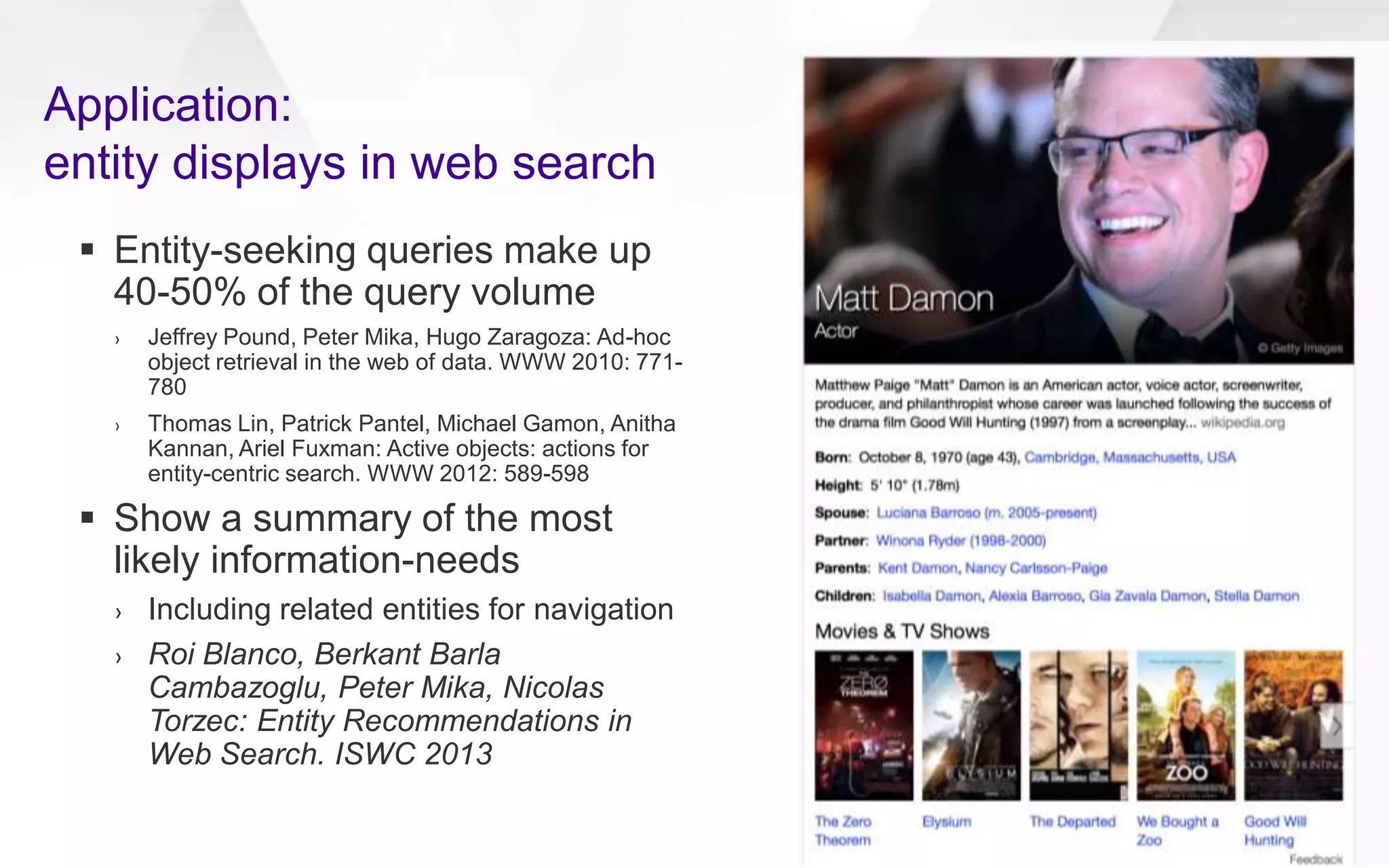
 Entity-seeking queries make up
40-50% of the query volume
› Jeffrey Pound, Peter Mika, Hugo Zaragoza: Ad-hoc
object retrieval in the web of data. WWW 2010: 771-
780
› Thomas Lin, Patrick Pantel, Michael Gamon, Anitha
Kannan, Ariel Fuxman: Active objects: actions for
entity-centric search. WWW 2012: 589-598
 Show a summary of the most
likely information-needs
› Including related entities for navigation
› Roi Blanco, Berkant Barla
Cambazoglu, Peter Mika, Nicolas
Torzec: Entity Recommendations in
Web Search. ISWC 2013
Application:
entity displays in web search
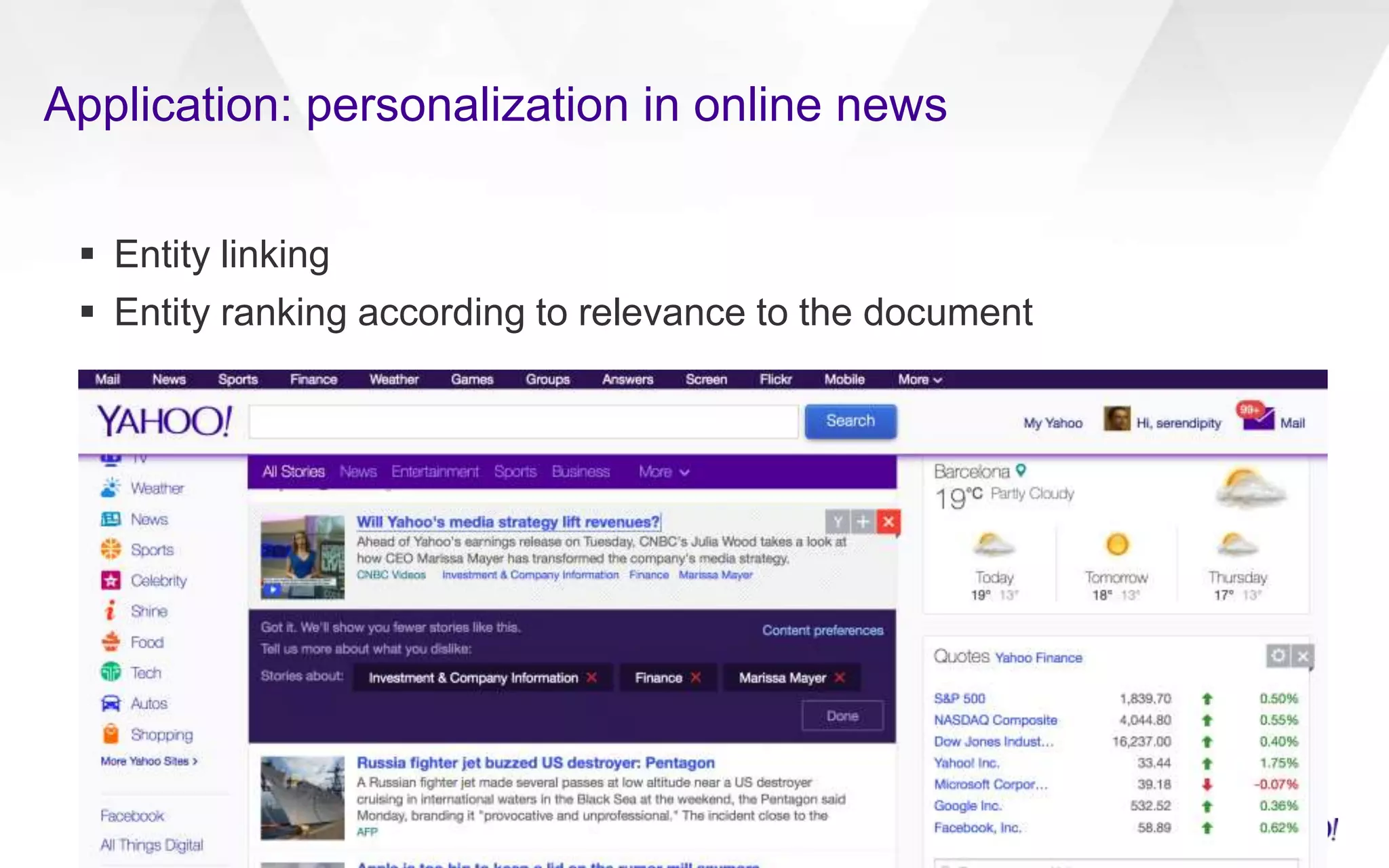
Application: personalization in online news
 Entity linking
 Entity ranking according to relevance to the document
New applications
Mobile search on the rise
 Information access on-the-go requires hands-free operation
› Driving, walking, gym, etc.
• Americans spend 540 hours a year in their cars [1] vs. 348 hours browsing the Web [2]
 ~50% of queries are coming from mobile devices (and growing)
› Changing habits, e.g. iPad usage peaks before bedtime
› Limitations in input/output
[1] http://answers.google.com/answers/threadview?id=392456
[2] http://articles.latimes.com/2012/jun/22/business/la-fi-tn-top-us-brands-news-web-sites-20120622
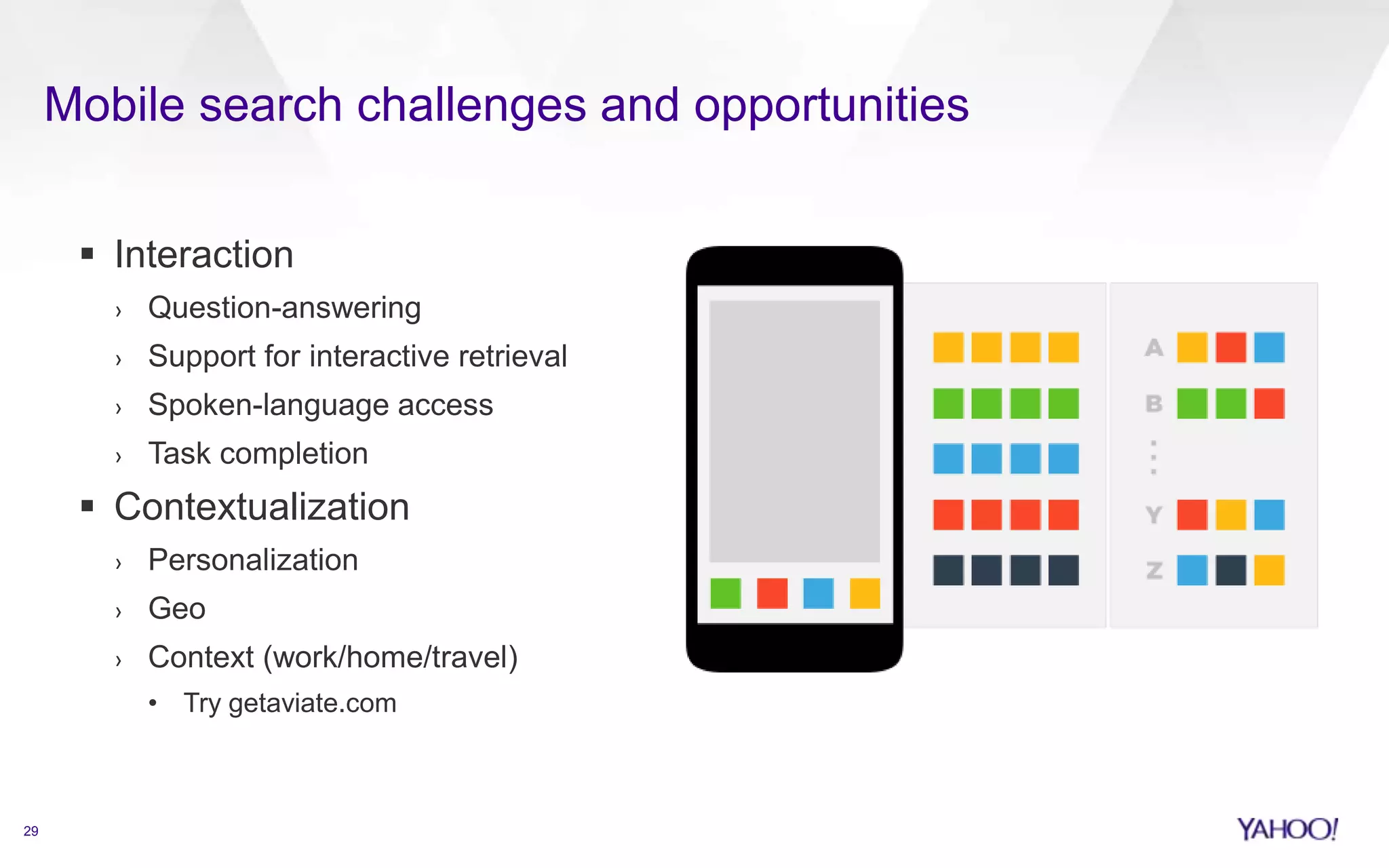
Mobile search challenges and opportunities
29
 Interaction
› Question-answering
› Support for interactive retrieval
› Spoken-language access
› Task completion
 Contextualization
› Personalization
› Geo
› Context (work/home/travel)
• Try getaviate.com
Interactive, conversational voice search
 Parlance EU project
› Complex dialogs within a domain
• Requires complete semantic understanding
 Complete system (mixed license)
› Automated Speech Recognition (ASR)
› Spoken Language Understanding (SLU)
› Interaction Management
› Knowledge Base
› Natural Language Generation (NLG)
› Text-to-Speech (TTS)
 Video
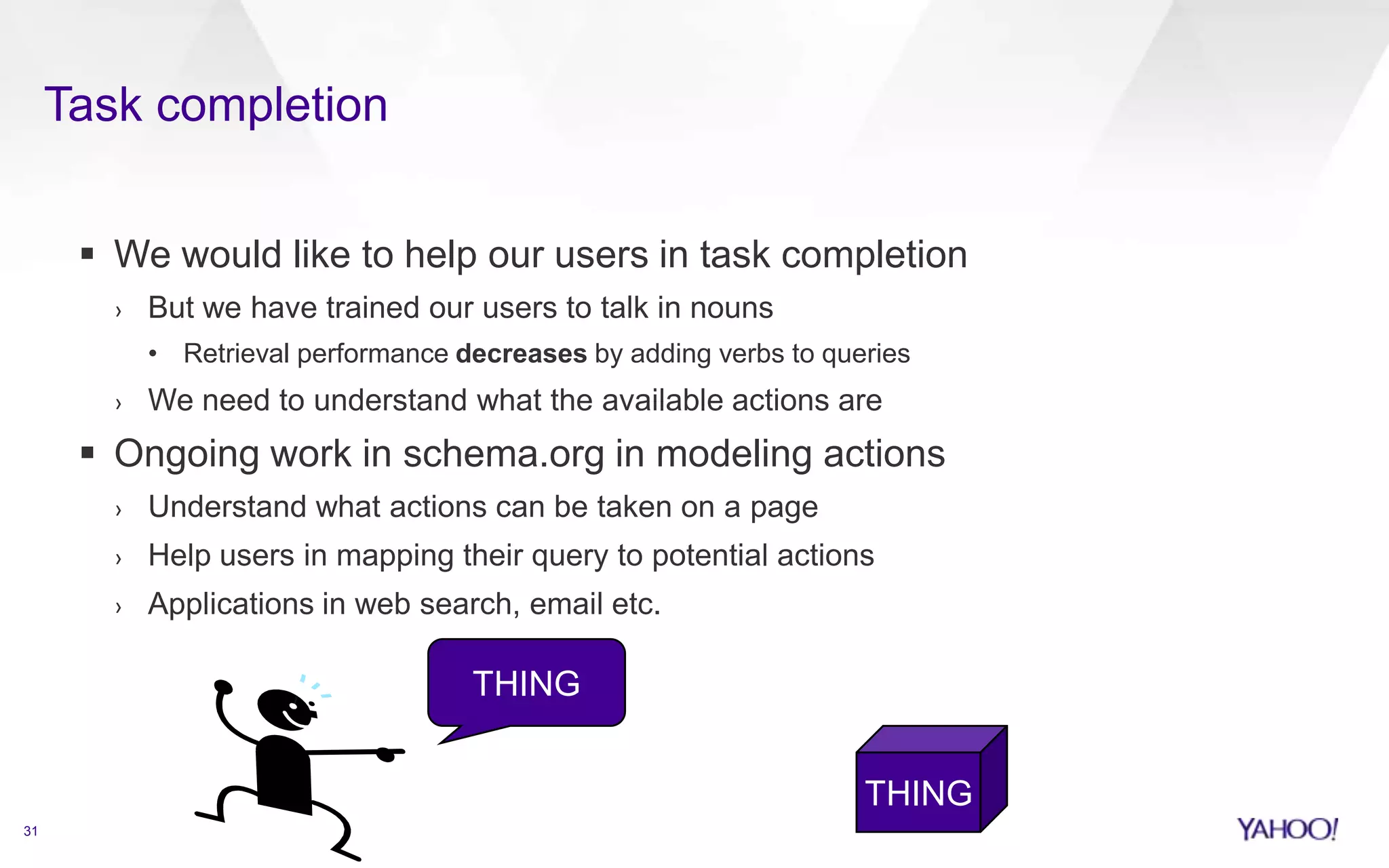
Task completion
31
 We would like to help our users in task completion
› But we have trained our users to talk in nouns
• Retrieval performance decreases by adding verbs to queries
› We need to understand what the available actions are
 Ongoing work in schema.org in modeling actions
› Understand what actions can be taken on a page
› Help users in mapping their query to potential actions
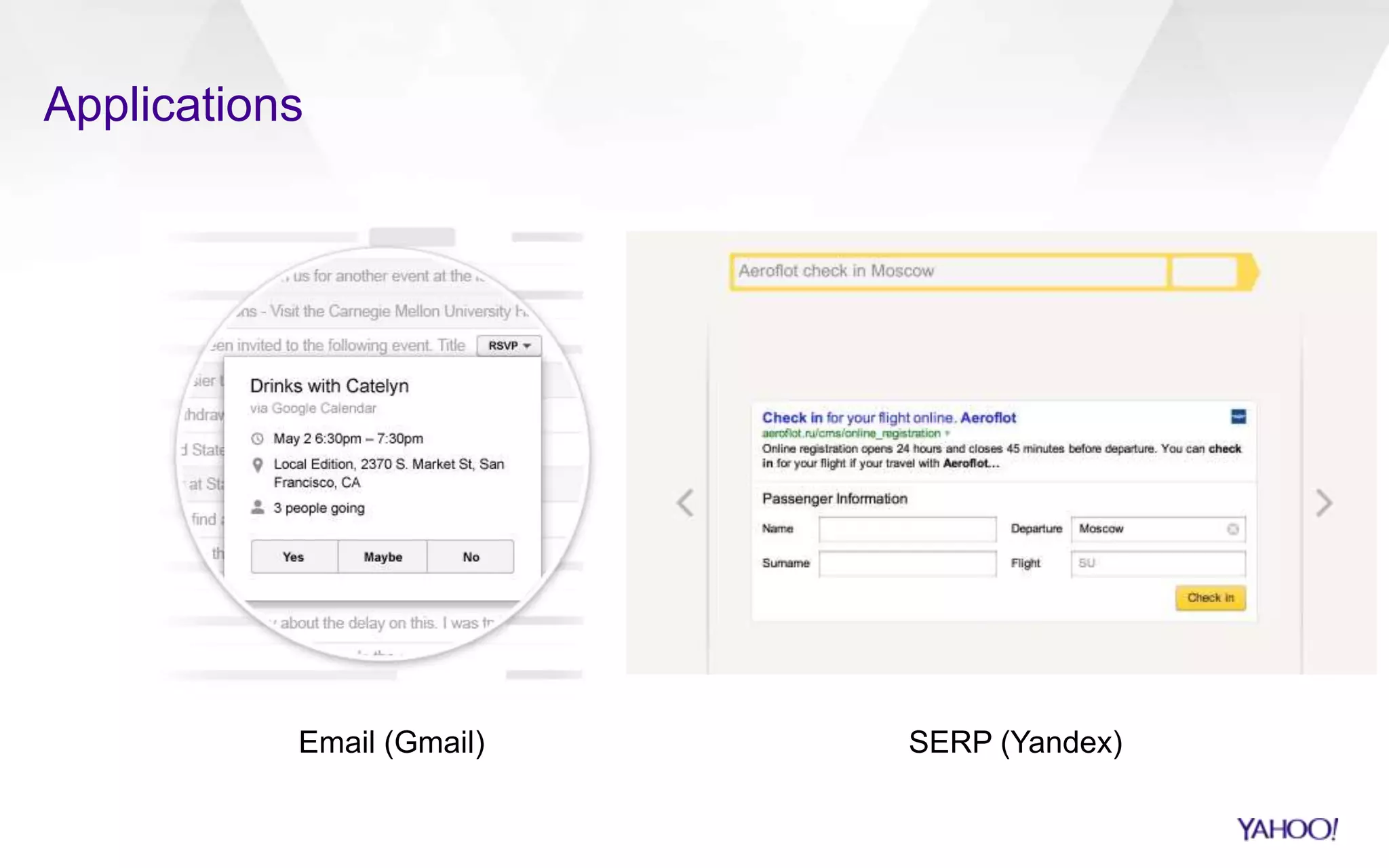
› Applications in web search, email etc.
THING
THING
Applications
Email (Gmail) SERP (Yandex)
Q&A
 Many thanks to members of the Semantic Search team
at Yahoo Labs Barcelona and to Yahoos around the world
 Contact me
› pmika@yahoo-inc.com
› @pmika
› www.slideshare.net/pmika
› Ask about our internships and other opportunities

Semantic Search at Yahoo

  • 1.
    Semantic Search atYahoo P R E S E N T E D B Y P e t e r M i k a , S r . R e s e a r c h S c i e n t i s t , Y a h o o L a b s ⎪ A p r i l 1 6 , 2 0 1 4
  • 2.
    The Semantic Web(2001-) 4/16/20142  Part of Tim Berners-Lee‟s original proposal for the Web  Beginning of a research community › Ontology engineering › Logical inference › Agents, web services  Rough start in deployment › Misplaced expectations › Lack of adoption
  • 3.
     The SemanticWeb, May 2001  “At the doctor's office, Lucy instructed her Semantic Web agent through her handheld Web browser. The agent promptly retrieved information about Mom's prescribed treatment from the doctor's agent, looked up several lists of providers, and checked for the ones in-plan for Mom's insurance within a 20-mile radius of her home and with a rating of excellent or very good on trusted rating services. It then began trying to find a match between available appointment times (supplied by the agents of individual providers through their Web sites) and Pete's and Lucy's busy schedules.”  (The emphasized keywords indicate terms whose semantics, or meaning, were defined for the agent through the Semantic Web.) 4/16/20143 Misplaced expectations?
  • 4.
    Lack of adoption Standardization ahead of adoption › URI, RDF, RDF/XML, RDFa, JSON-LD, OWL, RIF, SPARQL, OWL-S, POWDER …  Chicken and egg problem › No users/use cases, hence no data › No data, because no users/use cases  By 2007, some modest progress › Metadata in HTML: microformats › Linked Data: simplifying the stack
  • 5.
    Web search by2007 5  Large classes of queries are solved to perfection  Improvements in web search are harder and harder to come by › Relevance models, hyperlink structure and interaction data › Combination of features using machine learning › Heavy investment in computational power • real-time indexing, instant search, datacenters and edge services
  • 6.
     Language issues ›Multiple interpretations • jaguar • paris hilton › Secondary meaning • george bush (and I mean the beer brewer in Arizona) › Subjectivity • reliable digital camera • paris hilton sexy › Imprecise or overly precise searches • jim hendler  Complex needs › Missing information • brad pitt zombie • florida man with 115 guns • 35 year old computer scientist living in barcelona › Category queries • countries in africa • barcelona nightlife › Transactional or computational queries • 120 dollars in euros • digital camera under 300 dollars • world temperature in 2020 Poorly solved information needs remain Many of these queries would not be asked by users, who learned over time what search technology can and can not do.
  • 7.
    Web search by2007 7  Are there even any true keyword queries? › Lyrics, quotes and bugs… anything else?  Remaining challenges are not computational, but in modeling user cognition › Need a deeper understanding of the query, the content and/or the world at large
  • 8.
    Microsearch internal prototype(2007) Personal and private homepage of the same person (clear from the snippet but it could be also automatically de-duplicated) Conferences he plans to attend and his vacations from homepage plus bio events from LinkedIn Geolocation
  • 9.
    Enhanced Results  Computingabstracts is hard › Summarization of HTML • Template detection • Selecting relevant snippets • Composing readable text › Efficiency constraints  Structured data to replace or complement text summary › Key/value pairs › Deep links › Image or Video
  • 10.
    Yahoo SearchMonkey (2008) 1.Extract structured data › Semantic Web markup • Example: <span property=“vcard:city”>Santa Clara</span> <span property=“vcard:region”>CA</span> › Information Extraction 2. Presentation › Fixed presentation templates • One template per object type › Applications • Third-party modules to display data (SearchMonkey)
  • 11.
    Effectiveness of enhancedresults  Explicit user feedback › Side-by-side editorial evaluation (A/B testing) • Editors are shown a traditional search result and enhanced result for the same page • Users prefer enhanced results in 84% of the cases and traditional results in 3% (N=384)  Implicit user feedback › Click-through rate analysis • Long dwell time limit of 100s (Ciemiewicz et al. 2010) • 15% increase in „good‟ clicks › User interaction model • Enhanced results lead users to relevant documents (IV) even though less likely to clicked than textual (III) • Enhanced results effectively reduce bad clicks!  See › Kevin Haas, Peter Mika, Paul Tarjan, Roi Blanco: Enhanced results for web search. SIGIR 2011: 725-734
  • 12.
    Adoption among searchproviders  Google announces Rich Snippets - June, 2009 › Faceted search for recipes - Feb, 2011  Bing tiles – Feb, 2011  Facebook‟s Like button and the Open Graph Protocol (2010) › Shows up in profiles and news feed › Site owners can later reach users who have liked an object
  • 13.
    schema.org  Agreement ona shared set of schemas for common types of web content › Bing, Google, and Yahoo! as initial founders (June, 2011) • Yandex joins schema.org in Nov, 2011 › Similar in intent to sitemaps.org • Use a single format to communicate the same information to all three search engines  schema.org covers areas of interest to all search engines › Business listings (local), creative works (video), recipes, reviews and more › Microdata, RDFa, JSON-LD syntax  Collaborative effort › Growing number of 3rd party contributions › schema.org discussions at public-vocabs@w3.org
  • 14.
    Adoption among publishers R.V. Guha: Light at the end of the tunnel (ISWC 2013 keynote) › Over 15% of all pages now have schema.org markup › Over 5 million sites, over 25 billion entity references › In other words • Same order of magnitude as the web  See also › P. Mika, T. Potter. Metadata Statistics for a Large Web Corpus, LDOW 2012 • Based on Bing US corpus • 31% of webpages, 5% of domains contain some metadata › WebDataCommons • Based on CommonCrawl Nov 2013 • 26% of webpages, 14% of domains contain some metadata
  • 15.
    Semantic Search  Activeresearch field at the intersection of IR, NLP, DB and SemWeb › ESAIR at SIGIR, SemSearch at ESWC/WWW, EOS and JIWES at SIGIR, Semantic Search at VLDB  Exploiting semantic understanding in the retrieval process › User intent and resources are represented using semantic models • Not just symbolic representations › Semantic models are exploited in the matching and ranking of resources  Tasks › information extraction › information reconciliation/tracking › query understanding › retrieving/ranking entities/attributes/relations › result presentation
  • 16.
    Information extraction andreconciliation  Ontology management › Editorially maintained OWL ontology with 300+ classes › Covering the domains of interest of Yahoo  Information extraction › Automated information extraction • e.g. wrapper induction › Metadata from HTML pages • Focused crawler › Public datasets (e.g. Dbpedia) › Proprietary data  Data fusion › Manual mapping from the source schemas to the ontology › Supervised entity reconciliation • Kedar Bellare, Carlo Curino, Ashwin Machanavajihala, Peter Mika, Mandar Rahurkar, Aamod Sane: WOO: A Scalable and Multi-tenant Platform for Continuous Knowledge Base Synthesis. PVLDB 2013 • Michael J. Welch, Aamod Sane, Chris Drome: Fast and accurate incremental entity resolution relative to an entity knowledge base. CIKM 2012  Curation and quality assessment
  • 20.
    Yahoo‟s Knowledge Graph ChicagoCubs Chicago Barack Obama Carlos Zambrano 10% off tickets for plays for plays in lives in Brad Pitt Angelina Jolie Steven Soderbergh George Clooney Ocean’s Twelve partner directs casts in E/R casts in takes place in Fight Club casts in Dust Brothers casts in music by Nicolas Torzec: Making knowledge reusable at Yahoo!: a Look at the Yahoo! Knowledge Base (SemTech 2013)
  • 21.
    Query understanding 21  ~70%of queries contain a named entity  Entity linking in queries and query sessions › Online as input to ranking › Semantic log mining • Laura Hollink, Peter Mika, Roi Blanco: Web usage mining with semantic analysis. WWW 2013: 561-570  See tutorial on Entity Linking and Retrieval by Edgar Meij, Krisztián Balog and Daan Odijk
  • 22.
    list search related entityfinding entity search SemSearch 2010/11 list completion SemSearch 2011 TREC ELC taskTREC REF-LOD task semantic search Common retrieval tasks in Semantic Search question-answering QALD 2012/13/14
  • 23.
    Entity Retrieval evaluation SemSearch challenge (2010/2011) › Queries • 50 entity-mention queries selected from the Search Query Tiny Sample v1.0 dataset, provided by the Yahoo! Webscope program › Data • Billion Triples Challenge 2009 data set • Combination of crawls of multiple semantic search engines › Evaluation • Mechanical Turk  See report: › Roi Blanco, Harry Halpin, Daniel M. Herzig, Peter Mika, Jeffrey Pound, Henry S. Thompson, Thanh Tran: Repeatable and reliable semantic search evaluation. J. Web Sem. 21: 14-29 (2013)
  • 24.
    Glimmer: open-source retrievalengine over RDF data › Extension of MG4J from University of Milano › Indexing • MapReduce-based • Horizontal indexing (subject/predicate/object fields) • Vertical indexing (one field per predicate) › Retrieval • BM25F with machine-learned weights for properties and domains • 52% improvement over the best system in SemSearch 2010 › Roi Blanco, Peter Mika, Sebastiano Vigna: Effective and Efficient Entity Search in RDF Data. International Semantic Web Conference (1) 2011: 83-97 › https://github.com/yahoo/Glimmer/
  • 25.
     Entity-seeking queriesmake up 40-50% of the query volume › Jeffrey Pound, Peter Mika, Hugo Zaragoza: Ad-hoc object retrieval in the web of data. WWW 2010: 771- 780 › Thomas Lin, Patrick Pantel, Michael Gamon, Anitha Kannan, Ariel Fuxman: Active objects: actions for entity-centric search. WWW 2012: 589-598  Show a summary of the most likely information-needs › Including related entities for navigation › Roi Blanco, Berkant Barla Cambazoglu, Peter Mika, Nicolas Torzec: Entity Recommendations in Web Search. ISWC 2013 Application: entity displays in web search
  • 26.
    Application: personalization inonline news  Entity linking  Entity ranking according to relevance to the document
  • 27.
  • 28.
    Mobile search onthe rise  Information access on-the-go requires hands-free operation › Driving, walking, gym, etc. • Americans spend 540 hours a year in their cars [1] vs. 348 hours browsing the Web [2]  ~50% of queries are coming from mobile devices (and growing) › Changing habits, e.g. iPad usage peaks before bedtime › Limitations in input/output [1] http://answers.google.com/answers/threadview?id=392456 [2] http://articles.latimes.com/2012/jun/22/business/la-fi-tn-top-us-brands-news-web-sites-20120622
  • 29.
    Mobile search challengesand opportunities 29  Interaction › Question-answering › Support for interactive retrieval › Spoken-language access › Task completion  Contextualization › Personalization › Geo › Context (work/home/travel) • Try getaviate.com
  • 30.
    Interactive, conversational voicesearch  Parlance EU project › Complex dialogs within a domain • Requires complete semantic understanding  Complete system (mixed license) › Automated Speech Recognition (ASR) › Spoken Language Understanding (SLU) › Interaction Management › Knowledge Base › Natural Language Generation (NLG) › Text-to-Speech (TTS)  Video
  • 31.
    Task completion 31  Wewould like to help our users in task completion › But we have trained our users to talk in nouns • Retrieval performance decreases by adding verbs to queries › We need to understand what the available actions are  Ongoing work in schema.org in modeling actions › Understand what actions can be taken on a page › Help users in mapping their query to potential actions › Applications in web search, email etc. THING THING
  • 32.
  • 33.
    Q&A  Many thanksto members of the Semantic Search team at Yahoo Labs Barcelona and to Yahoos around the world  Contact me › pmika@yahoo-inc.com › @pmika › www.slideshare.net/pmika › Ask about our internships and other opportunities

Editor's Notes

  • #10 Non-trivial problems to solve without publisher assistance
  • #13 When the competition is copying you, you know that you are doing something right.
  • #14 Facebook invited, but continues to pursue OGP