WebGUI
  & the
  Semantic
  Web

William McKee
william@knowmad.com
WebGUI Users Conference 2009
Goals of this Presentation
●
    To learn more about the
 Semantic Web
● To share Tim Berners-Lee's

 vision of the Web
● To reinspire the WebGUI

 community around the potential
 of Web technology
● To show you how to

 implement Semantic Web
 technologies into your WebGUI
 site
Defining the
Semantic Web
Defining the Semantic Web

Background & History
“The Web of Meaning” / Web 3.0
Many Possibilities
Background & History
● The Web – envisioned & developed
in 1989 while working at CERN
● Goal – build a collaborative,
information sharing network
●   Key Features –
    ●   Browse & Create
    ●   Universal Access
    ●   Privacy
    ●   Trust
“The Web of Meaning”
Rise of the Semantic Web
• The vision for a Semantic Web came from Tim
Berners-Lee's book Weaving the Web, ©1999
• Part 1 => human-human collaboration
• Part 2 => machine analysis of Web content
“The Web of Meaning”
Requisites for a Semantic Web
• Organizing data, adding meaning & creating query tools
• Requires numerous technologies that work together to
create a coherent output
• Know-how to implement a Semantic Web involves
multiple disciplines (linguistics, information science,
computer science, philosophy and more)
“The Web of Meaning”
W3C Definition
“The goal of the Semantic Web initiative is as broad as that of the Web: to create a
universal medium for the exchange of data. It is envisaged to smoothly interconnect
personal information management, enterprise application integration, and the global
sharing of commercial, scientific and cultural data. Facilities to put machine-
understandable data on the Web are quickly becoming a high priority for many
organizations, individuals and communities.
“The Web can reach its full potential only if it becomes a place where data can be
shared and processed by automated tools as well as by people. For the Web to scale,
tomorrow's programs must be able to share and process data even when these
programs have been designed totally independently.”
Many Possibilities
Use Cases
 • Improved Search
 • Distributed Database
 • Intelligent Agents
 • Web Services
 • Trust Networks

See Resources for additional Case Studies & Use Cases.
State of
   the
Semantic
  Web
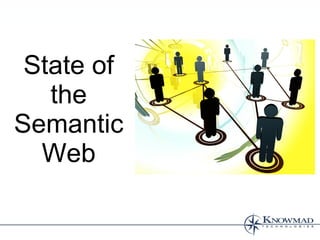
State of the Semantic Web

Technologies
W3C Accomplishments
Implementations
Technologies
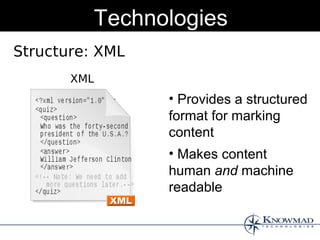
Structure: XML
       XML
                 • Provides a structured
                 format for marking
                 content
                 • Makes content
                 human and machine
                 readable
Technologies
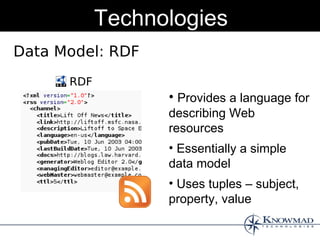
Data Model: RDF
      RDF
                  • Provides a language for
                  describing Web
                  resources
                  • Essentially a simple
                  data model
                  • Uses tuples – subject,
                  property, value
Technologies
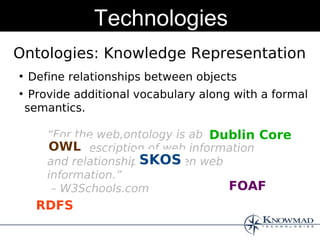
Ontologies: Knowledge Representation
●
    Define relationships between objects
●
     Provide additional vocabulary along with a formal
    semantics.

        “For the web,ontology is about the Core
                                     Dublin
        OWL
        exact description of web information
                        SKOS
        and relationships between web
        information.”
         – W3Schools.com                FOAF
      RDFS
Technologies
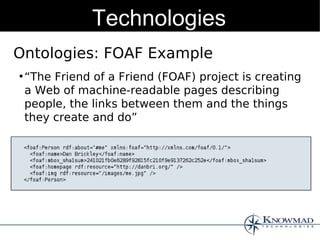
Ontologies: FOAF Example
●
    “The Friend of a Friend (FOAF) project is creating
    a Web of machine-readable pages describing
    people, the links between them and the things
    they create and do”
Technologies
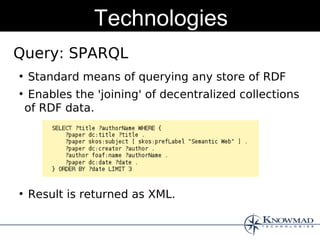
Query: SPARQL
●
    Standard means of querying any store of RDF
●
     Enables the 'joining' of decentralized collections
    of RDF data.


●
    Result is returned as XML.
Technologies
Where do we stand today?
●
    Many of the above mentioned technologies are
    W3C recommendations
●
    Reaching critical mass of technologies necessary
    to implement a web of meaning
●
    There are still many incomplete components and
    challenges for realizing a Semantic Web
    ●
        Rules – inferring new information
    ●
        Unifying Logic
    ●
        Proof & Trust
    ●
        Cryptography
W3C Accomplishments

●
    Pushing for Web Standards since 1994
●
    Currently has 356 member organizations
●
    Semantic Web specifications
     ●
         XML, RDF – stable specifications since 2004
     ●
         OWL – standard since 2004
     ●
         SPARQL – standard since 2008
     ●
         SKOS – became latest recommendation in August
●
    Claims that there are “over 10 million Semantic
    Web documents on the Web” today
Implementations
●
    Formats
    ●
        RSS
    ●
        Microformats
    ●
        RDFa

●
    Public Datasets
    ●
        dbpedia – Wikipedia as RDF
    ●
        RDF Book Mashup – merges Amazon & Google data
    ●
        IngentaConnect – over 200 million bibliographic
        entries
Implementations
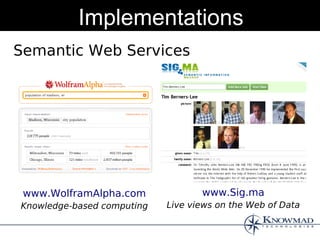
Semantic Web Services


 www.WolframAlpha.com              www.Sig.ma
Knowledge-based computing   Live views on the Web of Data
Implementing
  Semantic
Technologies
     in
  WebGUI
Implementing Semantic Web

Marking up your content
Linking data into your site
Perl libraries
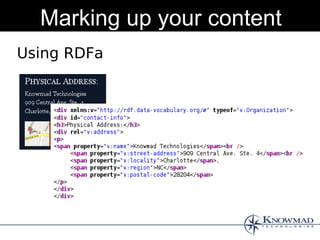
Marking up your content
Using RDFa
Linking Data
●
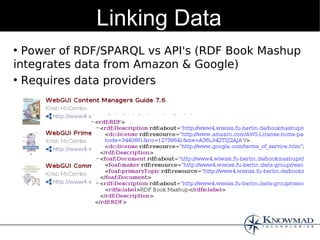
  Power of RDF/SPARQL vs API's (RDF Book Mashup
integrates data from Amazon & Google)
●
  Requires data providers
Perl Libraries
●
    XML
    ●
      hundreds of options
    ●
      XML::Simple (part of WRE)
●
    RDF
    ●
      RDF::Helper
    ●
      RDF::Notation3
    ●
      Class::RDF
    ●
      RDF::Simple::Serialiser
    ●
      and more...
Perl Libraries
●
    Ontologies
    ●
      Class::OWL
    ●
      XML::FOAF
    ●
      DublinCore::Record
    ●
      HTML::DublinCore
●
    SPARQL
     ●
       RDF::Query
The Future of the
 Semantic Web
Future Directions:
HTML5 & semantic markup
Linked data – information with
relationships
Emergent Properties – lots of
data allows lots of connections
Future Directions:


       Where do you
     think we're going?
Thank You!
         William McKee
         WebGUI Forums: knowmad
         IRC: knowmad
         Email: william@knowmad.com


  Resources Available at
www.knowmad.com/wuc2009

WebGUI And The Semantic Web

  • 1.
    WebGUI &the Semantic Web William McKee william@knowmad.com WebGUI Users Conference 2009
  • 2.
    Goals of thisPresentation ● To learn more about the Semantic Web ● To share Tim Berners-Lee's vision of the Web ● To reinspire the WebGUI community around the potential of Web technology ● To show you how to implement Semantic Web technologies into your WebGUI site
  • 3.
  • 4.
    Defining the SemanticWeb Background & History “The Web of Meaning” / Web 3.0 Many Possibilities
  • 5.
    Background & History ●The Web – envisioned & developed in 1989 while working at CERN ● Goal – build a collaborative, information sharing network ● Key Features – ● Browse & Create ● Universal Access ● Privacy ● Trust
  • 6.
    “The Web ofMeaning” Rise of the Semantic Web • The vision for a Semantic Web came from Tim Berners-Lee's book Weaving the Web, ©1999 • Part 1 => human-human collaboration • Part 2 => machine analysis of Web content
  • 7.
    “The Web ofMeaning” Requisites for a Semantic Web • Organizing data, adding meaning & creating query tools • Requires numerous technologies that work together to create a coherent output • Know-how to implement a Semantic Web involves multiple disciplines (linguistics, information science, computer science, philosophy and more)
  • 8.
    “The Web ofMeaning” W3C Definition “The goal of the Semantic Web initiative is as broad as that of the Web: to create a universal medium for the exchange of data. It is envisaged to smoothly interconnect personal information management, enterprise application integration, and the global sharing of commercial, scientific and cultural data. Facilities to put machine- understandable data on the Web are quickly becoming a high priority for many organizations, individuals and communities. “The Web can reach its full potential only if it becomes a place where data can be shared and processed by automated tools as well as by people. For the Web to scale, tomorrow's programs must be able to share and process data even when these programs have been designed totally independently.”
  • 9.
    Many Possibilities Use Cases • Improved Search • Distributed Database • Intelligent Agents • Web Services • Trust Networks See Resources for additional Case Studies & Use Cases.
  • 10.
    State of the Semantic Web
  • 11.
    State of theSemantic Web Technologies W3C Accomplishments Implementations
  • 12.
    Technologies Structure: XML XML • Provides a structured format for marking content • Makes content human and machine readable
  • 13.
    Technologies Data Model: RDF RDF • Provides a language for describing Web resources • Essentially a simple data model • Uses tuples – subject, property, value
  • 14.
    Technologies Ontologies: Knowledge Representation ● Define relationships between objects ● Provide additional vocabulary along with a formal semantics. “For the web,ontology is about the Core Dublin OWL exact description of web information SKOS and relationships between web information.” – W3Schools.com FOAF RDFS
  • 15.
    Technologies Ontologies: FOAF Example ● “The Friend of a Friend (FOAF) project is creating a Web of machine-readable pages describing people, the links between them and the things they create and do”
  • 16.
    Technologies Query: SPARQL ● Standard means of querying any store of RDF ● Enables the 'joining' of decentralized collections of RDF data. ● Result is returned as XML.
  • 17.
    Technologies Where do westand today? ● Many of the above mentioned technologies are W3C recommendations ● Reaching critical mass of technologies necessary to implement a web of meaning ● There are still many incomplete components and challenges for realizing a Semantic Web ● Rules – inferring new information ● Unifying Logic ● Proof & Trust ● Cryptography
  • 18.
    W3C Accomplishments ● Pushing for Web Standards since 1994 ● Currently has 356 member organizations ● Semantic Web specifications ● XML, RDF – stable specifications since 2004 ● OWL – standard since 2004 ● SPARQL – standard since 2008 ● SKOS – became latest recommendation in August ● Claims that there are “over 10 million Semantic Web documents on the Web” today
  • 19.
    Implementations ● Formats ● RSS ● Microformats ● RDFa ● Public Datasets ● dbpedia – Wikipedia as RDF ● RDF Book Mashup – merges Amazon & Google data ● IngentaConnect – over 200 million bibliographic entries
  • 20.
    Implementations Semantic Web Services www.WolframAlpha.com www.Sig.ma Knowledge-based computing Live views on the Web of Data
  • 21.
  • 22.
    Implementing Semantic Web Markingup your content Linking data into your site Perl libraries
  • 23.
    Marking up yourcontent Using RDFa
  • 24.
    Linking Data ● Power of RDF/SPARQL vs API's (RDF Book Mashup integrates data from Amazon & Google) ● Requires data providers
  • 25.
    Perl Libraries ● XML ● hundreds of options ● XML::Simple (part of WRE) ● RDF ● RDF::Helper ● RDF::Notation3 ● Class::RDF ● RDF::Simple::Serialiser ● and more...
  • 26.
    Perl Libraries ● Ontologies ● Class::OWL ● XML::FOAF ● DublinCore::Record ● HTML::DublinCore ● SPARQL ● RDF::Query
  • 27.
    The Future ofthe Semantic Web
  • 28.
    Future Directions: HTML5 &semantic markup Linked data – information with relationships Emergent Properties – lots of data allows lots of connections
  • 29.
    Future Directions: Where do you think we're going?
  • 30.
    Thank You! William McKee WebGUI Forums: knowmad IRC: knowmad Email: william@knowmad.com Resources Available at www.knowmad.com/wuc2009