Semantic Web
Abid Fakhre Alam
PGDLIM, SLIS
CUG
11/22/2018Semanticweb
1
Introduction
• Semantic web itself implies the meaning and
understanding.
• It enable the data to be linked from one source of
information to other source of Information that can
understand by the computers to processed the
information easily.
• In 1989, Tim Berners-Lee invented the World Wide
Web. To This it emerged the New Concept “Semantic
Web”. The Extension of WWW.
11/22/2018Semanticweb
2
Cont..
• Tim Berners-Lee is the person behind Semantic
Web.
• According to him on Semantic web is the
“Semantic” Indicate the Machine-Processable
with the data to make Understandable and
“Web” indicate the idea of the navigable space
of the Interconnected the object with mapping
from URIs to the resources
11/22/2018Semanticweb
3
Definition
• Semantic Web is a mesh of data that are associated in
such a way that they can easily be processed by
machines instead of human operators. It represents an
effective means of data representation in the form of a
globally linked database. By supporting the inclusion of
semantic content in Web pages, the Semantic Web
targets the conversion of the presently available Web of
unstructured documents to a Web of information/data --
- Techopedia
• The Semantic Web is an extension of the current web in
which information is given well-defined meaning, better
enabling computers and people to work in cooperation --
- Tim Berner Lee
11/22/2018Semanticweb
4
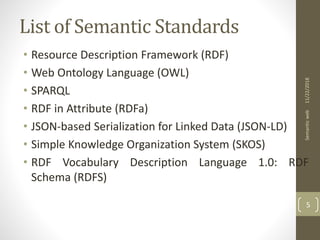
List of Semantic Standards
• Resource Description Framework (RDF)
• Web Ontology Language (OWL)
• SPARQL
• RDF in Attribute (RDFa)
• JSON-based Serialization for Linked Data (JSON-LD)
• Simple Knowledge Organization System (SKOS)
• RDF Vocabulary Description Language 1.0: RDF
Schema (RDFS)
11/22/2018Semanticweb
5
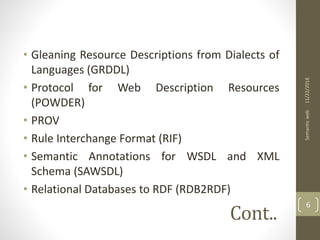
• Gleaning Resource Descriptions from Dialects of
Languages (GRDDL)
• Protocol for Web Description Resources
(POWDER)
• PROV
• Rule Interchange Format (RIF)
• Semantic Annotations for WSDL and XML
Schema (SAWSDL)
• Relational Databases to RDF (RDB2RDF)
11/22/2018Semanticweb
6
Cont..
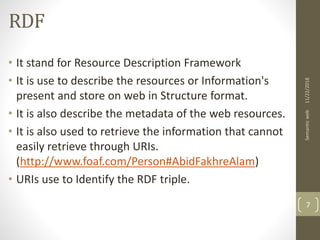
RDF
• It stand for Resource Description Framework
• It is use to describe the resources or Information's
present and store on web in Structure format.
• It is also describe the metadata of the web resources.
• It is also used to retrieve the information that cannot
easily retrieve through URIs.
(http://www.foaf.com/Person#AbidFakhreAlam)
• URIs use to Identify the RDF triple.
11/22/2018Semanticweb
7
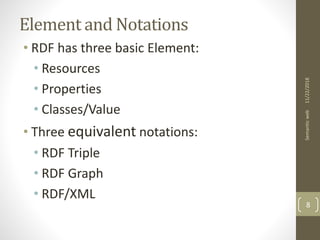
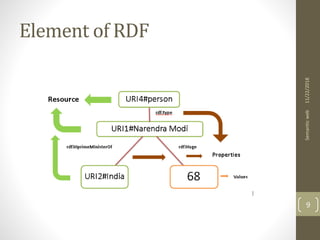
Element and Notations
• RDF has three basic Element:
• Resources
• Properties
• Classes/Value
• Three equivalent notations:
• RDF Triple
• RDF Graph
• RDF/XML
11/22/2018Semanticweb
8
Element of RDF
11/22/2018Semanticweb
9
RDF Triple
• Subject and Predicate must be a things, concept,
and has a URI and whereas the object can be a
resource or values.
• RDF Triple is the three data entities that codify
the statement in the form of Subject, Predicate
and Object
11/22/2018Semanticweb
10
RDF Graph
• Collection of Triple that consist of the Subject,
Predicate, and Object and form a set of the
Triple, that triple is called as the RDF Graphs.
• To make More logical RDF Graph serilized into
different format Such as RDF/XML, NTriple,
Turtle, N3, etc.
11/22/2018Semanticweb
11
RDF/XML
• It is based on Syntax to represent in RDF into XML.
• For Example:
<rdf:Dercription rdf:about="URI1#NarendraModi">
<rdf:type rdf:resource="URI4Person"/>
<URI2#isPrimeMinisterOf rdf:resource="URI3India“
<rdf:Description>
11/22/2018Semanticweb
12
Benefit and Application of RDF
• To providing Internet Resources metadata.
• It is easier to produce metadata that the software
exploits because of the Standard syntax.
• It also allow to easily exchange information to the
application because of standard syntax.
• To get precise results while searching.
11/22/2018Semanticweb
13
Cont..
• RDF is use in to Describe the property on the
Item in Shopping Mall, to Represent web page
Content , library on the web and so on.
• RDF provides the foundation for publishing and
linking your data.
11/22/2018Semanticweb
14
Conclusion
• The term “Semantic Web” refers to W3C’s vision
of the Web of linked data. Semantic Web
technologies enable people to create data stores
on the Web, build vocabularies, and write rules
for handling data. Linked data are empowered by
technologies such as RDF, SPARQL, OWL, and
SKOS.
• The inclusion of data to RDF files enables
computer programs or Web spiders to search,
discover, collect, assess and process the data on
the Web.
11/22/2018Semanticweb
15
Cont..
• The key goal of the Semantic Web is to trigger
the evolution of the existing Web to enable users
to search, discover, share and join information
with less effort.
• Semantic Web comes under the umbrella of
three things: Automation of information
retrieval, the Internet of Things and Personal
Assistants.
11/22/2018Semanticweb
16
Thank You
11/22/2018Semanticweb
17

Semantic web

  • 1.
    Semantic Web Abid FakhreAlam PGDLIM, SLIS CUG 11/22/2018Semanticweb 1
  • 2.
    Introduction • Semantic webitself implies the meaning and understanding. • It enable the data to be linked from one source of information to other source of Information that can understand by the computers to processed the information easily. • In 1989, Tim Berners-Lee invented the World Wide Web. To This it emerged the New Concept “Semantic Web”. The Extension of WWW. 11/22/2018Semanticweb 2
  • 3.
    Cont.. • Tim Berners-Leeis the person behind Semantic Web. • According to him on Semantic web is the “Semantic” Indicate the Machine-Processable with the data to make Understandable and “Web” indicate the idea of the navigable space of the Interconnected the object with mapping from URIs to the resources 11/22/2018Semanticweb 3
  • 4.
    Definition • Semantic Webis a mesh of data that are associated in such a way that they can easily be processed by machines instead of human operators. It represents an effective means of data representation in the form of a globally linked database. By supporting the inclusion of semantic content in Web pages, the Semantic Web targets the conversion of the presently available Web of unstructured documents to a Web of information/data -- - Techopedia • The Semantic Web is an extension of the current web in which information is given well-defined meaning, better enabling computers and people to work in cooperation -- - Tim Berner Lee 11/22/2018Semanticweb 4
  • 5.
    List of SemanticStandards • Resource Description Framework (RDF) • Web Ontology Language (OWL) • SPARQL • RDF in Attribute (RDFa) • JSON-based Serialization for Linked Data (JSON-LD) • Simple Knowledge Organization System (SKOS) • RDF Vocabulary Description Language 1.0: RDF Schema (RDFS) 11/22/2018Semanticweb 5
  • 6.
    • Gleaning ResourceDescriptions from Dialects of Languages (GRDDL) • Protocol for Web Description Resources (POWDER) • PROV • Rule Interchange Format (RIF) • Semantic Annotations for WSDL and XML Schema (SAWSDL) • Relational Databases to RDF (RDB2RDF) 11/22/2018Semanticweb 6 Cont..
  • 7.
    RDF • It standfor Resource Description Framework • It is use to describe the resources or Information's present and store on web in Structure format. • It is also describe the metadata of the web resources. • It is also used to retrieve the information that cannot easily retrieve through URIs. (http://www.foaf.com/Person#AbidFakhreAlam) • URIs use to Identify the RDF triple. 11/22/2018Semanticweb 7
  • 8.
    Element and Notations •RDF has three basic Element: • Resources • Properties • Classes/Value • Three equivalent notations: • RDF Triple • RDF Graph • RDF/XML 11/22/2018Semanticweb 8
  • 9.
  • 10.
    RDF Triple • Subjectand Predicate must be a things, concept, and has a URI and whereas the object can be a resource or values. • RDF Triple is the three data entities that codify the statement in the form of Subject, Predicate and Object 11/22/2018Semanticweb 10
  • 11.
    RDF Graph • Collectionof Triple that consist of the Subject, Predicate, and Object and form a set of the Triple, that triple is called as the RDF Graphs. • To make More logical RDF Graph serilized into different format Such as RDF/XML, NTriple, Turtle, N3, etc. 11/22/2018Semanticweb 11
  • 12.
    RDF/XML • It isbased on Syntax to represent in RDF into XML. • For Example: <rdf:Dercription rdf:about="URI1#NarendraModi"> <rdf:type rdf:resource="URI4Person"/> <URI2#isPrimeMinisterOf rdf:resource="URI3India“ <rdf:Description> 11/22/2018Semanticweb 12
  • 13.
    Benefit and Applicationof RDF • To providing Internet Resources metadata. • It is easier to produce metadata that the software exploits because of the Standard syntax. • It also allow to easily exchange information to the application because of standard syntax. • To get precise results while searching. 11/22/2018Semanticweb 13
  • 14.
    Cont.. • RDF isuse in to Describe the property on the Item in Shopping Mall, to Represent web page Content , library on the web and so on. • RDF provides the foundation for publishing and linking your data. 11/22/2018Semanticweb 14
  • 15.
    Conclusion • The term“Semantic Web” refers to W3C’s vision of the Web of linked data. Semantic Web technologies enable people to create data stores on the Web, build vocabularies, and write rules for handling data. Linked data are empowered by technologies such as RDF, SPARQL, OWL, and SKOS. • The inclusion of data to RDF files enables computer programs or Web spiders to search, discover, collect, assess and process the data on the Web. 11/22/2018Semanticweb 15
  • 16.
    Cont.. • The keygoal of the Semantic Web is to trigger the evolution of the existing Web to enable users to search, discover, share and join information with less effort. • Semantic Web comes under the umbrella of three things: Automation of information retrieval, the Internet of Things and Personal Assistants. 11/22/2018Semanticweb 16
  • 17.