FUTURE SEO VISTAS
     THE SEMANTIC WEB &
     INTERNET OF THINGS

       BRIGHTON SEO
         13TH APRIL 2012


1
Philip Sheldrake
    Blog www.philipsheldrake.com
    Meanwhile www.wearemeanwhile.com
    LinkedIn /in/philipsheldrake
    Twitter @sheldrake


    Author, The Business of Influence, Wiley 2011
    Book website www.influenceprofessional.com


2                  13th April 2012 / Creative Commons Attribution Share Alike License 2.0 England and Wales
Your role, imho

    Today:

    Improving the visibility of a website or a web page in search
    engines' "natural," or un-paid ("organic" or "algorithmic"), search
    results.   [Wikipedia]   For the website owner.

    Tomorrow:

    Improving the presentation, discoverability, machinability and
    usefulness of data, information and knowledge. For all
    stakeholders.


3                        13th April 2012 / Creative Commons Attribution Share Alike License 2.0 England and Wales
“Web 3.0”
    “The Web of Data”

    THE SEMANTIC WEB


4                13th April 2012 / Creative Commons Attribution Share Alike License 2.0 England and Wales
Web 3.0

    Whilst there is some confusion over the term, most people use
    “Web 3.0” to refer to the Semantic Web. I do.

    Either way, the label is a bit of a distraction, but marketers love
    it, so what can I say!


5                   13th April 2012 / Creative Commons Attribution Share Alike License 2.0 England and Wales
Web 3.0 cont.

    Web 3.0 is about the Web itself understanding the meaning of
    web content and social web participation.

    The Web becomes a universal medium for data, information
    and knowledge exchange.

    The Semantic Web converts the current web of unstructured
    documents into a "web of data” building on the W3C's Resource
    Description Framework (RDF).


6                  13th April 2012 / Creative Commons Attribution Share Alike License 2.0 England and Wales
Triples

    A hypothesis of the Semantic Web is that meaning can be
    conveyed via expressions known as triples:

    Subject                  Predicate                              Object
    (resource)               (property)                             (value)

    Kathryn Bigelow          Directed                               Hurt Locker

    Mark Boal                Wrote                                  Hurt Locker

    Hurt Locker              Stars                                  Jeremy Renner


7                 13th April 2012 / Creative Commons Attribution Share Alike License 2.0 England and Wales
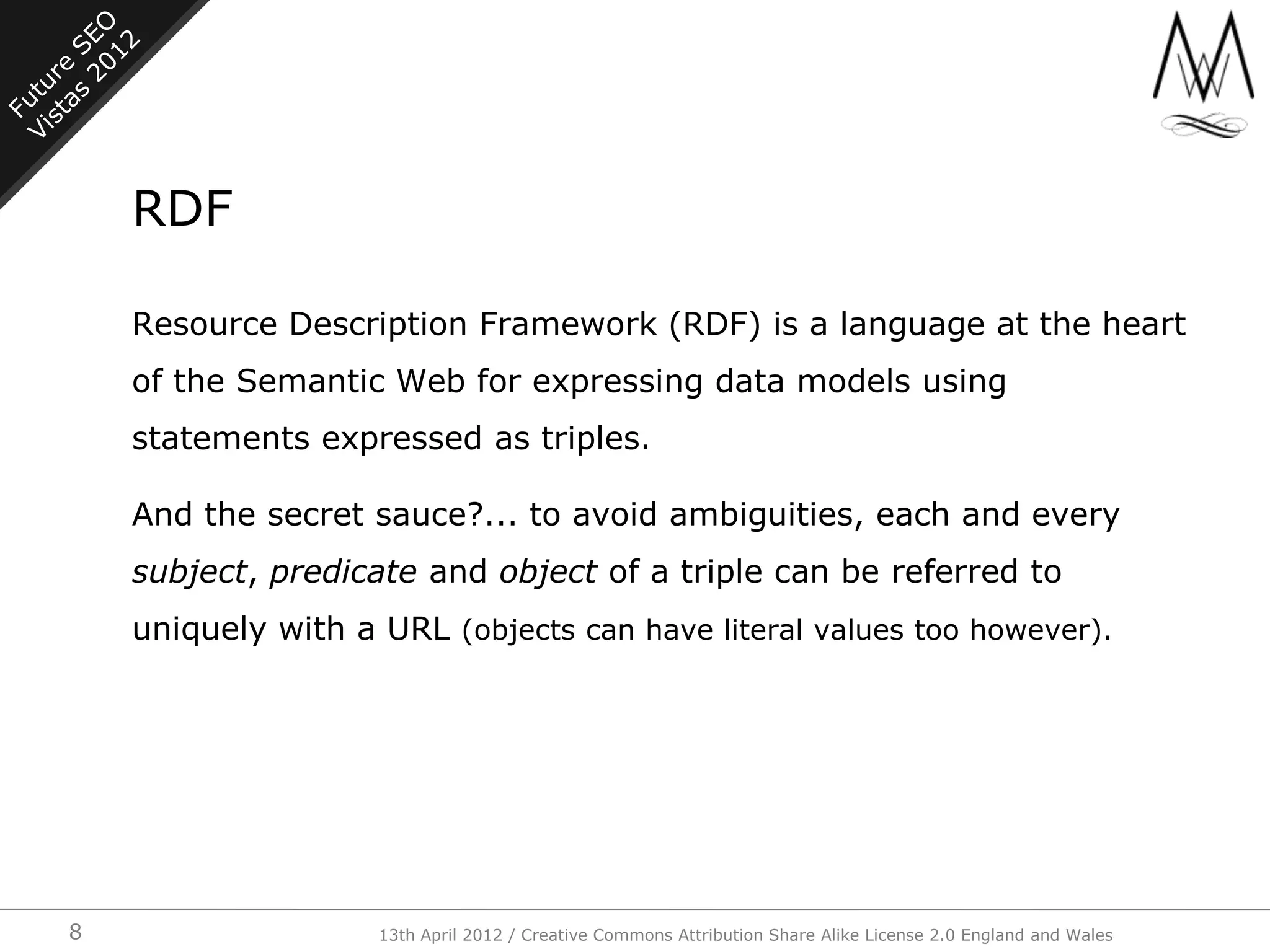
RDF

    Resource Description Framework (RDF) is a language at the heart
    of the Semantic Web for expressing data models using
    statements expressed as triples.

    And the secret sauce?... to avoid ambiguities, each and every
    subject, predicate and object of a triple can be referred to
    uniquely with a URL (objects can have literal values too however).


8                   13th April 2012 / Creative Commons Attribution Share Alike License 2.0 England and Wales
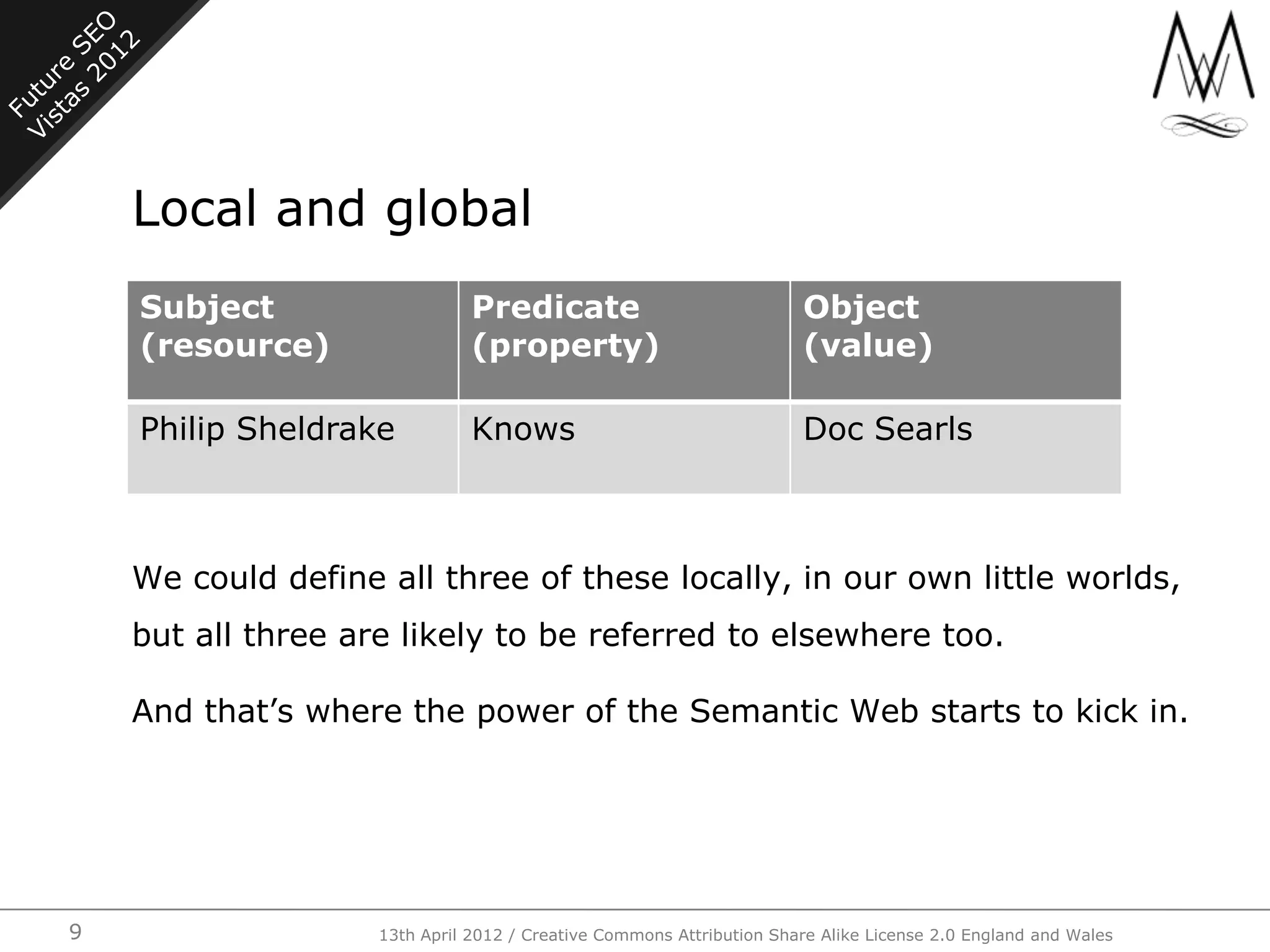
Local and global
    Subject                    Predicate                              Object
    (resource)                 (property)                             (value)

    Philip Sheldrake           Knows                                  Doc Searls


    We could define all three of these locally, in our own little worlds,
    but all three are likely to be referred to elsewhere too.

    And that‟s where the power of the Semantic Web starts to kick in.


9                   13th April 2012 / Creative Commons Attribution Share Alike License 2.0 England and Wales
The subject and object

     I‟m not the one and only Philip Sheldrake.
     Eg, Professor Philip Sheldrake is a Professorial Research Fellow in the Department of
     Theology and Religion at Durham University.

     So how do we define me uniquely? Well, with reference to:

     http://sheldrake.myopenid.comor
     http://philipsheldrake.com or
     http://www.google.com/profiles/philip.sheldrake.

     Similarly, Doc Searls may be http://searls.com.


10                      13th April 2012 / Creative Commons Attribution Share Alike License 2.0 England and Wales
The predicate

     But what about the concept of “knows”?

     What does “knows” mean to you right now?

     What about in different social contexts?

     How might other cultures and languages regard “knows”?

     Eg, The French language has “savoir” & “connaître”.


11                  13th April 2012 / Creative Commons Attribution Share Alike License 2.0 England and Wales
The predicate               cont.


     Well FOAF (Friend Of A Friend) is a machine-readable ontology /
     vocabulary describing persons, their activities and their relations
     to other people and objects.

     To invoke reference to the FOAF ontology we write:

     <rdf:RDFxmlns:foaf=http://xmlns.com/foaf/0.1/>

     At that URI we will find a definition of “knows”:

     http://xmlns.com/foaf/spec/#term_knows


12                  13th April 2012 / Creative Commons Attribution Share Alike License 2.0 England and Wales
The resultant triple

     So now, when we express a statement as a triple like

     Subject -              http://philipsheldrake.com

     Predicate -            foaf:knows

     Object -               http://searls.com

     there is no ambiguity as to what it means.


     [Note: this format is for explanation purposes only and does not constitute sound syntax!]


13                         13th April 2012 / Creative Commons Attribution Share Alike License 2.0 England and Wales
The full potential

     I referred earlier to the Semantic Web‟s full potential, and that
     full potential is described by a vision known as Linked Data.

     Tim Berners-Lee‟s four principles of Linked Data, paraphrased:
      1. Use URIs to identify things

      2. Use HTTP URIs so that these things can be referred to and looked up
         ("dereferenced") by people and user agents

      3. Provide useful information about the thing when its URI is dereferenced, using
         standard formats such as RDF/XML

      4. Include links to other, related URIs in the exposed data to improve discovery
         of other related information on the Web.


14                     13th April 2012 / Creative Commons Attribution Share Alike License 2.0 England and Wales
LinkedData image


Linking Open Data datasets, September 2011
http://en.wikipedia.org/wiki/File:LOD_Cloud_Diagram_as_of_September_2011.png

15                         13th April 2012 / Creative Commons Attribution Share Alike License 2.0 England and Wales
Google getting more semantic

     Wall Street Journal
     March 15, 2012

     Google Gives Search a Refresh

     By AMIR EFRATI

     Google Inc. is giving its tried-and-true Web-search formula a makeover as it tries to fix the
     shortcomings of today's technology and maintain its dominant market share.

     Over the next few months, Google's search engine will begin spitting out more than a list of blue
     Web links. It will also present more facts and direct answers to queries at the top of the search-
     results page.


     http://online.wsj.com/article/SB10001424052702304459804577281842851136290.html


16                          13th April 2012 / Creative Commons Attribution Share Alike License 2.0 England and Wales
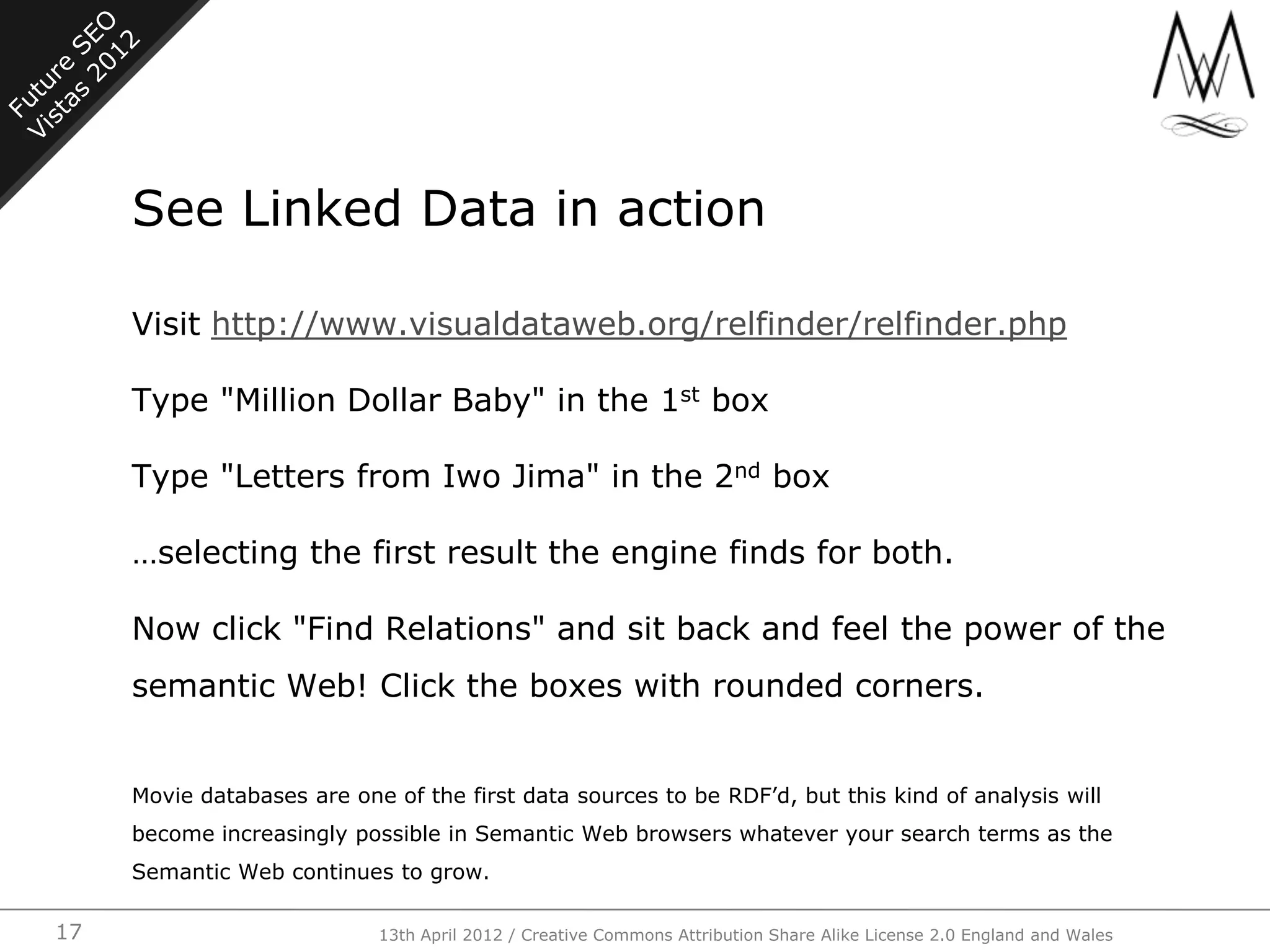
See Linked Data in action

     Visit http://www.visualdataweb.org/relfinder/relfinder.php

     Type "Million Dollar Baby" in the 1st box

     Type "Letters from Iwo Jima" in the 2nd box

     …selecting the first result the engine finds for both.

     Now click "Find Relations" and sit back and feel the power of the
     semantic Web! Click the boxes with rounded corners.


     Movie databases are one of the first data sources to be RDF‟d, but this kind of analysis will
     become increasingly possible in Semantic Web browsers whatever your search terms as the
     Semantic Web continues to grow.

17                          13th April 2012 / Creative Commons Attribution Share Alike License 2.0 England and Wales
Tim Berners-Lee on the Semantic Web


      http://www.youtube.com/watch_popup?v=HeUrEh-nqtU

18                  13th April 2012 / Creative Commons Attribution Share Alike License 2.0 England and Wales
Machined media

     Paid – Pay others to have your message on their media

     Owned – This media is (actually or effectively) mine; I can
     publish what I like

     Earned – Media relations, stakeholder conversations, user-
     generated content, endorsements (or otherwise)

     Machined – content that is automatically discovered, presented
     and published by machines for humans.


19                          13th April 2012 / Creative Commons Attribution Share Alike License 2.0 England and Wales
(Today‟s) Facebook is dead

     The Web of Data exposes connections, correlations, relationships.

     Business models that monetize network effects – where the
     analytical and commercial power accrues to the host with the
     largest dataset so even more data is attracted gravitationally –
     are dead.

     Eventually.

     Discovery is the new search. The new social graph is truly open.


20                  13th April 2012 / Creative Commons Attribution Share Alike License 2.0 England and Wales
THE INTERNET OF THINGS


21        13th April 2012 / Creative Commons Attribution Share Alike License 2.0 England and Wales
Defining the Internet of Things

     The Internet of Things refers to a network of objects not
     historically connected. We can consider four kinds of objects:
       The device containing electronics in order to fulfil its primary function

        (eg, washing machine, car, aircon unit)

       The electrical device traditionally absent of sophisticated electronics

        (eg, lighting, heating, power distribution)

       Non-electrical objects

        (eg, food and drink packages, animals, clothing)

       Environmental sensors

        (eg, for variables such as temperature, ambient sound and moisture).


22                      13th April 2012 / Creative Commons Attribution Share Alike License 2.0 England and Wales
IBM Internet of Things video


      http://www.youtube.com/watch_popup?v=sfEbMV295Kk

23                  13th April 2012 / Creative Commons Attribution Share Alike License 2.0 England and Wales
How many things?


            Number of things on the
                  Internet.

               Typical forecast for 2020.
                                                                          Global
                                                                          human
                                                                           popn.


24            13th April 2012 / Creative Commons Attribution Share Alike License 2.0 England and Wales
Digital detritus

     Each and every one of us is going to be kicking off more data –
     what some refer to as our digital exhaust or digital footprint.

     I like to call it digital detritus.

     Detritus – discarded organic matter that‟s then decomposed by
     microorganisms and re-appropriated by animal and plant life.

     Interestingly analogous then to our regard for and treatment of
     this data we‟re all shedding.


25                     13th April 2012 / Creative Commons Attribution Share Alike License 2.0 England and Wales
Digital detritus                cont.


     We collect the click path of visitors‟ interactions with our website
     today, but we can‟t yet access the data describing their use of
     physical products.

     We can invite customers to share their location data with us, but
     we can‟t yet help them review their transport carbon footprint.

     We will soon.


26                   13th April 2012 / Creative Commons Attribution Share Alike License 2.0 England and Wales
Digital detritus                cont.


     We can encourage the consumer to reap the anticipated
     advantages of greener products and services, but we can‟t
     identify the actual advantage they achieve and reflect it back at
     them.

     We can market a food product‟s expected role in a balanced diet,
     but not the specific role it plays in a particular household‟s diet.

     We will soon.


27                   13th April 2012 / Creative Commons Attribution Share Alike License 2.0 England and Wales
The Internetome

     I call the manifestations of the Internet of Things – the properties
     that result from enmeshing the analogue and digital worlds – the
     Internetome.

     If emergent behaviours stem from the 2 billion humans on
     today‟s social web, we can expect something similar from the
     „real world‟ interacting with many tens of billions of things.

     The Internetome itself might become an organizational
     stakeholder of sorts.


28                            13th April 2012 / Creative Commons Attribution Share Alike License 2.0 England and Wales
SO?


29         13th April 2012 / Creative Commons Attribution Share Alike License 2.0 England and Wales
Big Data. Big Info. Big Knowledge.

                  the web + semantic web + internet of things

                                               = really big.


     Data – discrete, objective facts, signals or symbols devoid of context and
     interpretation and therefore of no meaning or value.

     Information – the result of structuring or organizing data in such a way as to give
     it meaning and relevance for specific purpose or in a specific context.

     Knowledge – the result of structuring or organizing information in such a way that
     it helps to form a framework for the incorporation of further information and aids the
     evaluation of the world, accruing experience, expertise and know-how.


30                       13th April 2012 / Creative Commons Attribution Share Alike License 2.0 England and Wales
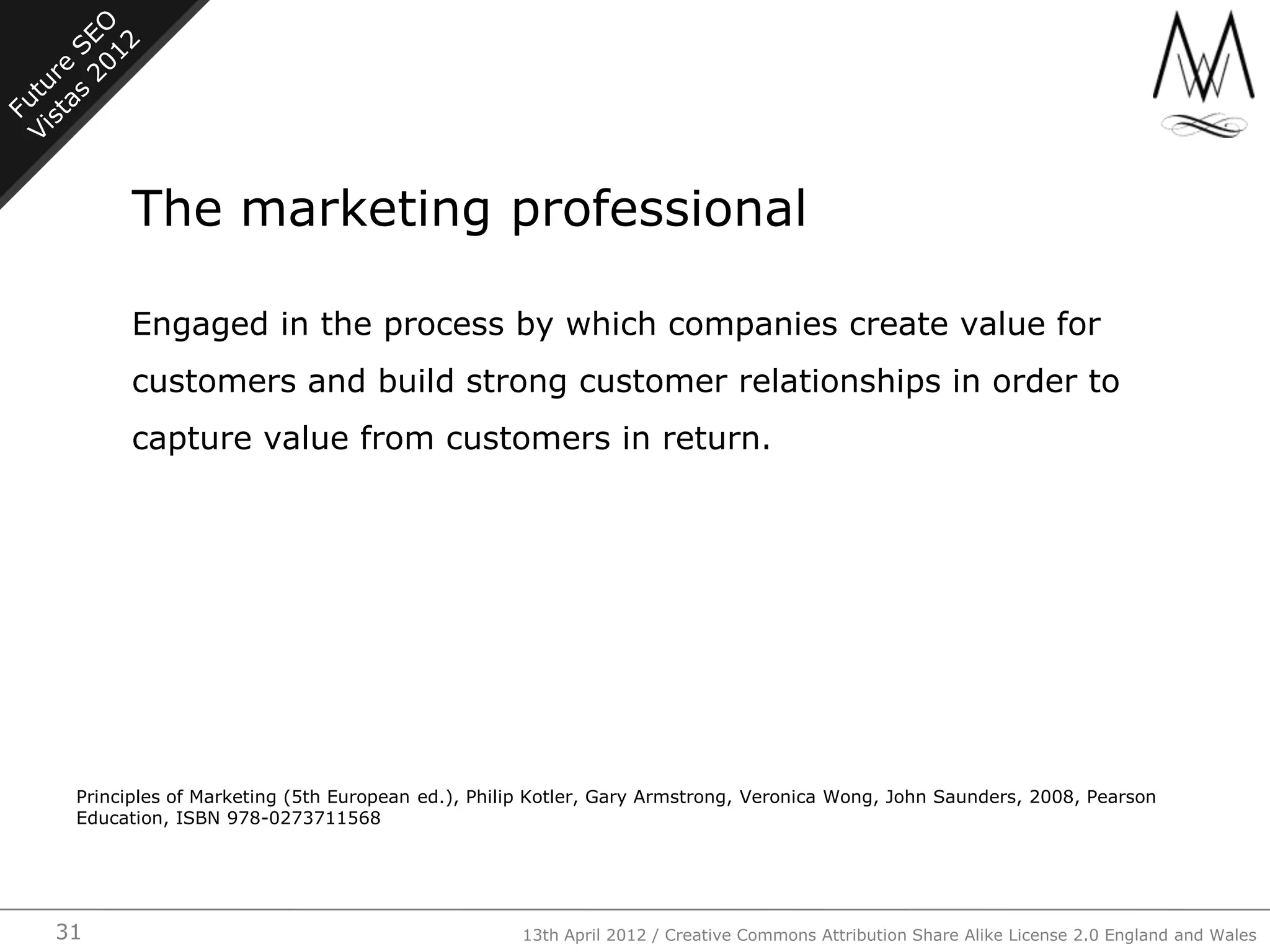
The marketing professional

       Engaged in the process by which companies create value for
       customers and build strong customer relationships in order to
       capture value from customers in return.


 Principles of Marketing (5th European ed.), Philip Kotler, Gary Armstrong, Veronica Wong, John Saunders, 2008, Pearson
 Education, ISBN 978-0273711568


31                                               13th April 2012 / Creative Commons Attribution Share Alike License 2.0 England and Wales
The public relations professional

      Engaged in the planned and sustained effort to influence opinion
      and behaviour, and to be influenced similarly, in order to build
      mutual understanding and goodwill.


 http://www.philipsheldrake.com/2011/11/public-relations-defined-%E2%80%93-the-anatomy-of-a-candidate-definition-ver-
 0-2/


32                                             13th April 2012 / Creative Commons Attribution Share Alike License 2.0 England and Wales
Flows of data, information & knowledge

     An organization‟s place in the world will increasingly become
     defined by the related flows of data, information and knowledge.

     Such flows constitute influence flows when they lead a
     stakeholder to do something they wouldn‟t otherwise have done
     or think something they wouldn‟t otherwise have thought.


      The Six Influence Flows

33                              13th April 2012 / Creative Commons Attribution Share Alike License 2.0 England and Wales
The influence professional

     The influence professional knows that the ease and effectiveness
     with which we manage and learn from influence flows is integral
     to the ways all stakeholders interact with organizations to broker
     mutually valuable, beneficial relationships.


34                            13th April 2012 / Creative Commons Attribution Share Alike License 2.0 England and Wales
Your role

     Content for content‟s sake may drive transactional volume (eg,
     clicks) but contributes little to long-term engagement, or
     reputation building, or the formation of trusted, loyal and
     valuable relationships.

     You can help an organization learn what the world needs, and
     identify when it has the data, information or knowledge to meet
     that need.


35                             13th April 2012 / Creative Commons Attribution Share Alike License 2.0 England and Wales
Your role       cont.


     Your role is increasingly related to the practice of the influence
     professional.

     It entails identifying, preparing, publishing and maintaining data,
     information and knowledge, and establishing and developing the
     systems needed to do so, so that the organization ishelpful,
     valuable and influential to all stakeholders…

           past, present and future customers, employees, citizens,
           partners, etc.


36                            13th April 2012 / Creative Commons Attribution Share Alike License 2.0 England and Wales
Reading

     http://semanticweb.org

     http://en.wikipedia.org/wiki/Semantic_Web

     http://linkeddata.org

     http://en.wikipedia.org/wiki/Linked_data

     http://www.cambridgesemantics.com/semantic-university

     http://en.wikipedia.org/wiki/Internet_of_Things

     http://www.readwriteweb.com/archives/internet-of-things

     http://www.philipsheldrake.com - my blog 


37                      13th April 2012 / Creative Commons Attribution Share Alike License 2.0 England and Wales

Future SEO Vistas 2012

  • 1.
    FUTURE SEO VISTAS THE SEMANTIC WEB & INTERNET OF THINGS BRIGHTON SEO 13TH APRIL 2012 1
  • 2.
    Philip Sheldrake Blog www.philipsheldrake.com Meanwhile www.wearemeanwhile.com LinkedIn /in/philipsheldrake Twitter @sheldrake Author, The Business of Influence, Wiley 2011 Book website www.influenceprofessional.com 2 13th April 2012 / Creative Commons Attribution Share Alike License 2.0 England and Wales
  • 3.
    Your role, imho Today: Improving the visibility of a website or a web page in search engines' "natural," or un-paid ("organic" or "algorithmic"), search results. [Wikipedia] For the website owner. Tomorrow: Improving the presentation, discoverability, machinability and usefulness of data, information and knowledge. For all stakeholders. 3 13th April 2012 / Creative Commons Attribution Share Alike License 2.0 England and Wales
  • 4.
    “Web 3.0” “The Web of Data” THE SEMANTIC WEB 4 13th April 2012 / Creative Commons Attribution Share Alike License 2.0 England and Wales
  • 5.
    Web 3.0 Whilst there is some confusion over the term, most people use “Web 3.0” to refer to the Semantic Web. I do. Either way, the label is a bit of a distraction, but marketers love it, so what can I say! 5 13th April 2012 / Creative Commons Attribution Share Alike License 2.0 England and Wales
  • 6.
    Web 3.0 cont. Web 3.0 is about the Web itself understanding the meaning of web content and social web participation. The Web becomes a universal medium for data, information and knowledge exchange. The Semantic Web converts the current web of unstructured documents into a "web of data” building on the W3C's Resource Description Framework (RDF). 6 13th April 2012 / Creative Commons Attribution Share Alike License 2.0 England and Wales
  • 7.
    Triples A hypothesis of the Semantic Web is that meaning can be conveyed via expressions known as triples: Subject Predicate Object (resource) (property) (value) Kathryn Bigelow Directed Hurt Locker Mark Boal Wrote Hurt Locker Hurt Locker Stars Jeremy Renner 7 13th April 2012 / Creative Commons Attribution Share Alike License 2.0 England and Wales
  • 8.
    RDF Resource Description Framework (RDF) is a language at the heart of the Semantic Web for expressing data models using statements expressed as triples. And the secret sauce?... to avoid ambiguities, each and every subject, predicate and object of a triple can be referred to uniquely with a URL (objects can have literal values too however). 8 13th April 2012 / Creative Commons Attribution Share Alike License 2.0 England and Wales
  • 9.
    Local and global Subject Predicate Object (resource) (property) (value) Philip Sheldrake Knows Doc Searls We could define all three of these locally, in our own little worlds, but all three are likely to be referred to elsewhere too. And that‟s where the power of the Semantic Web starts to kick in. 9 13th April 2012 / Creative Commons Attribution Share Alike License 2.0 England and Wales
  • 10.
    The subject andobject I‟m not the one and only Philip Sheldrake. Eg, Professor Philip Sheldrake is a Professorial Research Fellow in the Department of Theology and Religion at Durham University. So how do we define me uniquely? Well, with reference to: http://sheldrake.myopenid.comor http://philipsheldrake.com or http://www.google.com/profiles/philip.sheldrake. Similarly, Doc Searls may be http://searls.com. 10 13th April 2012 / Creative Commons Attribution Share Alike License 2.0 England and Wales
  • 11.
    The predicate But what about the concept of “knows”? What does “knows” mean to you right now? What about in different social contexts? How might other cultures and languages regard “knows”? Eg, The French language has “savoir” & “connaître”. 11 13th April 2012 / Creative Commons Attribution Share Alike License 2.0 England and Wales
  • 12.
    The predicate cont. Well FOAF (Friend Of A Friend) is a machine-readable ontology / vocabulary describing persons, their activities and their relations to other people and objects. To invoke reference to the FOAF ontology we write: <rdf:RDFxmlns:foaf=http://xmlns.com/foaf/0.1/> At that URI we will find a definition of “knows”: http://xmlns.com/foaf/spec/#term_knows 12 13th April 2012 / Creative Commons Attribution Share Alike License 2.0 England and Wales
  • 13.
    The resultant triple So now, when we express a statement as a triple like Subject - http://philipsheldrake.com Predicate - foaf:knows Object - http://searls.com there is no ambiguity as to what it means. [Note: this format is for explanation purposes only and does not constitute sound syntax!] 13 13th April 2012 / Creative Commons Attribution Share Alike License 2.0 England and Wales
  • 14.
    The full potential I referred earlier to the Semantic Web‟s full potential, and that full potential is described by a vision known as Linked Data. Tim Berners-Lee‟s four principles of Linked Data, paraphrased: 1. Use URIs to identify things 2. Use HTTP URIs so that these things can be referred to and looked up ("dereferenced") by people and user agents 3. Provide useful information about the thing when its URI is dereferenced, using standard formats such as RDF/XML 4. Include links to other, related URIs in the exposed data to improve discovery of other related information on the Web. 14 13th April 2012 / Creative Commons Attribution Share Alike License 2.0 England and Wales
  • 15.
    LinkedData image Linking OpenData datasets, September 2011 http://en.wikipedia.org/wiki/File:LOD_Cloud_Diagram_as_of_September_2011.png 15 13th April 2012 / Creative Commons Attribution Share Alike License 2.0 England and Wales
  • 16.
    Google getting moresemantic Wall Street Journal March 15, 2012 Google Gives Search a Refresh By AMIR EFRATI Google Inc. is giving its tried-and-true Web-search formula a makeover as it tries to fix the shortcomings of today's technology and maintain its dominant market share. Over the next few months, Google's search engine will begin spitting out more than a list of blue Web links. It will also present more facts and direct answers to queries at the top of the search- results page. http://online.wsj.com/article/SB10001424052702304459804577281842851136290.html 16 13th April 2012 / Creative Commons Attribution Share Alike License 2.0 England and Wales
  • 17.
    See Linked Datain action Visit http://www.visualdataweb.org/relfinder/relfinder.php Type "Million Dollar Baby" in the 1st box Type "Letters from Iwo Jima" in the 2nd box …selecting the first result the engine finds for both. Now click "Find Relations" and sit back and feel the power of the semantic Web! Click the boxes with rounded corners. Movie databases are one of the first data sources to be RDF‟d, but this kind of analysis will become increasingly possible in Semantic Web browsers whatever your search terms as the Semantic Web continues to grow. 17 13th April 2012 / Creative Commons Attribution Share Alike License 2.0 England and Wales
  • 18.
    Tim Berners-Lee onthe Semantic Web http://www.youtube.com/watch_popup?v=HeUrEh-nqtU 18 13th April 2012 / Creative Commons Attribution Share Alike License 2.0 England and Wales
  • 19.
    Machined media Paid – Pay others to have your message on their media Owned – This media is (actually or effectively) mine; I can publish what I like Earned – Media relations, stakeholder conversations, user- generated content, endorsements (or otherwise) Machined – content that is automatically discovered, presented and published by machines for humans. 19 13th April 2012 / Creative Commons Attribution Share Alike License 2.0 England and Wales
  • 20.
    (Today‟s) Facebook isdead The Web of Data exposes connections, correlations, relationships. Business models that monetize network effects – where the analytical and commercial power accrues to the host with the largest dataset so even more data is attracted gravitationally – are dead. Eventually. Discovery is the new search. The new social graph is truly open. 20 13th April 2012 / Creative Commons Attribution Share Alike License 2.0 England and Wales
  • 21.
    THE INTERNET OFTHINGS 21 13th April 2012 / Creative Commons Attribution Share Alike License 2.0 England and Wales
  • 22.
    Defining the Internetof Things The Internet of Things refers to a network of objects not historically connected. We can consider four kinds of objects:  The device containing electronics in order to fulfil its primary function (eg, washing machine, car, aircon unit)  The electrical device traditionally absent of sophisticated electronics (eg, lighting, heating, power distribution)  Non-electrical objects (eg, food and drink packages, animals, clothing)  Environmental sensors (eg, for variables such as temperature, ambient sound and moisture). 22 13th April 2012 / Creative Commons Attribution Share Alike License 2.0 England and Wales
  • 23.
    IBM Internet ofThings video http://www.youtube.com/watch_popup?v=sfEbMV295Kk 23 13th April 2012 / Creative Commons Attribution Share Alike License 2.0 England and Wales
  • 24.
    How many things? Number of things on the Internet. Typical forecast for 2020. Global human popn. 24 13th April 2012 / Creative Commons Attribution Share Alike License 2.0 England and Wales
  • 25.
    Digital detritus Each and every one of us is going to be kicking off more data – what some refer to as our digital exhaust or digital footprint. I like to call it digital detritus. Detritus – discarded organic matter that‟s then decomposed by microorganisms and re-appropriated by animal and plant life. Interestingly analogous then to our regard for and treatment of this data we‟re all shedding. 25 13th April 2012 / Creative Commons Attribution Share Alike License 2.0 England and Wales
  • 26.
    Digital detritus cont. We collect the click path of visitors‟ interactions with our website today, but we can‟t yet access the data describing their use of physical products. We can invite customers to share their location data with us, but we can‟t yet help them review their transport carbon footprint. We will soon. 26 13th April 2012 / Creative Commons Attribution Share Alike License 2.0 England and Wales
  • 27.
    Digital detritus cont. We can encourage the consumer to reap the anticipated advantages of greener products and services, but we can‟t identify the actual advantage they achieve and reflect it back at them. We can market a food product‟s expected role in a balanced diet, but not the specific role it plays in a particular household‟s diet. We will soon. 27 13th April 2012 / Creative Commons Attribution Share Alike License 2.0 England and Wales
  • 28.
    The Internetome I call the manifestations of the Internet of Things – the properties that result from enmeshing the analogue and digital worlds – the Internetome. If emergent behaviours stem from the 2 billion humans on today‟s social web, we can expect something similar from the „real world‟ interacting with many tens of billions of things. The Internetome itself might become an organizational stakeholder of sorts. 28 13th April 2012 / Creative Commons Attribution Share Alike License 2.0 England and Wales
  • 29.
    SO? 29 13th April 2012 / Creative Commons Attribution Share Alike License 2.0 England and Wales
  • 30.
    Big Data. BigInfo. Big Knowledge. the web + semantic web + internet of things = really big. Data – discrete, objective facts, signals or symbols devoid of context and interpretation and therefore of no meaning or value. Information – the result of structuring or organizing data in such a way as to give it meaning and relevance for specific purpose or in a specific context. Knowledge – the result of structuring or organizing information in such a way that it helps to form a framework for the incorporation of further information and aids the evaluation of the world, accruing experience, expertise and know-how. 30 13th April 2012 / Creative Commons Attribution Share Alike License 2.0 England and Wales
  • 31.
    The marketing professional Engaged in the process by which companies create value for customers and build strong customer relationships in order to capture value from customers in return. Principles of Marketing (5th European ed.), Philip Kotler, Gary Armstrong, Veronica Wong, John Saunders, 2008, Pearson Education, ISBN 978-0273711568 31 13th April 2012 / Creative Commons Attribution Share Alike License 2.0 England and Wales
  • 32.
    The public relationsprofessional Engaged in the planned and sustained effort to influence opinion and behaviour, and to be influenced similarly, in order to build mutual understanding and goodwill. http://www.philipsheldrake.com/2011/11/public-relations-defined-%E2%80%93-the-anatomy-of-a-candidate-definition-ver- 0-2/ 32 13th April 2012 / Creative Commons Attribution Share Alike License 2.0 England and Wales
  • 33.
    Flows of data,information & knowledge An organization‟s place in the world will increasingly become defined by the related flows of data, information and knowledge. Such flows constitute influence flows when they lead a stakeholder to do something they wouldn‟t otherwise have done or think something they wouldn‟t otherwise have thought. The Six Influence Flows 33 13th April 2012 / Creative Commons Attribution Share Alike License 2.0 England and Wales
  • 34.
    The influence professional The influence professional knows that the ease and effectiveness with which we manage and learn from influence flows is integral to the ways all stakeholders interact with organizations to broker mutually valuable, beneficial relationships. 34 13th April 2012 / Creative Commons Attribution Share Alike License 2.0 England and Wales
  • 35.
    Your role Content for content‟s sake may drive transactional volume (eg, clicks) but contributes little to long-term engagement, or reputation building, or the formation of trusted, loyal and valuable relationships. You can help an organization learn what the world needs, and identify when it has the data, information or knowledge to meet that need. 35 13th April 2012 / Creative Commons Attribution Share Alike License 2.0 England and Wales
  • 36.
    Your role cont. Your role is increasingly related to the practice of the influence professional. It entails identifying, preparing, publishing and maintaining data, information and knowledge, and establishing and developing the systems needed to do so, so that the organization ishelpful, valuable and influential to all stakeholders… past, present and future customers, employees, citizens, partners, etc. 36 13th April 2012 / Creative Commons Attribution Share Alike License 2.0 England and Wales
  • 37.
    Reading http://semanticweb.org http://en.wikipedia.org/wiki/Semantic_Web http://linkeddata.org http://en.wikipedia.org/wiki/Linked_data http://www.cambridgesemantics.com/semantic-university http://en.wikipedia.org/wiki/Internet_of_Things http://www.readwriteweb.com/archives/internet-of-things http://www.philipsheldrake.com - my blog  37 13th April 2012 / Creative Commons Attribution Share Alike License 2.0 England and Wales