
Making the Web Searchable Peter Mika  Senior Researcher and Data Architect Yahoo! Inc.
Agenda Web Directions Convergence of Search and Online Media Semantic technologies (th)at work  Semantics for search RDFa, microdata Semantics for data integration RDF, OWL, SPARQL Take home: use what works!
Convergence of  Search and Online Media
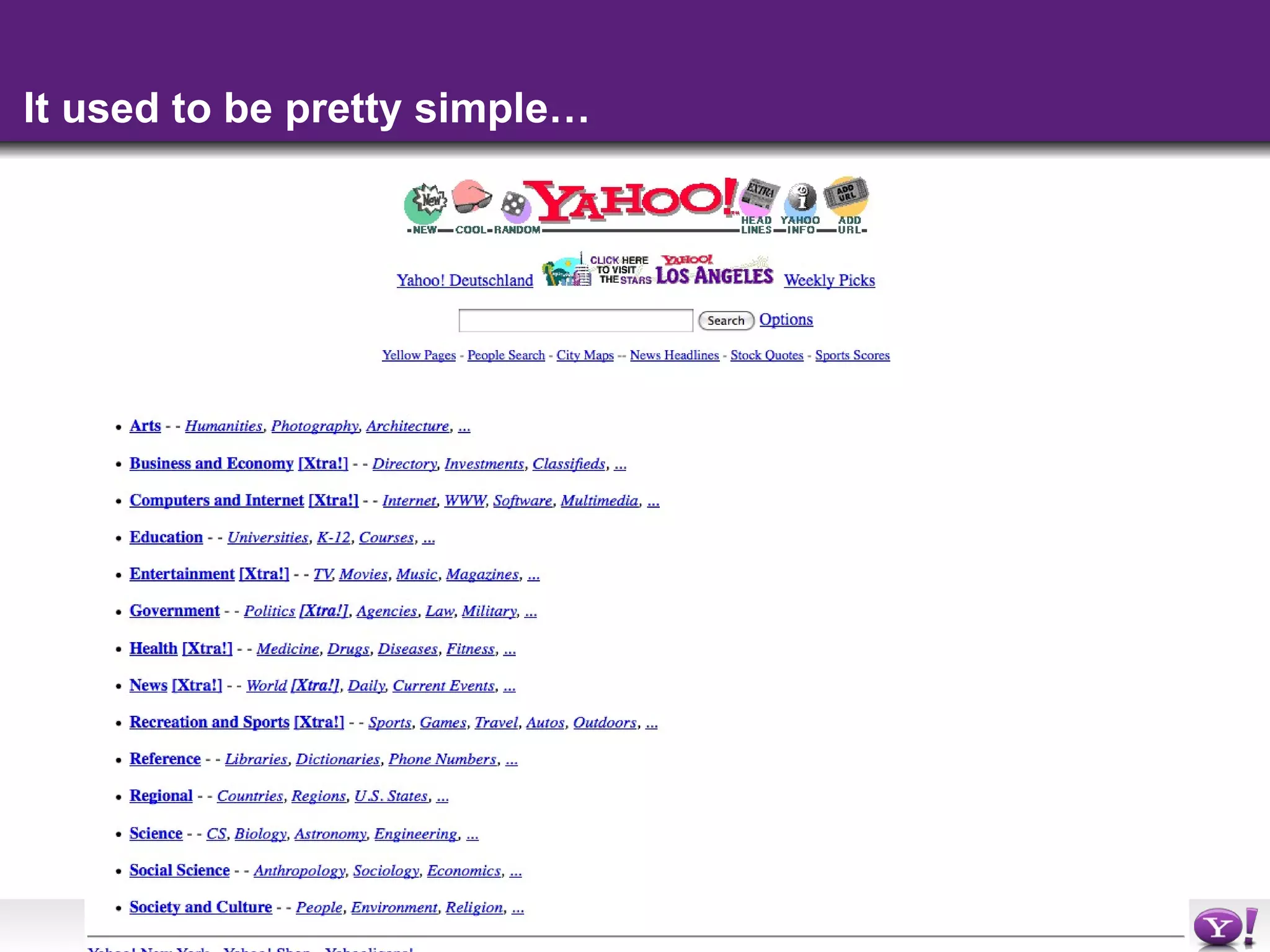
It used to be pretty simple…
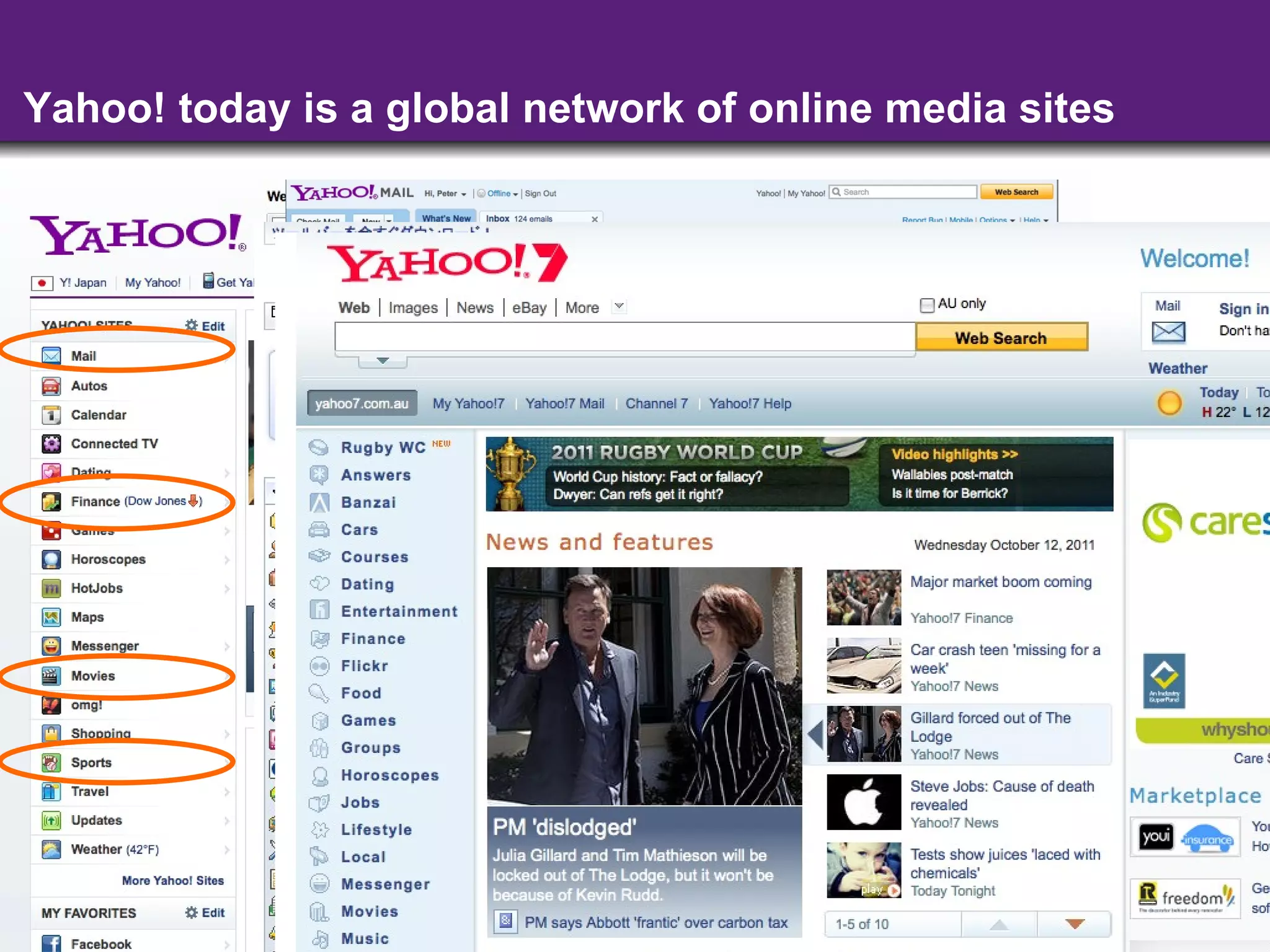
Yahoo! today is a global network of online media sites
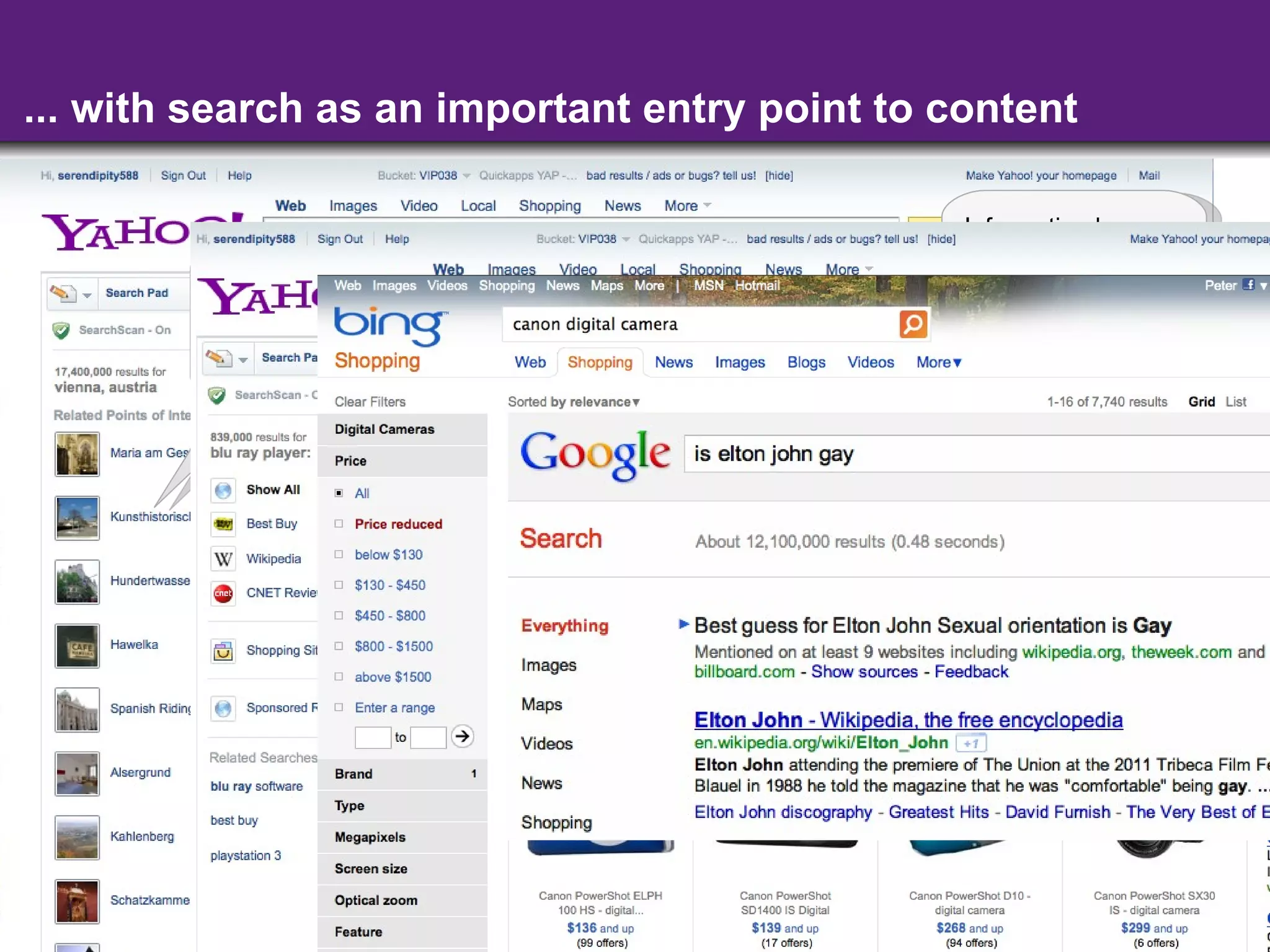
... with search as an important entry point to content Information box with content from and links to Yahoo! Travel Points of interest in Vienna, Austria Since Aug, 2010, ‘regular’ search results are ‘Powered by Bing’ Shopping results from  Yahoo! Shopping
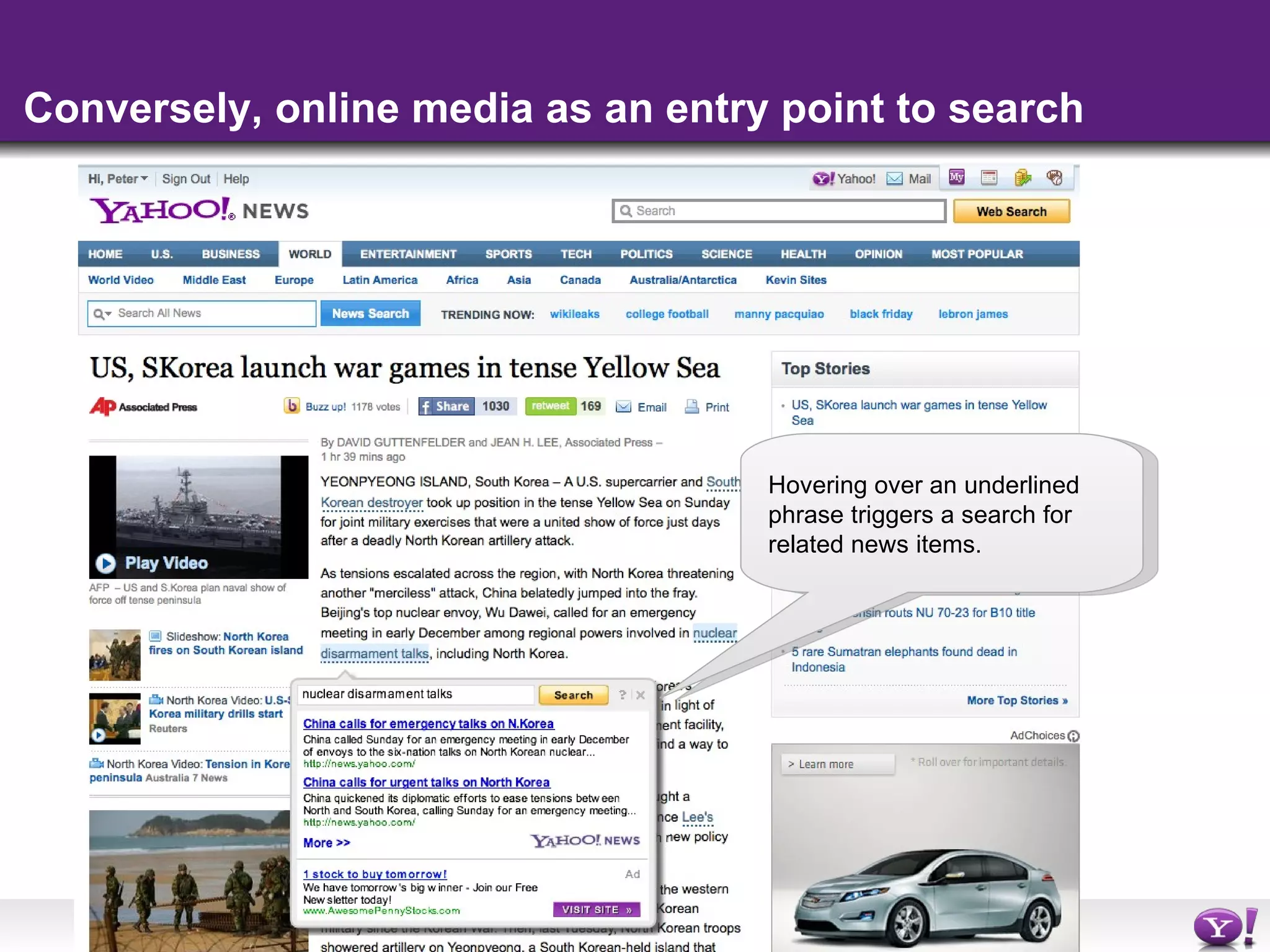
Conversely, online media as an entry point to search Hovering over an underlined phrase triggers a search for related news items.
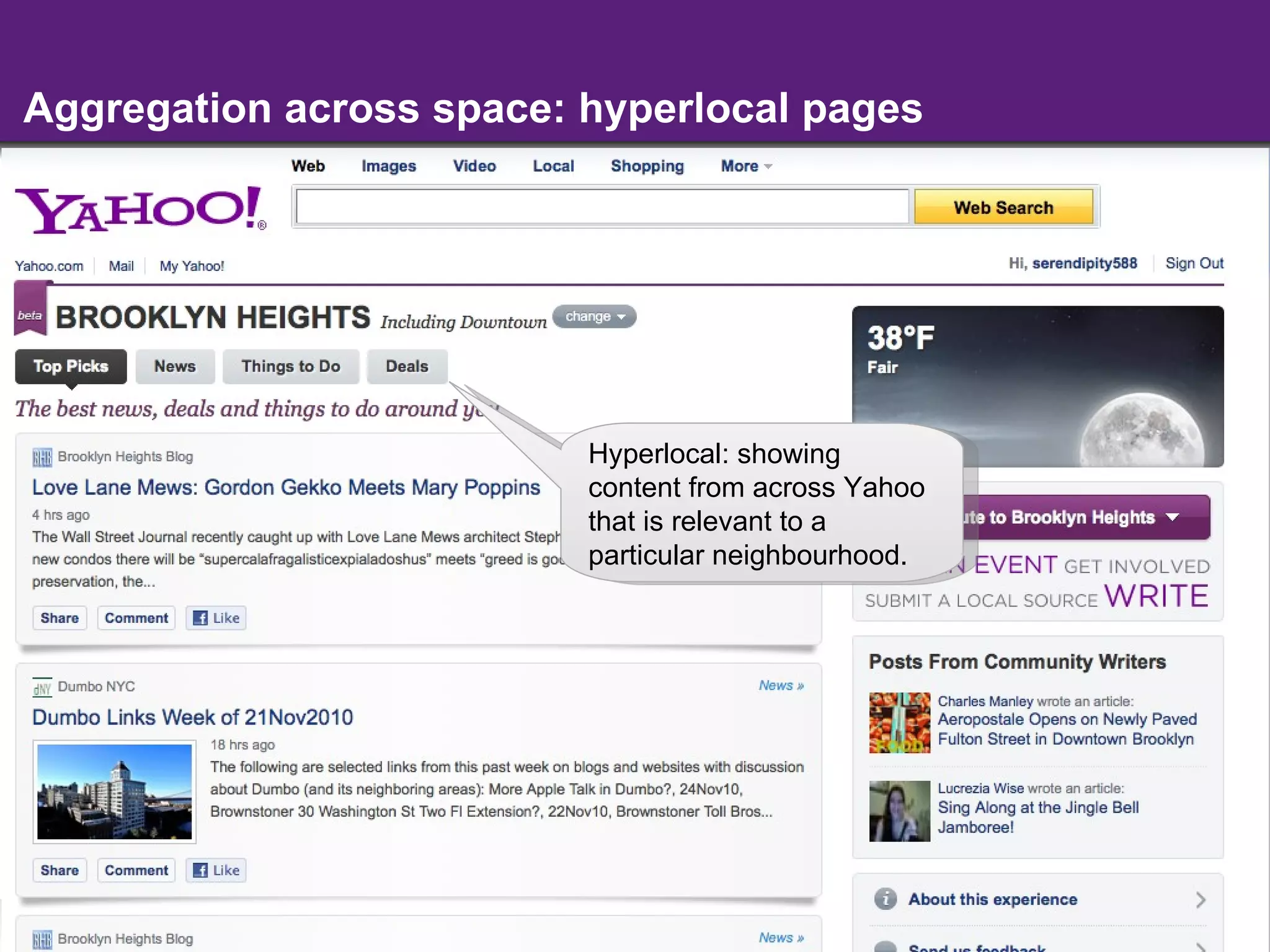
Aggregation across space: hyperlocal pages Hyperlocal: showing content from across Yahoo that is relevant to a particular neighbourhood.
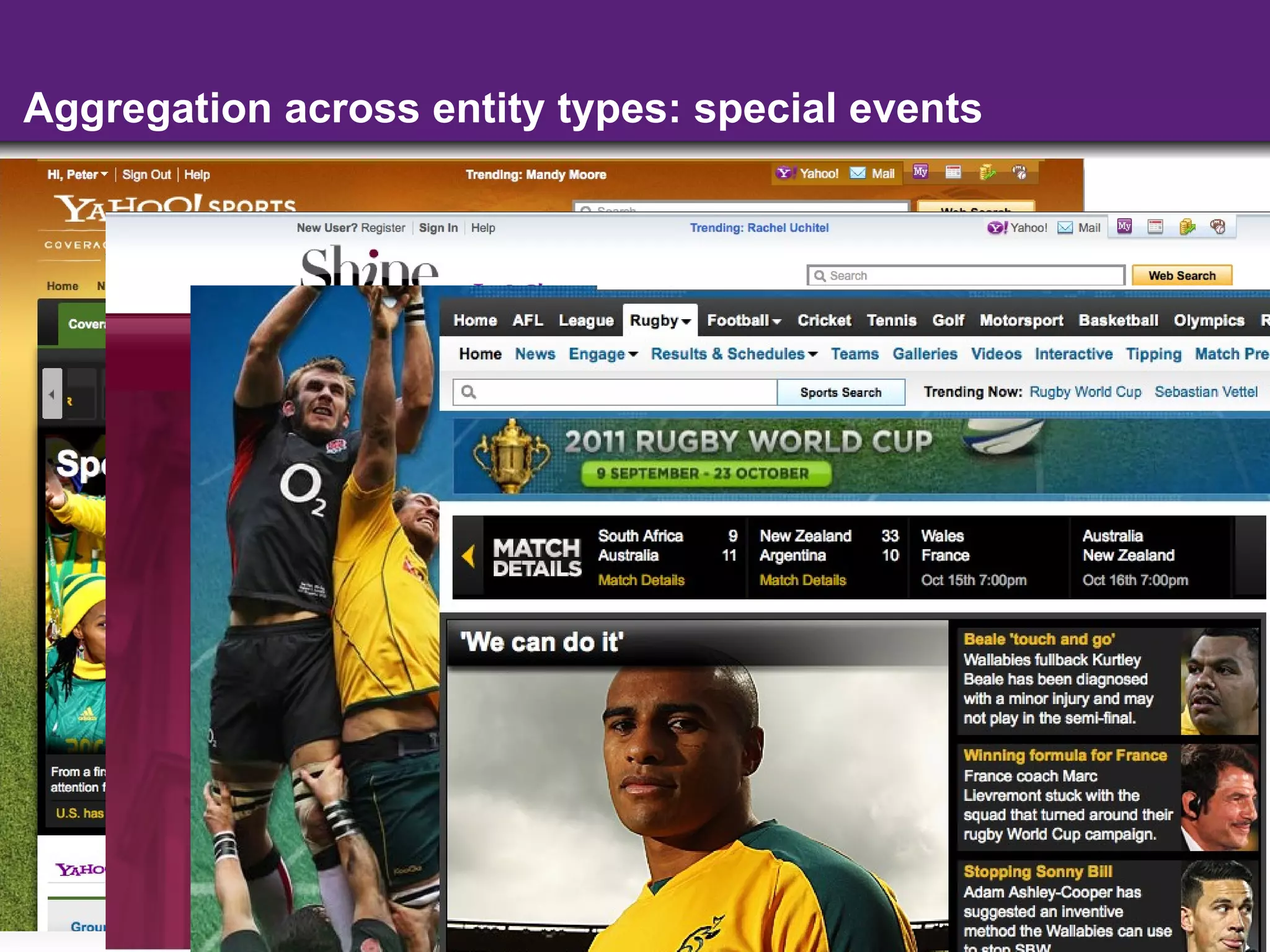
Aggregation across entity types: special events
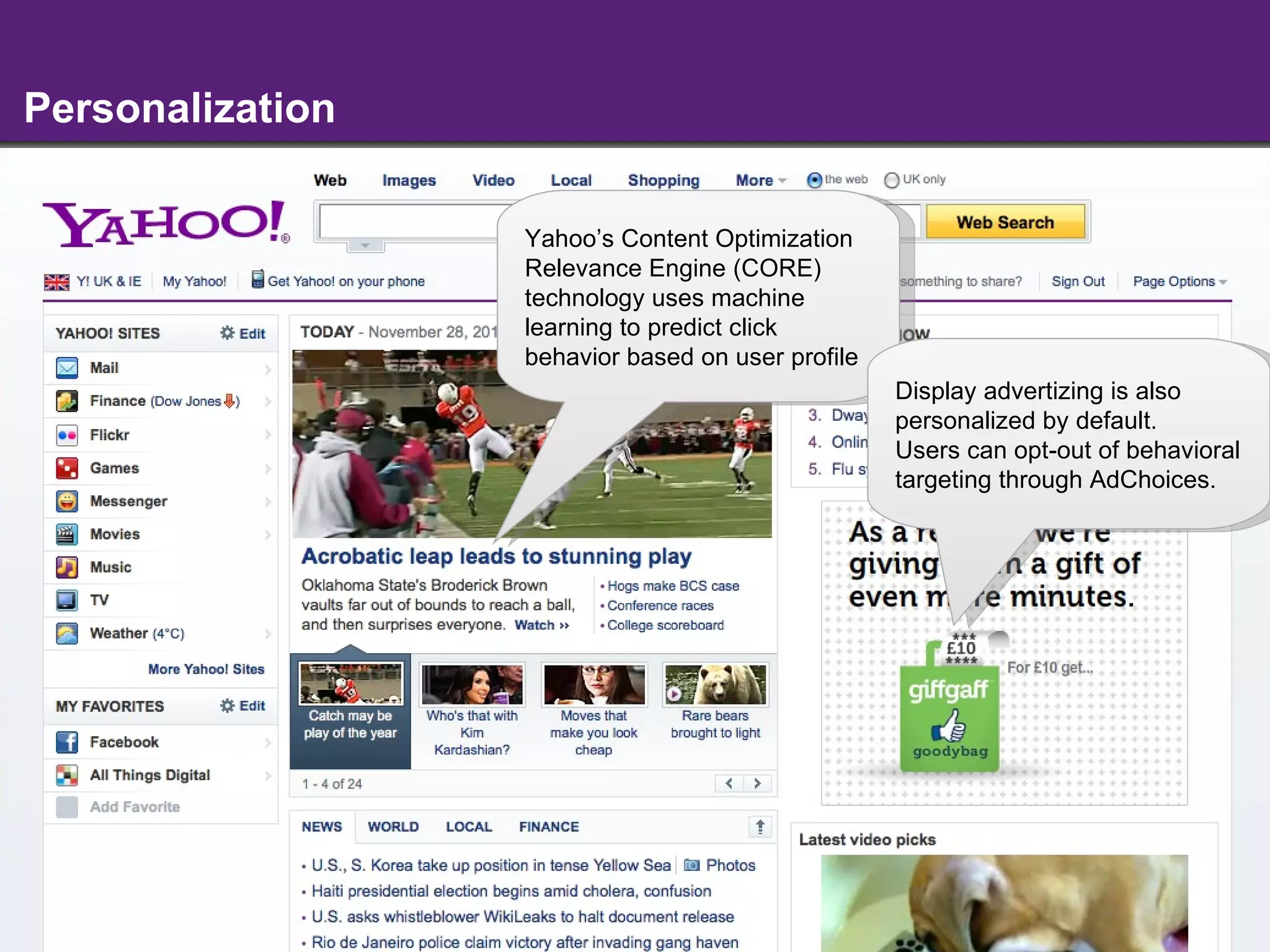
Personalization Yahoo’s Content Optimization Relevance Engine (CORE) technology uses machine learning to predict click behavior based on user profile Display advertizing is also personalized by default. Users can opt-out of behavioral targeting through AdChoices.
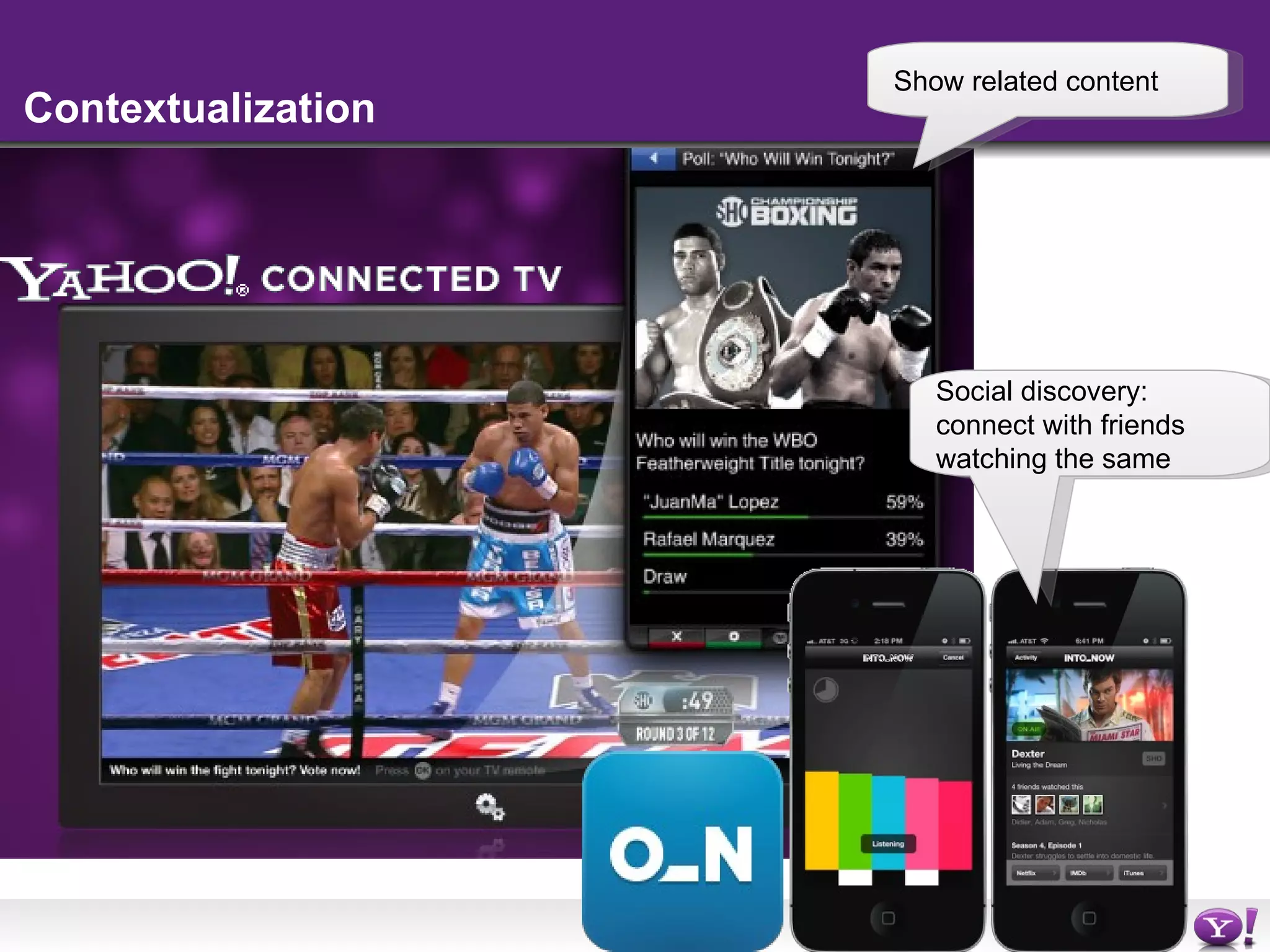
Contextualization Show related content Social discovery: connect with friends watching the same
Convergence of search and online media Complex answers in search Using structured data, not just text Search over owned content and the best of the Web Aggregation Content aggregation around events, persons, other entities From creating topic pages to creating entire new websites Personalization and contextualization Understand user interests at a fine grained level Build and carry user profiles across search and media Common to these is a need for a more advanced  understanding of the Web and our content
Semantic technologies for Search
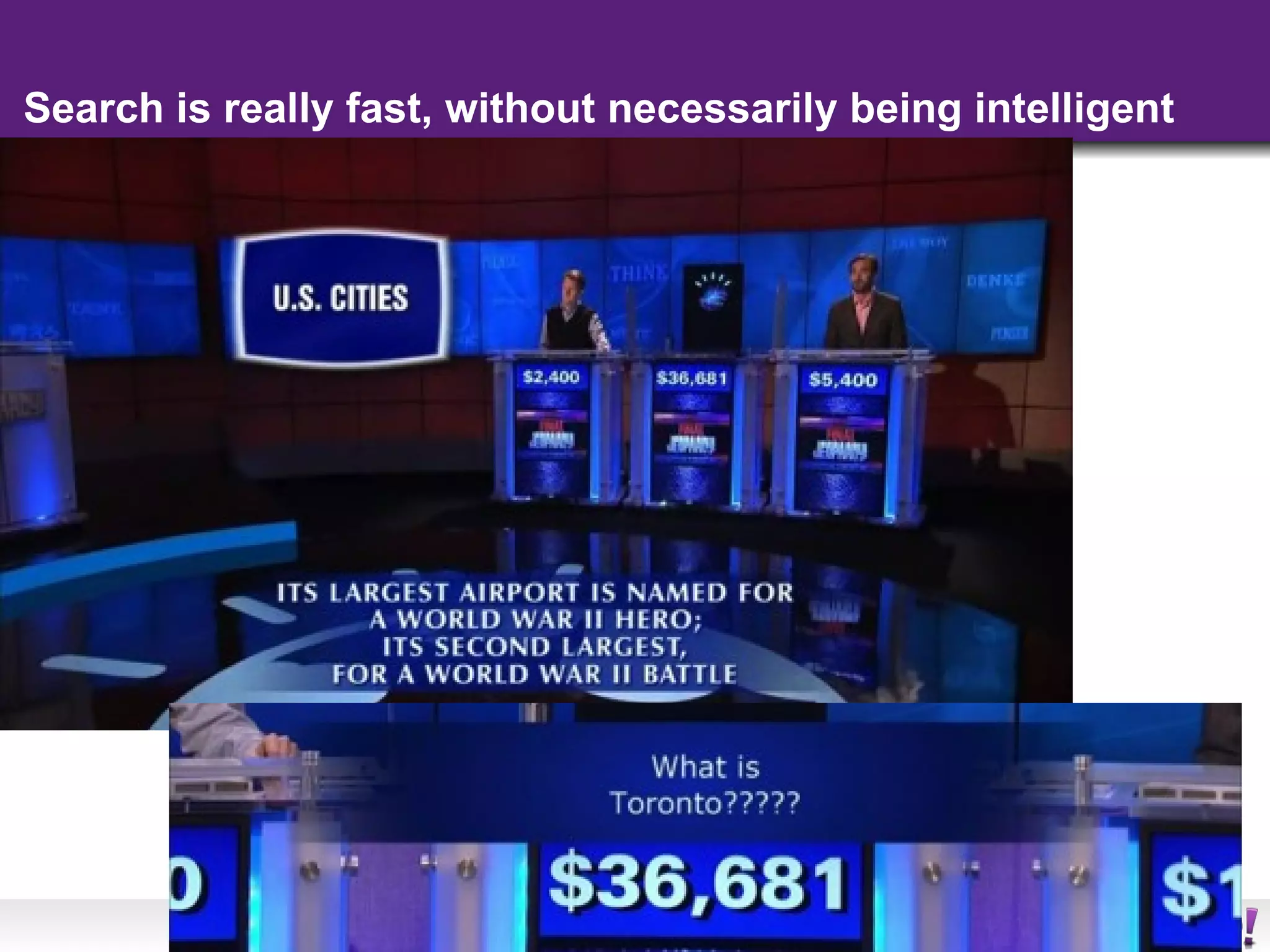
Search is really fast, without necessarily being intelligent
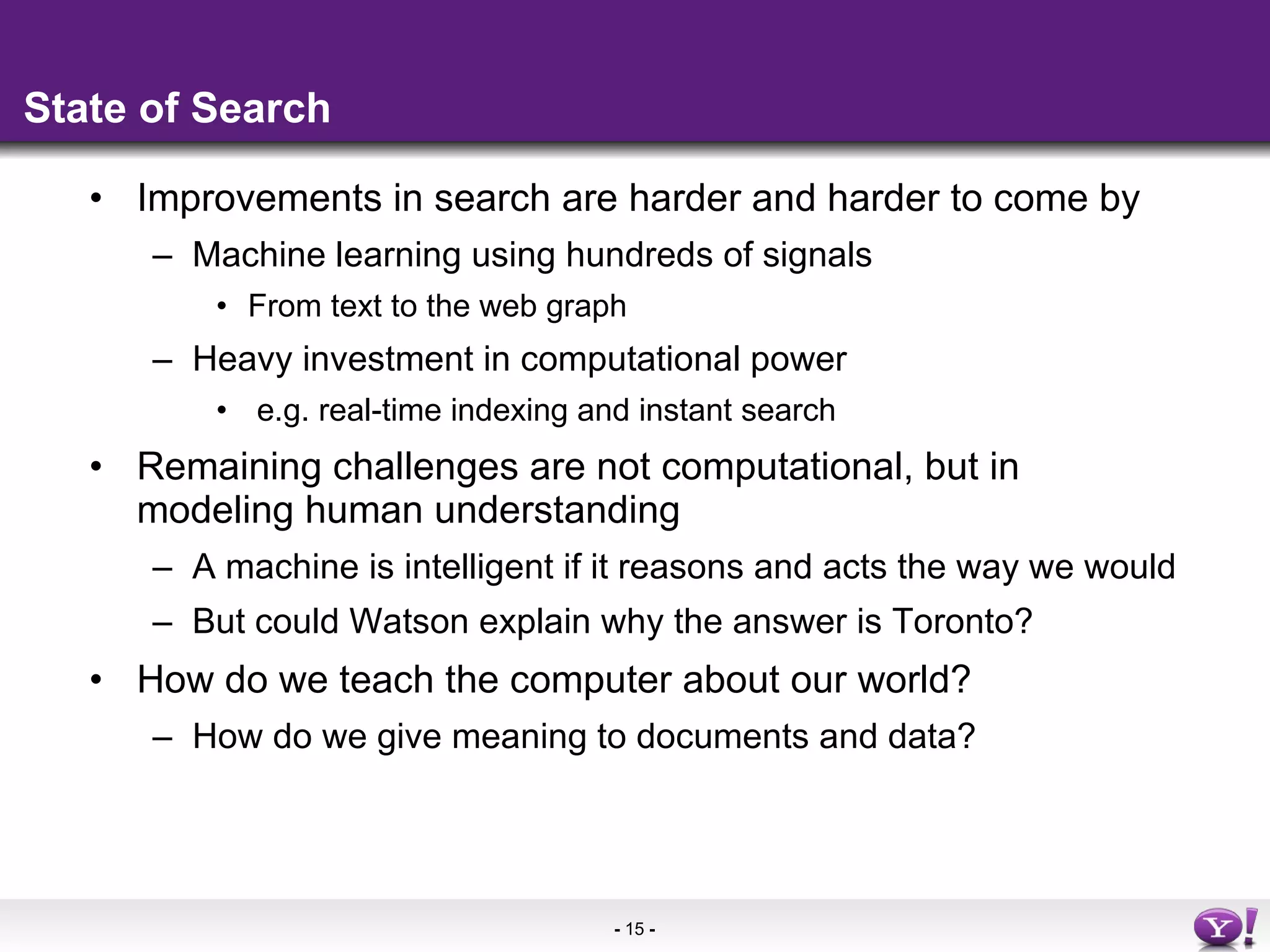
State of Search Improvements in search are harder and harder to come by Machine learning using hundreds of signals From text to the web graph Heavy investment in computational power e.g. real-time indexing and instant search Remaining challenges are not computational, but in modeling human understanding A machine is intelligent if it reasons and acts the way we would But could Watson explain why the answer is Toronto? How do we teach the computer about our world? How do we give meaning to documents and data?
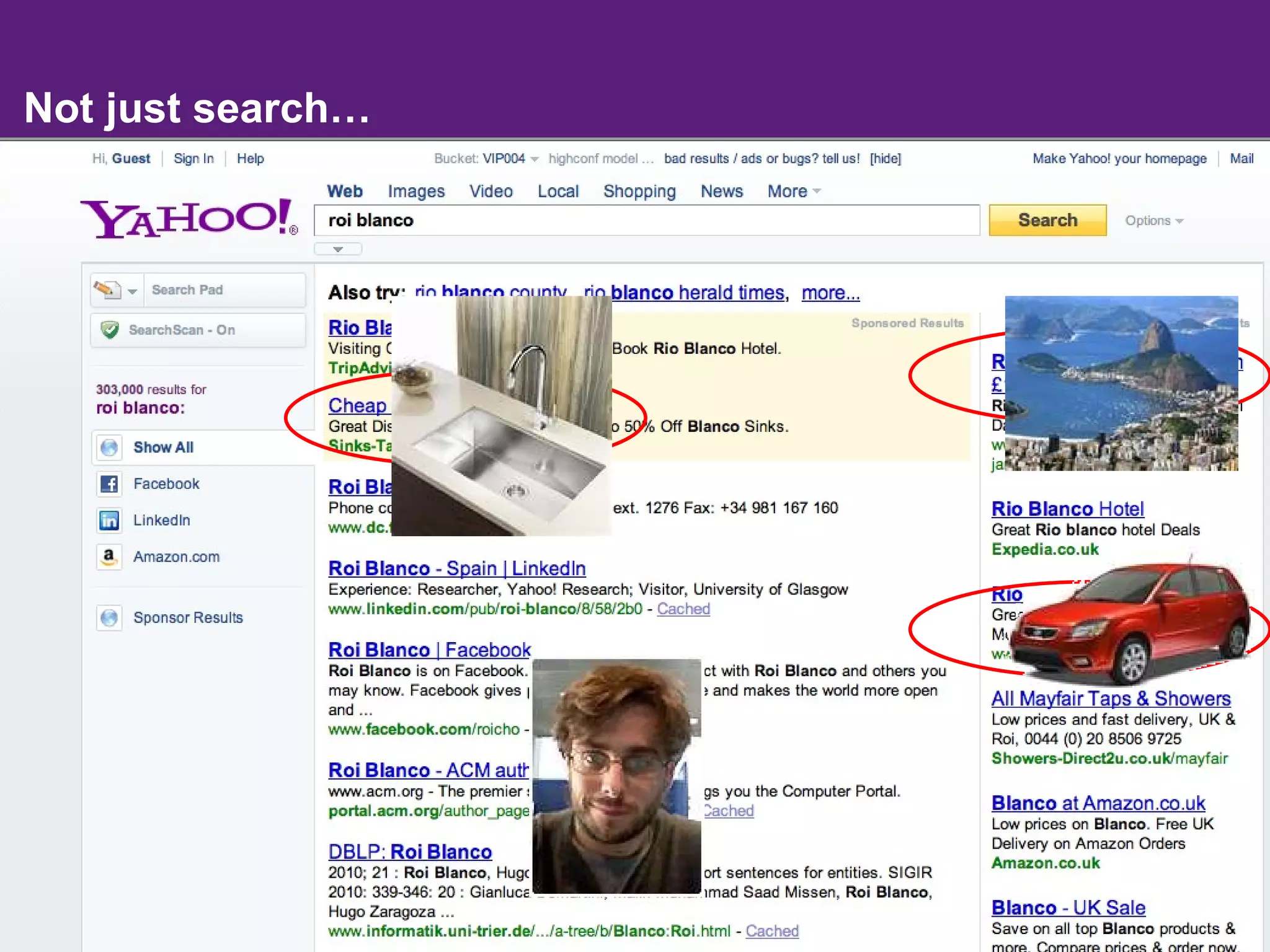
Not just search…
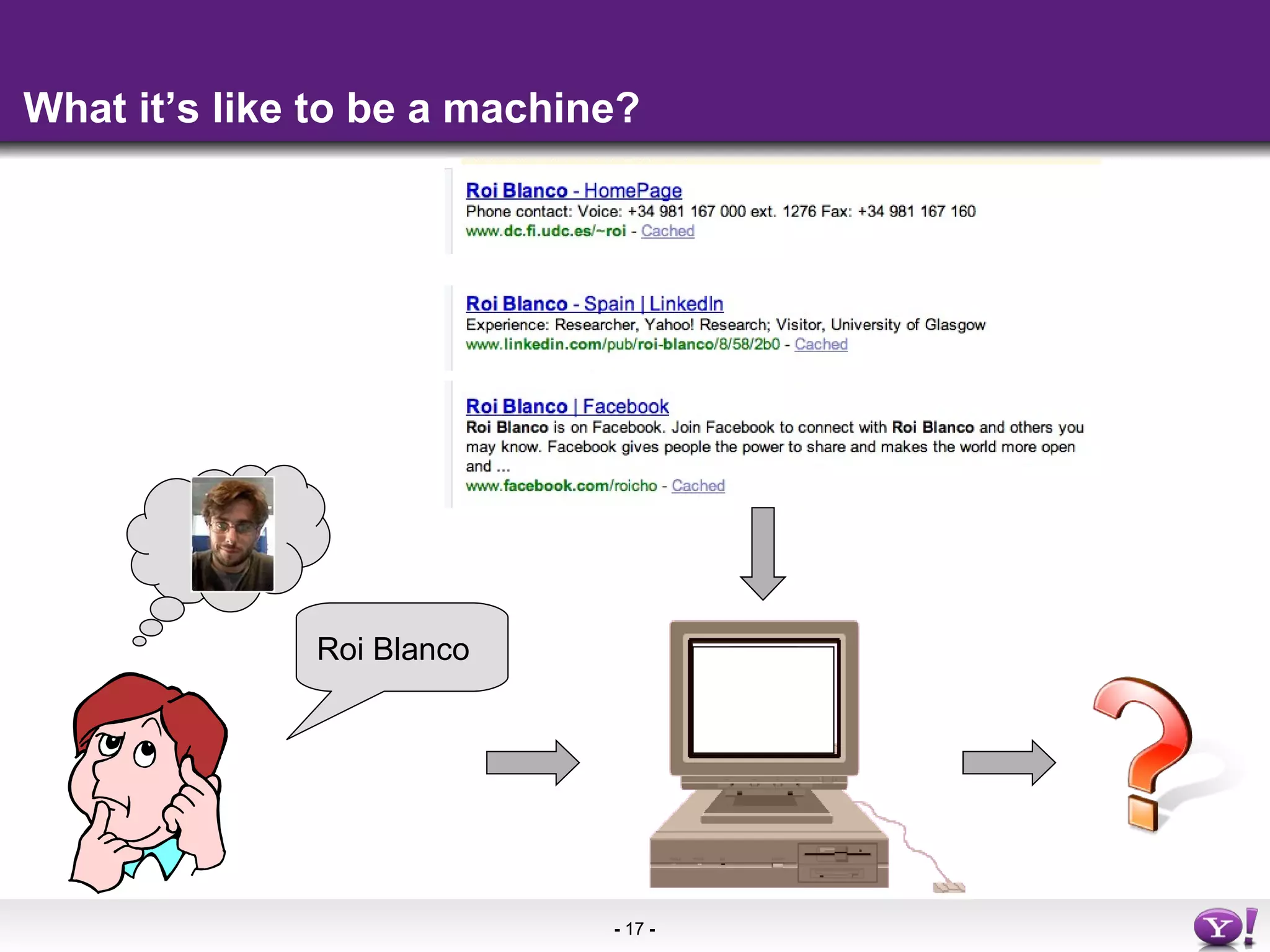
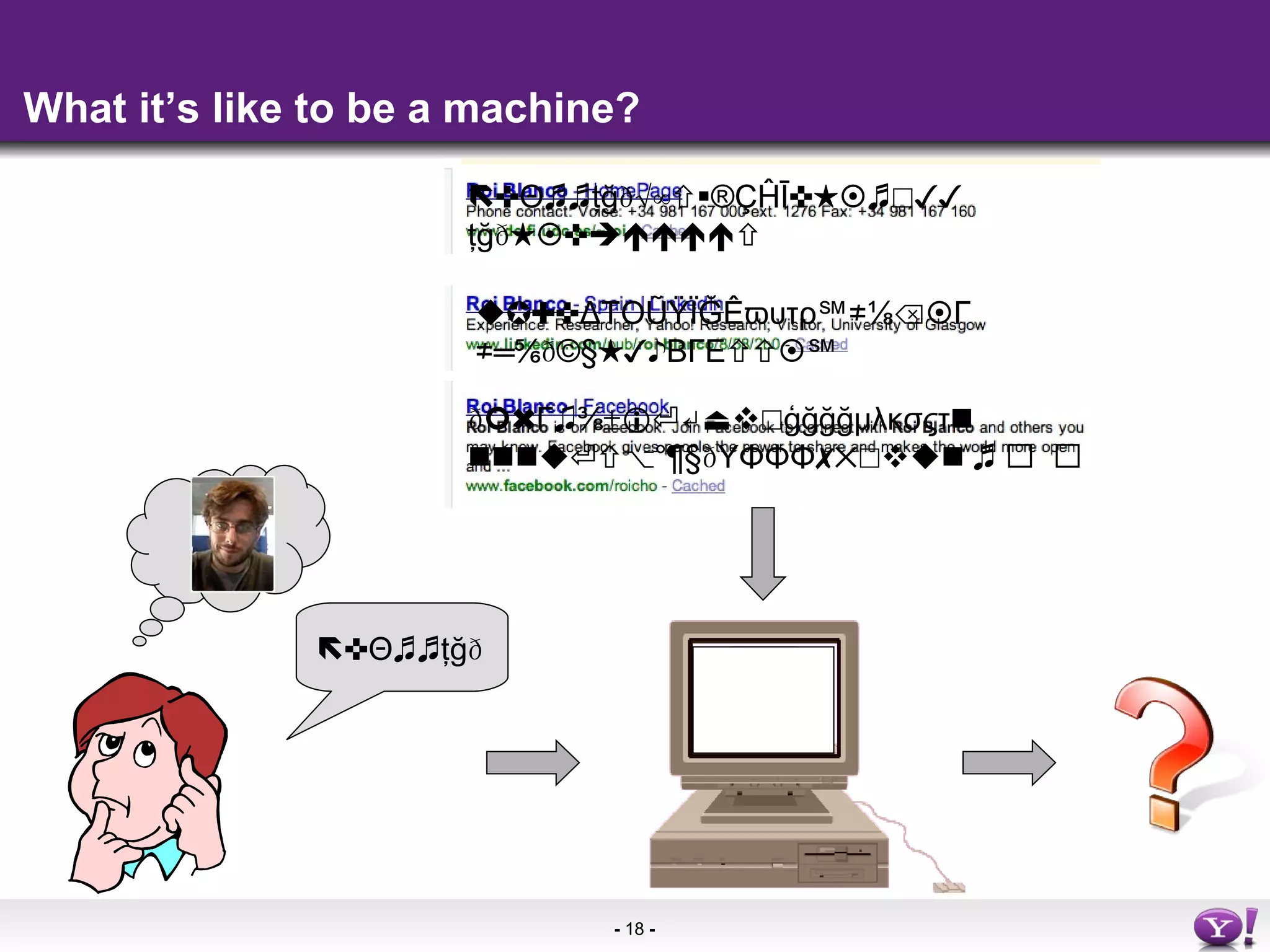
What it’s like to be a machine? Roi Blanco
What it’s like to be a machine?  ✜ Θ ♬♬ţğ   ✜ Θ ♬♬ţğ √∞  ®ÇĤĪ ✜★  ♬☐ ✓✓ ţğ  ★  ✜   ✪✚✜ Δ ΤΟŨŸÏĞÊϖυτρ℠≠⅛⌫ Γ ≠ =⅚ ©§ ★✓♪ ΒΓΕ  ℠   ✖ Γ ♫⅜±  ⏎ ↵⏏  ☐ģğğğμλκσςτ   ⏎  ⌥ °¶§ΥΦΦΦ ✗✕ ☐ 
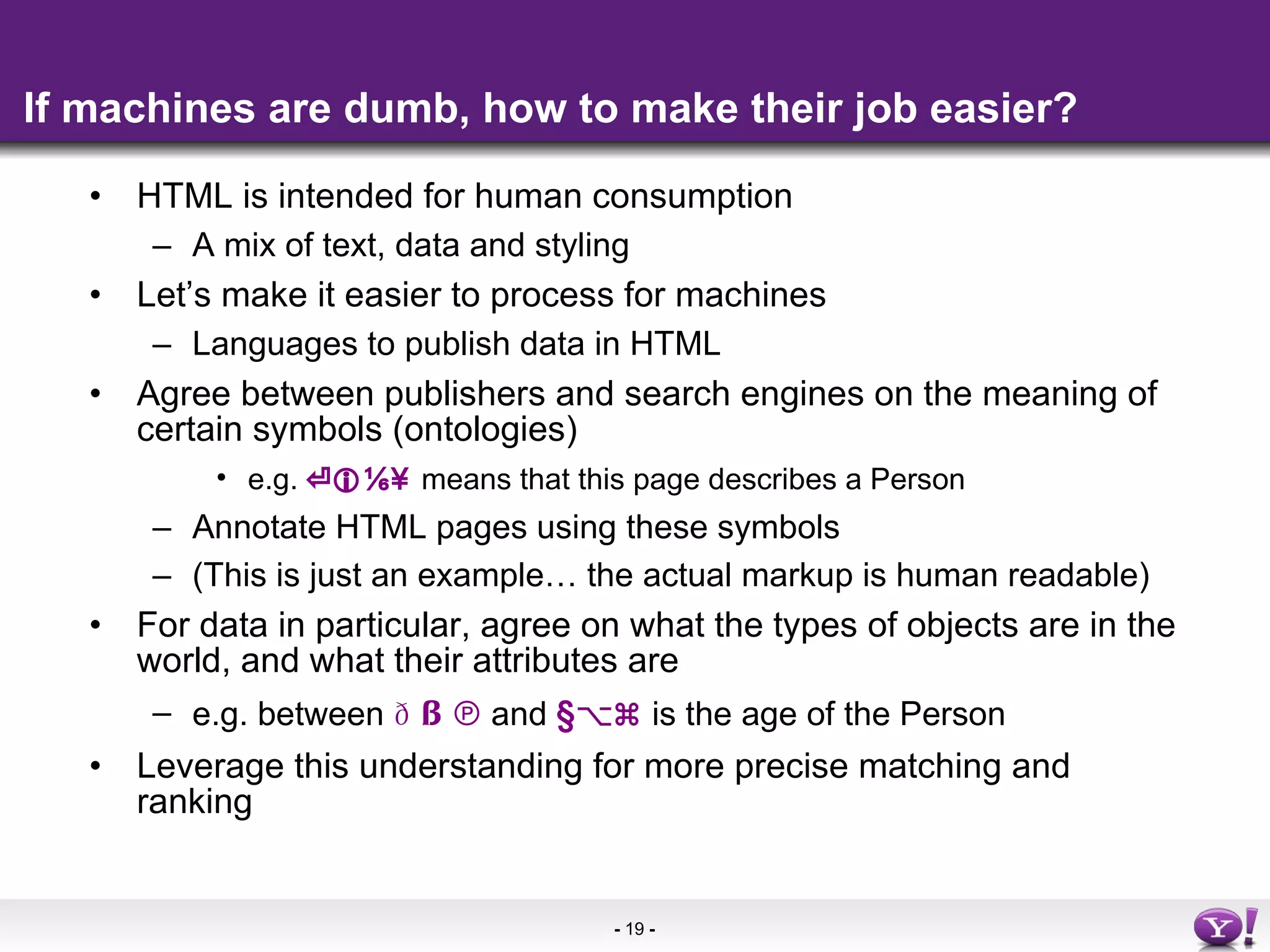
If machines are dumb, how to make their job easier? HTML is intended for human consumption A mix of text, data and styling Let’s make it easier to process for machines Languages to publish data in HTML Agree between publishers and search engines on the meaning of certain symbols (ontologies) e.g.  ⏎  ⅙¥   means that this page describes a Person Annotate HTML pages using these symbols (This is just an example… the actual markup is human readable) For data in particular, agree on what the types of objects are in the world, and what their attributes are e.g. between  §℗  and  §⌥⌘  is the age of the Person Leverage this understanding for more precise matching and ranking
Enter the Semantic Web Sharing information across the Web Publish data in standard formats (RDF, RDFa) Share the meaning using powerful, logic-based languages  (OWL, RIF) Query using standard languages and protocols (HTTP, SPARQL) Two main forms of publishing Linked Data Data published as RDF documents linked to other RDF documents and/or using SPARQL end-points Community effort to re-publish large public datasets (e.g. Dbpedia, open government data) Embedding metadata in HTML pages Preferred by search engines that already process HTML pages
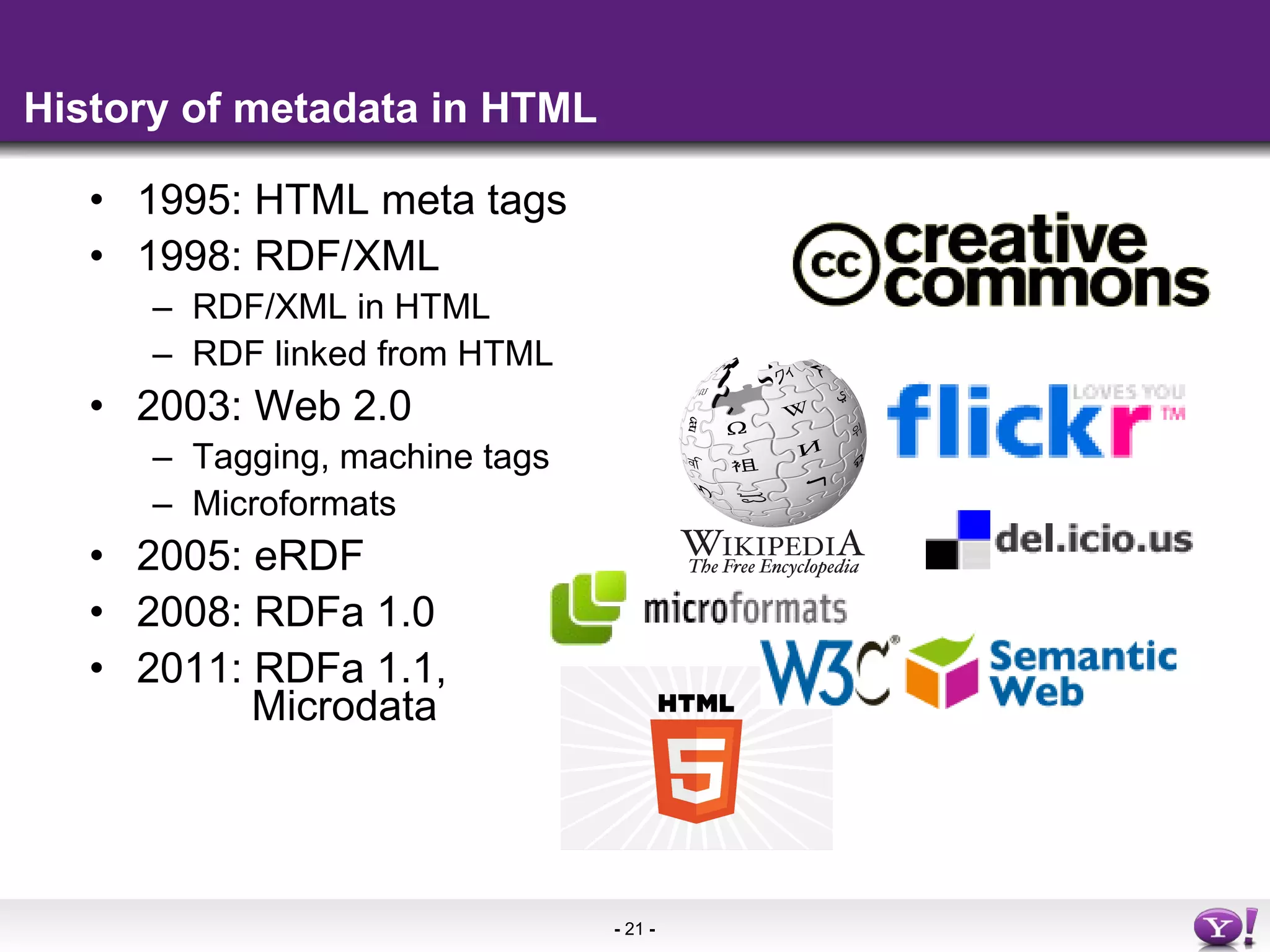
History of metadata in HTML 1995: HTML meta tags 1998: RDF/XML RDF/XML in HTML RDF linked from HTML 2003: Web 2.0 Tagging, machine tags Microformats 2005: eRDF  2008: RDFa 1.0 2011: RDFa 1.1,    Microdata
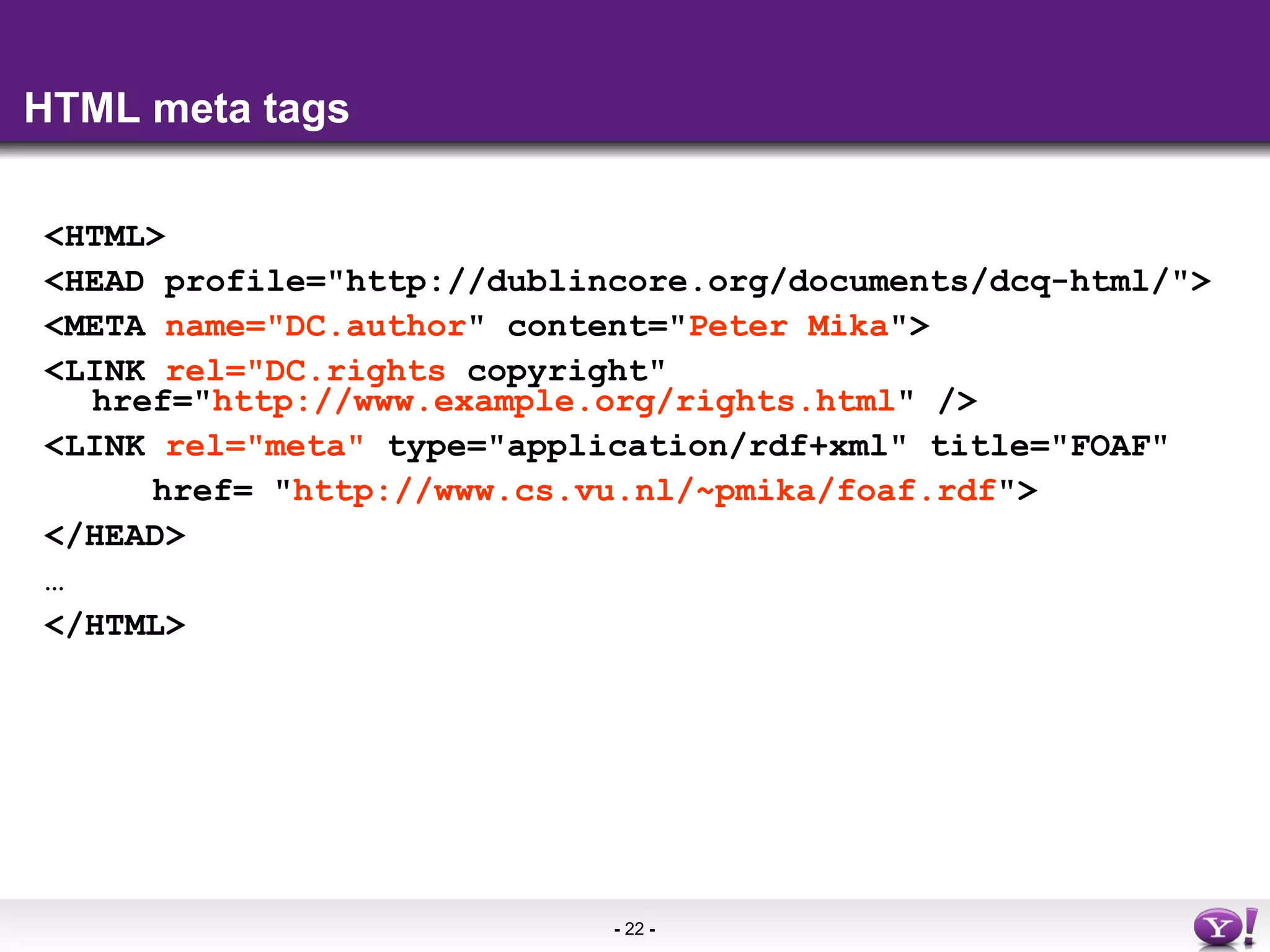
HTML meta tags <HTML> <HEAD profile=&quot;http://dublincore.org/documents/dcq-html/&quot;> <META  name=&quot;DC.author &quot; content=&quot; Peter Mika &quot;> <LINK  rel=&quot;DC.rights  copyright&quot; href=&quot; http://www.example.org/rights.html &quot; />  <LINK  rel=&quot;meta&quot;  type=&quot;application/rdf+xml&quot; title=&quot;FOAF&quot;    href= &quot; http://www.cs.vu.nl/~pmika/foaf.rdf &quot;>  </HEAD>  … </HTML>
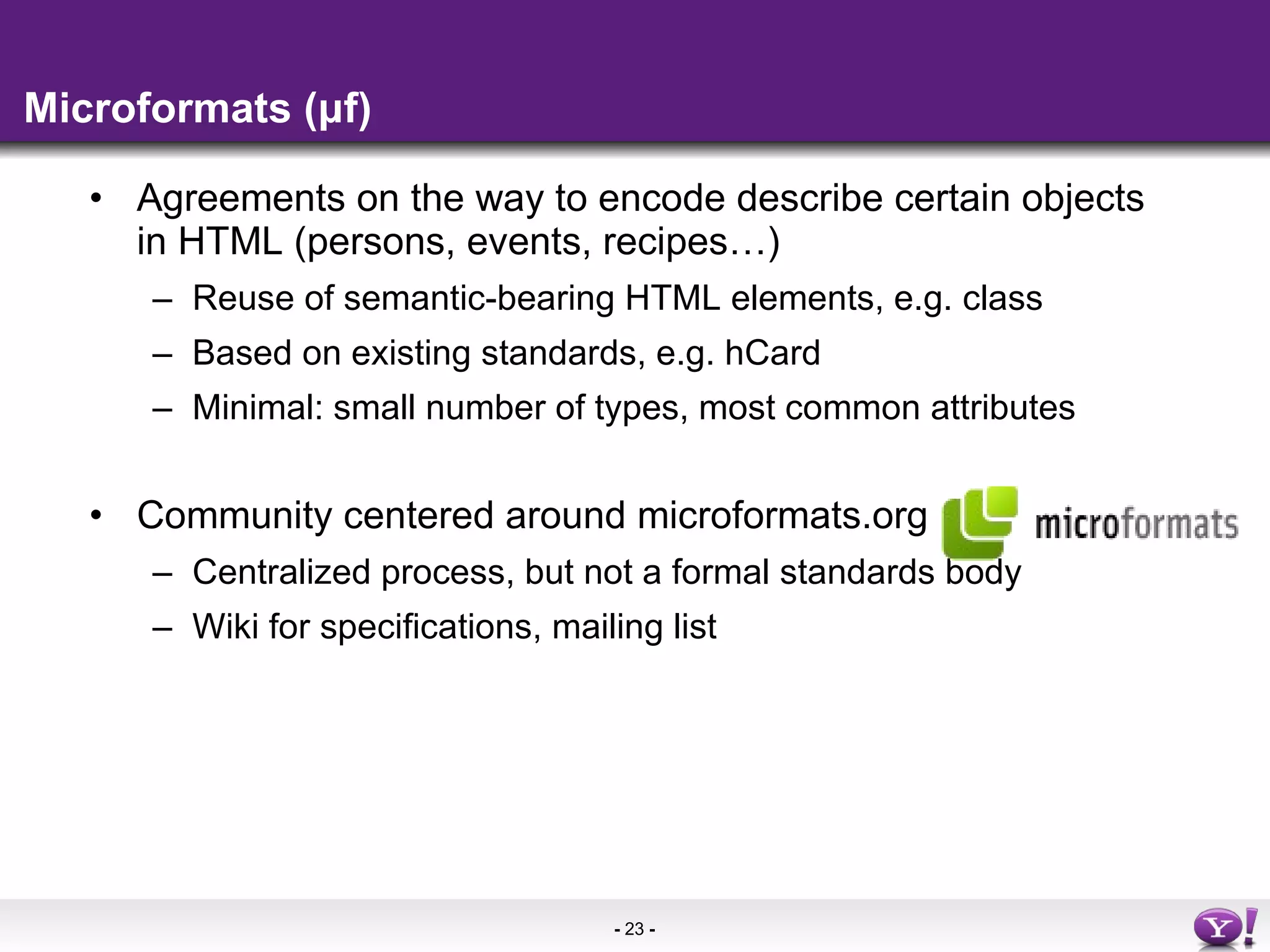
Microformats (μf) Agreements on the way to encode describe certain objects in HTML (persons, events, recipes…) Reuse of semantic-bearing HTML elements, e.g. class Based on existing standards, e.g. hCard Minimal: small number of types, most common attributes Community centered around microformats.org Centralized process, but not a formal standards body Wiki for specifications, mailing list
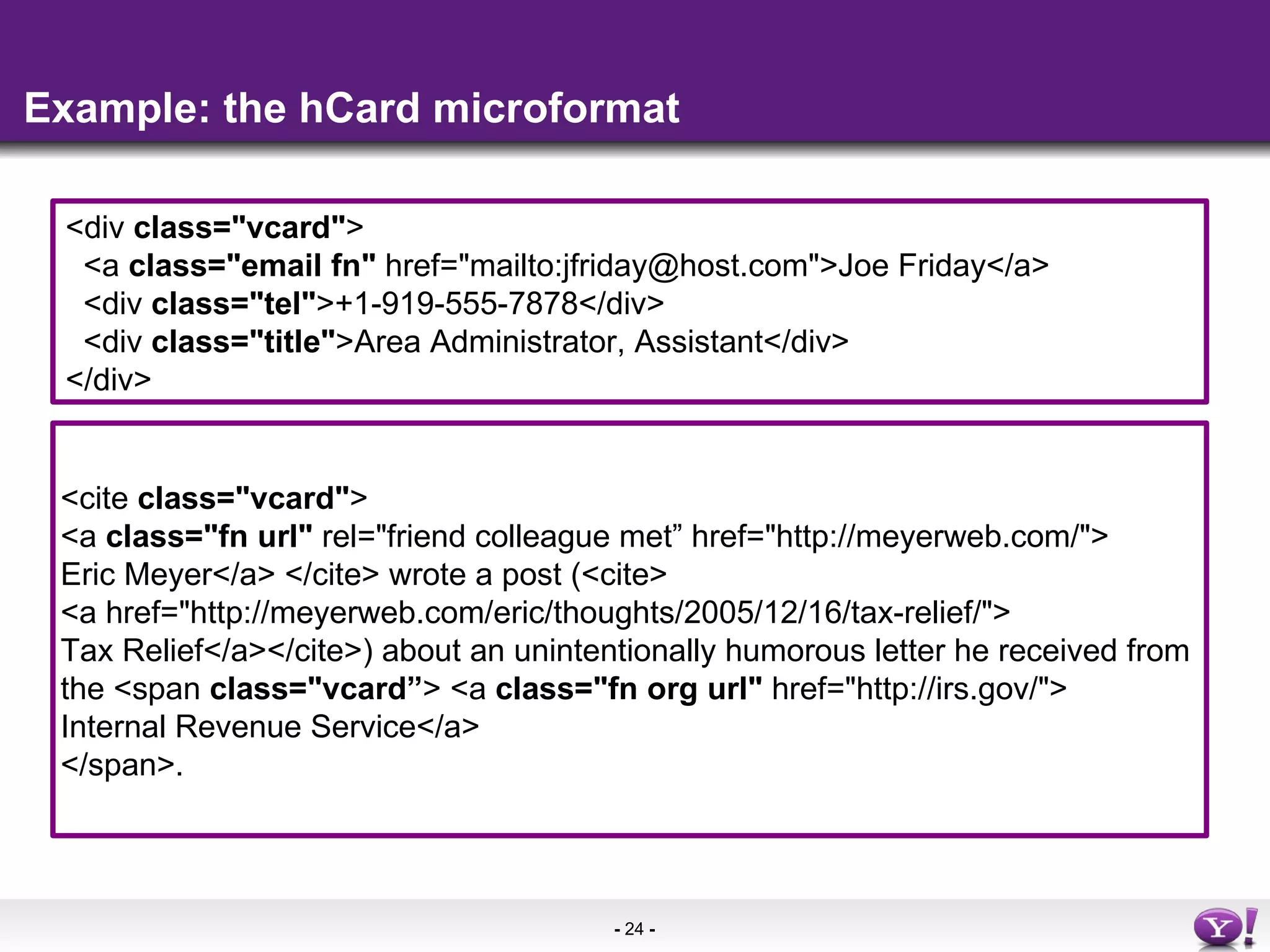
Example: the hCard microformat <cite  class=&quot;vcard&quot; > <a  class=&quot;fn url&quot;  rel=&quot;friend colleague met” href=&quot;http://meyerweb.com/&quot;> Eric Meyer</a> </cite> wrote a post (<cite> <a href=&quot;http://meyerweb.com/eric/thoughts/2005/12/16/tax-relief/&quot;> Tax Relief</a></cite>) about an unintentionally humorous letter he received from  the <span  class=&quot;vcard” > <a  class=&quot;fn org url&quot;  href=&quot;http://irs.gov/&quot;> Internal Revenue Service</a>  </span>.  <div  class=&quot;vcard&quot; >  <a  class=&quot;email fn&quot;  href=&quot;mailto:jfriday@host.com&quot;>Joe Friday</a>  <div  class=&quot;tel&quot; >+1-919-555-7878</div>  <div  class=&quot;title&quot; >Area Administrator, Assistant</div>  </div>
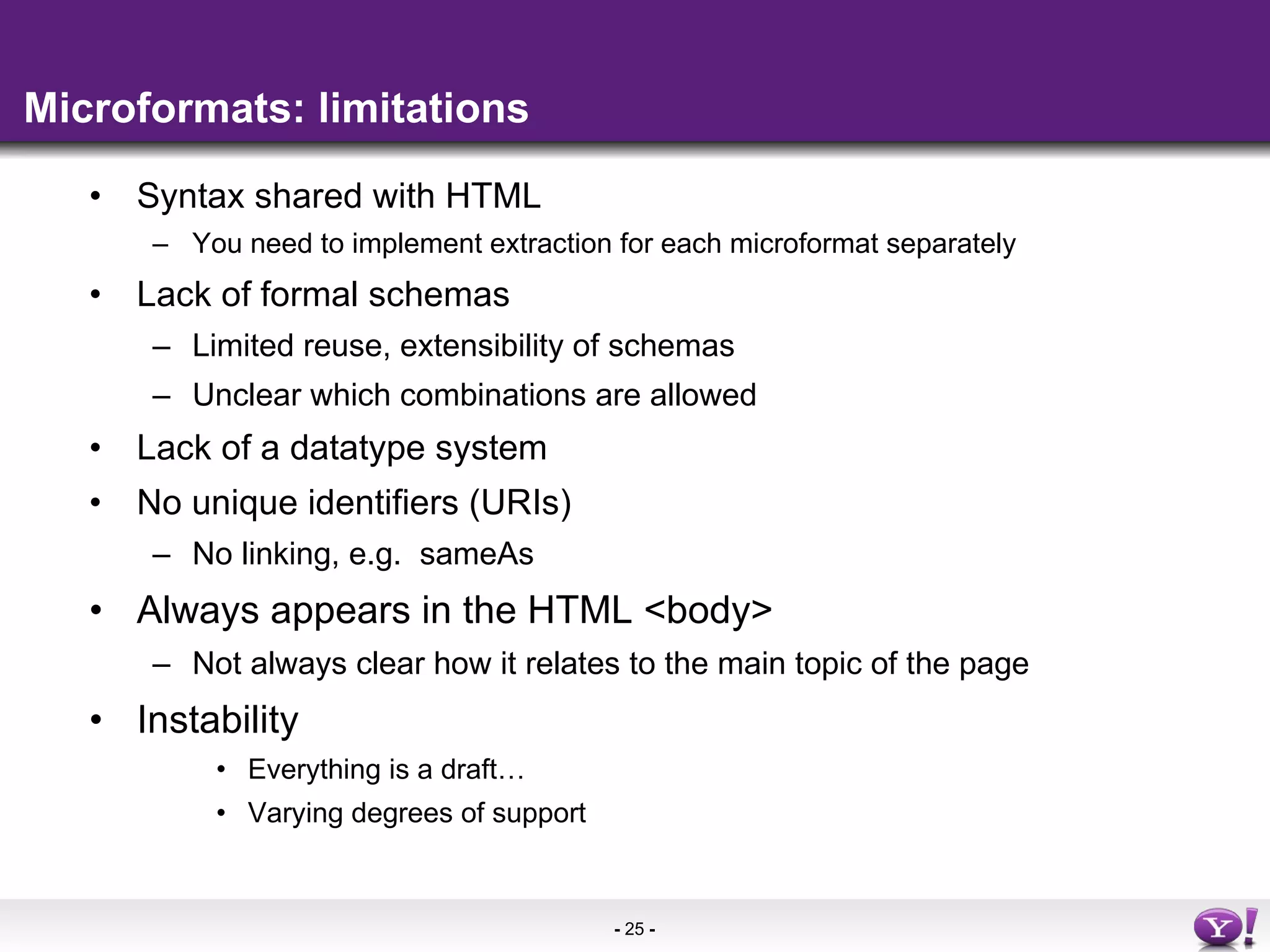
Microformats: limitations Syntax shared with HTML You need to implement extraction for each microformat separately Lack of formal schemas Limited reuse, extensibility of schemas Unclear which combinations are allowed Lack of a datatype system No unique  identifiers  (URIs)  No linking, e.g.  sameAs Always appears in the HTML <body> Not always clear how it relates to the main topic of the page Instability Everything is a draft… Varying degrees of support
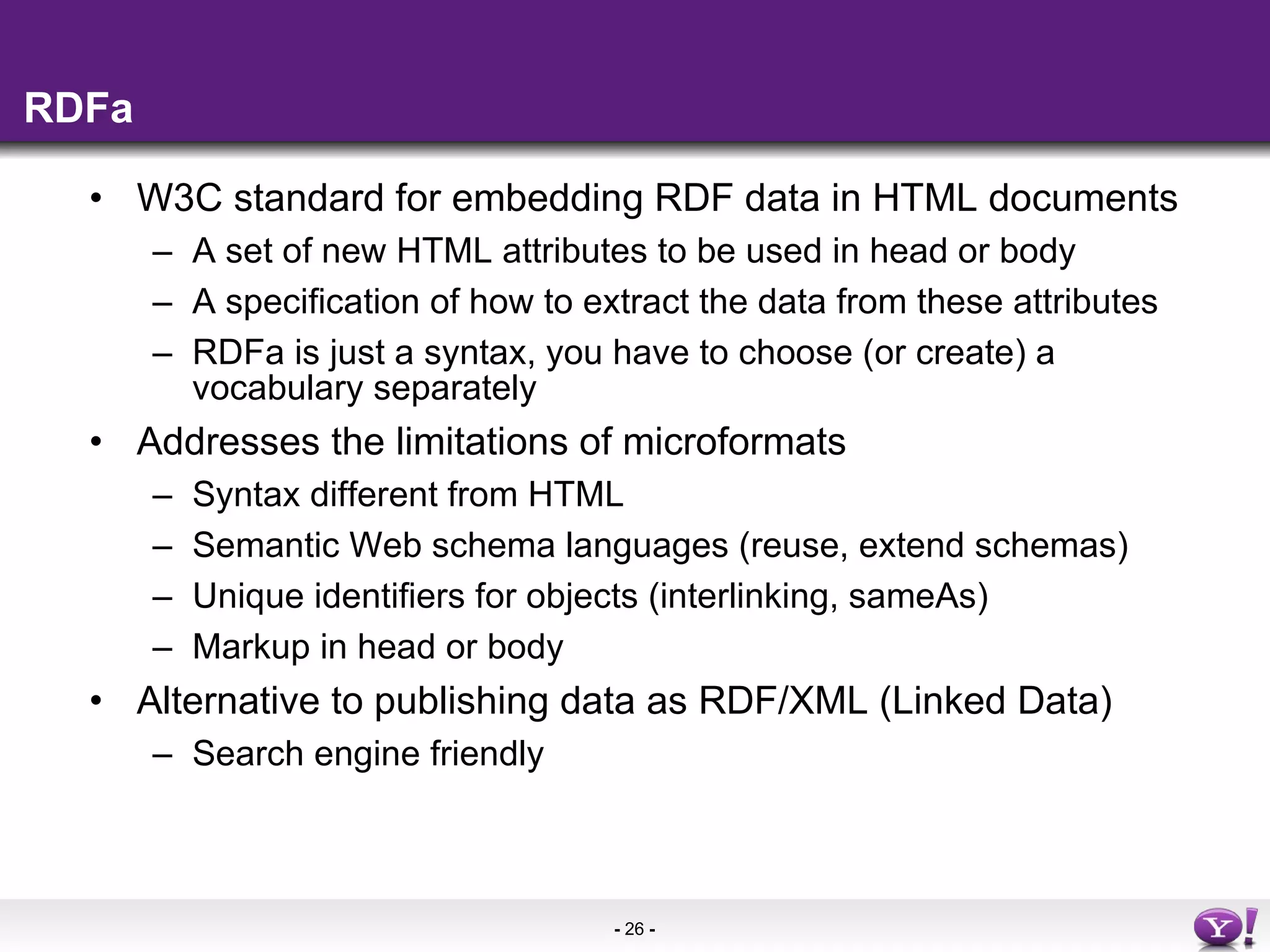
RDFa W3C standard for embedding RDF data in HTML documents A set of new HTML attributes to be used in head or body A specification of how to extract the data from these attributes  RDFa is just a syntax, you have to choose (or create) a vocabulary separately Addresses the limitations of microformats Syntax different from HTML Semantic Web schema languages (reuse, extend schemas) Unique identifiers for objects (interlinking, sameAs) Markup in head or body Alternative to publishing data as RDF/XML (Linked Data) Search engine friendly
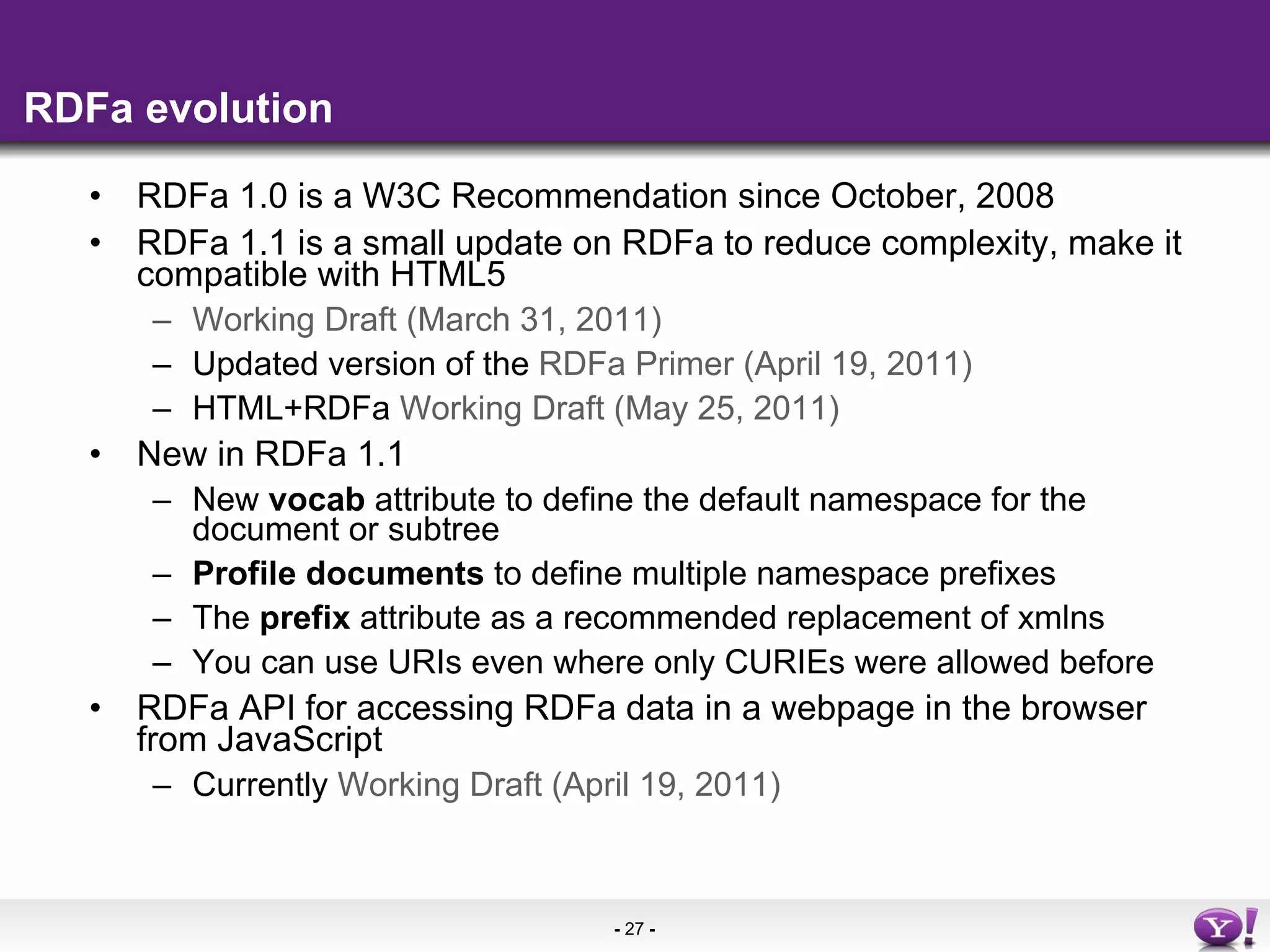
RDFa evolution RDFa 1.0 is a W3C Recommendation since October, 2008 RDFa 1.1 is a small update on RDFa to reduce complexity, make it compatible with HTML5 Working Draft (March 31, 2011) Updated version of the  RDFa Primer (April 19, 2011) HTML+RDFa  Working Draft (May 25, 2011)   New in RDFa 1.1 New  vocab  attribute to define the default namespace for the document or subtree Profile documents  to define multiple namespace prefixes The  prefix  attribute as a recommended replacement of xmlns You can use URIs even where only CURIEs were allowed before RDFa API for accessing RDFa data in a webpage in the browser from JavaScript Currently  Working Draft (April 19, 2011)
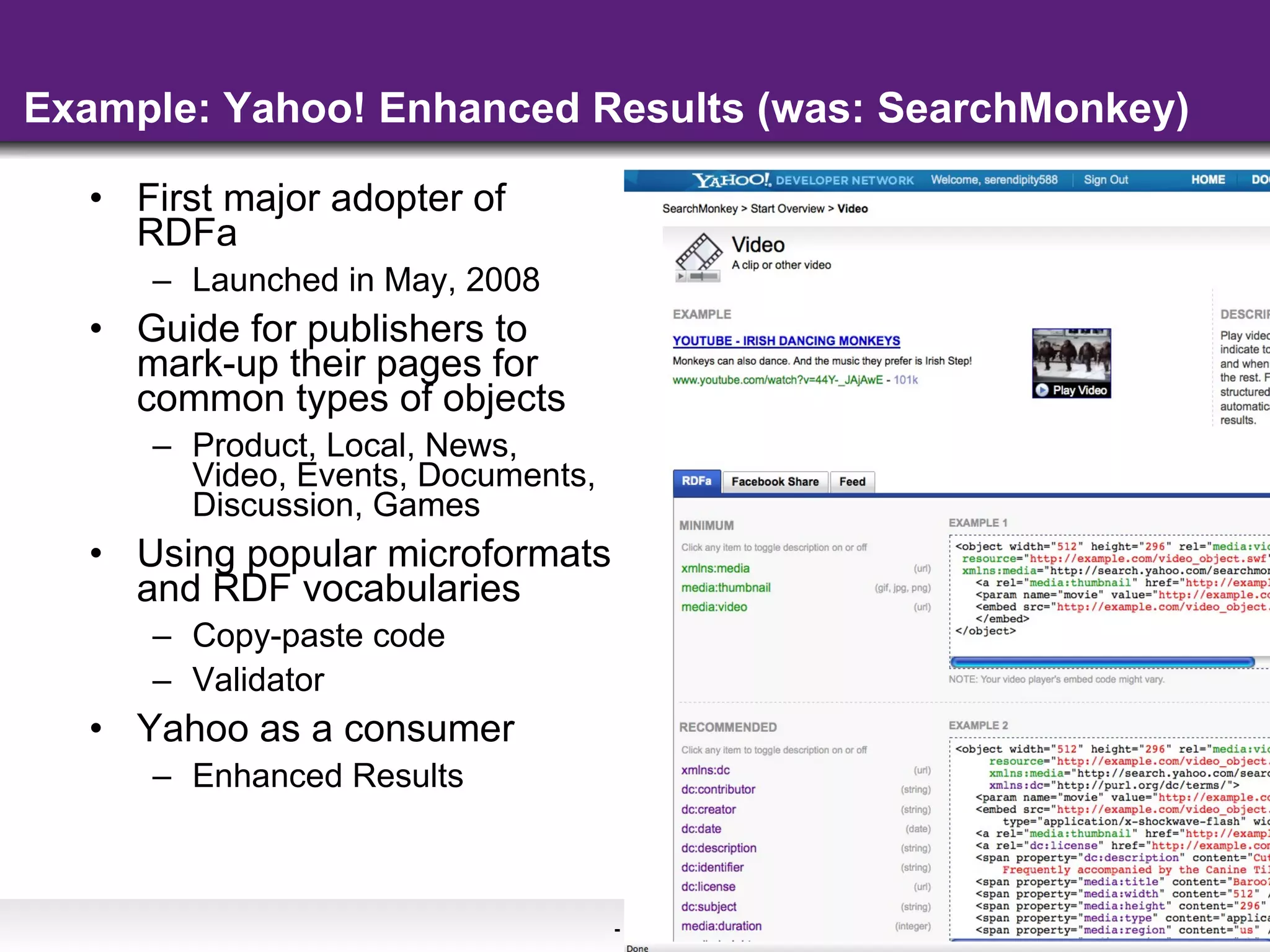
Example: Yahoo! Enhanced Results (was: SearchMonkey) First major adopter of RDFa Launched in May, 2008 Guide for publishers to mark-up their pages for common types of objects Product, Local, News, Video, Events, Documents, Discussion, Games Using popular microformats and RDF vocabularies Copy-paste code  Validator Yahoo as a consumer Enhanced Results
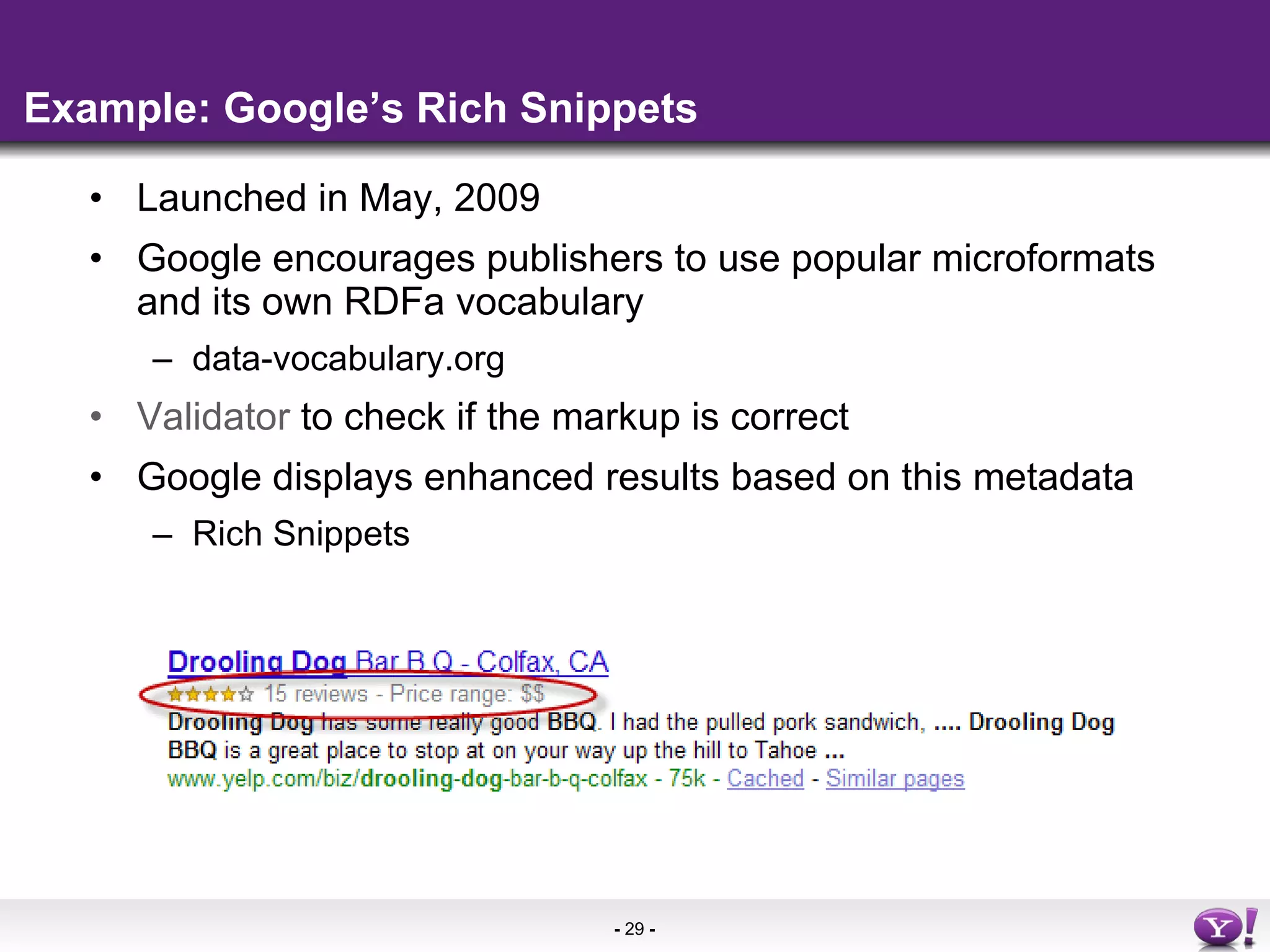
Example: Google’s Rich Snippets Launched in May, 2009 Google encourages publishers to use popular microformats and its own RDFa vocabulary data-vocabulary.org Validator  to check if the markup is correct Google displays enhanced results based on this metadata Rich Snippets
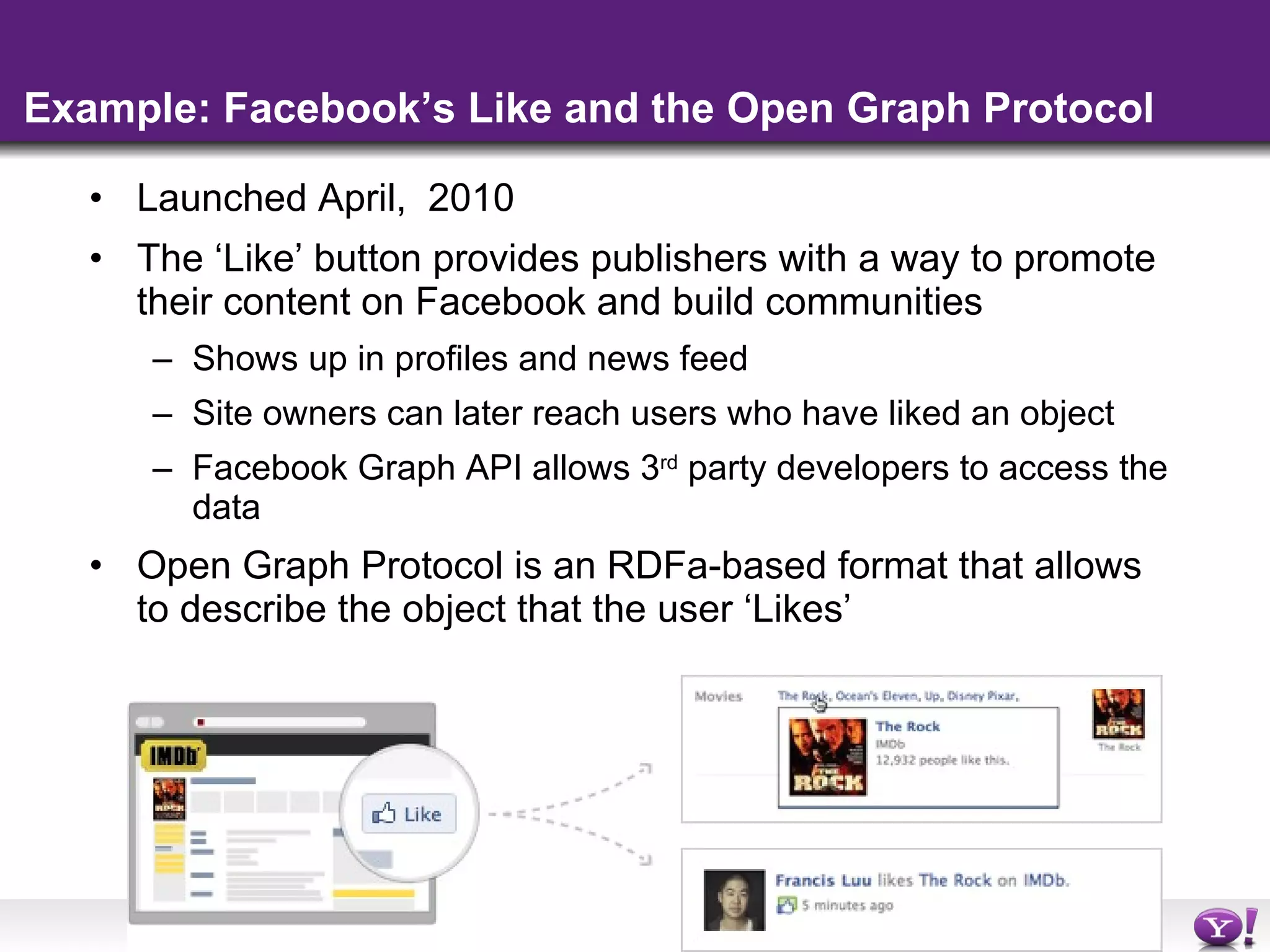
Example: Facebook’s Like and the Open Graph Protocol Launched April,  2010 The ‘Like’ button provides publishers with a way to promote their content on Facebook and build communities  Shows up in profiles and news feed Site owners can later reach users who have liked an object Facebook Graph API allows 3 rd  party developers to access the data  Open Graph Protocol is an RDFa-based format that allows to describe the object that the user ‘Likes’
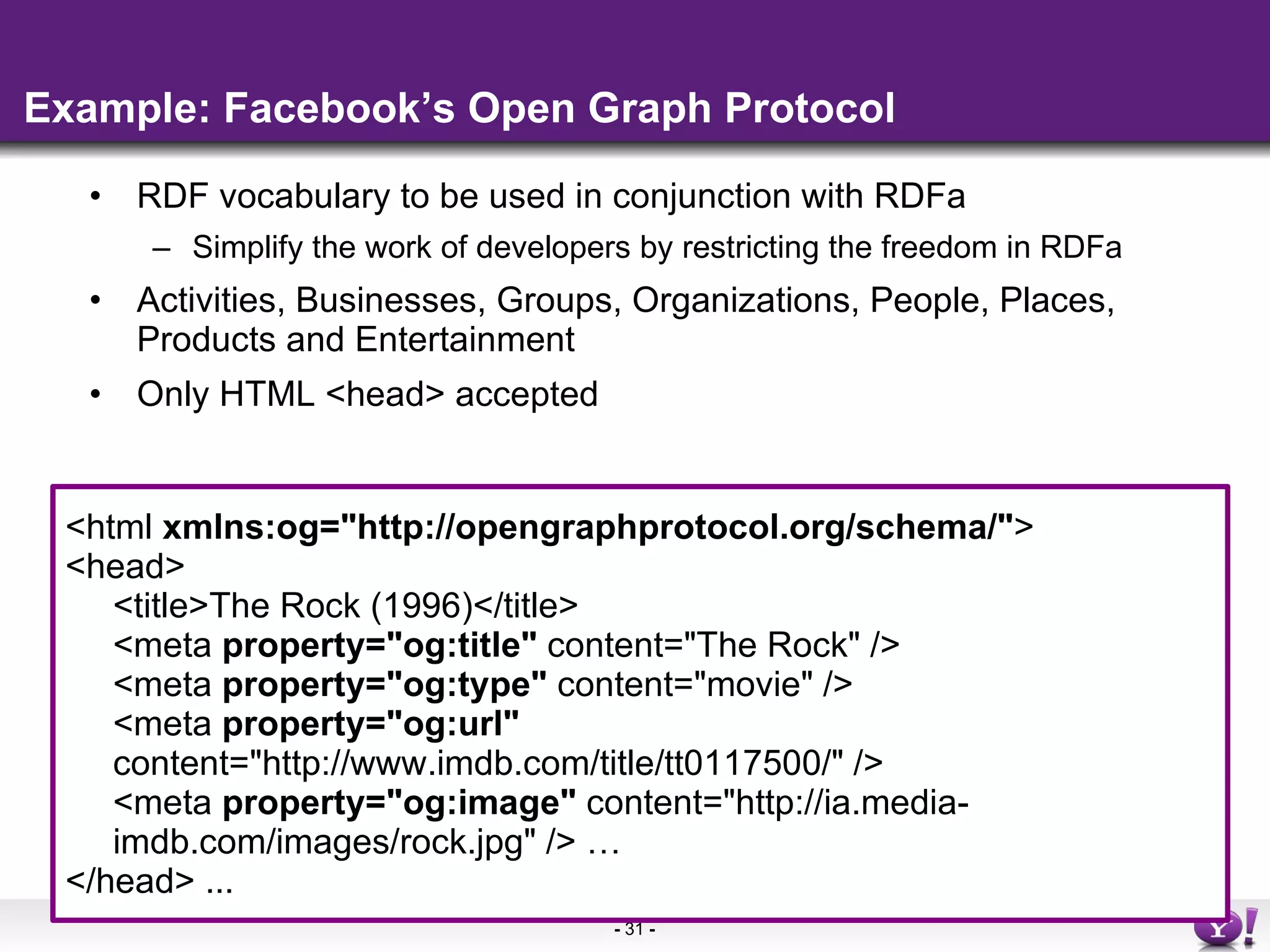
Example: Facebook’s Open Graph Protocol RDF vocabulary to be used in conjunction with RDFa Simplify the work of developers by restricting the freedom in RDFa Activities, Businesses, Groups, Organizations, People, Places, Products and Entertainment Only HTML <head> accepted <html  xmlns:og=&quot;http://opengraphprotocol.org/schema/&quot; >  <head>  <title>The Rock (1996)</title>  <meta  property=&quot;og:title&quot;  content=&quot;The Rock&quot; />  <meta  property=&quot;og:type&quot;  content=&quot;movie&quot; />  <meta  property=&quot;og:url&quot;  content=&quot;http://www.imdb.com/title/tt0117500/&quot; />  <meta  property=&quot;og:image&quot;  content=&quot;http://ia.media-imdb.com/images/rock.jpg&quot; /> … </head> ...
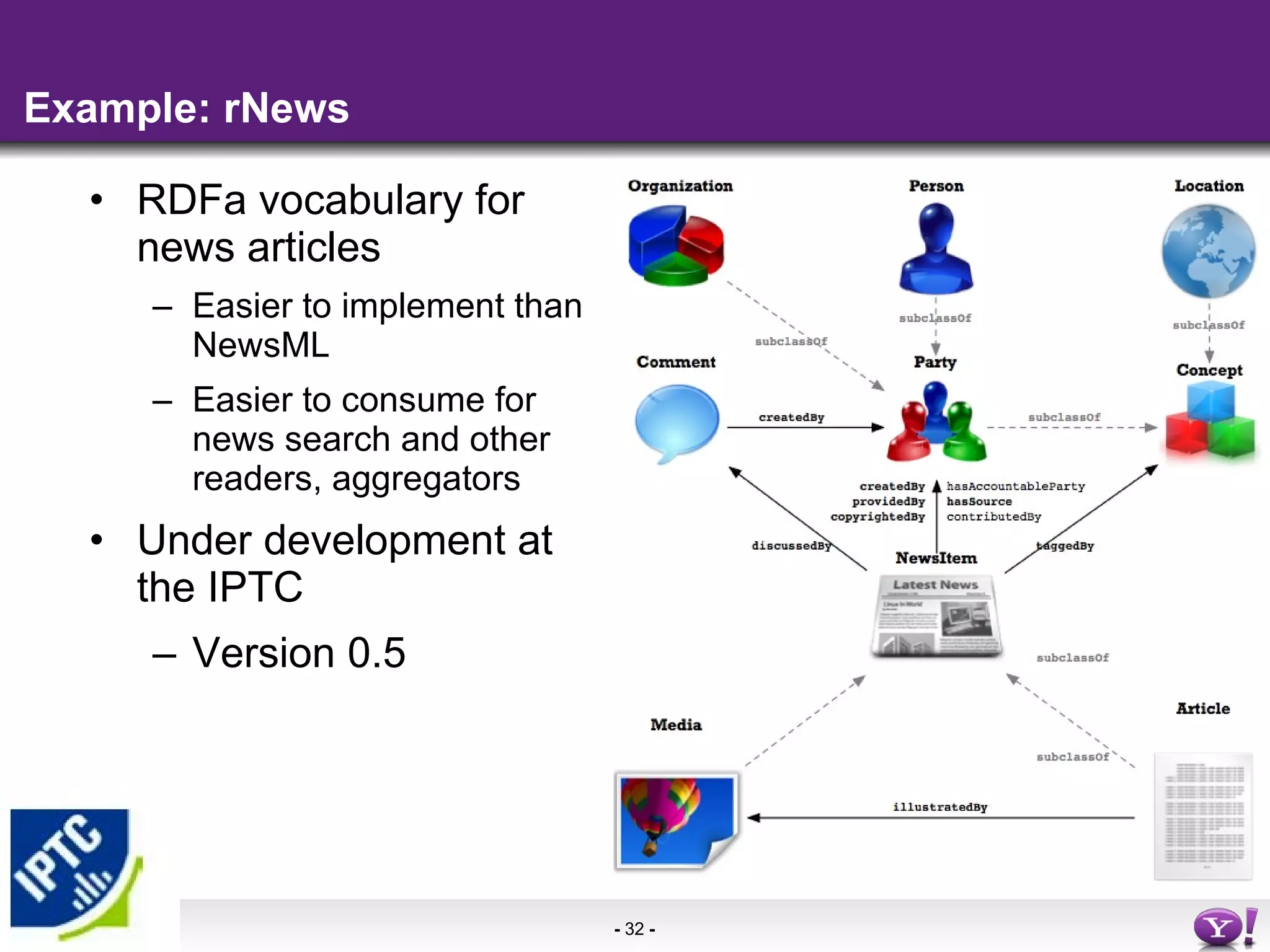
Example: rNews RDFa vocabulary for news articles Easier to implement than NewsML  Easier to consume for news search and other readers, aggregators Under development at the IPTC Version 0.5
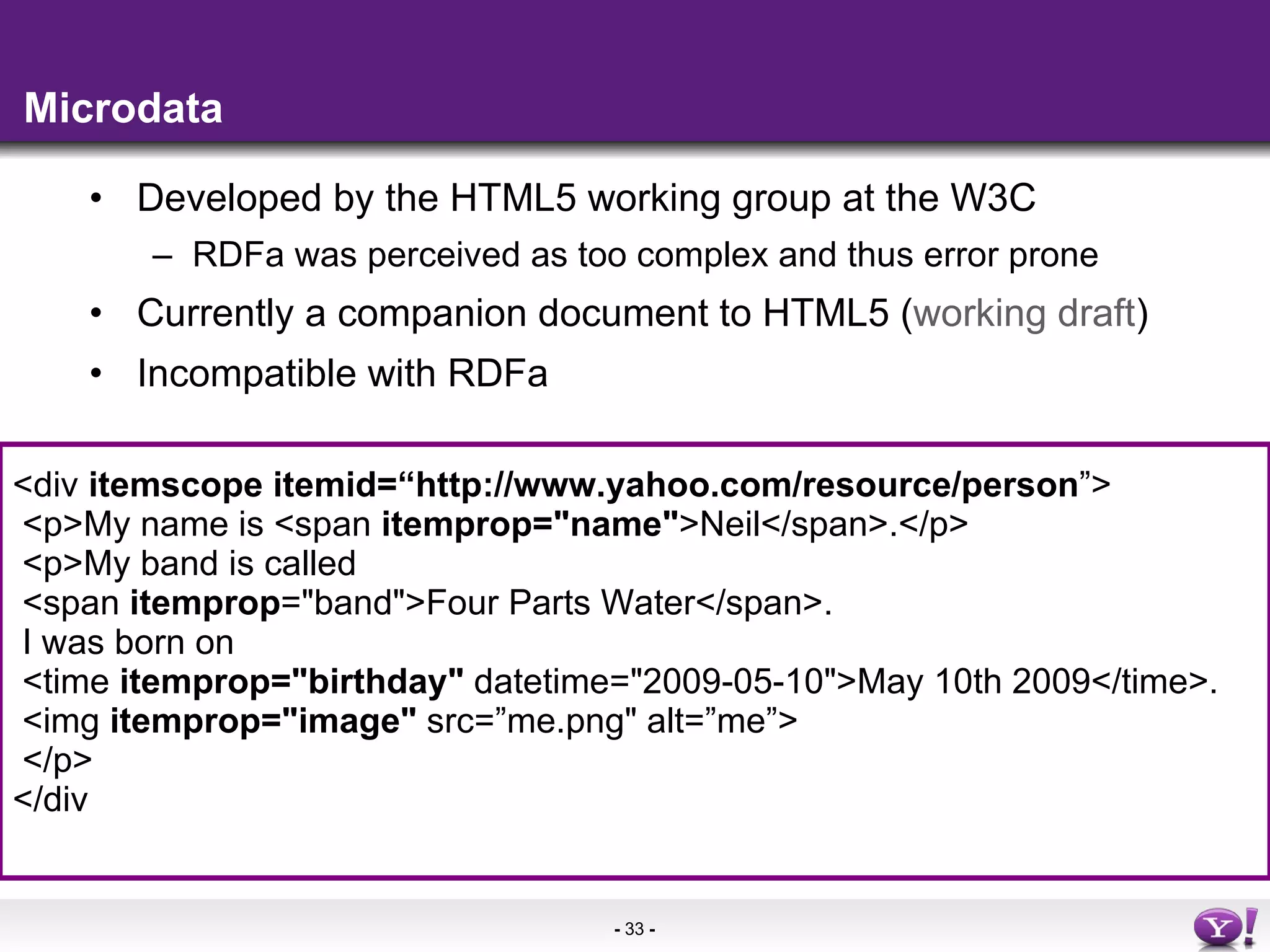
Microdata Developed by the HTML5 working group at the W3C RDFa was perceived as too complex and thus error prone Currently a companion document to HTML5 ( working draft ) Incompatible with RDFa  <div  itemscope itemid=“http://www.yahoo.com/resource/person ”> <p>My name is <span  itemprop=&quot;name&quot; >Neil</span>.</p> <p>My band is called  <span  itemprop =&quot;band&quot;>Four Parts Water</span>. I was born on  <time  itemprop=&quot;birthday&quot;  datetime=&quot;2009-05-10&quot;>May 10th 2009</time>. <img  itemprop=&quot;image&quot;  src=”me.png&quot; alt=”me”> </p> </div
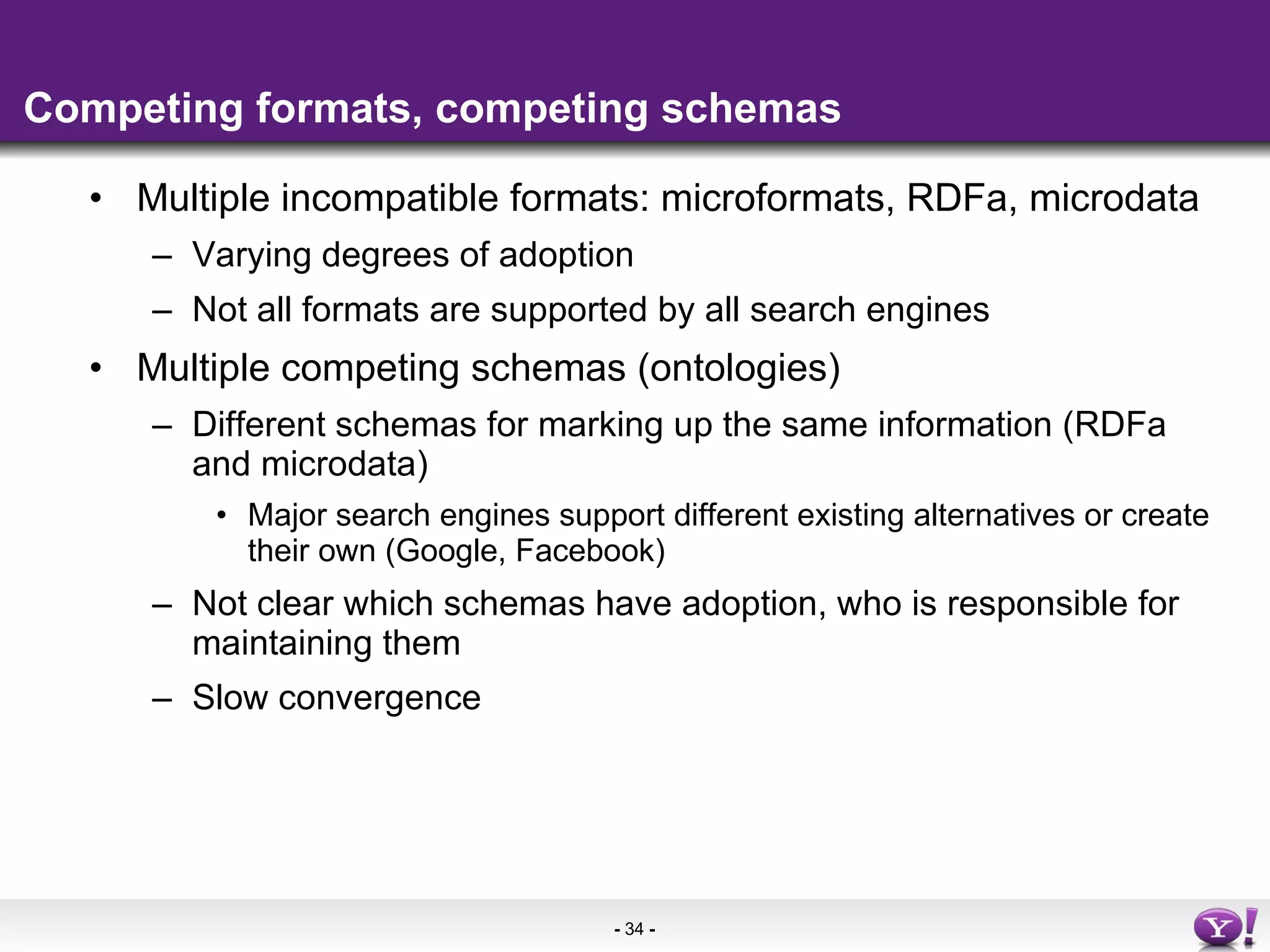
Competing formats, competing schemas Multiple incompatible formats: microformats, RDFa, microdata Varying degrees of adoption Not all formats are supported by all search engines Multiple competing schemas (ontologies) Different schemas for marking up the same information (RDFa and microdata) Major search engines support different existing alternatives or create their own (Google, Facebook) Not clear which schemas have adoption, who is responsible for maintaining them Slow convergence
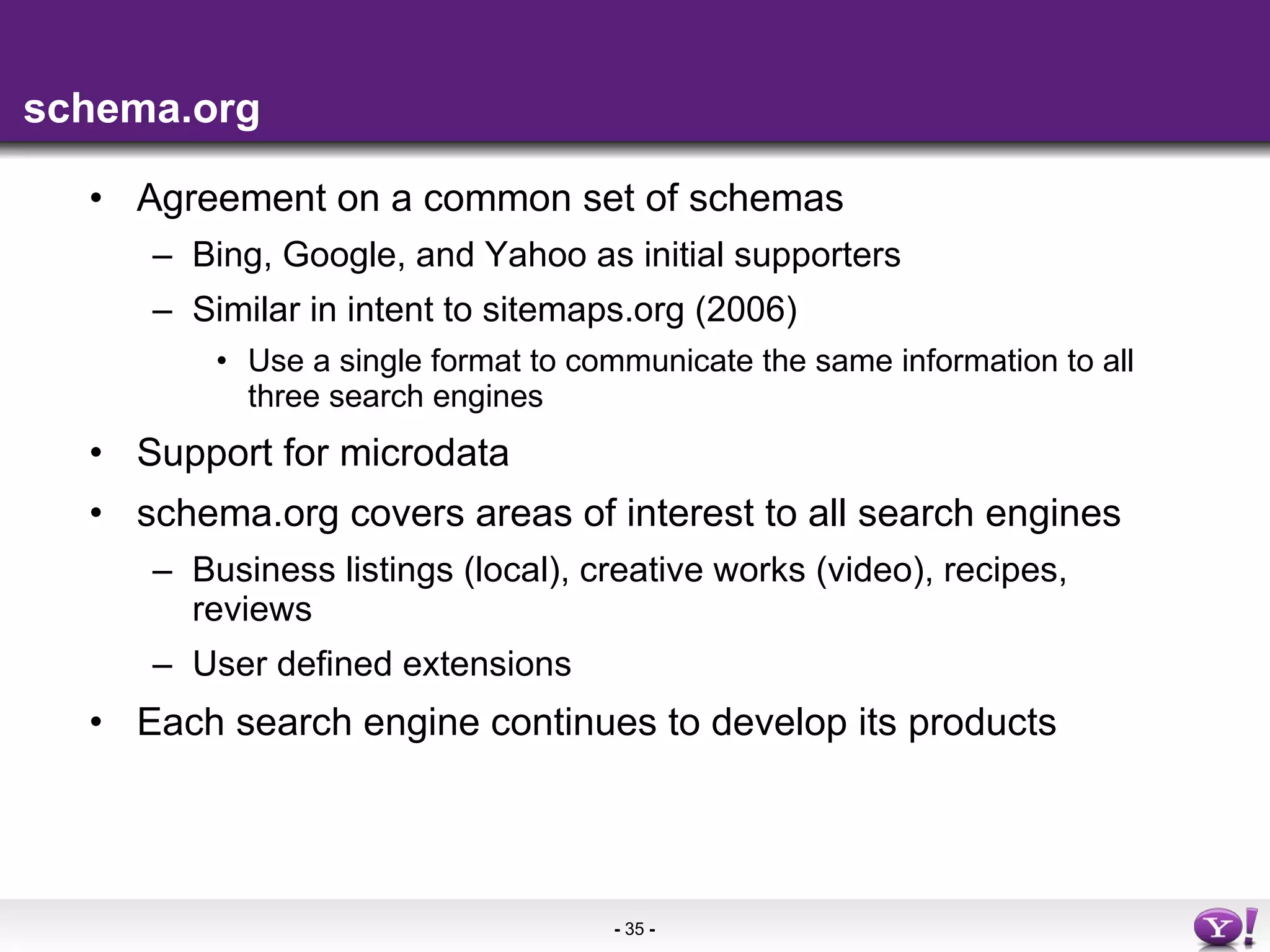
schema.org Agreement on a common set of schemas Bing, Google, and Yahoo as initial supporters Similar in intent to sitemaps.org (2006) Use a single format to communicate the same information to all three search engines Support for microdata schema.org covers areas of interest to all search engines Business listings (local), creative works (video), recipes, reviews User defined extensions Each search engine continues to develop its products
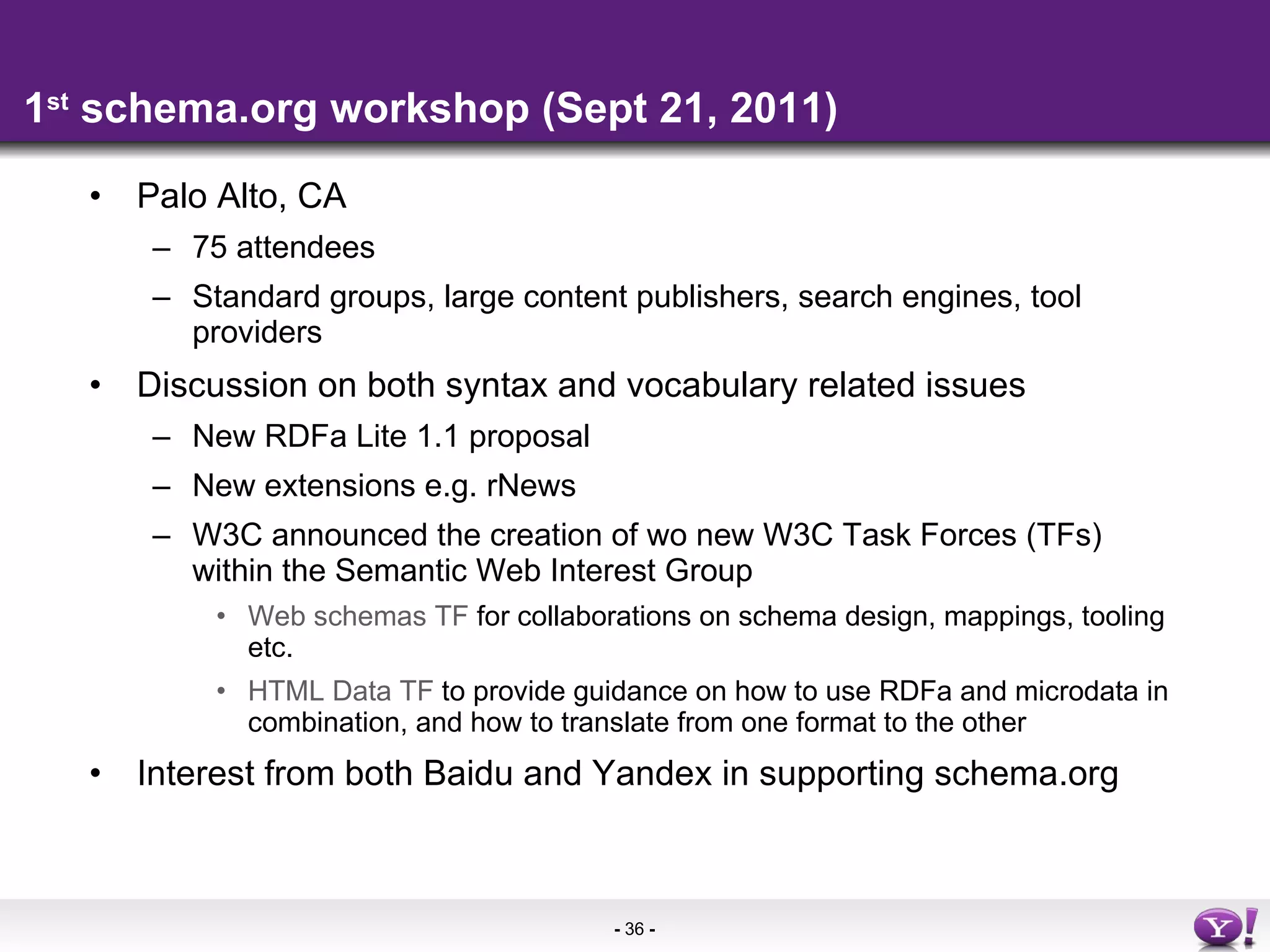
1 st  schema.org workshop (Sept 21, 2011) Palo Alto, CA 75 attendees Standard groups, large content publishers, search engines, tool providers Discussion on both syntax and vocabulary related issues New RDFa Lite 1.1 proposal New extensions e.g. rNews W3C announced the creation of wo new W3C Task Forces (TFs) within the Semantic Web Interest Group Web schemas TF  for collaborations on schema design, mappings, tooling etc. HTML Data TF  to provide guidance on how to use RDFa and microdata in combination, and how to translate from one format to the other Interest from both Baidu and Yandex in supporting schema.org
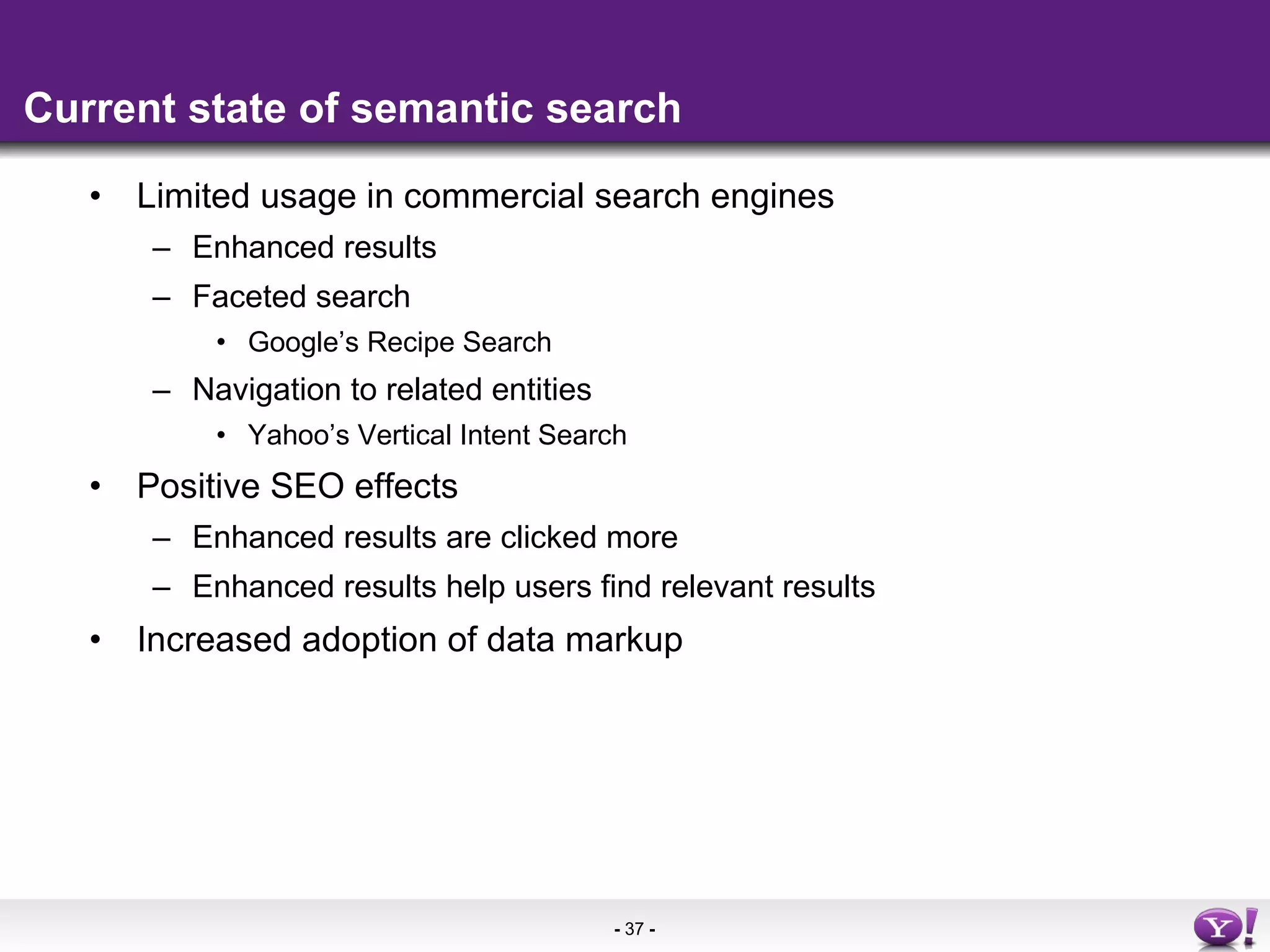
Current state of semantic search Limited usage in commercial search engines Enhanced results Faceted search  Google’s Recipe Search Navigation to related entities Yahoo’s Vertical Intent Search  Positive SEO effects Enhanced results are clicked more Enhanced results help users find relevant results  Increased adoption of data markup
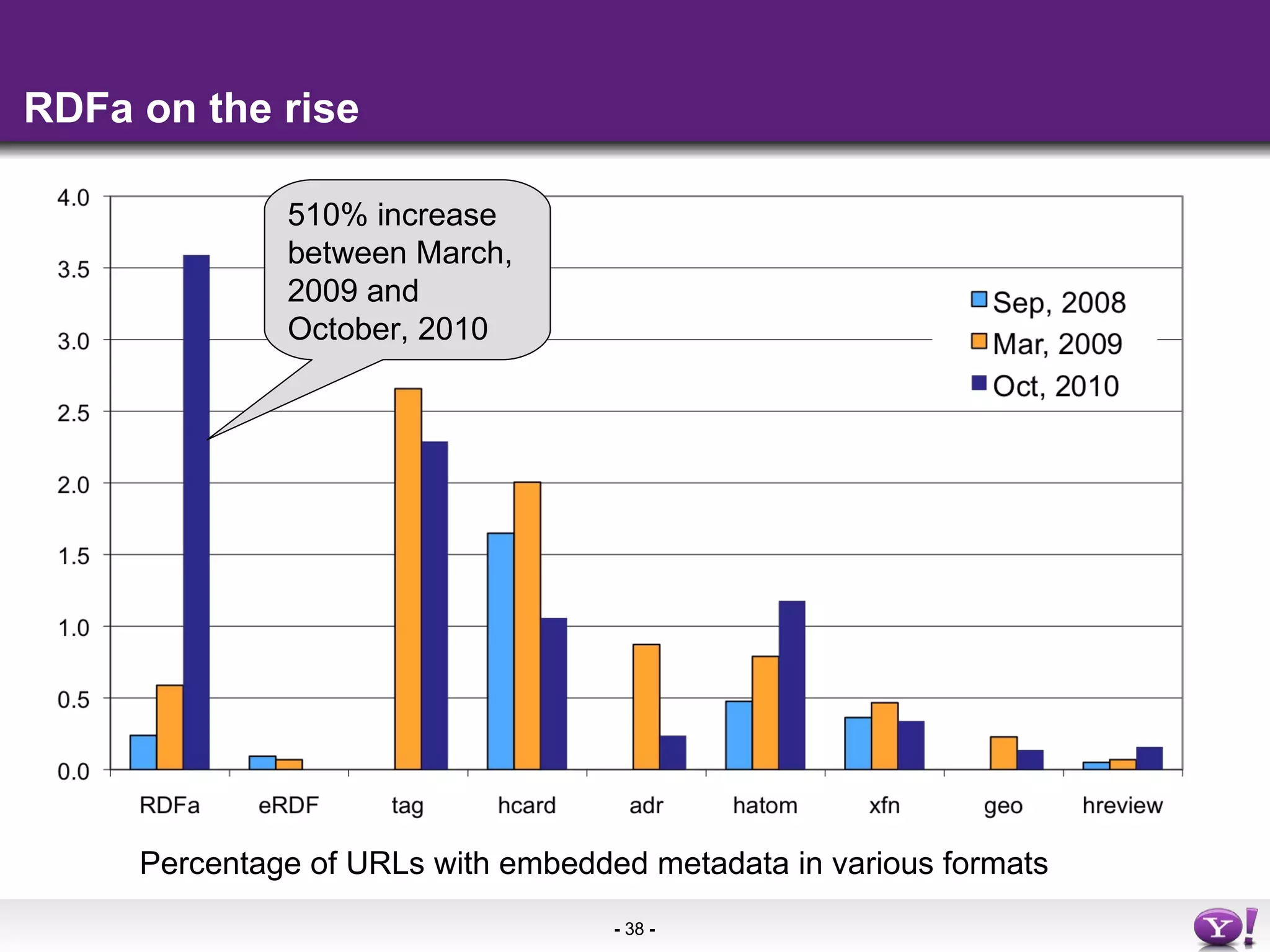
RDFa on the rise Percentage of URLs with embedded metadata in various formats 510% increase between March, 2009 and October, 2010
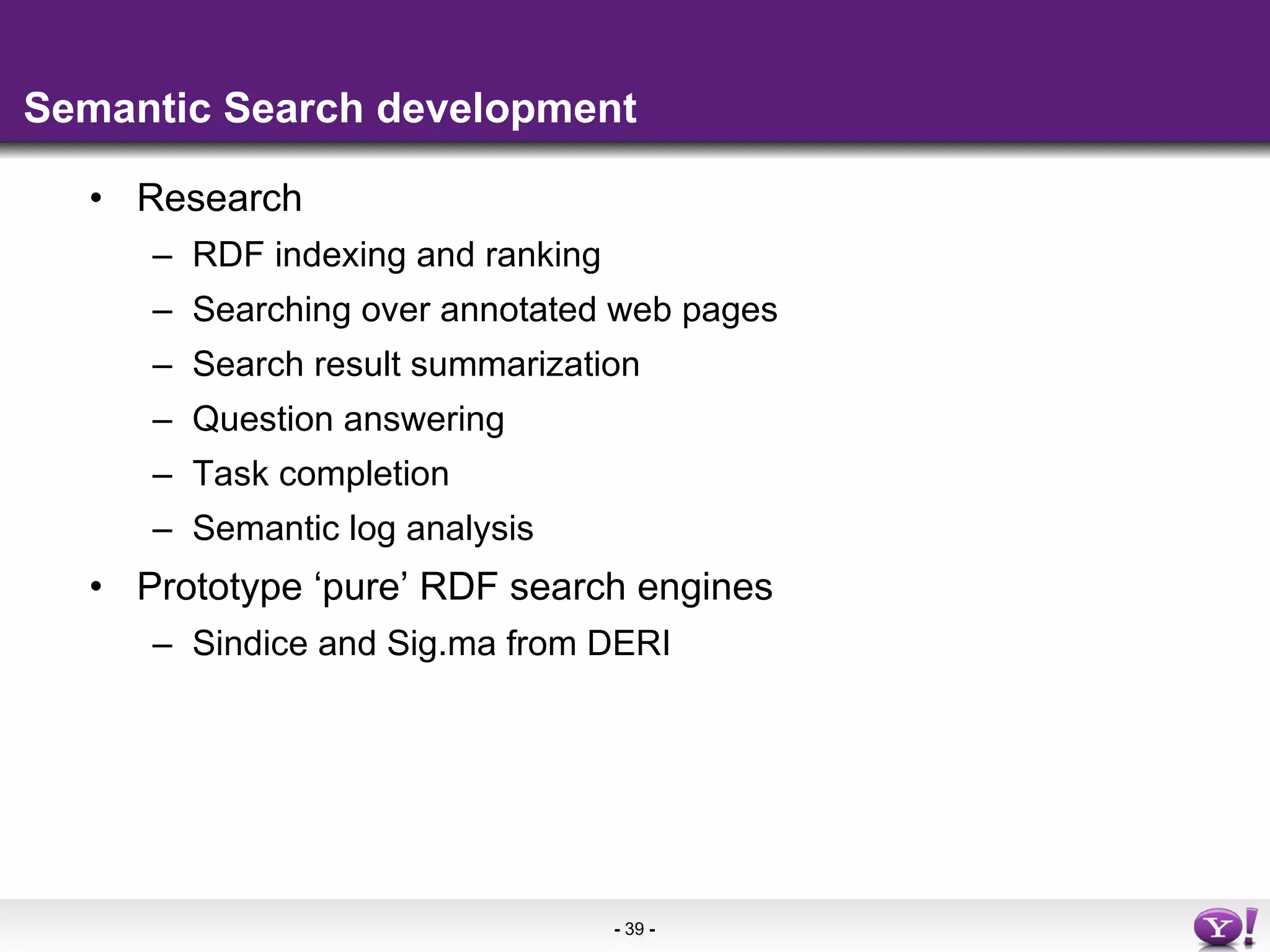
Semantic Search development Research RDF indexing and ranking Searching over annotated web pages Search result summarization Question answering Task completion Semantic log analysis Prototype ‘pure’ RDF search engines Sindice and Sig.ma from DERI
Semantic technologies for Data Integration
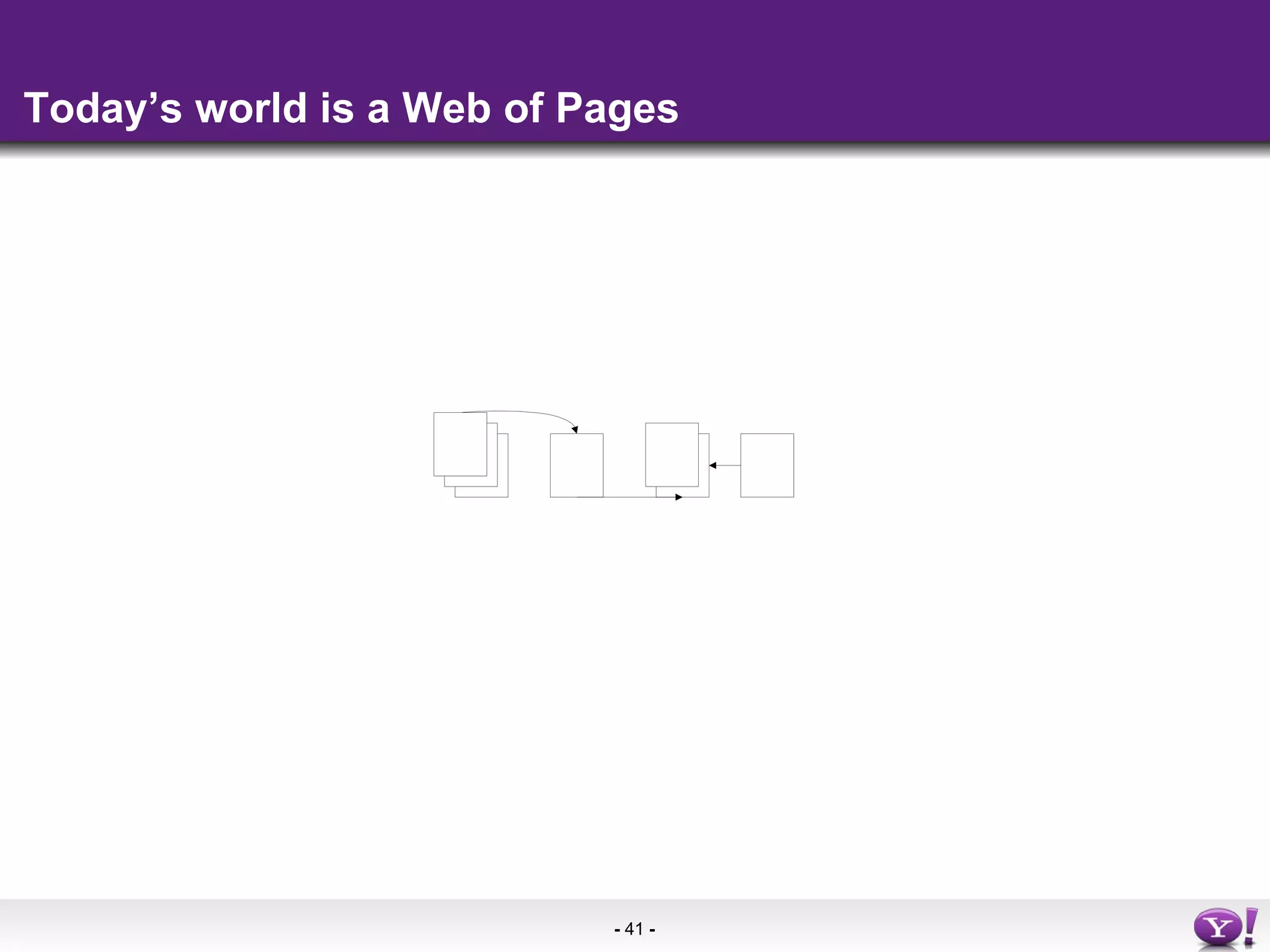
Today’s world is a Web of Pages
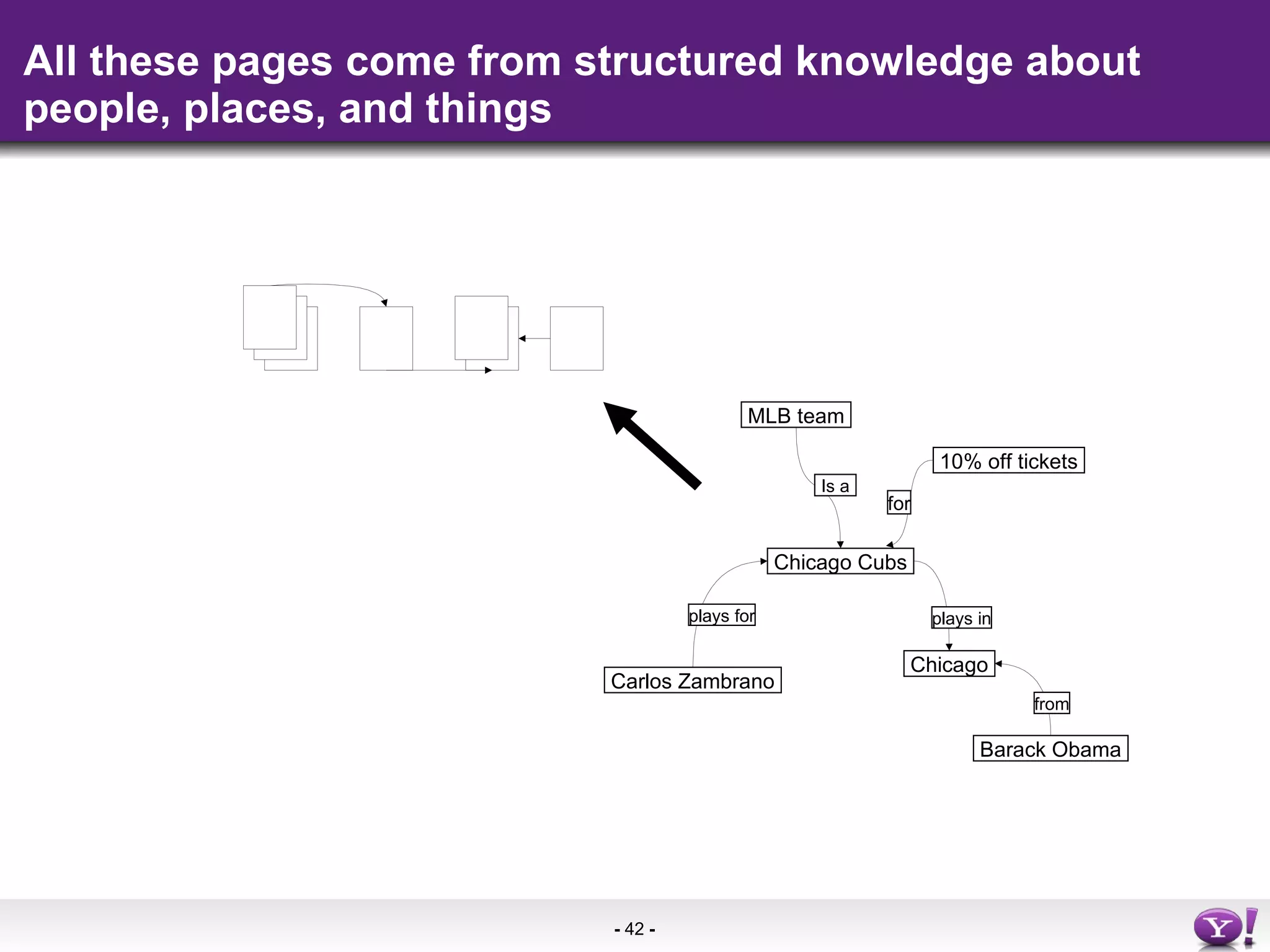
All these pages come from structured knowledge about people, places, and things MLB team Chicago Cubs Is a Chicago Barack Obama Carlos Zambrano 10% off tickets for plays for plays in from
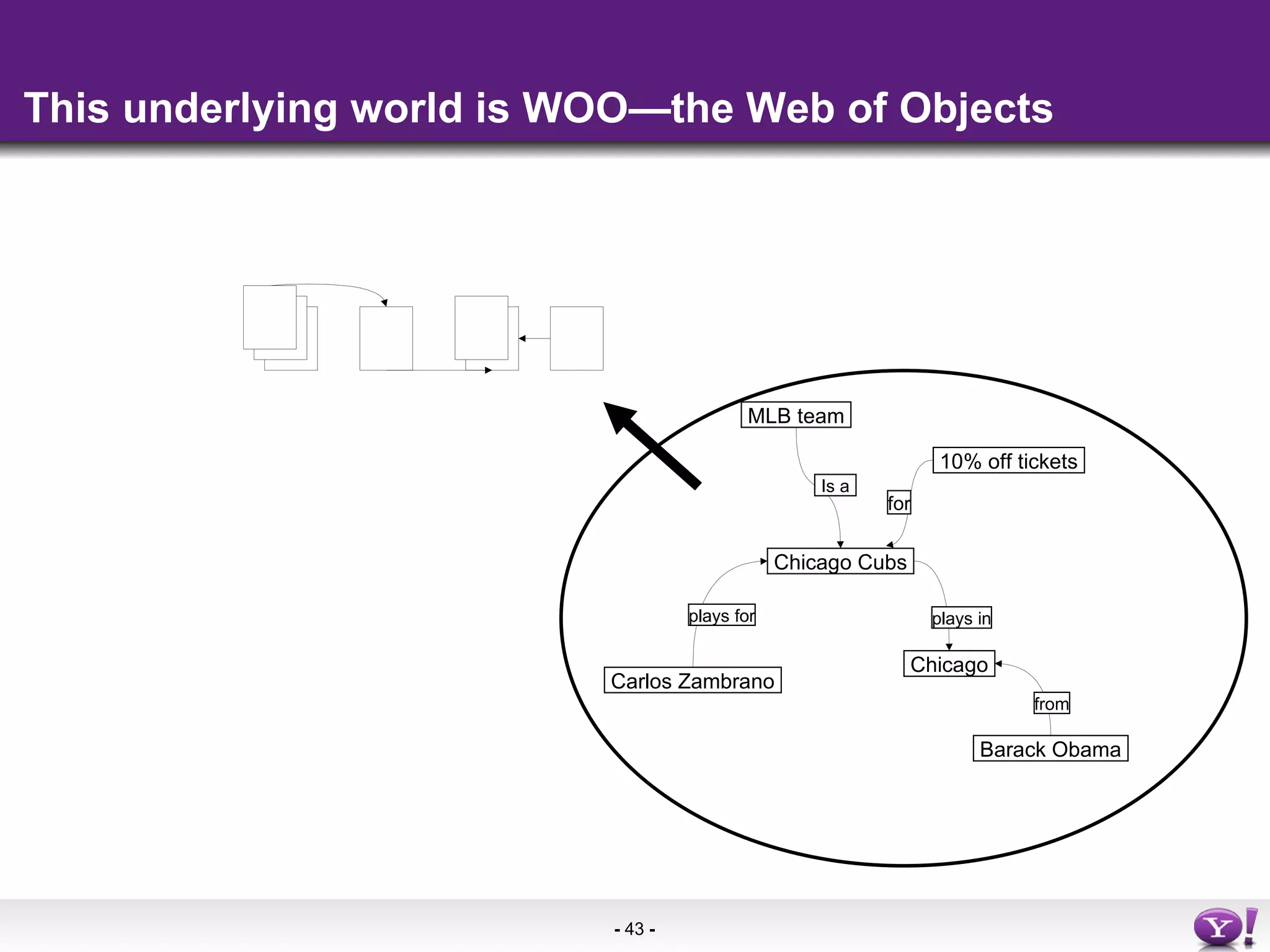
This underlying world is WOO—the Web of Objects MLB team Chicago Cubs Is a Chicago Barack Obama Carlos Zambrano 10% off tickets for plays for plays in from
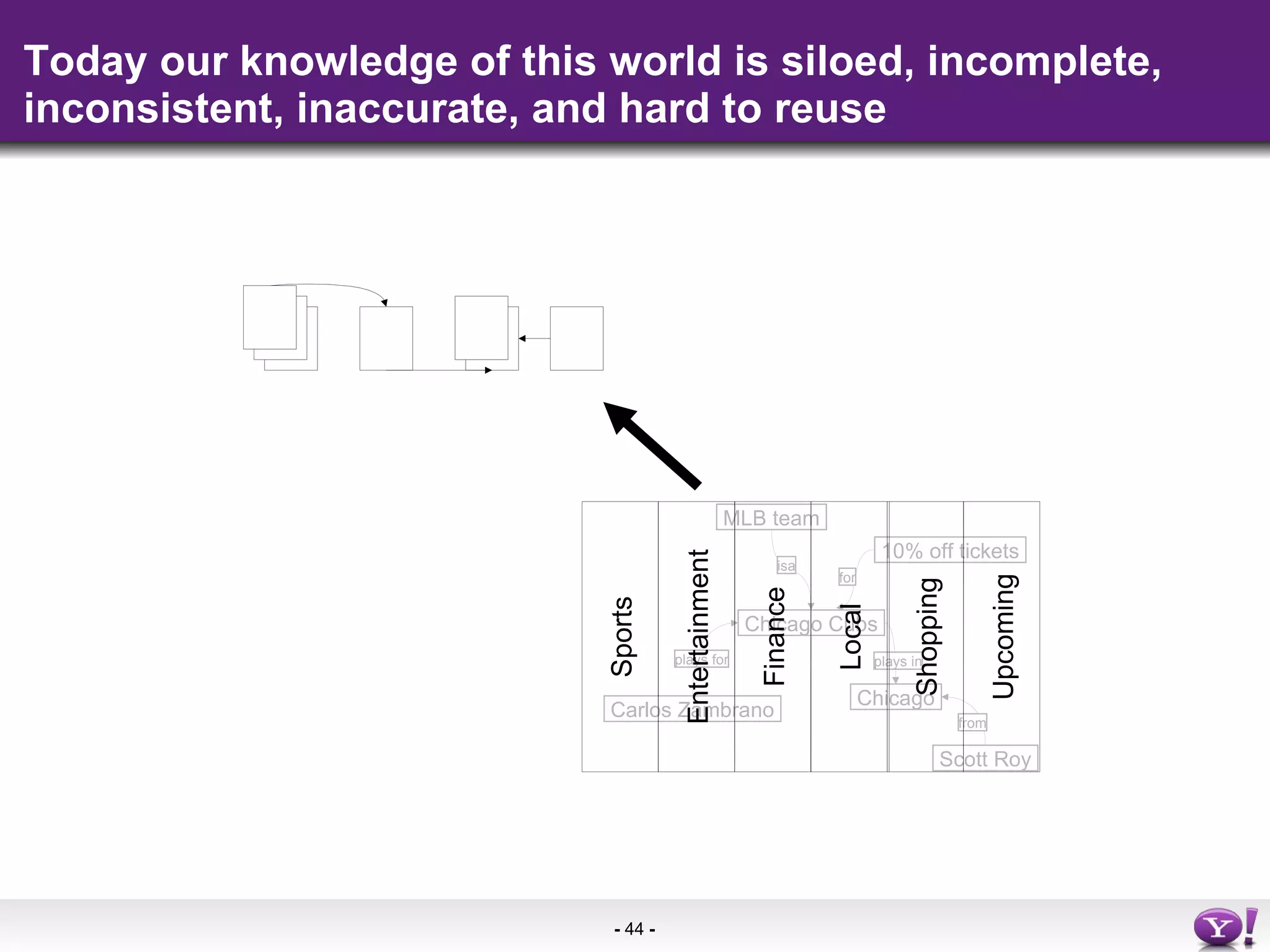
Today our knowledge of this world is siloed, incomplete, inconsistent, inaccurate, and hard to reuse Sports Entertainment Finance Local Shopping Upcoming MLB team Chicago Cubs isa Chicago Scott Roy Carlos Zambrano 10% off tickets for plays for plays in from
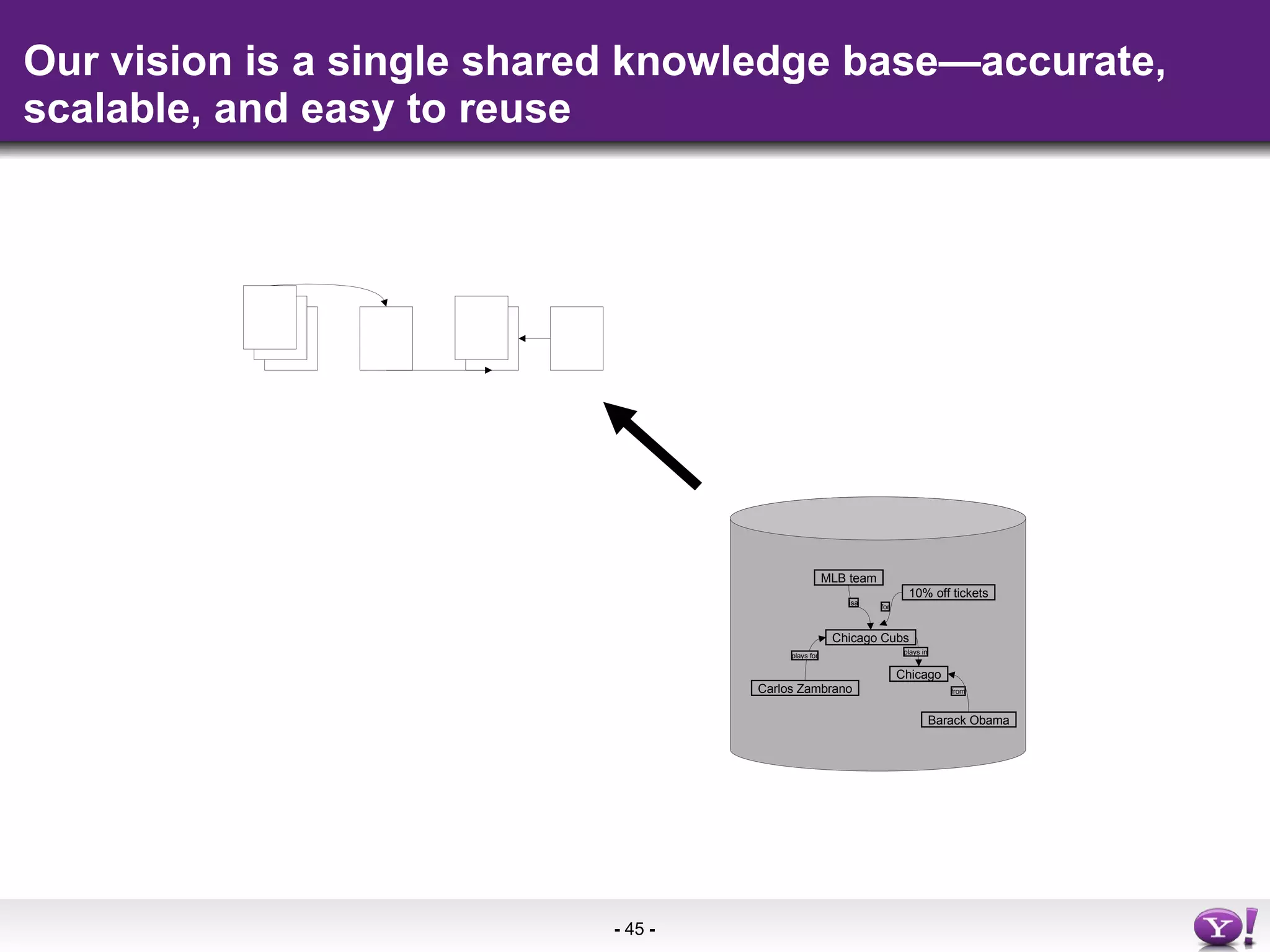
Our vision is a single shared knowledge base—accurate, scalable, and easy to reuse MLB team Chicago Cubs isa Chicago Barack Obama Carlos Zambrano 10% off tickets for plays for plays in from
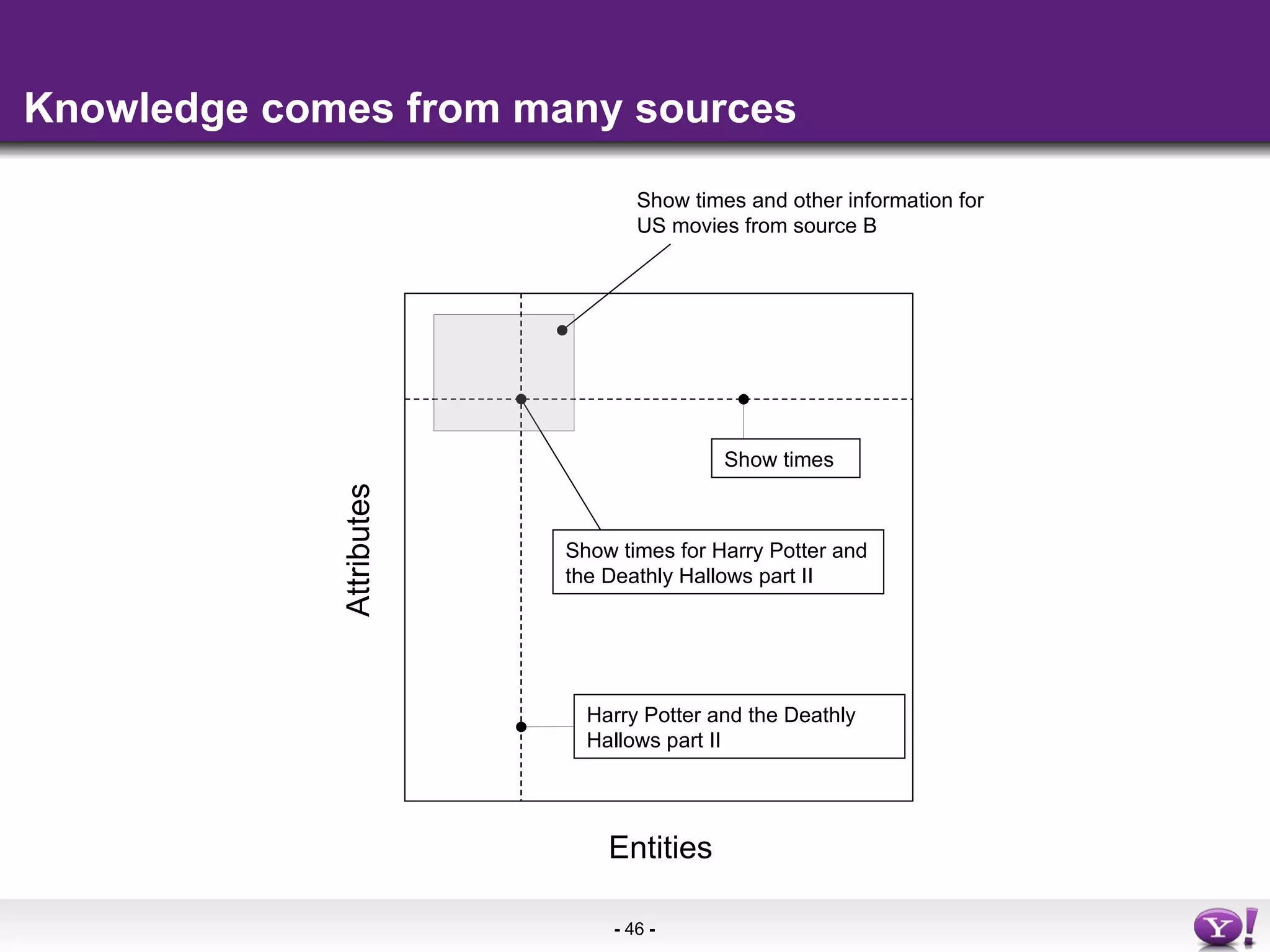
Knowledge comes from many sources Entities Attributes Show times and other information for US movies from source B Harry Potter and the Deathly Hallows part II Show times Show times for Harry Potter and the Deathly Hallows part II
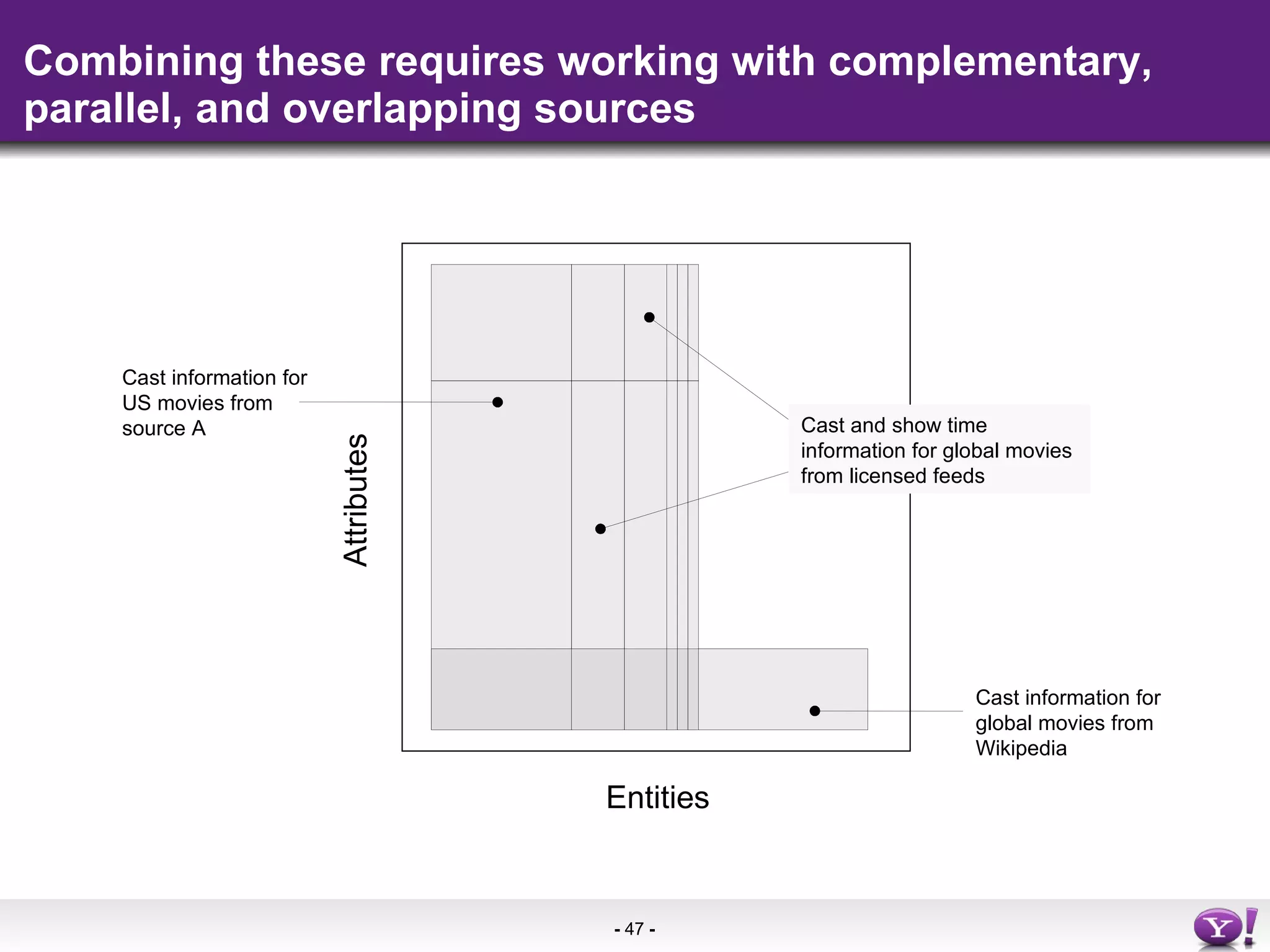
Combining these requires working with complementary, parallel, and overlapping sources Attributes Entities Cast information for global movies from Wikipedia Cast information for US movies from source A Cast and show time information for global movies from licensed feeds
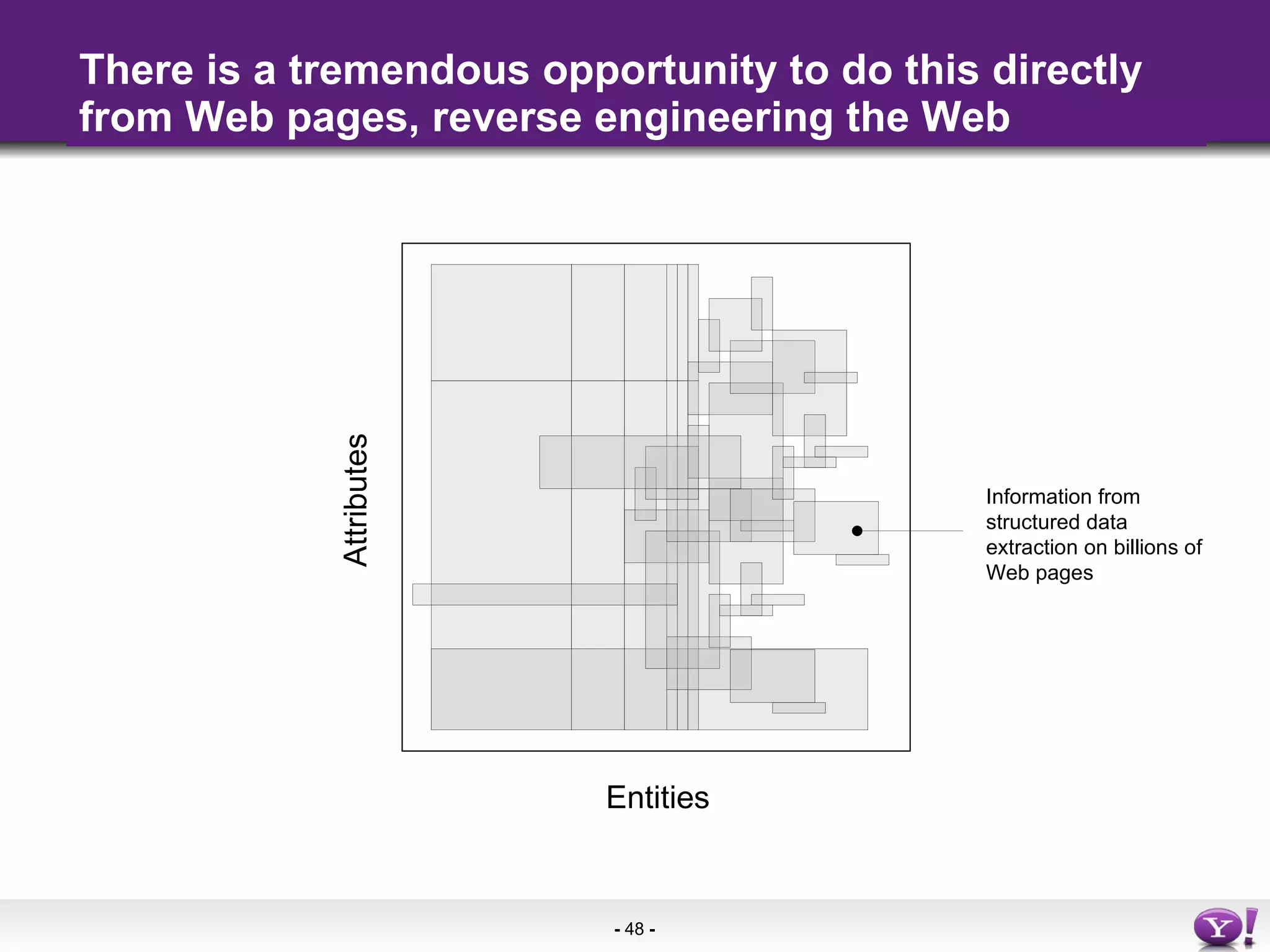
There is a tremendous opportunity to do this directly from Web pages, reverse engineering the Web Attributes Entities Information from structured data extraction on billions of Web pages
Semantic technologies for data integration Semantic Web provides the basic technologies for Linked Data  URIs as unique identifiers Retrieve data from the (internal) web Follow links in the data that is returned RDF as a common data format OWL as a powerful schema language for validation and reasoning SPARQL for queries, reasoning and transformations
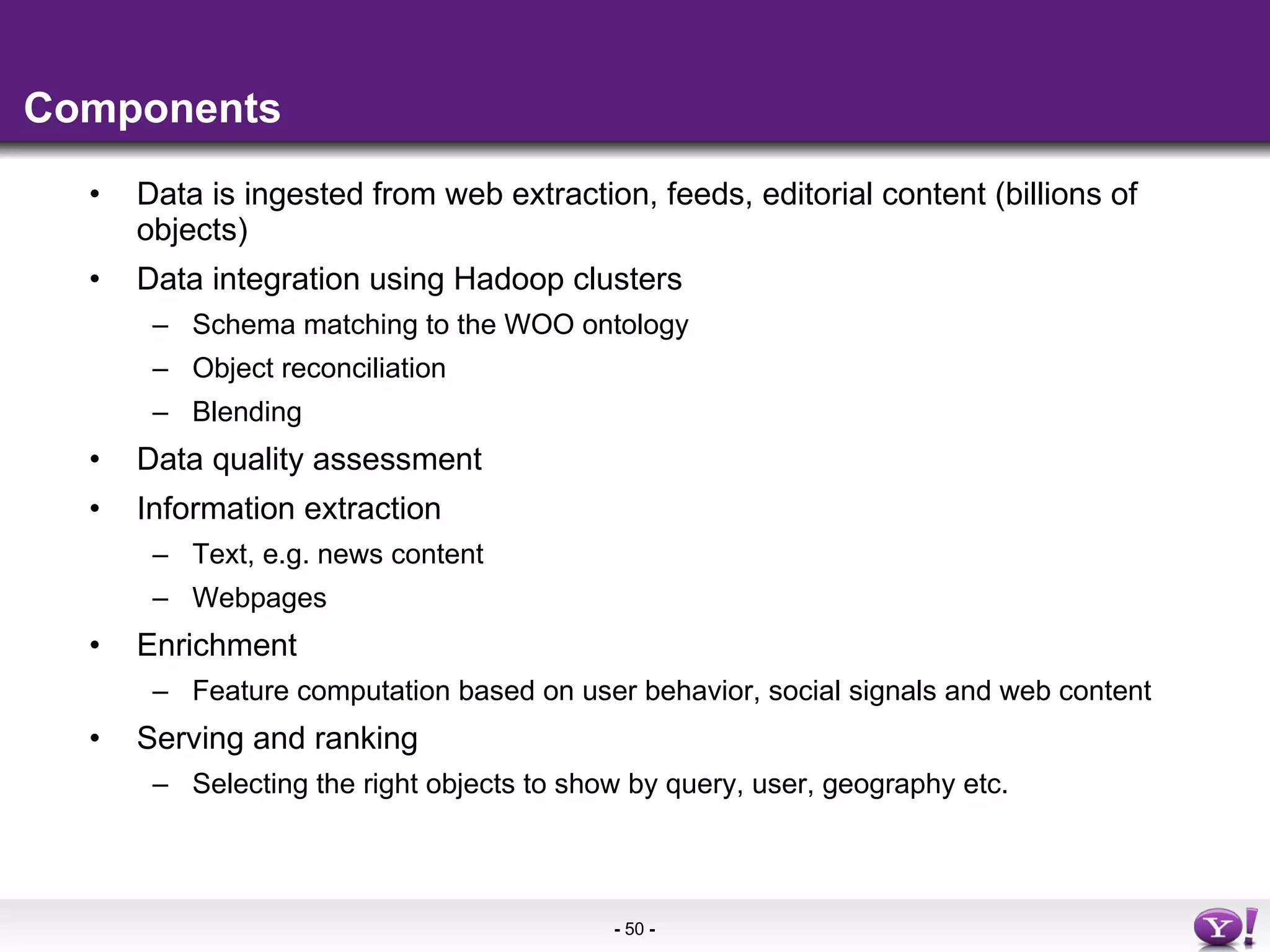
Components Data is ingested from web extraction, feeds, editorial content (billions of objects) Data integration using Hadoop clusters Schema matching to the WOO ontology Object reconciliation Blending Data quality assessment Information extraction Text, e.g. news content Webpages Enrichment Feature computation based on user behavior, social signals and web content Serving and ranking Selecting the right objects to show by query, user, geography etc.
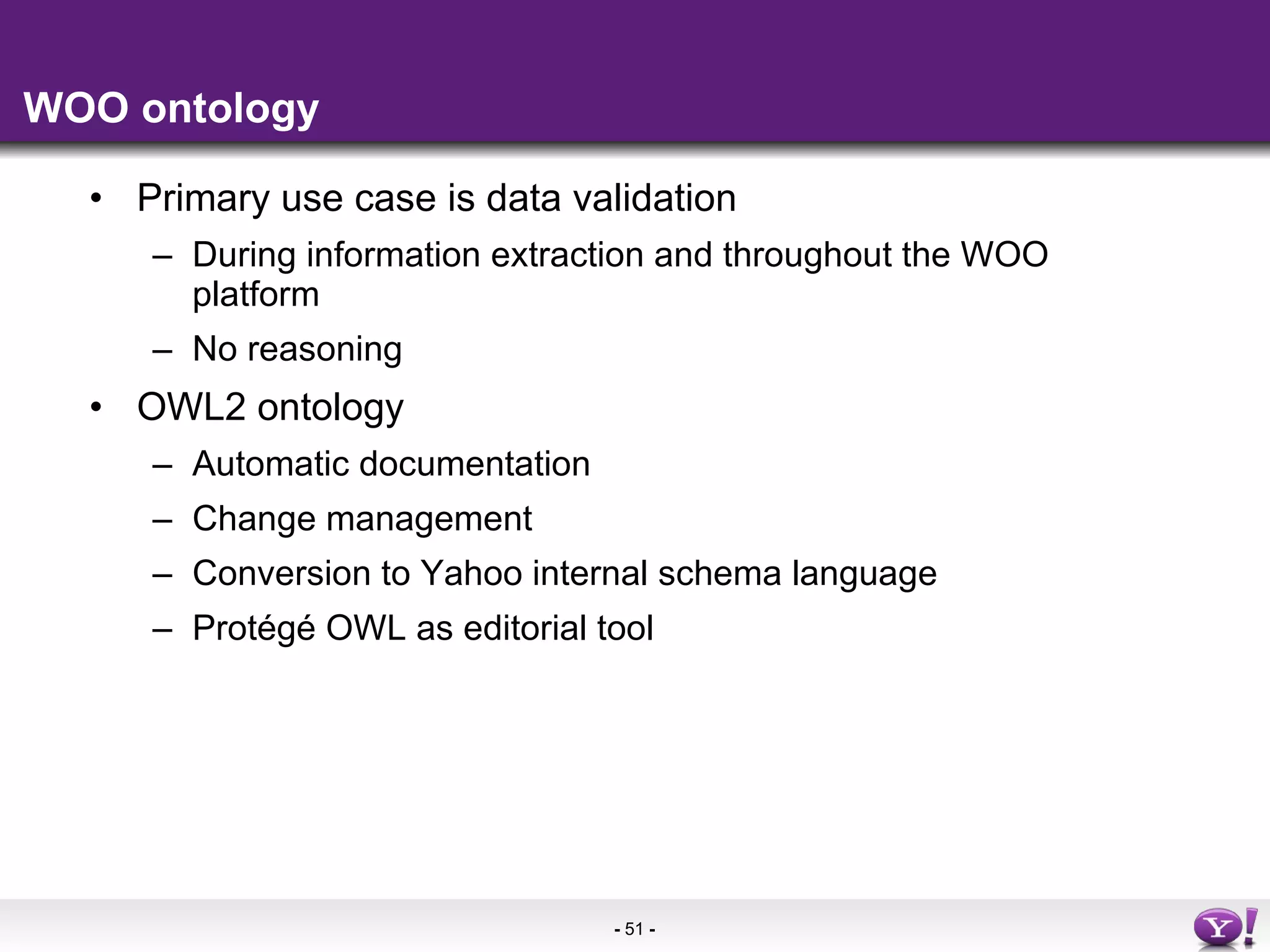
WOO ontology Primary use case is data validation During information extraction and throughout the WOO platform No reasoning OWL2 ontology Automatic documentation Change management Conversion to Yahoo internal schema language Protégé OWL as editorial tool
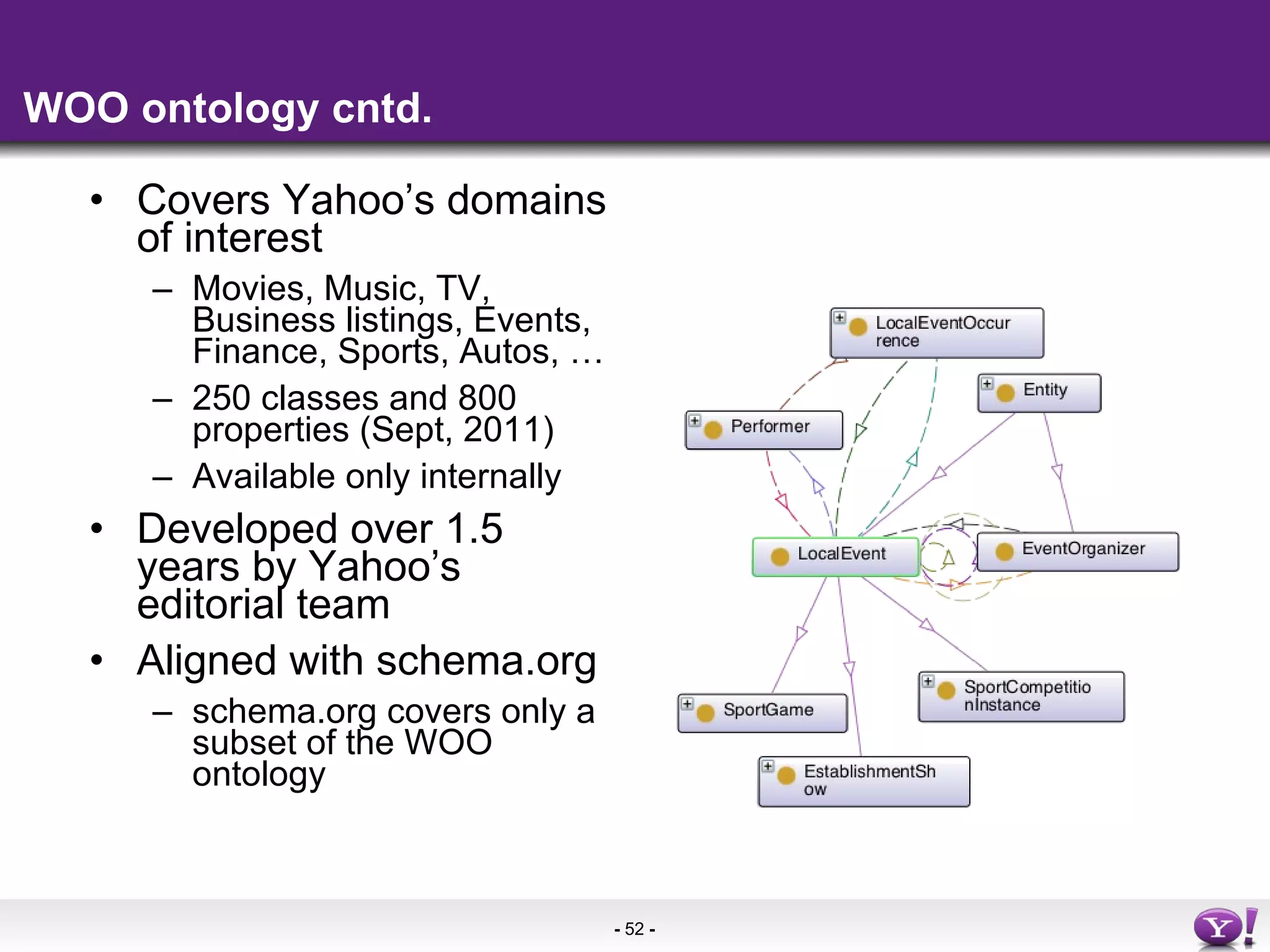
WOO ontology cntd. Covers Yahoo’s domains of interest Movies, Music, TV, Business listings, Events, Finance, Sports, Autos, … 250 classes and 800 properties (Sept, 2011) Available only internally Developed over 1.5 years by Yahoo’s editorial team Aligned with schema.org schema.org covers only a subset of the WOO ontology
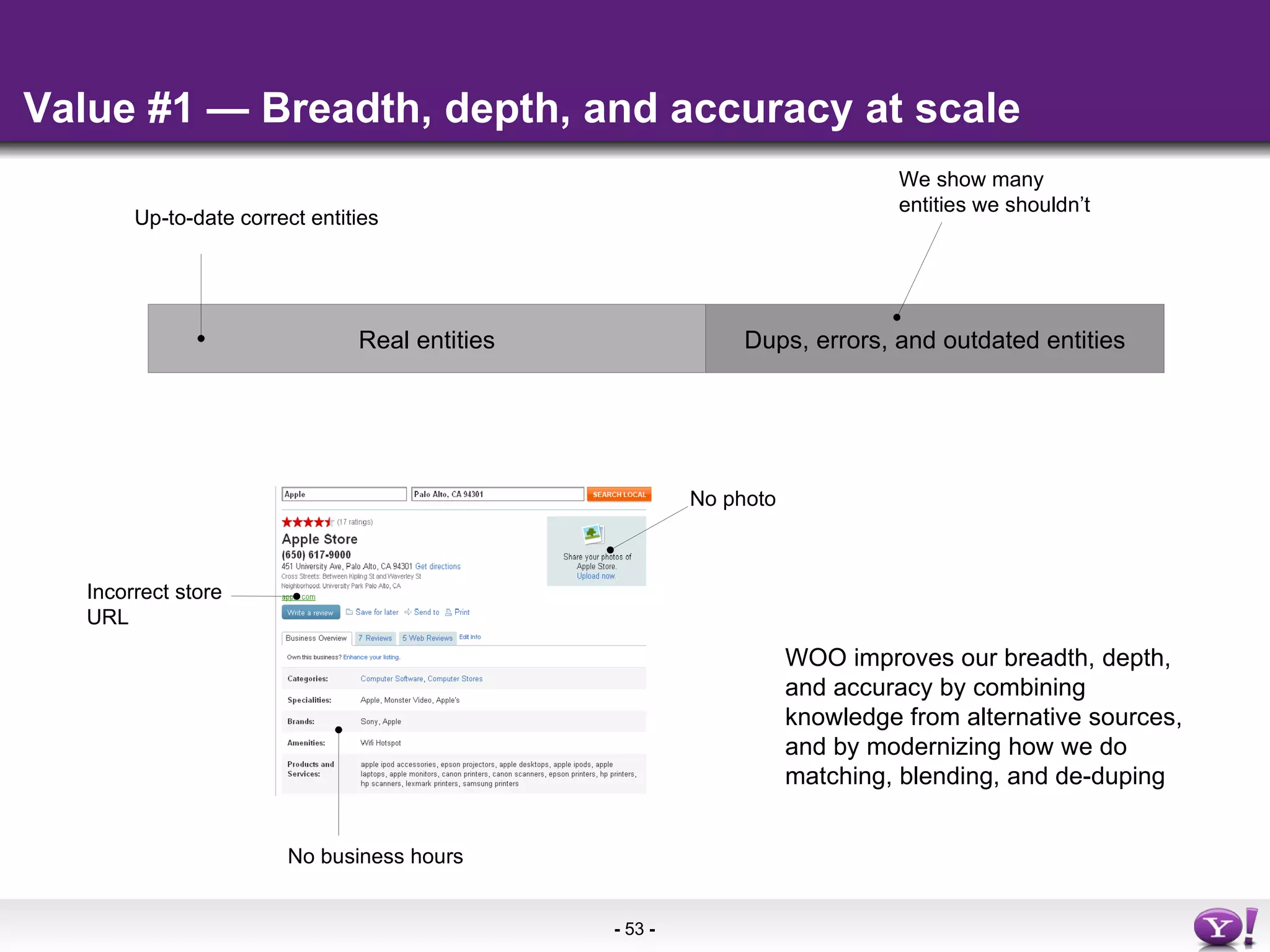
Value #1 — Breadth, depth, and accuracy at scale Real entities Dups, errors, and outdated entities Up-to-date correct entities  Incorrect store URL No photo We show many entities we shouldn’t No business hours WOO improves our breadth, depth, and accuracy by combining knowledge from alternative sources, and by modernizing how we do matching, blending, and de-duping
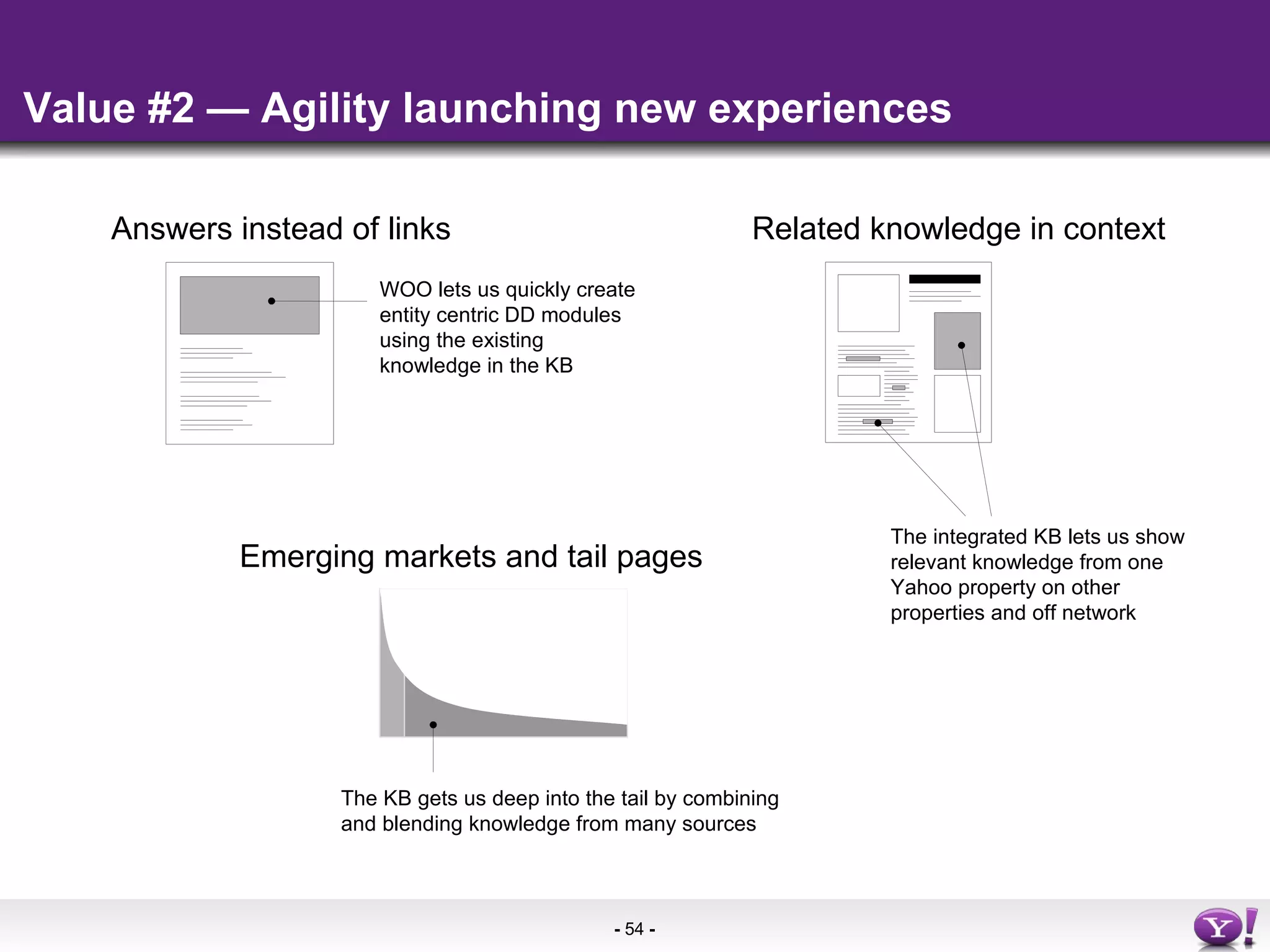
Value #2 — Agility launching new experiences Answers instead of links WOO lets us quickly create entity centric DD modules using the existing knowledge in the KB Related knowledge in context The integrated KB lets us show relevant knowledge from one Yahoo property on other properties and off network Emerging markets and tail pages The KB gets us deep into the tail by combining and blending knowledge from many sources
Other potential benefits Dynamic interlinking of content E.g. direct links from Yahoo! News to background information in Yahoo! Music about an artist Dynamic composition of web pages Topic-entity pages Better understanding of user intent Semantic analysis of query logs Semantic analysis of navigation paths Exposure of Yahoo! content using standard technologies Linking to external sources to make it part of the Linked Data cloud
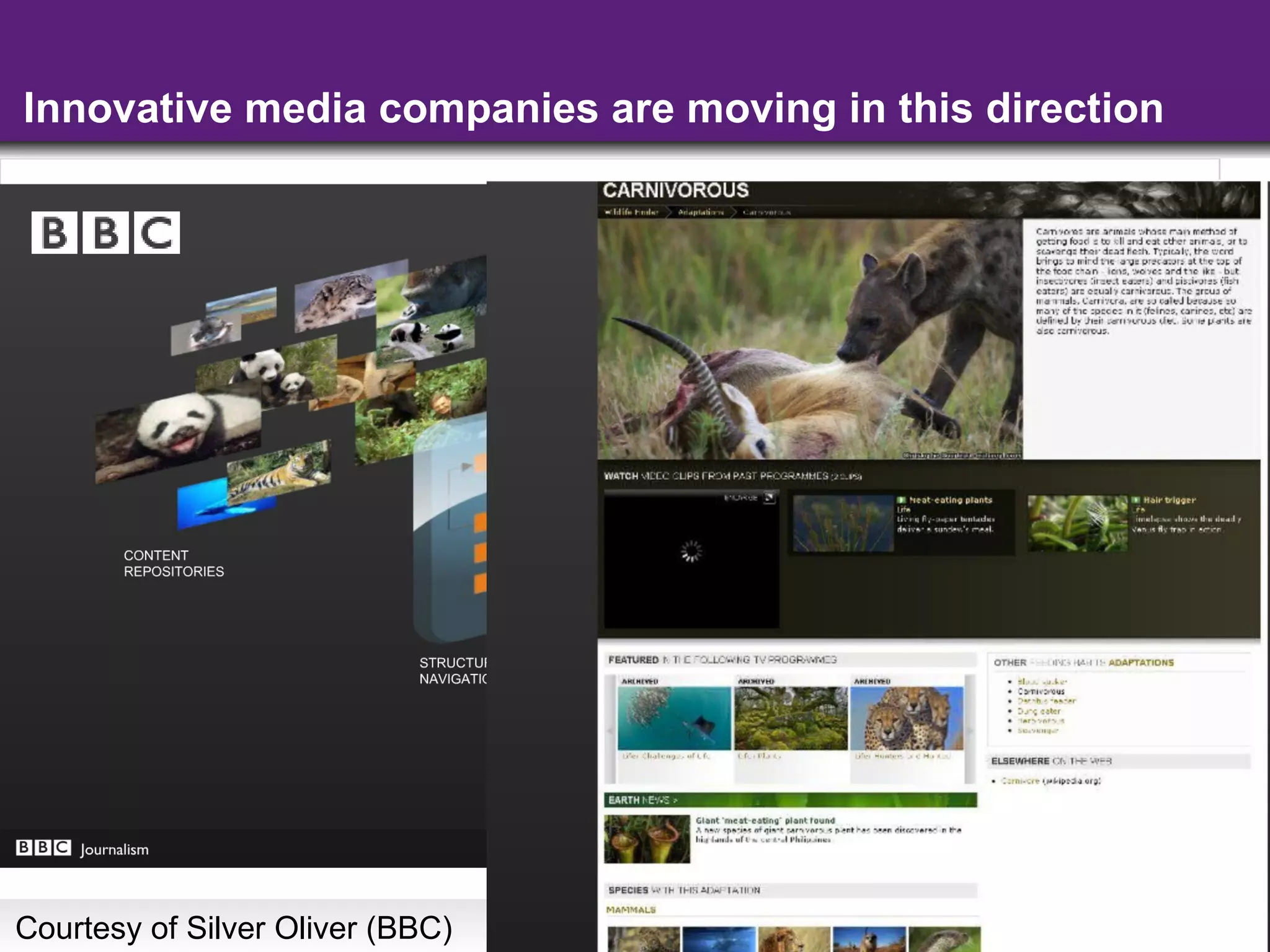
Innovative media companies are moving in this direction Courtesy of Silver Oliver (BBC)
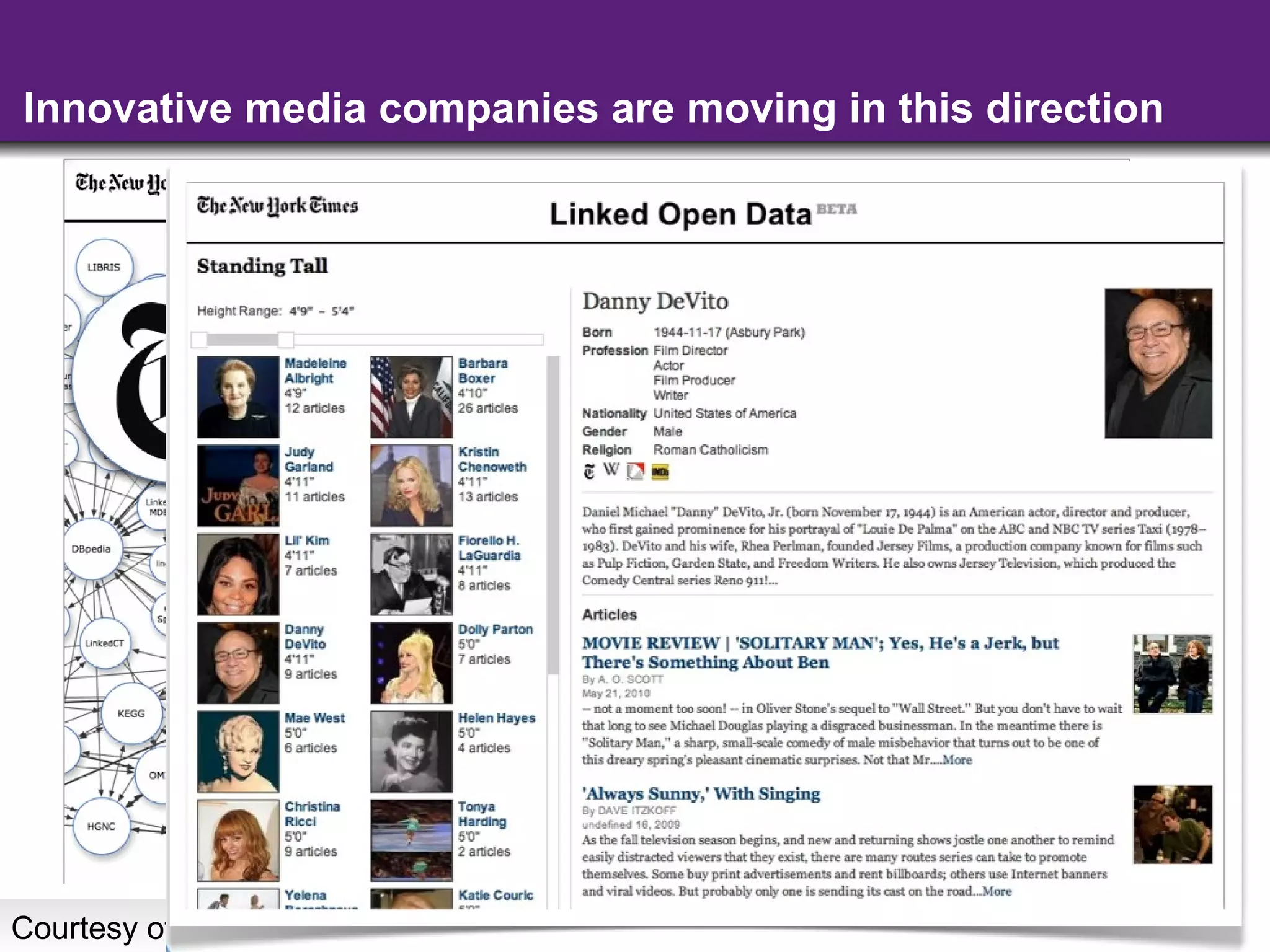
Innovative media companies are moving in this direction Courtesy of Evan Sandhaus (NYT).
Take home: use what works! The W3C’s semantic technology stack is daunting The basics are simple:  URIs for entity identifiers, RDF for data exchange Standards for embedding data in HTML Useful in search and at other points of content consumption Standards for expressing the meaning of data Useful in data integration Do your bit!
The End Credits to many people from Yahoo! around the world Contact me at [email_address]

Making the Web searchable

  • 1.
    Making the WebSearchable Peter Mika Senior Researcher and Data Architect Yahoo! Inc.
  • 2.
    Agenda Web DirectionsConvergence of Search and Online Media Semantic technologies (th)at work Semantics for search RDFa, microdata Semantics for data integration RDF, OWL, SPARQL Take home: use what works!
  • 3.
    Convergence of Search and Online Media
  • 4.
    It used tobe pretty simple…
  • 5.
    Yahoo! today isa global network of online media sites
  • 6.
    ... with searchas an important entry point to content Information box with content from and links to Yahoo! Travel Points of interest in Vienna, Austria Since Aug, 2010, ‘regular’ search results are ‘Powered by Bing’ Shopping results from Yahoo! Shopping
  • 7.
    Conversely, online mediaas an entry point to search Hovering over an underlined phrase triggers a search for related news items.
  • 8.
    Aggregation across space:hyperlocal pages Hyperlocal: showing content from across Yahoo that is relevant to a particular neighbourhood.
  • 9.
    Aggregation across entitytypes: special events
  • 10.
    Personalization Yahoo’s ContentOptimization Relevance Engine (CORE) technology uses machine learning to predict click behavior based on user profile Display advertizing is also personalized by default. Users can opt-out of behavioral targeting through AdChoices.
  • 11.
    Contextualization Show relatedcontent Social discovery: connect with friends watching the same
  • 12.
    Convergence of searchand online media Complex answers in search Using structured data, not just text Search over owned content and the best of the Web Aggregation Content aggregation around events, persons, other entities From creating topic pages to creating entire new websites Personalization and contextualization Understand user interests at a fine grained level Build and carry user profiles across search and media Common to these is a need for a more advanced understanding of the Web and our content
  • 13.
  • 14.
    Search is reallyfast, without necessarily being intelligent
  • 15.
    State of SearchImprovements in search are harder and harder to come by Machine learning using hundreds of signals From text to the web graph Heavy investment in computational power e.g. real-time indexing and instant search Remaining challenges are not computational, but in modeling human understanding A machine is intelligent if it reasons and acts the way we would But could Watson explain why the answer is Toronto? How do we teach the computer about our world? How do we give meaning to documents and data?
  • 16.
  • 17.
    What it’s liketo be a machine? Roi Blanco
  • 18.
    What it’s liketo be a machine?  ✜ Θ ♬♬ţğ   ✜ Θ ♬♬ţğ √∞  ®ÇĤĪ ✜★  ♬☐ ✓✓ ţğ  ★  ✜   ✪✚✜ Δ ΤΟŨŸÏĞÊϖυτρ℠≠⅛⌫ Γ ≠ =⅚ ©§ ★✓♪ ΒΓΕ  ℠   ✖ Γ ♫⅜±  ⏎ ↵⏏  ☐ģğğğμλκσςτ   ⏎  ⌥ °¶§ΥΦΦΦ ✗✕ ☐ 
  • 19.
    If machines aredumb, how to make their job easier? HTML is intended for human consumption A mix of text, data and styling Let’s make it easier to process for machines Languages to publish data in HTML Agree between publishers and search engines on the meaning of certain symbols (ontologies) e.g. ⏎  ⅙¥ means that this page describes a Person Annotate HTML pages using these symbols (This is just an example… the actual markup is human readable) For data in particular, agree on what the types of objects are in the world, and what their attributes are e.g. between §℗ and §⌥⌘ is the age of the Person Leverage this understanding for more precise matching and ranking
  • 20.
    Enter the SemanticWeb Sharing information across the Web Publish data in standard formats (RDF, RDFa) Share the meaning using powerful, logic-based languages (OWL, RIF) Query using standard languages and protocols (HTTP, SPARQL) Two main forms of publishing Linked Data Data published as RDF documents linked to other RDF documents and/or using SPARQL end-points Community effort to re-publish large public datasets (e.g. Dbpedia, open government data) Embedding metadata in HTML pages Preferred by search engines that already process HTML pages
  • 21.
    History of metadatain HTML 1995: HTML meta tags 1998: RDF/XML RDF/XML in HTML RDF linked from HTML 2003: Web 2.0 Tagging, machine tags Microformats 2005: eRDF 2008: RDFa 1.0 2011: RDFa 1.1, Microdata
  • 22.
    HTML meta tags<HTML> <HEAD profile=&quot;http://dublincore.org/documents/dcq-html/&quot;> <META name=&quot;DC.author &quot; content=&quot; Peter Mika &quot;> <LINK rel=&quot;DC.rights copyright&quot; href=&quot; http://www.example.org/rights.html &quot; /> <LINK rel=&quot;meta&quot; type=&quot;application/rdf+xml&quot; title=&quot;FOAF&quot; href= &quot; http://www.cs.vu.nl/~pmika/foaf.rdf &quot;> </HEAD> … </HTML>
  • 23.
    Microformats (μf) Agreementson the way to encode describe certain objects in HTML (persons, events, recipes…) Reuse of semantic-bearing HTML elements, e.g. class Based on existing standards, e.g. hCard Minimal: small number of types, most common attributes Community centered around microformats.org Centralized process, but not a formal standards body Wiki for specifications, mailing list
  • 24.
    Example: the hCardmicroformat <cite class=&quot;vcard&quot; > <a class=&quot;fn url&quot; rel=&quot;friend colleague met” href=&quot;http://meyerweb.com/&quot;> Eric Meyer</a> </cite> wrote a post (<cite> <a href=&quot;http://meyerweb.com/eric/thoughts/2005/12/16/tax-relief/&quot;> Tax Relief</a></cite>) about an unintentionally humorous letter he received from the <span class=&quot;vcard” > <a class=&quot;fn org url&quot; href=&quot;http://irs.gov/&quot;> Internal Revenue Service</a> </span>. <div class=&quot;vcard&quot; > <a class=&quot;email fn&quot; href=&quot;mailto:jfriday@host.com&quot;>Joe Friday</a> <div class=&quot;tel&quot; >+1-919-555-7878</div> <div class=&quot;title&quot; >Area Administrator, Assistant</div> </div>
  • 25.
    Microformats: limitations Syntaxshared with HTML You need to implement extraction for each microformat separately Lack of formal schemas Limited reuse, extensibility of schemas Unclear which combinations are allowed Lack of a datatype system No unique identifiers (URIs) No linking, e.g. sameAs Always appears in the HTML <body> Not always clear how it relates to the main topic of the page Instability Everything is a draft… Varying degrees of support
  • 26.
    RDFa W3C standardfor embedding RDF data in HTML documents A set of new HTML attributes to be used in head or body A specification of how to extract the data from these attributes RDFa is just a syntax, you have to choose (or create) a vocabulary separately Addresses the limitations of microformats Syntax different from HTML Semantic Web schema languages (reuse, extend schemas) Unique identifiers for objects (interlinking, sameAs) Markup in head or body Alternative to publishing data as RDF/XML (Linked Data) Search engine friendly
  • 27.
    RDFa evolution RDFa1.0 is a W3C Recommendation since October, 2008 RDFa 1.1 is a small update on RDFa to reduce complexity, make it compatible with HTML5 Working Draft (March 31, 2011) Updated version of the RDFa Primer (April 19, 2011) HTML+RDFa Working Draft (May 25, 2011) New in RDFa 1.1 New vocab attribute to define the default namespace for the document or subtree Profile documents to define multiple namespace prefixes The prefix attribute as a recommended replacement of xmlns You can use URIs even where only CURIEs were allowed before RDFa API for accessing RDFa data in a webpage in the browser from JavaScript Currently Working Draft (April 19, 2011)
  • 28.
    Example: Yahoo! EnhancedResults (was: SearchMonkey) First major adopter of RDFa Launched in May, 2008 Guide for publishers to mark-up their pages for common types of objects Product, Local, News, Video, Events, Documents, Discussion, Games Using popular microformats and RDF vocabularies Copy-paste code Validator Yahoo as a consumer Enhanced Results
  • 29.
    Example: Google’s RichSnippets Launched in May, 2009 Google encourages publishers to use popular microformats and its own RDFa vocabulary data-vocabulary.org Validator to check if the markup is correct Google displays enhanced results based on this metadata Rich Snippets
  • 30.
    Example: Facebook’s Likeand the Open Graph Protocol Launched April, 2010 The ‘Like’ button provides publishers with a way to promote their content on Facebook and build communities Shows up in profiles and news feed Site owners can later reach users who have liked an object Facebook Graph API allows 3 rd party developers to access the data Open Graph Protocol is an RDFa-based format that allows to describe the object that the user ‘Likes’
  • 31.
    Example: Facebook’s OpenGraph Protocol RDF vocabulary to be used in conjunction with RDFa Simplify the work of developers by restricting the freedom in RDFa Activities, Businesses, Groups, Organizations, People, Places, Products and Entertainment Only HTML <head> accepted <html xmlns:og=&quot;http://opengraphprotocol.org/schema/&quot; > <head> <title>The Rock (1996)</title> <meta property=&quot;og:title&quot; content=&quot;The Rock&quot; /> <meta property=&quot;og:type&quot; content=&quot;movie&quot; /> <meta property=&quot;og:url&quot; content=&quot;http://www.imdb.com/title/tt0117500/&quot; /> <meta property=&quot;og:image&quot; content=&quot;http://ia.media-imdb.com/images/rock.jpg&quot; /> … </head> ...
  • 32.
    Example: rNews RDFavocabulary for news articles Easier to implement than NewsML Easier to consume for news search and other readers, aggregators Under development at the IPTC Version 0.5
  • 33.
    Microdata Developed bythe HTML5 working group at the W3C RDFa was perceived as too complex and thus error prone Currently a companion document to HTML5 ( working draft ) Incompatible with RDFa <div itemscope itemid=“http://www.yahoo.com/resource/person ”> <p>My name is <span itemprop=&quot;name&quot; >Neil</span>.</p> <p>My band is called <span itemprop =&quot;band&quot;>Four Parts Water</span>. I was born on <time itemprop=&quot;birthday&quot; datetime=&quot;2009-05-10&quot;>May 10th 2009</time>. <img itemprop=&quot;image&quot; src=”me.png&quot; alt=”me”> </p> </div
  • 34.
    Competing formats, competingschemas Multiple incompatible formats: microformats, RDFa, microdata Varying degrees of adoption Not all formats are supported by all search engines Multiple competing schemas (ontologies) Different schemas for marking up the same information (RDFa and microdata) Major search engines support different existing alternatives or create their own (Google, Facebook) Not clear which schemas have adoption, who is responsible for maintaining them Slow convergence
  • 35.
    schema.org Agreement ona common set of schemas Bing, Google, and Yahoo as initial supporters Similar in intent to sitemaps.org (2006) Use a single format to communicate the same information to all three search engines Support for microdata schema.org covers areas of interest to all search engines Business listings (local), creative works (video), recipes, reviews User defined extensions Each search engine continues to develop its products
  • 36.
    1 st schema.org workshop (Sept 21, 2011) Palo Alto, CA 75 attendees Standard groups, large content publishers, search engines, tool providers Discussion on both syntax and vocabulary related issues New RDFa Lite 1.1 proposal New extensions e.g. rNews W3C announced the creation of wo new W3C Task Forces (TFs) within the Semantic Web Interest Group Web schemas TF for collaborations on schema design, mappings, tooling etc. HTML Data TF to provide guidance on how to use RDFa and microdata in combination, and how to translate from one format to the other Interest from both Baidu and Yandex in supporting schema.org
  • 37.
    Current state ofsemantic search Limited usage in commercial search engines Enhanced results Faceted search Google’s Recipe Search Navigation to related entities Yahoo’s Vertical Intent Search Positive SEO effects Enhanced results are clicked more Enhanced results help users find relevant results Increased adoption of data markup
  • 38.
    RDFa on therise Percentage of URLs with embedded metadata in various formats 510% increase between March, 2009 and October, 2010
  • 39.
    Semantic Search developmentResearch RDF indexing and ranking Searching over annotated web pages Search result summarization Question answering Task completion Semantic log analysis Prototype ‘pure’ RDF search engines Sindice and Sig.ma from DERI
  • 40.
    Semantic technologies forData Integration
  • 41.
    Today’s world isa Web of Pages
  • 42.
    All these pagescome from structured knowledge about people, places, and things MLB team Chicago Cubs Is a Chicago Barack Obama Carlos Zambrano 10% off tickets for plays for plays in from
  • 43.
    This underlying worldis WOO—the Web of Objects MLB team Chicago Cubs Is a Chicago Barack Obama Carlos Zambrano 10% off tickets for plays for plays in from
  • 44.
    Today our knowledgeof this world is siloed, incomplete, inconsistent, inaccurate, and hard to reuse Sports Entertainment Finance Local Shopping Upcoming MLB team Chicago Cubs isa Chicago Scott Roy Carlos Zambrano 10% off tickets for plays for plays in from
  • 45.
    Our vision isa single shared knowledge base—accurate, scalable, and easy to reuse MLB team Chicago Cubs isa Chicago Barack Obama Carlos Zambrano 10% off tickets for plays for plays in from
  • 46.
    Knowledge comes frommany sources Entities Attributes Show times and other information for US movies from source B Harry Potter and the Deathly Hallows part II Show times Show times for Harry Potter and the Deathly Hallows part II
  • 47.
    Combining these requiresworking with complementary, parallel, and overlapping sources Attributes Entities Cast information for global movies from Wikipedia Cast information for US movies from source A Cast and show time information for global movies from licensed feeds
  • 48.
    There is atremendous opportunity to do this directly from Web pages, reverse engineering the Web Attributes Entities Information from structured data extraction on billions of Web pages
  • 49.
    Semantic technologies fordata integration Semantic Web provides the basic technologies for Linked Data URIs as unique identifiers Retrieve data from the (internal) web Follow links in the data that is returned RDF as a common data format OWL as a powerful schema language for validation and reasoning SPARQL for queries, reasoning and transformations
  • 50.
    Components Data isingested from web extraction, feeds, editorial content (billions of objects) Data integration using Hadoop clusters Schema matching to the WOO ontology Object reconciliation Blending Data quality assessment Information extraction Text, e.g. news content Webpages Enrichment Feature computation based on user behavior, social signals and web content Serving and ranking Selecting the right objects to show by query, user, geography etc.
  • 51.
    WOO ontology Primaryuse case is data validation During information extraction and throughout the WOO platform No reasoning OWL2 ontology Automatic documentation Change management Conversion to Yahoo internal schema language Protégé OWL as editorial tool
  • 52.
    WOO ontology cntd.Covers Yahoo’s domains of interest Movies, Music, TV, Business listings, Events, Finance, Sports, Autos, … 250 classes and 800 properties (Sept, 2011) Available only internally Developed over 1.5 years by Yahoo’s editorial team Aligned with schema.org schema.org covers only a subset of the WOO ontology
  • 53.
    Value #1 —Breadth, depth, and accuracy at scale Real entities Dups, errors, and outdated entities Up-to-date correct entities Incorrect store URL No photo We show many entities we shouldn’t No business hours WOO improves our breadth, depth, and accuracy by combining knowledge from alternative sources, and by modernizing how we do matching, blending, and de-duping
  • 54.
    Value #2 —Agility launching new experiences Answers instead of links WOO lets us quickly create entity centric DD modules using the existing knowledge in the KB Related knowledge in context The integrated KB lets us show relevant knowledge from one Yahoo property on other properties and off network Emerging markets and tail pages The KB gets us deep into the tail by combining and blending knowledge from many sources
  • 55.
    Other potential benefitsDynamic interlinking of content E.g. direct links from Yahoo! News to background information in Yahoo! Music about an artist Dynamic composition of web pages Topic-entity pages Better understanding of user intent Semantic analysis of query logs Semantic analysis of navigation paths Exposure of Yahoo! content using standard technologies Linking to external sources to make it part of the Linked Data cloud
  • 56.
    Innovative media companiesare moving in this direction Courtesy of Silver Oliver (BBC)
  • 57.
    Innovative media companiesare moving in this direction Courtesy of Evan Sandhaus (NYT).
  • 58.
    Take home: usewhat works! The W3C’s semantic technology stack is daunting The basics are simple: URIs for entity identifiers, RDF for data exchange Standards for embedding data in HTML Useful in search and at other points of content consumption Standards for expressing the meaning of data Useful in data integration Do your bit!
  • 59.
    The End Creditsto many people from Yahoo! around the world Contact me at [email_address]

Editor's Notes

  • #3 Everything is search: search and online media are converging businesses
  • #6 Yahoo serves over 600 million users in 25 countries 38% of O&amp;O revenue from search advertizing, 53% from display advertizing, 9% from listings and other marketing services (Q3 2010)
  • #7 Search is a form of content aggregation
  • #16 Improvements in search are harder and harder to come by…. The current search paradigm reached a plateau: we have solved large classes of queries, and what remains is difficult to solve in the current paradigm.
  • #17 With ads, the situation is even worse due to the sparsity problem. Note how poor the ads are…
  • #18 This is how a human sees the world.
  • #19 This is how a machine sees the world… Machines are not ‘intelligent’ and can not ‘read’… they just see a string of symbols and try to match the users input to that stream.
  • #20 However, we can make the job of the machine easier by giving some hints…
  • #24 Designed for humans first and machines second, microformats are a set of simple, open data formats built upon existing and widely adopted standards. Instead of throwing away what works today, microformats intend to solve simpler problems first by adapting to current behaviors and usage patterns
  • #36 Facebook invited, but continues to pursue OGP
  • #59 Publisher: schema.org enable your website, publish Linked Data Developer: build standard APIs using Linked Data technology