Nova Spivack CEO & Founder Radar Networks Making  Sense of the  Semantic  Web
About This Talk Making sense of the semantic sector Making the Semantic Web more useable Future outlook Twine.com Q & A
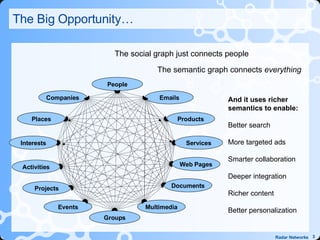
The Big Opportunity… And it uses richer semantics to enable: Better search More targeted ads Smarter collaboration Deeper integration Richer content Better personalization The social graph just connects people People Groups The semantic graph connects  everything Emails Companies Products Services Web Pages Multimedia Documents Events Projects Activities Interests Places
The third decade of the Web A period in time, not a technology… Enrich the structure of the Web Improve the quality of search, collaboration, publishing, advertising Enables applications to become more integrated and intelligent Transform Web from fileserver to database Semantic technologies will play a key role
A Higher Resolution Web Coldplay Band Palo Alto City Jane Person IBM Company Dave Person Bob Person Design Team Group Stanford Alumnae Group IBM.com Web Site 123.JPG Photo Dave.com Weblog Sue Person Joe Person Dave.com RSS Feed Lives in Publisher of Friend of Depiction of Depiction of Member of Married to Member  of Member of Member of Fan of Lives in Subscriber to Source of Author of Member of Employee of Fan of
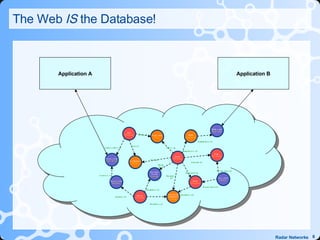
The Web  IS  the Database! Application A Application B Coldplay Band Palo Alto City Jane Person IBM Company Dave Person Bob Person Design Team Group Stanford Alumnae Group IBM.com Web Site 123.JPG Photo Dave.com Weblog Sue Person Joe Person Dave.com RSS Feed Lives in Publisher of Friend of Depiction of Depiction of Member of Married to Member  of Member of Member of Fan of Lives in Subscriber to Source of Author of Member of Employee of Fan of
The Intelligence is in the Connections Connections between people Connections between Information Email Social Networking Groupware Javascript Weblogs Databases File Systems HTTP Keyword Search USENET Wikis Websites Directory Portals 2010 - 2020 Web 1.0  2000 - 2010 1990 - 2000 PC Era 1980 - 1990 RSS Widgets PC’s 2020 - 2030 Office 2.0 XML RDF SPARQL AJAX FTP IRC SOAP Mashups File Servers Social Media Sharing Lightweight Collaboration ATOM Web 3.0  Web 4.0  Semantic Search Semantic Databases Distributed Search Intelligent personal agents Java SaaS Web 2.0  Flash OWL HTML SGML SQL Gopher P2P The Web The PC Windows MacOS SWRL OpenID BBS MMO’s VR Semantic Web Intelligent Web  The Internet Social Web Web OS
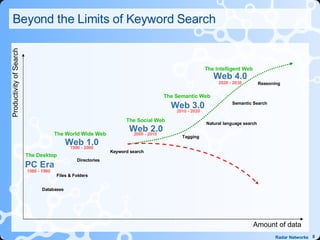
Beyond the Limits of Keyword Search  Amount of data Productivity of Search Databases 2010 - 2020 Web 1.0  2000 - 2010 1990 - 2000 PC Era 1980 - 1990 2020 - 2030 Web 3.0  Web 4.0  Web 2.0  The World Wide Web The Desktop Keyword search Natural language search Reasoning Tagging Semantic Search The Semantic Web The Intelligent Web Directories The Social Web  Files & Folders
The Future of the Platform… 1980’s  -- The Desktop is the platform 1990’s  -- The Browser / Server is the platform 2000’s  -- Web Services are the platform 2010’s  -- The Semantic Web is the platform 2020’s  -- The WebOS is the platform 2030’s  -- The Human Body is the platform…?
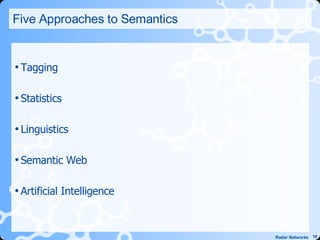
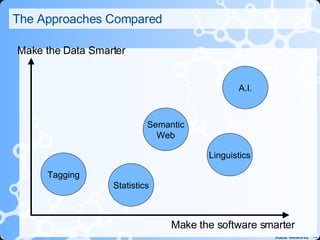
Five Approaches to Semantics Tagging Statistics  Linguistics  Semantic Web Artificial Intelligence
The Tagging Approach Pros Easy for users to add and read tags Tags are just strings No algorithms or ontologies to deal with No technology to learn Cons Easy for users to add and read tags Tags are just strings No algorithms or ontologies to deal with No technology to learn Technorati Del.icio.us Flickr Wikipedia
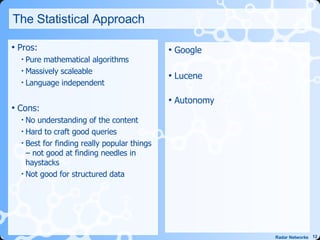
The Statistical Approach Pros:  Pure mathematical algorithms Massively scaleable Language independent Cons:  No understanding of the content Hard to craft good queries Best for finding really popular things – not good at finding needles in haystacks Not good for structured data Google Lucene Autonomy
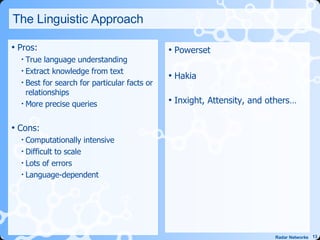
The Linguistic Approach Pros: True language understanding Extract knowledge from text Best for search for particular facts or relationships More precise queries Cons: Computationally intensive Difficult to scale Lots of errors Language-dependent Powerset  Hakia Inxight, Attensity, and others…
The Semantic Web Approach Pros: More precise queries Smarter apps with less work Not as computationally intensive Share & link data between apps Works for both unstructured and structured data Cons: Lack of tools Difficult to scale Who makes all the metadata? Radar Networks DBpedia Project Metaweb
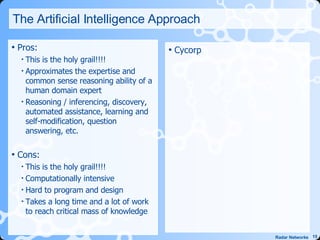
The Artificial Intelligence Approach Pros: This is the holy grail!!!! Approximates the expertise and common sense reasoning ability of a human domain expert Reasoning / inferencing, discovery, automated assistance, learning and self-modification, question answering, etc. Cons: This is the holy grail!!!! Computationally intensive Hard to program and design Takes a long time and a lot of work to reach critical mass of knowledge Cycorp
The Approaches Compared Make the software smarter Make the Data Smarter Statistics Linguistics Semantic Web A.I. Tagging
Two Paths to Adding Semantics “ Bottom-Up”  (Classic) Add semantic metadata to pages and databases all over the Web Every Website becomes semantic Everyone has to learn RDF/OWL “ Top-Down” (Contemporary) Automatically generate semantic metadata for vertical domains Create services that provide this as an overlay to non-semantic Web Nobody has to learn RDF/OWL -- Alex Iskold
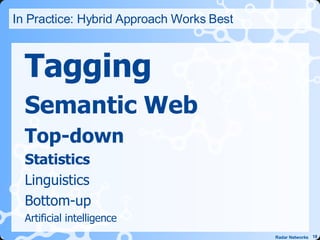
In Practice: Hybrid Approach Works Best Tagging Semantic Web Top-down Statistics Linguistics Bottom-up Artificial intelligence
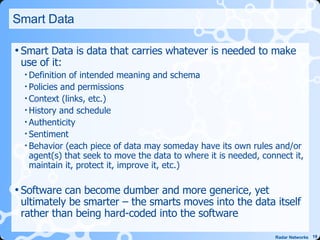
Smart Data Smart Data is data that carries whatever is needed to make use of it: Definition of intended meaning and schema Policies and permissions Context (links, etc.) History and schedule Authenticity Sentiment Behavior (each piece of data may someday have its own rules and/or agent(s) that seek to move the data to where it is needed, connect it, maintain it, protect it, improve it, etc.) Software can become dumber and more generice, yet ultimately be smarter – the smarts moves into the data itself rather than being hard-coded into the software
The Semantic Web is a Key Enabler Moves the “intelligence” out of applications, into the data Data becomes self-describing; Meaning of data becomes part of the data: Data = Metadata. Data can be shared and linked more easily Just-in-time schemas – applications can pull the schema for data only when the data is actually needed, rather than having to anticipate it
The Semantic Web = Open database layer for the Web User Profiles Web Content Data Records Apps & Services Ads & Listings Open Data Mappings Open Data Records Open Rules Open Ontologies Open Query Interfaces
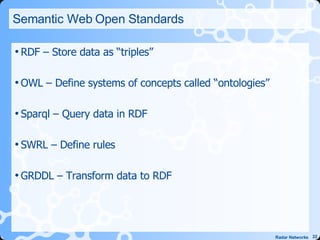
Semantic Web Open Standards RDF – Store data as “triples”  OWL – Define systems of concepts called “ontologies” Sparql – Query data in RDF SWRL – Define rules GRDDL – Transform data to RDF
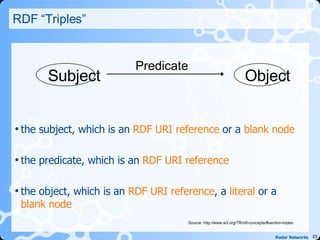
RDF “Triples” the subject, which is an  RDF URI reference  or a  blank node   the predicate, which is an  RDF URI reference   the object, which is an  RDF URI reference , a  literal  or a  blank node   Source: http://www.w3.org/TR/rdf-concepts/#section-triples Subject Object Predicate
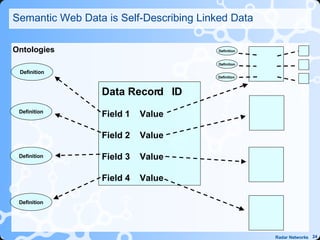
Semantic Web Data is Self-Describing Linked Data Data Record   ID Field 1  Value Field 2  Value Field 3  Value Field 4  Value Definition Definition Definition Definition Definition Definition Definition Ontologies
RDBMS vs Triplestore S P O Person Table f_name jim nova chris lew ID 001 002 003 004 l_name wissner spivack jones tucker Colleagues Table SRC-ID 001 001 001 001 002 002 002 002 003 003 003 003 004 004 004 004 TGT-ID 001 002 003 004 001 002 003 004 001 002 003 004 001 002 003 004 Subject Predicate Object 001 isA Person 001 firstName Jim 001 lastName Wissner 001 hasColleague 002 002 isA Person 002 firstName Nova 002 lastName Spivack 002 hasColleague 003 003 isA Person 003 firstName Chris 003 lastName Jones 003 hasColleague 004 004 isA Person 004 firstName Lew 004 lastName Tucker
Merging Databases in RDF is Easy S P O S P O S P O
Are RDF/OWL the Only Way to Express Semantics? Other contenders: String tags Taxonomies and controlled vocabularies Microformats Ad hoc [name, value] pairs Alternative semantic metadata notations
One Semantic Web or Many? The answer is….Both The Semantic Web is a web of semantic webs Each of us may have our own semantic web…
Why has it Taken So Long? The Dream of the Semantic Web has been slow to arrive The original vision was too focused on A.I. Technologies and tools were insufficient Needs for open data on the Web were not strong enough Keyword search and tagging were good enough…for a while Lack of end-user facing killer apps Lots of misunderstanding to clear up
Crossing the Chasm… Communicating the vision Focus on open data, not A.I. Technology progress Standards & tools finally maturing Needs were not strong enough Keyword search and tagging not as productive anymore Apps need better way to share data Killer apps and content Several companies are starting to expose data to the Semantic Web. Soon there will be a lot of data. Market Education Show the market what the benefits are
Future Outlook 2007 – 2009 Early-Adoption A few killer apps emerge Other apps start to integrate 2010 – 2020 Mainstream Adoption Semantics widely used in Web content and apps 2020 + Next big cycle: Reasoning and A.I.  The Intelligent Web The Web learns and thinks collectively
A Mainstream Application of  the Semantic Web…
Twine.com Overview Helps individuals and groups  organize, share and discover  information around their interests .  Instead of social networking, it’s interest networking   Twine is the best service for keeping up with your interests and sharing what interests you with other like-minded people.  Twine will generate a large number of vertical interest portals and attract traffic from search engines and partners Twine will monetize through advertising, affiliate commerce, sponsorships and subscriptions
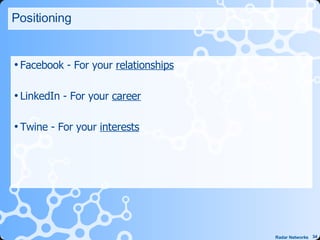
Positioning Facebook - For your  relationships LinkedIn - For your  career Twine - For your  interests
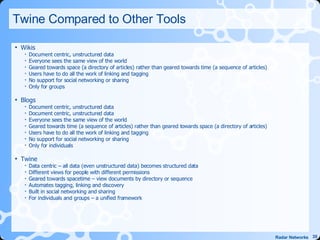
Twine Compared to Other Tools Wikis  Document centric, unstructured data Everyone sees the same view of the world Geared towards space (a directory of articles) rather than geared towards time (a sequence of articles) Users have to do all the work of linking and tagging No support for social networking or sharing Only for groups Blogs Document centric, unstructured data Document centric, unstructured data Everyone sees the same view of the world Geared towards time (a sequence of articles) rather than geared towards space (a directory of articles) Users have to do all the work of linking and tagging No support for social networking or sharing Only for individuals Twine Data centric – all data (even unstructured data) becomes structured data Different views for people with different permissions Geared towards spacetime – view documents by directory or sequence Automates tagging, linking and discovery Built in social networking and sharing For individuals and groups – a unified framework
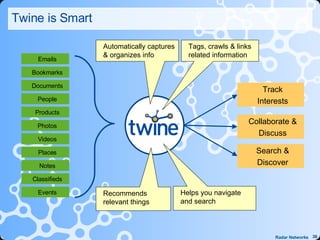
Twine is Smart  Emails Bookmarks Documents Products Collaborate & Discuss Search & Discover Track Interests Automatically captures & organizes info Recommends relevant things Helps you navigate and search Tags, crawls & links related information People Photos Videos Places Classifieds Notes Events
Let’s take a look at Twine… (demo of Twine site…)
Twine is Powered by The Semantic Web Twine is built on a new Semantic Web platform 15 patents pending and in process Easily create new Semantic Web apps  Written in pure Java Anyone can add & edit ontologies Scale to manage 10’s of billions of RDF triples Developer tools and API’s Open up our platform API’s and open-source in the future Be the center of the Semantic Web ecosystem
Radar Networks’ Semantic Web Platform SQL Database Web App KnowledgeBase Bookmarklet & Email User Portal REST API SPARQL Relational database RSS Feeds Object Query & Cache Class inferencing Semantic Object TupleStore service SQL Query Generator Predicate Inferencing Tuple Query Access Control WebDAV File Store Flat File Store AJAX, Jetty, PicoContainer, Java, XML, SPARQL Jena, ATOM RDF, OWL RDF, OWL, SQL  Mina Postgres, Solaris webDAV, Isilon cluster Cache Remote Access Cache Cache Twine.com Platform Storage Ontology
Differentiation Focused on sharing knowledge around interests, not just socializing Smarter than other sites – Twine learns, organizes and recommends automatically Powered by the Semantic Web – New capabilities are possible Unified place for all types of information
Target Customer Twine is for active users of the Web, including consumers and professionals, who create, find and share information about their interests Interests : Professional associations Alumni groups Social networks (Facebook, Plaxo, LinkedIn) Volunteer organizations Groups based on interests (hobbies, health, sports, entertainment, culture, family, technology, user groups, etc.) Participating/working in teams at organizations of all sizes Demographics: 18 – 45 years old Have many personal interests and hobbies Social connections are important – family, friends, colleagues Americans with a household income of $100,000 or more Nearly 26 million such consumers used the Internet in August 2003, spending an average of 27.6 hours online -- more than any other income segment.  Consume an average of nearly 3,000 pages a month, almost 300 pages more than the average Internet user
Market Opportunities for Twine Individuals Individual consumers Individual professionals Groups, Teams and Communities Interest communities Support groups Content publishers Users groups Hobbyists Social groups Product communities Event communities Communities of practice Customer support Collaborative teams
Contact Info Visit  www.twine.com  to sign up for the invite beta wait-list You can email me at  [email_address]   My blog is at  http://www.mindingtheplanet.net   Thanks!
Rights This presentation is licensed under the Creative Commons Attribution License. Details: This work is licensed under the Creative Commons Attribution 3.0 Unported License. To view a copy of this license, visit http://creativecommons.org/licenses/by/3.0/ or send a letter to Creative Commons, 171 Second Street, Suite 300, San Francisco, California, 94105, USA. If you reproduce or redistribute in whole or in part, please give attribution to Nova Spivack, with a link to http://www.mindingtheplanet.net

Spivack Blogtalk 2008

  • 1.
    Nova Spivack CEO& Founder Radar Networks Making Sense of the Semantic Web
  • 2.
    About This TalkMaking sense of the semantic sector Making the Semantic Web more useable Future outlook Twine.com Q & A
  • 3.
    The Big Opportunity…And it uses richer semantics to enable: Better search More targeted ads Smarter collaboration Deeper integration Richer content Better personalization The social graph just connects people People Groups The semantic graph connects everything Emails Companies Products Services Web Pages Multimedia Documents Events Projects Activities Interests Places
  • 4.
    The third decadeof the Web A period in time, not a technology… Enrich the structure of the Web Improve the quality of search, collaboration, publishing, advertising Enables applications to become more integrated and intelligent Transform Web from fileserver to database Semantic technologies will play a key role
  • 5.
    A Higher ResolutionWeb Coldplay Band Palo Alto City Jane Person IBM Company Dave Person Bob Person Design Team Group Stanford Alumnae Group IBM.com Web Site 123.JPG Photo Dave.com Weblog Sue Person Joe Person Dave.com RSS Feed Lives in Publisher of Friend of Depiction of Depiction of Member of Married to Member of Member of Member of Fan of Lives in Subscriber to Source of Author of Member of Employee of Fan of
  • 6.
    The Web IS the Database! Application A Application B Coldplay Band Palo Alto City Jane Person IBM Company Dave Person Bob Person Design Team Group Stanford Alumnae Group IBM.com Web Site 123.JPG Photo Dave.com Weblog Sue Person Joe Person Dave.com RSS Feed Lives in Publisher of Friend of Depiction of Depiction of Member of Married to Member of Member of Member of Fan of Lives in Subscriber to Source of Author of Member of Employee of Fan of
  • 7.
    The Intelligence isin the Connections Connections between people Connections between Information Email Social Networking Groupware Javascript Weblogs Databases File Systems HTTP Keyword Search USENET Wikis Websites Directory Portals 2010 - 2020 Web 1.0 2000 - 2010 1990 - 2000 PC Era 1980 - 1990 RSS Widgets PC’s 2020 - 2030 Office 2.0 XML RDF SPARQL AJAX FTP IRC SOAP Mashups File Servers Social Media Sharing Lightweight Collaboration ATOM Web 3.0 Web 4.0 Semantic Search Semantic Databases Distributed Search Intelligent personal agents Java SaaS Web 2.0 Flash OWL HTML SGML SQL Gopher P2P The Web The PC Windows MacOS SWRL OpenID BBS MMO’s VR Semantic Web Intelligent Web The Internet Social Web Web OS
  • 8.
    Beyond the Limitsof Keyword Search Amount of data Productivity of Search Databases 2010 - 2020 Web 1.0 2000 - 2010 1990 - 2000 PC Era 1980 - 1990 2020 - 2030 Web 3.0 Web 4.0 Web 2.0 The World Wide Web The Desktop Keyword search Natural language search Reasoning Tagging Semantic Search The Semantic Web The Intelligent Web Directories The Social Web Files & Folders
  • 9.
    The Future ofthe Platform… 1980’s -- The Desktop is the platform 1990’s -- The Browser / Server is the platform 2000’s -- Web Services are the platform 2010’s -- The Semantic Web is the platform 2020’s -- The WebOS is the platform 2030’s -- The Human Body is the platform…?
  • 10.
    Five Approaches toSemantics Tagging Statistics Linguistics Semantic Web Artificial Intelligence
  • 11.
    The Tagging ApproachPros Easy for users to add and read tags Tags are just strings No algorithms or ontologies to deal with No technology to learn Cons Easy for users to add and read tags Tags are just strings No algorithms or ontologies to deal with No technology to learn Technorati Del.icio.us Flickr Wikipedia
  • 12.
    The Statistical ApproachPros: Pure mathematical algorithms Massively scaleable Language independent Cons: No understanding of the content Hard to craft good queries Best for finding really popular things – not good at finding needles in haystacks Not good for structured data Google Lucene Autonomy
  • 13.
    The Linguistic ApproachPros: True language understanding Extract knowledge from text Best for search for particular facts or relationships More precise queries Cons: Computationally intensive Difficult to scale Lots of errors Language-dependent Powerset Hakia Inxight, Attensity, and others…
  • 14.
    The Semantic WebApproach Pros: More precise queries Smarter apps with less work Not as computationally intensive Share & link data between apps Works for both unstructured and structured data Cons: Lack of tools Difficult to scale Who makes all the metadata? Radar Networks DBpedia Project Metaweb
  • 15.
    The Artificial IntelligenceApproach Pros: This is the holy grail!!!! Approximates the expertise and common sense reasoning ability of a human domain expert Reasoning / inferencing, discovery, automated assistance, learning and self-modification, question answering, etc. Cons: This is the holy grail!!!! Computationally intensive Hard to program and design Takes a long time and a lot of work to reach critical mass of knowledge Cycorp
  • 16.
    The Approaches ComparedMake the software smarter Make the Data Smarter Statistics Linguistics Semantic Web A.I. Tagging
  • 17.
    Two Paths toAdding Semantics “ Bottom-Up” (Classic) Add semantic metadata to pages and databases all over the Web Every Website becomes semantic Everyone has to learn RDF/OWL “ Top-Down” (Contemporary) Automatically generate semantic metadata for vertical domains Create services that provide this as an overlay to non-semantic Web Nobody has to learn RDF/OWL -- Alex Iskold
  • 18.
    In Practice: HybridApproach Works Best Tagging Semantic Web Top-down Statistics Linguistics Bottom-up Artificial intelligence
  • 19.
    Smart Data SmartData is data that carries whatever is needed to make use of it: Definition of intended meaning and schema Policies and permissions Context (links, etc.) History and schedule Authenticity Sentiment Behavior (each piece of data may someday have its own rules and/or agent(s) that seek to move the data to where it is needed, connect it, maintain it, protect it, improve it, etc.) Software can become dumber and more generice, yet ultimately be smarter – the smarts moves into the data itself rather than being hard-coded into the software
  • 20.
    The Semantic Webis a Key Enabler Moves the “intelligence” out of applications, into the data Data becomes self-describing; Meaning of data becomes part of the data: Data = Metadata. Data can be shared and linked more easily Just-in-time schemas – applications can pull the schema for data only when the data is actually needed, rather than having to anticipate it
  • 21.
    The Semantic Web= Open database layer for the Web User Profiles Web Content Data Records Apps & Services Ads & Listings Open Data Mappings Open Data Records Open Rules Open Ontologies Open Query Interfaces
  • 22.
    Semantic Web OpenStandards RDF – Store data as “triples” OWL – Define systems of concepts called “ontologies” Sparql – Query data in RDF SWRL – Define rules GRDDL – Transform data to RDF
  • 23.
    RDF “Triples” thesubject, which is an RDF URI reference or a blank node the predicate, which is an RDF URI reference the object, which is an RDF URI reference , a literal or a blank node Source: http://www.w3.org/TR/rdf-concepts/#section-triples Subject Object Predicate
  • 24.
    Semantic Web Datais Self-Describing Linked Data Data Record ID Field 1 Value Field 2 Value Field 3 Value Field 4 Value Definition Definition Definition Definition Definition Definition Definition Ontologies
  • 25.
    RDBMS vs TriplestoreS P O Person Table f_name jim nova chris lew ID 001 002 003 004 l_name wissner spivack jones tucker Colleagues Table SRC-ID 001 001 001 001 002 002 002 002 003 003 003 003 004 004 004 004 TGT-ID 001 002 003 004 001 002 003 004 001 002 003 004 001 002 003 004 Subject Predicate Object 001 isA Person 001 firstName Jim 001 lastName Wissner 001 hasColleague 002 002 isA Person 002 firstName Nova 002 lastName Spivack 002 hasColleague 003 003 isA Person 003 firstName Chris 003 lastName Jones 003 hasColleague 004 004 isA Person 004 firstName Lew 004 lastName Tucker
  • 26.
    Merging Databases inRDF is Easy S P O S P O S P O
  • 27.
    Are RDF/OWL theOnly Way to Express Semantics? Other contenders: String tags Taxonomies and controlled vocabularies Microformats Ad hoc [name, value] pairs Alternative semantic metadata notations
  • 28.
    One Semantic Webor Many? The answer is….Both The Semantic Web is a web of semantic webs Each of us may have our own semantic web…
  • 29.
    Why has itTaken So Long? The Dream of the Semantic Web has been slow to arrive The original vision was too focused on A.I. Technologies and tools were insufficient Needs for open data on the Web were not strong enough Keyword search and tagging were good enough…for a while Lack of end-user facing killer apps Lots of misunderstanding to clear up
  • 30.
    Crossing the Chasm…Communicating the vision Focus on open data, not A.I. Technology progress Standards & tools finally maturing Needs were not strong enough Keyword search and tagging not as productive anymore Apps need better way to share data Killer apps and content Several companies are starting to expose data to the Semantic Web. Soon there will be a lot of data. Market Education Show the market what the benefits are
  • 31.
    Future Outlook 2007– 2009 Early-Adoption A few killer apps emerge Other apps start to integrate 2010 – 2020 Mainstream Adoption Semantics widely used in Web content and apps 2020 + Next big cycle: Reasoning and A.I. The Intelligent Web The Web learns and thinks collectively
  • 32.
    A Mainstream Applicationof the Semantic Web…
  • 33.
    Twine.com Overview Helpsindividuals and groups organize, share and discover information around their interests . Instead of social networking, it’s interest networking Twine is the best service for keeping up with your interests and sharing what interests you with other like-minded people. Twine will generate a large number of vertical interest portals and attract traffic from search engines and partners Twine will monetize through advertising, affiliate commerce, sponsorships and subscriptions
  • 34.
    Positioning Facebook -For your relationships LinkedIn - For your career Twine - For your interests
  • 35.
    Twine Compared toOther Tools Wikis Document centric, unstructured data Everyone sees the same view of the world Geared towards space (a directory of articles) rather than geared towards time (a sequence of articles) Users have to do all the work of linking and tagging No support for social networking or sharing Only for groups Blogs Document centric, unstructured data Document centric, unstructured data Everyone sees the same view of the world Geared towards time (a sequence of articles) rather than geared towards space (a directory of articles) Users have to do all the work of linking and tagging No support for social networking or sharing Only for individuals Twine Data centric – all data (even unstructured data) becomes structured data Different views for people with different permissions Geared towards spacetime – view documents by directory or sequence Automates tagging, linking and discovery Built in social networking and sharing For individuals and groups – a unified framework
  • 36.
    Twine is Smart Emails Bookmarks Documents Products Collaborate & Discuss Search & Discover Track Interests Automatically captures & organizes info Recommends relevant things Helps you navigate and search Tags, crawls & links related information People Photos Videos Places Classifieds Notes Events
  • 37.
    Let’s take alook at Twine… (demo of Twine site…)
  • 38.
    Twine is Poweredby The Semantic Web Twine is built on a new Semantic Web platform 15 patents pending and in process Easily create new Semantic Web apps Written in pure Java Anyone can add & edit ontologies Scale to manage 10’s of billions of RDF triples Developer tools and API’s Open up our platform API’s and open-source in the future Be the center of the Semantic Web ecosystem
  • 39.
    Radar Networks’ SemanticWeb Platform SQL Database Web App KnowledgeBase Bookmarklet & Email User Portal REST API SPARQL Relational database RSS Feeds Object Query & Cache Class inferencing Semantic Object TupleStore service SQL Query Generator Predicate Inferencing Tuple Query Access Control WebDAV File Store Flat File Store AJAX, Jetty, PicoContainer, Java, XML, SPARQL Jena, ATOM RDF, OWL RDF, OWL, SQL Mina Postgres, Solaris webDAV, Isilon cluster Cache Remote Access Cache Cache Twine.com Platform Storage Ontology
  • 40.
    Differentiation Focused onsharing knowledge around interests, not just socializing Smarter than other sites – Twine learns, organizes and recommends automatically Powered by the Semantic Web – New capabilities are possible Unified place for all types of information
  • 41.
    Target Customer Twineis for active users of the Web, including consumers and professionals, who create, find and share information about their interests Interests : Professional associations Alumni groups Social networks (Facebook, Plaxo, LinkedIn) Volunteer organizations Groups based on interests (hobbies, health, sports, entertainment, culture, family, technology, user groups, etc.) Participating/working in teams at organizations of all sizes Demographics: 18 – 45 years old Have many personal interests and hobbies Social connections are important – family, friends, colleagues Americans with a household income of $100,000 or more Nearly 26 million such consumers used the Internet in August 2003, spending an average of 27.6 hours online -- more than any other income segment. Consume an average of nearly 3,000 pages a month, almost 300 pages more than the average Internet user
  • 42.
    Market Opportunities forTwine Individuals Individual consumers Individual professionals Groups, Teams and Communities Interest communities Support groups Content publishers Users groups Hobbyists Social groups Product communities Event communities Communities of practice Customer support Collaborative teams
  • 43.
    Contact Info Visit www.twine.com to sign up for the invite beta wait-list You can email me at [email_address] My blog is at http://www.mindingtheplanet.net Thanks!
  • 44.
    Rights This presentationis licensed under the Creative Commons Attribution License. Details: This work is licensed under the Creative Commons Attribution 3.0 Unported License. To view a copy of this license, visit http://creativecommons.org/licenses/by/3.0/ or send a letter to Creative Commons, 171 Second Street, Suite 300, San Francisco, California, 94105, USA. If you reproduce or redistribute in whole or in part, please give attribution to Nova Spivack, with a link to http://www.mindingtheplanet.net