Welcome to The most exciting development in pr since the cluetrain.PROBABLY.well maybe.1
PR &The semantic webaka “Web 3.0”Philip SheldrakeInfluence Crowd LLPwww.influencecrowd.comLinkedIn /in/philipsheldrake@sheldrake2A presentation to members of the CIPR SM Panel and other geeks. London, 21st April 2010.
Introduction to the Semantic WebLinkedDataXML and XPRLThe ontologiesHow to get involvedReading, collaboration, conversation.This presentation includes:21st April 2010 / Influence Crowd LLP / Creative Commons Attribution Share Alike License 2.0 England and Wales3
The Semantic Web421st April 2010 / Influence Crowd LLP / Creative Commons Attribution Share Alike License 2.0 England and Wales
Whilst there is some confusion over the term, most people use “Web 3.0” to refer to the Semantic Web. I do.Either way, the label is a bit of a distraction, but marketers love it, so what can I say!I use the terms interchangeably here.Web 3.05
If Web 2.0 was all about (user generated) content and community participation, Web 3.0 is about the Web itself understanding the meaning of all the content and participation.Indeed, the Web becomes a universal medium for data, information and knowledge exchange.Web 2.0 and Web 3.06
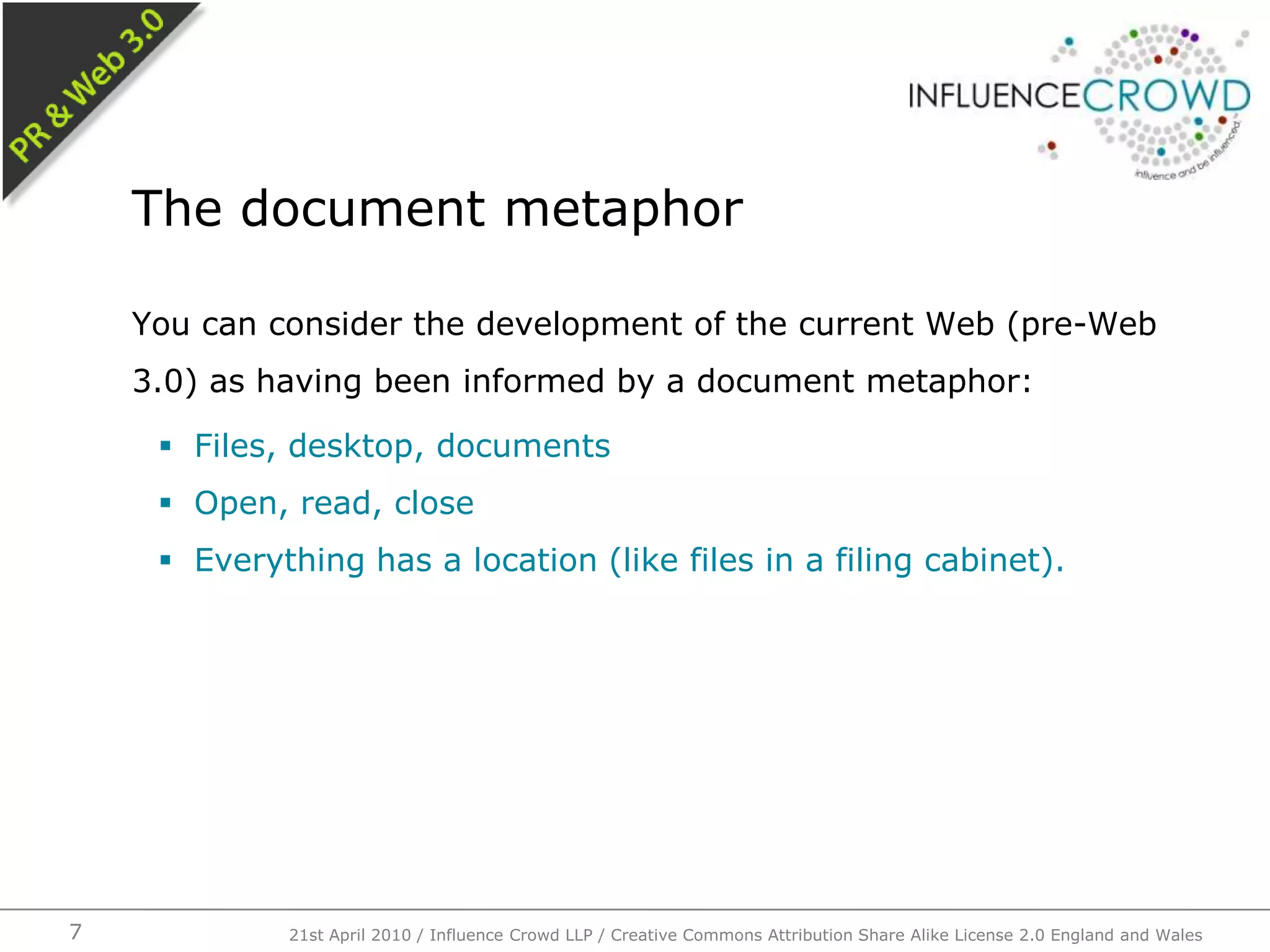
You can consider the development of the current Web (pre-Web 3.0) as having been informed by a document metaphor:Files, desktop, documentsOpen, read, closeEverything has a location (like files in a filing cabinet).The document metaphor21st April 2010 / Influence Crowd LLP / Creative Commons Attribution Share Alike License 2.0 England and Wales7
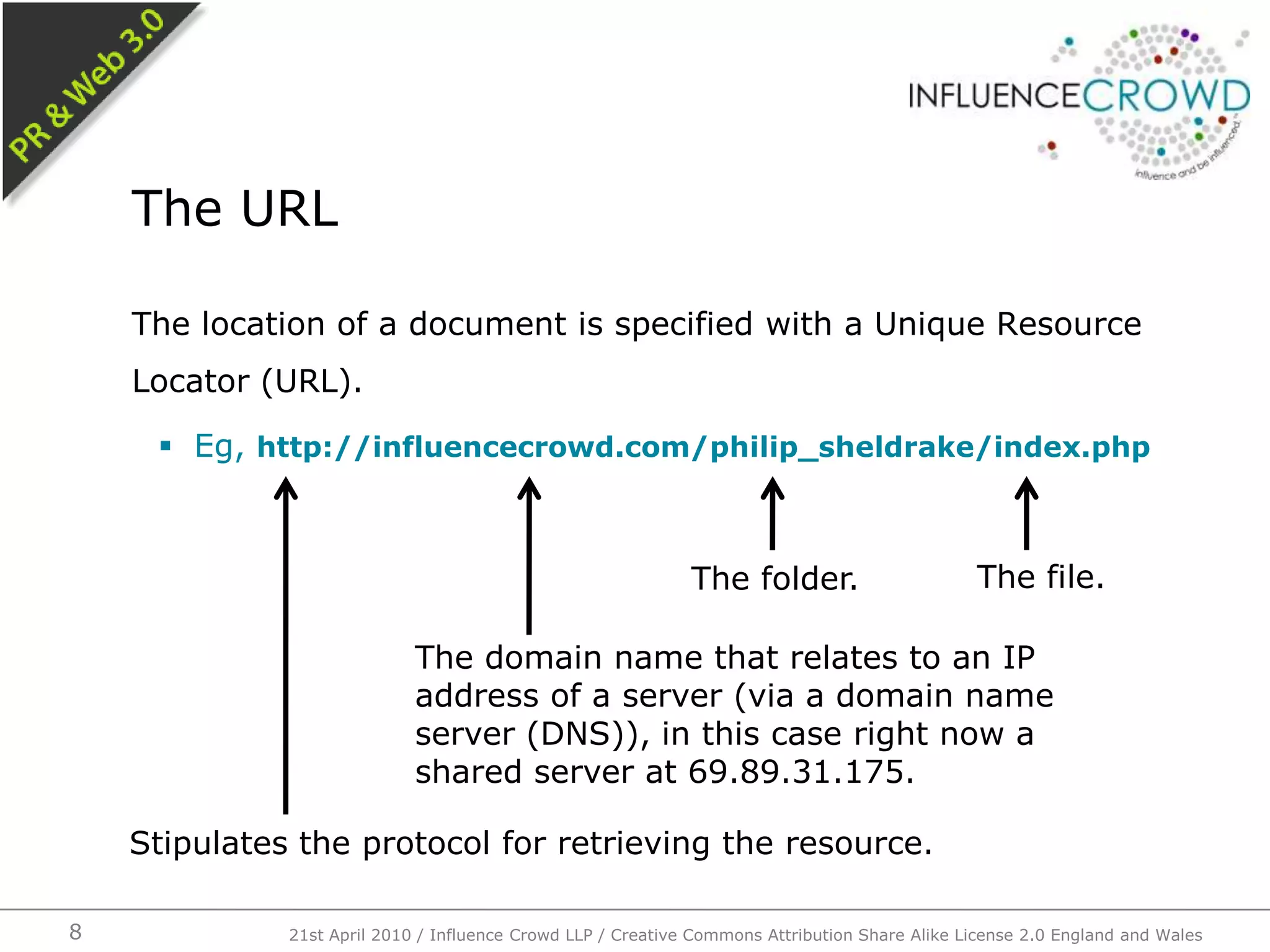
The location of a document is specified with a Unique Resource Locator (URL).Eg, http://influencecrowd.com/philip_sheldrake/index.phpThe URL21st April 2010 / Influence Crowd LLP / Creative Commons Attribution Share Alike License 2.0 England and Wales8The file.The folder.The domain name that relates to an IP address of a server (via a domain name server (DNS)), in this case right now a shared server at 69.89.31.175.Stipulates the protocol for retrieving the resource.
But the URL is just one type of Unique Resource Indicator (URI), the other is a URN.A URI identifies something on the InternetA URL does so by addressing it (eg, where Stephen lives)A URN does so by unique, persistent and location-independent name (eg, “Stephen Waddington”)Although of course the one and only Stephen Waddington may not actually be the only, so [firstname, lastname] does not make for a good URN schema!The URI and URN21st April 2010 / Influence Crowd LLP / Creative Commons Attribution Share Alike License 2.0 England and Wales9
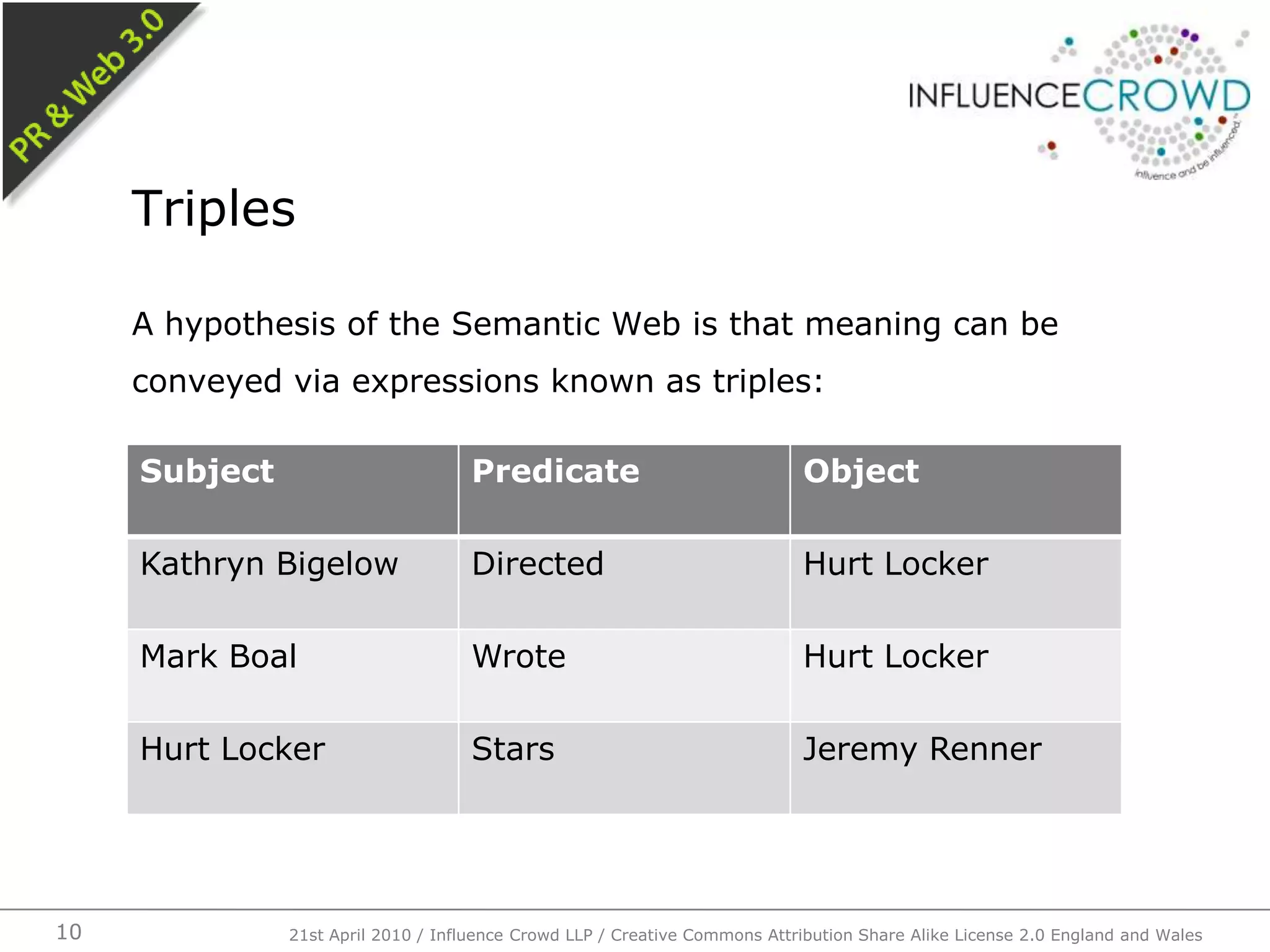
A hypothesis of the Semantic Web is that meaning can be conveyed via expressions known as triples:Triples21st April 2010 / Influence Crowd LLP / Creative Commons Attribution Share Alike License 2.0 England and Wales10
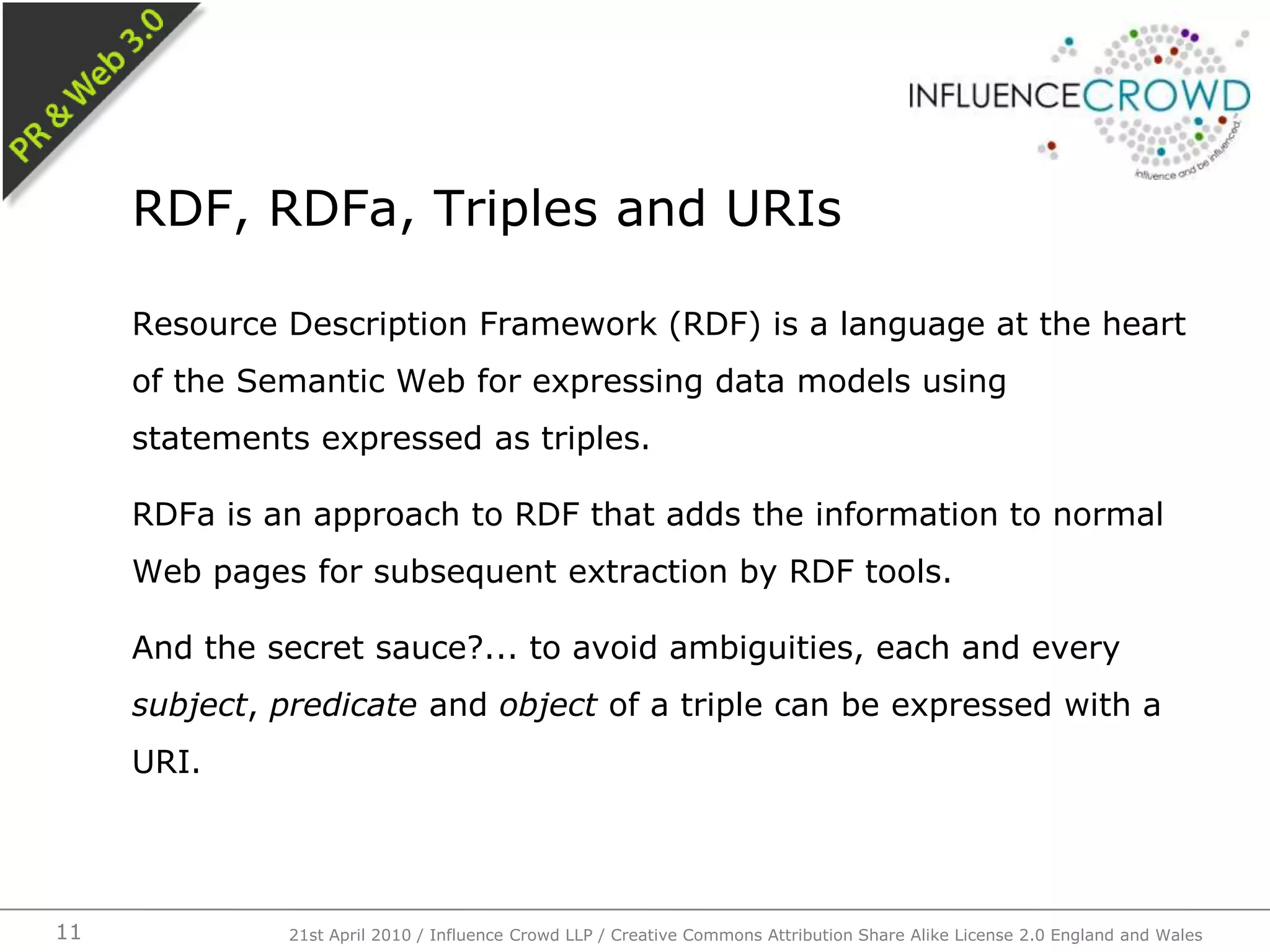
Resource Description Framework (RDF) is a language at the heart of the Semantic Web for expressing data models using statements expressed as triples.RDFa is an approach to RDF that adds the information to normal Web pages for subsequent extraction by RDF tools.And the secret sauce?... to avoid ambiguities, each and every subject, predicate and object of a triple can be expressed with a URI.RDF, RDFa, Triples and URIs21st April 2010 / Influence Crowd LLP / Creative Commons Attribution Share Alike License 2.0 England and Wales11
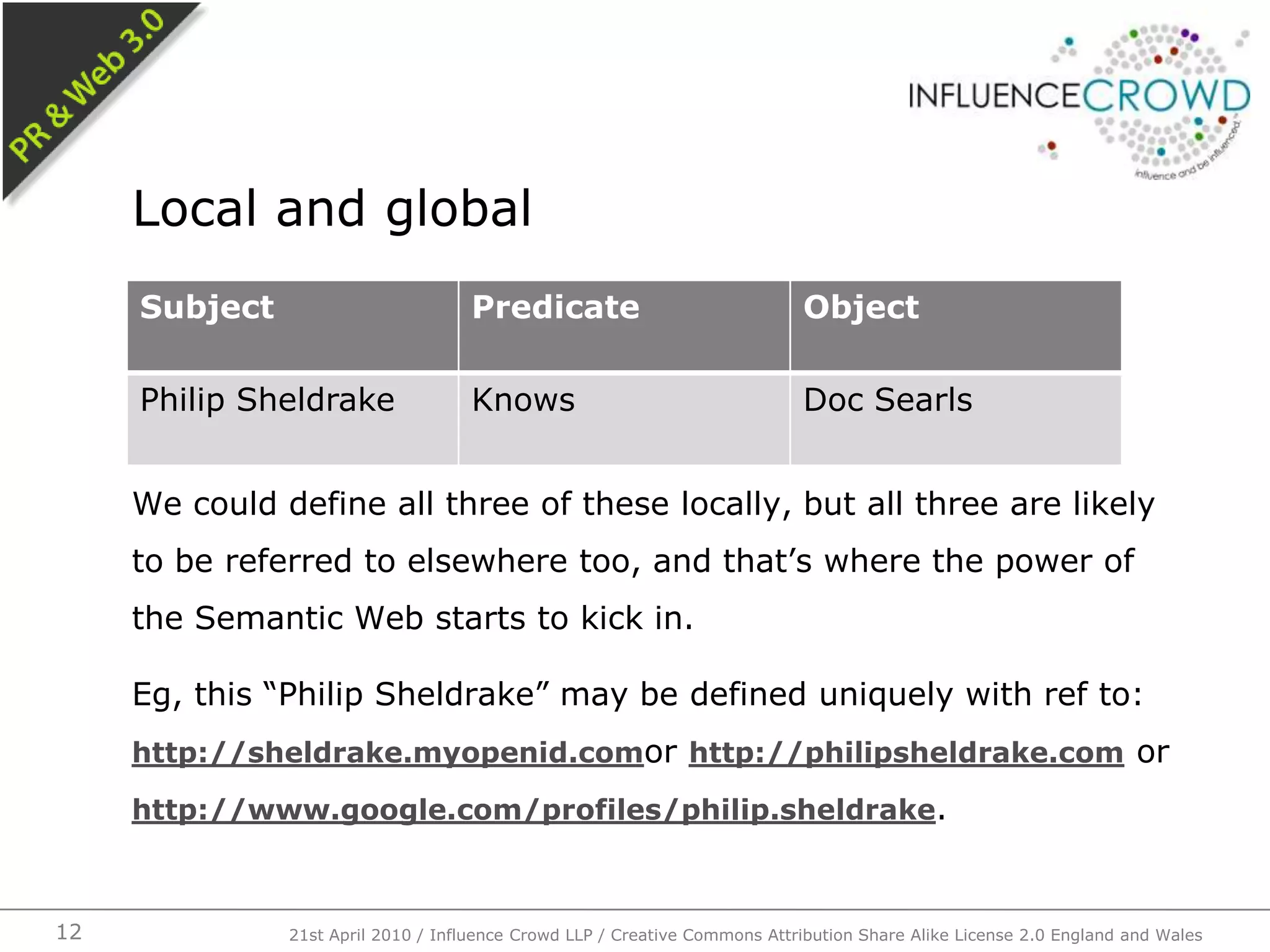
We could define all three of these locally, but all three are likely to be referred to elsewhere too, and that’s where the power of the Semantic Web starts to kick in.Eg, this “Philip Sheldrake” may be defined uniquely with ref to: http://sheldrake.myopenid.comor http://philipsheldrake.com or http://www.google.com/profiles/philip.sheldrake.Local and global21st April 2010 / Influence Crowd LLP / Creative Commons Attribution Share Alike License 2.0 England and Wales12
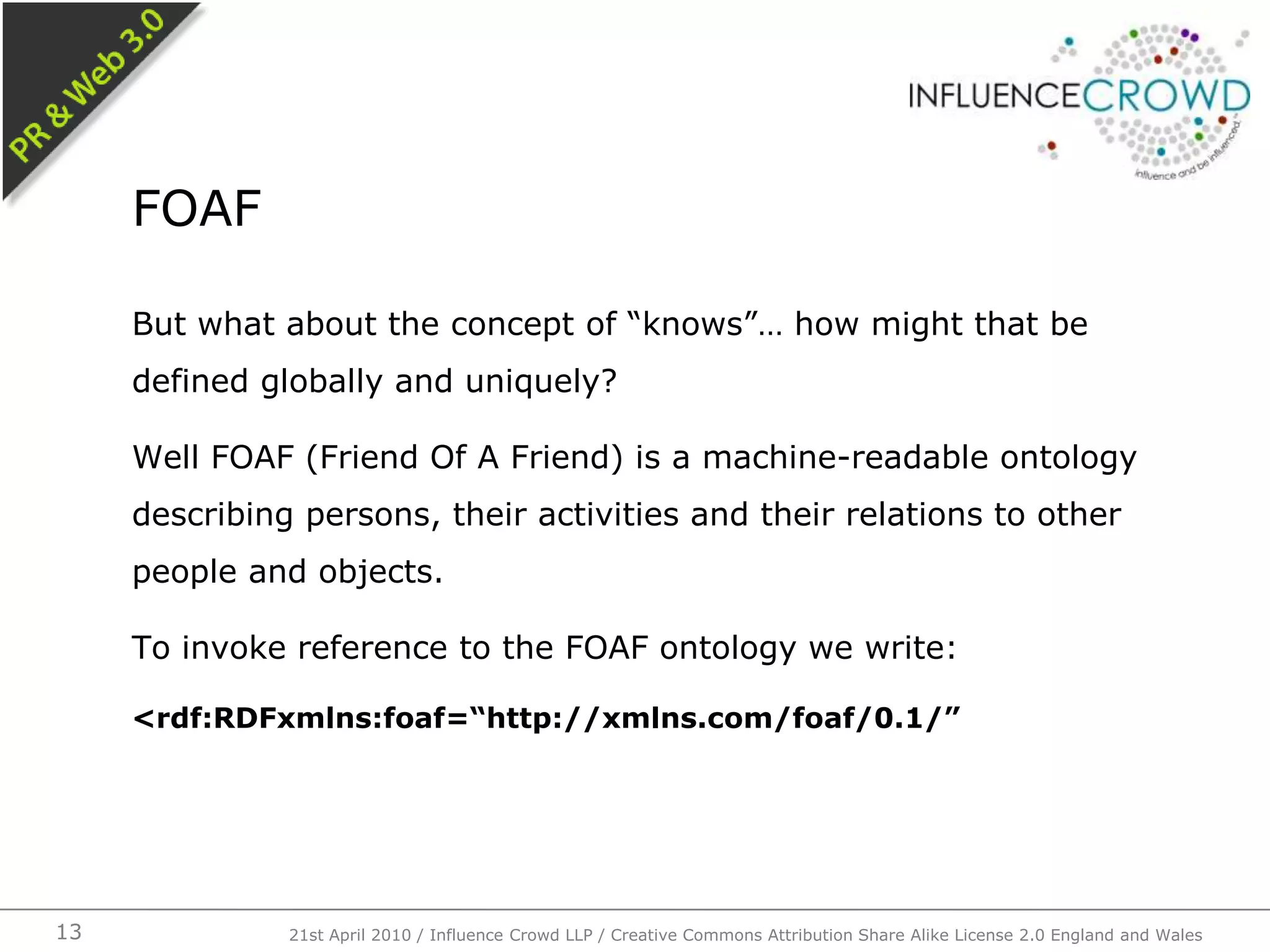
But what about the concept of “knows”… how might that be defined globally and uniquely?Well FOAF (Friend Of A Friend) is a machine-readable ontology describing persons, their activities and their relations to other people and objects.To invoke reference to the FOAF ontology we write:<rdf:RDFxmlns:foaf=“http://xmlns.com/foaf/0.1/”FOAF21st April 2010 / Influence Crowd LLP / Creative Commons Attribution Share Alike License 2.0 England and Wales13
At that URI we will find a definition of “knows”:http://xmlns.com/foaf/spec/#term_knowsSo now, when we express a statement as a triple likeSubject	-	http://philipsheldrake.comPredicate -	foaf:knowsObject -		http://searls.comthere is no ambiguity as to what it means.Note: this format is for explanation purposes only and does not constitute sound syntax!FOAF /221st April 2010 / Influence Crowd LLP / Creative Commons Attribution Share Alike License 2.0 England and Wales14
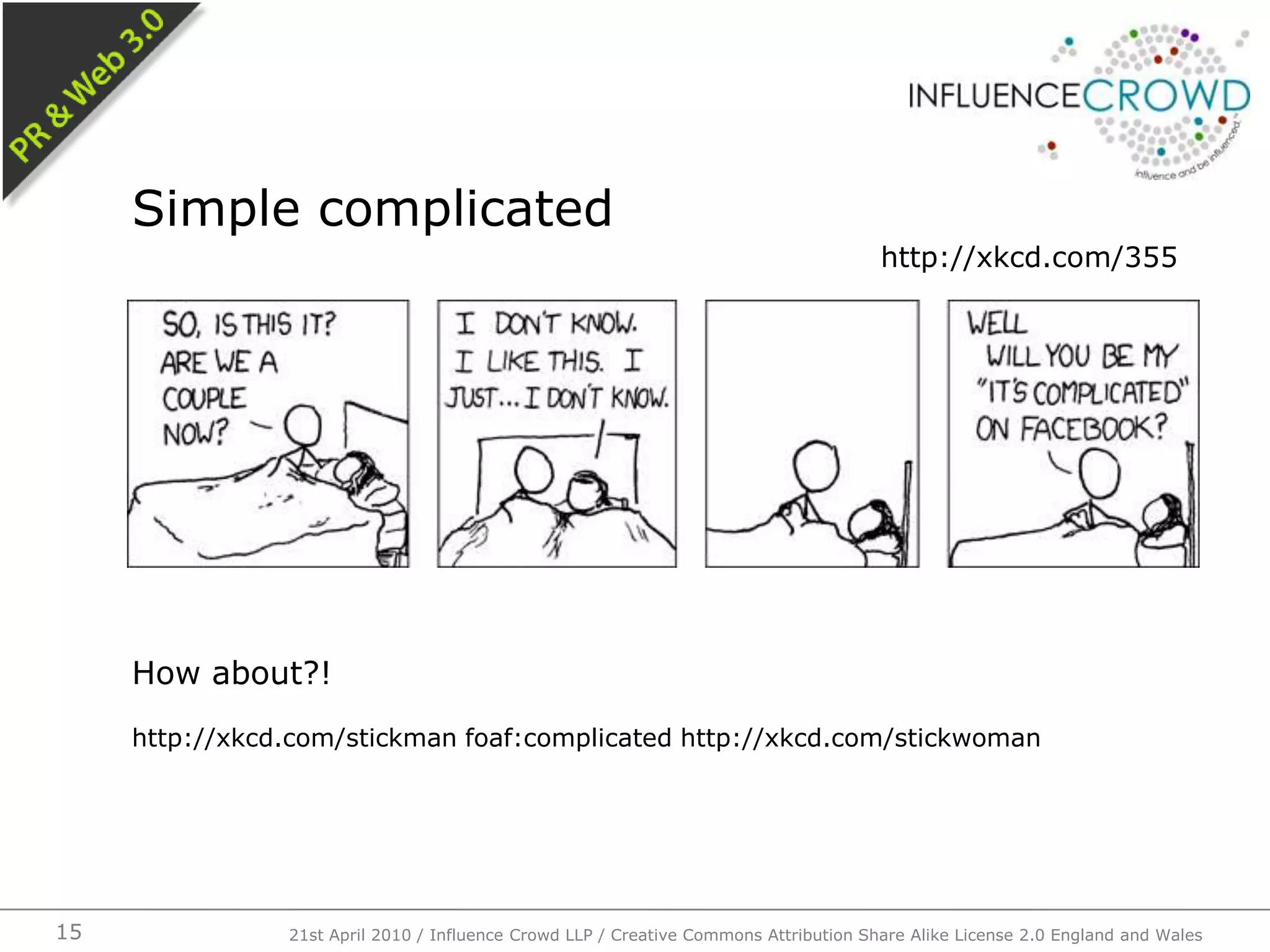
How about?!http://xkcd.com/stickman foaf:complicated http://xkcd.com/stickwomanSimple complicated21st April 2010 / Influence Crowd LLP / Creative Commons Attribution Share Alike License 2.0 England and Wales15http://xkcd.com/355
A microformat is an alternative approach to semantic markup.The eXtensible Friends Network (XFN) is the microformat most similar to FOAF for example. XFN is used to express how one blogger is related to another whose blog they list in their blogroll.hCardand hCalendarare other microformats you may have come across.See http://evan.prodromou.name/RDFa_vs_microformats for a more detailed comparison of RDF and microformats.RDF and microformats21st April 2010 / Influence Crowd LLP / Creative Commons Attribution Share Alike License 2.0 England and Wales16
I endorse the RDF approach for several reasons, the most important ones here being:It comes under the purview of the W3CMicroformats cannot scale to achieve the Semantic Web’s full potential.RDF is being used today by:dbpedia – a project to represent Wikipedia content in RDFdata.gov.uk – making the UK’s data mashable!Amazon.com – to mark up its and its partners’ products.RDF is the future21st April 2010 / Influence Crowd LLP / Creative Commons Attribution Share Alike License 2.0 England and Wales17
21st April 2010 / Influence Crowd LLP / Creative Commons Attribution Share Alike License 2.0 England and Wales18Wake up!Wake up at the back!Google’s coming next!http://www.flickr.com/photos/morberg/3146874095Attribution-ShareAlike 2.0 Generic
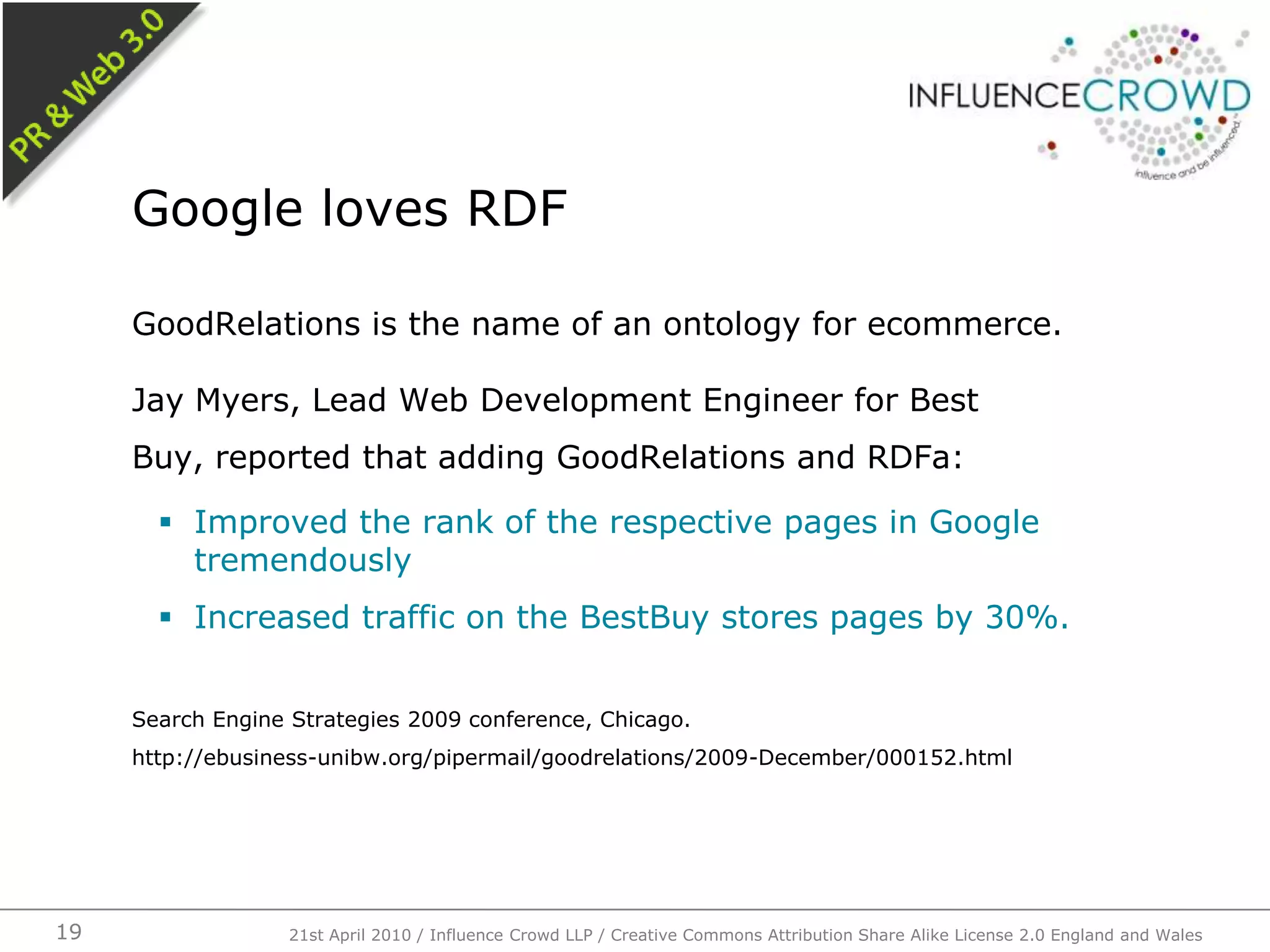
GoodRelations is the name of an ontology for ecommerce.Jay Myers, Lead Web Development Engineer for Best Buy, reported that adding GoodRelations and RDFa:Improved the rank of the respective pages in Google tremendouslyIncreased traffic on the BestBuy stores pages by 30%.Search Engine Strategies 2009 conference, Chicago.http://ebusiness-unibw.org/pipermail/goodrelations/2009-December/000152.htmlGoogle loves RDF21st April 2010 / Influence Crowd LLP / Creative Commons Attribution Share Alike License 2.0 England and Wales19
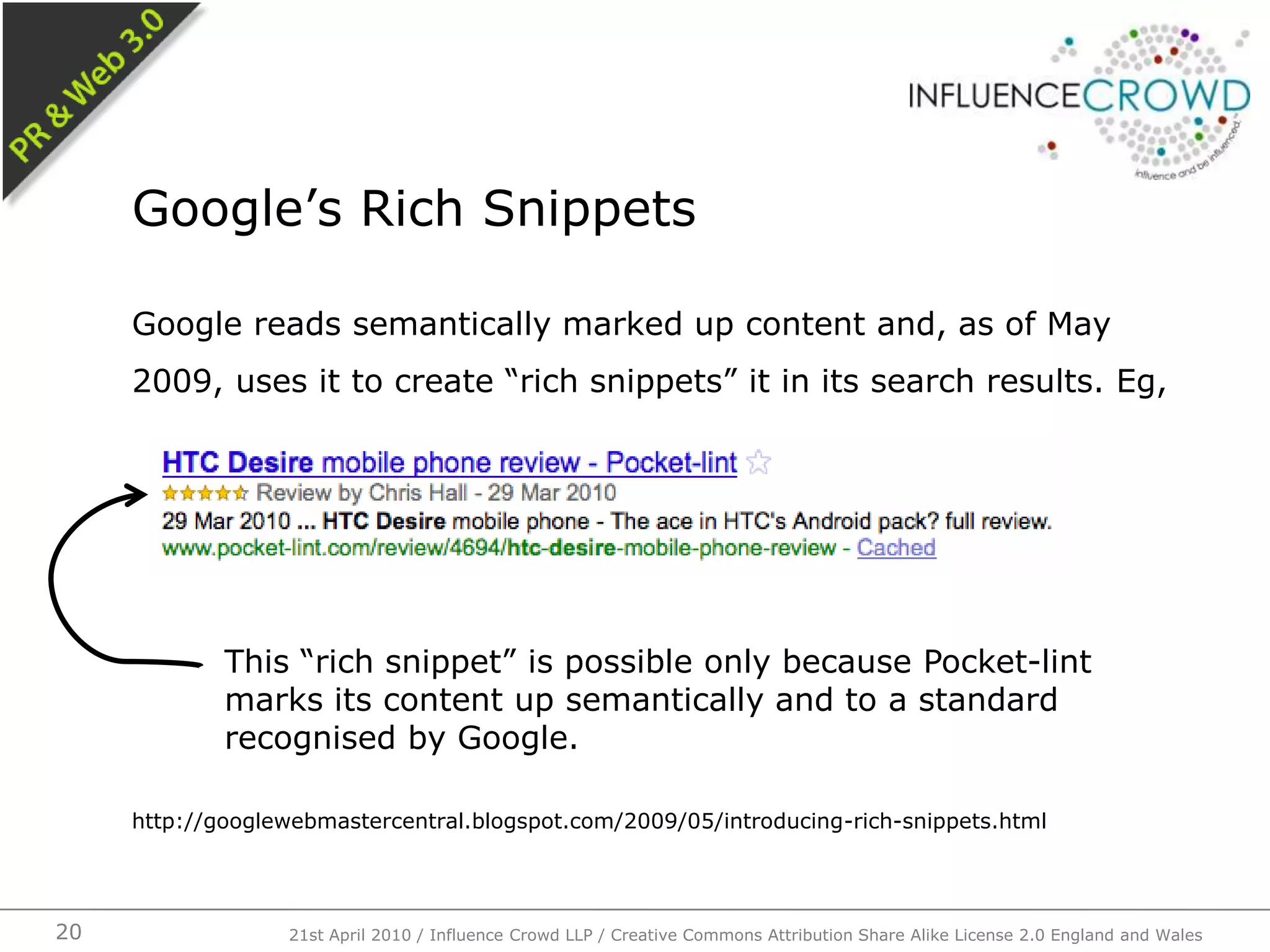
Google reads semantically marked up content and, as of May 2009, uses it to create “rich snippets” it in its search results. Eg,http://googlewebmastercentral.blogspot.com/2009/05/introducing-rich-snippets.htmlGoogle’s Rich Snippets21st April 2010 / Influence Crowd LLP / Creative Commons Attribution Share Alike License 2.0 England and Wales20This “rich snippet” is possible only because Pocket-lint marks its content up semantically and to a standard recognised by Google.
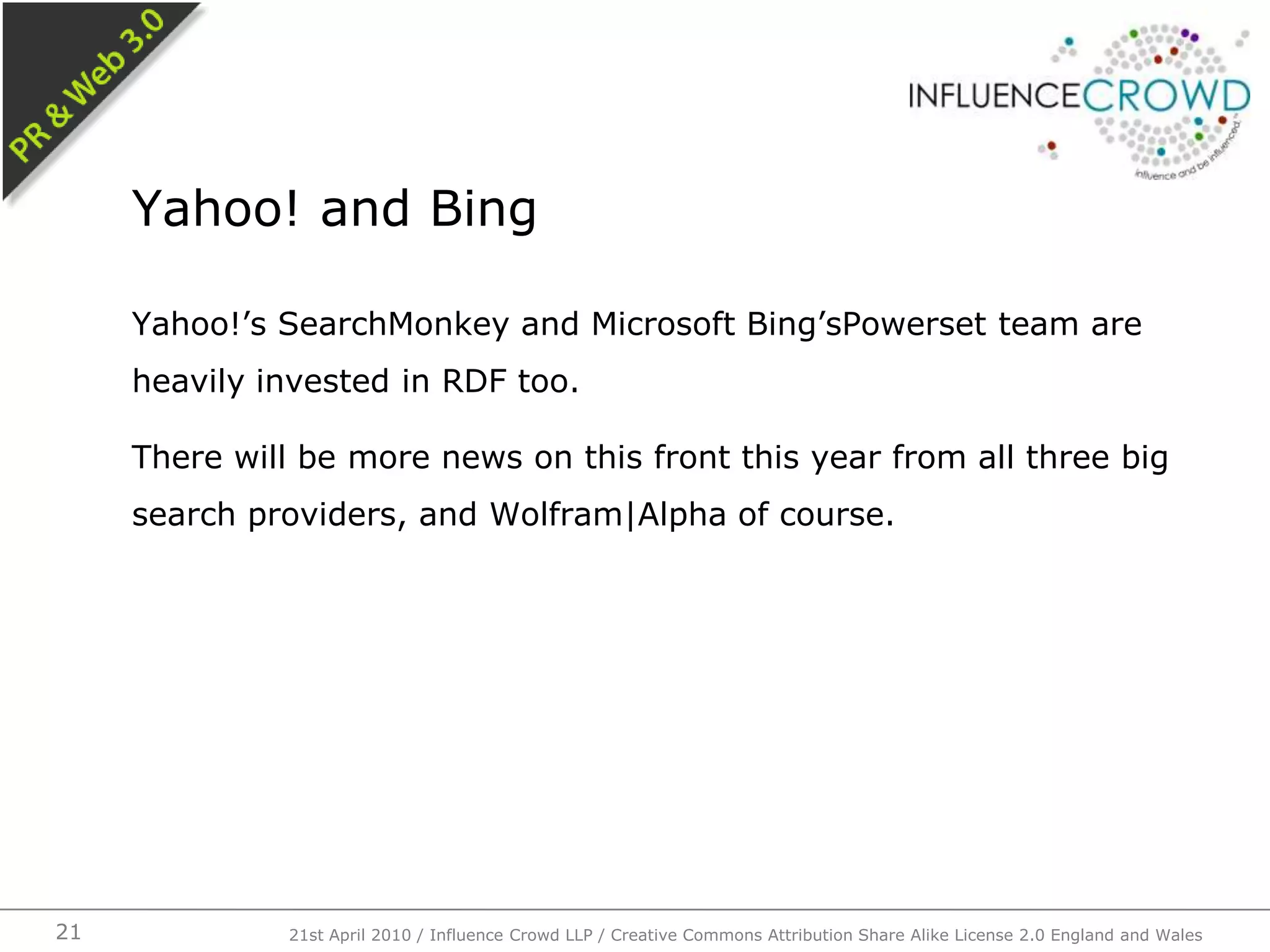
Yahoo!’s SearchMonkey and Microsoft Bing’sPowerset team are heavily invested in RDF too.There will be more news on this front this year from all three big search providers, and Wolfram|Alpha of course.Yahoo! and Bing21st April 2010 / Influence Crowd LLP / Creative Commons Attribution Share Alike License 2.0 England and Wales21
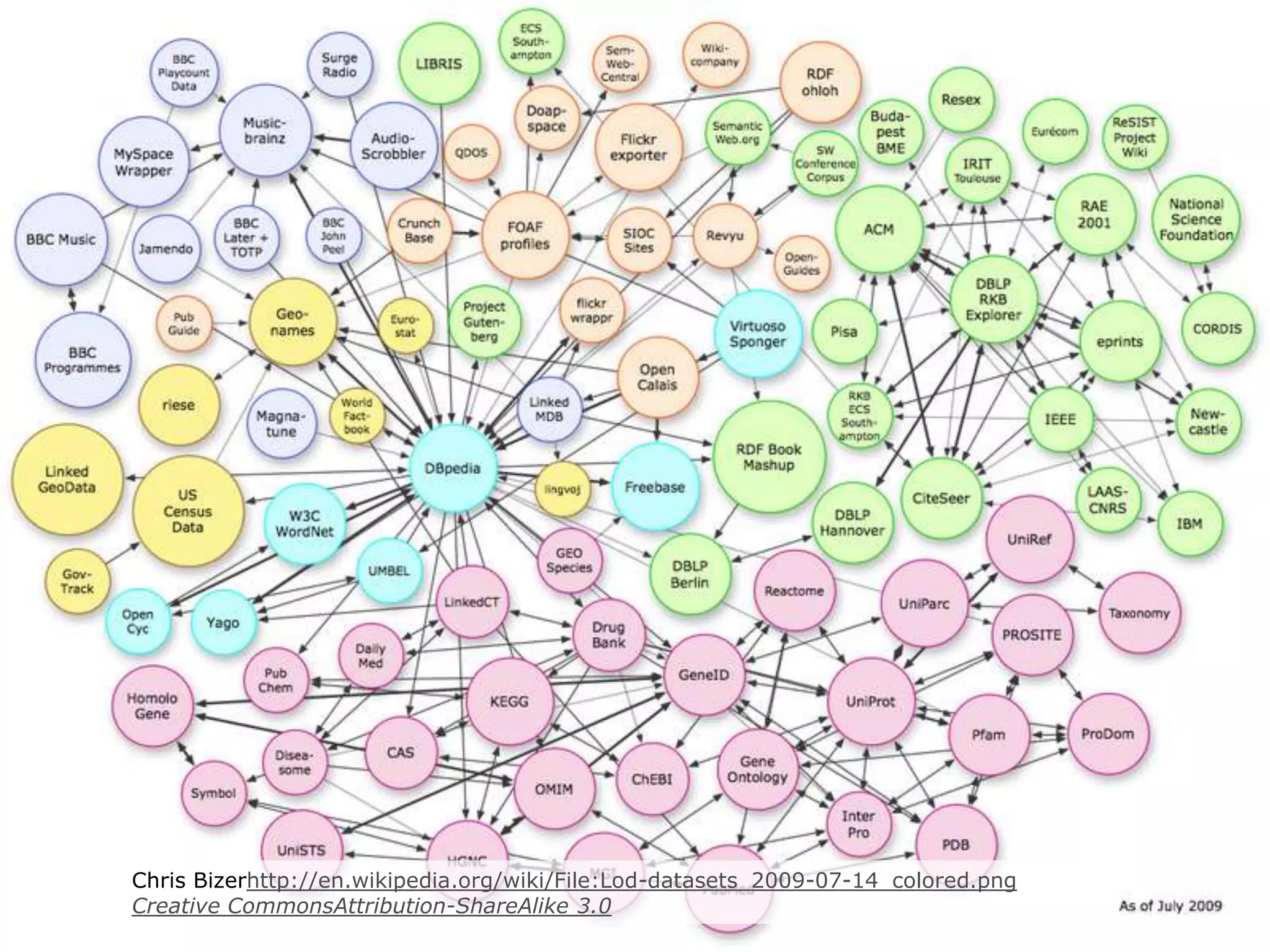
I referred earlier to the Semantic Web’s full potential, and that full potential is described by a vision known as Linked Data.The following diagram of Linked Data, and ones like it, are as important to PR and marketing professionals as any Web 2.0 illustration you will have seen bandied around over the years.The full potential21st April 2010 / Influence Crowd LLP / Creative Commons Attribution Share Alike License 2.0 England and Wales22
LinkedData image21st April 2010 / Influence Crowd LLP / Creative Commons Attribution Share Alike License 2.0 England and Wales23Chris Bizerhttp://en.wikipedia.org/wiki/File:Lod-datasets_2009-07-14_colored.pngCreative CommonsAttribution-ShareAlike 3.0
Linked Data is about using the Web to connect related data that wasn't previously linked, or using the Web to lower the barriers to linking data currently linked using other methods.More specifically, Wikipedia defines Linked Data as "a term used to describe a recommended best practice for exposing, sharing, and connecting pieces of data, information, and knowledge  on the Semantic Web using URIs and RDF.”Source: http://linkeddata.orgLinked Data21st April 2010 / Influence Crowd LLP / Creative Commons Attribution Share Alike License 2.0 England and Wales24
Linked Data is made possible because the URIs referred to in the triple statements are described universally and ontologically.An ontology is a way to describe subjects, objects and predicates. It is an expression of a view of the world; a domain’s objects and concepts and their properties and relations.Useful ontologies (ie, ones that can form building blocks of the Semantic Web Linked Data) are described in a formal ontological language. The one endorsed by W3C is the Web Ontology Language, or OWL for short.Ontologies21st April 2010 / Influence Crowd LLP / Creative Commons Attribution Share Alike License 2.0 England and Wales25
Some popular Semantic Web ontologies include:The Dublin CoreFOAFRSSVCardCreative Commons metadataThere are no ontologies yet, to my knowledge, emanating from or working within the field of public relations specifically (except the product review ontology perhaps).Ontologies /221st April 2010 / Influence Crowd LLP / Creative Commons Attribution Share Alike License 2.0 England and Wales26
The International Press Telecommunications Council announced the official launch and widespread adoption of its G2 family of news exchange standards earlier this month, supported by:Agence France-PresseAssociated PressdpaThe Press AssociationThomson ReutersIt’s XML, and contains some RDF components.News from the IPTC21st April 2010 / Influence Crowd LLP / Creative Commons Attribution Share Alike License 2.0 England and Wales27
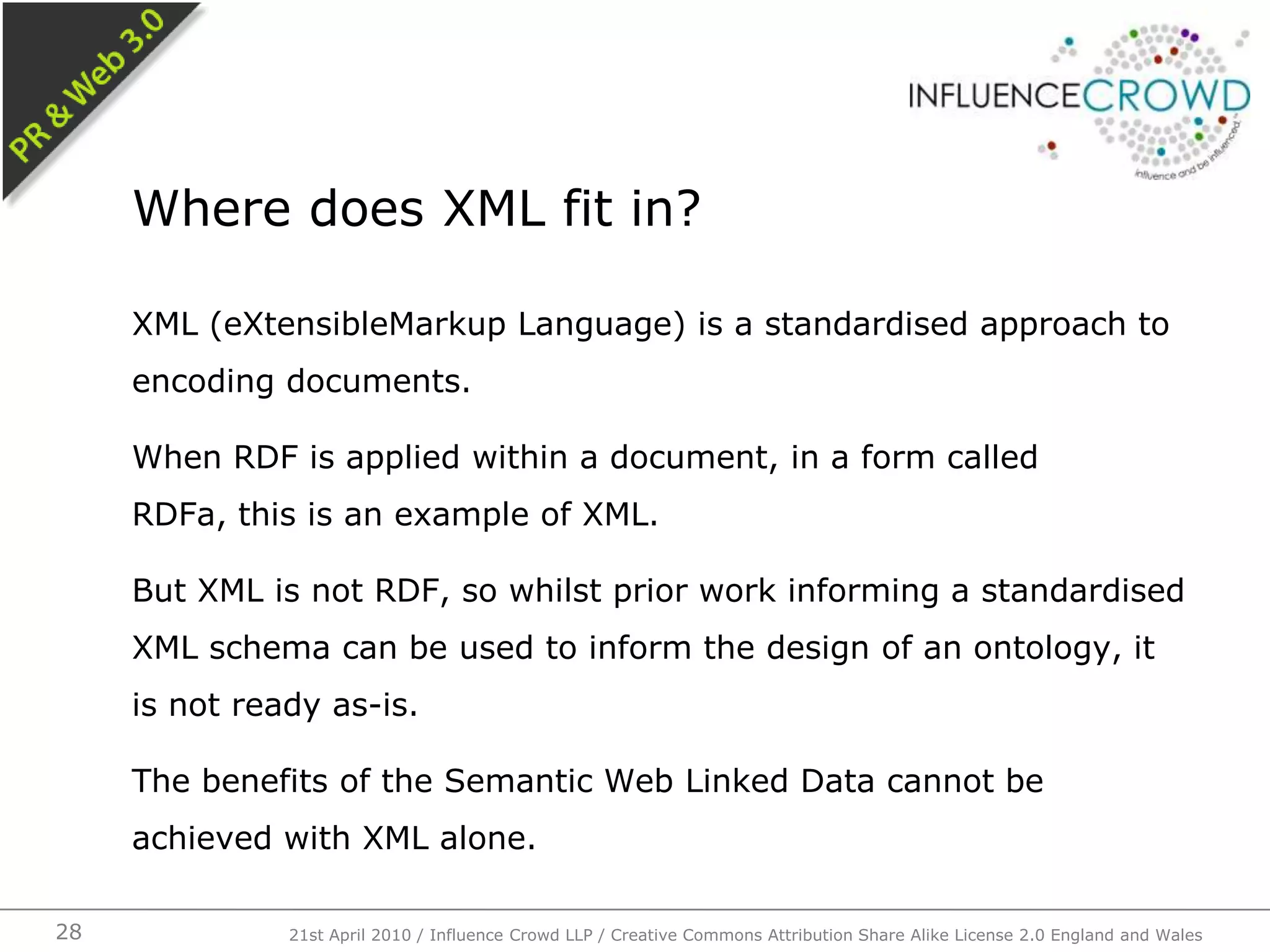
XML (eXtensibleMarkup Language) is a standardised approach to encoding documents.When RDF is applied within a document, in a form called RDFa, this is an example of XML.But XML is not RDF, so whilst prior work informing a standardised XML schema can be used to inform the design of an ontology, it is not ready as-is.The benefits of the Semantic Web Linked Data cannot be achieved with XML alone.Where does XML fit in?21st April 2010 / Influence Crowd LLP / Creative Commons Attribution Share Alike License 2.0 England and Wales28
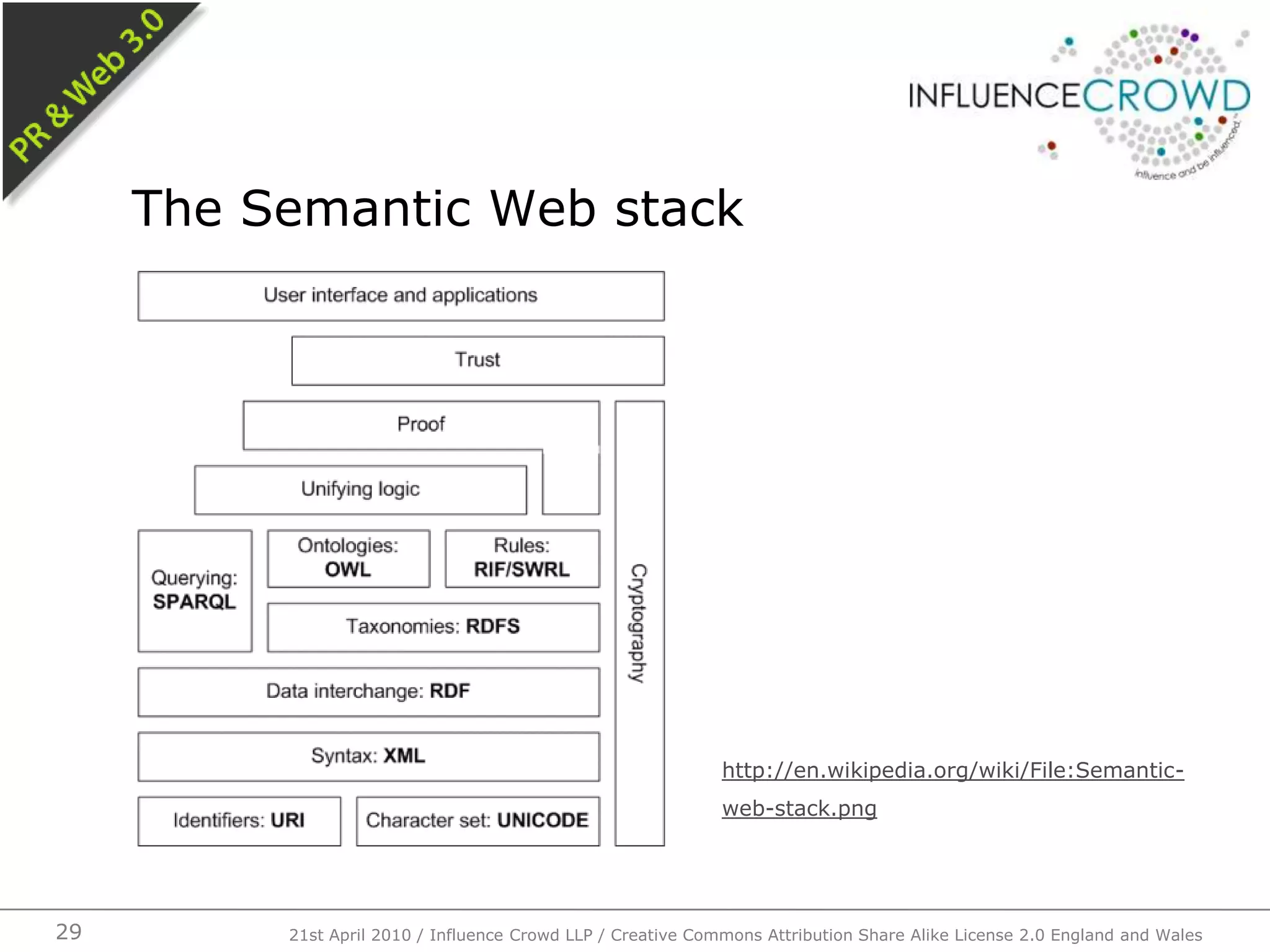
http://en.wikipedia.org/wiki/File:Semantic-web-stack.pngThe Semantic Web stack21st April 2010 / Influence Crowd LLP / Creative Commons Attribution Share Alike License 2.0 England and Wales29
XPRL was a valiant effort to design an XML schema for common PR processes.The first release aimed to encode the processes of:Encapsulating a press releaseBriefing a media reporting agency to report on media coverageReporting media coverage (clipping reports).What happened to XPRL?21st April 2010 / Influence Crowd LLP / Creative Commons Attribution Share Alike License 2.0 England and Wales30
In my opinion, XPRL was not adopted for the following reasons:An XML approach is more valuable the higher the level of automation and data interchange – yet PR practice has historically very low levelsXML of itself does not possess the compelling, can’t-be-ignored, synergistic potential of RDFThe PR profession is not renowned for being the most technically savvy to date.In conclusion, the PR industry simply could not see its value.What happened to XPRL? /221st April 2010 / Influence Crowd LLP / Creative Commons Attribution Share Alike License 2.0 England and Wales31
In my opinion, PR and associated disciplines should be gearing up for Web 3.0 now because:The level of automation and data interchange is growing rapidly, particularly with the massive growth of:Web analyticsRetail analyticsSearch engine optimisationSearch engine marketingSocial Web analyticsand the nascent social relationship management (SRM) and “ERPing” of the influence (marketing and PR) processes.What’s changed?21st April 2010 / Influence Crowd LLP / Creative Commons Attribution Share Alike License 2.0 England and Wales32
In my opinion, PR and associated disciplines should be gearing up for Web 3.0 now because (continued):RDF’s synergistic potential cannot be ignored during the influence processesIt is happening now, and in ways no well-founded PR / influence campaign can ignore (eg, Google ranking!)It doesn’t matter if today’s PR practitioner isn’t technically savvy – they will become ‘admin’ or be replaced by those who are.I refer to the latter as the rise of the Influence Professional and the Chief Influence Officer; see my presentation on “Influence”.What’s changed? /221st April 2010 / Influence Crowd LLP / Creative Commons Attribution Share Alike License 2.0 England and Wales33
21st April 2010 / Influence Crowd LLP / Creative Commons Attribution Share Alike License 2.0 England and Wales34InfluenceInfluencehttp://www.flickr.com/photos/philip_sheldrake/2642725725
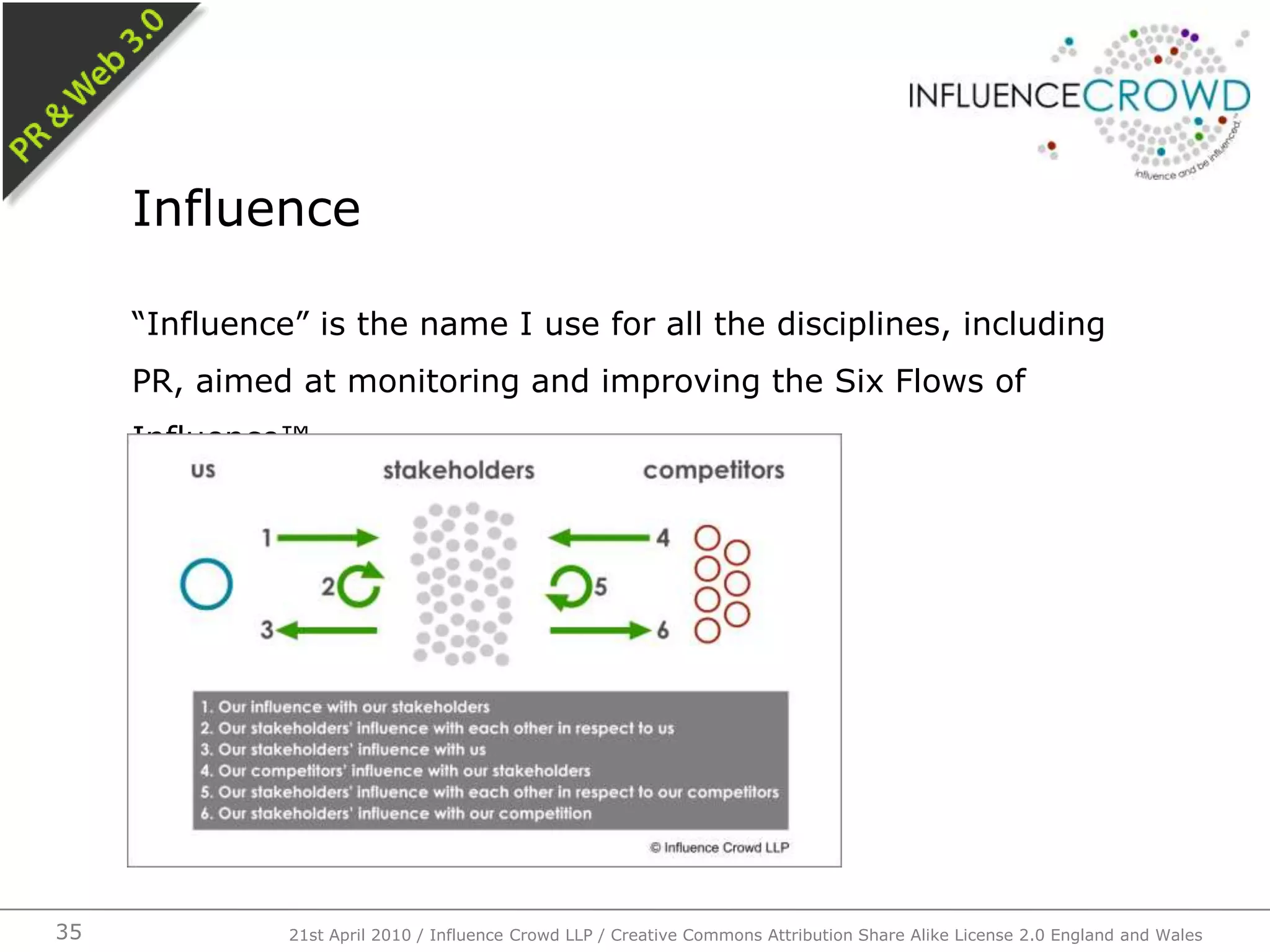
“Influence” is the name I use for all the disciplines, including PR, aimed at monitoring and improving the Six Flows of Influence™.Influence21st April 2010 / Influence Crowd LLP / Creative Commons Attribution Share Alike License 2.0 England and Wales35
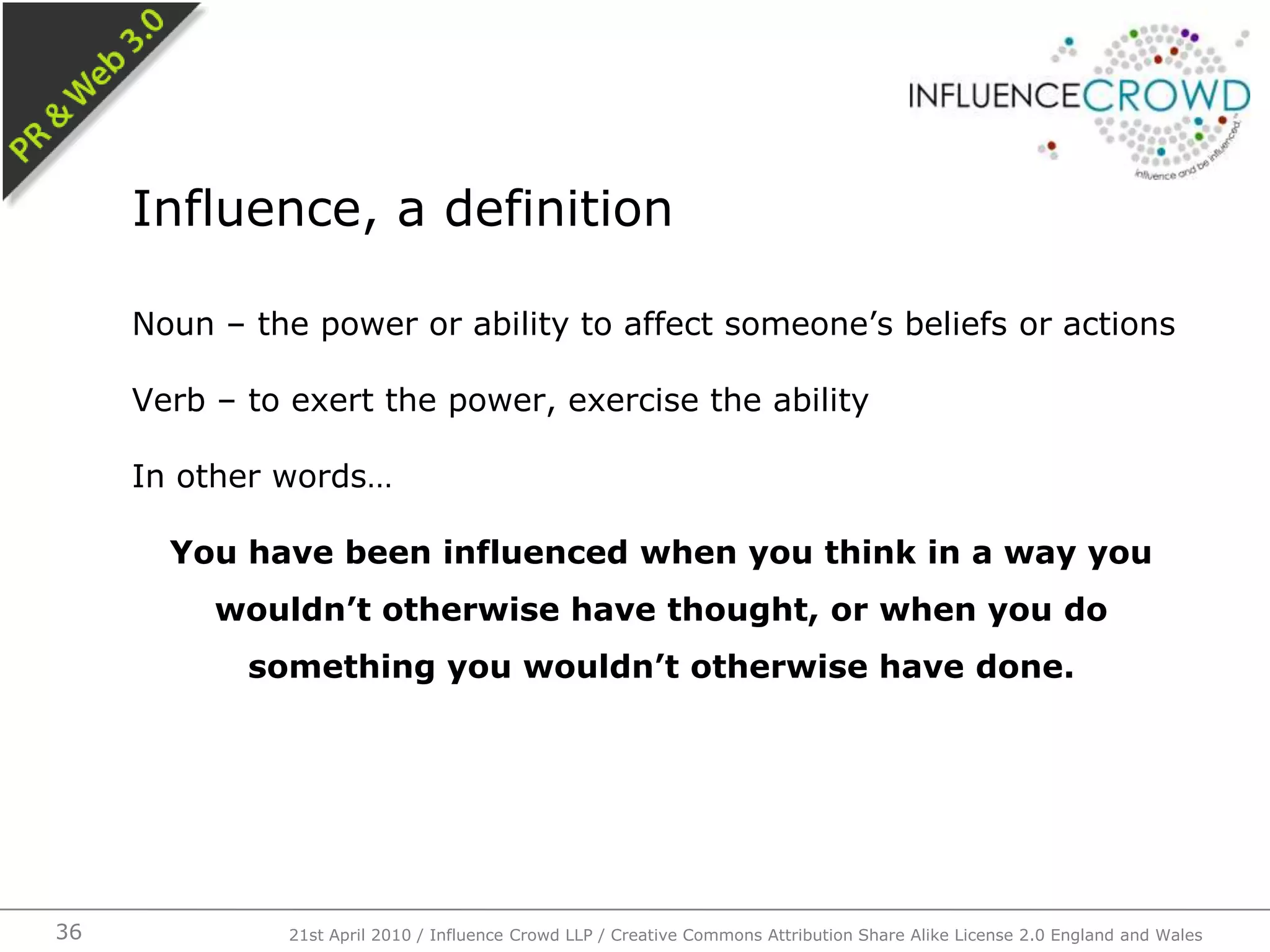
Noun – the power or ability to affect someone’s beliefs or actionsVerb – to exert the power, exercise the abilityIn other words…You have been influenced when you think in a way you wouldn’t otherwise have thought, or when you do something you wouldn’t otherwise have done. Influence, a definition21st April 2010 / Influence Crowd LLP / Creative Commons Attribution Share Alike License 2.0 England and Wales36
21st April 2010 / Influence Crowd LLP / Creative Commons Attribution Share Alike License 2.0 England and Wales37InfluenceOntologieshttp://www.flickr.com/photos/philip_sheldrake/2772635450
I contend that the PR and the other influence disciplines need at least two ontologies:One for our worldOne for the world out thereSo what ontologies do we need?21st April 2010 / Influence Crowd LLP / Creative Commons Attribution Share Alike License 2.0 England and Wales38
Trends informing the design of a PR Ontology, an ontology for the influence disciplines:Convergence of marketing and PR teamsThe increasing application of ITThe “ERPing” of marketing and PRGreater demand for board level accountabilityThe increasing need for campaign adaptability / nimblenessThe need for campaigns to be more responsiveThe need for all organisations to be more responsiveTeam structure (esp. agency) adaptability – plug’n’play.The ontology for our world21st April 2010 / Influence Crowd LLP / Creative Commons Attribution Share Alike License 2.0 England and Wales39
Perhaps trying to answer the following questions will help inform the design of the PR Ontology:What processes could be standardised because there is no room left for competitive advantage beyond workforce efficiency in their execution?What can we learn from disciplines in which IT and such semantic approaches have become ingrained earlier?How do we connect our data, information and knowledge into the wider organisation’s / client’s other operational data, information and knowledge?What is the atom of influence?The ontology for our world /221st April 2010 / Influence Crowd LLP / Creative Commons Attribution Share Alike License 2.0 England and Wales40
Following on from the assertion in my previous presentation that the influence disciplines should pursue an influence-centric rather than influencer-centric approach…Helping our publics, our stakeholders better express and communicate their thoughts and actions can only benefit all parties.The ontology for the world out there21st April 2010 / Influence Crowd LLP / Creative Commons Attribution Share Alike License 2.0 England and Wales41
Our profession needs to develop…The Ontology For Feelings About Things.This may well be informed by extant work by Linda Childers Hon, James E. Grunig, Bruning and Ledingham, and many others I’m sure.http://influencescorecard.wikispaces.com/The+original+email+about+the+ontologyhttp://influencescorecard.wikispaces.com/The+ontology+for+feelings+about+thingshttp://influencescorecard.wikispaces.com/Classes+and+properties+for+input+into+the+ontology+designThe ontology for the world out there /221st April 2010 / Influence Crowd LLP / Creative Commons Attribution Share Alike License 2.0 England and Wales42
For the WWW's social media participants to be part of Web 3.0 as well as Web 2.0, they need a set of easy-to-understand and easy-to-use extensions / add-ons / plugins / apps to augment their current applications and services.To mark-up their contributions with their feelings, semantically.The Ontology For Feelings About Things informs the design and user experience of such apps and services.And then what?21st April 2010 / Influence Crowd LLP / Creative Commons Attribution Share Alike License 2.0 England and Wales43
Properly applied, the Ontology For Feelings About Things should:Empower all social media participants to increase the utility of every social media contribution with very little additional effortAllow brands to gain a better understanding of their stakeholders' (incl. customers' and prospects') points of view courtesy of their analytics services, to get into the conversation and to improve their products and servicesFeed into the Vendor Relationship Management Project.The Ontology For Feelings About Things21st April 2010 / Influence Crowd LLP / Creative Commons Attribution Share Alike License 2.0 England and Wales44
Development of the ontologies is open, collaborative and subject to the Creative Commons Attribution Share-Alike 3.0 License.Development of associated software is open and subject to GPLv3.I'm delighted thatWooThemes‘ AdriaanPienaar is helping lead this side of things. If you don't know these guys, you might see that they come second only to wordpress.org in Google's search results for "Wordpress themes”. They are simply a very talented bunch!Get involved21st April 2010 / Influence Crowd LLP / Creative Commons Attribution Share Alike License 2.0 England and Wales45
Just drop in and register at the wiki, or contact Philip @sheldrake or philip@influencecrowd.com.Get in touch21st April 2010 / Influence Crowd LLP / Creative Commons Attribution Share Alike License 2.0 England and Wales46
Thanks to Steve Waddington and Speed Communications for hosting this event.@wadds / www.speedcommunications.comThanks47
With the current paucity of “meaning”, forgive me for helping search engines help others find this presentation:Marketing and Web 3.0Marketing and the Semantic WebMarketing and Linked DataAdvertising and Web 3.0Advertising and the Semantic WebAdvertising and Linked DataPublic relations and Web 3.0Public relations and the Semantic WebPublic relations and Linked DataOnline PR and Digital PROptimisation slide21st April 2010 / Influence Crowd LLP / Creative Commons Attribution Share Alike License 2.0 England and Wales48
http://semanticweb.orghttp://en.wikipedia.org/wiki/Semantic_Webhttp://linkeddata.orghttp://en.wikipedia.org/wiki/Linked_datahttp://influencescorecard.wikispaces.com - the wiki for the emergence of an overarching methodologyhttp://www.philipsheldrake.me.uk - my blogCIPR Social Media group: #ciprsm / http://twitter.com/sheldrake/cipr-digital-groupReading, collaboration, conversation21st April 2010 / Influence Crowd LLP / Creative Commons Attribution Share Alike License 2.0 England and Wales49

PR and Web 3.0

  • 1.
    Welcome to Themost exciting development in pr since the cluetrain.PROBABLY.well maybe.1
  • 2.
    PR &The semanticwebaka “Web 3.0”Philip SheldrakeInfluence Crowd LLPwww.influencecrowd.comLinkedIn /in/philipsheldrake@sheldrake2A presentation to members of the CIPR SM Panel and other geeks. London, 21st April 2010.
  • 3.
    Introduction to theSemantic WebLinkedDataXML and XPRLThe ontologiesHow to get involvedReading, collaboration, conversation.This presentation includes:21st April 2010 / Influence Crowd LLP / Creative Commons Attribution Share Alike License 2.0 England and Wales3
  • 4.
    The Semantic Web421stApril 2010 / Influence Crowd LLP / Creative Commons Attribution Share Alike License 2.0 England and Wales
  • 5.
    Whilst there issome confusion over the term, most people use “Web 3.0” to refer to the Semantic Web. I do.Either way, the label is a bit of a distraction, but marketers love it, so what can I say!I use the terms interchangeably here.Web 3.05
  • 6.
    If Web 2.0was all about (user generated) content and community participation, Web 3.0 is about the Web itself understanding the meaning of all the content and participation.Indeed, the Web becomes a universal medium for data, information and knowledge exchange.Web 2.0 and Web 3.06
  • 7.
    You can considerthe development of the current Web (pre-Web 3.0) as having been informed by a document metaphor:Files, desktop, documentsOpen, read, closeEverything has a location (like files in a filing cabinet).The document metaphor21st April 2010 / Influence Crowd LLP / Creative Commons Attribution Share Alike License 2.0 England and Wales7
  • 8.
    The location ofa document is specified with a Unique Resource Locator (URL).Eg, http://influencecrowd.com/philip_sheldrake/index.phpThe URL21st April 2010 / Influence Crowd LLP / Creative Commons Attribution Share Alike License 2.0 England and Wales8The file.The folder.The domain name that relates to an IP address of a server (via a domain name server (DNS)), in this case right now a shared server at 69.89.31.175.Stipulates the protocol for retrieving the resource.
  • 9.
    But the URLis just one type of Unique Resource Indicator (URI), the other is a URN.A URI identifies something on the InternetA URL does so by addressing it (eg, where Stephen lives)A URN does so by unique, persistent and location-independent name (eg, “Stephen Waddington”)Although of course the one and only Stephen Waddington may not actually be the only, so [firstname, lastname] does not make for a good URN schema!The URI and URN21st April 2010 / Influence Crowd LLP / Creative Commons Attribution Share Alike License 2.0 England and Wales9
  • 10.
    A hypothesis ofthe Semantic Web is that meaning can be conveyed via expressions known as triples:Triples21st April 2010 / Influence Crowd LLP / Creative Commons Attribution Share Alike License 2.0 England and Wales10
  • 11.
    Resource Description Framework(RDF) is a language at the heart of the Semantic Web for expressing data models using statements expressed as triples.RDFa is an approach to RDF that adds the information to normal Web pages for subsequent extraction by RDF tools.And the secret sauce?... to avoid ambiguities, each and every subject, predicate and object of a triple can be expressed with a URI.RDF, RDFa, Triples and URIs21st April 2010 / Influence Crowd LLP / Creative Commons Attribution Share Alike License 2.0 England and Wales11
  • 12.
    We could defineall three of these locally, but all three are likely to be referred to elsewhere too, and that’s where the power of the Semantic Web starts to kick in.Eg, this “Philip Sheldrake” may be defined uniquely with ref to: http://sheldrake.myopenid.comor http://philipsheldrake.com or http://www.google.com/profiles/philip.sheldrake.Local and global21st April 2010 / Influence Crowd LLP / Creative Commons Attribution Share Alike License 2.0 England and Wales12
  • 13.
    But what aboutthe concept of “knows”… how might that be defined globally and uniquely?Well FOAF (Friend Of A Friend) is a machine-readable ontology describing persons, their activities and their relations to other people and objects.To invoke reference to the FOAF ontology we write:<rdf:RDFxmlns:foaf=“http://xmlns.com/foaf/0.1/”FOAF21st April 2010 / Influence Crowd LLP / Creative Commons Attribution Share Alike License 2.0 England and Wales13
  • 14.
    At that URIwe will find a definition of “knows”:http://xmlns.com/foaf/spec/#term_knowsSo now, when we express a statement as a triple likeSubject - http://philipsheldrake.comPredicate - foaf:knowsObject - http://searls.comthere is no ambiguity as to what it means.Note: this format is for explanation purposes only and does not constitute sound syntax!FOAF /221st April 2010 / Influence Crowd LLP / Creative Commons Attribution Share Alike License 2.0 England and Wales14
  • 15.
    How about?!http://xkcd.com/stickman foaf:complicatedhttp://xkcd.com/stickwomanSimple complicated21st April 2010 / Influence Crowd LLP / Creative Commons Attribution Share Alike License 2.0 England and Wales15http://xkcd.com/355
  • 16.
    A microformat isan alternative approach to semantic markup.The eXtensible Friends Network (XFN) is the microformat most similar to FOAF for example. XFN is used to express how one blogger is related to another whose blog they list in their blogroll.hCardand hCalendarare other microformats you may have come across.See http://evan.prodromou.name/RDFa_vs_microformats for a more detailed comparison of RDF and microformats.RDF and microformats21st April 2010 / Influence Crowd LLP / Creative Commons Attribution Share Alike License 2.0 England and Wales16
  • 17.
    I endorse theRDF approach for several reasons, the most important ones here being:It comes under the purview of the W3CMicroformats cannot scale to achieve the Semantic Web’s full potential.RDF is being used today by:dbpedia – a project to represent Wikipedia content in RDFdata.gov.uk – making the UK’s data mashable!Amazon.com – to mark up its and its partners’ products.RDF is the future21st April 2010 / Influence Crowd LLP / Creative Commons Attribution Share Alike License 2.0 England and Wales17
  • 18.
    21st April 2010/ Influence Crowd LLP / Creative Commons Attribution Share Alike License 2.0 England and Wales18Wake up!Wake up at the back!Google’s coming next!http://www.flickr.com/photos/morberg/3146874095Attribution-ShareAlike 2.0 Generic
  • 19.
    GoodRelations is thename of an ontology for ecommerce.Jay Myers, Lead Web Development Engineer for Best Buy, reported that adding GoodRelations and RDFa:Improved the rank of the respective pages in Google tremendouslyIncreased traffic on the BestBuy stores pages by 30%.Search Engine Strategies 2009 conference, Chicago.http://ebusiness-unibw.org/pipermail/goodrelations/2009-December/000152.htmlGoogle loves RDF21st April 2010 / Influence Crowd LLP / Creative Commons Attribution Share Alike License 2.0 England and Wales19
  • 20.
    Google reads semanticallymarked up content and, as of May 2009, uses it to create “rich snippets” it in its search results. Eg,http://googlewebmastercentral.blogspot.com/2009/05/introducing-rich-snippets.htmlGoogle’s Rich Snippets21st April 2010 / Influence Crowd LLP / Creative Commons Attribution Share Alike License 2.0 England and Wales20This “rich snippet” is possible only because Pocket-lint marks its content up semantically and to a standard recognised by Google.
  • 21.
    Yahoo!’s SearchMonkey andMicrosoft Bing’sPowerset team are heavily invested in RDF too.There will be more news on this front this year from all three big search providers, and Wolfram|Alpha of course.Yahoo! and Bing21st April 2010 / Influence Crowd LLP / Creative Commons Attribution Share Alike License 2.0 England and Wales21
  • 22.
    I referred earlierto the Semantic Web’s full potential, and that full potential is described by a vision known as Linked Data.The following diagram of Linked Data, and ones like it, are as important to PR and marketing professionals as any Web 2.0 illustration you will have seen bandied around over the years.The full potential21st April 2010 / Influence Crowd LLP / Creative Commons Attribution Share Alike License 2.0 England and Wales22
  • 23.
    LinkedData image21st April2010 / Influence Crowd LLP / Creative Commons Attribution Share Alike License 2.0 England and Wales23Chris Bizerhttp://en.wikipedia.org/wiki/File:Lod-datasets_2009-07-14_colored.pngCreative CommonsAttribution-ShareAlike 3.0
  • 24.
    Linked Data isabout using the Web to connect related data that wasn't previously linked, or using the Web to lower the barriers to linking data currently linked using other methods.More specifically, Wikipedia defines Linked Data as "a term used to describe a recommended best practice for exposing, sharing, and connecting pieces of data, information, and knowledge on the Semantic Web using URIs and RDF.”Source: http://linkeddata.orgLinked Data21st April 2010 / Influence Crowd LLP / Creative Commons Attribution Share Alike License 2.0 England and Wales24
  • 25.
    Linked Data ismade possible because the URIs referred to in the triple statements are described universally and ontologically.An ontology is a way to describe subjects, objects and predicates. It is an expression of a view of the world; a domain’s objects and concepts and their properties and relations.Useful ontologies (ie, ones that can form building blocks of the Semantic Web Linked Data) are described in a formal ontological language. The one endorsed by W3C is the Web Ontology Language, or OWL for short.Ontologies21st April 2010 / Influence Crowd LLP / Creative Commons Attribution Share Alike License 2.0 England and Wales25
  • 26.
    Some popular SemanticWeb ontologies include:The Dublin CoreFOAFRSSVCardCreative Commons metadataThere are no ontologies yet, to my knowledge, emanating from or working within the field of public relations specifically (except the product review ontology perhaps).Ontologies /221st April 2010 / Influence Crowd LLP / Creative Commons Attribution Share Alike License 2.0 England and Wales26
  • 27.
    The International PressTelecommunications Council announced the official launch and widespread adoption of its G2 family of news exchange standards earlier this month, supported by:Agence France-PresseAssociated PressdpaThe Press AssociationThomson ReutersIt’s XML, and contains some RDF components.News from the IPTC21st April 2010 / Influence Crowd LLP / Creative Commons Attribution Share Alike License 2.0 England and Wales27
  • 28.
    XML (eXtensibleMarkup Language)is a standardised approach to encoding documents.When RDF is applied within a document, in a form called RDFa, this is an example of XML.But XML is not RDF, so whilst prior work informing a standardised XML schema can be used to inform the design of an ontology, it is not ready as-is.The benefits of the Semantic Web Linked Data cannot be achieved with XML alone.Where does XML fit in?21st April 2010 / Influence Crowd LLP / Creative Commons Attribution Share Alike License 2.0 England and Wales28
  • 29.
    http://en.wikipedia.org/wiki/File:Semantic-web-stack.pngThe Semantic Webstack21st April 2010 / Influence Crowd LLP / Creative Commons Attribution Share Alike License 2.0 England and Wales29
  • 30.
    XPRL was avaliant effort to design an XML schema for common PR processes.The first release aimed to encode the processes of:Encapsulating a press releaseBriefing a media reporting agency to report on media coverageReporting media coverage (clipping reports).What happened to XPRL?21st April 2010 / Influence Crowd LLP / Creative Commons Attribution Share Alike License 2.0 England and Wales30
  • 31.
    In my opinion,XPRL was not adopted for the following reasons:An XML approach is more valuable the higher the level of automation and data interchange – yet PR practice has historically very low levelsXML of itself does not possess the compelling, can’t-be-ignored, synergistic potential of RDFThe PR profession is not renowned for being the most technically savvy to date.In conclusion, the PR industry simply could not see its value.What happened to XPRL? /221st April 2010 / Influence Crowd LLP / Creative Commons Attribution Share Alike License 2.0 England and Wales31
  • 32.
    In my opinion,PR and associated disciplines should be gearing up for Web 3.0 now because:The level of automation and data interchange is growing rapidly, particularly with the massive growth of:Web analyticsRetail analyticsSearch engine optimisationSearch engine marketingSocial Web analyticsand the nascent social relationship management (SRM) and “ERPing” of the influence (marketing and PR) processes.What’s changed?21st April 2010 / Influence Crowd LLP / Creative Commons Attribution Share Alike License 2.0 England and Wales32
  • 33.
    In my opinion,PR and associated disciplines should be gearing up for Web 3.0 now because (continued):RDF’s synergistic potential cannot be ignored during the influence processesIt is happening now, and in ways no well-founded PR / influence campaign can ignore (eg, Google ranking!)It doesn’t matter if today’s PR practitioner isn’t technically savvy – they will become ‘admin’ or be replaced by those who are.I refer to the latter as the rise of the Influence Professional and the Chief Influence Officer; see my presentation on “Influence”.What’s changed? /221st April 2010 / Influence Crowd LLP / Creative Commons Attribution Share Alike License 2.0 England and Wales33
  • 34.
    21st April 2010/ Influence Crowd LLP / Creative Commons Attribution Share Alike License 2.0 England and Wales34InfluenceInfluencehttp://www.flickr.com/photos/philip_sheldrake/2642725725
  • 35.
    “Influence” is thename I use for all the disciplines, including PR, aimed at monitoring and improving the Six Flows of Influence™.Influence21st April 2010 / Influence Crowd LLP / Creative Commons Attribution Share Alike License 2.0 England and Wales35
  • 36.
    Noun – thepower or ability to affect someone’s beliefs or actionsVerb – to exert the power, exercise the abilityIn other words…You have been influenced when you think in a way you wouldn’t otherwise have thought, or when you do something you wouldn’t otherwise have done. Influence, a definition21st April 2010 / Influence Crowd LLP / Creative Commons Attribution Share Alike License 2.0 England and Wales36
  • 37.
    21st April 2010/ Influence Crowd LLP / Creative Commons Attribution Share Alike License 2.0 England and Wales37InfluenceOntologieshttp://www.flickr.com/photos/philip_sheldrake/2772635450
  • 38.
    I contend thatthe PR and the other influence disciplines need at least two ontologies:One for our worldOne for the world out thereSo what ontologies do we need?21st April 2010 / Influence Crowd LLP / Creative Commons Attribution Share Alike License 2.0 England and Wales38
  • 39.
    Trends informing thedesign of a PR Ontology, an ontology for the influence disciplines:Convergence of marketing and PR teamsThe increasing application of ITThe “ERPing” of marketing and PRGreater demand for board level accountabilityThe increasing need for campaign adaptability / nimblenessThe need for campaigns to be more responsiveThe need for all organisations to be more responsiveTeam structure (esp. agency) adaptability – plug’n’play.The ontology for our world21st April 2010 / Influence Crowd LLP / Creative Commons Attribution Share Alike License 2.0 England and Wales39
  • 40.
    Perhaps trying toanswer the following questions will help inform the design of the PR Ontology:What processes could be standardised because there is no room left for competitive advantage beyond workforce efficiency in their execution?What can we learn from disciplines in which IT and such semantic approaches have become ingrained earlier?How do we connect our data, information and knowledge into the wider organisation’s / client’s other operational data, information and knowledge?What is the atom of influence?The ontology for our world /221st April 2010 / Influence Crowd LLP / Creative Commons Attribution Share Alike License 2.0 England and Wales40
  • 41.
    Following on fromthe assertion in my previous presentation that the influence disciplines should pursue an influence-centric rather than influencer-centric approach…Helping our publics, our stakeholders better express and communicate their thoughts and actions can only benefit all parties.The ontology for the world out there21st April 2010 / Influence Crowd LLP / Creative Commons Attribution Share Alike License 2.0 England and Wales41
  • 42.
    Our profession needsto develop…The Ontology For Feelings About Things.This may well be informed by extant work by Linda Childers Hon, James E. Grunig, Bruning and Ledingham, and many others I’m sure.http://influencescorecard.wikispaces.com/The+original+email+about+the+ontologyhttp://influencescorecard.wikispaces.com/The+ontology+for+feelings+about+thingshttp://influencescorecard.wikispaces.com/Classes+and+properties+for+input+into+the+ontology+designThe ontology for the world out there /221st April 2010 / Influence Crowd LLP / Creative Commons Attribution Share Alike License 2.0 England and Wales42
  • 43.
    For the WWW'ssocial media participants to be part of Web 3.0 as well as Web 2.0, they need a set of easy-to-understand and easy-to-use extensions / add-ons / plugins / apps to augment their current applications and services.To mark-up their contributions with their feelings, semantically.The Ontology For Feelings About Things informs the design and user experience of such apps and services.And then what?21st April 2010 / Influence Crowd LLP / Creative Commons Attribution Share Alike License 2.0 England and Wales43
  • 44.
    Properly applied, theOntology For Feelings About Things should:Empower all social media participants to increase the utility of every social media contribution with very little additional effortAllow brands to gain a better understanding of their stakeholders' (incl. customers' and prospects') points of view courtesy of their analytics services, to get into the conversation and to improve their products and servicesFeed into the Vendor Relationship Management Project.The Ontology For Feelings About Things21st April 2010 / Influence Crowd LLP / Creative Commons Attribution Share Alike License 2.0 England and Wales44
  • 45.
    Development of theontologies is open, collaborative and subject to the Creative Commons Attribution Share-Alike 3.0 License.Development of associated software is open and subject to GPLv3.I'm delighted thatWooThemes‘ AdriaanPienaar is helping lead this side of things. If you don't know these guys, you might see that they come second only to wordpress.org in Google's search results for "Wordpress themes”. They are simply a very talented bunch!Get involved21st April 2010 / Influence Crowd LLP / Creative Commons Attribution Share Alike License 2.0 England and Wales45
  • 46.
    Just drop inand register at the wiki, or contact Philip @sheldrake or philip@influencecrowd.com.Get in touch21st April 2010 / Influence Crowd LLP / Creative Commons Attribution Share Alike License 2.0 England and Wales46
  • 47.
    Thanks to SteveWaddington and Speed Communications for hosting this event.@wadds / www.speedcommunications.comThanks47
  • 48.
    With the currentpaucity of “meaning”, forgive me for helping search engines help others find this presentation:Marketing and Web 3.0Marketing and the Semantic WebMarketing and Linked DataAdvertising and Web 3.0Advertising and the Semantic WebAdvertising and Linked DataPublic relations and Web 3.0Public relations and the Semantic WebPublic relations and Linked DataOnline PR and Digital PROptimisation slide21st April 2010 / Influence Crowd LLP / Creative Commons Attribution Share Alike License 2.0 England and Wales48
  • 49.
    http://semanticweb.orghttp://en.wikipedia.org/wiki/Semantic_Webhttp://linkeddata.orghttp://en.wikipedia.org/wiki/Linked_datahttp://influencescorecard.wikispaces.com - thewiki for the emergence of an overarching methodologyhttp://www.philipsheldrake.me.uk - my blogCIPR Social Media group: #ciprsm / http://twitter.com/sheldrake/cipr-digital-groupReading, collaboration, conversation21st April 2010 / Influence Crowd LLP / Creative Commons Attribution Share Alike License 2.0 England and Wales49