Semantic Roles
(Kreidler,1998)
TABLE OF CONTENT
Some changes in
valency
03.
Sentence and
proposition
01.
Semantic roles
02.
(Kreidler,1998)
Sentence and
proposition
01.
01
(Kreidler,1998)
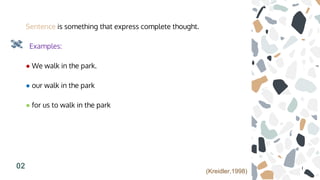
Sentence is something that express complete thought.
Examples:
● We walk in the park.
● our walk in the park
● for us to walk in the park
02
(Kreidler,1998)
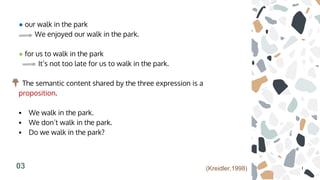
● our walk in the park
We enjoyed our walk in the park.
● for us to walk in the park
It’s not too late for us to walk in the park.
The semantic content shared by the three expression is a
proposition.
 We walk in the park.
 We don’t walk in the park.
 Do we walk in the park?
03 (Kreidler,1998)
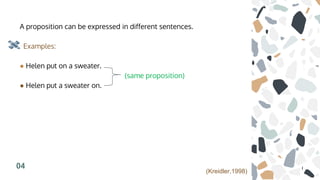
A proposition can be expressed in different sentences.
Examples:
● Helen put on a sweater.
(same proposition)
● Helen put a sweater on.
04
(Kreidler,1998)
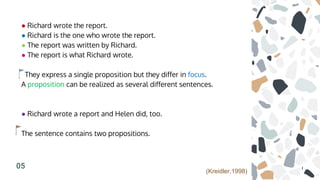
● Richard wrote the report.
● Richard is the one who wrote the report.
● The report was written by Richard.
● The report is what Richard wrote.
They express a single proposition but they differ in focus.
A proposition can be realized as several different sentences.
● Richard wrote a report and Helen did, too.
The sentence contains two propositions.
05
(Kreidler,1998)
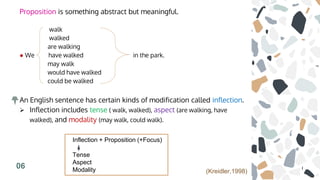
Proposition is something abstract but meaningful.
walk
walked
are walking
● We have walked in the park.
may walk
would have walked
could be walked
An English sentence has certain kinds of modification called inflection.
 Inflection includes tense ( walk, walked), aspect (are walking, have
walked), and modality (may walk, could walk).
Inflection + Proposition (+Focus)
Tense
Aspect
Modality
06
(Kreidler,1998)
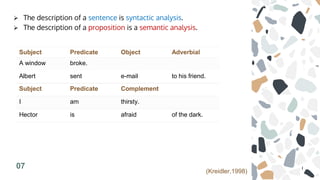
 The description of a sentence is syntactic analysis.
 The description of a proposition is a semantic analysis.
Subject Predicate Object Adverbial
A window broke.
Albert sent e-mail to his friend.
Subject Predicate Complement
I am thirsty.
Hector is afraid of the dark.
07
(Kreidler,1998)
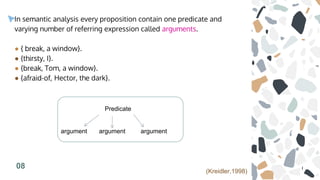
In semantic analysis every proposition contain one predicate and
varying number of referring expression called arguments.
● { break, a window}.
● {thirsty, I}.
● {break, Tom, a window}.
● {afraid-of, Hector, the dark}.
Predicate
argument argument argument
08
(Kreidler,1998)
Semantic roles
02.
09
(Kreidler,1998)
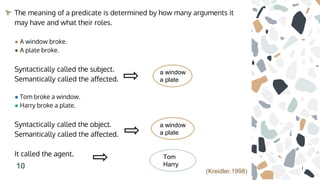
The meaning of a predicate is determined by how many arguments it
may have and what their roles.
● A window broke.
● A plate broke.
Syntactically called the subject.
Semantically called the affected.
● Tom broke a window.
● Harry broke a plate.
Syntactically called the object.
Semantically called the affected.
It called the agent.
a window
a plate
a window
a plate
Tom
Harry
10
(Kreidler,1998)
An account of the number of the arguments that a predicate has is
called the valency of the predicate.
The valency theory is a description of the semantic potential of
predicates in terms of the number and types of arguments.
● A window broke.
● Tom broke a window.
11
(Kreidler,1998)
Valency Zero
02.1
12
(Kreidler,1998)
Examples :
● It is snowing.
● It has been thundering (in the west).
 The subject (it) doesn’t name anything.
 The sentence has a subject because English requires a
subject, but this subject doesn’t correspond to anything in
the underling proposition.
Examples:
● It’s windy (today).
● It was rainy (all last month).
13
(Kreidler,1998)
THANK YOU
Any questions?
Refrences:
• Kreidler, C. W. (1998). Introducing english semantics. Psychology Press.

Semantic roles ch4

  • 1.
  • 2.
    TABLE OF CONTENT Somechanges in valency 03. Sentence and proposition 01. Semantic roles 02. (Kreidler,1998)
  • 3.
  • 4.
    Sentence is somethingthat express complete thought. Examples: ● We walk in the park. ● our walk in the park ● for us to walk in the park 02 (Kreidler,1998)
  • 5.
    ● our walkin the park We enjoyed our walk in the park. ● for us to walk in the park It’s not too late for us to walk in the park. The semantic content shared by the three expression is a proposition.  We walk in the park.  We don’t walk in the park.  Do we walk in the park? 03 (Kreidler,1998)
  • 6.
    A proposition canbe expressed in different sentences. Examples: ● Helen put on a sweater. (same proposition) ● Helen put a sweater on. 04 (Kreidler,1998)
  • 7.
    ● Richard wrotethe report. ● Richard is the one who wrote the report. ● The report was written by Richard. ● The report is what Richard wrote. They express a single proposition but they differ in focus. A proposition can be realized as several different sentences. ● Richard wrote a report and Helen did, too. The sentence contains two propositions. 05 (Kreidler,1998)
  • 8.
    Proposition is somethingabstract but meaningful. walk walked are walking ● We have walked in the park. may walk would have walked could be walked An English sentence has certain kinds of modification called inflection.  Inflection includes tense ( walk, walked), aspect (are walking, have walked), and modality (may walk, could walk). Inflection + Proposition (+Focus) Tense Aspect Modality 06 (Kreidler,1998)
  • 9.
     The descriptionof a sentence is syntactic analysis.  The description of a proposition is a semantic analysis. Subject Predicate Object Adverbial A window broke. Albert sent e-mail to his friend. Subject Predicate Complement I am thirsty. Hector is afraid of the dark. 07 (Kreidler,1998)
  • 10.
    In semantic analysisevery proposition contain one predicate and varying number of referring expression called arguments. ● { break, a window}. ● {thirsty, I}. ● {break, Tom, a window}. ● {afraid-of, Hector, the dark}. Predicate argument argument argument 08 (Kreidler,1998)
  • 11.
  • 12.
    The meaning ofa predicate is determined by how many arguments it may have and what their roles. ● A window broke. ● A plate broke. Syntactically called the subject. Semantically called the affected. ● Tom broke a window. ● Harry broke a plate. Syntactically called the object. Semantically called the affected. It called the agent. a window a plate a window a plate Tom Harry 10 (Kreidler,1998)
  • 13.
    An account ofthe number of the arguments that a predicate has is called the valency of the predicate. The valency theory is a description of the semantic potential of predicates in terms of the number and types of arguments. ● A window broke. ● Tom broke a window. 11 (Kreidler,1998)
  • 14.
  • 15.
    Examples : ● Itis snowing. ● It has been thundering (in the west).  The subject (it) doesn’t name anything.  The sentence has a subject because English requires a subject, but this subject doesn’t correspond to anything in the underling proposition. Examples: ● It’s windy (today). ● It was rainy (all last month). 13 (Kreidler,1998)
  • 16.
  • 17.
    Refrences: • Kreidler, C.W. (1998). Introducing english semantics. Psychology Press.