Past, Present and
Future Directions
From Cook’s (2003). Applied Linguistics– Ch8
King Abdulaziz University
Department of European
Languages & Literature
Faculty of Arts & Humanities
Applied linguistics– LANE 621
● Early orientation
● Subsequent changes
● Second Language Acquisition (SLA)
● Corpus linguistics
● Being applied
● Critical Applied Linguistics (CALx)
● ‘Post-modern’ applied linguistics
● A harder future: mediation
Table of Contents
Early orientation
• The term ‘Applied linguistics’ emerged
in tandem with, and in response to, the
changing international linguistic landscape
after World War II.
• At first its concerns were almost exclusively
with TEFL.
Early orientation
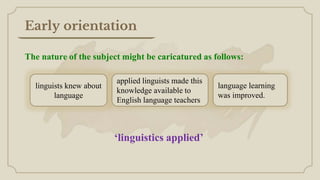
The nature of the subject might be caricatured as follows:
Early orientation
applied linguists made this
knowledge available to
English language teachers
language learning
was improved.
linguists knew about
language
‘linguistics applied’
Subsequent changes
Subsequent changes
1. The issue of scope
2. The relationship with linguistics
Subsequent changes
3. New attitudes and ideas among
professionals, especially teachers
4. Tensions at all interfaces of the old three-
way relationship between linguists, applied
linguists and language professionals
Second Language
Acquisition (SLA)
Second Language Acquisition (SLA)
• Explaining and describing the process of acquiring a
second language.
• The ways in which it is affected by external factors.
• The degree of transfer from the first language/s.

In the 1970s, SLA research concerned itself with:
Second Language Acquisition (SLA)
• Variation between learners or within one learner
• Why the process of acquiring a second language,
is so often regarded as ‘incomplete’.
• Ways of improving language teaching and
learning.
In the 1970s, SLA research concerned itself with:
Second Language Acquisition (SLA)
• The frequent assumption of a
universalist model of the kind
developed for first language
acquisition in Chomskyan
linguistics.
• The frequent implication that
monolingualism is the normal
starting point for language
learners.
Points of criticism
Corpus linguistics
Corpus Linguistics
‘Corpus’ (plural ‘corpora’)
refers to databank of language which has
actually occurred- whether written, spoken
or a mixture of the two.
Corpus linguistics
is concerned with the patterns and
regularities of language use which can be
revealed by systematic analysis of such
corpora.
Corpus Linguistics
Collocations
• There are collocations with very similar
meanings which occur with great frequency,
for example, It is much more usual to
say ‘provide assistance’ than ‘supply assistance’
• Corpus linguistics provide information
about ‘attestedness’
Corpus Linguistics
The fact that something occurs frequently in a
corpus does not necessarily mean that it is
processed as a ready-made unit by each individual
user.
Nevertheless, the prominence of collocation does
strongly suggest a greater role for memory in
language processing.
Corpus Linguistics
• Applications of corpus linguistics are
far wider than language teaching.
• It has revolutionized Lexicography.
• It can be used to establish the
authorship of a document.
Being applied
Being applied
SLA is predominantly psychological in
orientation, focused upon how language
develops in the mind.
Corpus linguistics is predominantly social,
studying the language behavior of people who
are already proficient in language use.
Being applied
• SLA and Corpus linguistics lay claim to having
uncovered objective scientific facts about
language,
SLA about learning, Corpus linguistics about use.
• Both assume that such findings should be the main
factor in language-related decisions.
Critical Applied Linguistics
(CALx)
Critical Applied Linguistics (CALx)
In Critical Applied Linguistics (CALx)
applied linguistics aligns itself more
explicitly with political action.
Critical Applied Linguistics (CALx)
• It should be engaged with social change and action.
• Combat injustice and inequality.
• Incorporate work in critical political theory
into applied linguistics
• It should be self-critical.
The main principles:
Critical Applied Linguistics (CALx)
• CALx’s claims to political commitment are
extremely vague.
• It is not clear what is new about CALx other
than the word ‘critical’.
Criticisms of (CALx):
‘Post-modern’ applied
linguistics
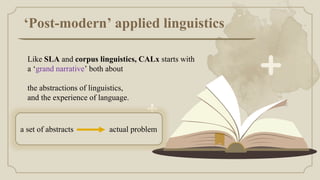
‘Post-modern’ applied linguistics
Like SLA and corpus linguistics, CALx starts with
a ‘grand narrative’ both about
the abstractions of linguistics,
and the experience of language.
a set of abstracts actual problem
‘Post-modern’ applied linguistics
In the spirit of post-modernism, this approach:
abandons ‘grand narratives’ altogether
and relocates the impetus for action within the
problem itself.
Those with language-related problems should
seek advice from other academic disciplines or
outside the academic field.
‘Post-modern’ applied linguistics
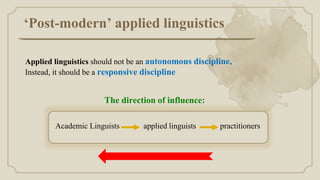
Applied linguistics should not be an autonomous discipline,
Instead, it should be a responsive discipline
Academic Linguists applied linguists practitioners
The direction of influence:
‘Post-modern’ applied linguistics
• The danger to intellectual inquiry posed by any activity which is driven by
purely practical criteria.
• This approach may be exploited by employers, corporations and
governments whose interest is in various self-seeking agendas of their own.
Criticism of this approach:
A harder future: mediation
Applied linguistics is concerned with the
most emotive and important issues which
are global but manifested in personal
decision-making too.
A harder future: mediation
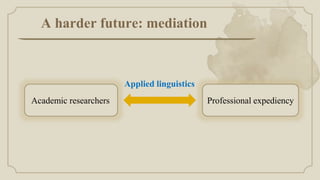
Professional expediency
Academic researchers
Applied linguistics
A harder future: mediation
Interdisciplinarity as though
applied linguistics existed only at the
intersection of other fields
Further Readings
Text 1
ROSAMUND MITCHELL and FLORENCE MYLES:
Second Language Learning Theories. Arnold 1998, page 195
Further Readings
Text 2
SUSAN HUNSTON: Corpora in Applied Linguistics.
Cambridge University Press 2002, pages 3, 13, 14
Further Readings
Text 3
ALASTAIR PENNYCOOK: Critical Applied linguistics: A
Critical Introduction. Lawrence Erlbaum Associates 2001,
pages 4, 5, 9
Cook, G. (2003). Applied linguistics.
Oxford University Press.
References
Thank you…

(Applied linguistics) cook's book ch 8

  • 1.
    Past, Present and FutureDirections From Cook’s (2003). Applied Linguistics– Ch8 King Abdulaziz University Department of European Languages & Literature Faculty of Arts & Humanities Applied linguistics– LANE 621
  • 2.
    ● Early orientation ●Subsequent changes ● Second Language Acquisition (SLA) ● Corpus linguistics ● Being applied ● Critical Applied Linguistics (CALx) ● ‘Post-modern’ applied linguistics ● A harder future: mediation Table of Contents
  • 3.
  • 4.
    • The term‘Applied linguistics’ emerged in tandem with, and in response to, the changing international linguistic landscape after World War II. • At first its concerns were almost exclusively with TEFL. Early orientation
  • 5.
    The nature ofthe subject might be caricatured as follows: Early orientation applied linguists made this knowledge available to English language teachers language learning was improved. linguists knew about language ‘linguistics applied’
  • 6.
  • 7.
    Subsequent changes 1. Theissue of scope 2. The relationship with linguistics
  • 8.
    Subsequent changes 3. Newattitudes and ideas among professionals, especially teachers 4. Tensions at all interfaces of the old three- way relationship between linguists, applied linguists and language professionals
  • 9.
  • 10.
    Second Language Acquisition(SLA) • Explaining and describing the process of acquiring a second language. • The ways in which it is affected by external factors. • The degree of transfer from the first language/s. In the 1970s, SLA research concerned itself with:
  • 11.
    Second Language Acquisition(SLA) • Variation between learners or within one learner • Why the process of acquiring a second language, is so often regarded as ‘incomplete’. • Ways of improving language teaching and learning. In the 1970s, SLA research concerned itself with:
  • 12.
    Second Language Acquisition(SLA) • The frequent assumption of a universalist model of the kind developed for first language acquisition in Chomskyan linguistics. • The frequent implication that monolingualism is the normal starting point for language learners. Points of criticism
  • 13.
  • 14.
    Corpus Linguistics ‘Corpus’ (plural‘corpora’) refers to databank of language which has actually occurred- whether written, spoken or a mixture of the two. Corpus linguistics is concerned with the patterns and regularities of language use which can be revealed by systematic analysis of such corpora.
  • 15.
    Corpus Linguistics Collocations • Thereare collocations with very similar meanings which occur with great frequency, for example, It is much more usual to say ‘provide assistance’ than ‘supply assistance’ • Corpus linguistics provide information about ‘attestedness’
  • 16.
    Corpus Linguistics The factthat something occurs frequently in a corpus does not necessarily mean that it is processed as a ready-made unit by each individual user. Nevertheless, the prominence of collocation does strongly suggest a greater role for memory in language processing.
  • 17.
    Corpus Linguistics • Applicationsof corpus linguistics are far wider than language teaching. • It has revolutionized Lexicography. • It can be used to establish the authorship of a document.
  • 18.
  • 19.
    Being applied SLA ispredominantly psychological in orientation, focused upon how language develops in the mind. Corpus linguistics is predominantly social, studying the language behavior of people who are already proficient in language use.
  • 20.
    Being applied • SLAand Corpus linguistics lay claim to having uncovered objective scientific facts about language, SLA about learning, Corpus linguistics about use. • Both assume that such findings should be the main factor in language-related decisions.
  • 21.
  • 22.
    Critical Applied Linguistics(CALx) In Critical Applied Linguistics (CALx) applied linguistics aligns itself more explicitly with political action.
  • 23.
    Critical Applied Linguistics(CALx) • It should be engaged with social change and action. • Combat injustice and inequality. • Incorporate work in critical political theory into applied linguistics • It should be self-critical. The main principles:
  • 24.
    Critical Applied Linguistics(CALx) • CALx’s claims to political commitment are extremely vague. • It is not clear what is new about CALx other than the word ‘critical’. Criticisms of (CALx):
  • 25.
  • 26.
    ‘Post-modern’ applied linguistics LikeSLA and corpus linguistics, CALx starts with a ‘grand narrative’ both about the abstractions of linguistics, and the experience of language. a set of abstracts actual problem
  • 27.
    ‘Post-modern’ applied linguistics Inthe spirit of post-modernism, this approach: abandons ‘grand narratives’ altogether and relocates the impetus for action within the problem itself. Those with language-related problems should seek advice from other academic disciplines or outside the academic field.
  • 28.
    ‘Post-modern’ applied linguistics Appliedlinguistics should not be an autonomous discipline, Instead, it should be a responsive discipline Academic Linguists applied linguists practitioners The direction of influence:
  • 29.
    ‘Post-modern’ applied linguistics •The danger to intellectual inquiry posed by any activity which is driven by purely practical criteria. • This approach may be exploited by employers, corporations and governments whose interest is in various self-seeking agendas of their own. Criticism of this approach:
  • 30.
  • 31.
    A harder future:mediation Applied linguistics is concerned with the most emotive and important issues which are global but manifested in personal decision-making too.
  • 32.
    A harder future:mediation Professional expediency Academic researchers Applied linguistics
  • 33.
    A harder future:mediation Interdisciplinarity as though applied linguistics existed only at the intersection of other fields
  • 34.
    Further Readings Text 1 ROSAMUNDMITCHELL and FLORENCE MYLES: Second Language Learning Theories. Arnold 1998, page 195
  • 35.
    Further Readings Text 2 SUSANHUNSTON: Corpora in Applied Linguistics. Cambridge University Press 2002, pages 3, 13, 14
  • 36.
    Further Readings Text 3 ALASTAIRPENNYCOOK: Critical Applied linguistics: A Critical Introduction. Lawrence Erlbaum Associates 2001, pages 4, 5, 9
  • 37.
    Cook, G. (2003).Applied linguistics. Oxford University Press. References
  • 38.