Systemic Functional GrammarThe Relations of Forms and MeaningsLILIA INDRIANIENGLISH DEPARTMENT-FKIPTIDAR UNIVERSITY OF MAGELANGlilia_indriani@yahoo.com.au
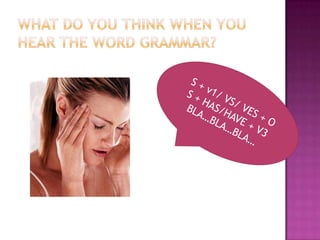
What do you think when you hear the word grammar?S + v1/ VS/ VES + OS + HAS/HAVE + V3BLA…BLA…BLA…
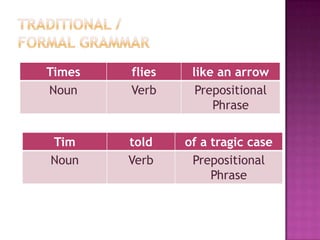
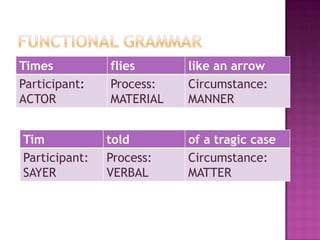
What is grammar?Is a theory of language, of how language is put together and how it is works.It is the study of wordings.WHAT IS WORDINGS?Time flies like an arrow.Wording is the words and their order
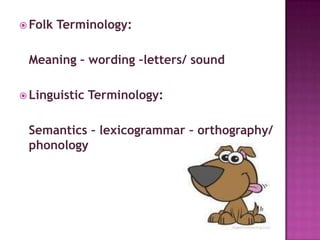
Folk Terminology: 	Meaning – wording –letters/ soundLinguistic Terminology:	Semantics – lexicogrammar – orthography/ phonology
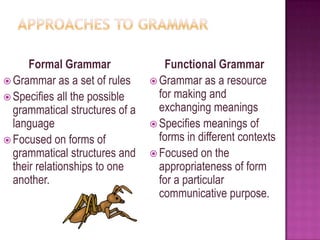
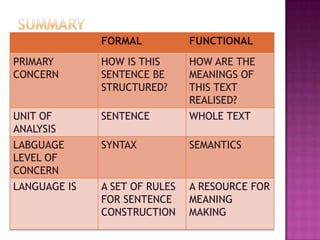
Approaches to GrammarFormal GrammarGrammar as a set of rulesSpecifies all the possible grammatical structures of a languageFocused on forms of grammatical structures and their relationships to one another.Functional GrammarGrammar as a resource for making and exchanging meaningsSpecifies meanings of forms in different contextsFocused on the appropriateness of form for a particular communicative purpose.
TRADITIONAL /FORMAL GRAMMAR
FUNCTIONAL GRAMMAR
SUMMARY
THE CONTEXT-TEXT CONNECTIONGEROT AND WIGNELL (p.10)
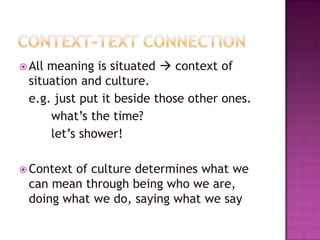
Context-text connectionAll meaning is situated  context of situation and culture.	e.g. just put it beside those other ones.		what’s the time? 		let’s shower!Context of culture determines what we can mean through being who we are, doing what we do, saying what we say
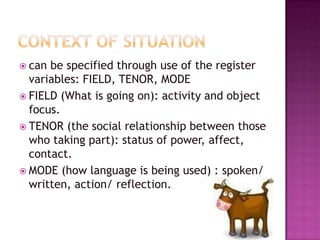
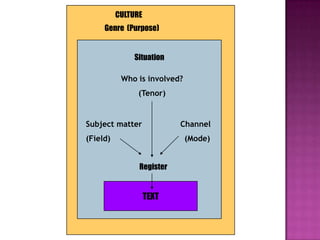
Context of situationcan be specified through use of the register variables: FIELD, TENOR, MODEFIELD (What is going on): activity and object focus.TENOR (the social relationship between those who taking part): status of power, affect, contact.MODE (how language is being used) : spoken/ written, action/ reflection.
CULTUREGenre  (Purpose)SituationWho is involved?(Tenor)Subject matter                Channel(Field)                               (Mode)RegisterTEXT
Reconstructing the contextThe wordings of text simultaneously encode three types of meaning:Ideational Meaning	Interpersonal Meaning	Textual Meaning
Ideational MeaningsMeanings about phenomenaAbout things and goings onAbout circumstances surrounding the happenings and doingsRealized in wordings through Participants, Processes and circumstancesCentrally influenced by the field of discourse
Examples
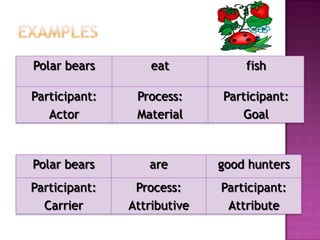
What does the sentence mean?We can answer by explaining what it is about.It is about an animal (polar bears) performing a habitual action (eat) onto another animal (fish).This is known as experiential meaning.This represents our experience of the world as well as thoughts and feelings.Concerned with how we talk about actions, happenings, feelings, beliefs, situations, states, etc.
Interpersonal meaningsExpress a speaker’s attitudes and judgmentsFor acting upon and with othersRealized in wordings through MOOD and modality.Most centrally influenced by tenor of discourse
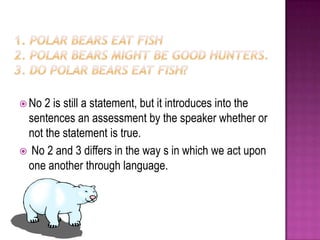
1. Polar bears eat fish2. Polar bears might be good hunters.3. Do polar bears eat fish?No 2 is still a statement, but it introduces into the sentences an assessment by the speaker whether or not the statement is true. No 2 and 3 differs in the way s in which we act upon one another through language.
Examples(Gerot and Wignell 1995:13)Declarative:
We inspect the growing plants every week
Imperative:
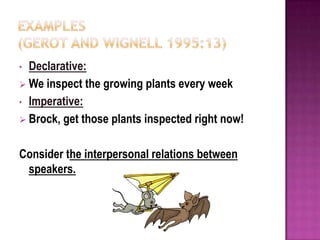
Brock, get those plants inspected right now!Consider the interpersonal relations between speakers.
examplesBrock, do you really expect me to believe this crap?Mr. Brock, I find your position untenableConsider the degree of informality or formality
ExamplesMr. Brock is a fine, upstanding employee.Brock is a lazy, incompetent fool.Consider the attitudinal lexis which express affect, the degree of like and dislike
Examples: ModalityUnfortunately, Brock is an inspector.Fortunately, Brock is an inspector.Consider the Mood Adjunct which reveal attitude or judgment.The crop mightbe inspected.
The crop should be inspected
The crop must be inspectedConsider modal operators revealing the speaker’ certainty.
Textual MeaningsExpress the relation of language to its environment (including what has been spoken or written before),Realized through patterns of Theme and cohesion,Most centrally influenced by mode of discourse,Has to do with the ways in which a stretch of language is organized in relation to its contextIs important in the creation of coherence in spoken and written texts.
The linguistic differences between the following spoken and written texts below relate primarily to differences in thematic choices and patterns of cohesion.	This is yer phone bill and you hafta go to the Post Office to pay it – uh, by next Monday – that’s what this box tells ya – or they’ll cut yer phone off!All phone bills must be paid by the date shown or service will be discontinued.
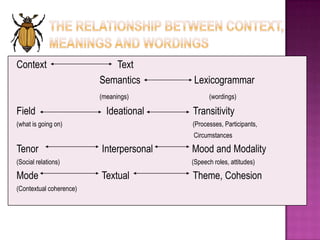
The relationship between context, meanings and wordingsContext                             Text                                  Semantics                      Lexicogrammar(meanings)                                                  (wordings)Field                             Ideational                    Transitivity(what is going on)                                                                                 (Processes, Participants,                                                                                                              CircumstancesTenor                          Interpersonal                Mood and Modality(Social relations)                                                                                  (Speech roles, attitudes)Mode                          Textual                          Theme, Cohesion(Contextual coherence)
The MountainLong ago, a great mountain began to rumble and shake. People came from far and near to see what would happen.“A great river will be born,” said one.“A mighty dragon will come out,” said another.“A god himself will spring from these rocks,” said a third.Finally, a small crack appeared in the mountainside. And out popped a mouse.
The Prayer    I pray you'll be our eyesAnd watch us where we goAnd help us to be wiseIn times when we don't knowLet this be our prayerAs we go our wayLead us to a placeGuide us with your GraceTo a place where we'll be safe
Love Changes EverythingLove, love changes everythingHands and faces, birds and skyLove, love changes everythingHow you live and how you dieLove can make the summer flyOr a night seem like a lifetimeYes, love, love changes everythingNow I tremble at your nameNothing in the world will ever bethe sameLove, love changes everythingDays are longer, words mean moreLove, love changes everythingPain is deeper than beforeLove will turn your world aroundAnd that world would last foreverYes, love, love changes everythingBrings you glory, brings you shameNothing in the world will ever be the sameLove, into the world we goPlanning future, shaping yearsLove does its acts suddenlyAll our wisdom disappearsLove makes moves on everyoneAll the rules we make are brokenYes, love, love changes everythingLive or perish in its nameLove will never, never let you be the same
Candle in the WindLoveliness we've lostThese empty days without your smileThis torch we'll always carryFor our nation's golden childAnd even though we tryThe truth brings us to tearsAll our words cannot expressThe joy you brought us through the yearsAnd it seems …Goodbye England's roseMay you ever grow in our heartsYou were the grace that placed itselfWhere lives were torn apartGoodbye England's roseFrom a country lost without your soulWho'll miss the wings of your compassionMore than you'll ever know* And it seems…Goodbye England's roseMay you ever grow in our heartsYou were the grace that placed itselfWhere lives were torn apartYou called out to our countryAnd you whispered to those in painNow you belong to heavenAnd the stars spell out your name* And it seems to me you lived your lifeLike a candle in the windNever fading with the sunsetWhen the rain set inAnd your footsteps will always fall youAlong England's greenest hillsYour candle's burned out long beforeYour legend never will
Mood- chapter 2GEROT AND WIGNELL (p.21-50)
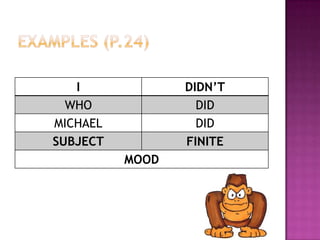
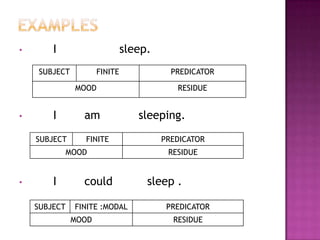
Constituent of MOODThere are three main elements of MOOD constituent:	1. an expression of polarity: either YES (positive polarity) or NO (negative polarity)	2. a nominal-type element, which we will call the SUBJECT	3.a verbal-type element, which we will call the FINITE.
SUBJECTSUBJECT realizes the thing by reference to which the proposition can be affirmed or denied. It provides the person or thing in whom is vested the success or failure of the proposition, what is “held responsible”The identification of the SUBJECT can be achieved by the tag test: the element that gets picked up by the pronoun in the tag is the SUBJECT.Another test is to change the verb from singular to plural or plural to singular.
FINITEHalliday (1985) defines the FINITE in terms of its function in the clause to make the proposition definite, to anchor the proposition in a way that we can argue about it. (see: Eggins 1994:157-159)The definition of the FINITE again involves the tag test: the verbal part of the tag tells you which element the FINITE is. (see: Eggins: 1994: 158-1959)
EXAMPLES (p.24)
EXAMPLES       I                  sleep.
       I        am           sleeping.
       I        could		sleep .Constituent of RESIDUEThe RESIDUE component of the clause is that part of the clause which is somehow less essential to the arguability of the clause than is the MOOD component.RESIDUE component can also contain a number of functional elements: a PREDICATOR, one or more COMPLEMENTS, and any number of different types of ADJUNCTS.
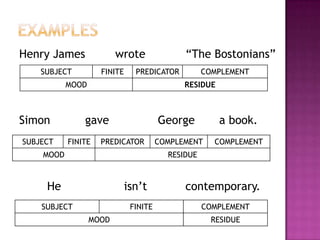
PREDICATORThe PREDICATOR is the lexical or content part of the verbal group.PREDICATOR fills the role of specifying the actual event, action, process being discussed.The verbal group contains two elements. The first part of the verbal group is the FINITE. The second part is the PREDICATOR.
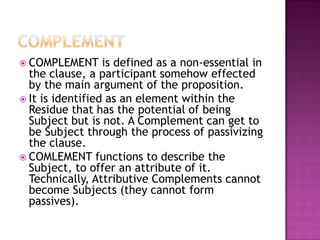
COMPLEMENTCOMPLEMENT is defined as a non-essential in the clause, a participant somehow effected by the main argument of the proposition.It is identified as an element within the Residue that has the potential of being Subject but is not. A Complement can get to be Subject through the process of passivizing the clause.COMLEMENT functions to describe the Subject, to offer an attribute of it. Technically, Attributive Complements cannot become Subjects (they cannot form passives).
EXAMPLES Henry James	wrote	           “The Bostonians”Simon          gave              George       a book.        He                  isn’t           contemporary.
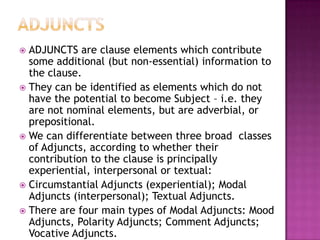
ADJUNCTSADJUNCTS are clause elements which contribute some additional (but non-essential) information to the clause.They can be identified as elements which do not have the potential to become Subject – i.e. they are not nominal elements, but are adverbial, or prepositional.We can differentiate between three broad  classes of Adjuncts, according to whether their contribution to the clause is principally experiential, interpersonal or textual:Circumstantial Adjuncts (experiential); Modal Adjuncts (interpersonal); Textual Adjuncts.There are four main types of Modal Adjuncts: Mood Adjuncts, Polarity Adjuncts; Comment Adjuncts; Vocative Adjuncts.
CIRCUMSTANTIAL ADJUNCTSThey add experiential content to the clause, by expressing some circumstance relating to the process represented in the clause.They refer to time (when), place (where), cause (why), matter (about what), accompaniment (with whom), beneficiary (to whom), agent (by whom).
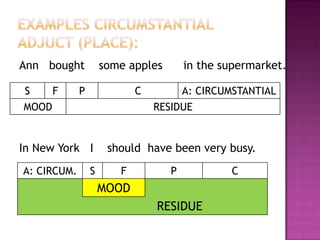
Examples CIRCUMSTANTIAL ADJUCT (PLACE): Ann   bought    some apples      in the supermarket.In New York   I    should  have been very busy.
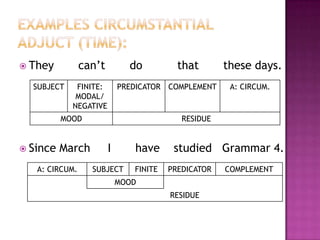
Examples CIRCUMSTANTIAL ADJUCT (TIME): They       can’t       do          that       these days.Since March     I       have    studied   Grammar 4.
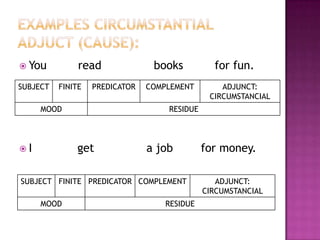
Examples CIRCUMSTANTIAL ADJUCT (CAUSE): You         read               books         for fun.I             get               a job        for money.
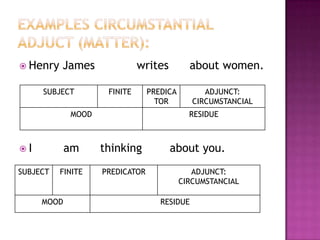
Examples CIRCUMSTANTIAL ADJUCT (matter):Henry James            writes      about women.I         am      thinking        about you.
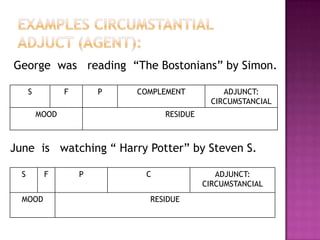
Examples CIRCUMSTANTIAL ADJUCT (agent):   George  was   reading  “The Bostonians” by Simon.  June  is   watching “ Harry Potter” by Steven S.
Modal adjuncts (interpersonal)Are clause constituents which add interpersonal meaning to clause.They add meanings which are some how connected to the creation and maintenance of the dialogue.There are four main types of Modal Adjunct:	1. MOOD ADJUNCTS	2. POLARITY ADJUNCTS	3. COMMENT ADJUNCTS	4. VOCATIVE ADJUNCTS
MOOD ADJUNCTSThey provide a ”second chance” for the speaker to add his judgment of probability.Expressions of :	probability : perhaps, may be, probablyusuality : sometimes, usually, etc.	intensification : really, absolutely, just, somewhat	presumption: evidently, presumably, obviously	inclination: happily, willingly
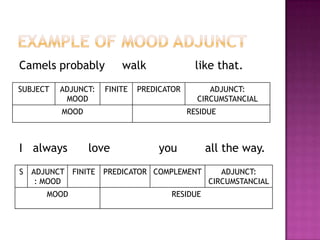
Example of mood adjunctCamels probably     walk              like that.I   always      love              you        all the way.
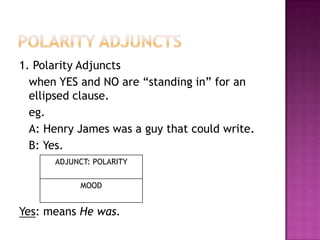
Polarity adjuncts1. Polarity Adjuncts	when YES and NO are “standing in” for an ellipsed clause.eg.	A: Henry James was a guy that could write.	B: Yes.Yes: means He was.
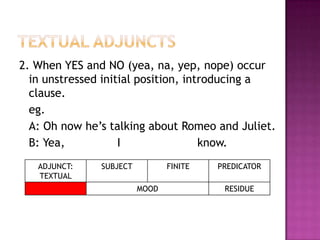
Textual adjuncts2. When YES and NO (yea, na, yep, nope) occur in unstressed initial position, introducing a clause.eg.	A: Oh now he’s talking about Romeo and Juliet.	B: Yea,               I                      know.
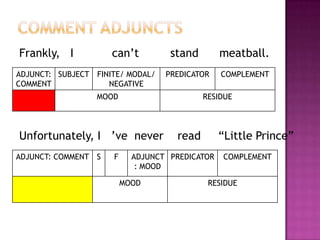
COMMENT ADJUNCTSThey function to express an assessment about the clause as a whole.Typically occur in clause initial position, or directly after the subject, and realized by adverbs.   1. admission : frankly   2. assertion : honestly, really   3. how desirable : luckily, hopefully   4. how constant: tentatively, provisionally   5. how valid : broadly speaking, generally   6. how sensible : understandably, wisely   7. how expected : as expected, amazingly
COMMENT ADJUNCTSFrankly,   I           can’t         stand      meatball.Unfortunately, I   ’ve  never    read     “Little Prince”
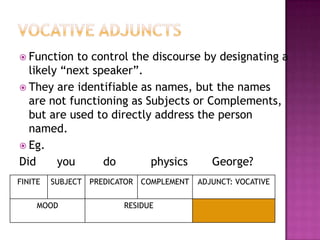
Vocative adjunctsFunction to control the discourse by designating a likely “next speaker”.They are identifiable as names, but the names are not functioning as Subjects or Complements, but are used to directly address the person named.Eg.Did      you        do          physics       George?
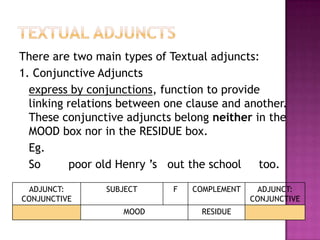
Textual adjunctsThere are two main types of Textual adjuncts:1. Conjunctive Adjunctsexpress by conjunctions, function to provide linking relations between one clause and another. These conjunctive adjuncts belong neither in the MOOD box nor in the RESIDUE box.Eg.	So        poor old Henry ’s   out the school     too.
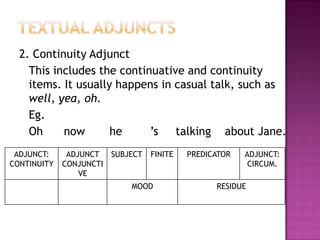
Textual adjuncts2. Continuity Adjunct	This includes the continuative and continuity items. It usually happens in casual talk, such as well, yea, oh.Eg.Oh      now       he        ’s     talking    about Jane.
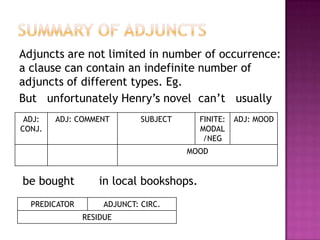
SUMMARY OF ADJUNCTSAdjuncts are not limited in number of occurrence: a clause can contain an indefinite number of adjuncts of different types. Eg.But   unfortunately Henry’s novel  can’t   usually be bought       in local bookshops.
POLAR INTERROGATIVESEnglish offers two main structures for asking questions: polar interrogatives (yes/no questions); or wh-interrogatives (questions using who, what, which, when, where, why, how)The structure of the polar interrogative involves the positioning of the Finite before the Subject.In cases where the related declarative contained a fused Finite/Predicator, we need to introduce a Finite element to place before the Subject. This Finite element is typically the “do’ auxiliary verb. (see Eggins 1994: 173)
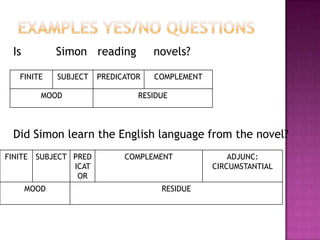
Examples YES/NO QUESTIONSIs          Simon   reading     novels?Did Simon learn the English language from the novel?
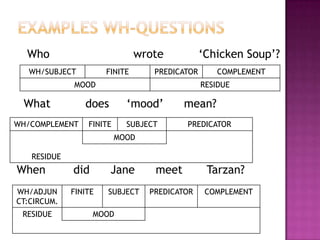
WH-InterrogativesIn a wh-interrogative, we need to recognize the presence of a WH element. This WH element is always conflated (mapped onto, fused with) another element of clause structure. It may be conflated with either the Subject, the Complement or a Circumstantial Adjunct, and is shown as a constituent of the MOOD or RESIDUE according to the status of the element with which it is conflated. (see: Eggins 1994: 175-176)
EXAMPLES WH-QUESTIONS    Who                        wrote          ‘Chicken Soup’?   What          does     ‘mood’      mean? When        did      Jane      meet       Tarzan?
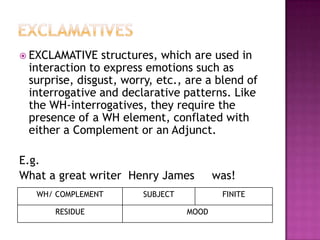
EXCLAMATIVESEXCLAMATIVE structures, which are used in interaction to express emotions such as surprise, disgust, worry, etc., are a blend of interrogative and declarative patterns. Like the WH-interrogatives, they require the presence of a WH element, conflated with either a Complement or an Adjunct.E.g.What a great writer  Henry James     was!
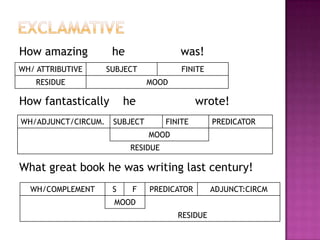
EXCLAMATIVEHow amazing       he                was!How fantastically    he                 wrote!What great book he was writing last century!
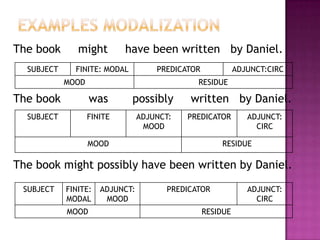
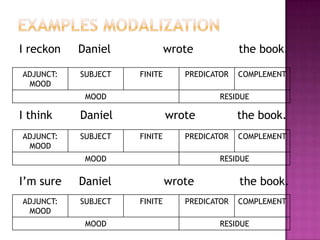
MODALITY: (1) ModalizationWhen we exchange information, the clause takes he form of a proposition. A proposition is something that can be argued, but argued in a particular way. When we exchange information we are arguing about whether something IS or IS NOT. Information is something that can be affirmed, or denied.But these two poles of polarity are not the only possibilities. In between these two extremes are a number of choices of degree of certainty, or of usuality: something is perhaps, something isn’t for sure. Something is sometimes or something isn’t always.The intermediate positios are what we refer to MODALIZATION.
EXAMPLES MODALIZATIONThe book     might     have been written   by Daniel.The book        was       possibly     written   by Daniel.The book might possibly have been written by Daniel.
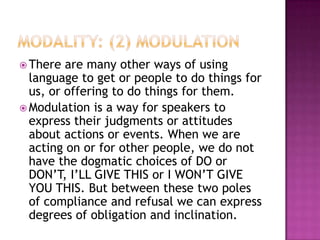
MODALITY: (2) ModulationThere are many other ways of using language to get or people to do things for us, or offering to do things for them. Modulation is a way for speakers to express their judgments or attitudes about actions or events. When we are acting on or for other people, we do not have the dogmatic choices of DO or DON’T, I’LL GIVE THIS or I WON’T GIVE YOU THIS. But between these two poles of compliance and refusal we can express degrees of obligation and inclination.
EXAMPLES MODALIZATIONI reckon     Daniel               wrote             the book.I think        Daniel               wrote            the book.I’m sure     Daniel               wrote             the book.
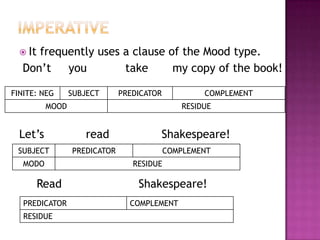
imperativeIt frequently uses a clause of the Mood type. Don’t     you           take       my copy of the book!Let’s            read               Shakespeare!     Read                      Shakespeare!
The Dog that takes you into the BarTwo men are walking their dogs (a Doberman and a Chihuahua) when they say to each other “I’m thirsty.” They see a nearby Bar and walk up to it. Unfortunately, there was a sign on the door that said NO DOGS. They thought for a while to try to figure out what they should do with no luck.
Suddenly, the man with the Doberman said, “I have an idea! Do what I do!” The man put on his sunglasses, walked up to the door and tried to get in but a big muscular man stopped him. “Where do you think you’re going?” asked the big man. “This is my seeing-eye dog,“ said the man hoping for good feedback. “Alright mister, go right in,” said the big man.
The Doberman man walked in. The second man slipped his sunglasses on and did the same as the first man. “Where are you going?” asked the big man. “I’m going into the bar, this is my seeing-eye dog,” he said. “A Chihuahua?” asked the big man with suspicion. The other man, playing his part yelled, “They gave me a Chihuahua?!”
Transitivitychapter 3Gerot and Wignell p. 52-79
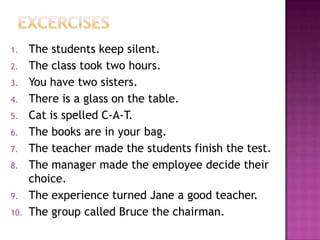
TransitivityIt organizes the clause to realize the experiential meaning.Clauses with  two participants – Actor and Goal – are normally known as transitive clauses.Clauses with the single participant Actor are normally known as intransitive clauses
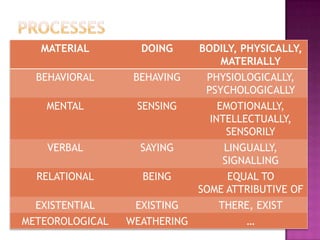
Processes
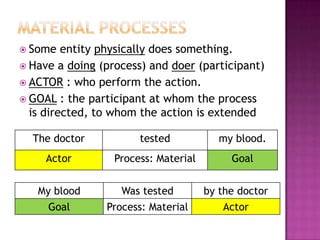
MATERIAL PROCESSESSome entity physically does something.Have a doing (process) and doer (participant)ACTOR : who perform the action.GOAL : the participant at whom the process is directed, to whom the action is extended
GOAL VS RANGERange is the element that specifies the scope or domain of the Process.“What did X do to Y?” (Question to determine is it range or goal)Eg. (1) They did the transfusion.         (2) They transfused the blood.(1) What did they do to the transfusion?(2) What did they do to the blood?The transfusion in (1) is RANGE, while the blood in (2) is GOAL.This is the first type of range.
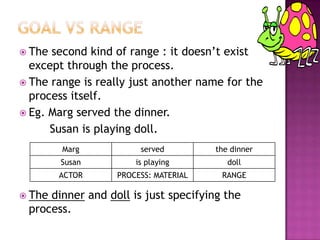
GOAL VS RANGEThe second kind of range : it doesn’t exist except through the process. The range is really just another name for the process itself.Eg. Marg served the dinner.	      Susan is playing doll.The dinner and doll is just specifying the process.
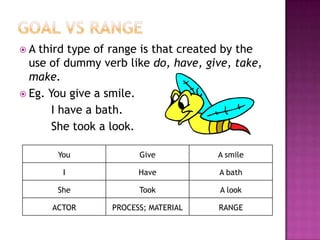
GOAL VS RANGEA third type of range is that created by the use of dummy verb like do, have, give, take, make.Eg. You give a smile.		I have a bath.		She took a look.
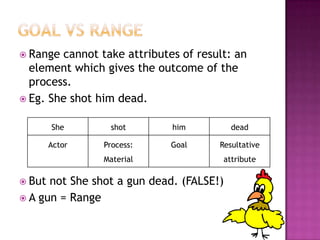
GOAL VS RANGERange cannot take attributes of result: an element which gives the outcome of the process.Eg. She shot him dead.But not She shot a gun dead. (FALSE!)A gun = Range
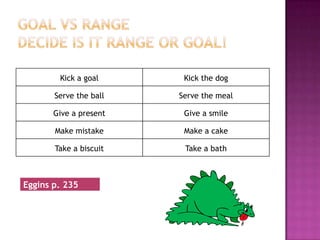
GOAL VS RANGEDecide is it range or goal!
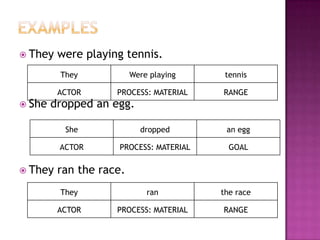
ExamplesThey were playing tennis.She dropped an egg.They ran the race.
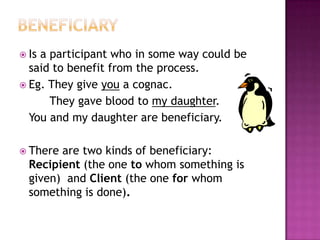
BENEFICIARYIs a participant who in some way could be said to benefit from the process.Eg. They give you a cognac.	      They gave blood to my daughter.	You and my daughter are beneficiary.There are two kinds of beneficiary: Recipient (the one to whom something is given) and Client (the one for whom something is done).
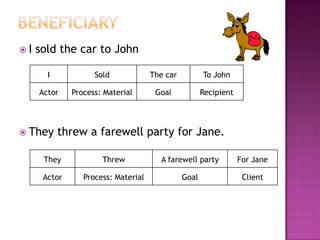
BENEFICIARYI sold the car to JohnThey threw a farewell party for Jane.
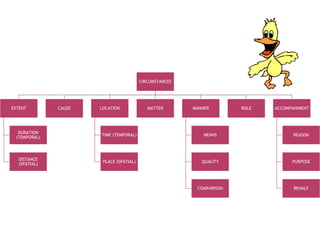
CircumstancesAre realized by adverbial groups or prepositional phrases. Eg. Eggins p. 238I stay up all night. (Circ: extent)They rang me up on the Saturday night. (Circ: location)They did the transfusion through the umbilical artery. (circ: Manner)
CircumstancesIn Switzerlandunlike Greece, they give you a cognac. (Circ: location, manner)She carried the bomb for her boyfriend. (Circ: cause)She got on plane without her friend. (Circ: accompaniment)She was travelling to Israel as a tourist. (Circ: role)
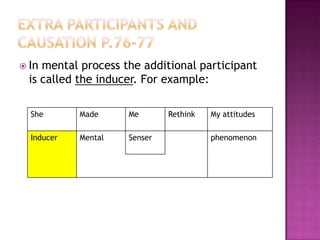
Mental processAre one of sensing: feeling, thinking, perceiving.There are three types: Affective or reactive (feeling)Cognitive (thinking)Perceptive (perceiving through the five sense)The participant are SENSER and PHENOMENON.
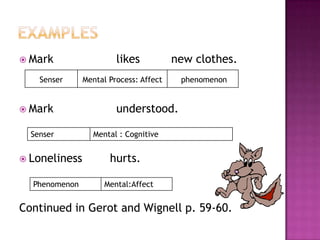
eXAMPLESMark                  likes         new clothes.Mark                  understood.Loneliness        hurts.Continued in Gerot and Wignell p. 59-60.
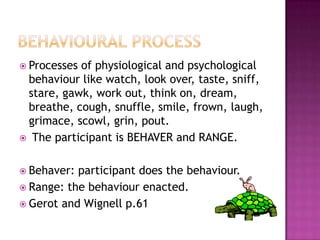
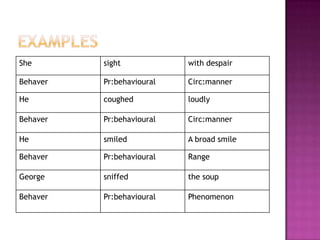
Behavioural processProcesses of physiological and psychological behaviour like watch, look over, taste, sniff, stare, gawk, work out, think on, dream, breathe, cough, snuffle, smile, frown, laugh, grimace, scowl, grin, pout. The participant is BEHAVER and RANGE.Behaver: participant does the behaviour.Range: the behaviour enacted.Gerot and Wignell p.61
Examples
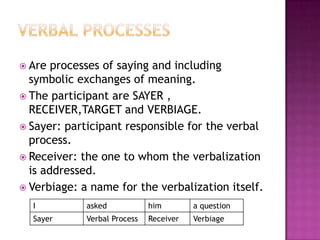
Verbal processesAre processes of saying and including symbolic exchanges of meaning.The participant are SAYER , RECEIVER,TARGET and VERBIAGE.Sayer: participant responsible for the verbal process.Receiver: the one to whom the verbalization is addressed.Verbiage: a name for the verbalization itself.
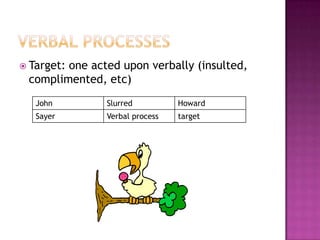
Verbal processesTarget: one acted upon verbally (insulted, complimented, etc)
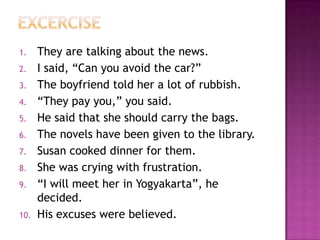
ExcerciseThey are talking about the news.I said, “Can you avoid the car?”The boyfriend told her a lot of rubbish.“They pay you,” you said.He said that she should carry the bags.The novels have been given to the library.Susan cooked dinner for them.She was crying with frustration.“I will meet her in Yogyakarta”, he decided.His excuses were believed.
Transitivitychapter 3Existensial and Relational ProcessGerot and Wignell p.67
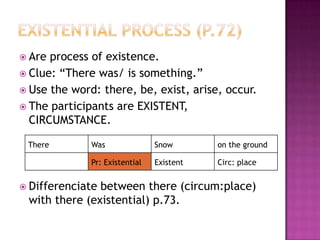
Existential process (p.72)Are process of existence.Clue: “There was/ is something.”Use the word: there, be, exist, arise, occur.The participants are EXISTENT, CIRCUMSTANCE.Differenciate between there (circum:place) with there (existential) p.73.
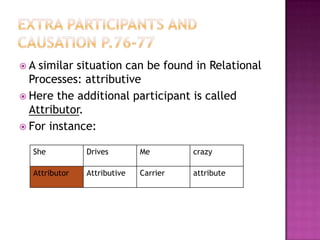
Relational processes: processes of being and havingRelational Processes involve states of being (including having).Processes are Identifying or Attributive.Identifying Process is a process which establish an identity.Attributive process is a process which assign a quality.You are the thinner one here. (Identifying)You are very thin. (Attributive)
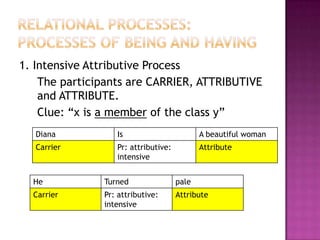
Relational processes: processes of being and having1. Intensive Attributive Process	The participants are CARRIER, ATTRIBUTIVE and ATTRIBUTE.	Clue: “x is a member of the class y”
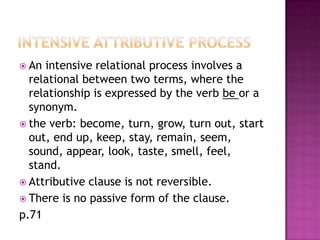
Intensive Attributive ProcessAn intensive relational process involves a relational between two terms, where the relationship is expressed by the verb be or a synonym.the verb: become, turn, grow, turn out, start out, end up, keep, stay, remain, seem, sound, appear, look, taste, smell, feel, stand.Attributive clause is not reversible.There is no passive form of the clause.p.71
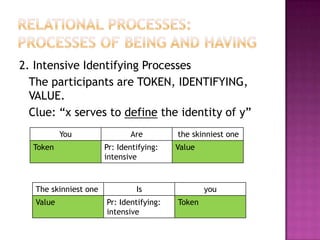
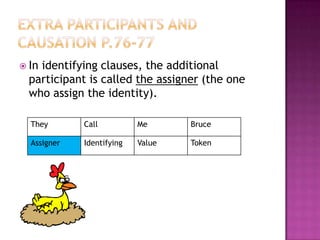
Relational processes: processes of being and having2. Intensive Identifying Processes	The participants are TOKEN, IDENTIFYING, VALUE.	Clue: “x serves to define the identity of y”
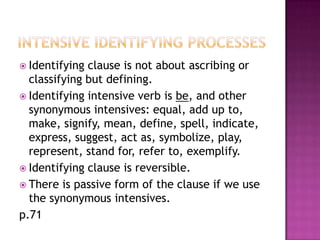
Intensive Identifying ProcessesIdentifying clause is not about ascribing or classifying but defining.Identifying intensive verb is be, and other synonymous intensives: equal, add up to, make, signify, mean, define, spell, indicate, express, suggest, act as, symbolize, play, represent, stand for, refer to, exemplify.Identifying clause is reversible.There is passive form of the clause if we use the synonymous intensives.p.71
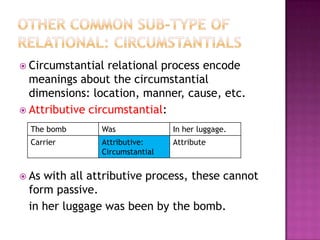
Other common sub-type of relational: circumstantialsCircumstantial relational process encode meanings about the circumstantial dimensions: location, manner, cause, etc.Attributive circumstantial:As with all attributive process, these cannot form passive.	in her luggage was been by the bomb.
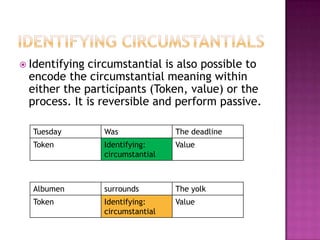
Identifying circumstantialsIdentifying circumstantial is also possible to encode the circumstantial meaning within either the participants (Token, value) or the process. It is reversible and perform passive.
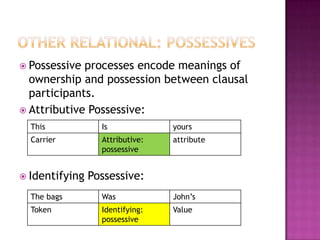
Other relational: PossessivesPossessive processes encode meanings of ownership and possession between clausal participants. Attributive Possessive:Identifying Possessive:
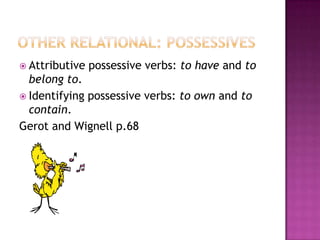
Other relational: PossessivesAttributive possessive verbs: to have and to belong to.Identifying possessive verbs: to own and to contain.Gerot and Wignell p.68

Grammar 4

  • 1.
    Systemic Functional GrammarTheRelations of Forms and MeaningsLILIA INDRIANIENGLISH DEPARTMENT-FKIPTIDAR UNIVERSITY OF MAGELANGlilia_indriani@yahoo.com.au
  • 2.
    What do youthink when you hear the word grammar?S + v1/ VS/ VES + OS + HAS/HAVE + V3BLA…BLA…BLA…
  • 4.
    What is grammar?Isa theory of language, of how language is put together and how it is works.It is the study of wordings.WHAT IS WORDINGS?Time flies like an arrow.Wording is the words and their order
  • 5.
    Folk Terminology: Meaning– wording –letters/ soundLinguistic Terminology: Semantics – lexicogrammar – orthography/ phonology
  • 6.
    Approaches to GrammarFormalGrammarGrammar as a set of rulesSpecifies all the possible grammatical structures of a languageFocused on forms of grammatical structures and their relationships to one another.Functional GrammarGrammar as a resource for making and exchanging meaningsSpecifies meanings of forms in different contextsFocused on the appropriateness of form for a particular communicative purpose.
  • 7.
  • 8.
  • 9.
  • 10.
  • 11.
    Context-text connectionAll meaningis situated  context of situation and culture. e.g. just put it beside those other ones. what’s the time? let’s shower!Context of culture determines what we can mean through being who we are, doing what we do, saying what we say
  • 12.
    Context of situationcanbe specified through use of the register variables: FIELD, TENOR, MODEFIELD (What is going on): activity and object focus.TENOR (the social relationship between those who taking part): status of power, affect, contact.MODE (how language is being used) : spoken/ written, action/ reflection.
  • 13.
    CULTUREGenre (Purpose)SituationWhois involved?(Tenor)Subject matter Channel(Field) (Mode)RegisterTEXT
  • 14.
    Reconstructing the contextThewordings of text simultaneously encode three types of meaning:Ideational Meaning Interpersonal Meaning Textual Meaning
  • 15.
    Ideational MeaningsMeanings aboutphenomenaAbout things and goings onAbout circumstances surrounding the happenings and doingsRealized in wordings through Participants, Processes and circumstancesCentrally influenced by the field of discourse
  • 16.
  • 17.
    What does thesentence mean?We can answer by explaining what it is about.It is about an animal (polar bears) performing a habitual action (eat) onto another animal (fish).This is known as experiential meaning.This represents our experience of the world as well as thoughts and feelings.Concerned with how we talk about actions, happenings, feelings, beliefs, situations, states, etc.
  • 18.
    Interpersonal meaningsExpress aspeaker’s attitudes and judgmentsFor acting upon and with othersRealized in wordings through MOOD and modality.Most centrally influenced by tenor of discourse
  • 19.
    1. Polar bearseat fish2. Polar bears might be good hunters.3. Do polar bears eat fish?No 2 is still a statement, but it introduces into the sentences an assessment by the speaker whether or not the statement is true. No 2 and 3 differs in the way s in which we act upon one another through language.
  • 20.
    Examples(Gerot and Wignell1995:13)Declarative:
  • 21.
    We inspect thegrowing plants every week
  • 22.
  • 23.
    Brock, get thoseplants inspected right now!Consider the interpersonal relations between speakers.
  • 24.
    examplesBrock, do youreally expect me to believe this crap?Mr. Brock, I find your position untenableConsider the degree of informality or formality
  • 25.
    ExamplesMr. Brock isa fine, upstanding employee.Brock is a lazy, incompetent fool.Consider the attitudinal lexis which express affect, the degree of like and dislike
  • 26.
    Examples: ModalityUnfortunately, Brockis an inspector.Fortunately, Brock is an inspector.Consider the Mood Adjunct which reveal attitude or judgment.The crop mightbe inspected.
  • 27.
    The crop shouldbe inspected
  • 28.
    The crop mustbe inspectedConsider modal operators revealing the speaker’ certainty.
  • 29.
    Textual MeaningsExpress therelation of language to its environment (including what has been spoken or written before),Realized through patterns of Theme and cohesion,Most centrally influenced by mode of discourse,Has to do with the ways in which a stretch of language is organized in relation to its contextIs important in the creation of coherence in spoken and written texts.
  • 30.
    The linguistic differencesbetween the following spoken and written texts below relate primarily to differences in thematic choices and patterns of cohesion. This is yer phone bill and you hafta go to the Post Office to pay it – uh, by next Monday – that’s what this box tells ya – or they’ll cut yer phone off!All phone bills must be paid by the date shown or service will be discontinued.
  • 31.
    The relationship betweencontext, meanings and wordingsContext Text Semantics Lexicogrammar(meanings) (wordings)Field Ideational Transitivity(what is going on) (Processes, Participants, CircumstancesTenor Interpersonal Mood and Modality(Social relations) (Speech roles, attitudes)Mode Textual Theme, Cohesion(Contextual coherence)
  • 32.
    The MountainLong ago,a great mountain began to rumble and shake. People came from far and near to see what would happen.“A great river will be born,” said one.“A mighty dragon will come out,” said another.“A god himself will spring from these rocks,” said a third.Finally, a small crack appeared in the mountainside. And out popped a mouse.
  • 33.
    The Prayer I pray you'll be our eyesAnd watch us where we goAnd help us to be wiseIn times when we don't knowLet this be our prayerAs we go our wayLead us to a placeGuide us with your GraceTo a place where we'll be safe
  • 34.
    Love Changes EverythingLove,love changes everythingHands and faces, birds and skyLove, love changes everythingHow you live and how you dieLove can make the summer flyOr a night seem like a lifetimeYes, love, love changes everythingNow I tremble at your nameNothing in the world will ever bethe sameLove, love changes everythingDays are longer, words mean moreLove, love changes everythingPain is deeper than beforeLove will turn your world aroundAnd that world would last foreverYes, love, love changes everythingBrings you glory, brings you shameNothing in the world will ever be the sameLove, into the world we goPlanning future, shaping yearsLove does its acts suddenlyAll our wisdom disappearsLove makes moves on everyoneAll the rules we make are brokenYes, love, love changes everythingLive or perish in its nameLove will never, never let you be the same
  • 35.
    Candle in theWindLoveliness we've lostThese empty days without your smileThis torch we'll always carryFor our nation's golden childAnd even though we tryThe truth brings us to tearsAll our words cannot expressThe joy you brought us through the yearsAnd it seems …Goodbye England's roseMay you ever grow in our heartsYou were the grace that placed itselfWhere lives were torn apartGoodbye England's roseFrom a country lost without your soulWho'll miss the wings of your compassionMore than you'll ever know* And it seems…Goodbye England's roseMay you ever grow in our heartsYou were the grace that placed itselfWhere lives were torn apartYou called out to our countryAnd you whispered to those in painNow you belong to heavenAnd the stars spell out your name* And it seems to me you lived your lifeLike a candle in the windNever fading with the sunsetWhen the rain set inAnd your footsteps will always fall youAlong England's greenest hillsYour candle's burned out long beforeYour legend never will
  • 36.
    Mood- chapter 2GEROTAND WIGNELL (p.21-50)
  • 37.
    Constituent of MOODThereare three main elements of MOOD constituent: 1. an expression of polarity: either YES (positive polarity) or NO (negative polarity) 2. a nominal-type element, which we will call the SUBJECT 3.a verbal-type element, which we will call the FINITE.
  • 38.
    SUBJECTSUBJECT realizes thething by reference to which the proposition can be affirmed or denied. It provides the person or thing in whom is vested the success or failure of the proposition, what is “held responsible”The identification of the SUBJECT can be achieved by the tag test: the element that gets picked up by the pronoun in the tag is the SUBJECT.Another test is to change the verb from singular to plural or plural to singular.
  • 39.
    FINITEHalliday (1985) definesthe FINITE in terms of its function in the clause to make the proposition definite, to anchor the proposition in a way that we can argue about it. (see: Eggins 1994:157-159)The definition of the FINITE again involves the tag test: the verbal part of the tag tells you which element the FINITE is. (see: Eggins: 1994: 158-1959)
  • 40.
  • 41.
    EXAMPLES I sleep.
  • 42.
    I am sleeping.
  • 43.
    I could sleep .Constituent of RESIDUEThe RESIDUE component of the clause is that part of the clause which is somehow less essential to the arguability of the clause than is the MOOD component.RESIDUE component can also contain a number of functional elements: a PREDICATOR, one or more COMPLEMENTS, and any number of different types of ADJUNCTS.
  • 44.
    PREDICATORThe PREDICATOR isthe lexical or content part of the verbal group.PREDICATOR fills the role of specifying the actual event, action, process being discussed.The verbal group contains two elements. The first part of the verbal group is the FINITE. The second part is the PREDICATOR.
  • 45.
    COMPLEMENTCOMPLEMENT is definedas a non-essential in the clause, a participant somehow effected by the main argument of the proposition.It is identified as an element within the Residue that has the potential of being Subject but is not. A Complement can get to be Subject through the process of passivizing the clause.COMLEMENT functions to describe the Subject, to offer an attribute of it. Technically, Attributive Complements cannot become Subjects (they cannot form passives).
  • 46.
    EXAMPLES Henry James wrote “The Bostonians”Simon gave George a book. He isn’t contemporary.
  • 47.
    ADJUNCTSADJUNCTS are clauseelements which contribute some additional (but non-essential) information to the clause.They can be identified as elements which do not have the potential to become Subject – i.e. they are not nominal elements, but are adverbial, or prepositional.We can differentiate between three broad classes of Adjuncts, according to whether their contribution to the clause is principally experiential, interpersonal or textual:Circumstantial Adjuncts (experiential); Modal Adjuncts (interpersonal); Textual Adjuncts.There are four main types of Modal Adjuncts: Mood Adjuncts, Polarity Adjuncts; Comment Adjuncts; Vocative Adjuncts.
  • 48.
    CIRCUMSTANTIAL ADJUNCTSThey addexperiential content to the clause, by expressing some circumstance relating to the process represented in the clause.They refer to time (when), place (where), cause (why), matter (about what), accompaniment (with whom), beneficiary (to whom), agent (by whom).
  • 49.
    Examples CIRCUMSTANTIAL ADJUCT(PLACE): Ann bought some apples in the supermarket.In New York I should have been very busy.
  • 50.
    Examples CIRCUMSTANTIAL ADJUCT(TIME): They can’t do that these days.Since March I have studied Grammar 4.
  • 51.
    Examples CIRCUMSTANTIAL ADJUCT(CAUSE): You read books for fun.I get a job for money.
  • 52.
    Examples CIRCUMSTANTIAL ADJUCT(matter):Henry James writes about women.I am thinking about you.
  • 53.
    Examples CIRCUMSTANTIAL ADJUCT(agent): George was reading “The Bostonians” by Simon. June is watching “ Harry Potter” by Steven S.
  • 54.
    Modal adjuncts (interpersonal)Areclause constituents which add interpersonal meaning to clause.They add meanings which are some how connected to the creation and maintenance of the dialogue.There are four main types of Modal Adjunct: 1. MOOD ADJUNCTS 2. POLARITY ADJUNCTS 3. COMMENT ADJUNCTS 4. VOCATIVE ADJUNCTS
  • 55.
    MOOD ADJUNCTSThey providea ”second chance” for the speaker to add his judgment of probability.Expressions of : probability : perhaps, may be, probablyusuality : sometimes, usually, etc. intensification : really, absolutely, just, somewhat presumption: evidently, presumably, obviously inclination: happily, willingly
  • 56.
    Example of moodadjunctCamels probably walk like that.I always love you all the way.
  • 57.
    Polarity adjuncts1. PolarityAdjuncts when YES and NO are “standing in” for an ellipsed clause.eg. A: Henry James was a guy that could write. B: Yes.Yes: means He was.
  • 58.
    Textual adjuncts2. WhenYES and NO (yea, na, yep, nope) occur in unstressed initial position, introducing a clause.eg. A: Oh now he’s talking about Romeo and Juliet. B: Yea, I know.
  • 59.
    COMMENT ADJUNCTSThey functionto express an assessment about the clause as a whole.Typically occur in clause initial position, or directly after the subject, and realized by adverbs. 1. admission : frankly 2. assertion : honestly, really 3. how desirable : luckily, hopefully 4. how constant: tentatively, provisionally 5. how valid : broadly speaking, generally 6. how sensible : understandably, wisely 7. how expected : as expected, amazingly
  • 60.
    COMMENT ADJUNCTSFrankly, I can’t stand meatball.Unfortunately, I ’ve never read “Little Prince”
  • 61.
    Vocative adjunctsFunction tocontrol the discourse by designating a likely “next speaker”.They are identifiable as names, but the names are not functioning as Subjects or Complements, but are used to directly address the person named.Eg.Did you do physics George?
  • 62.
    Textual adjunctsThere aretwo main types of Textual adjuncts:1. Conjunctive Adjunctsexpress by conjunctions, function to provide linking relations between one clause and another. These conjunctive adjuncts belong neither in the MOOD box nor in the RESIDUE box.Eg. So poor old Henry ’s out the school too.
  • 63.
    Textual adjuncts2. ContinuityAdjunct This includes the continuative and continuity items. It usually happens in casual talk, such as well, yea, oh.Eg.Oh now he ’s talking about Jane.
  • 64.
    SUMMARY OF ADJUNCTSAdjunctsare not limited in number of occurrence: a clause can contain an indefinite number of adjuncts of different types. Eg.But unfortunately Henry’s novel can’t usually be bought in local bookshops.
  • 65.
    POLAR INTERROGATIVESEnglish offerstwo main structures for asking questions: polar interrogatives (yes/no questions); or wh-interrogatives (questions using who, what, which, when, where, why, how)The structure of the polar interrogative involves the positioning of the Finite before the Subject.In cases where the related declarative contained a fused Finite/Predicator, we need to introduce a Finite element to place before the Subject. This Finite element is typically the “do’ auxiliary verb. (see Eggins 1994: 173)
  • 66.
    Examples YES/NO QUESTIONSIs Simon reading novels?Did Simon learn the English language from the novel?
  • 67.
    WH-InterrogativesIn a wh-interrogative,we need to recognize the presence of a WH element. This WH element is always conflated (mapped onto, fused with) another element of clause structure. It may be conflated with either the Subject, the Complement or a Circumstantial Adjunct, and is shown as a constituent of the MOOD or RESIDUE according to the status of the element with which it is conflated. (see: Eggins 1994: 175-176)
  • 68.
    EXAMPLES WH-QUESTIONS Who wrote ‘Chicken Soup’? What does ‘mood’ mean? When did Jane meet Tarzan?
  • 69.
    EXCLAMATIVESEXCLAMATIVE structures, whichare used in interaction to express emotions such as surprise, disgust, worry, etc., are a blend of interrogative and declarative patterns. Like the WH-interrogatives, they require the presence of a WH element, conflated with either a Complement or an Adjunct.E.g.What a great writer Henry James was!
  • 70.
    EXCLAMATIVEHow amazing he was!How fantastically he wrote!What great book he was writing last century!
  • 71.
    MODALITY: (1) ModalizationWhenwe exchange information, the clause takes he form of a proposition. A proposition is something that can be argued, but argued in a particular way. When we exchange information we are arguing about whether something IS or IS NOT. Information is something that can be affirmed, or denied.But these two poles of polarity are not the only possibilities. In between these two extremes are a number of choices of degree of certainty, or of usuality: something is perhaps, something isn’t for sure. Something is sometimes or something isn’t always.The intermediate positios are what we refer to MODALIZATION.
  • 72.
    EXAMPLES MODALIZATIONThe book might have been written by Daniel.The book was possibly written by Daniel.The book might possibly have been written by Daniel.
  • 73.
    MODALITY: (2) ModulationThereare many other ways of using language to get or people to do things for us, or offering to do things for them. Modulation is a way for speakers to express their judgments or attitudes about actions or events. When we are acting on or for other people, we do not have the dogmatic choices of DO or DON’T, I’LL GIVE THIS or I WON’T GIVE YOU THIS. But between these two poles of compliance and refusal we can express degrees of obligation and inclination.
  • 74.
    EXAMPLES MODALIZATIONI reckon Daniel wrote the book.I think Daniel wrote the book.I’m sure Daniel wrote the book.
  • 75.
    imperativeIt frequently usesa clause of the Mood type. Don’t you take my copy of the book!Let’s read Shakespeare! Read Shakespeare!
  • 76.
    The Dog thattakes you into the BarTwo men are walking their dogs (a Doberman and a Chihuahua) when they say to each other “I’m thirsty.” They see a nearby Bar and walk up to it. Unfortunately, there was a sign on the door that said NO DOGS. They thought for a while to try to figure out what they should do with no luck.
  • 77.
    Suddenly, the manwith the Doberman said, “I have an idea! Do what I do!” The man put on his sunglasses, walked up to the door and tried to get in but a big muscular man stopped him. “Where do you think you’re going?” asked the big man. “This is my seeing-eye dog,“ said the man hoping for good feedback. “Alright mister, go right in,” said the big man.
  • 78.
    The Doberman manwalked in. The second man slipped his sunglasses on and did the same as the first man. “Where are you going?” asked the big man. “I’m going into the bar, this is my seeing-eye dog,” he said. “A Chihuahua?” asked the big man with suspicion. The other man, playing his part yelled, “They gave me a Chihuahua?!”
  • 79.
  • 80.
    TransitivityIt organizes theclause to realize the experiential meaning.Clauses with two participants – Actor and Goal – are normally known as transitive clauses.Clauses with the single participant Actor are normally known as intransitive clauses
  • 81.
  • 82.
    MATERIAL PROCESSESSome entityphysically does something.Have a doing (process) and doer (participant)ACTOR : who perform the action.GOAL : the participant at whom the process is directed, to whom the action is extended
  • 83.
    GOAL VS RANGERangeis the element that specifies the scope or domain of the Process.“What did X do to Y?” (Question to determine is it range or goal)Eg. (1) They did the transfusion. (2) They transfused the blood.(1) What did they do to the transfusion?(2) What did they do to the blood?The transfusion in (1) is RANGE, while the blood in (2) is GOAL.This is the first type of range.
  • 84.
    GOAL VS RANGEThesecond kind of range : it doesn’t exist except through the process. The range is really just another name for the process itself.Eg. Marg served the dinner. Susan is playing doll.The dinner and doll is just specifying the process.
  • 85.
    GOAL VS RANGEAthird type of range is that created by the use of dummy verb like do, have, give, take, make.Eg. You give a smile. I have a bath. She took a look.
  • 86.
    GOAL VS RANGERangecannot take attributes of result: an element which gives the outcome of the process.Eg. She shot him dead.But not She shot a gun dead. (FALSE!)A gun = Range
  • 87.
    GOAL VS RANGEDecideis it range or goal!
  • 88.
    ExamplesThey were playingtennis.She dropped an egg.They ran the race.
  • 89.
    BENEFICIARYIs a participantwho in some way could be said to benefit from the process.Eg. They give you a cognac. They gave blood to my daughter. You and my daughter are beneficiary.There are two kinds of beneficiary: Recipient (the one to whom something is given) and Client (the one for whom something is done).
  • 90.
    BENEFICIARYI sold thecar to JohnThey threw a farewell party for Jane.
  • 92.
    CircumstancesAre realized byadverbial groups or prepositional phrases. Eg. Eggins p. 238I stay up all night. (Circ: extent)They rang me up on the Saturday night. (Circ: location)They did the transfusion through the umbilical artery. (circ: Manner)
  • 93.
    CircumstancesIn Switzerlandunlike Greece,they give you a cognac. (Circ: location, manner)She carried the bomb for her boyfriend. (Circ: cause)She got on plane without her friend. (Circ: accompaniment)She was travelling to Israel as a tourist. (Circ: role)
  • 94.
    Mental processAre oneof sensing: feeling, thinking, perceiving.There are three types: Affective or reactive (feeling)Cognitive (thinking)Perceptive (perceiving through the five sense)The participant are SENSER and PHENOMENON.
  • 95.
    eXAMPLESMark likes new clothes.Mark understood.Loneliness hurts.Continued in Gerot and Wignell p. 59-60.
  • 96.
    Behavioural processProcesses ofphysiological and psychological behaviour like watch, look over, taste, sniff, stare, gawk, work out, think on, dream, breathe, cough, snuffle, smile, frown, laugh, grimace, scowl, grin, pout. The participant is BEHAVER and RANGE.Behaver: participant does the behaviour.Range: the behaviour enacted.Gerot and Wignell p.61
  • 97.
  • 98.
    Verbal processesAre processesof saying and including symbolic exchanges of meaning.The participant are SAYER , RECEIVER,TARGET and VERBIAGE.Sayer: participant responsible for the verbal process.Receiver: the one to whom the verbalization is addressed.Verbiage: a name for the verbalization itself.
  • 99.
    Verbal processesTarget: oneacted upon verbally (insulted, complimented, etc)
  • 100.
    ExcerciseThey are talkingabout the news.I said, “Can you avoid the car?”The boyfriend told her a lot of rubbish.“They pay you,” you said.He said that she should carry the bags.The novels have been given to the library.Susan cooked dinner for them.She was crying with frustration.“I will meet her in Yogyakarta”, he decided.His excuses were believed.
  • 101.
    Transitivitychapter 3Existensial andRelational ProcessGerot and Wignell p.67
  • 102.
    Existential process (p.72)Areprocess of existence.Clue: “There was/ is something.”Use the word: there, be, exist, arise, occur.The participants are EXISTENT, CIRCUMSTANCE.Differenciate between there (circum:place) with there (existential) p.73.
  • 103.
    Relational processes: processesof being and havingRelational Processes involve states of being (including having).Processes are Identifying or Attributive.Identifying Process is a process which establish an identity.Attributive process is a process which assign a quality.You are the thinner one here. (Identifying)You are very thin. (Attributive)
  • 104.
    Relational processes: processesof being and having1. Intensive Attributive Process The participants are CARRIER, ATTRIBUTIVE and ATTRIBUTE. Clue: “x is a member of the class y”
  • 105.
    Intensive Attributive ProcessAnintensive relational process involves a relational between two terms, where the relationship is expressed by the verb be or a synonym.the verb: become, turn, grow, turn out, start out, end up, keep, stay, remain, seem, sound, appear, look, taste, smell, feel, stand.Attributive clause is not reversible.There is no passive form of the clause.p.71
  • 106.
    Relational processes: processesof being and having2. Intensive Identifying Processes The participants are TOKEN, IDENTIFYING, VALUE. Clue: “x serves to define the identity of y”
  • 107.
    Intensive Identifying ProcessesIdentifyingclause is not about ascribing or classifying but defining.Identifying intensive verb is be, and other synonymous intensives: equal, add up to, make, signify, mean, define, spell, indicate, express, suggest, act as, symbolize, play, represent, stand for, refer to, exemplify.Identifying clause is reversible.There is passive form of the clause if we use the synonymous intensives.p.71
  • 108.
    Other common sub-typeof relational: circumstantialsCircumstantial relational process encode meanings about the circumstantial dimensions: location, manner, cause, etc.Attributive circumstantial:As with all attributive process, these cannot form passive. in her luggage was been by the bomb.
  • 109.
    Identifying circumstantialsIdentifying circumstantialis also possible to encode the circumstantial meaning within either the participants (Token, value) or the process. It is reversible and perform passive.
  • 110.
    Other relational: PossessivesPossessiveprocesses encode meanings of ownership and possession between clausal participants. Attributive Possessive:Identifying Possessive:
  • 111.
    Other relational: PossessivesAttributivepossessive verbs: to have and to belong to.Identifying possessive verbs: to own and to contain.Gerot and Wignell p.68