SENSE RELATIONS 2
By group 2
OPPOSITENESS AND DISSIMILARITY OF SENSE AND AMBIGUITY
INDAH HARTANTI
DEWI MUSLIMAH
POETRI ARDIFA
MERY PUSPITA
TRI WULANDARI
FAISAL RAMANDIKA
AHMAD ROMMARIS
RIZAUZROTUL
LAILATUL CHURIAH
INDAH MUSTIKA
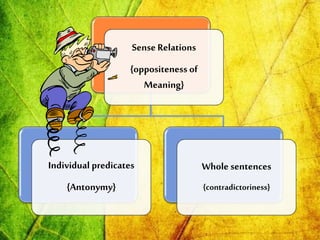
Sense Relations
{oppositeness of
Meaning}
Individual predicates
{Antonymy}
Whole sentences
{contradictoriness}
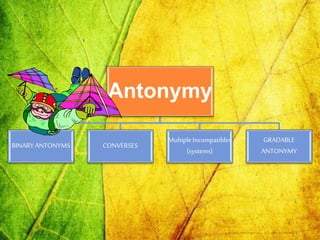
Antonymy
BINARYANTONYMS CONVERSES
MultipleIncompatibles
(systems)
GRADABLE
ANTONYMY
Antonymy
The traditional view of antonymy
simply ‘oppositeness of meaning’
not adequate
Some words may be opposite in meaning indifferent ways
Some words have no real opposites
E.g. Thick is not the opposite of thin in the same way as dead is
the opposite of alive
4. basic types of antonymy (or semantic incompatibility).
BINARY ANTONYMS
BINARY ANTONYMS are predicates which come in pairs and between
them exhaust all the relevant possibilities. If the one predicate is
applicable, then the other cannot be, and vice versa.
Another way to view this is to say that a predicate is a binary antonym of
another predicate if it entails the negative of the other predicate.
E.g.
true and false are binary antonyms.
If a sentence is true, it cannot be false. If it is false, it cannot be true.
Alternatively, if something is true, this entails that it is not false. If it is
false, this entails it is not true.
Also CalledComplementarity
BINARY ANTONYMY
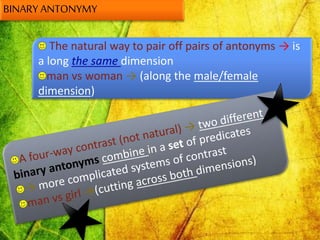
The natural way to pair off pairs of antonyms → is
a long the same dimension
man vs woman → (along the male/female
dimension)
CONVERSES
If a predicate describes a relationship between two things (or
people) and some other predicate describes the same
relationship when the two things (or people)are mentioned in
the opposite order, then the two predicates are CONVERSES
of each other.
E.g. Parent and child are converses,
because X is the parent of Y (one order)
describes the same situation (relationship) as Y is the child of
X (opposite order).
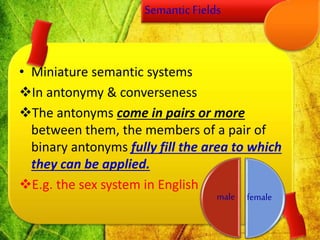
SemanticFields
• Miniature semantic systems
In antonymy & converseness
The antonyms come in pairs or more
between them, the members of a pair of
binary antonyms fully fill the area to which
they can be applied.
E.g. the sex system in English
femalemale
Multiple Incompatibles(systems)
a) All the terms in a given system are mutually incompatible
↘e.g. a playing card cannot belong to both the hearts suit
and the spades suit
b) together, the members of a system cover all the relevant
area.
↘e.g. And besides hearts, clubs, diamonds, and spades
there are no other suits.
There are large numbers of, open-ended systems of
multiple incompatibility.
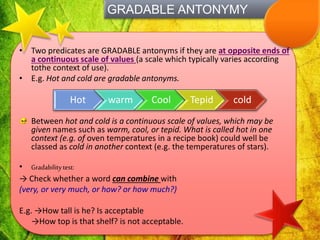
GRADABLE ANTONYMY
• Two predicates are GRADABLE antonyms if they are at opposite ends of
a continuous scale of values (a scale which typically varies according
tothe context of use).
• E.g. Hot and cold are gradable antonyms.
Between hot and cold is a continuous scale of values, which may be
given names such as warm, cool, or tepid. What is called hot in one
context (e.g. of oven temperatures in a recipe book) could well be
classed as cold in another context (e.g. the temperatures of stars).
• Gradabilitytest:
→ Check whether a word can combine with
(very, or very much, or how? or how much?)
E.g. →How tall is he? Is acceptable
→How top is that shelf? is not acceptable.
Hot warm Cool Tepid cold
contradictoriness
contradictoriness
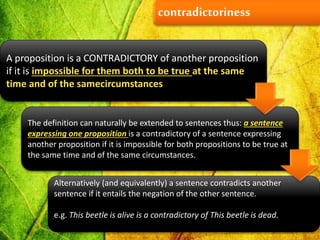
A proposition is a CONTRADICTORY of another proposition
if it is impossible for them both to be true at the same
time and of the samecircumstances
The definition can naturally be extended to sentences thus: a sentence
expressing one proposition is a contradictory of a sentence expressing
another proposition if it is impossible for both propositions to be true at
the same time and of the same circumstances.
Alternatively (and equivalently) a sentence contradicts another
sentence if it entails the negation of the other sentence.
e.g. This beetle is alive is a contradictory of This beetle is dead.
The Relationship between Contradictoriness & Antonymy
(Incompatibility)
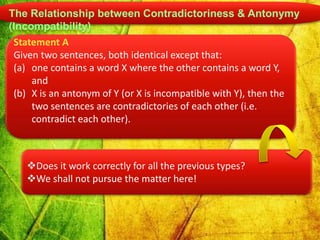
Statement A
Given two sentences, both identical except that:
(a) one contains a word X where the other contains a word Y,
and
(b) X is an antonym of Y (or X is incompatible with Y), then the
two sentences are contradictories of each other (i.e.
contradict each other).
Does it work correctly for all the previous types?
We shall not pursue the matter here!
Ambiguity
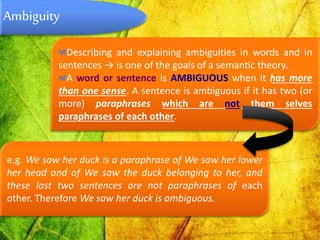
Describing and explaining ambiguities in words and in
sentences → is one of the goals of a semantic theory.
A word or sentence is AMBIGUOUS when it has more
than one sense. A sentence is ambiguous if it has two (or
more) paraphrases which are not them selves
paraphrases of each other.
e.g. We saw her duck is a paraphrase of We saw her lower
her head and of We saw the duck belonging to her, and
these last two sentences are not paraphrases of each
other. Therefore We saw her duck is ambiguous.
Ambiguity
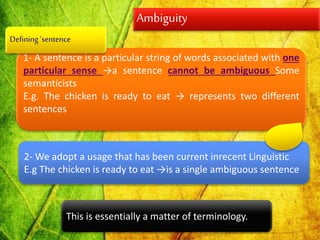
1- A sentence is a particular string of words associated with one
particular sense →a sentence cannot be ambiguous Some
semanticists
E.g. The chicken is ready to eat → represents two different
sentences
2- We adopt a usage that has been current inrecent Linguistic
E.g The chicken is ready to eat →is a single ambiguous sentence
This is essentially a matter of terminology.
Defining ‘sentence
Ambiguity
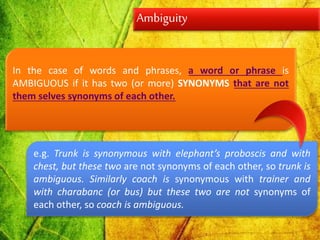
In the case of words and phrases, a word or phrase is
AMBIGUOUS if it has two (or more) SYNONYMS that are not
them selves synonyms of each other.
e.g. Trunk is synonymous with elephant’s proboscis and with
chest, but these two are not synonyms of each other, so trunk is
ambiguous. Similarly coach is synonymous with trainer and
with charabanc (or bus) but these two are not synonyms of
each other, so coach is ambiguous.
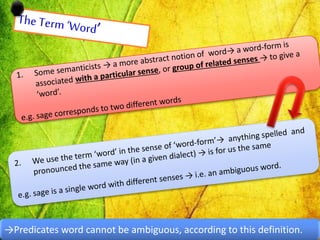
→Predicates word cannot be ambiguous, according to this definition.
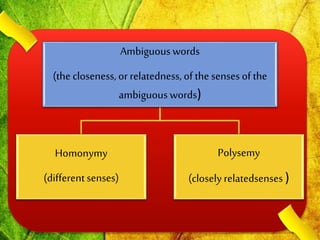
Ambiguous words
(the closeness,or relatedness,of the sensesof the
ambiguous words)
Homonymy
(differentsenses)
Polysemy
(closely relatedsenses)
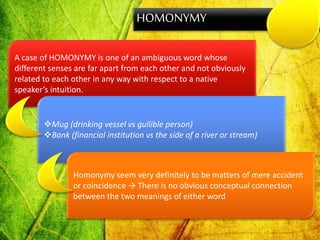
HOMONYMY
A case of HOMONYMY is one of an ambiguous word whose
different senses are far apart from each other and not obviously
related to each other in any way with respect to a native
speaker’s intuition.
Mug (drinking vessel vs gullible person)
Bank (financial institution vs the side of a river or stream)
Homonymy seem very definitely to be matters of mere accident
or coincidence → There is no obvious conceptual connection
between the two meanings of either word
POLYSEMY
A case of POLYSEMY is one where a word has several very closely
related senses. → In otherwords, a native speaker of the language
has clear intuitions that the different senses are related toeach
other in some way
E,g. guard (person who guards, sentinel vs solid protective shield,
e.g. Around machinery)
Explanation: Both contain the concept of protection against
danger.
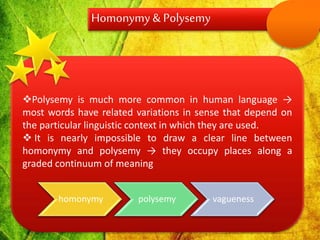
Homonymy & Polysemy
Polysemy is much more common in human language →
most words have related variations in sense that depend on
the particular linguistic context in which they are used.
 It is nearly impossible to draw a clear line between
homonymy and polysemy → they occupy places along a
graded continuum of meaning
homonymy polysemy vagueness
Vague Words
A vague word appears to have one basic sense (monosemy)
which is nevertheless flexible enough to allow for minor
variations in meaning or use which are not particularly
entrenched in the mind of the speaker.
Homonymy
E.g.sage.
we had to resort to the
Latin botanical label
(cheating) → synonymy is
usually a relation between
words(and phrases) in the
same language.
EXAMPLE
It is not always possible to
find an exactly synonymous
phrase for a given word
→ yet it is possible to indicate
different senses of a word by
giving different environments in
which the word may be used
E.g. Grass
has two senses which are
indicated by the following
environments:
(a) Please keep off the grass.
(b) The informer grassed on
his partners-in-crime.
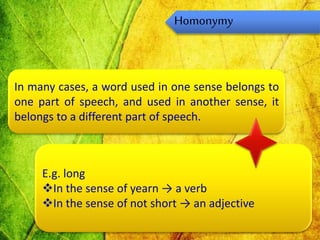
Homonymy
In many cases, a word used in one sense belongs to
one part of speech, and used in another sense, it
belongs to a different part of speech.
E.g. long
In the sense of yearn → a verb
In the sense of not short → an adjective
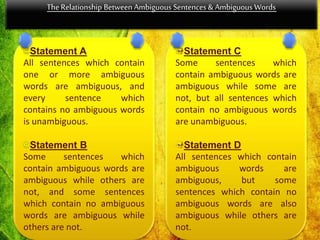
TheRelationship Between Ambiguous Sentences & Ambiguous Words
Statement A
All sentences which contain
one or more ambiguous
words are ambiguous, and
every sentence which
contains no ambiguous words
is unambiguous.
Statement B
Some sentences which
contain ambiguous words are
ambiguous while others are
not, and some sentences
which contain no ambiguous
words are ambiguous while
others are not.
Statement C
Some sentences which
contain ambiguous words are
ambiguous while some are
not, but all sentences which
contain no ambiguous words
are unambiguous.
Statement D
All sentences which contain
ambiguous words are
ambiguous, but some
sentences which contain no
ambiguous words are also
ambiguous while others are
not.
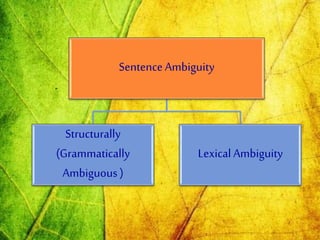
SentenceAmbiguity
Structurally
(Grammatically
Ambiguous)
Lexical Ambiguity
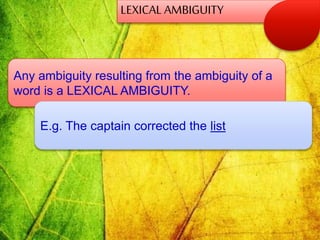
LEXICAL AMBIGUITY
Any ambiguity resulting from the ambiguity of a
word is a LEXICAL AMBIGUITY.
E.g. The captain corrected the list
STRUCTURALLY (orGRAMMATICALLY) AMBIGUOUS
A sentence which is ambiguous because its words relate to each
other in different ways, even though none of the individual words
are ambiguous, is STRUCTURALLY (or GRAMMATICALLY)
AMBIGUOUS.
E.g. The chicken is ready to eat
a question of ‘what goes with
what’ in a sentence
can be shown by using
constituency diagrams
square brackets around the
relevant parts of the sentence
(or phrase).
e.g. The phrase old men and women
is structurally ambiguous. It is
synonymous with women and old
men and with old men and old
women. We represent these two
senses with square brackets thus:
(1) [old men] and women
old [men and women]
The first diagram indicates that old
modifies only men, and the second
ThingsthatMust not be Confusedwith Ambiguity
A phrase is REFERENTIALLY VERSATILE if it can be used to refer
to a wide range of different things or persons.
E.g.
She tall and short (adjectives)
Mountain and hill (nouns)
Aunt → does not have more than one sense → can be used to refer to more
than one distinct member of a kinship system.
The pronoun she can be used to refer to any female person. On a given
occasion she might be used to refer to Mary, on another occasion to Lucy, etc.,
but this does NOT mean that she is ambiguous, because although it is used to
refer to different people this is not a matter of a difference in sense.
There is no absolute distinction or line drawn between them +
interchangeable depending on the occasion
Referential vagueness is not the same thing as ambiguity
Sense relations 2

Sense relations 2

  • 1.
    SENSE RELATIONS 2 Bygroup 2 OPPOSITENESS AND DISSIMILARITY OF SENSE AND AMBIGUITY INDAH HARTANTI DEWI MUSLIMAH POETRI ARDIFA MERY PUSPITA TRI WULANDARI FAISAL RAMANDIKA AHMAD ROMMARIS RIZAUZROTUL LAILATUL CHURIAH INDAH MUSTIKA
  • 2.
    Sense Relations {oppositeness of Meaning} Individualpredicates {Antonymy} Whole sentences {contradictoriness}
  • 3.
  • 4.
    Antonymy The traditional viewof antonymy simply ‘oppositeness of meaning’ not adequate Some words may be opposite in meaning indifferent ways Some words have no real opposites E.g. Thick is not the opposite of thin in the same way as dead is the opposite of alive 4. basic types of antonymy (or semantic incompatibility).
  • 5.
    BINARY ANTONYMS BINARY ANTONYMSare predicates which come in pairs and between them exhaust all the relevant possibilities. If the one predicate is applicable, then the other cannot be, and vice versa. Another way to view this is to say that a predicate is a binary antonym of another predicate if it entails the negative of the other predicate. E.g. true and false are binary antonyms. If a sentence is true, it cannot be false. If it is false, it cannot be true. Alternatively, if something is true, this entails that it is not false. If it is false, this entails it is not true. Also CalledComplementarity
  • 6.
    BINARY ANTONYMY The naturalway to pair off pairs of antonyms → is a long the same dimension man vs woman → (along the male/female dimension)
  • 7.
    CONVERSES If a predicatedescribes a relationship between two things (or people) and some other predicate describes the same relationship when the two things (or people)are mentioned in the opposite order, then the two predicates are CONVERSES of each other. E.g. Parent and child are converses, because X is the parent of Y (one order) describes the same situation (relationship) as Y is the child of X (opposite order).
  • 8.
    SemanticFields • Miniature semanticsystems In antonymy & converseness The antonyms come in pairs or more between them, the members of a pair of binary antonyms fully fill the area to which they can be applied. E.g. the sex system in English femalemale
  • 9.
    Multiple Incompatibles(systems) a) Allthe terms in a given system are mutually incompatible ↘e.g. a playing card cannot belong to both the hearts suit and the spades suit b) together, the members of a system cover all the relevant area. ↘e.g. And besides hearts, clubs, diamonds, and spades there are no other suits. There are large numbers of, open-ended systems of multiple incompatibility.
  • 10.
    GRADABLE ANTONYMY • Twopredicates are GRADABLE antonyms if they are at opposite ends of a continuous scale of values (a scale which typically varies according tothe context of use). • E.g. Hot and cold are gradable antonyms. Between hot and cold is a continuous scale of values, which may be given names such as warm, cool, or tepid. What is called hot in one context (e.g. of oven temperatures in a recipe book) could well be classed as cold in another context (e.g. the temperatures of stars). • Gradabilitytest: → Check whether a word can combine with (very, or very much, or how? or how much?) E.g. →How tall is he? Is acceptable →How top is that shelf? is not acceptable. Hot warm Cool Tepid cold
  • 11.
  • 12.
    contradictoriness A proposition isa CONTRADICTORY of another proposition if it is impossible for them both to be true at the same time and of the samecircumstances The definition can naturally be extended to sentences thus: a sentence expressing one proposition is a contradictory of a sentence expressing another proposition if it is impossible for both propositions to be true at the same time and of the same circumstances. Alternatively (and equivalently) a sentence contradicts another sentence if it entails the negation of the other sentence. e.g. This beetle is alive is a contradictory of This beetle is dead.
  • 13.
    The Relationship betweenContradictoriness & Antonymy (Incompatibility) Statement A Given two sentences, both identical except that: (a) one contains a word X where the other contains a word Y, and (b) X is an antonym of Y (or X is incompatible with Y), then the two sentences are contradictories of each other (i.e. contradict each other). Does it work correctly for all the previous types? We shall not pursue the matter here!
  • 14.
    Ambiguity Describing and explainingambiguities in words and in sentences → is one of the goals of a semantic theory. A word or sentence is AMBIGUOUS when it has more than one sense. A sentence is ambiguous if it has two (or more) paraphrases which are not them selves paraphrases of each other. e.g. We saw her duck is a paraphrase of We saw her lower her head and of We saw the duck belonging to her, and these last two sentences are not paraphrases of each other. Therefore We saw her duck is ambiguous.
  • 15.
    Ambiguity 1- A sentenceis a particular string of words associated with one particular sense →a sentence cannot be ambiguous Some semanticists E.g. The chicken is ready to eat → represents two different sentences 2- We adopt a usage that has been current inrecent Linguistic E.g The chicken is ready to eat →is a single ambiguous sentence This is essentially a matter of terminology. Defining ‘sentence
  • 16.
    Ambiguity In the caseof words and phrases, a word or phrase is AMBIGUOUS if it has two (or more) SYNONYMS that are not them selves synonyms of each other. e.g. Trunk is synonymous with elephant’s proboscis and with chest, but these two are not synonyms of each other, so trunk is ambiguous. Similarly coach is synonymous with trainer and with charabanc (or bus) but these two are not synonyms of each other, so coach is ambiguous.
  • 17.
    →Predicates word cannotbe ambiguous, according to this definition.
  • 18.
    Ambiguous words (the closeness,orrelatedness,of the sensesof the ambiguous words) Homonymy (differentsenses) Polysemy (closely relatedsenses)
  • 19.
    HOMONYMY A case ofHOMONYMY is one of an ambiguous word whose different senses are far apart from each other and not obviously related to each other in any way with respect to a native speaker’s intuition. Mug (drinking vessel vs gullible person) Bank (financial institution vs the side of a river or stream) Homonymy seem very definitely to be matters of mere accident or coincidence → There is no obvious conceptual connection between the two meanings of either word
  • 20.
    POLYSEMY A case ofPOLYSEMY is one where a word has several very closely related senses. → In otherwords, a native speaker of the language has clear intuitions that the different senses are related toeach other in some way E,g. guard (person who guards, sentinel vs solid protective shield, e.g. Around machinery) Explanation: Both contain the concept of protection against danger.
  • 21.
    Homonymy & Polysemy Polysemyis much more common in human language → most words have related variations in sense that depend on the particular linguistic context in which they are used.  It is nearly impossible to draw a clear line between homonymy and polysemy → they occupy places along a graded continuum of meaning homonymy polysemy vagueness
  • 22.
    Vague Words A vagueword appears to have one basic sense (monosemy) which is nevertheless flexible enough to allow for minor variations in meaning or use which are not particularly entrenched in the mind of the speaker.
  • 23.
    Homonymy E.g.sage. we had toresort to the Latin botanical label (cheating) → synonymy is usually a relation between words(and phrases) in the same language. EXAMPLE It is not always possible to find an exactly synonymous phrase for a given word → yet it is possible to indicate different senses of a word by giving different environments in which the word may be used E.g. Grass has two senses which are indicated by the following environments: (a) Please keep off the grass. (b) The informer grassed on his partners-in-crime.
  • 24.
    Homonymy In many cases,a word used in one sense belongs to one part of speech, and used in another sense, it belongs to a different part of speech. E.g. long In the sense of yearn → a verb In the sense of not short → an adjective
  • 25.
    TheRelationship Between AmbiguousSentences & Ambiguous Words Statement A All sentences which contain one or more ambiguous words are ambiguous, and every sentence which contains no ambiguous words is unambiguous. Statement B Some sentences which contain ambiguous words are ambiguous while others are not, and some sentences which contain no ambiguous words are ambiguous while others are not. Statement C Some sentences which contain ambiguous words are ambiguous while some are not, but all sentences which contain no ambiguous words are unambiguous. Statement D All sentences which contain ambiguous words are ambiguous, but some sentences which contain no ambiguous words are also ambiguous while others are not.
  • 26.
  • 27.
    LEXICAL AMBIGUITY Any ambiguityresulting from the ambiguity of a word is a LEXICAL AMBIGUITY. E.g. The captain corrected the list
  • 28.
    STRUCTURALLY (orGRAMMATICALLY) AMBIGUOUS Asentence which is ambiguous because its words relate to each other in different ways, even though none of the individual words are ambiguous, is STRUCTURALLY (or GRAMMATICALLY) AMBIGUOUS. E.g. The chicken is ready to eat a question of ‘what goes with what’ in a sentence can be shown by using constituency diagrams square brackets around the relevant parts of the sentence (or phrase). e.g. The phrase old men and women is structurally ambiguous. It is synonymous with women and old men and with old men and old women. We represent these two senses with square brackets thus: (1) [old men] and women old [men and women] The first diagram indicates that old modifies only men, and the second
  • 29.
    ThingsthatMust not beConfusedwith Ambiguity A phrase is REFERENTIALLY VERSATILE if it can be used to refer to a wide range of different things or persons. E.g. She tall and short (adjectives) Mountain and hill (nouns) Aunt → does not have more than one sense → can be used to refer to more than one distinct member of a kinship system. The pronoun she can be used to refer to any female person. On a given occasion she might be used to refer to Mary, on another occasion to Lucy, etc., but this does NOT mean that she is ambiguous, because although it is used to refer to different people this is not a matter of a difference in sense. There is no absolute distinction or line drawn between them + interchangeable depending on the occasion Referential vagueness is not the same thing as ambiguity