Prepared by: Sarah Mae Faith Zamora
Based on the book An Introduction to Language by Victoria
Fromkin, Robert Rodman, Nina Hyams
What speakers know about sentence meaning
Linguistic knowledge permits us to determine:
• Whether a sentence is true or false
• When one sentence implies the truth
or falseness of another
• Whether a sentence has multiple
meanings
Truth-conditional Semantics
> by formulating semantic rules that build the meaning of a
sentence from the meanings of its words and the way the words
combine syntactically
Truth Value
>judging sentences as either true or false
Compositional Semantics
> calculates the truth value of a sentence by composing, or
putting together, the meanings of smaller units
Compositional Semantics
• looks at the meanings of sentences and longer
utterances
TRUTH
Ex. Jack swims.
* You do not need to actually know whether a sentence is
true or false to know its meaning. Knowing the meaning
tells you how to determine the truth value.
A restricted number of sentences are indeed always
true regardless of the circumstances. They are called
TAUTOLOGIES.
Some sentences are always false. These are called
CONTRADICTIONS.
ENTAILMENT – when one sentence entails another if
whenever the first sentence is true the second is also
true in all conceivable circumstances.
Two sentences are SYNONYMOUS if they entail each
other.
Two sentences are CONTRADICTORY if one entails the
negation of the other
AMBIGUITY
Our semantic knowledge tells us when words or phrases
(including sentences) have more than one meaning: that is,
when they are ambiguous.
Ex. The boy saw the man with the telescope.
* The sentence is structurally ambiguous because it is
associated with two different phrase structures, each
corresponding to a different meaning.
LEXICAL AMBIGUITY
 arises when at least one word in a phrase has more
than one meaning
Ex. This will make you smart
* The sentence is ambiguous because of the two
meanings of the word smart: ‘clever’ and ‘feel a
burning sensation.’.
PRINCIPLE OF COMPOSITIONALITY
 notion that the meaning of an expression is
composed of the meanings of its parts and how
they are combined structurally
COMPOSITIONAL SEMANTICS
To manage a system effectively, you might focus
on the interactions of the parts rather than their
behavior taken separately.
(RUSSELL L. ACKOFF)
* Grammar contains semantic rules
that combine the meanings
of words into meaningful
phrases and sentences
SEMANTIC RULES
• Jack (proper name) swims (its referent)
*Semanticists think that the best way to define predicates s
(verbs, adjectives and common nouns) is in terms of the
individuals that those predicates successfully describe
Word Meanings
Jack refers to (or means) the individual Jack
swims refers to (or means) the set of individuals that swim
When Compositionality Goes Awry
• The meaning of an expression is not always obvious, even to
a native speaker of the language. Meanings may be obscured
in many ways, or at least may require some imagination or
special knowledge to be apprehended.
ANOMALY
METAPHORS
IDIOMS
ANOMALY
 Ex. Colorless green ideas sleep furiously.
(semantically anomalous)
 Dark green leaves rustle furiously.
* Other English “sentences” make no sense at all
because they include “words” that have no meaning;
they are interpretable. They can be interpreted only if
some meaning for each nonsense word can be
dreamt up.
Lewis Carroll’s “Jabberwocky”
 is probably the most famous poem in which most
of the content words have no meaning—they do
not exist in the lexicon of the language
(semantically anomalous)
He took his vorpal sword in hand:
Long time the manxome foe he sought—
So rested he by the Tumtum tree,
And stood awhile in thought
Breaking the rules creates the desired imagery.
Ex. A grief ago ( a phrase by Dylan Thomas)
Ago is ordinarily used with words specified by some
temporal semantic feature:
a week ago *a table ago
an hour ago but not *a dream ago
a month ago *a mother ago
The fact that we are able to understand, or at least interpret,
anomalous expressions, and at the same time recognize their
anomalous nature, demonstrates our knowledge of the
semantic system and semantic properties of the language
METAPHORS
 Our doubts are traitors. (William Shakespeare)
 Walls have ears. (from Don Quixote)
 The night has a thousand eyes and the day but one.
(Bourdillon’s Light )
METAPHORS
 When what appears to be an anomaly is nevertheless
understood in terms of a meaningful concept, the
expression becomes a metaphor
 Technically, metaphors are anomalous, but the nature
of the anomaly creates the salient meanings that
metaphors usually have.
METAPHORS
 may have a literal meaning as well as their
metaphorical meaning, so in some sense they are
ambiguous
* Metaphorical use of language is language creativity
at its highest.
IDIOMS
 typically start out as metaphors that catch on and are
repeated so often that they become fixtures in the
language. Such expressions are called idioms, or
idiomatic phrases, as in these English examples:
sell down the river
rake over the coals
snap out of it
give a piece of your mind
IDIOMS
 Like metaphors, idioms can break the rules on combining
semantic properties.
Example
He ate his hat.
Eat your heart out.
* Idioms, grammatically as well as semantically, have
special characteristics. They must be entered into the
lexicon or mental dictionary as single items with their
meanings specified, and speakers must learn the special
restrictions on their use in sentences
LEXICAL SEMANTICS
> studies the meanings and relations of words
* The meaning of words is part of linguistic
knowledge. Our mental storehouse of
information about words and morphemes is
what we have been calling the LEXICON
Theories of Word Meaning
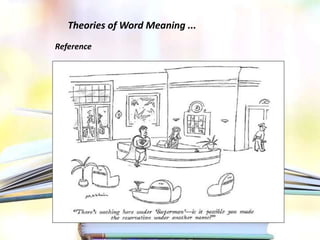
Reference
The meaning of a word or expression is its reference;
its association with the object it refers to.
Theories of Word Meaning ...
Reference
Theories of Word Meaning ...
Reference
Ex. Lois Lane is in love with Superman.
Sense
 This suggests the fact that speakers know the
meanings of many words that have no real-world
referents.
Ex. hobbits, unicorns and Harry Potter
* These additional elements of meaning are often
termed sense.
Lexical Relations
Words are semantically related to one another in a
variety of ways.
* Please do not annoy, torment, pester, plague, molest,
worry, badger, harry, harass, heckle, persecute, irk,
bullyrag, vex, disquiet, grate, beset, bother, tease,
nettle, tantalize, or ruffle the animals
Ex. A sign in the San Diego Zoo Wild Animal Park states:
SYNONYMS are words or expressions that have the
same meaning in some or all contexts.
Lexical Relations
• Complementary Pairs
ex. alive/dead present/absent awake or asleep
Kinds of Antonyms
ANTONYMS are words that are opposite in meaning
• Gradable Pairs
ex. big/small hot/cold fast/slow
• Relational Opposites
ex. give/receive buy/sell teacher/pupil
 In English there are several ways to form antonyms by
adding:
Un –
likely/unlikely able/unable fortunate/unfortunate
Non –
entity/nonentity conformist/nonconformist
In –
tolerant/intolerant discreet/indiscreet decent/indecent
Antonyms ..
• HOMONYMS - words that have different meanings but
are pronounced the same and may or may not be spelled
the same, homographs when spelled the same.
Ex. Bear and Bare
• POLYSEMY word that has multiple meanings that are
related conceptually or historically
Ex. Diamond (referring to a jewel and also to a
baseball field)
Other lexical relations ..
• HYPONYMY- the relationship between the more general
term and the more specific instances of it
Ex. color – red
feline – lion
SEMANTIC FEATURES
If it is true that words have meanings, why don’t we throw
away words and keep just the meanings?
LUDWIG WITTGENSTEIN
Other lexical relations ..
 Decomposing the meanings of words into semantic
features can clarify how certain words relate to other
words.
 Semantic features are among the conceptual elements
that are part of the meanings of words and sentences.
Consider, for example, the sentence:
The assassin killed Thwacklehurst.
SEMANTIC FEATURES
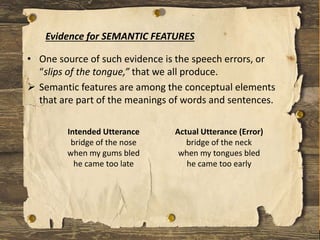
• One source of such evidence is the speech errors, or
“slips of the tongue,” that we all produce.
 Semantic features are among the conceptual elements
that are part of the meanings of words and sentences.
Evidence for SEMANTIC FEATURES
Intended Utterance
bridge of the nose
when my gums bled
he came too late
Actual Utterance (Error)
bridge of the neck
when my tongues bled
he came too early
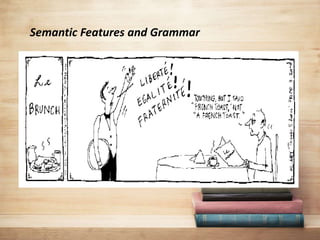
Semantic Features and Grammar
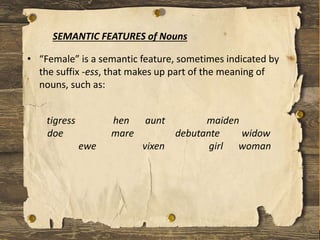
• “Female” is a semantic feature, sometimes indicated by
the suffix -ess, that makes up part of the meaning of
nouns, such as:
SEMANTIC FEATURES of Nouns
tigress hen aunt maiden
doe mare debutante widow
ewe vixen girl woman
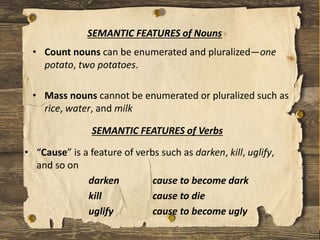
• “Cause” is a feature of verbs such as darken, kill, uglify,
and so on
darken cause to become dark
kill cause to die
uglify cause to become ugly
SEMANTIC FEATURES of Verbs
SEMANTIC FEATURES of Nouns
• Count nouns can be enumerated and pluralized—one
potato, two potatoes.
• Mass nouns cannot be enumerated or pluralized such as
rice, water, and milk
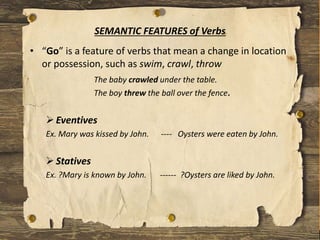
• “Go” is a feature of verbs that mean a change in location
or possession, such as swim, crawl, throw
The baby crawled under the table.
The boy threw the ball over the fence.
Eventives
Ex. Mary was kissed by John. ---- Oysters were eaten by John.
Statives
Ex. ?Mary is known by John. ------ ?Oysters are liked by John.
SEMANTIC FEATURES of Verbs
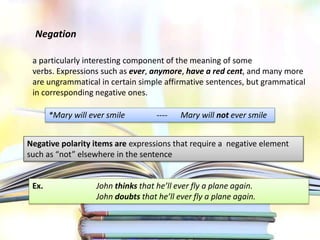
Negation
a particularly interesting component of the meaning of some
verbs. Expressions such as ever, anymore, have a red cent, and many more
are ungrammatical in certain simple affirmative sentences, but grammatical
in corresponding negative ones.
*Mary will ever smile ---- Mary will not ever smile
Negative polarity items are expressions that require a negative element
such as “not” elsewhere in the sentence
Ex. John thinks that he’ll ever fly a plane again.
John doubts that he’ll ever fly a plane again.
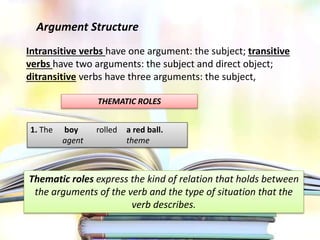
Argument Structure
Intransitive verbs have one argument: the subject; transitive
verbs have two arguments: the subject and direct object;
ditransitive verbs have three arguments: the subject,
THEMATIC ROLES
1. The boy rolled a red ball.
agent theme
Thematic roles express the kind of relation that holds between
the arguments of the verb and the type of situation that the
verb describes.
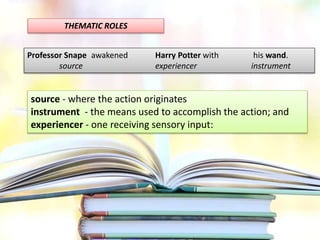
THEMATIC ROLES
Professor Snape awakened Harry Potter with his wand.
source experiencer instrument
source - where the action originates
instrument - the means used to accomplish the action; and
experiencer - one receiving sensory input:
Prepared by: Sarah Mae Faith Zamora & Helen Rhose Go

Semantics

  • 1.
    Prepared by: SarahMae Faith Zamora Based on the book An Introduction to Language by Victoria Fromkin, Robert Rodman, Nina Hyams
  • 2.
    What speakers knowabout sentence meaning Linguistic knowledge permits us to determine: • Whether a sentence is true or false • When one sentence implies the truth or falseness of another • Whether a sentence has multiple meanings
  • 3.
    Truth-conditional Semantics > byformulating semantic rules that build the meaning of a sentence from the meanings of its words and the way the words combine syntactically Truth Value >judging sentences as either true or false Compositional Semantics > calculates the truth value of a sentence by composing, or putting together, the meanings of smaller units
  • 4.
    Compositional Semantics • looksat the meanings of sentences and longer utterances TRUTH Ex. Jack swims. * You do not need to actually know whether a sentence is true or false to know its meaning. Knowing the meaning tells you how to determine the truth value.
  • 5.
    A restricted numberof sentences are indeed always true regardless of the circumstances. They are called TAUTOLOGIES. Some sentences are always false. These are called CONTRADICTIONS. ENTAILMENT – when one sentence entails another if whenever the first sentence is true the second is also true in all conceivable circumstances. Two sentences are SYNONYMOUS if they entail each other. Two sentences are CONTRADICTORY if one entails the negation of the other
  • 6.
    AMBIGUITY Our semantic knowledgetells us when words or phrases (including sentences) have more than one meaning: that is, when they are ambiguous. Ex. The boy saw the man with the telescope. * The sentence is structurally ambiguous because it is associated with two different phrase structures, each corresponding to a different meaning.
  • 7.
    LEXICAL AMBIGUITY  ariseswhen at least one word in a phrase has more than one meaning Ex. This will make you smart * The sentence is ambiguous because of the two meanings of the word smart: ‘clever’ and ‘feel a burning sensation.’.
  • 8.
    PRINCIPLE OF COMPOSITIONALITY notion that the meaning of an expression is composed of the meanings of its parts and how they are combined structurally
  • 9.
    COMPOSITIONAL SEMANTICS To managea system effectively, you might focus on the interactions of the parts rather than their behavior taken separately. (RUSSELL L. ACKOFF) * Grammar contains semantic rules that combine the meanings of words into meaningful phrases and sentences
  • 10.
    SEMANTIC RULES • Jack(proper name) swims (its referent) *Semanticists think that the best way to define predicates s (verbs, adjectives and common nouns) is in terms of the individuals that those predicates successfully describe Word Meanings Jack refers to (or means) the individual Jack swims refers to (or means) the set of individuals that swim
  • 11.
    When Compositionality GoesAwry • The meaning of an expression is not always obvious, even to a native speaker of the language. Meanings may be obscured in many ways, or at least may require some imagination or special knowledge to be apprehended. ANOMALY METAPHORS IDIOMS
  • 12.
    ANOMALY  Ex. Colorlessgreen ideas sleep furiously. (semantically anomalous)  Dark green leaves rustle furiously. * Other English “sentences” make no sense at all because they include “words” that have no meaning; they are interpretable. They can be interpreted only if some meaning for each nonsense word can be dreamt up.
  • 13.
    Lewis Carroll’s “Jabberwocky” is probably the most famous poem in which most of the content words have no meaning—they do not exist in the lexicon of the language (semantically anomalous) He took his vorpal sword in hand: Long time the manxome foe he sought— So rested he by the Tumtum tree, And stood awhile in thought
  • 14.
    Breaking the rulescreates the desired imagery. Ex. A grief ago ( a phrase by Dylan Thomas) Ago is ordinarily used with words specified by some temporal semantic feature: a week ago *a table ago an hour ago but not *a dream ago a month ago *a mother ago
  • 15.
    The fact thatwe are able to understand, or at least interpret, anomalous expressions, and at the same time recognize their anomalous nature, demonstrates our knowledge of the semantic system and semantic properties of the language
  • 16.
    METAPHORS  Our doubtsare traitors. (William Shakespeare)  Walls have ears. (from Don Quixote)  The night has a thousand eyes and the day but one. (Bourdillon’s Light )
  • 17.
    METAPHORS  When whatappears to be an anomaly is nevertheless understood in terms of a meaningful concept, the expression becomes a metaphor  Technically, metaphors are anomalous, but the nature of the anomaly creates the salient meanings that metaphors usually have.
  • 18.
    METAPHORS  may havea literal meaning as well as their metaphorical meaning, so in some sense they are ambiguous * Metaphorical use of language is language creativity at its highest.
  • 19.
    IDIOMS  typically startout as metaphors that catch on and are repeated so often that they become fixtures in the language. Such expressions are called idioms, or idiomatic phrases, as in these English examples: sell down the river rake over the coals snap out of it give a piece of your mind
  • 20.
    IDIOMS  Like metaphors,idioms can break the rules on combining semantic properties. Example He ate his hat. Eat your heart out. * Idioms, grammatically as well as semantically, have special characteristics. They must be entered into the lexicon or mental dictionary as single items with their meanings specified, and speakers must learn the special restrictions on their use in sentences
  • 21.
    LEXICAL SEMANTICS > studiesthe meanings and relations of words * The meaning of words is part of linguistic knowledge. Our mental storehouse of information about words and morphemes is what we have been calling the LEXICON
  • 22.
    Theories of WordMeaning Reference The meaning of a word or expression is its reference; its association with the object it refers to.
  • 23.
    Theories of WordMeaning ... Reference
  • 24.
    Theories of WordMeaning ... Reference Ex. Lois Lane is in love with Superman.
  • 25.
    Sense  This suggeststhe fact that speakers know the meanings of many words that have no real-world referents. Ex. hobbits, unicorns and Harry Potter * These additional elements of meaning are often termed sense.
  • 26.
    Lexical Relations Words aresemantically related to one another in a variety of ways. * Please do not annoy, torment, pester, plague, molest, worry, badger, harry, harass, heckle, persecute, irk, bullyrag, vex, disquiet, grate, beset, bother, tease, nettle, tantalize, or ruffle the animals Ex. A sign in the San Diego Zoo Wild Animal Park states: SYNONYMS are words or expressions that have the same meaning in some or all contexts.
  • 27.
    Lexical Relations • ComplementaryPairs ex. alive/dead present/absent awake or asleep Kinds of Antonyms ANTONYMS are words that are opposite in meaning • Gradable Pairs ex. big/small hot/cold fast/slow • Relational Opposites ex. give/receive buy/sell teacher/pupil
  • 28.
     In Englishthere are several ways to form antonyms by adding: Un – likely/unlikely able/unable fortunate/unfortunate Non – entity/nonentity conformist/nonconformist In – tolerant/intolerant discreet/indiscreet decent/indecent Antonyms ..
  • 29.
    • HOMONYMS -words that have different meanings but are pronounced the same and may or may not be spelled the same, homographs when spelled the same. Ex. Bear and Bare • POLYSEMY word that has multiple meanings that are related conceptually or historically Ex. Diamond (referring to a jewel and also to a baseball field) Other lexical relations ..
  • 30.
    • HYPONYMY- therelationship between the more general term and the more specific instances of it Ex. color – red feline – lion SEMANTIC FEATURES If it is true that words have meanings, why don’t we throw away words and keep just the meanings? LUDWIG WITTGENSTEIN Other lexical relations ..
  • 31.
     Decomposing themeanings of words into semantic features can clarify how certain words relate to other words.  Semantic features are among the conceptual elements that are part of the meanings of words and sentences. Consider, for example, the sentence: The assassin killed Thwacklehurst. SEMANTIC FEATURES
  • 32.
    • One sourceof such evidence is the speech errors, or “slips of the tongue,” that we all produce.  Semantic features are among the conceptual elements that are part of the meanings of words and sentences. Evidence for SEMANTIC FEATURES Intended Utterance bridge of the nose when my gums bled he came too late Actual Utterance (Error) bridge of the neck when my tongues bled he came too early
  • 33.
  • 34.
    • “Female” isa semantic feature, sometimes indicated by the suffix -ess, that makes up part of the meaning of nouns, such as: SEMANTIC FEATURES of Nouns tigress hen aunt maiden doe mare debutante widow ewe vixen girl woman
  • 35.
    • “Cause” isa feature of verbs such as darken, kill, uglify, and so on darken cause to become dark kill cause to die uglify cause to become ugly SEMANTIC FEATURES of Verbs SEMANTIC FEATURES of Nouns • Count nouns can be enumerated and pluralized—one potato, two potatoes. • Mass nouns cannot be enumerated or pluralized such as rice, water, and milk
  • 36.
    • “Go” isa feature of verbs that mean a change in location or possession, such as swim, crawl, throw The baby crawled under the table. The boy threw the ball over the fence. Eventives Ex. Mary was kissed by John. ---- Oysters were eaten by John. Statives Ex. ?Mary is known by John. ------ ?Oysters are liked by John. SEMANTIC FEATURES of Verbs
  • 37.
    Negation a particularly interestingcomponent of the meaning of some verbs. Expressions such as ever, anymore, have a red cent, and many more are ungrammatical in certain simple affirmative sentences, but grammatical in corresponding negative ones. *Mary will ever smile ---- Mary will not ever smile Negative polarity items are expressions that require a negative element such as “not” elsewhere in the sentence Ex. John thinks that he’ll ever fly a plane again. John doubts that he’ll ever fly a plane again.
  • 38.
    Argument Structure Intransitive verbshave one argument: the subject; transitive verbs have two arguments: the subject and direct object; ditransitive verbs have three arguments: the subject, THEMATIC ROLES 1. The boy rolled a red ball. agent theme Thematic roles express the kind of relation that holds between the arguments of the verb and the type of situation that the verb describes.
  • 39.
    THEMATIC ROLES Professor Snapeawakened Harry Potter with his wand. source experiencer instrument source - where the action originates instrument - the means used to accomplish the action; and experiencer - one receiving sensory input:
  • 40.
    Prepared by: SarahMae Faith Zamora & Helen Rhose Go