From Words to Major Phrase Types
Faiz Rizki Muhammad
Syntax
Syntax is the study of rules which generate an infinite number
of grammatical sentences.
The main goal of syntax is building a grammar that can
generate an
infinite set of well-formed, grammatical English sentences.
Forming grammatical sentences
Words (lexical categories)  Phrases  Clauses  Sentences
Words, or ‘lexical’ categories.
These lexical categories then form a larger constituent ‘phrase’
Phrases go together to form a ‘clause’. A clause either is, or is
part of, a well-formed sentence.
A ‘clause’ refers to a complete sentence-like unit, but which may
be part of another clause, as a subordinate or adverbial clause.
Each of the sentences in (1b)–(1d) contains more than one
clause, in particular, with one clause embedded inside another:
(1)
a. The weather is lovely today.
b. I am hoping [that the weather is lovely today].
c. [If the weather is lovely today] then we will go out.
d. The birds are singing [because the weather is lovely today].
2.2 Lexical Categories
The basic units of syntax are words. BUT
What kinds of words (also known as parts of
speech, or lexical categories, or grammatical
categories) does English have?
Are they simply noun, verb, adjective, adverb,
preposition, and maybe a few others?
2.2 Lexical Categories
Most of us would not be able to come up with simple
definitions to explain the categorization of words.
For instance, why do we categorize book as a noun, but kick
as a verb?
To make it more difficult,
How do we know that virtue is a noun, that without is a
preposition, and that well is an adverb (in one meaning)?
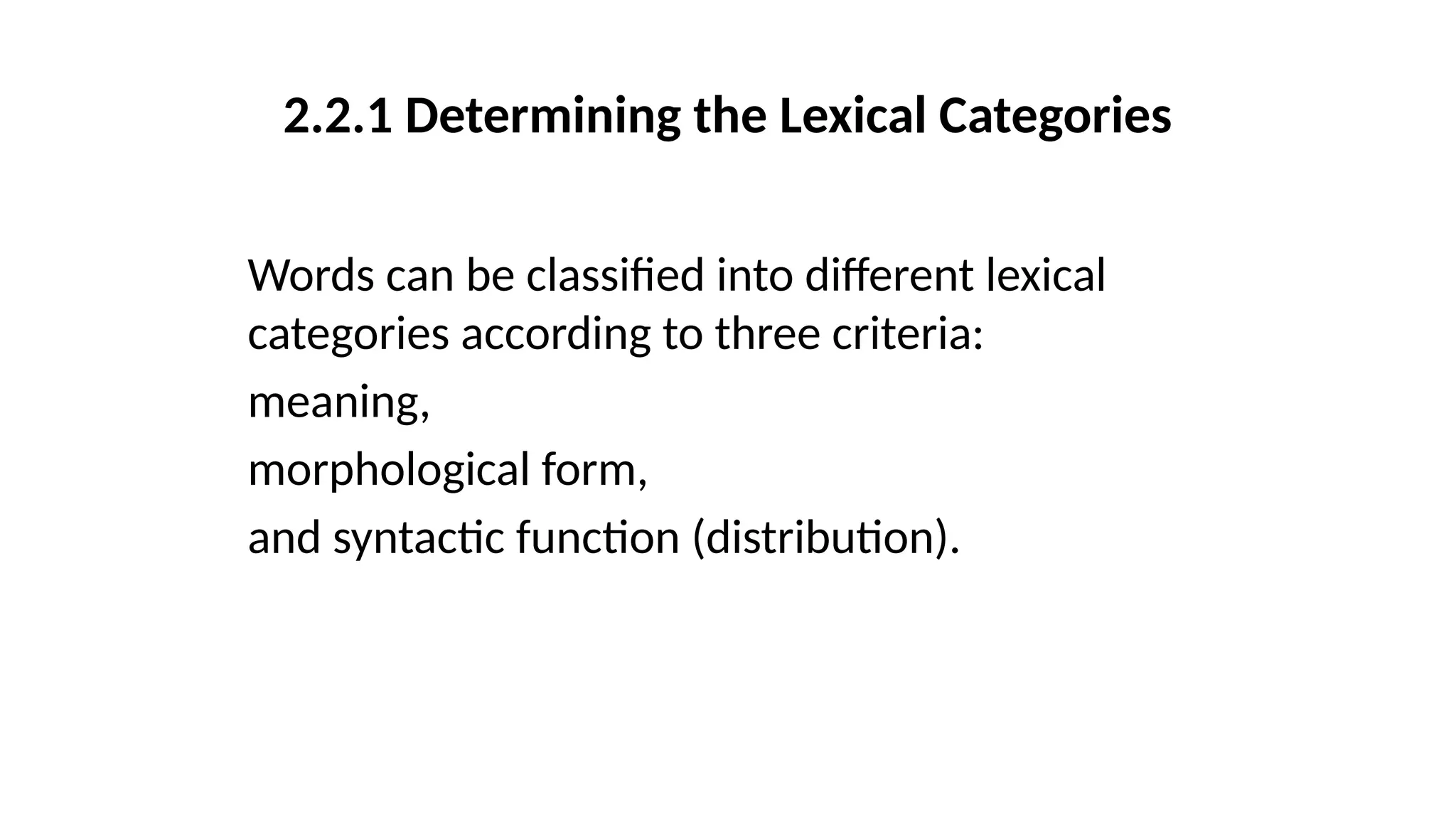
2.2.1 Determining the Lexical Categories
Words can be classified into different lexical
categories according to three criteria:
meaning,
morphological form,
and syntactic function (distribution).
Meaning
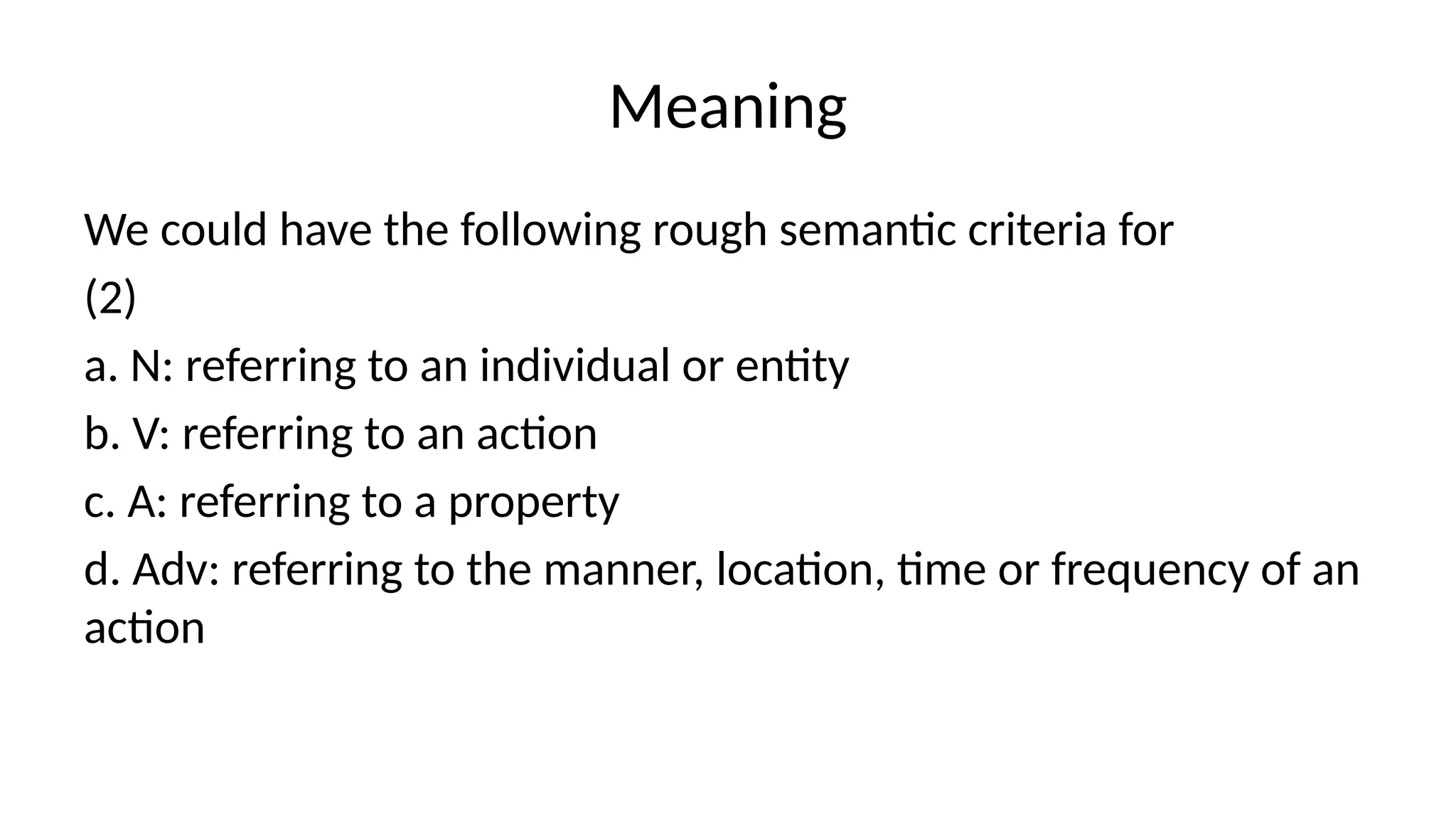
We could have the following rough semantic criteria for
(2)
a. N: referring to an individual or entity
b. V: referring to an action
c. A: referring to a property
d. Adv: referring to the manner, location, time or frequency of an
action
Meaning
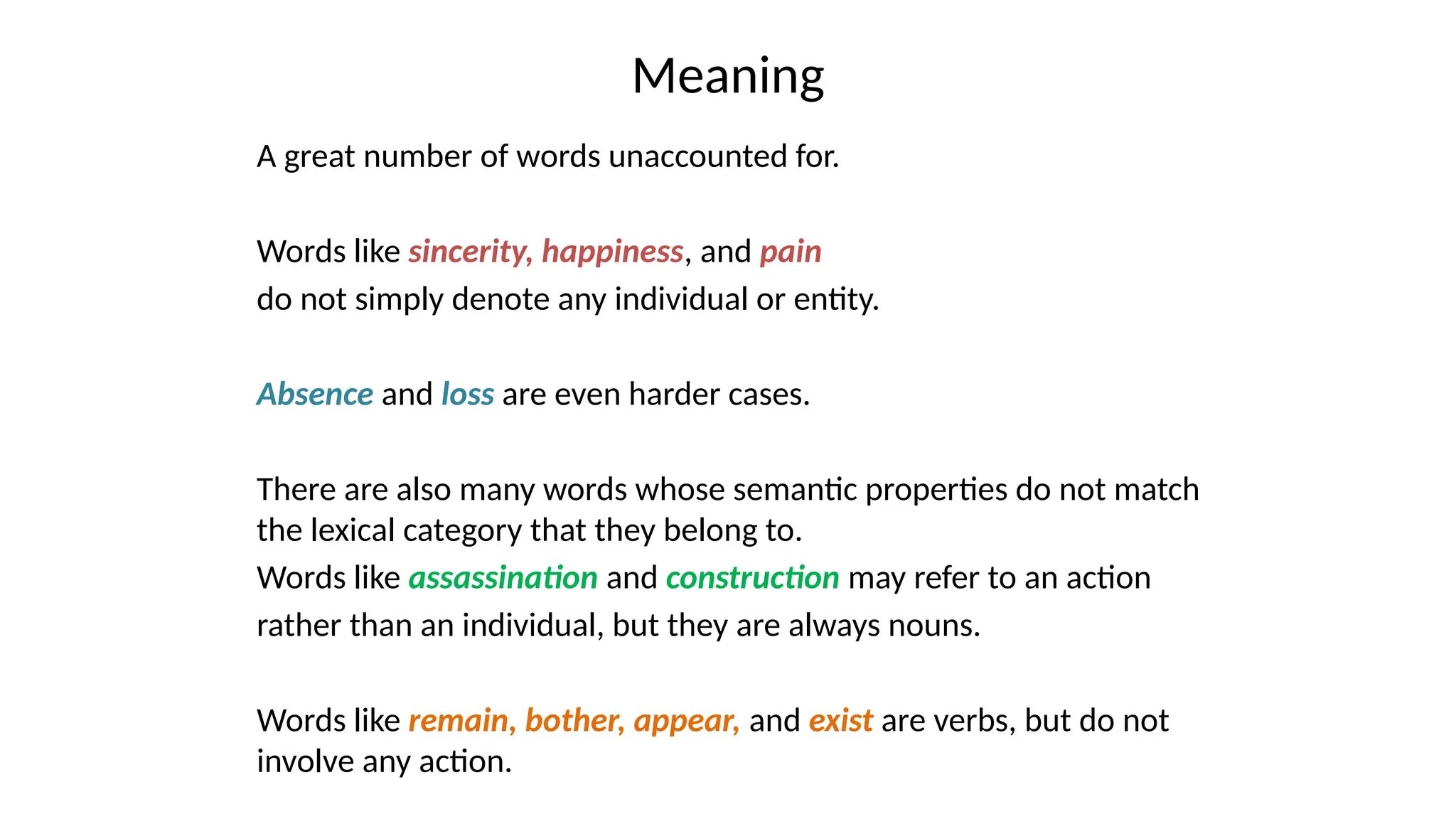
A great number of words unaccounted for.
Words like sincerity, happiness, and pain
do not simply denote any individual or entity.
Absence and loss are even harder cases.
There are also many words whose semantic properties do not match
the lexical category that they belong to.
Words like assassination and construction may refer to an action
rather than an individual, but they are always nouns.
Words like remain, bother, appear, and exist are verbs, but do not
involve any action.
Morphological Form
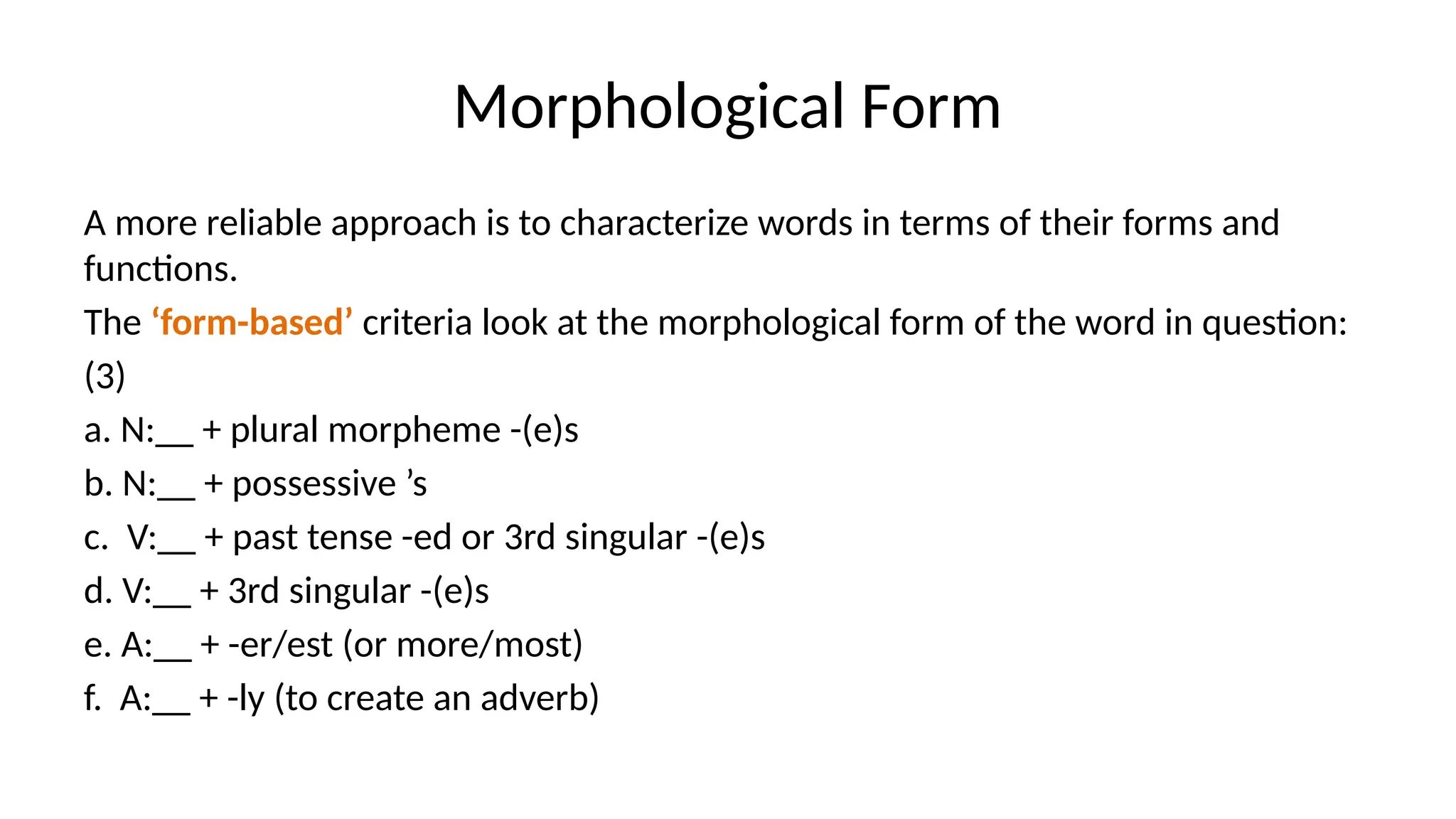
A more reliable approach is to characterize words in terms of their forms and
functions.
The ‘form-based’ criteria look at the morphological form of the word in question:
(3)
a. N:__ + plural morpheme -(e)s
b. N:__ + possessive ’s
c. V:__ + past tense -ed or 3rd singular -(e)s
d. V:__ + 3rd singular -(e)s
e. A:__ + -er/est (or more/most)
f. A:__ + -ly (to create an adverb)
Morphological Form
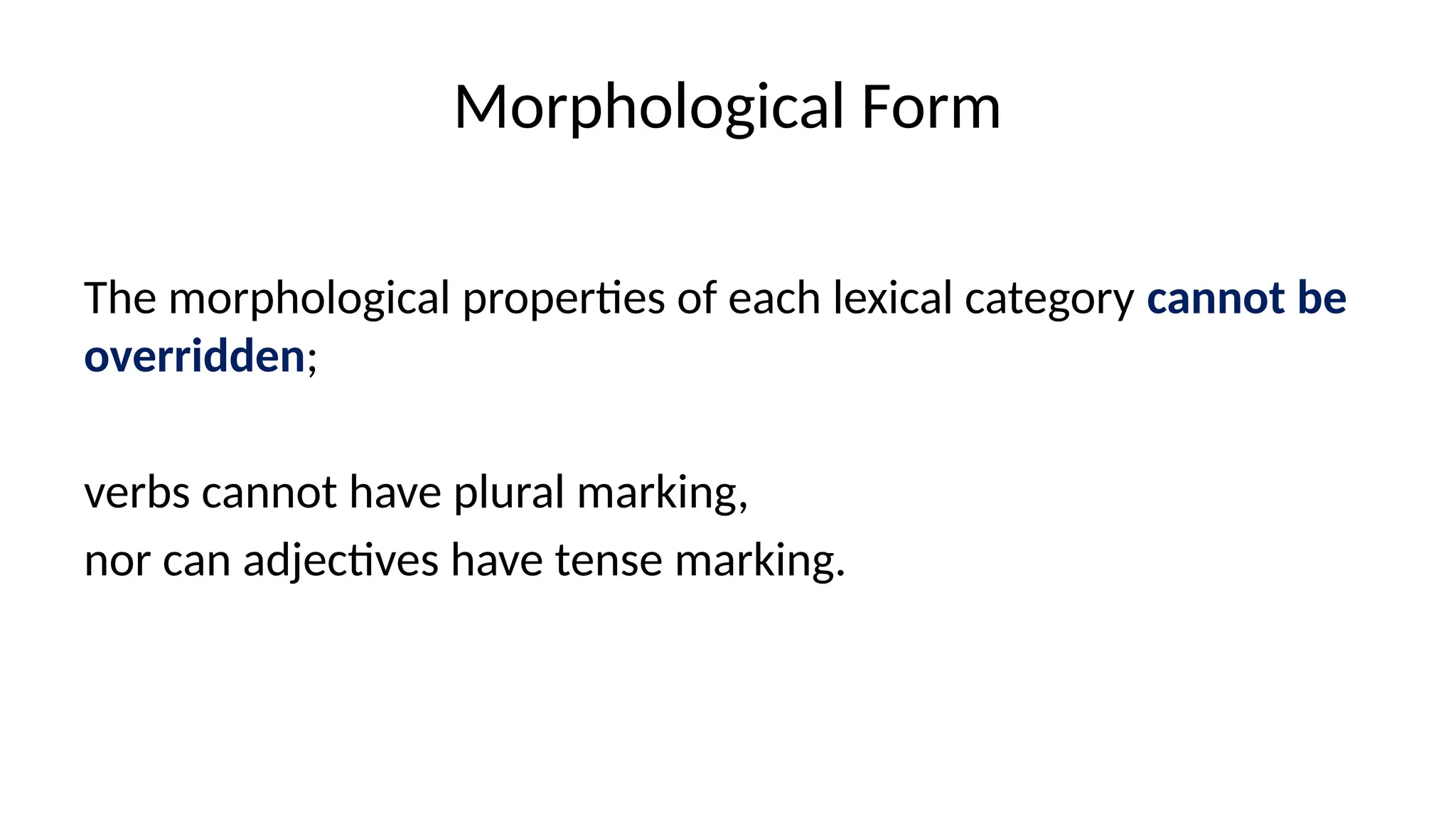
The morphological properties of each lexical category cannot be
overridden;
verbs cannot have plural marking,
nor can adjectives have tense marking.
Morphological Form
BUT
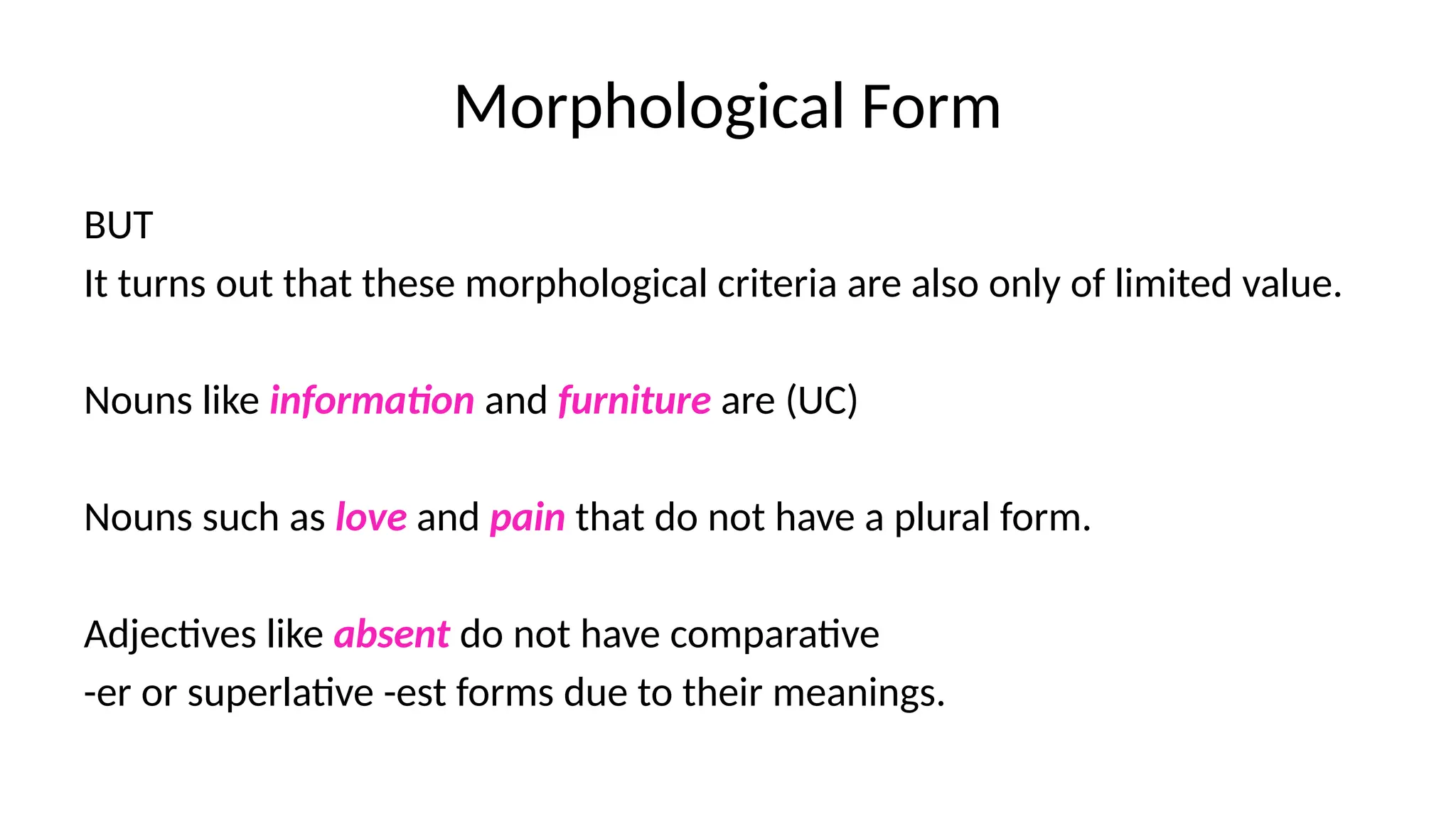
It turns out that these morphological criteria are also only of limited value.
Nouns like information and furniture are (UC)
Nouns such as love and pain that do not have a plural form.
Adjectives like absent do not have comparative
-er or superlative -est forms due to their meanings.
Morphological Form
CONCLUSION
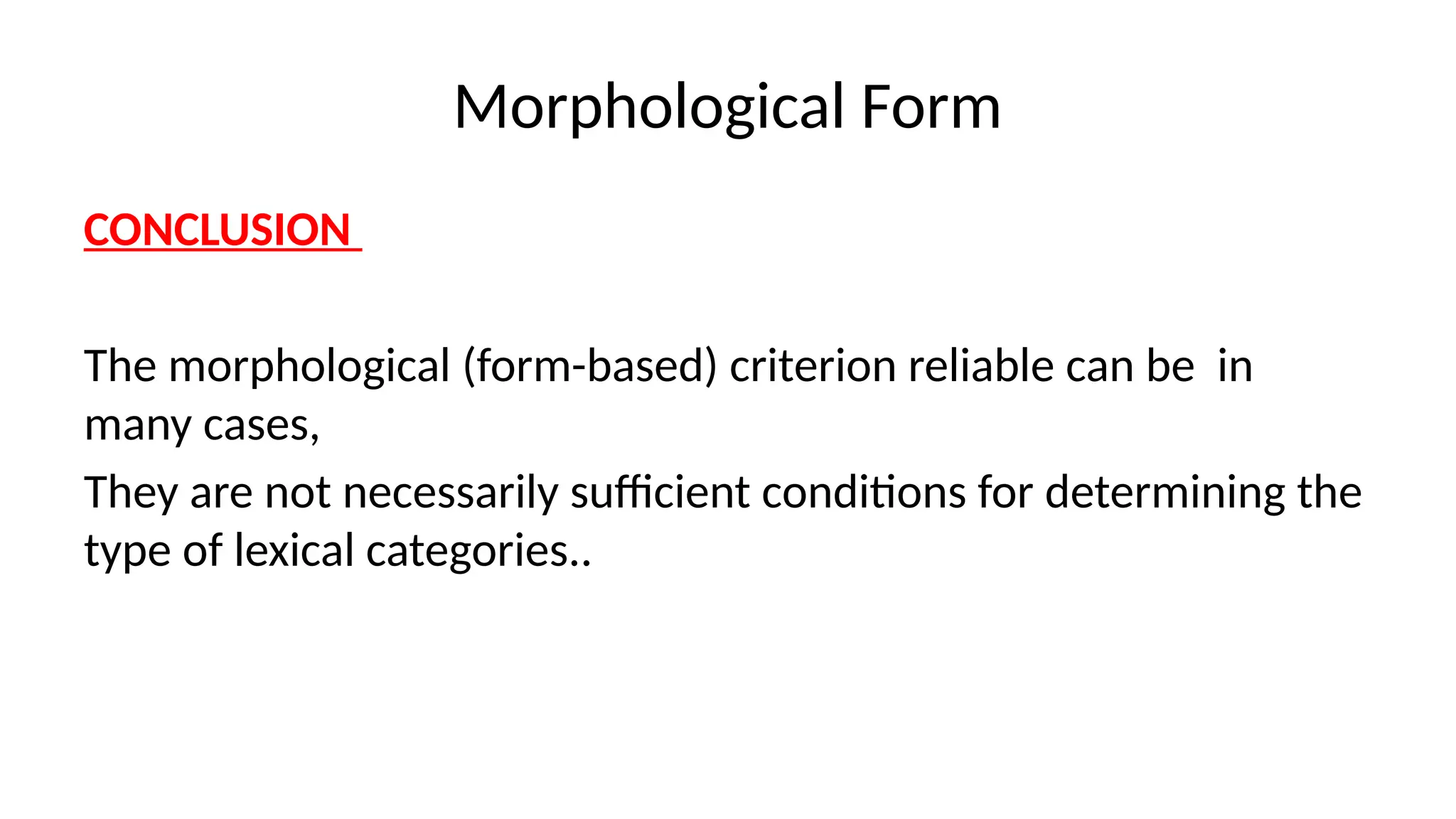
The morphological (form-based) criterion reliable can be in
many cases,
They are not necessarily sufficient conditions for determining the
type of lexical categories..
Function
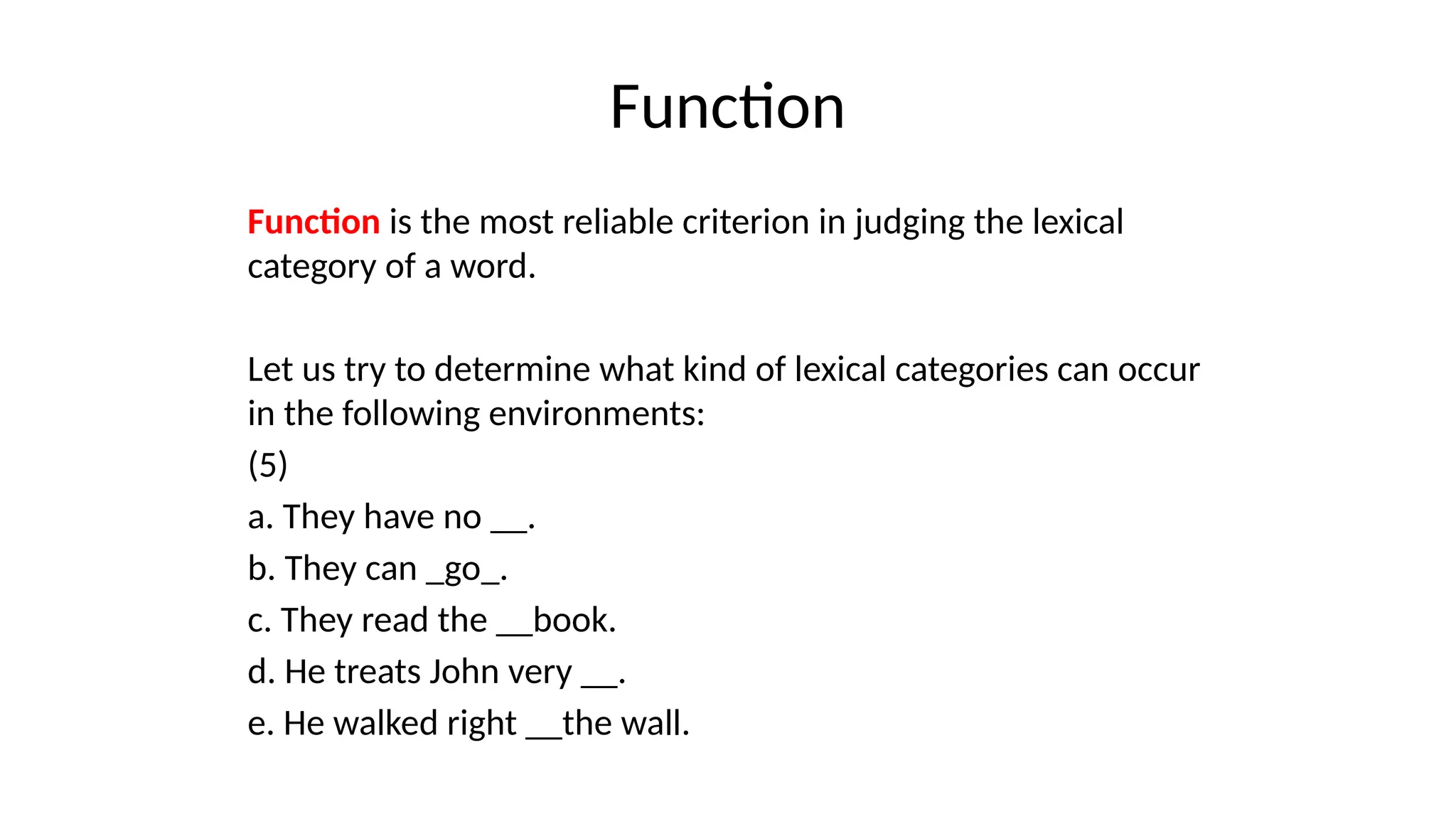
Function is the most reliable criterion in judging the lexical
category of a word.
Let us try to determine what kind of lexical categories can occur
in the following environments:
(5)
a. They have no __.
b. They can _go_.
c. They read the __book.
d. He treats John very __.
e. He walked right __the wall.
Function
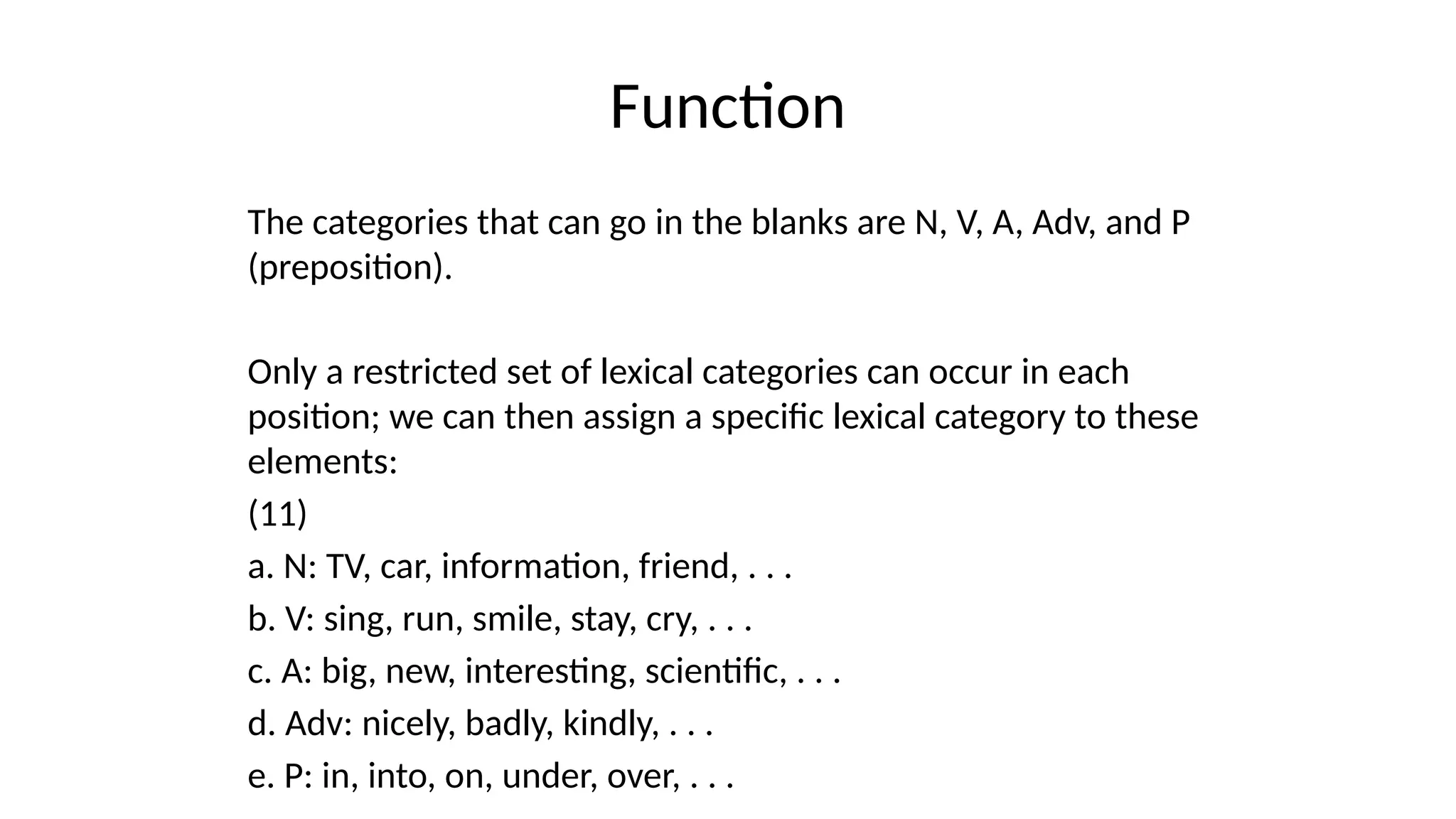
The categories that can go in the blanks are N, V, A, Adv, and P
(preposition).
Only a restricted set of lexical categories can occur in each
position; we can then assign a specific lexical category to these
elements:
(11)
a. N: TV, car, information, friend, . . .
b. V: sing, run, smile, stay, cry, . . .
c. A: big, new, interesting, scientific, . . .
d. Adv: nicely, badly, kindly, . . .
e. P: in, into, on, under, over, . . .
Function
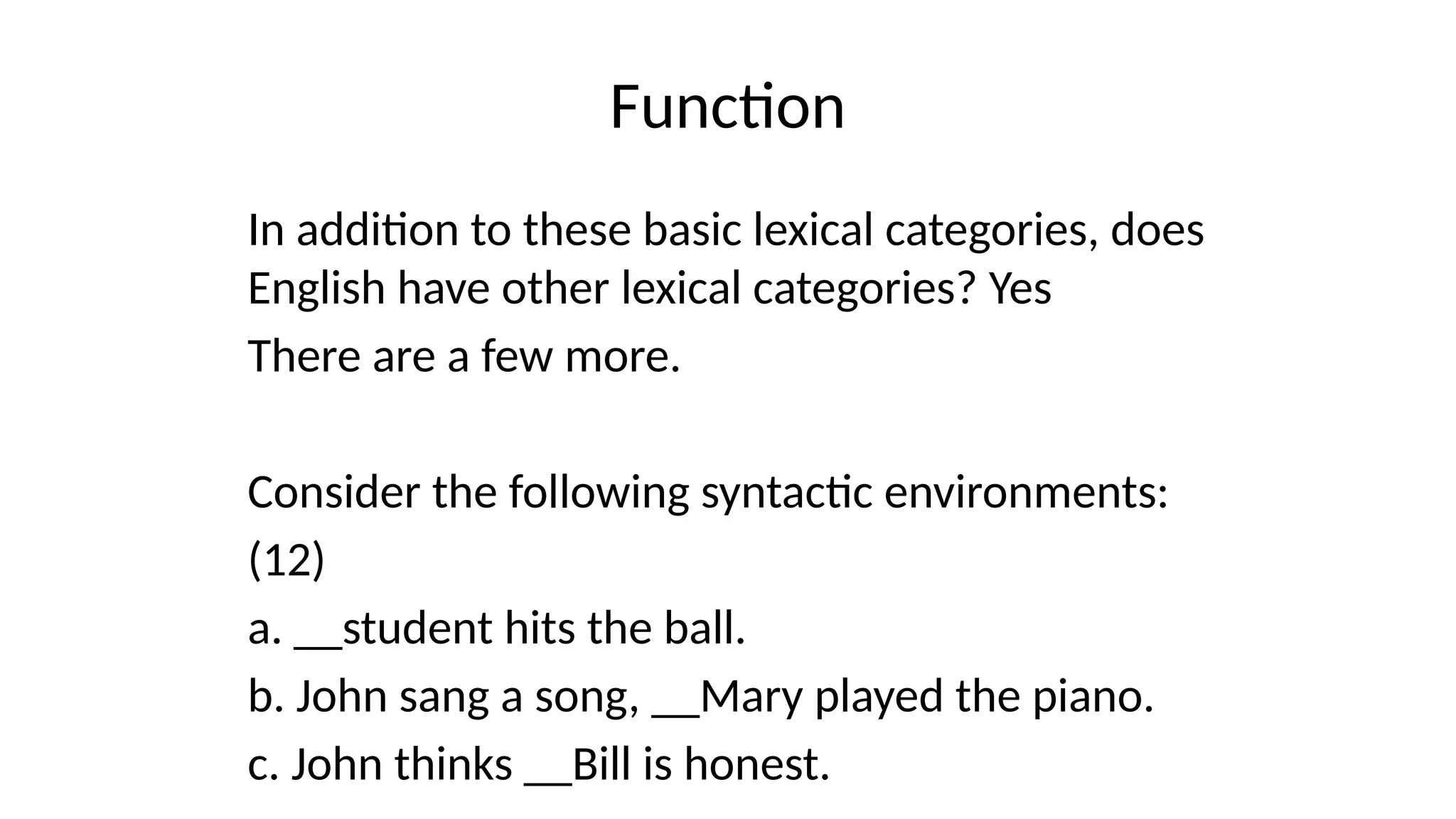
In addition to these basic lexical categories, does
English have other lexical categories? Yes
There are a few more.
Consider the following syntactic environments:
(12)
a. __student hits the ball.
b. John sang a song, __Mary played the piano.
c. John thinks __Bill is honest.
Function
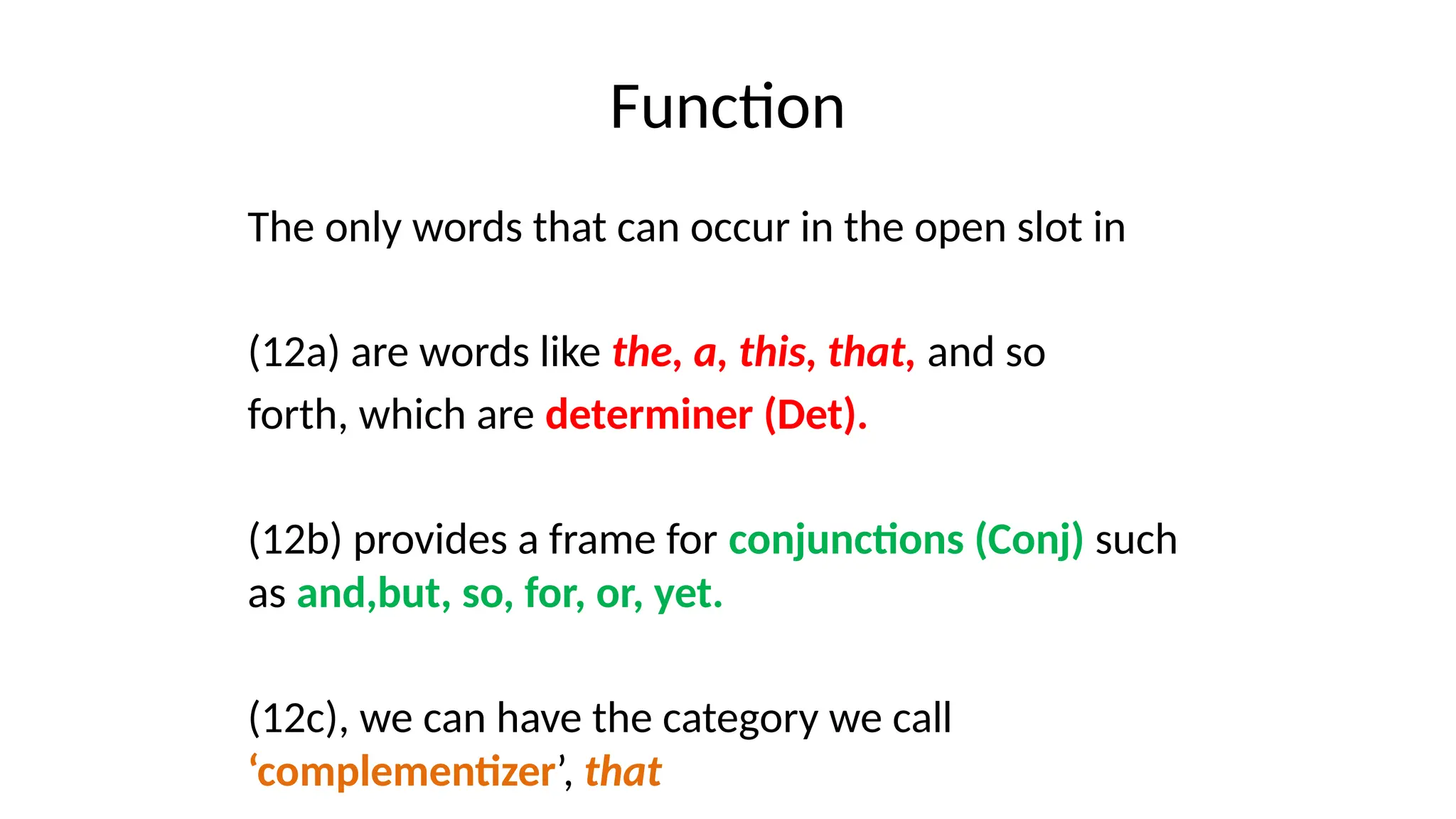
The only words that can occur in the open slot in
(12a) are words like the, a, this, that, and so
forth, which are determiner (Det).
(12b) provides a frame for conjunctions (Conj) such
as and,but, so, for, or, yet.
(12c), we can have the category we call
‘complementizer’, that
Function
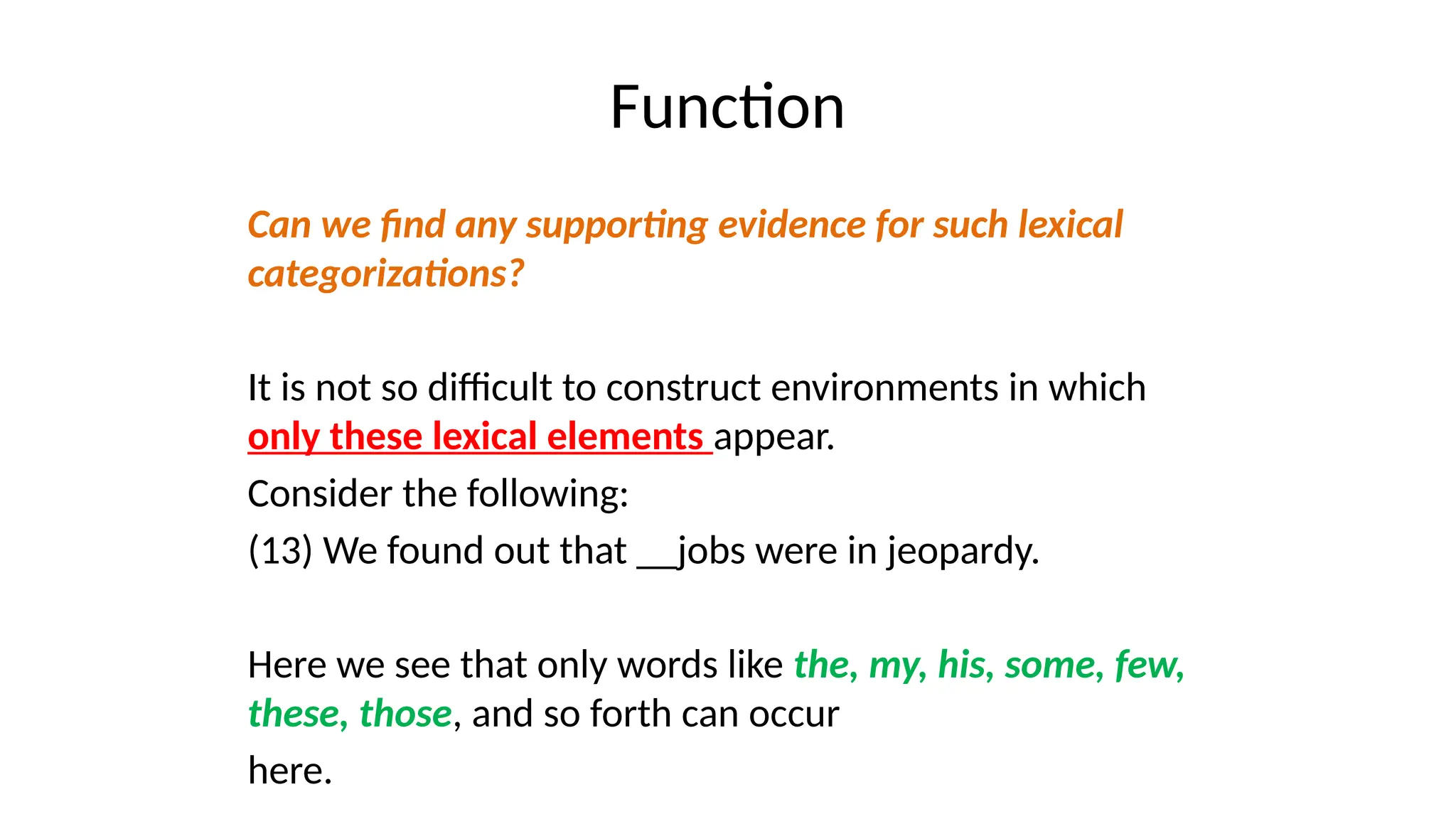
Can we find any supporting evidence for such lexical
categorizations?
It is not so difficult to construct environments in which
only these lexical elements appear.
Consider the following:
(13) We found out that __jobs were in jeopardy.
Here we see that only words like the, my, his, some, few,
these, those, and so forth can occur
here.
Function
Determiners
These articles, possessives, quantifiers, and demonstratives all
‘determine’ the referential
properties of jobs here, and for this reason.
They cannot occupy the same position (or occur together) at the
same time:
(14)
a. *[My these jobs] are in jeopardy.
b. *[Some my jobs] are in jeopardy.
c. *[The his jobs] are in jeopardy.
They compete with each other for just one structural position.
Function
Once again, the possible words that can occur in the specific slot
in (16) are strictly limited.
(16)
a. I think that [learning English is not all that easy].
b. I doubt if [you can help me in understanding this].
c. I am anxious for [you to study English grammar hard].
- The italicized words introduce a complement clause.
- They may be sensitive to the tense of that clause.
that and if introduce tensed clause (finite clause) (present or
past tense).
for requires an infinitival clause marked with to.
Function
We cannot disturb these relationships:
(17)
a. *I think that [learning English to be not all that easy].
b. *I doubt if [you to help me in understanding this].
c. *I am anxious for [you should study English grammar hard].
A ‘complement’ refers to an obligatory dependent clause or
phrase relative to a head.
The italicized elements in (17) introduce a clausal complement
and are consequently know as ‘complementizers’ (abbreviated
as ‘C’).
There are only a few complementizers in English (that,
for, if , and whether),
Function
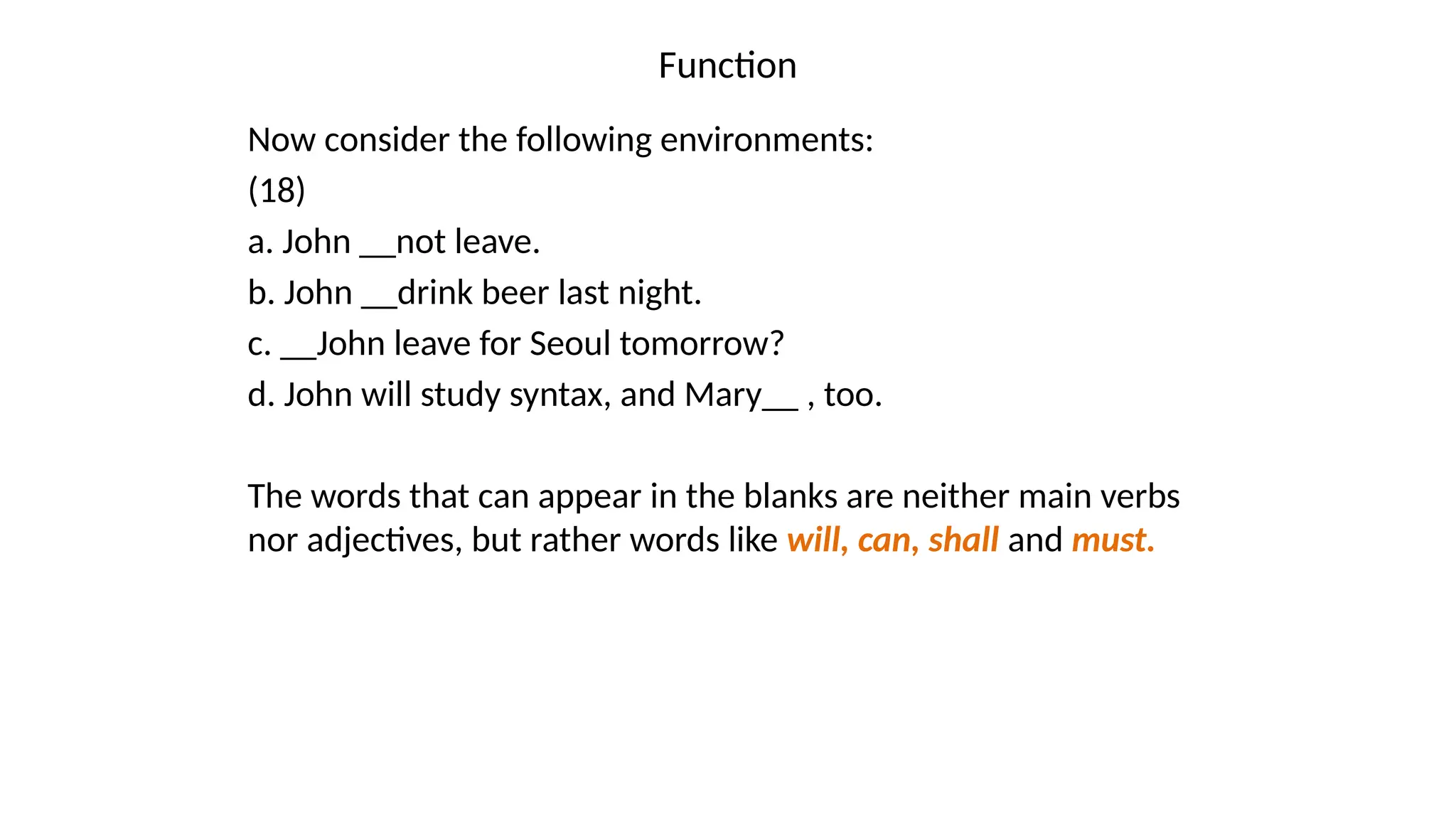
Now consider the following environments:
(18)
a. John __not leave.
b. John __drink beer last night.
c. __John leave for Seoul tomorrow?
d. John will study syntax, and Mary__ , too.
The words that can appear in the blanks are neither main verbs
nor adjectives, but rather words like will, can, shall and must.
Function
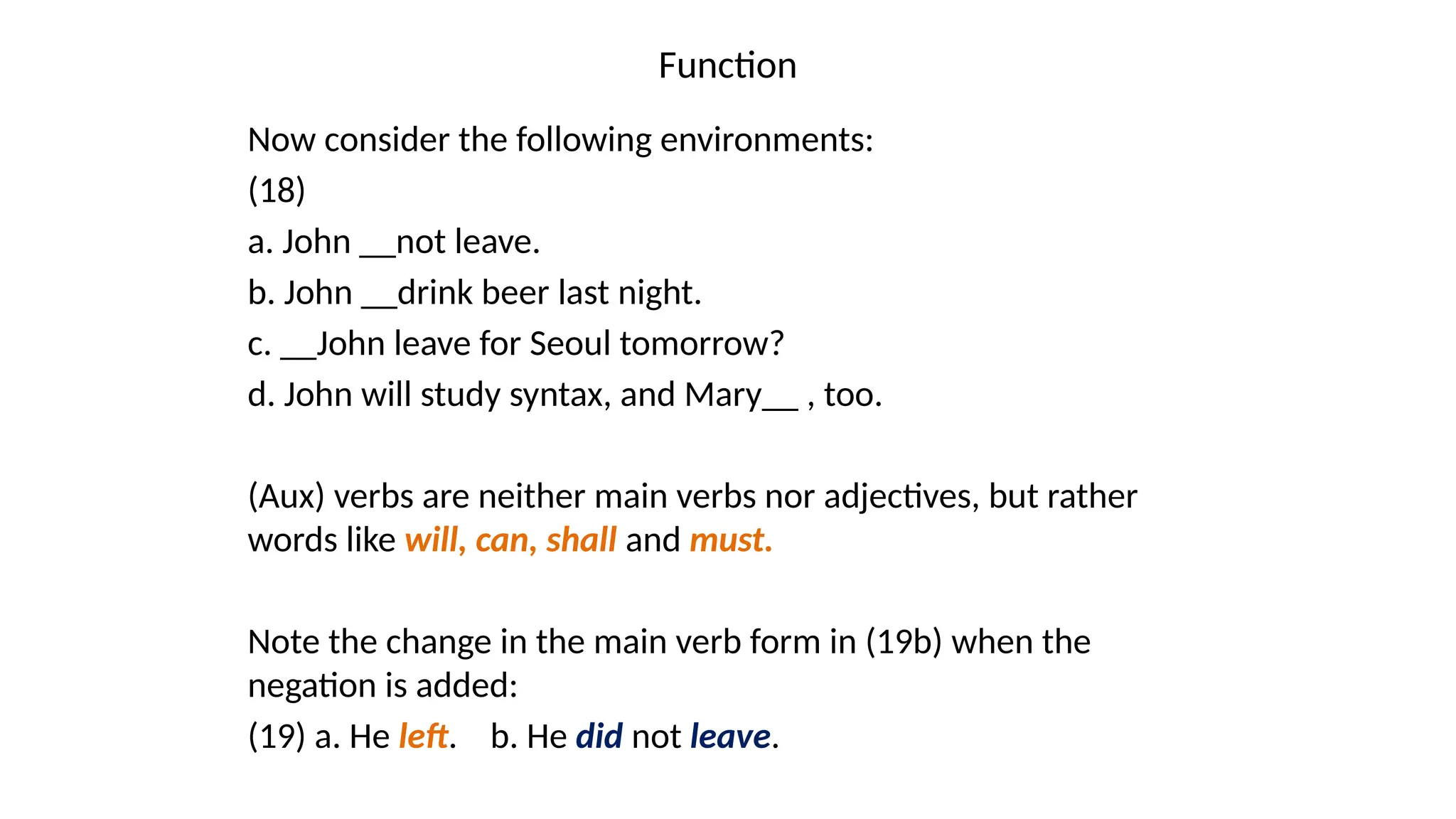
Now consider the following environments:
(18)
a. John __not leave.
b. John __drink beer last night.
c. __John leave for Seoul tomorrow?
d. John will study syntax, and Mary__ , too.
(Aux) verbs are neither main verbs nor adjectives, but rather
words like will, can, shall and must.
Note the change in the main verb form in (19b) when the
negation is added:
(19) a. He left. b. He did not leave.
Function to
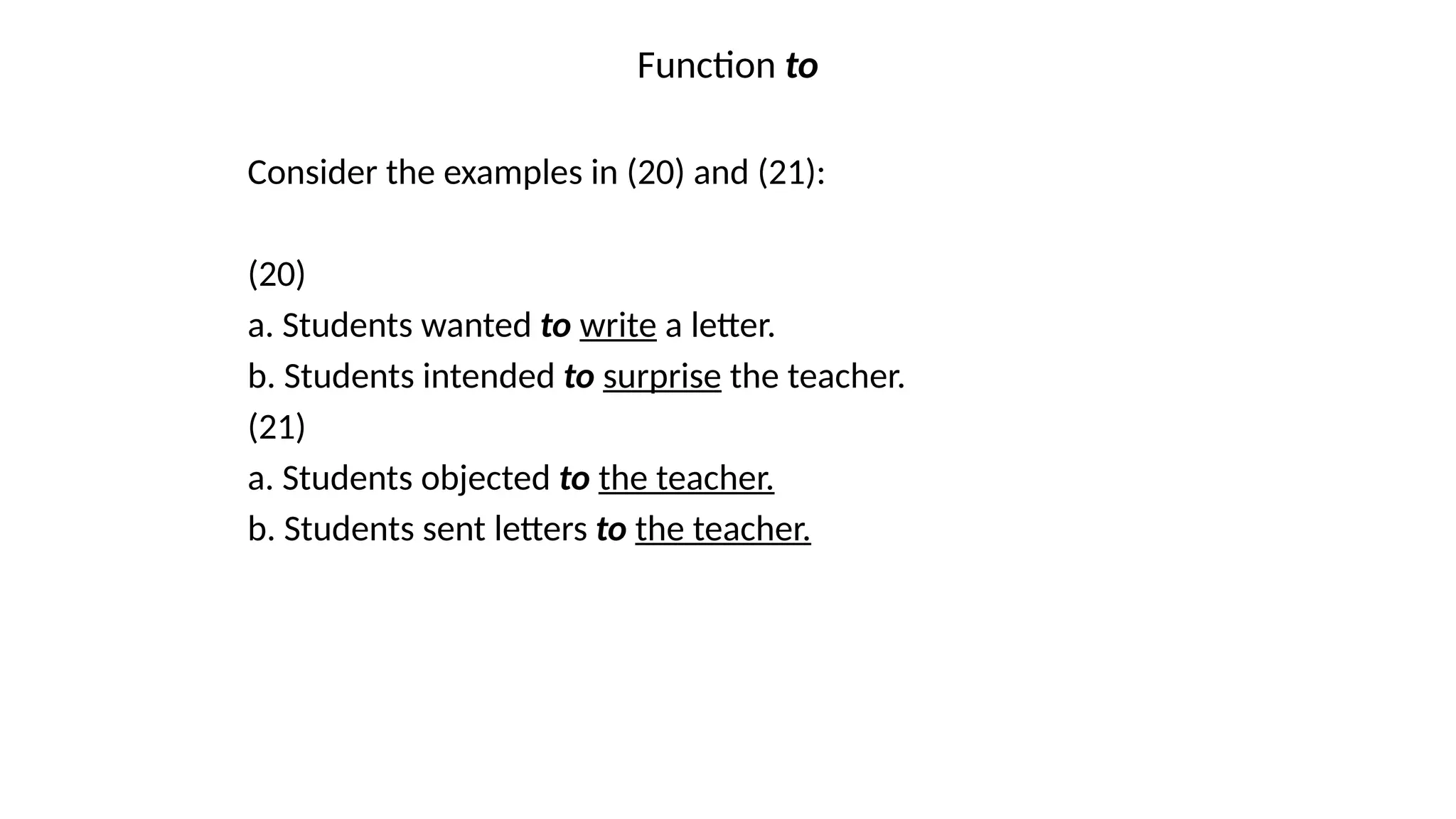
Consider the examples in (20) and (21):
(20)
a. Students wanted to write a letter.
b. Students intended to surprise the teacher.
(21)
a. Students objected to the teacher.
b. Students sent letters to the teacher.
Function to
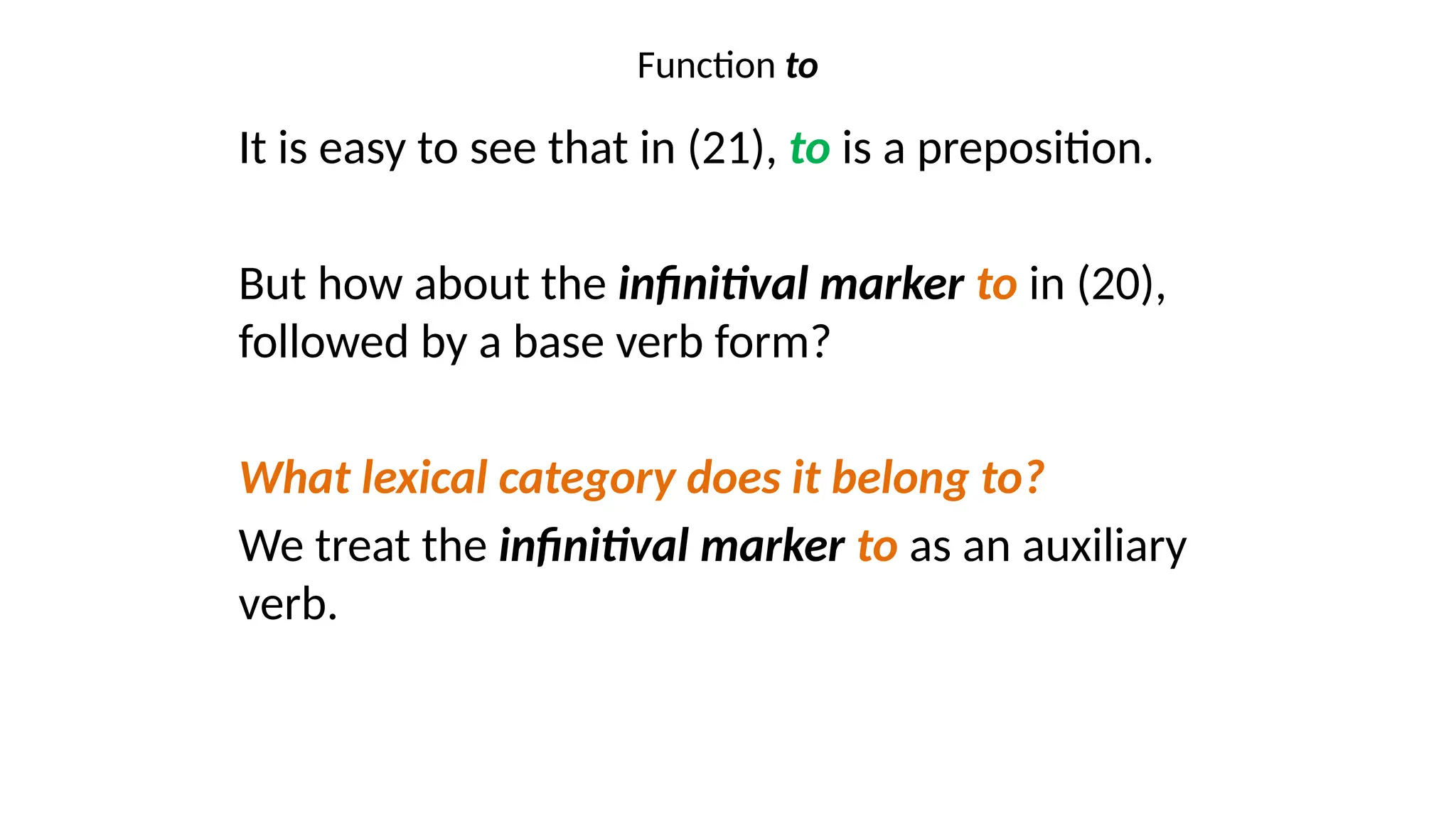
It is easy to see that in (21), to is a preposition.
But how about the infinitival marker to in (20),
followed by a base verb form?
What lexical category does it belong to?
We treat the infinitival marker to as an auxiliary
verb.
Function to
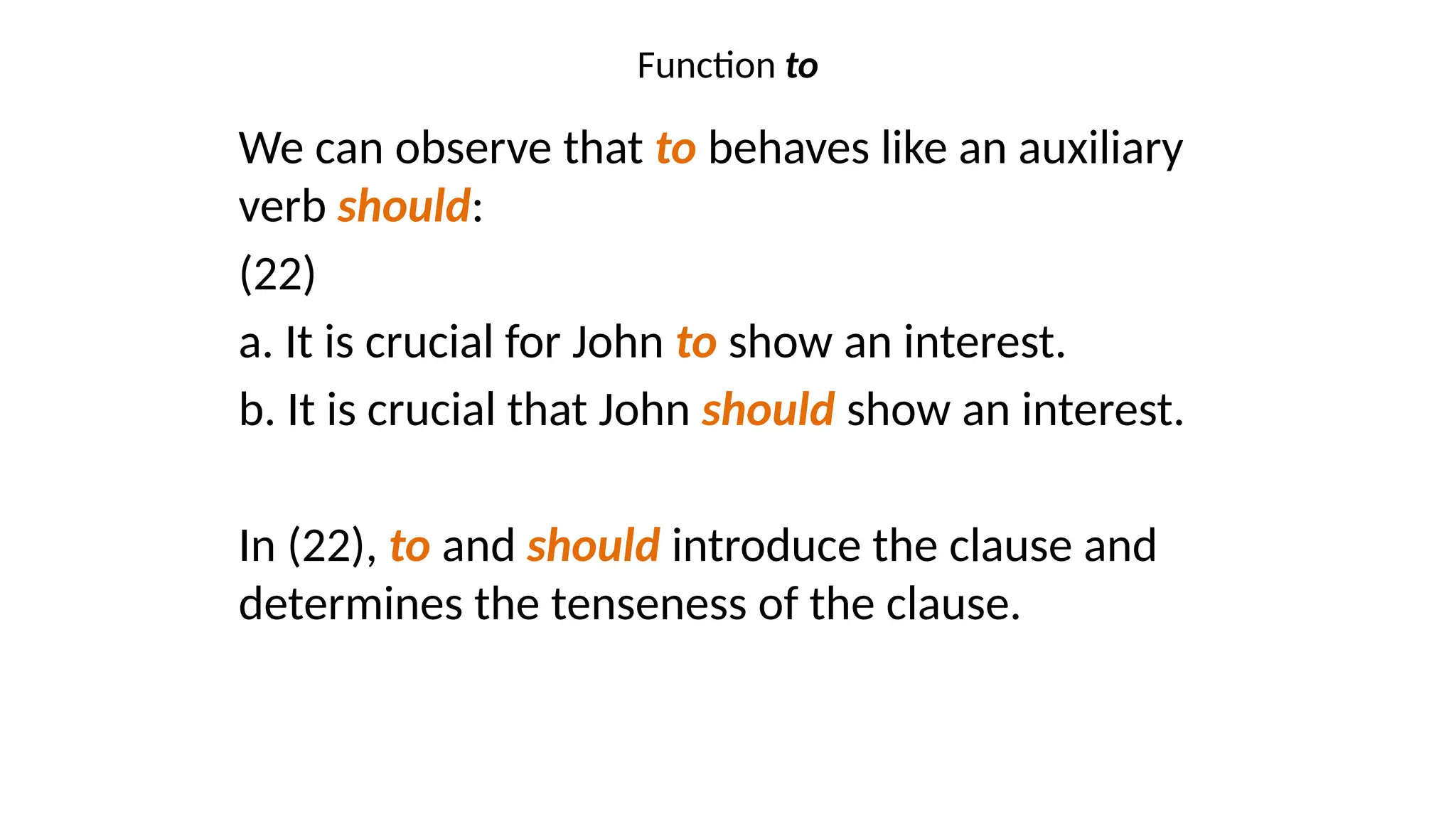
We can observe that to behaves like an auxiliary
verb should:
(22)
a. It is crucial for John to show an interest.
b. It is crucial that John should show an interest.
In (22), to and should introduce the clause and
determines the tenseness of the clause.
Function
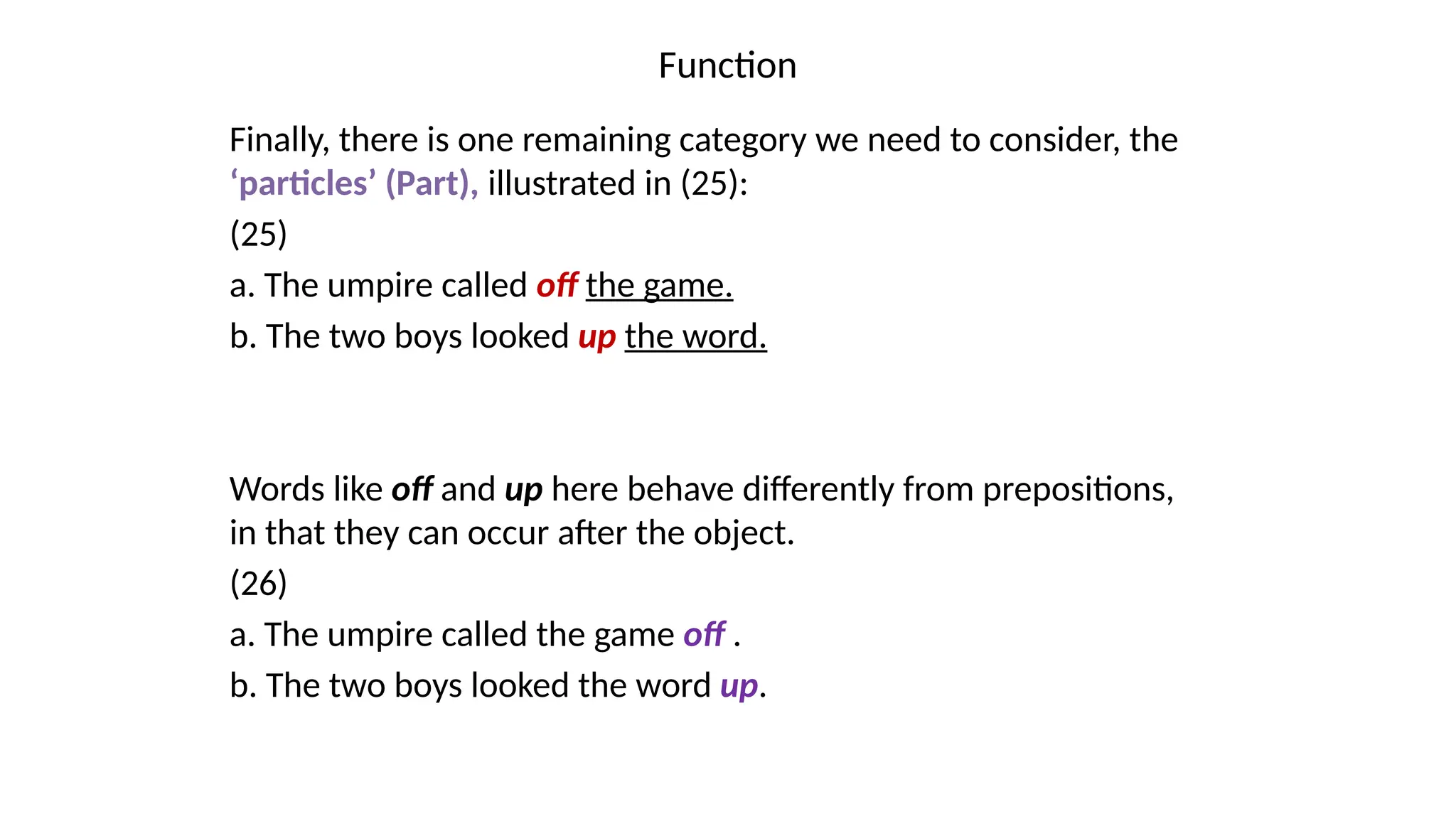
Finally, there is one remaining category we need to consider, the
‘particles’ (Part), illustrated in (25):
(25)
a. The umpire called off the game.
b. The two boys looked up the word.
Words like off and up here behave differently from prepositions,
in that they can occur after the object.
(26)
a. The umpire called the game off .
b. The two boys looked the word up.
Function
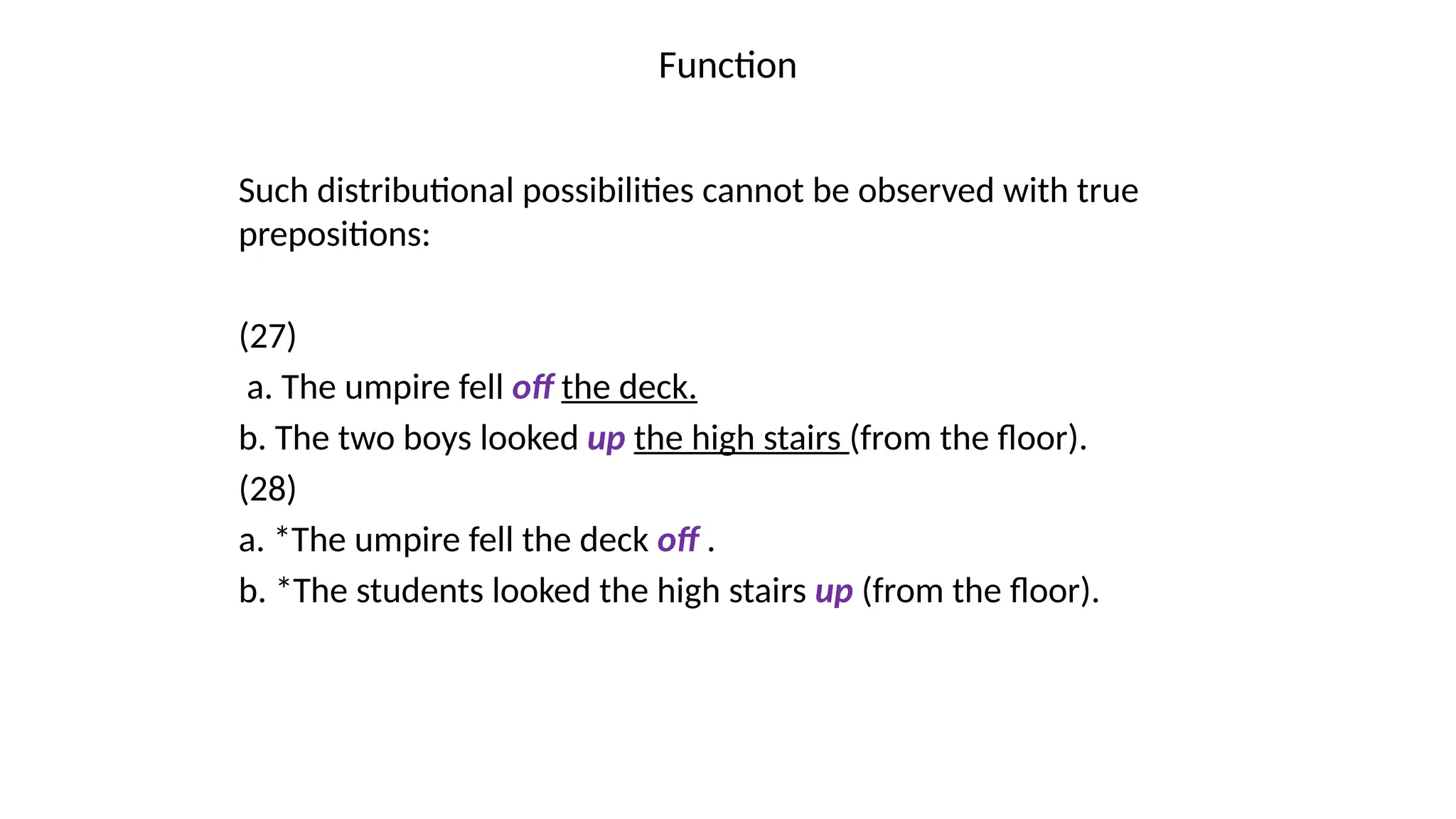
Such distributional possibilities cannot be observed with true
prepositions:
(27)
a. The umpire fell off the deck.
b. The two boys looked up the high stairs (from the floor).
(28)
a. *The umpire fell the deck off .
b. *The students looked the high stairs up (from the floor).
Function
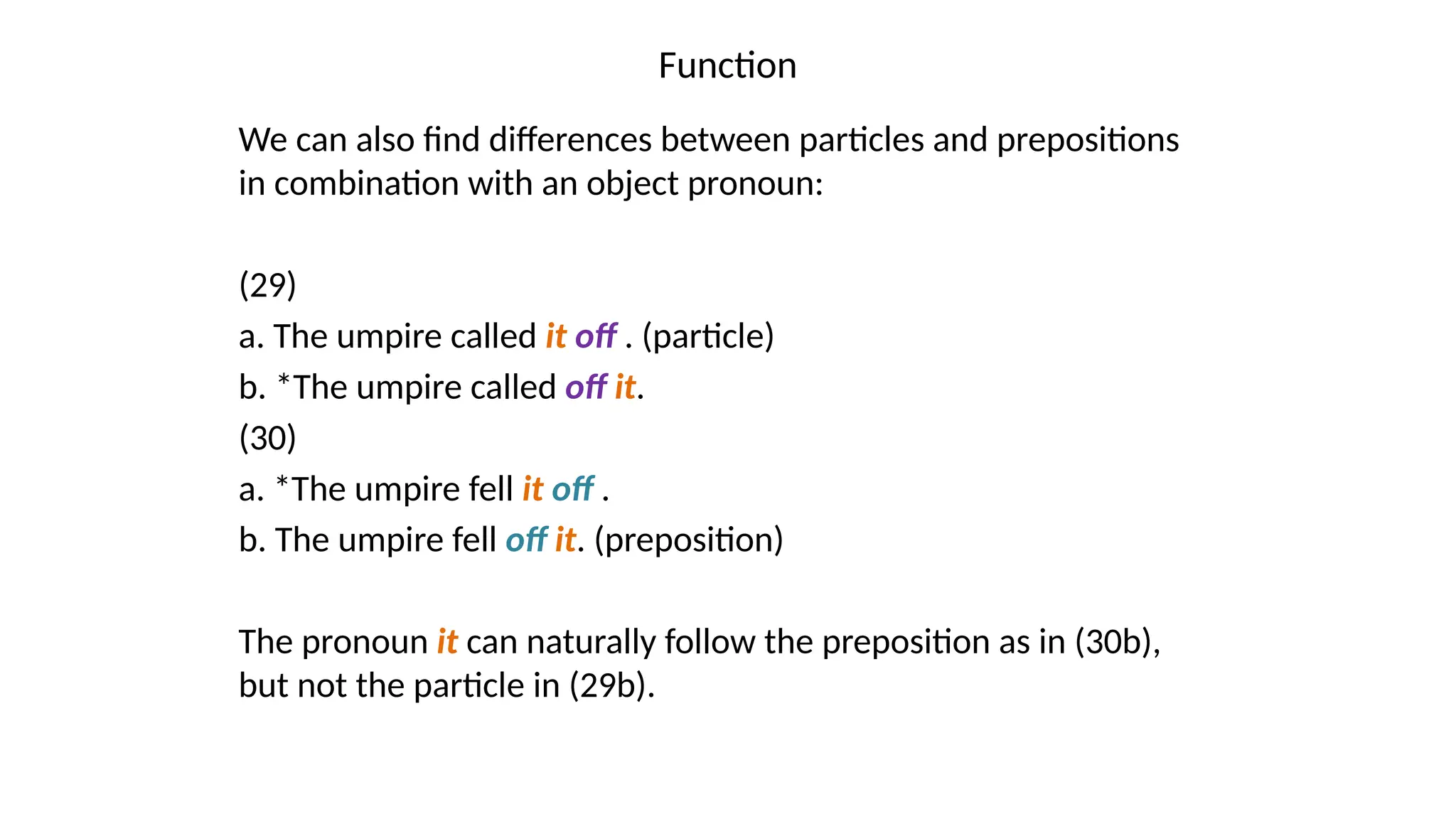
We can also find differences between particles and prepositions
in combination with an object pronoun:
(29)
a. The umpire called it off . (particle)
b. *The umpire called off it.
(30)
a. *The umpire fell it off .
b. The umpire fell off it. (preposition)
The pronoun it can naturally follow the preposition as in (30b),
but not the particle in (29b).
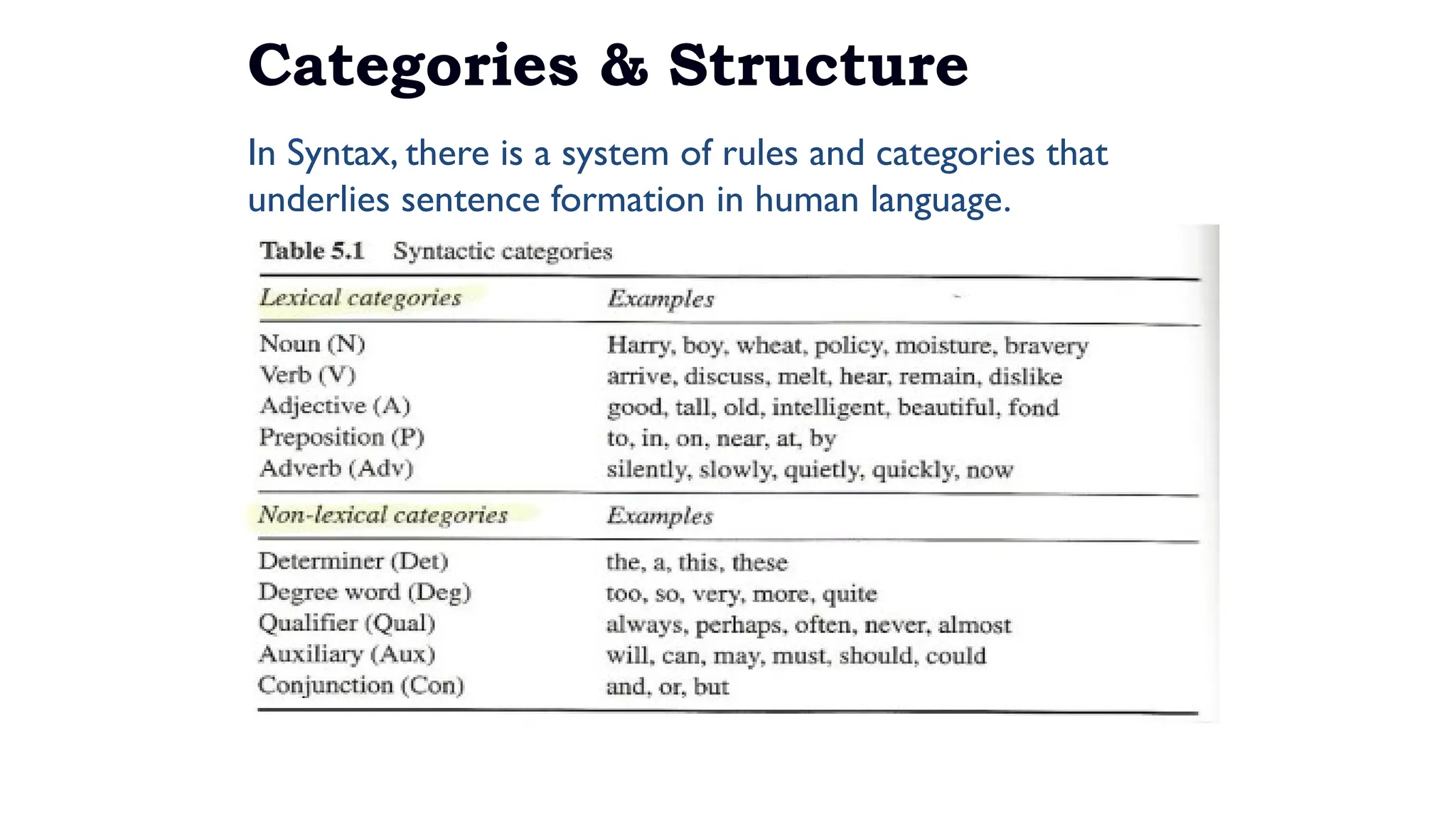
Categories & Structure
In Syntax, there is a system of rules and categories that
underlies sentence formation in human language.
2.2.2 Content vs. function words
The lexical categories can be classified
into:
Content words are those with
substantive semantic contents
Function words are those primarily
serving to carry grammatical
information.
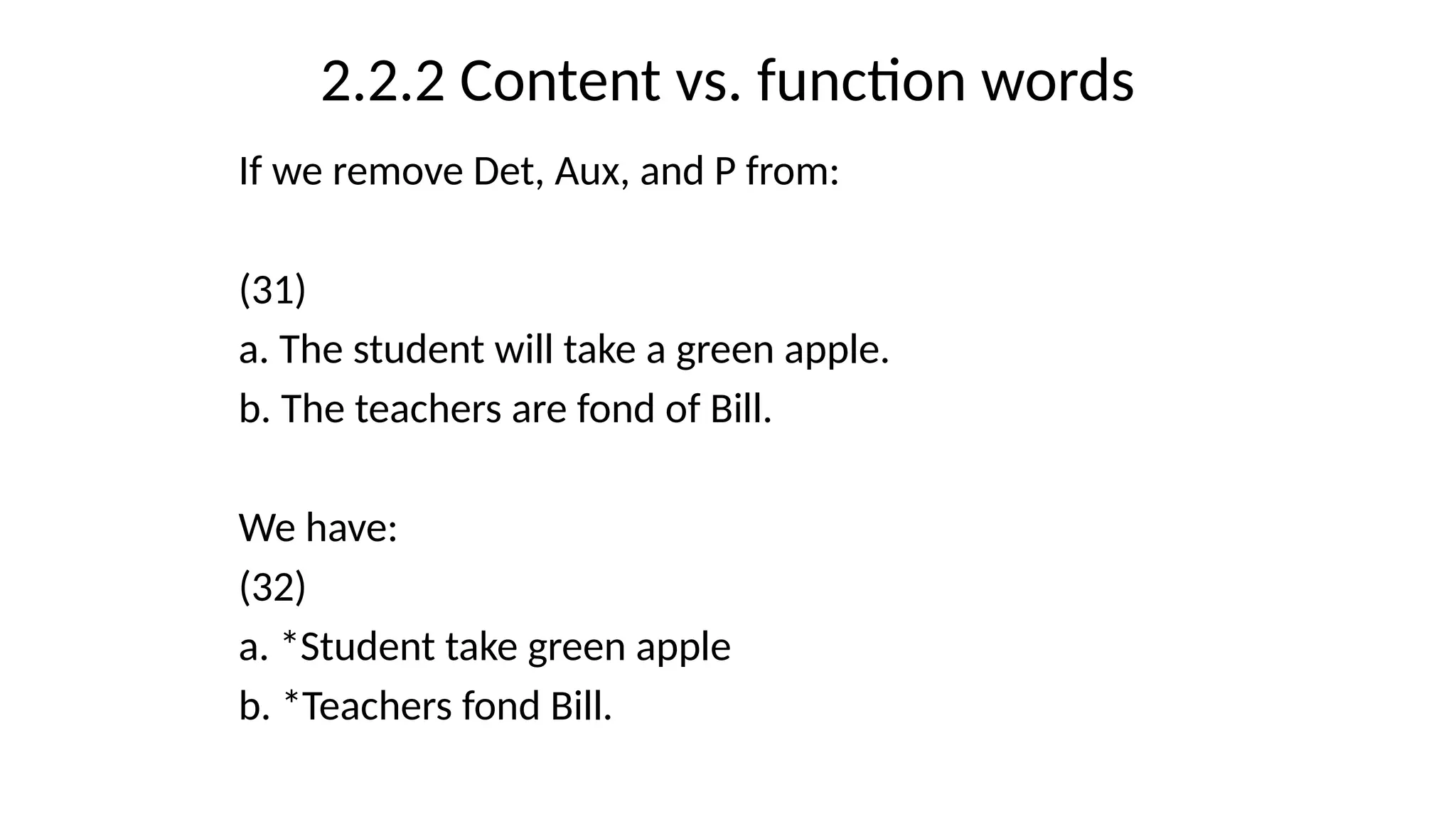
2.2.2 Content vs. function words
If we remove Det, Aux, and P from:
(31)
a. The student will take a green apple.
b. The teachers are fond of Bill.
We have:
(32)
a. *Student take green apple
b. *Teachers fond Bill.
2.2.2 Content vs. function words
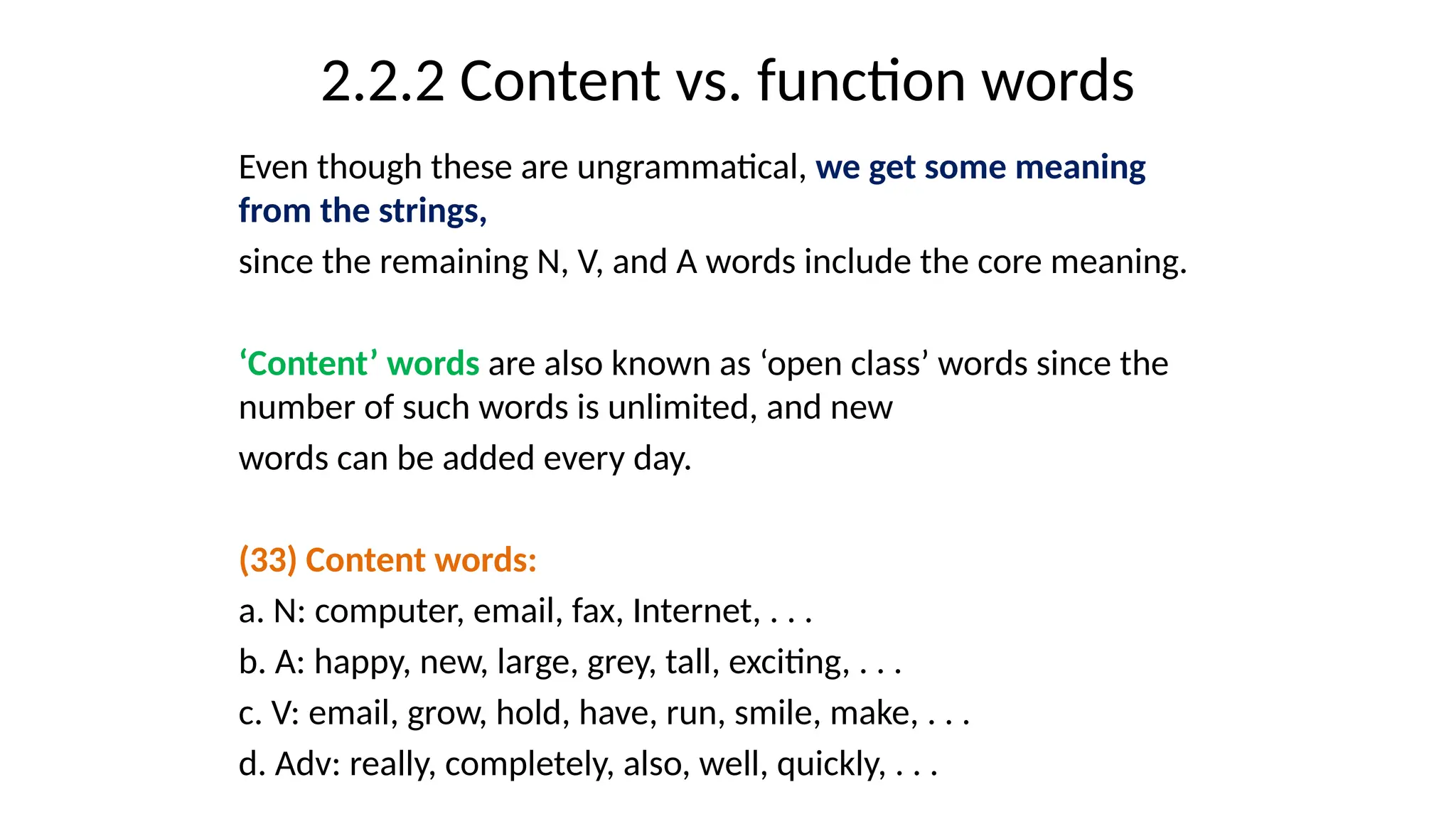
Even though these are ungrammatical, we get some meaning
from the strings,
since the remaining N, V, and A words include the core meaning.
‘Content’ words are also known as ‘open class’ words since the
number of such words is unlimited, and new
words can be added every day.
(33) Content words:
a. N: computer, email, fax, Internet, . . .
b. A: happy, new, large, grey, tall, exciting, . . .
c. V: email, grow, hold, have, run, smile, make, . . .
d. Adv: really, completely, also, well, quickly, . . .
2.2.2 Content vs. function words
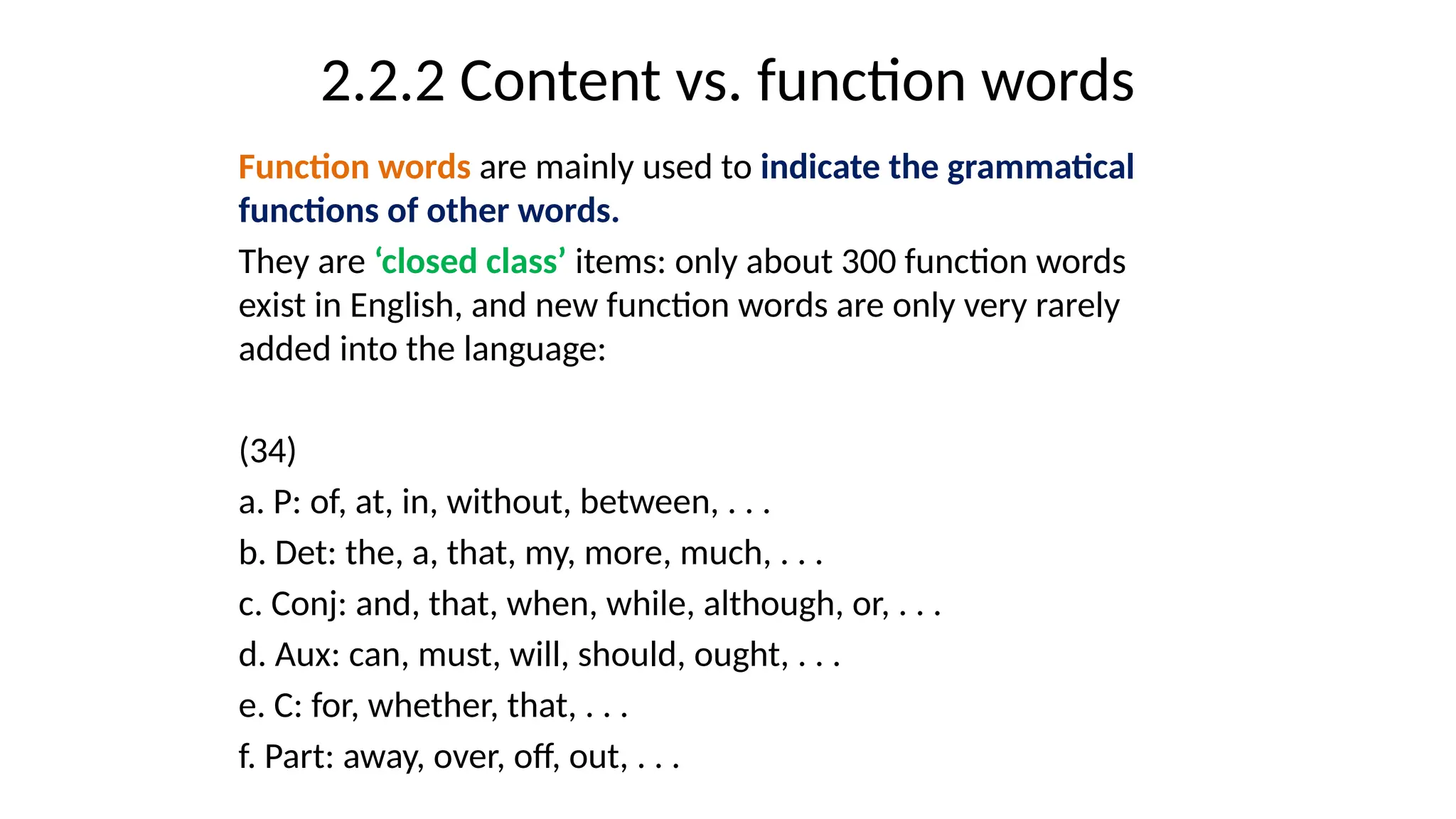
Function words are mainly used to indicate the grammatical
functions of other words.
They are ‘closed class’ items: only about 300 function words
exist in English, and new function words are only very rarely
added into the language:
(34)
a. P: of, at, in, without, between, . . .
b. Det: the, a, that, my, more, much, . . .
c. Conj: and, that, when, while, although, or, . . .
d. Aux: can, must, will, should, ought, . . .
e. C: for, whether, that, . . .
f. Part: away, over, off, out, . . .

Syntax and Phrase: From Words to Major Phrase Types.pptx

  • 1.
    From Words toMajor Phrase Types Faiz Rizki Muhammad
  • 2.
    Syntax Syntax is thestudy of rules which generate an infinite number of grammatical sentences. The main goal of syntax is building a grammar that can generate an infinite set of well-formed, grammatical English sentences. Forming grammatical sentences Words (lexical categories)  Phrases  Clauses  Sentences Words, or ‘lexical’ categories. These lexical categories then form a larger constituent ‘phrase’ Phrases go together to form a ‘clause’. A clause either is, or is part of, a well-formed sentence.
  • 3.
    A ‘clause’ refersto a complete sentence-like unit, but which may be part of another clause, as a subordinate or adverbial clause. Each of the sentences in (1b)–(1d) contains more than one clause, in particular, with one clause embedded inside another: (1) a. The weather is lovely today. b. I am hoping [that the weather is lovely today]. c. [If the weather is lovely today] then we will go out. d. The birds are singing [because the weather is lovely today].
  • 4.
    2.2 Lexical Categories Thebasic units of syntax are words. BUT What kinds of words (also known as parts of speech, or lexical categories, or grammatical categories) does English have? Are they simply noun, verb, adjective, adverb, preposition, and maybe a few others?
  • 5.
    2.2 Lexical Categories Mostof us would not be able to come up with simple definitions to explain the categorization of words. For instance, why do we categorize book as a noun, but kick as a verb? To make it more difficult, How do we know that virtue is a noun, that without is a preposition, and that well is an adverb (in one meaning)?
  • 6.
    2.2.1 Determining theLexical Categories Words can be classified into different lexical categories according to three criteria: meaning, morphological form, and syntactic function (distribution).
  • 7.
    Meaning We could havethe following rough semantic criteria for (2) a. N: referring to an individual or entity b. V: referring to an action c. A: referring to a property d. Adv: referring to the manner, location, time or frequency of an action
  • 8.
    Meaning A great numberof words unaccounted for. Words like sincerity, happiness, and pain do not simply denote any individual or entity. Absence and loss are even harder cases. There are also many words whose semantic properties do not match the lexical category that they belong to. Words like assassination and construction may refer to an action rather than an individual, but they are always nouns. Words like remain, bother, appear, and exist are verbs, but do not involve any action.
  • 9.
    Morphological Form A morereliable approach is to characterize words in terms of their forms and functions. The ‘form-based’ criteria look at the morphological form of the word in question: (3) a. N:__ + plural morpheme -(e)s b. N:__ + possessive ’s c. V:__ + past tense -ed or 3rd singular -(e)s d. V:__ + 3rd singular -(e)s e. A:__ + -er/est (or more/most) f. A:__ + -ly (to create an adverb)
  • 10.
    Morphological Form The morphologicalproperties of each lexical category cannot be overridden; verbs cannot have plural marking, nor can adjectives have tense marking.
  • 11.
    Morphological Form BUT It turnsout that these morphological criteria are also only of limited value. Nouns like information and furniture are (UC) Nouns such as love and pain that do not have a plural form. Adjectives like absent do not have comparative -er or superlative -est forms due to their meanings.
  • 12.
    Morphological Form CONCLUSION The morphological(form-based) criterion reliable can be in many cases, They are not necessarily sufficient conditions for determining the type of lexical categories..
  • 13.
    Function Function is themost reliable criterion in judging the lexical category of a word. Let us try to determine what kind of lexical categories can occur in the following environments: (5) a. They have no __. b. They can _go_. c. They read the __book. d. He treats John very __. e. He walked right __the wall.
  • 14.
    Function The categories thatcan go in the blanks are N, V, A, Adv, and P (preposition). Only a restricted set of lexical categories can occur in each position; we can then assign a specific lexical category to these elements: (11) a. N: TV, car, information, friend, . . . b. V: sing, run, smile, stay, cry, . . . c. A: big, new, interesting, scientific, . . . d. Adv: nicely, badly, kindly, . . . e. P: in, into, on, under, over, . . .
  • 15.
    Function In addition tothese basic lexical categories, does English have other lexical categories? Yes There are a few more. Consider the following syntactic environments: (12) a. __student hits the ball. b. John sang a song, __Mary played the piano. c. John thinks __Bill is honest.
  • 16.
    Function The only wordsthat can occur in the open slot in (12a) are words like the, a, this, that, and so forth, which are determiner (Det). (12b) provides a frame for conjunctions (Conj) such as and,but, so, for, or, yet. (12c), we can have the category we call ‘complementizer’, that
  • 17.
    Function Can we findany supporting evidence for such lexical categorizations? It is not so difficult to construct environments in which only these lexical elements appear. Consider the following: (13) We found out that __jobs were in jeopardy. Here we see that only words like the, my, his, some, few, these, those, and so forth can occur here.
  • 18.
    Function Determiners These articles, possessives,quantifiers, and demonstratives all ‘determine’ the referential properties of jobs here, and for this reason. They cannot occupy the same position (or occur together) at the same time: (14) a. *[My these jobs] are in jeopardy. b. *[Some my jobs] are in jeopardy. c. *[The his jobs] are in jeopardy. They compete with each other for just one structural position.
  • 19.
    Function Once again, thepossible words that can occur in the specific slot in (16) are strictly limited. (16) a. I think that [learning English is not all that easy]. b. I doubt if [you can help me in understanding this]. c. I am anxious for [you to study English grammar hard]. - The italicized words introduce a complement clause. - They may be sensitive to the tense of that clause. that and if introduce tensed clause (finite clause) (present or past tense). for requires an infinitival clause marked with to.
  • 20.
    Function We cannot disturbthese relationships: (17) a. *I think that [learning English to be not all that easy]. b. *I doubt if [you to help me in understanding this]. c. *I am anxious for [you should study English grammar hard]. A ‘complement’ refers to an obligatory dependent clause or phrase relative to a head. The italicized elements in (17) introduce a clausal complement and are consequently know as ‘complementizers’ (abbreviated as ‘C’). There are only a few complementizers in English (that, for, if , and whether),
  • 21.
    Function Now consider thefollowing environments: (18) a. John __not leave. b. John __drink beer last night. c. __John leave for Seoul tomorrow? d. John will study syntax, and Mary__ , too. The words that can appear in the blanks are neither main verbs nor adjectives, but rather words like will, can, shall and must.
  • 22.
    Function Now consider thefollowing environments: (18) a. John __not leave. b. John __drink beer last night. c. __John leave for Seoul tomorrow? d. John will study syntax, and Mary__ , too. (Aux) verbs are neither main verbs nor adjectives, but rather words like will, can, shall and must. Note the change in the main verb form in (19b) when the negation is added: (19) a. He left. b. He did not leave.
  • 23.
    Function to Consider theexamples in (20) and (21): (20) a. Students wanted to write a letter. b. Students intended to surprise the teacher. (21) a. Students objected to the teacher. b. Students sent letters to the teacher.
  • 24.
    Function to It iseasy to see that in (21), to is a preposition. But how about the infinitival marker to in (20), followed by a base verb form? What lexical category does it belong to? We treat the infinitival marker to as an auxiliary verb.
  • 25.
    Function to We canobserve that to behaves like an auxiliary verb should: (22) a. It is crucial for John to show an interest. b. It is crucial that John should show an interest. In (22), to and should introduce the clause and determines the tenseness of the clause.
  • 26.
    Function Finally, there isone remaining category we need to consider, the ‘particles’ (Part), illustrated in (25): (25) a. The umpire called off the game. b. The two boys looked up the word. Words like off and up here behave differently from prepositions, in that they can occur after the object. (26) a. The umpire called the game off . b. The two boys looked the word up.
  • 27.
    Function Such distributional possibilitiescannot be observed with true prepositions: (27) a. The umpire fell off the deck. b. The two boys looked up the high stairs (from the floor). (28) a. *The umpire fell the deck off . b. *The students looked the high stairs up (from the floor).
  • 28.
    Function We can alsofind differences between particles and prepositions in combination with an object pronoun: (29) a. The umpire called it off . (particle) b. *The umpire called off it. (30) a. *The umpire fell it off . b. The umpire fell off it. (preposition) The pronoun it can naturally follow the preposition as in (30b), but not the particle in (29b).
  • 29.
    Categories & Structure InSyntax, there is a system of rules and categories that underlies sentence formation in human language.
  • 30.
    2.2.2 Content vs.function words The lexical categories can be classified into: Content words are those with substantive semantic contents Function words are those primarily serving to carry grammatical information.
  • 31.
    2.2.2 Content vs.function words If we remove Det, Aux, and P from: (31) a. The student will take a green apple. b. The teachers are fond of Bill. We have: (32) a. *Student take green apple b. *Teachers fond Bill.
  • 32.
    2.2.2 Content vs.function words Even though these are ungrammatical, we get some meaning from the strings, since the remaining N, V, and A words include the core meaning. ‘Content’ words are also known as ‘open class’ words since the number of such words is unlimited, and new words can be added every day. (33) Content words: a. N: computer, email, fax, Internet, . . . b. A: happy, new, large, grey, tall, exciting, . . . c. V: email, grow, hold, have, run, smile, make, . . . d. Adv: really, completely, also, well, quickly, . . .
  • 33.
    2.2.2 Content vs.function words Function words are mainly used to indicate the grammatical functions of other words. They are ‘closed class’ items: only about 300 function words exist in English, and new function words are only very rarely added into the language: (34) a. P: of, at, in, without, between, . . . b. Det: the, a, that, my, more, much, . . . c. Conj: and, that, when, while, although, or, . . . d. Aux: can, must, will, should, ought, . . . e. C: for, whether, that, . . . f. Part: away, over, off, out, . . .