Aspects of Semantic Knowledge,
Sentences, Utterances,
and Propositions
By:
1. Perwari Melati Akmilia 0203518062
2. Endang Susilowati 0203518064
3. Aditya Nugrahanto 0203518067
SUB TOPICS
1
2 Utterances
4
5
Aspects of Semantics
Knowledge
Propositions
A Relevant Article
3 Sentence
s
Aspects of Semantics
Knowledge
Utterances
Sentence
Propositions
Article
Aspects of
Semantics
Knowledge
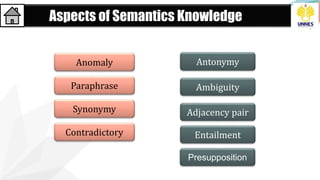
Aspects of Semantics Knowledge
Ambiguity
Entailment
Adjacency pair
Anomaly
Paraphrase
Synonymy
Antonymy
Contradictory
Presupposition
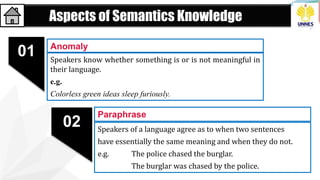
Aspects of Semantics Knowledge
Speakers know whether something is or is not meaningful in
their language.
e.g.
Colorless green ideas sleep furiously.
Anomaly
01
02 Speakers of a language agree as to when two sentences
have essentially the same meaning and when they do not.
e.g. The police chased the burglar.
The burglar was chased by the police.
Paraphrase
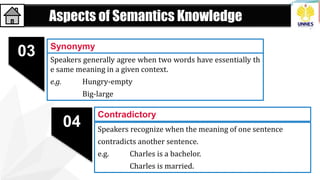
Aspects of Semantics Knowledge
Speakers generally agree when two words have essentially th
e same meaning in a given context.
e.g. Hungry-empty
Big-large
Synonymy
03
04 Speakers recognize when the meaning of one sentence
contradicts another sentence.
e.g. Charles is a bachelor.
• Charles is married.
Contradictory
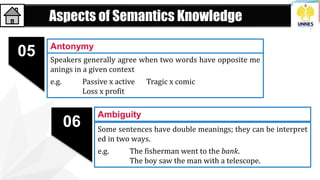
Aspects of Semantics Knowledge
Speakers generally agree when two words have opposite me
anings in a given context
e.g. Passive x active Tragic x comic
Loss x profit
Antonymy
05
06 Some sentences have double meanings; they can be interpret
ed in two ways.
e.g. The fisherman went to the bank.
The boy saw the man with a telescope.
Ambiguity
Aspects of Semantics Knowledge
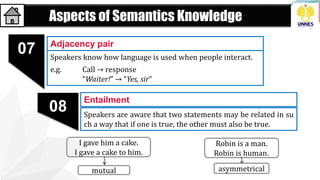
Speakers know how language is used when people interact.
e.g. Call → response
“Waiter!” → “Yes, sir”
Adjacency pair
07
08 Speakers are aware that two statements may be related in su
ch a way that if one is true, the other must also be true.
Entailment
I gave him a cake.
I gave a cake to him.
Robin is a man.
Robin is human.
mutual asymmetrical
Aspects of Semantics Knowledge
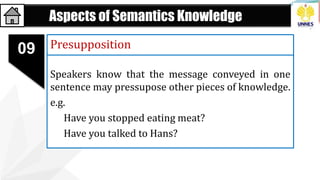
Speakers know that the message conveyed in one
sentence may pressupose other pieces of knowledge.
e.g.
 Have you stopped eating meat?
 Have you talked to Hans?
Presupposition09
Utterances
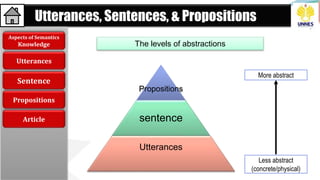
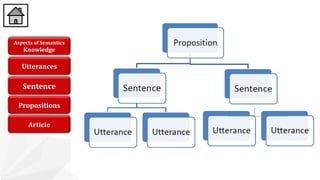
Utterances, Sentences, & Propositions
Propositions
sentence
Utterances
The levels of abstractions
Less abstract
(concrete/physical)
More abstract
Aspects of Semantics
Knowledge
Utterances
Sentence
Propositions
Article
Utterances
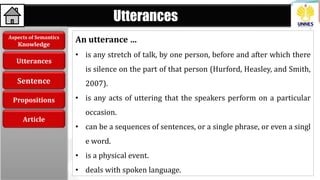
An utterance …
• is any stretch of talk, by one person, before and after which there
is silence on the part of that person (Hurford, Heasley, and Smith,
2007).
• is any acts of uttering that the speakers perform on a particular
occasion.
• can be a sequences of sentences, or a single phrase, or even a singl
e word.
• is a physical event.
• deals with spoken language.
Aspects of Semantics
Knowledge
Utterances
Sentence
Propositions
Article
Utterances
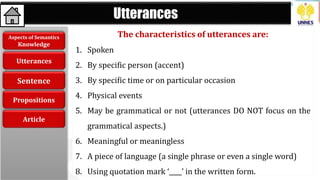
The characteristics of utterances are:
1. Spoken
2. By specific person (accent)
3. By specific time or on particular occasion
4. Physical events
5. May be grammatical or not (utterances DO NOT focus on the
grammatical aspects.)
6. Meaningful or meaningless
7. A piece of language (a single phrase or even a single word)
8. Using quotation mark ‘____’ in the written form.
Aspects of Semantics
Knowledge
Utterances
Sentence
Propositions
Article
Utterances
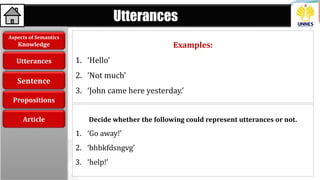
Examples:
1. ‘Hello’
2. ‘Not much’
3. ‘John came here yesterday.’
Decide whether the following could represent utterances or not.
1. ‘Go away!’
2. ‘bhbkfdsngvg’
3. ‘help!’
Aspects of Semantics
Knowledge
Utterances
Sentence
Propositions
Article
Sentences
Sentences
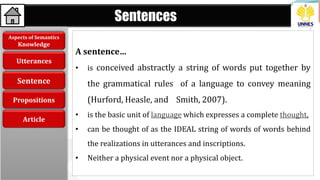
A sentence…
• is conceived abstractly a string of words put together by
the grammatical rules of a language to convey meaning
(Hurford, Heasle, and Smith, 2007).
• is the basic unit of language which expresses a complete thought.
• can be thought of as the IDEAL string of words of words behind
the realizations in utterances and inscriptions.
• Neither a physical event nor a physical object.
Aspects of Semantics
Knowledge
Utterances
Sentence
Propositions
Article
Sentences
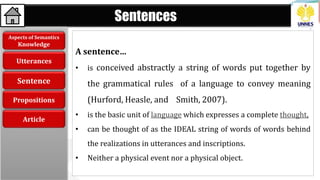
A sentence…
• is conceived abstractly a string of words put together by
the grammatical rules of a language to convey meaning
(Hurford, Heasle, and Smith, 2007).
• is the basic unit of language which expresses a complete thought.
• can be thought of as the IDEAL string of words of words behind
the realizations in utterances and inscriptions.
• Neither a physical event nor a physical object.
Aspects of Semantics
Knowledge
Utterances
Sentence
Propositions
Article
Utterances
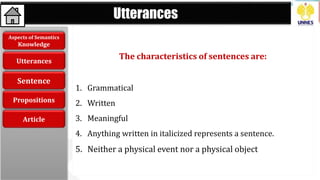
The characteristics of sentences are:
1. Grammatical
2. Written
3. Meaningful
4. Anything written in italicized represents a sentence.
5. Neither a physical event nor a physical object
Aspects of Semantics
Knowledge
Utterances
Sentence
Propositions
Article
Utterances
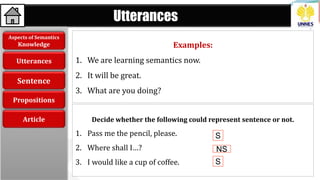
Examples:
1. We are learning semantics now.
2. It will be great.
3. What are you doing?
Decide whether the following could represent sentence or not.
1. Pass me the pencil, please.
2. Where shall I…?
3. I would like a cup of coffee.
S
NS
S
Aspects of Semantics
Knowledge
Utterances
Sentence
Propositions
Article
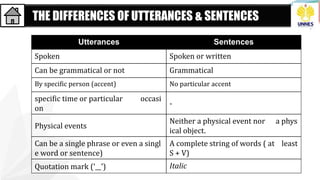
THE DIFFERENCES OF UTTERANCES & SENTENCES
Utterances Sentences
Spoken Spoken or written
Can be grammatical or not Grammatical
By specific person (accent) No particular accent
specific time or particular occasi
on
-
Physical events
Neither a physical event nor a phys
ical object.
Can be a single phrase or even a singl
e word or sentence)
A complete string of words ( at least
S + V)
Quotation mark (‘__’) Italic
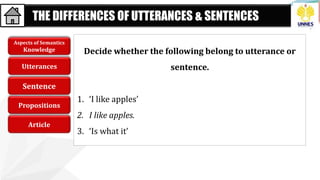
THE DIFFERENCES OF UTTERANCES & SENTENCES
Decide whether the following belong to utterance or
sentence.
1. ‘I like apples’
2. I like apples.
3. ‘Is what it’
Aspects of Semantics
Knowledge
Utterances
Sentence
Propositions
Article
PROPOSITI
ONS
Aspects of Semantics
Knowledge
Utterances
Sentence
Propositions
Article
Propositions
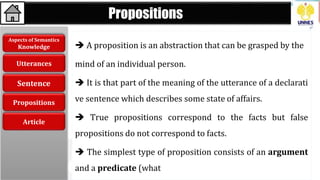
 A proposition is an abstraction that can be grasped by the
mind of an individual person.
 It is that part of the meaning of the utterance of a declarati
ve sentence which describes some state of affairs.
 True propositions correspond to the facts but false
propositions do not correspond to facts.
 The simplest type of proposition consists of an argument
and a predicate (what
Aspects of Semantics
Knowledge
Utterances
Sentence
Propositions
Article
Propositions
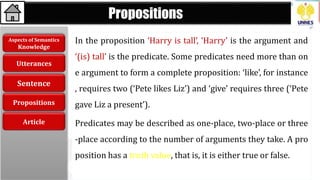
In the proposition ‘Harry is tall’, ‘Harry’ is the argument and
‘(is) tall’ is the predicate. Some predicates need more than on
e argument to form a complete proposition: ‘like’, for instance
, requires two (‘Pete likes Liz’) and ‘give’ requires three (‘Pete
gave Liz a present’).
Predicates may be described as one-place, two-place or three
-place according to the number of arguments they take. A pro
position has a truth value, that is, it is either true or false.
Aspects of Semantics
Knowledge
Utterances
Sentence
Propositions
Article
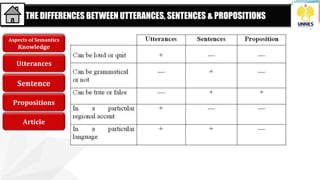
THE DIFFERENCES BETWEEN UTTERANCES, SENTENCES & PROPOSITIONS
Aspects of Semantics
Knowledge
Utterances
Sentence
Propositions
Article
Propositions
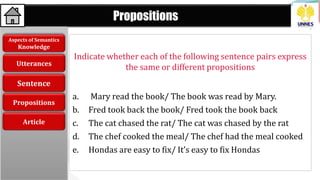
Indicate whether each of the following sentence pairs express
the same or different propositions
a. Mary read the book/ The book was read by Mary.
b. Fred took back the book/ Fred took the book back
c. The cat chased the rat/ The cat was chased by the rat
d. The chef cooked the meal/ The chef had the meal cooked
e. Hondas are easy to fix/ It’s easy to fix Hondas
Aspects of Semantics
Knowledge
Utterances
Sentence
Propositions
Article
ARTICLE
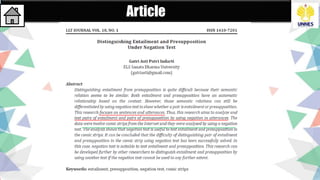
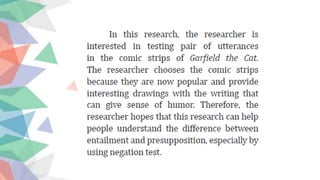
Article
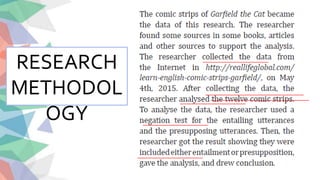
RESEARCH
METHODOL
OGY
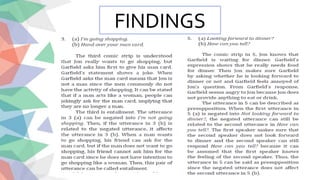
FINDINGS
CONCLUSIO
N
Thank you

Aspects of Semantic Knowledge_Sentences-Utterances-Propositions

  • 1.
    Aspects of SemanticKnowledge, Sentences, Utterances, and Propositions By: 1. Perwari Melati Akmilia 0203518062 2. Endang Susilowati 0203518064 3. Aditya Nugrahanto 0203518067
  • 2.
    SUB TOPICS 1 2 Utterances 4 5 Aspectsof Semantics Knowledge Propositions A Relevant Article 3 Sentence s Aspects of Semantics Knowledge Utterances Sentence Propositions Article
  • 3.
  • 4.
    Aspects of SemanticsKnowledge Ambiguity Entailment Adjacency pair Anomaly Paraphrase Synonymy Antonymy Contradictory Presupposition
  • 5.
    Aspects of SemanticsKnowledge Speakers know whether something is or is not meaningful in their language. e.g. Colorless green ideas sleep furiously. Anomaly 01 02 Speakers of a language agree as to when two sentences have essentially the same meaning and when they do not. e.g. The police chased the burglar. The burglar was chased by the police. Paraphrase
  • 6.
    Aspects of SemanticsKnowledge Speakers generally agree when two words have essentially th e same meaning in a given context. e.g. Hungry-empty Big-large Synonymy 03 04 Speakers recognize when the meaning of one sentence contradicts another sentence. e.g. Charles is a bachelor. • Charles is married. Contradictory
  • 7.
    Aspects of SemanticsKnowledge Speakers generally agree when two words have opposite me anings in a given context e.g. Passive x active Tragic x comic Loss x profit Antonymy 05 06 Some sentences have double meanings; they can be interpret ed in two ways. e.g. The fisherman went to the bank. The boy saw the man with a telescope. Ambiguity
  • 8.
    Aspects of SemanticsKnowledge Speakers know how language is used when people interact. e.g. Call → response “Waiter!” → “Yes, sir” Adjacency pair 07 08 Speakers are aware that two statements may be related in su ch a way that if one is true, the other must also be true. Entailment I gave him a cake. I gave a cake to him. Robin is a man. Robin is human. mutual asymmetrical
  • 9.
    Aspects of SemanticsKnowledge Speakers know that the message conveyed in one sentence may pressupose other pieces of knowledge. e.g.  Have you stopped eating meat?  Have you talked to Hans? Presupposition09
  • 10.
  • 11.
    Utterances, Sentences, &Propositions Propositions sentence Utterances The levels of abstractions Less abstract (concrete/physical) More abstract Aspects of Semantics Knowledge Utterances Sentence Propositions Article
  • 12.
    Utterances An utterance … •is any stretch of talk, by one person, before and after which there is silence on the part of that person (Hurford, Heasley, and Smith, 2007). • is any acts of uttering that the speakers perform on a particular occasion. • can be a sequences of sentences, or a single phrase, or even a singl e word. • is a physical event. • deals with spoken language. Aspects of Semantics Knowledge Utterances Sentence Propositions Article
  • 13.
    Utterances The characteristics ofutterances are: 1. Spoken 2. By specific person (accent) 3. By specific time or on particular occasion 4. Physical events 5. May be grammatical or not (utterances DO NOT focus on the grammatical aspects.) 6. Meaningful or meaningless 7. A piece of language (a single phrase or even a single word) 8. Using quotation mark ‘____’ in the written form. Aspects of Semantics Knowledge Utterances Sentence Propositions Article
  • 14.
    Utterances Examples: 1. ‘Hello’ 2. ‘Notmuch’ 3. ‘John came here yesterday.’ Decide whether the following could represent utterances or not. 1. ‘Go away!’ 2. ‘bhbkfdsngvg’ 3. ‘help!’ Aspects of Semantics Knowledge Utterances Sentence Propositions Article
  • 15.
  • 16.
    Sentences A sentence… • isconceived abstractly a string of words put together by the grammatical rules of a language to convey meaning (Hurford, Heasle, and Smith, 2007). • is the basic unit of language which expresses a complete thought. • can be thought of as the IDEAL string of words of words behind the realizations in utterances and inscriptions. • Neither a physical event nor a physical object. Aspects of Semantics Knowledge Utterances Sentence Propositions Article
  • 17.
    Sentences A sentence… • isconceived abstractly a string of words put together by the grammatical rules of a language to convey meaning (Hurford, Heasle, and Smith, 2007). • is the basic unit of language which expresses a complete thought. • can be thought of as the IDEAL string of words of words behind the realizations in utterances and inscriptions. • Neither a physical event nor a physical object. Aspects of Semantics Knowledge Utterances Sentence Propositions Article
  • 18.
    Utterances The characteristics ofsentences are: 1. Grammatical 2. Written 3. Meaningful 4. Anything written in italicized represents a sentence. 5. Neither a physical event nor a physical object Aspects of Semantics Knowledge Utterances Sentence Propositions Article
  • 19.
    Utterances Examples: 1. We arelearning semantics now. 2. It will be great. 3. What are you doing? Decide whether the following could represent sentence or not. 1. Pass me the pencil, please. 2. Where shall I…? 3. I would like a cup of coffee. S NS S Aspects of Semantics Knowledge Utterances Sentence Propositions Article
  • 20.
    THE DIFFERENCES OFUTTERANCES & SENTENCES Utterances Sentences Spoken Spoken or written Can be grammatical or not Grammatical By specific person (accent) No particular accent specific time or particular occasi on - Physical events Neither a physical event nor a phys ical object. Can be a single phrase or even a singl e word or sentence) A complete string of words ( at least S + V) Quotation mark (‘__’) Italic
  • 21.
    THE DIFFERENCES OFUTTERANCES & SENTENCES Decide whether the following belong to utterance or sentence. 1. ‘I like apples’ 2. I like apples. 3. ‘Is what it’ Aspects of Semantics Knowledge Utterances Sentence Propositions Article
  • 22.
  • 23.
  • 24.
    Propositions  A propositionis an abstraction that can be grasped by the mind of an individual person.  It is that part of the meaning of the utterance of a declarati ve sentence which describes some state of affairs.  True propositions correspond to the facts but false propositions do not correspond to facts.  The simplest type of proposition consists of an argument and a predicate (what Aspects of Semantics Knowledge Utterances Sentence Propositions Article
  • 25.
    Propositions In the proposition‘Harry is tall’, ‘Harry’ is the argument and ‘(is) tall’ is the predicate. Some predicates need more than on e argument to form a complete proposition: ‘like’, for instance , requires two (‘Pete likes Liz’) and ‘give’ requires three (‘Pete gave Liz a present’). Predicates may be described as one-place, two-place or three -place according to the number of arguments they take. A pro position has a truth value, that is, it is either true or false. Aspects of Semantics Knowledge Utterances Sentence Propositions Article
  • 26.
    THE DIFFERENCES BETWEENUTTERANCES, SENTENCES & PROPOSITIONS Aspects of Semantics Knowledge Utterances Sentence Propositions Article
  • 27.
    Propositions Indicate whether eachof the following sentence pairs express the same or different propositions a. Mary read the book/ The book was read by Mary. b. Fred took back the book/ Fred took the book back c. The cat chased the rat/ The cat was chased by the rat d. The chef cooked the meal/ The chef had the meal cooked e. Hondas are easy to fix/ It’s easy to fix Hondas Aspects of Semantics Knowledge Utterances Sentence Propositions Article
  • 28.
  • 29.
  • 31.
  • 32.
  • 33.
  • 34.