
AN
Assignment
On
SELF HELP GROUPs
Submitted, by
Leelesh Kumar Sahu
M.sc.(Ag) Previous
Agricultural Economics
Guided, by
Dr. A.K. Gauraha
Prof. Deptt. Of
Agricultural Economics
College of Agriculture
IGKV Raipur
Introduction to Self help groups
Self Help Groups SHGs-A self help groups is a small
economically homogenous and affinity group of rural
poor voluntarily coming together
1. To save small amounts regularly
2. To mutually agree to contribute to a common fund
3. To meet their emergency needs
4. To have collective decision-making
5. To solve conflicts though collective leadership and
mutual decision
6. To provide collateral free loans with terms decided
by the group at market rates.
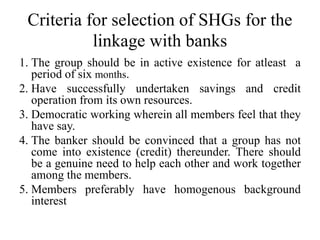
Criteria for selection of SHGs for the
linkage with banks
1. The group should be in active existence for atleast a
period of six months.
2. Have successfully undertaken savings and credit
operation from its own resources.
3. Democratic working wherein all members feel that they
have say.
4. The banker should be convinced that a group has not
come into existence (credit) thereunder. There should
be a genuine need to help each other and work together
among the members.
5. Members preferably have homogenous background
interest
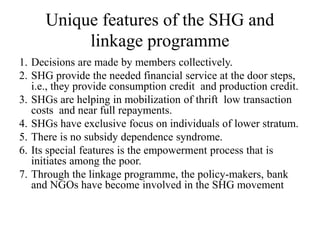
Unique features of the SHG and
linkage programme
1. Decisions are made by members collectively.
2. SHG provide the needed financial service at the door steps,
i.e., they provide consumption credit and production credit.
3. SHGs are helping in mobilization of thrift low transaction
costs and near full repayments.
4. SHGs have exclusive focus on individuals of lower stratum.
5. There is no subsidy dependence syndrome.
6. Its special features is the empowerment process that is
initiates among the poor.
7. Through the linkage programme, the policy-makers, bank
and NGOs have become involved in the SHG movement
NABARD and the SHG linkage
programme
1. Conceptualization and introduction of pilot phase of the SHG linkage
programme in February 1992 for linking 500 SHGs with the banks after
consultations RBI, banks NGOs.
2. Developing conducive policy framework through provision of opening
savings banks accounts in the name of SHGs, relaxation collateral norms,
documentation delegation of all credit decisions and terms to SHGs.
3. Introduction of bulk lending scheme in 1993 for encouraging NGOs
which were keen to try group approach and other financial services in the
rural areas.
4. Training and sensitization of bank officials and standardization of
training modules.
5. Experimenting with RRBs for promotion of SHGs.
6. Selective support to NGOs for promotion of SHGs.
7. Close monitoring through state level forums.
8. Dissemination through seminars , workshops, occasional papers,etc
Linkage models
• The linkage between the self help group and
the banks is expected to be of symbiotic in
nature. The linkage concept is based on
savings linked credit.
Linkage Model
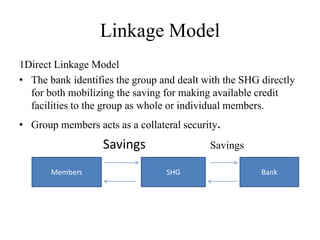
1Direct Linkage Model
• The bank identifies the group and dealt with the SHG directly
for both mobilizing the saving for making available credit
facilities to the group as whole or individual members.
• Group members acts as a collateral security.
Savings Savings
Members SHG Bank
Linkage Model
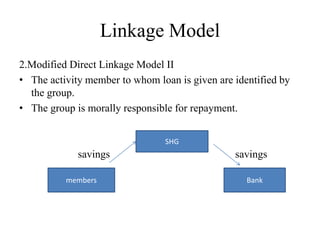
2.Modified Direct Linkage Model II
• The activity member to whom loan is given are identified by
the group.
• The group is morally responsible for repayment.
savings savings
SHG
members Bank
Linkage Model
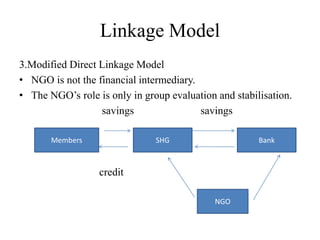
3.Modified Direct Linkage Model
• NGO is not the financial intermediary.
• The NGO’s role is only in group evaluation and stabilisation.
savings savings
credit
Members SHG Bank
NGO
Linkage Model
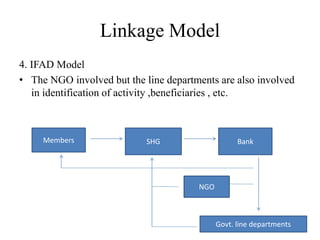
4. IFAD Model
• The NGO involved but the line departments are also involved
in identification of activity ,beneficiaries , etc.
Members SHG Bank
NGO
Govt. line departments
Linkage Model
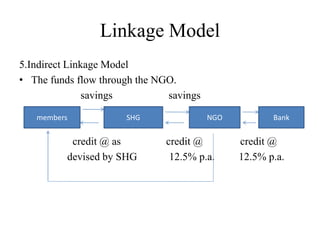
5.Indirect Linkage Model
• The funds flow through the NGO.
savings savings
credit @ as credit @ credit @
devised by SHG 12.5% p.a. 12.5% p.a.
members SHG NGO Bank
Linkage Model
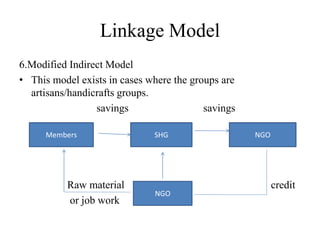
6.Modified Indirect Model
• This model exists in cases where the groups are
artisans/handicrafts groups.
savings savings
Raw material credit
or job work
Members SHG NGO
NGO
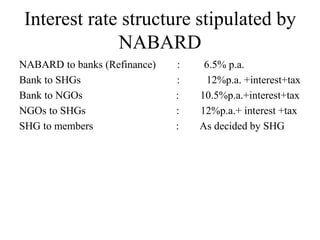
Interest rate structure stipulated by
NABARD
NABARD to banks (Refinance) : 6.5% p.a.
Bank to SHGs : 12%p.a. +interest+tax
Bank to NGOs : 10.5%p.a.+interest+tax
NGOs to SHGs : 12%p.a.+ interest +tax
SHG to members : As decided by SHG
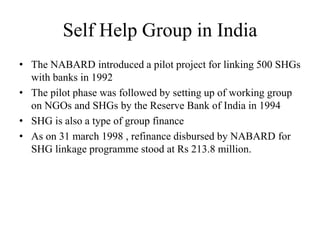
Self Help Group in India
• The NABARD introduced a pilot project for linking 500 SHGs
with banks in 1992
• The pilot phase was followed by setting up of working group
on NGOs and SHGs by the Reserve Bank of India in 1994
• SHG is also a type of group finance
• As on 31 march 1998 , refinance disbursed by NABARD for
SHG linkage programme stood at Rs 213.8 million.
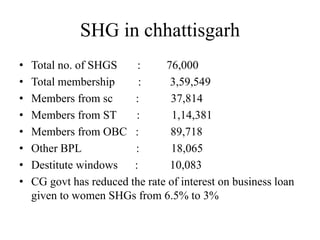
SHG in chhattisgarh
• Total no. of SHGS : 76,000
• Total membership : 3,59,549
• Members from sc : 37,814
• Members from ST : 1,14,381
• Members from OBC : 89,718
• Other BPL : 18,065
• Destitute windows : 10,083
• CG govt has reduced the rate of interest on business loan
given to women SHGs from 6.5% to 3%
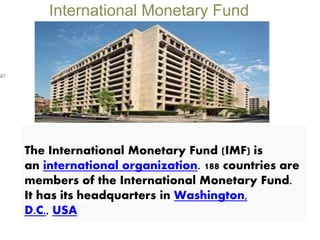
International Monetary Fund
The International Monetary Fund (IMF) is
an international organization. 188 countries are
members of the International Monetary Fund.
It has its headquarters in Washington,
D.C., USA
History:-
The International Monetary Fund (IMF) It is
an international organization that was initiated in 1944
at theBretton Woods Conference and formally created
in 1945 by 29 member countries. The IMF's stated goal
was to assist in the reconstruction of the
world's international payment system post–World War
II.
Management:-
A Board of Directors manages the IMF. One tradition has
governed the selection of two most senior posts of IMF.
Firstly, IMF’s managing director is always European.World
Bank's president is always from the United States of
America. The major countries of Europe and America
control the IMF. This is because they have given more
money to IMF by way of first subscriptions, and so have
larger share of voting rights.
Official logo for the IMF
Abbreviation IMF
FMI
Formation Formally 27 December 1945 (67 years
ago)
Actually 1 March 1947(66 years ago)
Type International Economic Organization
Headquarters Washington, D.C., United States
Membership 29 countries (founding); 188 countries
(to date)
Official languages English, French, and Spanish
Managing Director Christine Lagarde
Main organ Board of Governors
Website www.imf.org
Functions:-
The IMF does a number of supervisory works relating to
financial dealings between different countries. Some of
the works done by IMF are:
•Helping in international trade, that is business between
countries
•Looking after exchange rates
•Looking after balance of payments
•Helping member countries in economic development
•It also provides a machinery for international
consultations.
References -:
 http://www.humanrights.gov/2012/01/12/fact-
sheet-non-governmental-organizations-ngos-in-
the-united-states/
"India: More NGOs, than schools and health
centres".OneWorld.net.
 "First official estimate: An NGO for every 400
people in India".
Willetts, Peter. "What is a Non-Governmental
Organization?". UNESCO Encyclopaedia of Life
Support Systems. City University London.
Retrieved 18 July 2012.
McCormick, John. "The Role of Environmental
NGOs in International Regimes".
Books.google.com.
WWW.IMF.ORG
SGH
Thanks

SELF HELF GROUP

  • 1.
    AN Assignment On SELF HELP GROUPs Submitted,by Leelesh Kumar Sahu M.sc.(Ag) Previous Agricultural Economics Guided, by Dr. A.K. Gauraha Prof. Deptt. Of Agricultural Economics College of Agriculture IGKV Raipur
  • 2.
    Introduction to Selfhelp groups Self Help Groups SHGs-A self help groups is a small economically homogenous and affinity group of rural poor voluntarily coming together 1. To save small amounts regularly 2. To mutually agree to contribute to a common fund 3. To meet their emergency needs 4. To have collective decision-making 5. To solve conflicts though collective leadership and mutual decision 6. To provide collateral free loans with terms decided by the group at market rates.
  • 3.
    Criteria for selectionof SHGs for the linkage with banks 1. The group should be in active existence for atleast a period of six months. 2. Have successfully undertaken savings and credit operation from its own resources. 3. Democratic working wherein all members feel that they have say. 4. The banker should be convinced that a group has not come into existence (credit) thereunder. There should be a genuine need to help each other and work together among the members. 5. Members preferably have homogenous background interest
  • 4.
    Unique features ofthe SHG and linkage programme 1. Decisions are made by members collectively. 2. SHG provide the needed financial service at the door steps, i.e., they provide consumption credit and production credit. 3. SHGs are helping in mobilization of thrift low transaction costs and near full repayments. 4. SHGs have exclusive focus on individuals of lower stratum. 5. There is no subsidy dependence syndrome. 6. Its special features is the empowerment process that is initiates among the poor. 7. Through the linkage programme, the policy-makers, bank and NGOs have become involved in the SHG movement
  • 5.
    NABARD and theSHG linkage programme 1. Conceptualization and introduction of pilot phase of the SHG linkage programme in February 1992 for linking 500 SHGs with the banks after consultations RBI, banks NGOs. 2. Developing conducive policy framework through provision of opening savings banks accounts in the name of SHGs, relaxation collateral norms, documentation delegation of all credit decisions and terms to SHGs. 3. Introduction of bulk lending scheme in 1993 for encouraging NGOs which were keen to try group approach and other financial services in the rural areas. 4. Training and sensitization of bank officials and standardization of training modules. 5. Experimenting with RRBs for promotion of SHGs. 6. Selective support to NGOs for promotion of SHGs. 7. Close monitoring through state level forums. 8. Dissemination through seminars , workshops, occasional papers,etc
  • 6.
    Linkage models • Thelinkage between the self help group and the banks is expected to be of symbiotic in nature. The linkage concept is based on savings linked credit.
  • 7.
    Linkage Model 1Direct LinkageModel • The bank identifies the group and dealt with the SHG directly for both mobilizing the saving for making available credit facilities to the group as whole or individual members. • Group members acts as a collateral security. Savings Savings Members SHG Bank
  • 8.
    Linkage Model 2.Modified DirectLinkage Model II • The activity member to whom loan is given are identified by the group. • The group is morally responsible for repayment. savings savings SHG members Bank
  • 9.
    Linkage Model 3.Modified DirectLinkage Model • NGO is not the financial intermediary. • The NGO’s role is only in group evaluation and stabilisation. savings savings credit Members SHG Bank NGO
  • 10.
    Linkage Model 4. IFADModel • The NGO involved but the line departments are also involved in identification of activity ,beneficiaries , etc. Members SHG Bank NGO Govt. line departments
  • 11.
    Linkage Model 5.Indirect LinkageModel • The funds flow through the NGO. savings savings credit @ as credit @ credit @ devised by SHG 12.5% p.a. 12.5% p.a. members SHG NGO Bank
  • 12.
    Linkage Model 6.Modified IndirectModel • This model exists in cases where the groups are artisans/handicrafts groups. savings savings Raw material credit or job work Members SHG NGO NGO
  • 13.
    Interest rate structurestipulated by NABARD NABARD to banks (Refinance) : 6.5% p.a. Bank to SHGs : 12%p.a. +interest+tax Bank to NGOs : 10.5%p.a.+interest+tax NGOs to SHGs : 12%p.a.+ interest +tax SHG to members : As decided by SHG
  • 14.
    Self Help Groupin India • The NABARD introduced a pilot project for linking 500 SHGs with banks in 1992 • The pilot phase was followed by setting up of working group on NGOs and SHGs by the Reserve Bank of India in 1994 • SHG is also a type of group finance • As on 31 march 1998 , refinance disbursed by NABARD for SHG linkage programme stood at Rs 213.8 million.
  • 15.
    SHG in chhattisgarh •Total no. of SHGS : 76,000 • Total membership : 3,59,549 • Members from sc : 37,814 • Members from ST : 1,14,381 • Members from OBC : 89,718 • Other BPL : 18,065 • Destitute windows : 10,083 • CG govt has reduced the rate of interest on business loan given to women SHGs from 6.5% to 3%
  • 16.
    International Monetary Fund TheInternational Monetary Fund (IMF) is an international organization. 188 countries are members of the International Monetary Fund. It has its headquarters in Washington, D.C., USA
  • 17.
    History:- The International MonetaryFund (IMF) It is an international organization that was initiated in 1944 at theBretton Woods Conference and formally created in 1945 by 29 member countries. The IMF's stated goal was to assist in the reconstruction of the world's international payment system post–World War II.
  • 18.
    Management:- A Board ofDirectors manages the IMF. One tradition has governed the selection of two most senior posts of IMF. Firstly, IMF’s managing director is always European.World Bank's president is always from the United States of America. The major countries of Europe and America control the IMF. This is because they have given more money to IMF by way of first subscriptions, and so have larger share of voting rights.
  • 19.
    Official logo forthe IMF Abbreviation IMF FMI Formation Formally 27 December 1945 (67 years ago) Actually 1 March 1947(66 years ago) Type International Economic Organization Headquarters Washington, D.C., United States Membership 29 countries (founding); 188 countries (to date) Official languages English, French, and Spanish Managing Director Christine Lagarde
  • 20.
    Main organ Boardof Governors Website www.imf.org Functions:- The IMF does a number of supervisory works relating to financial dealings between different countries. Some of the works done by IMF are: •Helping in international trade, that is business between countries •Looking after exchange rates •Looking after balance of payments •Helping member countries in economic development •It also provides a machinery for international consultations.
  • 21.
    References -:  http://www.humanrights.gov/2012/01/12/fact- sheet-non-governmental-organizations-ngos-in- the-united-states/ "India:More NGOs, than schools and health centres".OneWorld.net.  "First official estimate: An NGO for every 400 people in India". Willetts, Peter. "What is a Non-Governmental Organization?". UNESCO Encyclopaedia of Life Support Systems. City University London. Retrieved 18 July 2012. McCormick, John. "The Role of Environmental NGOs in International Regimes". Books.google.com. WWW.IMF.ORG
  • 22.