SELF HELP GROUP
CREATED BY :- anmol mehrotra
SELF HELP GROUP
Self Help Groups are the association of financially weak people or members,
which are solely created for the benefits or common interests of the group
members itself. All the members of Self Help Groups have one common interest
i.e. seeking the financial well being of their members belonging to the group.
Generally, Self Help Groups are formed by taking 10 to 20 local people or
members. This SHG is an informal association with a view to addressing their
common problems or issues ideally form the homogeneous background.
The main reason for the creation of the Self Help Groups is the
development of socio-economic conditions of the members
within the group. They are much more self-reliant and seek to
enhance their current financial situation which would not
have been possible without forming this group. It has been a
constant endeavor of the Government towards women
empowerment and economic development through Self Help
Groups in India.
Before 1992 there was a huge supply of credit facilities to the
formal sectors across India. But no one was even bothered to
supply the same credit facilities to the informal sector like
SHG. Then the NABARD came to the rescue of these informal
sectors and launched the Self Help Groups scheme as one of
the informal credit facilities.
NEED OF SELF HELP GROUPS
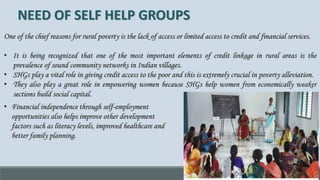
One of the chief reasons for rural poverty is the lack of access or limited access to credit and financial services.
• It is being recognized that one of the most important elements of credit linkage in rural areas is the
prevalence of sound community networks in Indian villages.
• SHGs play a vital role in giving credit access to the poor and this is extremely crucial in poverty alleviation.
• They also play a great role in empowering women because SHGs help women from economically weaker
sections build social capital.
• Financial independence through self-employment
opportunities also helps improve other development
factors such as literacy levels, improved healthcare and
better family planning.
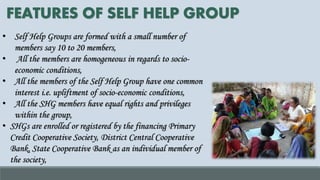
FEATURES OF SELF HELP GROUP
• Self Help Groups are formed with a small number of
members say 10 to 20 members,
• All the members are homogeneous in regards to socio-
economic conditions,
• All the members of the Self Help Group have one common
interest i.e. upliftment of socio-economic conditions,
• All the SHG members have equal rights and privileges
within the group,
• SHGs are enrolled or registered by the financing Primary
Credit Cooperative Society, District Central Cooperative
Bank, State Cooperative Bank as an individual member of
the society,
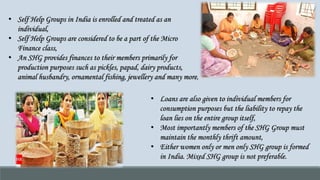
• Self Help Groups in India is enrolled and treated as an
individual,
• Self Help Groups are considered to be a part of the Micro
Finance class,
• An SHG provides finances to their members primarily for
production purposes such as pickles, papad, dairy products,
animal husbandry, ornamental fishing, jewellery and many more,
• Loans are also given to individual members for
consumption purposes but the liability to repay the
loan lies on the entire group itself,
• Most importantly members of the SHG Group must
maintain the monthly thrift amount,
• Either women only or men only SHG group is formed
in India. Mixed SHG group is not preferable.
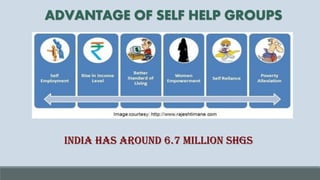
ADVANTAGE OF SELF HELP GROUPS
India has around 6.7 million SHGs
1. Capacity building: Self Help Groups in India is generally an association of 10 to 20
members. Thus this SHG group can transform the lives of many people at a time. Millions
of poor and people from the marginalized sections are transforming their lives, their
families, their societies through Self Help Groups. This SHG in India obtains various skill,
knowledge and apply them in discharging their duties within the group itself.
2. Self-confidence & self-esteem: Solving the most basic problems by earning a reasonable
amount provides self-confidence and enhances self-esteem. They feel the sense of having
their heads in high and becomes a part of the better society and a better India.
3. Mutual help: The most crucial advantage of the SHG groups is that they are eager to
help each other mutually. Instead of going alone they just give priorities to the groups.
Though the group is treated as an individual, it ensures mutual help.
4. Use of skill: With the constant help from the Govt. in terms of skill development, the
SHG groups are now well equipped to apply their earned skill in different areas such as
tailoring, beautician course, producing food products such as Jam, Jelly, Pickles, dairy
products, Junk jewellery, soft toys, incense sticks, showpiece and many more.
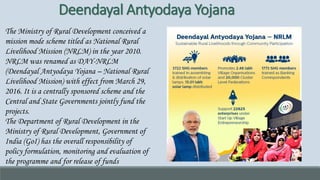
Deendayal Antyodaya Yojana
The Ministry of Rural Development conceived a
mission mode scheme titled as National Rural
Livelihood Mission (NRLM) in the year 2010.
NRLM was renamed as DAY-NRLM
(Deendayal Antyodaya Yojana – National Rural
Livelihood Mission) with effect from March 29,
2016. It is a centrally sponsored scheme and the
Central and State Governments jointly fund the
projects.
The Department of Rural Development in the
Ministry of Rural Development, Government of
India (GoI) has the overall responsibility of
policy formulation, monitoring and evaluation of
the programme and for release of funds
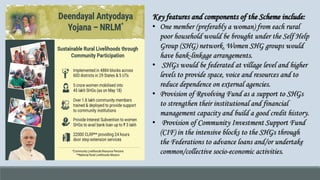
Key features and components of the Scheme include:
• One member (preferably a woman) from each rural
poor household would be brought under the Self Help
Group (SHG) network. Women SHG groups would
have bank-linkage arrangements.
• SHGs would be federated at village level and higher
levels to provide space, voice and resources and to
reduce dependence on external agencies.
• Provision of Revolving Fund as a support to SHGs
to strengthen their institutional and financial
management capacity and build a good credit history.
• Provision of Community Investment Support Fund
(CIF) in the intensive blocks to the SHGs through
the Federations to advance loans and/or undertake
common/collective socio-economic activities.
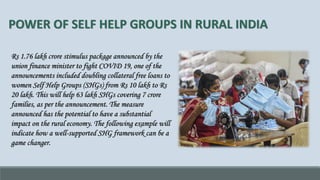
POWER OF SELF HELP GROUPS IN RURAL INDIA
Rs 1.76 lakh crore stimulus package announced by the
union finance minister to fight COVID 19, one of the
announcements included doubling collateral free loans to
women Self Help Groups (SHGs) from Rs 10 lakh to Rs
20 lakh. This will help 63 lakh SHGs covering 7 crore
families, as per the announcement. The measure
announced has the potential to have a substantial
impact on the rural economy. The following example will
indicate how a well-supported SHG framework can be a
game changer.
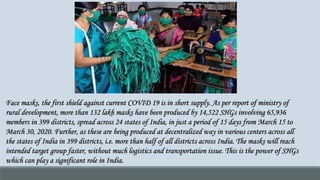
Face masks, the first shield against current COVID 19 is in short supply. As per report of ministry of
rural development, more than 132 lakh masks have been produced by 14,522 SHGs involving 65,936
members in 399 districts, spread across 24 states of India, in just a period of 15 days from March 15 to
March 30, 2020. Further, as these are being produced at decentralized way in various centers across all
the states of India in 399 districts, i.e. more than half of all districts across India. The masks will reach
intended target group faster, without much logistics and transportation issue. This is the power of SHGs
which can play a significant role in India.
Problems of Self-Help Groups (SHGs)
1. Ignorance of Members and Participants:
Even though the authorities take measures for creating awareness among the group members about the schemes
beneficial to them, still majority of the group are unaware of the schemes of assistance offered to them.
2. Inadequate Training Facilities:
The training facilities given to the members of SHGs in the specific areas of product selection, quality of products,
production techniques, managerial ability, packing, other technical knowledge ate are not adequate to compete
with that of strong units.
3.Problems related to Raw Materials: Mostly each SHG procures raw materials individually from the suppliers.
They purchase raw materials in smaller quantities and hence they may not be able to enjoy the benefits of large
scale purchase like discount, credit facilities etc.
4. Problems of Marketing: Marketing is an important area of functioning of the SHGs. This area faces different
problems in the marketing of products produced by them. Some problems includes lack of linkage with marketing
agencies, lack of adequate sales promotion measures, and last but not the least includes poor packaging system.
5.Exploitation by strong members : Strong members try to earn a lion’s share of the profit of the group, by
exploiting the ignorance and illiterate members.
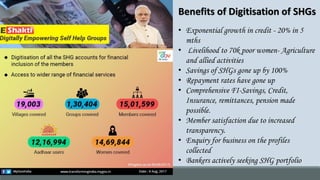
The National Bank of Agriculture and Rural Development (NABARD) has launched a project
titled “EShakti” for the digitization of all members of Self Help Group (SHG) in India.
The project aims to bring all SHG members under the fold of financial inclusion thereby helping
them access wider range of financial services. EShakti is designed to capture the demographic
and financial profiles of members, including their identification data like Aadhaar and EPIC
(Electors Photo Identity Card).
• Exponential growth in credit - 20% in 5
mths
• Livelihood to 70k poor women- Agriculture
and allied activities
• Savings of SHGs gone up by 100%
• Repayment rates have gone up
• Comprehensive FI-Savings, Credit,
Insurance, remittances, pension made
possible.
• Member satisfaction due to increased
transparency.
• Enquiry for business on the profiles
collected
• Bankers actively seeking SHG portfolio
Benefits of Digitisation of SHGs
Self help group s

Self help group s

  • 1.
    SELF HELP GROUP CREATEDBY :- anmol mehrotra
  • 2.
    SELF HELP GROUP SelfHelp Groups are the association of financially weak people or members, which are solely created for the benefits or common interests of the group members itself. All the members of Self Help Groups have one common interest i.e. seeking the financial well being of their members belonging to the group. Generally, Self Help Groups are formed by taking 10 to 20 local people or members. This SHG is an informal association with a view to addressing their common problems or issues ideally form the homogeneous background.
  • 3.
    The main reasonfor the creation of the Self Help Groups is the development of socio-economic conditions of the members within the group. They are much more self-reliant and seek to enhance their current financial situation which would not have been possible without forming this group. It has been a constant endeavor of the Government towards women empowerment and economic development through Self Help Groups in India. Before 1992 there was a huge supply of credit facilities to the formal sectors across India. But no one was even bothered to supply the same credit facilities to the informal sector like SHG. Then the NABARD came to the rescue of these informal sectors and launched the Self Help Groups scheme as one of the informal credit facilities.
  • 4.
    NEED OF SELFHELP GROUPS One of the chief reasons for rural poverty is the lack of access or limited access to credit and financial services. • It is being recognized that one of the most important elements of credit linkage in rural areas is the prevalence of sound community networks in Indian villages. • SHGs play a vital role in giving credit access to the poor and this is extremely crucial in poverty alleviation. • They also play a great role in empowering women because SHGs help women from economically weaker sections build social capital. • Financial independence through self-employment opportunities also helps improve other development factors such as literacy levels, improved healthcare and better family planning.
  • 5.
    FEATURES OF SELFHELP GROUP • Self Help Groups are formed with a small number of members say 10 to 20 members, • All the members are homogeneous in regards to socio- economic conditions, • All the members of the Self Help Group have one common interest i.e. upliftment of socio-economic conditions, • All the SHG members have equal rights and privileges within the group, • SHGs are enrolled or registered by the financing Primary Credit Cooperative Society, District Central Cooperative Bank, State Cooperative Bank as an individual member of the society,
  • 6.
    • Self HelpGroups in India is enrolled and treated as an individual, • Self Help Groups are considered to be a part of the Micro Finance class, • An SHG provides finances to their members primarily for production purposes such as pickles, papad, dairy products, animal husbandry, ornamental fishing, jewellery and many more, • Loans are also given to individual members for consumption purposes but the liability to repay the loan lies on the entire group itself, • Most importantly members of the SHG Group must maintain the monthly thrift amount, • Either women only or men only SHG group is formed in India. Mixed SHG group is not preferable.
  • 7.
    ADVANTAGE OF SELFHELP GROUPS India has around 6.7 million SHGs
  • 8.
    1. Capacity building:Self Help Groups in India is generally an association of 10 to 20 members. Thus this SHG group can transform the lives of many people at a time. Millions of poor and people from the marginalized sections are transforming their lives, their families, their societies through Self Help Groups. This SHG in India obtains various skill, knowledge and apply them in discharging their duties within the group itself. 2. Self-confidence & self-esteem: Solving the most basic problems by earning a reasonable amount provides self-confidence and enhances self-esteem. They feel the sense of having their heads in high and becomes a part of the better society and a better India. 3. Mutual help: The most crucial advantage of the SHG groups is that they are eager to help each other mutually. Instead of going alone they just give priorities to the groups. Though the group is treated as an individual, it ensures mutual help. 4. Use of skill: With the constant help from the Govt. in terms of skill development, the SHG groups are now well equipped to apply their earned skill in different areas such as tailoring, beautician course, producing food products such as Jam, Jelly, Pickles, dairy products, Junk jewellery, soft toys, incense sticks, showpiece and many more.
  • 9.
    Deendayal Antyodaya Yojana TheMinistry of Rural Development conceived a mission mode scheme titled as National Rural Livelihood Mission (NRLM) in the year 2010. NRLM was renamed as DAY-NRLM (Deendayal Antyodaya Yojana – National Rural Livelihood Mission) with effect from March 29, 2016. It is a centrally sponsored scheme and the Central and State Governments jointly fund the projects. The Department of Rural Development in the Ministry of Rural Development, Government of India (GoI) has the overall responsibility of policy formulation, monitoring and evaluation of the programme and for release of funds
  • 10.
    Key features andcomponents of the Scheme include: • One member (preferably a woman) from each rural poor household would be brought under the Self Help Group (SHG) network. Women SHG groups would have bank-linkage arrangements. • SHGs would be federated at village level and higher levels to provide space, voice and resources and to reduce dependence on external agencies. • Provision of Revolving Fund as a support to SHGs to strengthen their institutional and financial management capacity and build a good credit history. • Provision of Community Investment Support Fund (CIF) in the intensive blocks to the SHGs through the Federations to advance loans and/or undertake common/collective socio-economic activities.
  • 11.
    POWER OF SELFHELP GROUPS IN RURAL INDIA Rs 1.76 lakh crore stimulus package announced by the union finance minister to fight COVID 19, one of the announcements included doubling collateral free loans to women Self Help Groups (SHGs) from Rs 10 lakh to Rs 20 lakh. This will help 63 lakh SHGs covering 7 crore families, as per the announcement. The measure announced has the potential to have a substantial impact on the rural economy. The following example will indicate how a well-supported SHG framework can be a game changer.
  • 12.
    Face masks, thefirst shield against current COVID 19 is in short supply. As per report of ministry of rural development, more than 132 lakh masks have been produced by 14,522 SHGs involving 65,936 members in 399 districts, spread across 24 states of India, in just a period of 15 days from March 15 to March 30, 2020. Further, as these are being produced at decentralized way in various centers across all the states of India in 399 districts, i.e. more than half of all districts across India. The masks will reach intended target group faster, without much logistics and transportation issue. This is the power of SHGs which can play a significant role in India.
  • 14.
    Problems of Self-HelpGroups (SHGs) 1. Ignorance of Members and Participants: Even though the authorities take measures for creating awareness among the group members about the schemes beneficial to them, still majority of the group are unaware of the schemes of assistance offered to them. 2. Inadequate Training Facilities: The training facilities given to the members of SHGs in the specific areas of product selection, quality of products, production techniques, managerial ability, packing, other technical knowledge ate are not adequate to compete with that of strong units. 3.Problems related to Raw Materials: Mostly each SHG procures raw materials individually from the suppliers. They purchase raw materials in smaller quantities and hence they may not be able to enjoy the benefits of large scale purchase like discount, credit facilities etc. 4. Problems of Marketing: Marketing is an important area of functioning of the SHGs. This area faces different problems in the marketing of products produced by them. Some problems includes lack of linkage with marketing agencies, lack of adequate sales promotion measures, and last but not the least includes poor packaging system. 5.Exploitation by strong members : Strong members try to earn a lion’s share of the profit of the group, by exploiting the ignorance and illiterate members.
  • 16.
    The National Bankof Agriculture and Rural Development (NABARD) has launched a project titled “EShakti” for the digitization of all members of Self Help Group (SHG) in India. The project aims to bring all SHG members under the fold of financial inclusion thereby helping them access wider range of financial services. EShakti is designed to capture the demographic and financial profiles of members, including their identification data like Aadhaar and EPIC (Electors Photo Identity Card).
  • 17.
    • Exponential growthin credit - 20% in 5 mths • Livelihood to 70k poor women- Agriculture and allied activities • Savings of SHGs gone up by 100% • Repayment rates have gone up • Comprehensive FI-Savings, Credit, Insurance, remittances, pension made possible. • Member satisfaction due to increased transparency. • Enquiry for business on the profiles collected • Bankers actively seeking SHG portfolio Benefits of Digitisation of SHGs