
AN
ASSIGNMENT
ON
“CROP INSURANCE SCHEME”
COURSE TITLE :- AGRICULTURE FINANCE AND PROJECT
MANAGEMENT
COURSE NO. :- AG ECON – 509
CREDIT NO. :- 3 (2+1)
SUBMITTED TO SUBMITTED BY
DR. A.K. GAURAHA OM KUMAR NETAM
(ASST.PROF.)
M.Sc.(Ag.)PREVIOUS
DEPT. OF AGRIL. ECONOMICS DEPT. OF AGRIL. ‘ECONOMICS’
 HISTORY OF CROP INSURANCE SCHEME IN INDIA
 The recent history of crop insurance scheme in India is chronicled by
Dandekar (1976) and Dandekar (1985).
 In 1965 , the central government proposed a model crop insurance scheme.
 In 1971 , expert committee was formed to evaluate the model scheme.
 In 1972 , an experimental crop insurance scheme was established to
promote first time hybrid cotton production in the selected areas of Gujrat.
 A crop insurance scheme linking institutional credit ( crop loan based on
area approach ) was suggested by Prof. Dandekar in 1978 and his scheme
called as CCIS (comprehensive crop insurance scheme).
 On June 23, 1999 the prime minister launched a new crop
insurance called Rashtriya Krishi Bima Yojna (RKBY) Under
the National Agriculture Insurance Scheme (NAIS).
 Participation in RKBY was compulsory for farmers growing
notified crops and availing crop loans from formal credit
institutions.
 A farmer may also insure his crop beyond the value of
threshold yield level up to 150 per cent of average yield of
notified area on payment of premium at commercial rates.
 Under NAIS premium rates are -
Crop Premium rates (%)
Bajra and oilseed 3.5
Other Kharif Crops 2.5
Wheat 1.5
Other Rabi Crops 2
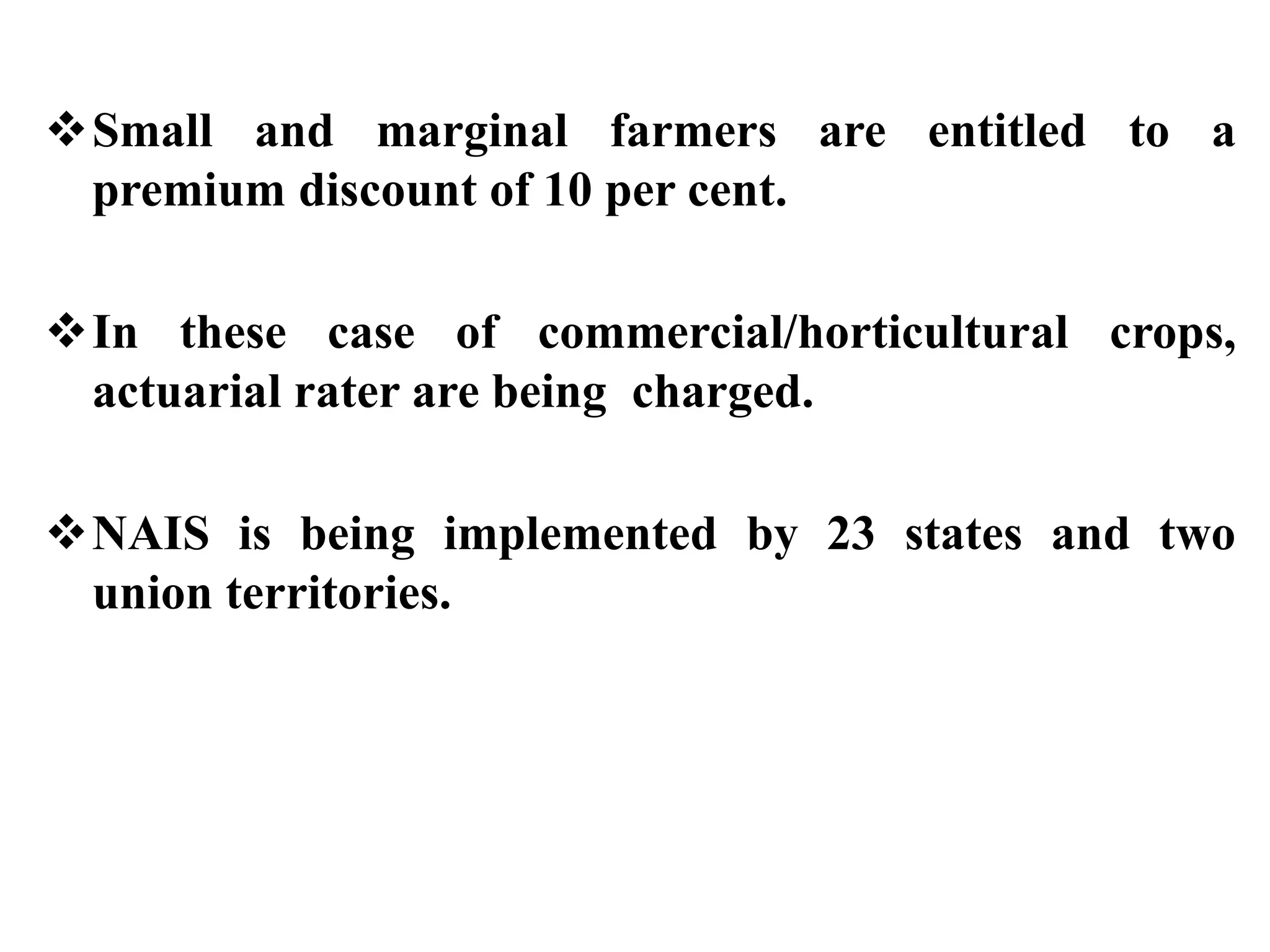
Small and marginal farmers are entitled to a
premium discount of 10 per cent.
In these case of commercial/horticultural crops,
actuarial rater are being charged.
NAIS is being implemented by 23 states and two
union territories.
INTRODUCTION OF CROP INSURANCE SCHEME
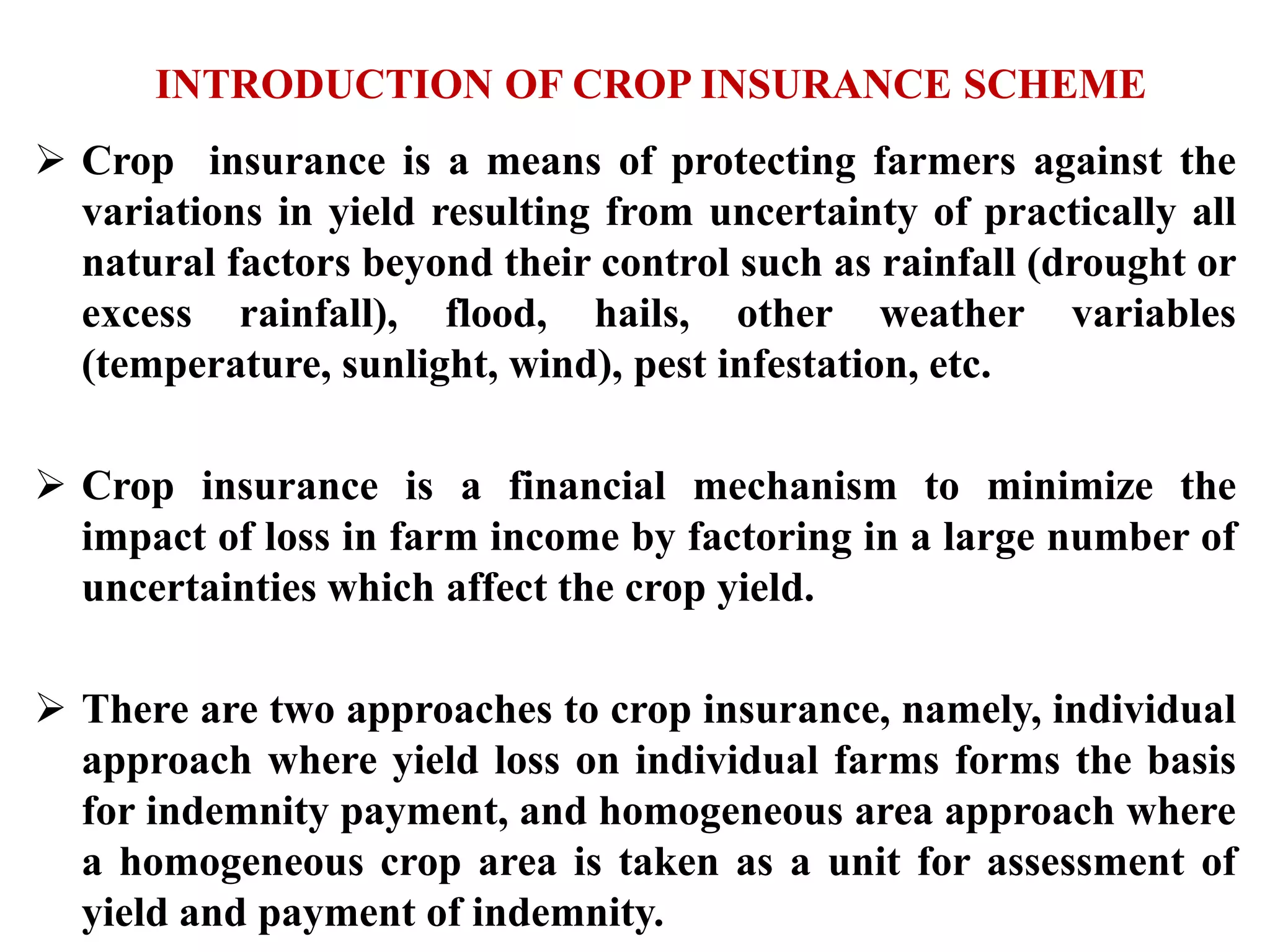
 Crop insurance is a means of protecting farmers against the
variations in yield resulting from uncertainty of practically all
natural factors beyond their control such as rainfall (drought or
excess rainfall), flood, hails, other weather variables
(temperature, sunlight, wind), pest infestation, etc.
 Crop insurance is a financial mechanism to minimize the
impact of loss in farm income by factoring in a large number of
uncertainties which affect the crop yield.
 There are two approaches to crop insurance, namely, individual
approach where yield loss on individual farms forms the basis
for indemnity payment, and homogeneous area approach where
a homogeneous crop area is taken as a unit for assessment of
yield and payment of indemnity.
Evolution of Crop Insurance
 J S Chakravarthi proposed ‘Drought Insurance’ based on
rainfall index in 1920
 First ever crop insurance started in 1972 for H-4 cotton
based on ‘individual farm’
 In 1979 a pilot insurance was introduced based on
‘homogenous area’ based yield index (Pilot Crop Insurance
Scheme – PCIS)
 In 1985 the PCIS was converted into a country-wide ‘yield
index’ based crop insurance covering cereals, millets, pulses
and oilseeds (Comprehensive Crop Insurance Scheme –
CCIS)
 Scope of CCIS expanded in 1999 as National
Agricultural Insurance Scheme – NAIS
 Pilot Farm Income Insurance Scheme(FIIS)
 Weather Based Crop Insurance Scheme –
WBCIS was introduced from 2007
 Modified NAIS as pilot in 50 Districts from
Rabi 2010-11 season
OBJECTIVES OF CROP INSURANCE
• To provide insurance coverage and financial
support to the farmers in the event of
prevented sowing & failure of any of the
notified crop as a result of natural calamities,
pests & diseases.
• To encourage the farmers to adopt progressive
farming practices, high value in-puts and
higher technology in Agriculture.
• To help stabilize farm incomes, particularly in
disaster years.
Key Features Of Crop Insurance
 Credit linkage, and mandatory for borrowing farmers
 Risk covered is based on production cost (safety-net)
 Credit institutions also finance the premium (in addition to
crop loan)
 Insurance acts as collateral, and lending agencies have the
first lien on claim
 Minimal distribution costs
 Claims process is automated
 Yield estimation is done by the provincial government
agencies , and based on ‘single series’
 Weather product uses crop modeling inputs
 Weather data comes from both public as well as
private data providers
 Extension activities and awareness programs are
also organized By the government
 Private insurance providers are allowed for
actuarially priced programs, and enjoy same level
of support as AIC
 Government provides for about 2/3rd cot of the
program
Existing Crop Insurance Schemes
 NAIS: yield based; non-actuarial premium
except horticultural crops / annual commercial
crops; underwriting of losses by Central & State
Govt. on 50:50 ratio
 WBCIS: weather based ; actuarial premium
with premium subsidy shared equally by
Central & State Govt.
 CCIS: Crop based; actuarial premium
 MNAIS: yield based; actuarial premium with
premium subsidy shared equally by Central &
State Govt.
NATIAONALAGRICULTURAL
INSURANCE SCHEME (NAIS)
• For improving the scope and content of CCIS a
broad based NAIS was introduced from Rabi 1999-
2000.
• NAIS provides for greater coverage of farmers, crops
and risk commitment.
• Premium-structure has been rationalized and the
scheme is required to operate at smaller unit area of
insurance.
• Subsidy to Small and Marginal farmers.
• It is presently being implemented by 25 States & 2
Union Territories
• In last 22 Crop Season:
Farmers Covered : 17.01 crore ( Av. not more
than 15% farmers)
Premium Collected: Rs. 6213.41 crore
Claims Paid : Rs. 20437.21 crore
Claim ratio : 3.29
Loss cost : 9.86%
State-wise farmers benefited under NAIS
(in lakhs)
0
10
20
30
40
50
60
70
80
90
Mah
Raj
Andhra
Karn
UP
MP
Guj
WB
Bihar
Jhar'nd
Orissa
Chatisgarh
TN
Others
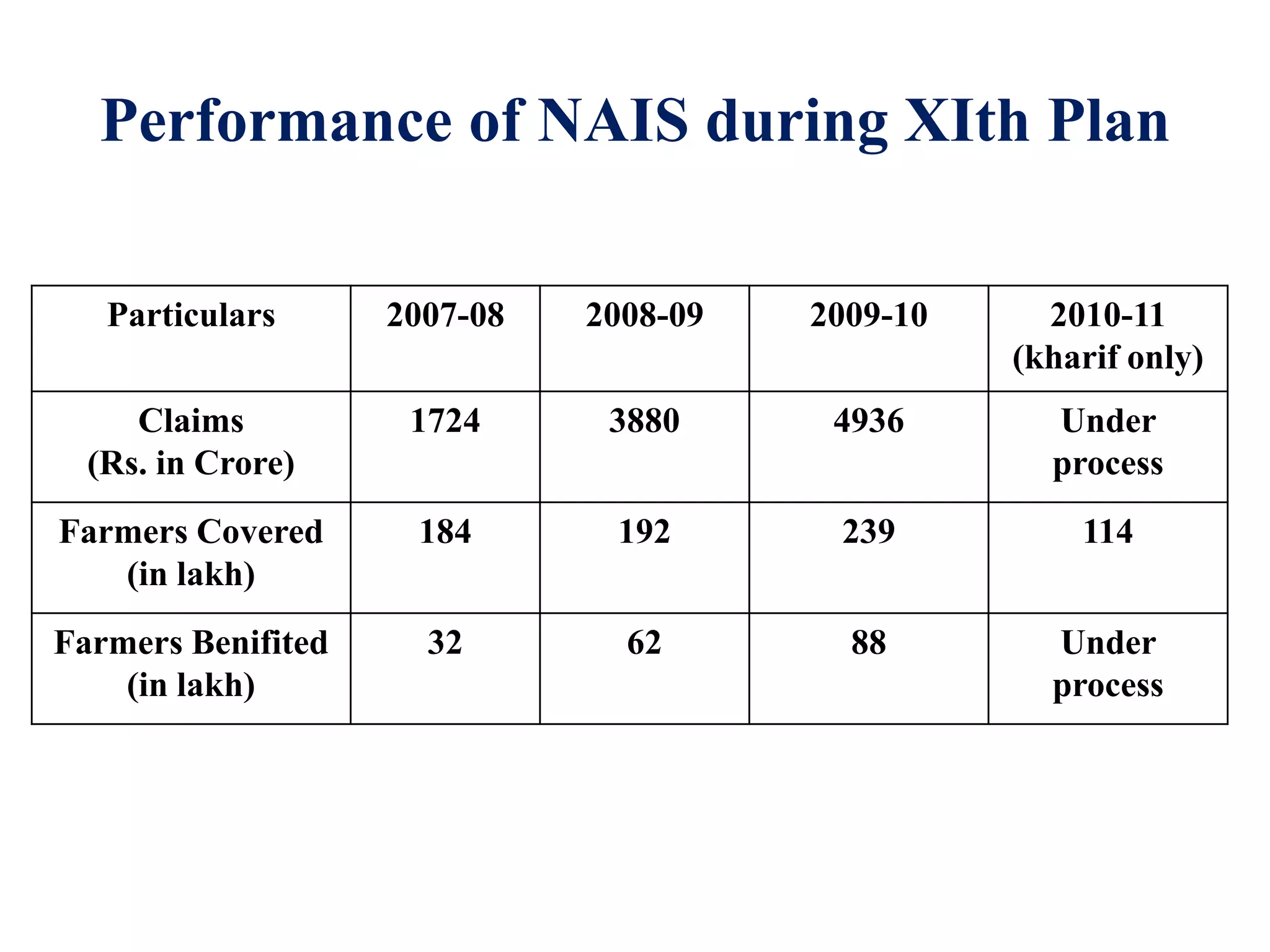
Performance of NAIS during XIth Plan
Particulars 2007-08 2008-09 2009-10 2010-11
(kharif only)
Claims
(Rs. in Crore)
1724 3880 4936 Under
process
Farmers Covered
(in lakh)
184 192 239 114
Farmers Benifited
(in lakh)
32 62 88 Under
process
Limitations of NAIS
Large insurance unit are
Delay in payment of claims due to late submission of
yield data & availability of Govt. funds
Pre-sowing/ planting Risk is not covered
Unattractive basis of calculation of threshold yield,
Low indemnity level,
Localised calamities are not covered
Post Harvest Losses are not covered
Different seasonality discipline for loanee & non-
loanee farmers
Lack of competition
Main Recommendations of JG Report
 Actuarial premium regime with suitable subsidy
 Reduction in insurance unit area to Gram Panchayat
 Basis of calculation of threshold yield –best 5 of 7 years’
yield
 Higher indemnity levels of 80% & 90%
 Coverage of:
 Pre-sowing & post-harvest losses
 Perennial crops
 Personal accident
 Package insurance policies covering other assets of
farmers, including Animal Husbandry
 Private insurers to be encouraged,
 Exemption from Income Tax & Service Tax so that an
adequate Catastrophic Reserve Fund can be built
SI.
NO.
Actuarial Premium
(% of SI)
Subsidy to farmers
(equally shared by
central and state Govt.)
Premium payable
by farmer
1 Upto 2 % NILL Upto 2 %
2 > 2-5 % 40 % subject to
minimum net premium
of 2 % of SI
2-3 %
3 > 5-10 % 50% subject to
minimum net premium
of 3% of SI
3-5 %
4 > 10-15 % 60% subject to net
premium of 5% of SI
5-6 %
5 > 15 % 17% subject to
minimum net premium
of 6% of SI
= > 6 %
Subsidy & Net Premium for Farmers under
MNAIS
MNAIS- Present Status
 Implemented in 34 districts covering 22 States during
Rabi 2010-11 season
 The scheme would be on actuarial regime in which
insurance company will receive premium on commercial
basis and will be responsible for all claims
 GOI & State Govts. will provide premium subsidy upto a
max. of 75% at different slabs of actuarial premium to
make the scheme affordable for farmers
 The coverage in Pilot MNAIS is expected to 25% of total
farmers of 50 districts.
Area Yield Index and Weather Index:
Advantage and Challenges
Area Index Weather Based Index
All peril covers (drought, excess
rainfall, flood, pest, & disease)
resulted yield
Single or sometimes multiple perils
cover rainfall-(excess & deficit),
temperature, relative humidity.
Easy design Technical challenges in index design
(peril,crop, farming practices, agro-
meteorological zone etc.)
Lower start-up costs High start-up cost
High loss assessment cost Lower loss assessment cost
Slow claims sttelment
ADVANTAGE OF CROP INSURANCE
 It stabilizes the farm business during the period of crop failure,
 The farmer can act much more confidently in farm business as there is
protection against hazards of farming,
 The necessary payment of premium inculcates a habit of thrift among the
farmers,
 It prevents the farmers to approach non-institutional agencies during the
periods of crop failure,
 It enhances the use of modern inputs to boost the productivity in
agriculture,
 In high-risk areas crop insurance serves as a catalyst I bringing areas under
cultivation which otherwise remained un cultivation.
SUGGESTIONS OF IMPROVING CROP
INSURANCE SCHEME
 All crops and all farmers should be brought under the
purview of the scheme,
 The premium rates should vary with the nature and index of
crop production in different areas,
 The defined unit area for paying indemnity should be a village
or group of village as against block , as is being considering at
present,
 Threshold yield should be worked out by considering indices of
crop production over a 10-year priod as against five-year
period, etc.
CROP INSURANCE SCHEME

CROP INSURANCE SCHEME

  • 1.
    AN ASSIGNMENT ON “CROP INSURANCE SCHEME” COURSETITLE :- AGRICULTURE FINANCE AND PROJECT MANAGEMENT COURSE NO. :- AG ECON – 509 CREDIT NO. :- 3 (2+1) SUBMITTED TO SUBMITTED BY DR. A.K. GAURAHA OM KUMAR NETAM (ASST.PROF.) M.Sc.(Ag.)PREVIOUS DEPT. OF AGRIL. ECONOMICS DEPT. OF AGRIL. ‘ECONOMICS’
  • 2.
     HISTORY OFCROP INSURANCE SCHEME IN INDIA  The recent history of crop insurance scheme in India is chronicled by Dandekar (1976) and Dandekar (1985).  In 1965 , the central government proposed a model crop insurance scheme.  In 1971 , expert committee was formed to evaluate the model scheme.  In 1972 , an experimental crop insurance scheme was established to promote first time hybrid cotton production in the selected areas of Gujrat.  A crop insurance scheme linking institutional credit ( crop loan based on area approach ) was suggested by Prof. Dandekar in 1978 and his scheme called as CCIS (comprehensive crop insurance scheme).
  • 3.
     On June23, 1999 the prime minister launched a new crop insurance called Rashtriya Krishi Bima Yojna (RKBY) Under the National Agriculture Insurance Scheme (NAIS).  Participation in RKBY was compulsory for farmers growing notified crops and availing crop loans from formal credit institutions.  A farmer may also insure his crop beyond the value of threshold yield level up to 150 per cent of average yield of notified area on payment of premium at commercial rates.  Under NAIS premium rates are - Crop Premium rates (%) Bajra and oilseed 3.5 Other Kharif Crops 2.5 Wheat 1.5 Other Rabi Crops 2
  • 4.
    Small and marginalfarmers are entitled to a premium discount of 10 per cent. In these case of commercial/horticultural crops, actuarial rater are being charged. NAIS is being implemented by 23 states and two union territories.
  • 5.
    INTRODUCTION OF CROPINSURANCE SCHEME  Crop insurance is a means of protecting farmers against the variations in yield resulting from uncertainty of practically all natural factors beyond their control such as rainfall (drought or excess rainfall), flood, hails, other weather variables (temperature, sunlight, wind), pest infestation, etc.  Crop insurance is a financial mechanism to minimize the impact of loss in farm income by factoring in a large number of uncertainties which affect the crop yield.  There are two approaches to crop insurance, namely, individual approach where yield loss on individual farms forms the basis for indemnity payment, and homogeneous area approach where a homogeneous crop area is taken as a unit for assessment of yield and payment of indemnity.
  • 6.
    Evolution of CropInsurance  J S Chakravarthi proposed ‘Drought Insurance’ based on rainfall index in 1920  First ever crop insurance started in 1972 for H-4 cotton based on ‘individual farm’  In 1979 a pilot insurance was introduced based on ‘homogenous area’ based yield index (Pilot Crop Insurance Scheme – PCIS)  In 1985 the PCIS was converted into a country-wide ‘yield index’ based crop insurance covering cereals, millets, pulses and oilseeds (Comprehensive Crop Insurance Scheme – CCIS)
  • 7.
     Scope ofCCIS expanded in 1999 as National Agricultural Insurance Scheme – NAIS  Pilot Farm Income Insurance Scheme(FIIS)  Weather Based Crop Insurance Scheme – WBCIS was introduced from 2007  Modified NAIS as pilot in 50 Districts from Rabi 2010-11 season
  • 8.
    OBJECTIVES OF CROPINSURANCE • To provide insurance coverage and financial support to the farmers in the event of prevented sowing & failure of any of the notified crop as a result of natural calamities, pests & diseases. • To encourage the farmers to adopt progressive farming practices, high value in-puts and higher technology in Agriculture. • To help stabilize farm incomes, particularly in disaster years.
  • 9.
    Key Features OfCrop Insurance  Credit linkage, and mandatory for borrowing farmers  Risk covered is based on production cost (safety-net)  Credit institutions also finance the premium (in addition to crop loan)  Insurance acts as collateral, and lending agencies have the first lien on claim  Minimal distribution costs  Claims process is automated  Yield estimation is done by the provincial government agencies , and based on ‘single series’
  • 10.
     Weather productuses crop modeling inputs  Weather data comes from both public as well as private data providers  Extension activities and awareness programs are also organized By the government  Private insurance providers are allowed for actuarially priced programs, and enjoy same level of support as AIC  Government provides for about 2/3rd cot of the program
  • 11.
    Existing Crop InsuranceSchemes  NAIS: yield based; non-actuarial premium except horticultural crops / annual commercial crops; underwriting of losses by Central & State Govt. on 50:50 ratio  WBCIS: weather based ; actuarial premium with premium subsidy shared equally by Central & State Govt.  CCIS: Crop based; actuarial premium  MNAIS: yield based; actuarial premium with premium subsidy shared equally by Central & State Govt.
  • 12.
    NATIAONALAGRICULTURAL INSURANCE SCHEME (NAIS) •For improving the scope and content of CCIS a broad based NAIS was introduced from Rabi 1999- 2000. • NAIS provides for greater coverage of farmers, crops and risk commitment. • Premium-structure has been rationalized and the scheme is required to operate at smaller unit area of insurance.
  • 13.
    • Subsidy toSmall and Marginal farmers. • It is presently being implemented by 25 States & 2 Union Territories • In last 22 Crop Season: Farmers Covered : 17.01 crore ( Av. not more than 15% farmers) Premium Collected: Rs. 6213.41 crore Claims Paid : Rs. 20437.21 crore Claim ratio : 3.29 Loss cost : 9.86%
  • 14.
    State-wise farmers benefitedunder NAIS (in lakhs) 0 10 20 30 40 50 60 70 80 90 Mah Raj Andhra Karn UP MP Guj WB Bihar Jhar'nd Orissa Chatisgarh TN Others
  • 15.
    Performance of NAISduring XIth Plan Particulars 2007-08 2008-09 2009-10 2010-11 (kharif only) Claims (Rs. in Crore) 1724 3880 4936 Under process Farmers Covered (in lakh) 184 192 239 114 Farmers Benifited (in lakh) 32 62 88 Under process
  • 16.
    Limitations of NAIS Largeinsurance unit are Delay in payment of claims due to late submission of yield data & availability of Govt. funds Pre-sowing/ planting Risk is not covered Unattractive basis of calculation of threshold yield, Low indemnity level,
  • 17.
    Localised calamities arenot covered Post Harvest Losses are not covered Different seasonality discipline for loanee & non- loanee farmers Lack of competition
  • 18.
    Main Recommendations ofJG Report  Actuarial premium regime with suitable subsidy  Reduction in insurance unit area to Gram Panchayat  Basis of calculation of threshold yield –best 5 of 7 years’ yield  Higher indemnity levels of 80% & 90%  Coverage of:  Pre-sowing & post-harvest losses  Perennial crops  Personal accident  Package insurance policies covering other assets of farmers, including Animal Husbandry  Private insurers to be encouraged,  Exemption from Income Tax & Service Tax so that an adequate Catastrophic Reserve Fund can be built
  • 19.
    SI. NO. Actuarial Premium (% ofSI) Subsidy to farmers (equally shared by central and state Govt.) Premium payable by farmer 1 Upto 2 % NILL Upto 2 % 2 > 2-5 % 40 % subject to minimum net premium of 2 % of SI 2-3 % 3 > 5-10 % 50% subject to minimum net premium of 3% of SI 3-5 % 4 > 10-15 % 60% subject to net premium of 5% of SI 5-6 % 5 > 15 % 17% subject to minimum net premium of 6% of SI = > 6 % Subsidy & Net Premium for Farmers under MNAIS
  • 20.
    MNAIS- Present Status Implemented in 34 districts covering 22 States during Rabi 2010-11 season  The scheme would be on actuarial regime in which insurance company will receive premium on commercial basis and will be responsible for all claims  GOI & State Govts. will provide premium subsidy upto a max. of 75% at different slabs of actuarial premium to make the scheme affordable for farmers  The coverage in Pilot MNAIS is expected to 25% of total farmers of 50 districts.
  • 21.
    Area Yield Indexand Weather Index: Advantage and Challenges Area Index Weather Based Index All peril covers (drought, excess rainfall, flood, pest, & disease) resulted yield Single or sometimes multiple perils cover rainfall-(excess & deficit), temperature, relative humidity. Easy design Technical challenges in index design (peril,crop, farming practices, agro- meteorological zone etc.) Lower start-up costs High start-up cost High loss assessment cost Lower loss assessment cost Slow claims sttelment
  • 22.
    ADVANTAGE OF CROPINSURANCE  It stabilizes the farm business during the period of crop failure,  The farmer can act much more confidently in farm business as there is protection against hazards of farming,  The necessary payment of premium inculcates a habit of thrift among the farmers,  It prevents the farmers to approach non-institutional agencies during the periods of crop failure,  It enhances the use of modern inputs to boost the productivity in agriculture,  In high-risk areas crop insurance serves as a catalyst I bringing areas under cultivation which otherwise remained un cultivation.
  • 23.
    SUGGESTIONS OF IMPROVINGCROP INSURANCE SCHEME  All crops and all farmers should be brought under the purview of the scheme,  The premium rates should vary with the nature and index of crop production in different areas,  The defined unit area for paying indemnity should be a village or group of village as against block , as is being considering at present,  Threshold yield should be worked out by considering indices of crop production over a 10-year priod as against five-year period, etc.