
PRESENTATION
ON
NABARD
SUBMITTED TO PRESENTED BY
Dr. A.K. Gauraha omprakash sonvanee
Professor M.Sc. Pre. Year
Dept. Of Agri. economics Dept. Of Agri.economics
NABARD
(NATIONAL BANK FOR AGRICULTURE
AND RURAL DEVELOPMENT)
• INTRODUCTION-
• NABARD was established on 12 July 1982(6th FYP)
• Headquarter-Mumbai.
• NABARD is set up as apex development bank
• It also has the mandate to support all other allied
economic activities promote integrated and
sustainable rural development and secure prosperity
of rural areas.
Historical & Genesis Background
• The Committee to Review Arrangements for
Institutional Credit for Agriculture and Rural
Development (CRAFICARD), in 1979 set up by the
Reserve Bank of India (RBI) under the Chairmanship
of Shri B. Sivaraman, conceived and recommended
the establishment of the National Bank for
Agriculture and Rural Development (NABARD).
• It repleced the Agriculture Credit Department(ACD) and Rural
Planning and Credi Cell (RPCC) of Reserve Bank of India and
Agriculture Refinance and Development Corporation(ARDC).
• It has been accredited with "matters concerning policy,
planning and operations in the field of credit
for agriculture and other economic activities in rural
areas in India".
• RBI sold its stake in NABARD to the Government of
India, which now holds 99% stake.
•NABARD is active in developing financial inclusion policy
and is a member of the Alliance for Financial Inclusion.
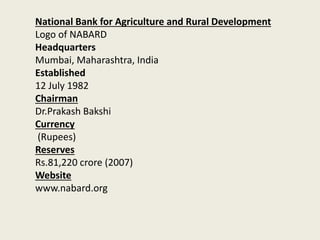
National Bank for Agriculture and Rural Development
Logo of NABARD
Headquarters
Mumbai, Maharashtra, India
Established
12 July 1982
Chairman
Dr.Prakash Bakshi
Currency
(Rupees)
Reserves
Rs.81,220 crore (2007)
Website
www.nabard.org
Organization structure
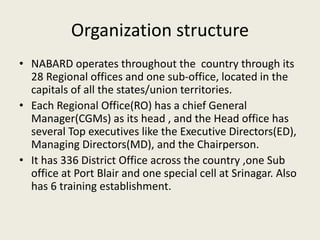
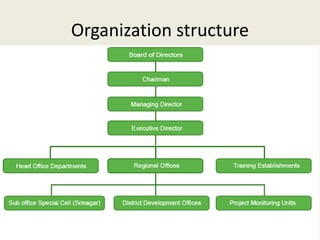
• NABARD operates throughout the country through its
28 Regional offices and one sub-office, located in the
capitals of all the states/union territories.
• Each Regional Office(RO) has a chief General
Manager(CGMs) as its head , and the Head office has
several Top executives like the Executive Directors(ED),
Managing Directors(MD), and the Chairperson.
• It has 336 District Office across the country ,one Sub
office at Port Blair and one special cell at Srinagar. Also
has 6 training establishment.
Organization structure
• It also has six training establishments in different
parts of the country for capacity building and
enhancement of the skills of its man power and also
of other organizations such as banks, NGOs, etc.,
who are equal partners in rural development.
Organization structure
MISSION
• Promoting sustainable agriculture and rural
development through effective credit support,
related services, institution building and other
innovative initiatives.
OBJECTIVE OF NABARD
• The bank will serve as a refinancing institution for
institutional credit such as long-term, short-turm
for the promotion of activities in the rural areas.
• The bank will also provide direct lending to any
institution as may approved by the central
government.
• Promote policies and practices conducive for
rural development.
• It will have close like with RBI for guidance and
assistance in financial matters.
NABARD, Role and Function
• Credit functions
• Developmental and Promotional Functions
• Supervisory Functions
• Institutional and Capacity building
• Role in Training
Role
•NABARD is the apex institution in the country which looks after the
development of the cottage industry, small industry and village
industry, and other rural industries.
• NABARD also reaches out to allied economies and supports and
promotes integrated development.
And to help NABARD discharge its duty, it has been given certain roles
as follows:
•Serves as an apex financing agency for the institutions providing
investment
•production credit for promoting the various developmental activities
in rural areas
Credit Functions
• NABARDs credit functions cover planning ,
dispensation and monitoring of credit.
This activity involves:
• Framing policy and guideline for rural financial
institutions.
• Providing credit facilities to issuing organization.
• Preparation of potential linked plans annually for
all districts for identification of credit potential.
• Monitoring the flow of ground level rural credit.
Short-term loan
• Agricultural production operations ,input like fertilizer,
seeds, pesticides etc.
• Production and marketing activities of village and cottage
industries, handcrafts and rural non farm enterprises.
Medium and long-term refinance
• Investment in agriculture and allied activities such as
minor irrigation , farm mechanization, land development,
soil conservation , dairy setting up of storage and market
yard.
• Conservation and rescheduling of refinance
• Under condition of drought, famines or other natural
calamities short term refinance facilities are converted in
to medium term refinance.
Developmental and Promotional
functions
• Development function concerning reinforcement of the
credit functions and making credit more productive.
• Help cooperative and regional rural banks to prepare
development action plan for themselves.
• Enter in to MOU state government and cooperative
banks ,specifying the obligations of each to improve
the banks affairs within astipulated time.
• It promote research in the field of rural banking ,
agriculture and rural development.
• Launched a project for linking SHGs to credit
institutions.
Supervisory Function
• Supervisory function ensuring the proper
functioning of cooperative banks and regional
rural banks .
• Undertakes inspections of regional rural
bank(RRBs) and cooperative banks under the
provisions of banking regulation Act,1949.
• Evaluating ,monitoring and inspecting the
client banks.
Role in Training
• Provide training for senior and middle level
executives of commercial banks , RRBs and
cooperative banks.
• Create awareness among the borrowers on
ethics of repayment through vikas volunteer
vahini/farmers clubs.
• Provide consultancy services in the field of
agriculture and rural development and other
related matters.
Schemes and Programmes
• Lounch of kisan Credit Card (KCC) in 1998.
• Rural Entrepreneurship Development Programme
(REDP).
• District Rural Industries Project (DRIP).
• Vlkas Volunteer Vahini Programme(Farmers Club
Programme).
• Farmers Technology Transfer Fund
• Umbrella Programme on Natural Resources
Management (UPNRM).
• SHG-Bank linkage Programme (Self help group)
• Development of Women and Children in Rural Areas.
Farmers Club Programme
• Mission Development of rural areas though
credit, technology transfer, awareness and
capacity building.
• Motivate farmers to adopt method and
technology which are most suitable to their soil
and geographical situation.
 Swarojgar Credit Card (SCC)Scheme
• Swarojgar Credit Card Scheme(SCC Scheme) was
introduced in September 2003.
• Aims at providing adequate and timely credit to
weaker section of society.
Kisan Credit Card Scheme
• NABARD formulated a model Kisan Credit Card
Scheme in consultation with major banks.
• Aims at provision of adequate and timely support
from the banking system to the farmers for their
cultivation need including purchase of input and
adopt technology.
 Women Development cell
• To take up activities for promoting increased
credit flow to women, organize awareness
programme .
• NABARD prepared guidelines for promoting
group activities under the programme and
provided 100 % refinance support.
Umbrella programme on natural
resource management (UPNRM)
• Improving livelihood situation in rural areas
through promoting and funding sustainable
use, management and conservation of natural
resources.
• Watershed development programme
• NABARD provides refinance to full extent for
project taken under National Watershed
Development Programme.
SHGs- Bank linkage programme (self
Help Groups)
• Conceptualization and introduction of pilot phase of
SHGs linkage programe in february1992 for linkage
500 SHGs with the banks after consultations with
RBI, bank and NGOs.
• Objective is to link the poor in large number to the
formal banking sector in a sustainable and cost
effective manner.
• The programme has been growing rapidly and the
number of SHGs financed increased from 81,780 in
1999-2000 to more then 6.87 lake in 2006-07.
Source of fund
• Authorized share capital of NABARD - Rs.2000
0crore.
• Issued and paid up capital 100 crore.
• Borrowing from the government of India and any
institution approved by government of India .
• Issue and sale of bounds by government of India.
• Deposits from state government and local
authorities.
• Gifts and grants received.
Microfinance and NABARD-
Thus the Reserve Bank of INDIA and NABARD has
laid out certain guidelines in 2006-07 for the
commercial banks, Regional Rural Banks and
Cooperative Banks to provide the data to RBI and
es data regarding loans given by banks to the
microfinance institutions.
NABARD a 100 % CSR company
•NABARD has been instrumental in grounding rural, social
innovations and social enterprises in the rural hinterlands.
• This endeavor is perhaps unparalleled in the country, it has
in the process partnered with about 4000 partner
organizations in grounding many of the interventions be it,
SHG-Bank Linkage programme, tree-based tribal
communities’ livelihoods initiative,
•watershed approach in soil and water conservation,
increasing crop productivity initiatives through lead crop
initiative or dissemination of information flow to agrarian
communities through Farmer clubs.
• Despite all this, it pays huge taxes too, to the
exchequer – figuring in the top 50 tax payers
consistently. NABARD virtually ploughs back all
the profits for development spending, in their
unending search for solutions and answers.
• Thus the organization had developed a huge
amount of trust capital in its 3 decades of work
with rural communities.
Thank you

Nabard

  • 1.
    PRESENTATION ON NABARD SUBMITTED TO PRESENTEDBY Dr. A.K. Gauraha omprakash sonvanee Professor M.Sc. Pre. Year Dept. Of Agri. economics Dept. Of Agri.economics
  • 2.
    NABARD (NATIONAL BANK FORAGRICULTURE AND RURAL DEVELOPMENT) • INTRODUCTION- • NABARD was established on 12 July 1982(6th FYP) • Headquarter-Mumbai. • NABARD is set up as apex development bank • It also has the mandate to support all other allied economic activities promote integrated and sustainable rural development and secure prosperity of rural areas.
  • 3.
    Historical & GenesisBackground • The Committee to Review Arrangements for Institutional Credit for Agriculture and Rural Development (CRAFICARD), in 1979 set up by the Reserve Bank of India (RBI) under the Chairmanship of Shri B. Sivaraman, conceived and recommended the establishment of the National Bank for Agriculture and Rural Development (NABARD). • It repleced the Agriculture Credit Department(ACD) and Rural Planning and Credi Cell (RPCC) of Reserve Bank of India and Agriculture Refinance and Development Corporation(ARDC).
  • 4.
    • It hasbeen accredited with "matters concerning policy, planning and operations in the field of credit for agriculture and other economic activities in rural areas in India". • RBI sold its stake in NABARD to the Government of India, which now holds 99% stake. •NABARD is active in developing financial inclusion policy and is a member of the Alliance for Financial Inclusion.
  • 5.
    National Bank forAgriculture and Rural Development Logo of NABARD Headquarters Mumbai, Maharashtra, India Established 12 July 1982 Chairman Dr.Prakash Bakshi Currency (Rupees) Reserves Rs.81,220 crore (2007) Website www.nabard.org
  • 6.
    Organization structure • NABARDoperates throughout the country through its 28 Regional offices and one sub-office, located in the capitals of all the states/union territories. • Each Regional Office(RO) has a chief General Manager(CGMs) as its head , and the Head office has several Top executives like the Executive Directors(ED), Managing Directors(MD), and the Chairperson. • It has 336 District Office across the country ,one Sub office at Port Blair and one special cell at Srinagar. Also has 6 training establishment.
  • 7.
    Organization structure • Italso has six training establishments in different parts of the country for capacity building and enhancement of the skills of its man power and also of other organizations such as banks, NGOs, etc., who are equal partners in rural development.
  • 8.
  • 9.
    MISSION • Promoting sustainableagriculture and rural development through effective credit support, related services, institution building and other innovative initiatives.
  • 10.
    OBJECTIVE OF NABARD •The bank will serve as a refinancing institution for institutional credit such as long-term, short-turm for the promotion of activities in the rural areas. • The bank will also provide direct lending to any institution as may approved by the central government. • Promote policies and practices conducive for rural development. • It will have close like with RBI for guidance and assistance in financial matters.
  • 11.
    NABARD, Role andFunction • Credit functions • Developmental and Promotional Functions • Supervisory Functions • Institutional and Capacity building • Role in Training
  • 12.
    Role •NABARD is theapex institution in the country which looks after the development of the cottage industry, small industry and village industry, and other rural industries. • NABARD also reaches out to allied economies and supports and promotes integrated development. And to help NABARD discharge its duty, it has been given certain roles as follows: •Serves as an apex financing agency for the institutions providing investment •production credit for promoting the various developmental activities in rural areas
  • 13.
    Credit Functions • NABARDscredit functions cover planning , dispensation and monitoring of credit. This activity involves: • Framing policy and guideline for rural financial institutions. • Providing credit facilities to issuing organization. • Preparation of potential linked plans annually for all districts for identification of credit potential. • Monitoring the flow of ground level rural credit.
  • 14.
    Short-term loan • Agriculturalproduction operations ,input like fertilizer, seeds, pesticides etc. • Production and marketing activities of village and cottage industries, handcrafts and rural non farm enterprises. Medium and long-term refinance • Investment in agriculture and allied activities such as minor irrigation , farm mechanization, land development, soil conservation , dairy setting up of storage and market yard. • Conservation and rescheduling of refinance • Under condition of drought, famines or other natural calamities short term refinance facilities are converted in to medium term refinance.
  • 15.
    Developmental and Promotional functions •Development function concerning reinforcement of the credit functions and making credit more productive. • Help cooperative and regional rural banks to prepare development action plan for themselves. • Enter in to MOU state government and cooperative banks ,specifying the obligations of each to improve the banks affairs within astipulated time. • It promote research in the field of rural banking , agriculture and rural development. • Launched a project for linking SHGs to credit institutions.
  • 16.
    Supervisory Function • Supervisoryfunction ensuring the proper functioning of cooperative banks and regional rural banks . • Undertakes inspections of regional rural bank(RRBs) and cooperative banks under the provisions of banking regulation Act,1949. • Evaluating ,monitoring and inspecting the client banks.
  • 17.
    Role in Training •Provide training for senior and middle level executives of commercial banks , RRBs and cooperative banks. • Create awareness among the borrowers on ethics of repayment through vikas volunteer vahini/farmers clubs. • Provide consultancy services in the field of agriculture and rural development and other related matters.
  • 18.
    Schemes and Programmes •Lounch of kisan Credit Card (KCC) in 1998. • Rural Entrepreneurship Development Programme (REDP). • District Rural Industries Project (DRIP). • Vlkas Volunteer Vahini Programme(Farmers Club Programme). • Farmers Technology Transfer Fund • Umbrella Programme on Natural Resources Management (UPNRM). • SHG-Bank linkage Programme (Self help group) • Development of Women and Children in Rural Areas.
  • 19.
    Farmers Club Programme •Mission Development of rural areas though credit, technology transfer, awareness and capacity building. • Motivate farmers to adopt method and technology which are most suitable to their soil and geographical situation.  Swarojgar Credit Card (SCC)Scheme • Swarojgar Credit Card Scheme(SCC Scheme) was introduced in September 2003. • Aims at providing adequate and timely credit to weaker section of society.
  • 20.
    Kisan Credit CardScheme • NABARD formulated a model Kisan Credit Card Scheme in consultation with major banks. • Aims at provision of adequate and timely support from the banking system to the farmers for their cultivation need including purchase of input and adopt technology.  Women Development cell • To take up activities for promoting increased credit flow to women, organize awareness programme . • NABARD prepared guidelines for promoting group activities under the programme and provided 100 % refinance support.
  • 21.
    Umbrella programme onnatural resource management (UPNRM) • Improving livelihood situation in rural areas through promoting and funding sustainable use, management and conservation of natural resources. • Watershed development programme • NABARD provides refinance to full extent for project taken under National Watershed Development Programme.
  • 22.
    SHGs- Bank linkageprogramme (self Help Groups) • Conceptualization and introduction of pilot phase of SHGs linkage programe in february1992 for linkage 500 SHGs with the banks after consultations with RBI, bank and NGOs. • Objective is to link the poor in large number to the formal banking sector in a sustainable and cost effective manner. • The programme has been growing rapidly and the number of SHGs financed increased from 81,780 in 1999-2000 to more then 6.87 lake in 2006-07.
  • 23.
    Source of fund •Authorized share capital of NABARD - Rs.2000 0crore. • Issued and paid up capital 100 crore. • Borrowing from the government of India and any institution approved by government of India . • Issue and sale of bounds by government of India. • Deposits from state government and local authorities. • Gifts and grants received.
  • 24.
    Microfinance and NABARD- Thusthe Reserve Bank of INDIA and NABARD has laid out certain guidelines in 2006-07 for the commercial banks, Regional Rural Banks and Cooperative Banks to provide the data to RBI and es data regarding loans given by banks to the microfinance institutions.
  • 25.
    NABARD a 100% CSR company •NABARD has been instrumental in grounding rural, social innovations and social enterprises in the rural hinterlands. • This endeavor is perhaps unparalleled in the country, it has in the process partnered with about 4000 partner organizations in grounding many of the interventions be it, SHG-Bank Linkage programme, tree-based tribal communities’ livelihoods initiative, •watershed approach in soil and water conservation, increasing crop productivity initiatives through lead crop initiative or dissemination of information flow to agrarian communities through Farmer clubs.
  • 26.
    • Despite allthis, it pays huge taxes too, to the exchequer – figuring in the top 50 tax payers consistently. NABARD virtually ploughs back all the profits for development spending, in their unending search for solutions and answers. • Thus the organization had developed a huge amount of trust capital in its 3 decades of work with rural communities.
  • 27.