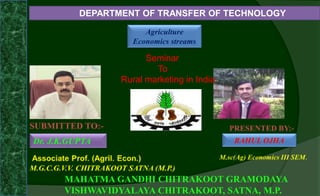
DEPARTMENT OF TRANSFER OF TECHNOLOGY
MAHATMA GANDHI CHITRAKOOT GRAMODAYA
VISHWAVIDYALAYA CHITRAKOOT, SATNA, M.P.
RAHUL OJHADr. J.K.GUPTA
Agriculture
Economics streams
Seminar
To
Rural marketing in India
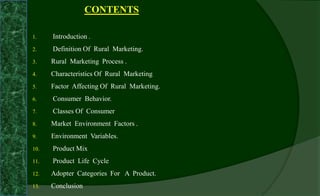
CONTENTS
1. Introduction .
2. Definition Of Rural Marketing.
3. Rural Marketing Process .
4. Characteristics Of Rural Marketing
5. Factor Affecting Of Rural Marketing.
6. Consumer Behavior.
7. Classes Of Consumer
8. Market Environment Factors .
9. Environment Variables.
10. Product Mix
11. Product Life Cycle
12. Adopter Categories For A Product.
13. Conclusion
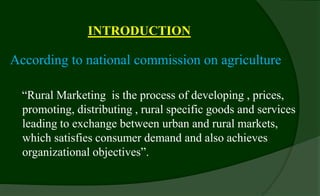
INTRODUCTION
According to national commission on agriculture
“Rural Marketing is the process of developing , prices,
promoting, distributing , rural specific goods and services
leading to exchange between urban and rural markets,
which satisfies consumer demand and also achieves
organizational objectives”.
Definition of Rural Marketing.
According to national commission of India-
“Rural marketing is defined as managing all the activities
involved in assessing, stimulating and converting the
purchasing power of the rural consumers into effective
demand for specific products and services and moving them
to the people in rural areas to create satisfaction and a better
standard of living and thus achieving organizational
objectives”.
IT IS A TWO -WAY MARKETING PROCESS WHERE IN:
Rural to urban-
Basically falls under agricultural marketing. A rural producer seeks to sell his
produce in urban market like seeds, fruits and vegetables, forest produce,
spices, milk and related products, etc.
Urban to rural-
Major part of rural marketing. Includes transactions of urban marketers who
sell their goods and services in rural areas pesticides, fertilizers, FMCG
products, tractors, bicycles, consumer durables, etc.
Rural to rural-
Includes the activities that take place between two villages in close proximity
to each other like agricultural tools, handicrafts, dress materials, bullock carts,
etc.
CHARACTERISTICS OF RURAL
MARKETING
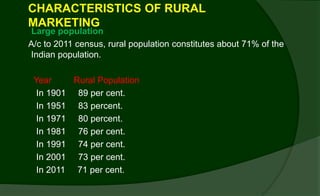
Large population
A/c to 2011 census, rural population constitutes about 71% of the
Indian population.
Year Rural Population
In 1901 89 per cent.
In 1951 83 percent.
In 1971 80 percent.
In 1981 76 per cent.
In 1991 74 per cent.
In 2001 73 per cent.
In 2011 71 per cent.
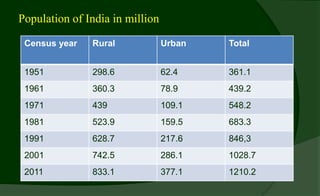
Census year Rural Urban Total
1951 298.6 62.4 361.1
1961 360.3 78.9 439.2
1971 439 109.1 548.2
1981 523.9 159.5 683.3
1991 628.7 217.6 846,3
2001 742.5 286.1 1028.7
2011 833.1 377.1 1210.2
Population of India in million
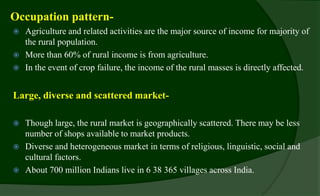
Occupation pattern-
 Agriculture and related activities are the major source of income for majority of
the rural population.
 More than 60% of rural income is from agriculture.
 In the event of crop failure, the income of the rural masses is directly affected.
Large, diverse and scattered market-
 Though large, the rural market is geographically scattered. There may be less
number of shops available to market products.
 Diverse and heterogeneous market in terms of religious, linguistic, social and
cultural factors.
 About 700 million Indians live in 6 38 365 villages across India.
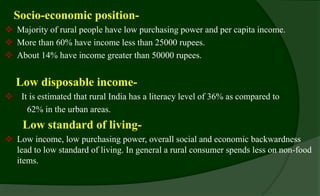
Socio-economic position-
 Majority of rural people have low purchasing power and per capita income.
 More than 60% have income less than 25000 rupees.
 About 14% have income greater than 50000 rupees.
Low disposable income-
 It is estimated that rural India has a literacy level of 36% as compared to
62% in the urban areas.
Low standard of living-
 Low income, low purchasing power, overall social and economic backwardness
lead to low standard of living. In general a rural consumer spends less on non-food
items.
INADEQUATE INFRASTRUCTURE FACILITIES-
 Infrastructure facilities like cemented roads, warehouses, and communication
system are inadequate in rural areas.
 About 20% of the six lakh villages are without telephone facility even today.
 About 50% of the markets are not connected by road. Most of the roads are
kachha and become unusable during rainy season.
Traditional outlook
 Villages develop slowly and have a traditional outlook.
 They accept changes gradually.
Distance
 Villages nearer to towns have elements of the urban life.
 Interior villages are more traditional.
Diverse socio-economic background-
Due to dispersion of geographical areas and uneven land fertility, rural people have
diverse socio-economic background.
Conservative lifestyle-
Lifestyle bounded by tradition, culture, religion and community.
Media reach-
The media reach in rural household is low.
Statistics indicates that the reach of Print media is 10%, followed by TV 31%, Radio
32% and Cinema 36%.
Medical facilities-
Medical facilities are quite inadequate and the villagers have to travel long distances
for getting medical treatment.
FACTOR AFFECTING OF RURAL MARKETING.
A - Psychological factor
 Needs and Motives.
 Attitude and Believes..
 Perception.
B- Personal factor
 Personality and self concept.
 life style.
 Education.
 Age, stage , family life style.
 Occupation .
c- Situational factor
 Physical surrounding of the purchase.
 Social surrounding of consumption.
 Time task definition.
d- Economic factor
 Income.
 Future income expectation.
 Liquid assets .
 Credit facility.
e- Social and Cultural factor
 Family.
 Social class.
 References group.
What is Consumer Behavior ?
Consumer Behavior is a branch which deals with the various stages a consumer
goes through before purchasing products or services for his end use.
Classification of consumer
The rural consumers are classified into the following groups based on their
economic status:
The Affluent Group
 They are case rich farmer.
 Very few number .
 They have affordability but do not form a demand base large enough for
marketing firms to depend on.
 Wheat farmers in Punjab and rice merchants of Andhra Pradesh fall in this
category.
The Middle Class-
 Of the largest segments for manufactured goods.
 It is fast expanding.
 Farmers cultivating sugar cane in UP and Karnataka fall in this
category.
The Poor-
 This constitutes a huge segment.
 Purchasing power is less, but strength is more.
 The farmers of Bihar and Orissa fall under this category.
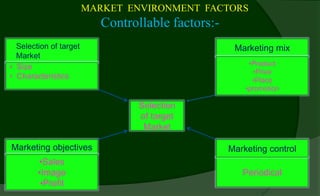
MARKET ENVIRONMENT FACTORS
Controllable factors:-
Selection of target
Market
• Size
• Characteristics
Selection
of target
Market
Marketing mix
•Product
•Price
•Place
•promotion
Marketing objectives
•Sales
•Image
•Profit
Periodical
Marketing control
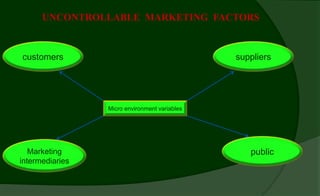
customers suppliers
publicMarketing
intermediaries
Micro environment variables
UNCONTROLLABLE MARKETING FACTORS
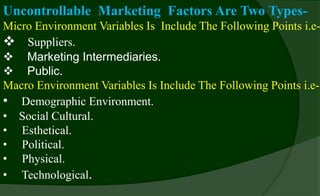
Uncontrollable Marketing Factors Are Two Types-
Micro Environment Variables Is Include The Following Points i.e-
 Suppliers.
 Marketing Intermediaries.
 Public.
Macro Environment Variables Is Include The Following Points i.e-
• Demographic Environment.
• Social Cultural.
• Esthetical.
• Political.
• Physical.
• Technological.
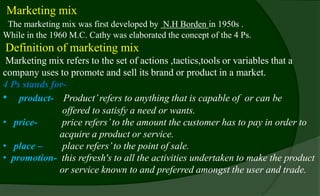
Marketing mix
The marketing mix was first developed by N.H Borden in 1950s .
While in the 1960 M.C. Cathy was elaborated the concept of the 4 Ps.
Definition of marketing mix –
Marketing mix refers to the set of actions ,tactics,tools or variables that a
company uses to promote and sell its brand or product in a market.
4 Ps stands for-
• product- Product’refers to anything that is capable of or can be
offered to satisfy a need or wants.
• price- price refers’to the amount the customer has to pay in order to
acquire a product or service.
• place – place refers’to the point of sale.
• promotion- this refresh's to all the activities undertaken to make the product
or service known to and preferred amongst the user and trade.
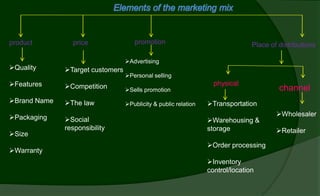
product price promotion Place of distributions
Quality
Features
Brand Name
Packaging
Size
Warranty
Target customers
Competition
The law
Social
responsibility
Advertising
Personal selling
Sells promotion
Publicity & public relation Transportation
Warehousing &
storage
Order processing
Inventory
control/location
Wholesaler
Retailer
physical
channel
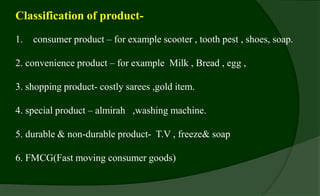
Classification of product-
1. consumer product – for example scooter , tooth pest , shoes, soap.
2. convenience product – for example Milk , Bread , egg ,
3. shopping product- costly sarees ,gold item.
4. special product – almirah ,washing machine.
5. durable & non-durable product- T.V , freeze& soap
6. FMCG(Fast moving consumer goods)
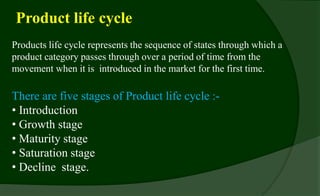
Product life cycle
Products life cycle represents the sequence of states through which a
product category passes through over a period of time from the
movement when it is introduced in the market for the first time.
There are five stages of Product life cycle :-
• Introduction
• Growth stage
• Maturity stage
• Saturation stage
• Decline stage.
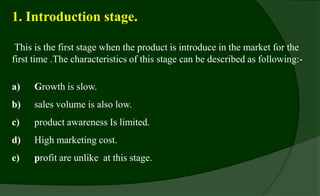
1. Introduction stage.
This is the first stage when the product is introduce in the market for the
first time .The characteristics of this stage can be described as following:-
a) Growth is slow.
b) sales volume is also low.
c) product awareness Is limited.
d) High marketing cost.
e) profit are unlike at this stage.
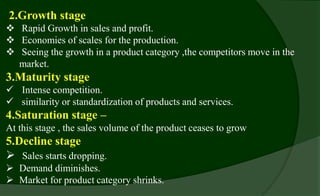
2.Growth stage
 Rapid Growth in sales and profit.
 Economies of scales for the production.
 Seeing the growth in a product category ,the competitors move in the
market.
3.Maturity stage
 Intense competition.
 similarity or standardization of products and services.
4.Saturation stage –
At this stage , the sales volume of the product ceases to grow
5.Decline stage
 Sales starts dropping.
 Demand diminishes.
 Market for product category shrinks.
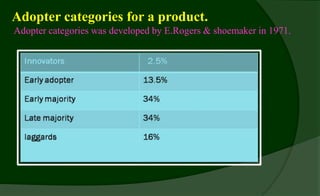
Adopter categories for a product.
Adopter categories was developed by E.Rogers & shoemaker in 1971.
Conclusion
 The rural market is very large in compare to the urban market as well as
it is more challenging market.
 The consumer wants those products which are long lasting, good, easy
to use and cheaper.
 The income level of rural consumers is not as high as the income level
of urban consumers that’s why they want low price goods.
 So we can say that “ rural marketing is real marketing and heart of
India”
RURAL MARKETING

RURAL MARKETING

  • 3.
    DEPARTMENT OF TRANSFEROF TECHNOLOGY MAHATMA GANDHI CHITRAKOOT GRAMODAYA VISHWAVIDYALAYA CHITRAKOOT, SATNA, M.P. RAHUL OJHADr. J.K.GUPTA Agriculture Economics streams Seminar To Rural marketing in India
  • 4.
    CONTENTS 1. Introduction . 2.Definition Of Rural Marketing. 3. Rural Marketing Process . 4. Characteristics Of Rural Marketing 5. Factor Affecting Of Rural Marketing. 6. Consumer Behavior. 7. Classes Of Consumer 8. Market Environment Factors . 9. Environment Variables. 10. Product Mix 11. Product Life Cycle 12. Adopter Categories For A Product. 13. Conclusion
  • 5.
    INTRODUCTION According to nationalcommission on agriculture “Rural Marketing is the process of developing , prices, promoting, distributing , rural specific goods and services leading to exchange between urban and rural markets, which satisfies consumer demand and also achieves organizational objectives”.
  • 6.
    Definition of RuralMarketing. According to national commission of India- “Rural marketing is defined as managing all the activities involved in assessing, stimulating and converting the purchasing power of the rural consumers into effective demand for specific products and services and moving them to the people in rural areas to create satisfaction and a better standard of living and thus achieving organizational objectives”.
  • 7.
    IT IS ATWO -WAY MARKETING PROCESS WHERE IN: Rural to urban- Basically falls under agricultural marketing. A rural producer seeks to sell his produce in urban market like seeds, fruits and vegetables, forest produce, spices, milk and related products, etc. Urban to rural- Major part of rural marketing. Includes transactions of urban marketers who sell their goods and services in rural areas pesticides, fertilizers, FMCG products, tractors, bicycles, consumer durables, etc. Rural to rural- Includes the activities that take place between two villages in close proximity to each other like agricultural tools, handicrafts, dress materials, bullock carts, etc.
  • 10.
    CHARACTERISTICS OF RURAL MARKETING Largepopulation A/c to 2011 census, rural population constitutes about 71% of the Indian population. Year Rural Population In 1901 89 per cent. In 1951 83 percent. In 1971 80 percent. In 1981 76 per cent. In 1991 74 per cent. In 2001 73 per cent. In 2011 71 per cent.
  • 11.
    Census year RuralUrban Total 1951 298.6 62.4 361.1 1961 360.3 78.9 439.2 1971 439 109.1 548.2 1981 523.9 159.5 683.3 1991 628.7 217.6 846,3 2001 742.5 286.1 1028.7 2011 833.1 377.1 1210.2 Population of India in million
  • 12.
    Occupation pattern-  Agricultureand related activities are the major source of income for majority of the rural population.  More than 60% of rural income is from agriculture.  In the event of crop failure, the income of the rural masses is directly affected. Large, diverse and scattered market-  Though large, the rural market is geographically scattered. There may be less number of shops available to market products.  Diverse and heterogeneous market in terms of religious, linguistic, social and cultural factors.  About 700 million Indians live in 6 38 365 villages across India.
  • 13.
    Socio-economic position-  Majorityof rural people have low purchasing power and per capita income.  More than 60% have income less than 25000 rupees.  About 14% have income greater than 50000 rupees. Low disposable income-  It is estimated that rural India has a literacy level of 36% as compared to 62% in the urban areas. Low standard of living-  Low income, low purchasing power, overall social and economic backwardness lead to low standard of living. In general a rural consumer spends less on non-food items.
  • 14.
    INADEQUATE INFRASTRUCTURE FACILITIES- Infrastructure facilities like cemented roads, warehouses, and communication system are inadequate in rural areas.  About 20% of the six lakh villages are without telephone facility even today.  About 50% of the markets are not connected by road. Most of the roads are kachha and become unusable during rainy season. Traditional outlook  Villages develop slowly and have a traditional outlook.  They accept changes gradually. Distance  Villages nearer to towns have elements of the urban life.  Interior villages are more traditional.
  • 15.
    Diverse socio-economic background- Dueto dispersion of geographical areas and uneven land fertility, rural people have diverse socio-economic background. Conservative lifestyle- Lifestyle bounded by tradition, culture, religion and community. Media reach- The media reach in rural household is low. Statistics indicates that the reach of Print media is 10%, followed by TV 31%, Radio 32% and Cinema 36%. Medical facilities- Medical facilities are quite inadequate and the villagers have to travel long distances for getting medical treatment.
  • 16.
    FACTOR AFFECTING OFRURAL MARKETING. A - Psychological factor  Needs and Motives.  Attitude and Believes..  Perception. B- Personal factor  Personality and self concept.  life style.  Education.  Age, stage , family life style.  Occupation .
  • 17.
    c- Situational factor Physical surrounding of the purchase.  Social surrounding of consumption.  Time task definition. d- Economic factor  Income.  Future income expectation.  Liquid assets .  Credit facility. e- Social and Cultural factor  Family.  Social class.  References group.
  • 18.
    What is ConsumerBehavior ? Consumer Behavior is a branch which deals with the various stages a consumer goes through before purchasing products or services for his end use. Classification of consumer The rural consumers are classified into the following groups based on their economic status: The Affluent Group  They are case rich farmer.  Very few number .  They have affordability but do not form a demand base large enough for marketing firms to depend on.  Wheat farmers in Punjab and rice merchants of Andhra Pradesh fall in this category.
  • 19.
    The Middle Class- Of the largest segments for manufactured goods.  It is fast expanding.  Farmers cultivating sugar cane in UP and Karnataka fall in this category. The Poor-  This constitutes a huge segment.  Purchasing power is less, but strength is more.  The farmers of Bihar and Orissa fall under this category.
  • 20.
    MARKET ENVIRONMENT FACTORS Controllablefactors:- Selection of target Market • Size • Characteristics Selection of target Market Marketing mix •Product •Price •Place •promotion Marketing objectives •Sales •Image •Profit Periodical Marketing control
  • 21.
  • 22.
    Uncontrollable Marketing FactorsAre Two Types- Micro Environment Variables Is Include The Following Points i.e-  Suppliers.  Marketing Intermediaries.  Public. Macro Environment Variables Is Include The Following Points i.e- • Demographic Environment. • Social Cultural. • Esthetical. • Political. • Physical. • Technological.
  • 23.
    Marketing mix The marketingmix was first developed by N.H Borden in 1950s . While in the 1960 M.C. Cathy was elaborated the concept of the 4 Ps. Definition of marketing mix – Marketing mix refers to the set of actions ,tactics,tools or variables that a company uses to promote and sell its brand or product in a market. 4 Ps stands for- • product- Product’refers to anything that is capable of or can be offered to satisfy a need or wants. • price- price refers’to the amount the customer has to pay in order to acquire a product or service. • place – place refers’to the point of sale. • promotion- this refresh's to all the activities undertaken to make the product or service known to and preferred amongst the user and trade.
  • 24.
    product price promotionPlace of distributions Quality Features Brand Name Packaging Size Warranty Target customers Competition The law Social responsibility Advertising Personal selling Sells promotion Publicity & public relation Transportation Warehousing & storage Order processing Inventory control/location Wholesaler Retailer physical channel
  • 25.
    Classification of product- 1.consumer product – for example scooter , tooth pest , shoes, soap. 2. convenience product – for example Milk , Bread , egg , 3. shopping product- costly sarees ,gold item. 4. special product – almirah ,washing machine. 5. durable & non-durable product- T.V , freeze& soap 6. FMCG(Fast moving consumer goods)
  • 26.
    Product life cycle Productslife cycle represents the sequence of states through which a product category passes through over a period of time from the movement when it is introduced in the market for the first time. There are five stages of Product life cycle :- • Introduction • Growth stage • Maturity stage • Saturation stage • Decline stage.
  • 27.
    1. Introduction stage. Thisis the first stage when the product is introduce in the market for the first time .The characteristics of this stage can be described as following:- a) Growth is slow. b) sales volume is also low. c) product awareness Is limited. d) High marketing cost. e) profit are unlike at this stage.
  • 28.
    2.Growth stage  RapidGrowth in sales and profit.  Economies of scales for the production.  Seeing the growth in a product category ,the competitors move in the market. 3.Maturity stage  Intense competition.  similarity or standardization of products and services. 4.Saturation stage – At this stage , the sales volume of the product ceases to grow 5.Decline stage  Sales starts dropping.  Demand diminishes.  Market for product category shrinks.
  • 29.
    Adopter categories fora product. Adopter categories was developed by E.Rogers & shoemaker in 1971.
  • 30.
    Conclusion  The ruralmarket is very large in compare to the urban market as well as it is more challenging market.  The consumer wants those products which are long lasting, good, easy to use and cheaper.  The income level of rural consumers is not as high as the income level of urban consumers that’s why they want low price goods.  So we can say that “ rural marketing is real marketing and heart of India”