PRESENTATION
ON
NABARD
SUBMITTED TO PRESENTED BY
Dr. A.K. Gauraha omprakash sonvanee
Professor M.Sc. Pre. Year
Dett. Of Agri. economics Dett. Of Agri. economics
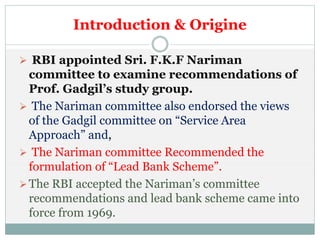
Introduction & Origine
 RBI appointed Sri. F.K.F Nariman
committee to examine recommendations of
Prof. Gadgil’s study group.
 The Nariman committee also endorsed the views
of the Gadgil committee on “Service Area
Approach” and,
 The Nariman committee Recommended the
formulation of “Lead Bank Scheme”.
The RBI accepted the Nariman’s committee
recommendations and lead bank scheme came into
force from 1969.
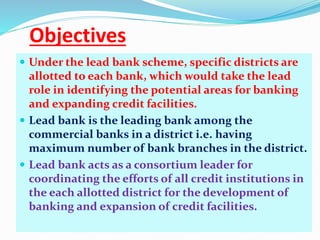
Objectives
 Under the lead bank scheme, specific districts are
allotted to each bank, which would take the lead
role in identifying the potential areas for banking
and expanding credit facilities.
 Lead bank is the leading bank among the
commercial banks in a district i.e. having
maximum number of bank branches in the district.
 Lead bank acts as a consortium leader for
coordinating the efforts of all credit institutions in
the each allotted district for the development of
banking and expansion of credit facilities.
Activity
The activities of lead bank can be dealt under two
important phases
Phase I: Survey of the lead district
 Surveying the potential areas for banking in the district.
 Identifying the business establishments which are so
far dependent on non –institutional agencies for credit
and financing them so as to raise their income
 Examining the available marketing facilities for
agricultural and industrial products and linking credit
with marketing.
 Invoking cooperation among different banks in opening
new bank branches.
Cont….
 Estimating the credit gaps in various sectors of district
economy.
 Developing contacts and maintaining liaison with the
Government and other agencies.
Phase II-Preparation of credit Plans:
RBI emphasized that the lead bank should
 Formulate the bankable loaning schemes involving
intensive use of labour, so as to generate additional
employment.
 Disburse loans to increase the productivity of land in
Agriculture and allied activities, so as to increase the
income level.
Cont….
 Give maximum credit to weaker sections of the society
mainly for productive purposes.
Therefore lead bank scheme expects the
banker to become an important participant in
the developmental process in the area of its
operation in rural areas, and the service area
approach put the banker in the position of
implementing the development plans.
PROGRESS-
The lead bank scheme now covers almost all the
district of the country.
STRUCTURE OF LEAD BANK SCHEME-
Lead bank scheme has a dynamic role to play. Thus its
structure can be examined under the following three heads.
1. Branch expansion- In 1969 lead bank started with the
massive branch expansion program.It is expected to act as
the consortium leader.
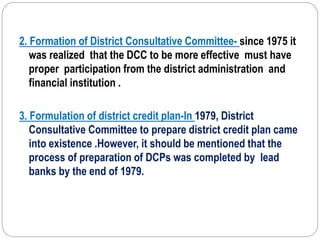
2. Formation of District Consultative Committee- since 1975 it
was realized that the DCC to be more effective must have
proper participation from the district administration and
financial institution .
3. Formulation of district credit plan-In 1979, District
Consultative Committee to prepare district credit plan came
into existence .However, it should be mentioned that the
process of preparation of DCPs was completed by lead
banks by the end of 1979.
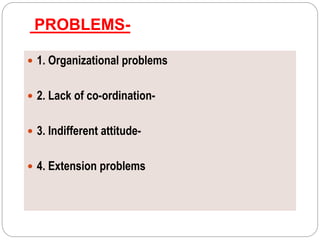
PROBLEMS-
 1. Organizational problems
 2. Lack of co-ordination-
 3. Indifferent attitude-
 4. Extension problems
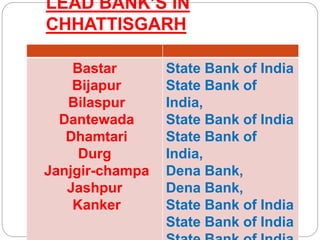
LEAD BANK’S IN
CHHATTISGARH
Bastar
Bijapur
Bilaspur
Dantewada
Dhamtari
Durg
Janjgir-champa
Jashpur
Kanker
State Bank of India
State Bank of
India,
State Bank of India
State Bank of
India,
Dena Bank,
Dena Bank,
State Bank of India
State Bank of India
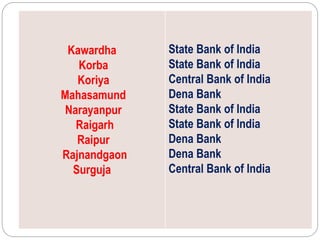
Kawardha
Korba
Koriya
Mahasamund
Narayanpur
Raigarh
Raipur
Rajnandgaon
Surguja
State Bank of India
State Bank of India
Central Bank of India
Dena Bank
State Bank of India
State Bank of India
Dena Bank
Dena Bank
Central Bank of India
NABARD

NABARD

  • 1.
    PRESENTATION ON NABARD SUBMITTED TO PRESENTEDBY Dr. A.K. Gauraha omprakash sonvanee Professor M.Sc. Pre. Year Dett. Of Agri. economics Dett. Of Agri. economics
  • 2.
    Introduction & Origine RBI appointed Sri. F.K.F Nariman committee to examine recommendations of Prof. Gadgil’s study group.  The Nariman committee also endorsed the views of the Gadgil committee on “Service Area Approach” and,  The Nariman committee Recommended the formulation of “Lead Bank Scheme”. The RBI accepted the Nariman’s committee recommendations and lead bank scheme came into force from 1969.
  • 3.
    Objectives  Under thelead bank scheme, specific districts are allotted to each bank, which would take the lead role in identifying the potential areas for banking and expanding credit facilities.  Lead bank is the leading bank among the commercial banks in a district i.e. having maximum number of bank branches in the district.  Lead bank acts as a consortium leader for coordinating the efforts of all credit institutions in the each allotted district for the development of banking and expansion of credit facilities.
  • 4.
    Activity The activities oflead bank can be dealt under two important phases Phase I: Survey of the lead district  Surveying the potential areas for banking in the district.  Identifying the business establishments which are so far dependent on non –institutional agencies for credit and financing them so as to raise their income  Examining the available marketing facilities for agricultural and industrial products and linking credit with marketing.  Invoking cooperation among different banks in opening new bank branches.
  • 5.
    Cont….  Estimating thecredit gaps in various sectors of district economy.  Developing contacts and maintaining liaison with the Government and other agencies. Phase II-Preparation of credit Plans: RBI emphasized that the lead bank should  Formulate the bankable loaning schemes involving intensive use of labour, so as to generate additional employment.  Disburse loans to increase the productivity of land in Agriculture and allied activities, so as to increase the income level.
  • 6.
    Cont….  Give maximumcredit to weaker sections of the society mainly for productive purposes. Therefore lead bank scheme expects the banker to become an important participant in the developmental process in the area of its operation in rural areas, and the service area approach put the banker in the position of implementing the development plans.
  • 7.
    PROGRESS- The lead bankscheme now covers almost all the district of the country. STRUCTURE OF LEAD BANK SCHEME- Lead bank scheme has a dynamic role to play. Thus its structure can be examined under the following three heads. 1. Branch expansion- In 1969 lead bank started with the massive branch expansion program.It is expected to act as the consortium leader.
  • 8.
    2. Formation ofDistrict Consultative Committee- since 1975 it was realized that the DCC to be more effective must have proper participation from the district administration and financial institution . 3. Formulation of district credit plan-In 1979, District Consultative Committee to prepare district credit plan came into existence .However, it should be mentioned that the process of preparation of DCPs was completed by lead banks by the end of 1979.
  • 9.
    PROBLEMS-  1. Organizationalproblems  2. Lack of co-ordination-  3. Indifferent attitude-  4. Extension problems
  • 10.
    LEAD BANK’S IN CHHATTISGARH Bastar Bijapur Bilaspur Dantewada Dhamtari Durg Janjgir-champa Jashpur Kanker StateBank of India State Bank of India, State Bank of India State Bank of India, Dena Bank, Dena Bank, State Bank of India State Bank of India
  • 11.
    Kawardha Korba Koriya Mahasamund Narayanpur Raigarh Raipur Rajnandgaon Surguja State Bank ofIndia State Bank of India Central Bank of India Dena Bank State Bank of India State Bank of India Dena Bank Dena Bank Central Bank of India