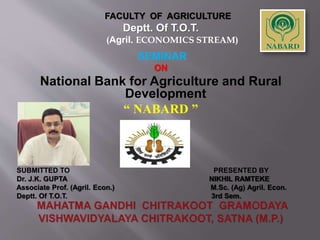
FACULTY OF AGRICULTURE
Deptt. Of T.O.T.
(Agril. ECONOMICS STREAM)
SEMINAR
ON
National Bank for Agriculture and Rural
Development
“ NABARD ”
SUBMITTED TO PRESENTED BY
Dr. J.K. GUPTA NIKHIL RAMTEKE
Associate Prof. (Agril. Econ.) M.Sc. (Ag) Agril. Econ.
Deptt. Of T.O.T. 3rd Sem.
 NABARD was established by an Act of Parliament on
12th July 1982 to implement the National Bank for
Agriculture and Rural Development Act, 1981.
 It replaced the Agricultural Credit Department (ACD) and
Rural Planning and Credit Cell (RPCC) of Reserve Bank of
India, and Agricultural Refinance and Development
Corporation (ARDC).
 NABARD was established in terms of the Preamble to the
Act,
 "for providing credit for the promotion of agriculture, small
scale industries, cottage and village industries, handicrafts
and other rural crafts and other allied economic activities in
rural areas with a view to promoting IRDP and securing
prosperity of rural areas and for matters connected therewith
in incidental thereto".
1. The National Bank will be an apex organization in respect of all
matters relating to policy, planning operational aspects in the field of
credit for promotion of Agriculture, Small Scale Industries, Cottage
and Village Industries, Handicrafts and other rural crafts and other
allied economic activities in rural areas.
2. The bank will serve as a refinancing institution for institutional credit
such as long-term, short-term for the promotion of activities in the
rural areas.
3. The bank will also provide direct lending to any institution as may be
approved by the Central Government.
4. The bank will have organic links with the Reserve Bank and maintain
a close link with in.
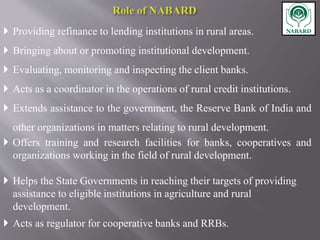
 Providing refinance to lending institutions in rural areas.
 Bringing about or promoting institutional development.
 Evaluating, monitoring and inspecting the client banks.
 Acts as a coordinator in the operations of rural credit institutions.
 Extends assistance to the government, the Reserve Bank of India and
other organizations in matters relating to rural development.
 Offers training and research facilities for banks, cooperatives and
organizations working in the field of rural development.
 Helps the State Governments in reaching their targets of providing
assistance to eligible institutions in agriculture and rural
development.
 Acts as regulator for cooperative banks and RRBs.
1. Credit functions, involving preparation of potential-linked credit
plans annually for all districts of the country for identification of
credit potential, monitoring the flow of ground level rural credit,
issuing policy and operational guidelines to rural financing
institutions and providing credit facilities to eligible institutions
under various programs .
2. Development functions, concerning reinforcement of the credit
functions and making credit more productive.
3. Supervisory functions, ensuring the proper functioning of
cooperative banks and regional rural banks.
4. It takes measures towards institution building for
improving absorptive capacity of the credit delivery
system, including monitoring, formulation of
rehabilitation schemes, restructuring of credit institutions,
training of personnel, etc.
5. It co-ordinates the rural financing activities of all the
institutions engaged in developmental work at the field
level and maintains liaison with Government of India,
State Governments, Reserve Bank of India and other
national level institutions concerned with policy
formulation.
6. It prepares, on annual basis, rural credit plans for all
districts in the country; these plans form the base for
annual credit plans of all rural financial institutions.
7. It undertakes monitoring and evaluation of projects
refinanced by it.
8. It promotes research in the fields of rural banking,
agriculture and rural development.
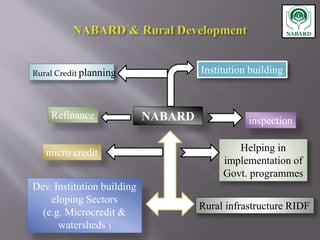
NABARD
Rural Credit planning
Refinance
micro credit
Dev. Institution building
eloping Sectors
(e.g. Microcredit &
watersheds )
Institution building
inspection
Helping in
implementation of
Govt. programmes
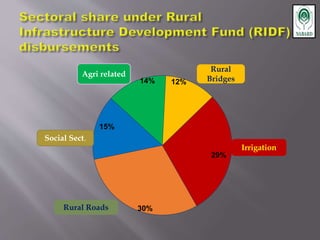
Rural infrastructure RIDF
29%
30%
15%
14% 12%
Agri related
Social Sect.
Rural Roads
Irrigation
Rural
Bridges
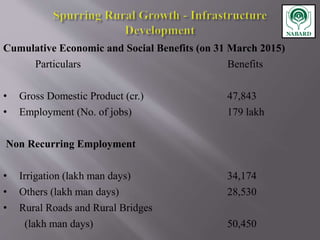
Cumulative Economic and Social Benefits (on 31 March 2015)
Particulars Benefits
• Gross Domestic Product (cr.) 47,843
• Employment (No. of jobs) 179 lakh
Non Recurring Employment
• Irrigation (lakh man days) 34,174
• Others (lakh man days) 28,530
• Rural Roads and Rural Bridges
(lakh man days) 50,450
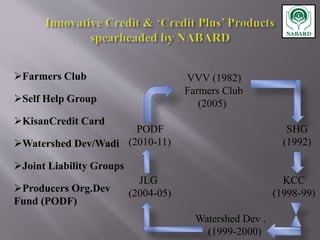
Farmers Club
Self Help Group
KisanCredit Card
Watershed Dev/Wadi
Joint Liability Groups
Producers Org.Dev
Fund (PODF)
VVV (1982)
Farmers Club
(2005)
PODF SHG
(2010-11) (1992)
JLG KCC
(2004-05) (1998-99)
Watershed Dev .
(1999-2000)
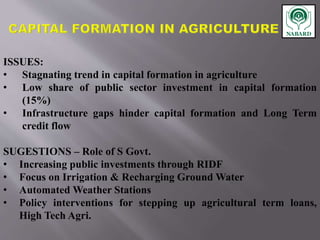
ISSUES:
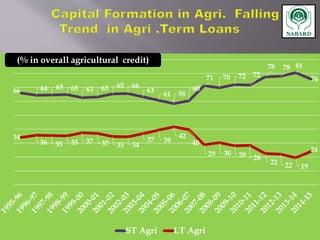
• Stagnating trend in capital formation in agriculture
• Low share of public sector investment in capital formation
(15%)
• Infrastructure gaps hinder capital formation and Long Term
credit flow
SUGESTIONS – Role of S Govt.
• Increasing public investments through RIDF
• Focus on Irrigation & Recharging Ground Water
• Automated Weather Stations
• Policy interventions for stepping up agricultural term loans,
High Tech Agri.
66 64 65 65 63 63 65 66
63 61 58
60
71 70 72 72
78 78 81
76
34
36 35 35 37 37 35 34
37 39
42
40
29 30 28 28
22 22 19
24
ST Agri LT Agri
(% in overall agricultural credit)
 Farmers, especially SF&MF, are cornerstone for Food Security
of more than one billion people of India.
 SF/MF constitute more than 80% of Indian farmers: The irony is
that 90% of them are rain-dependent.
 Natural calamities, threat of Climate Change, productivity being
on the wane and rising cost of cultivation are hobbling
agriculture.
 More than 50% of farmers are still deprived of formal financial
services.
 Speedy credit and entrepreneurial support to farmers is the need
of the hour.
Taking rural India forward
ग ाँव बढ़े तो देश बढ़े............

Nabard

  • 3.
    FACULTY OF AGRICULTURE Deptt.Of T.O.T. (Agril. ECONOMICS STREAM) SEMINAR ON National Bank for Agriculture and Rural Development “ NABARD ” SUBMITTED TO PRESENTED BY Dr. J.K. GUPTA NIKHIL RAMTEKE Associate Prof. (Agril. Econ.) M.Sc. (Ag) Agril. Econ. Deptt. Of T.O.T. 3rd Sem.
  • 4.
     NABARD wasestablished by an Act of Parliament on 12th July 1982 to implement the National Bank for Agriculture and Rural Development Act, 1981.  It replaced the Agricultural Credit Department (ACD) and Rural Planning and Credit Cell (RPCC) of Reserve Bank of India, and Agricultural Refinance and Development Corporation (ARDC).  NABARD was established in terms of the Preamble to the Act,  "for providing credit for the promotion of agriculture, small scale industries, cottage and village industries, handicrafts and other rural crafts and other allied economic activities in rural areas with a view to promoting IRDP and securing prosperity of rural areas and for matters connected therewith in incidental thereto".
  • 5.
    1. The NationalBank will be an apex organization in respect of all matters relating to policy, planning operational aspects in the field of credit for promotion of Agriculture, Small Scale Industries, Cottage and Village Industries, Handicrafts and other rural crafts and other allied economic activities in rural areas. 2. The bank will serve as a refinancing institution for institutional credit such as long-term, short-term for the promotion of activities in the rural areas. 3. The bank will also provide direct lending to any institution as may be approved by the Central Government. 4. The bank will have organic links with the Reserve Bank and maintain a close link with in.
  • 6.
     Providing refinanceto lending institutions in rural areas.  Bringing about or promoting institutional development.  Evaluating, monitoring and inspecting the client banks.  Acts as a coordinator in the operations of rural credit institutions.  Extends assistance to the government, the Reserve Bank of India and other organizations in matters relating to rural development.  Offers training and research facilities for banks, cooperatives and organizations working in the field of rural development.  Helps the State Governments in reaching their targets of providing assistance to eligible institutions in agriculture and rural development.  Acts as regulator for cooperative banks and RRBs.
  • 7.
    1. Credit functions,involving preparation of potential-linked credit plans annually for all districts of the country for identification of credit potential, monitoring the flow of ground level rural credit, issuing policy and operational guidelines to rural financing institutions and providing credit facilities to eligible institutions under various programs . 2. Development functions, concerning reinforcement of the credit functions and making credit more productive.
  • 8.
    3. Supervisory functions,ensuring the proper functioning of cooperative banks and regional rural banks. 4. It takes measures towards institution building for improving absorptive capacity of the credit delivery system, including monitoring, formulation of rehabilitation schemes, restructuring of credit institutions, training of personnel, etc. 5. It co-ordinates the rural financing activities of all the institutions engaged in developmental work at the field level and maintains liaison with Government of India, State Governments, Reserve Bank of India and other national level institutions concerned with policy formulation.
  • 9.
    6. It prepares,on annual basis, rural credit plans for all districts in the country; these plans form the base for annual credit plans of all rural financial institutions. 7. It undertakes monitoring and evaluation of projects refinanced by it. 8. It promotes research in the fields of rural banking, agriculture and rural development.
  • 10.
    NABARD Rural Credit planning Refinance microcredit Dev. Institution building eloping Sectors (e.g. Microcredit & watersheds ) Institution building inspection Helping in implementation of Govt. programmes Rural infrastructure RIDF
  • 11.
    29% 30% 15% 14% 12% Agri related SocialSect. Rural Roads Irrigation Rural Bridges
  • 12.
    Cumulative Economic andSocial Benefits (on 31 March 2015) Particulars Benefits • Gross Domestic Product (cr.) 47,843 • Employment (No. of jobs) 179 lakh Non Recurring Employment • Irrigation (lakh man days) 34,174 • Others (lakh man days) 28,530 • Rural Roads and Rural Bridges (lakh man days) 50,450
  • 13.
    Farmers Club Self HelpGroup KisanCredit Card Watershed Dev/Wadi Joint Liability Groups Producers Org.Dev Fund (PODF) VVV (1982) Farmers Club (2005) PODF SHG (2010-11) (1992) JLG KCC (2004-05) (1998-99) Watershed Dev . (1999-2000)
  • 14.
    ISSUES: • Stagnating trendin capital formation in agriculture • Low share of public sector investment in capital formation (15%) • Infrastructure gaps hinder capital formation and Long Term credit flow SUGESTIONS – Role of S Govt. • Increasing public investments through RIDF • Focus on Irrigation & Recharging Ground Water • Automated Weather Stations • Policy interventions for stepping up agricultural term loans, High Tech Agri.
  • 15.
    66 64 6565 63 63 65 66 63 61 58 60 71 70 72 72 78 78 81 76 34 36 35 35 37 37 35 34 37 39 42 40 29 30 28 28 22 22 19 24 ST Agri LT Agri (% in overall agricultural credit)
  • 16.
     Farmers, especiallySF&MF, are cornerstone for Food Security of more than one billion people of India.  SF/MF constitute more than 80% of Indian farmers: The irony is that 90% of them are rain-dependent.  Natural calamities, threat of Climate Change, productivity being on the wane and rising cost of cultivation are hobbling agriculture.  More than 50% of farmers are still deprived of formal financial services.  Speedy credit and entrepreneurial support to farmers is the need of the hour.
  • 17.
    Taking rural Indiaforward ग ाँव बढ़े तो देश बढ़े............