WEL-COME
WELCOME
TO
SEMINAR
MAHATMA GANDHI CHITRAKOOT GRAMODAYA
VISHWAVIDYALAYA CHITRAKOOT, SATNA (M.P.)
FACULTY OF AGRICULTURE
(Agril. ECONOMICS STREAM)
SEMINAR
ON
National Income
SUBMITTED TO PRESENTED BY
Dr. J.K. GUPTA NEETU SINGH GURJAR
Associate Prof. (Agril. Econ.) M.Sc. (Ag) Agril. Econ.
Deptt. Of T.O.T. 3rd Sem.
CONTENTS
1. Introduction
2. Definition Of National Income.
3. Concepts Of National Income.
4. Important Of National Income Analysis.
5. Methods Of Measuring National Income .
6. Difficulties Or Limitation In Measuring N.I.
7. India GDP Growth Disappoints.
8. Method Used In India.
9. Conclusion.
NATIONAL INCOME
INTRODUCTION:-
National Income is an uncertain term which is used interchangeably
with national dividend, national output and national expenditure .
This basis ,national income has been defined in a number of ways .
In common parlance ,national income means the total value of goods
and services produced annually in a country .
It includes payments made to all resources in the form of wages ,
interest, rent , and profits.
Definition of National Income
The definition of national income can be grouped into two classes :
one , the traditional definition advanced by marshall , pigou and
fisher and modern definition .
The Marshallian Definition
According to Marshall –
“ The labour and capital of a country acting on its natural
resources produce annually a certain net aggregate of commodities ,
material and immaterial including services of all kind ,this is the true
net annual income or revenue of the country or national dividend”.in
this definition , the word ‘net’ refers to deductions from the gross
national income in respect of depreciation and wearing out of
machines .and to this , must be added income from abroad .
The Pigouvian Definition .
In The Words Of Pigou ,
‘National income is that part of objective income of the
community, including of course income derived from abroad which
can be measured in money.this definition is better than the
marshallian definition .
Fishers’s Definition –
A/C To Fisher’s –
‘The national dividend or income consists solely of services
as received by ultimate consumers, whether from their material or
from the human environments.
Modern Definition –
From The Modern Point Of View-
‘ The net output of commodities and services flowing during
the year from the country’s productive system in the hands of the
ultimate consumers.
Concepts of National Income
There are a number of concepts pertaining to national income and
methods of measurement relating to them-
A. Gross Domestic Product(GDP):-
GDP is the total value of goods and
services produced within the country during a year. This is calculated
value of the output of final goods and services produced in the
domestic territory of a country during an accounting year.
There are three different ways to measure GDP : product method ,
income method , and expenditure method.
1.The Product Method :-
In this method ,the value of all goods and
services produced in different industries during the years is added up.
The following items are included in India.
In This Agriculture and allied services ,mining ,manufacturing
,construction ,electricity , gas and water supply ,transport
,communication and trade ,banking and insurance ,real estates and
ownership of dwelling and business services ,and public
administration and defence and their services . in other words ,it is the
some of gross value added.
2.The Income Method :-
The people of country who produce GDP during a years receive
incomes from their work. Thus GDP by income method is the sum of
all factors incomes : wages and salaries , rent ,Interest,profits .
3.Expenditure Method:-
This method focuses on goods and services
produced within the country during one year.
GDP By Expenditure Method Includes
a) Consumer expenditure on services and durable and non
durable goods(C)
b) Investment in fixed capital such as residential and non
residential building, machinery and inventories(I)
c) Govt. Expenditure on final goods and services (G)
d) Export of goods and services produced by the people of
country (X)
e) Less imports (M)
Thus GDP by expenditure method at market prices=
C+I+G+(X-M)
(B)Net Domestic Products:-
GDP is the value of the economy
during the year. The value of this capital consumption is some
percentage of gross investment which is deducted from GDP.
Thus NDP=GDP at factor cost- Depreciation.
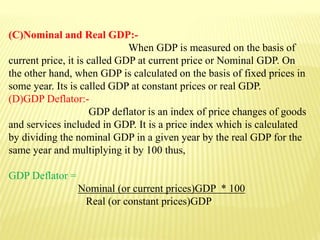
(C)Nominal and Real GDP:-
When GDP is measured on the basis of
current price, it is called GDP at current price or Nominal GDP. On
the other hand, when GDP is calculated on the basis of fixed prices in
some year. Its is called GDP at constant prices or real GDP.
(D)GDP Deflator:-
GDP deflator is an index of price changes of goods
and services included in GDP. It is a price index which is calculated
by dividing the nominal GDP in a given year by the real GDP for the
same year and multiplying it by 100 thus,
GDP Deflator =
Nominal (or current prices)GDP * 100
Real (or constant prices)GDP
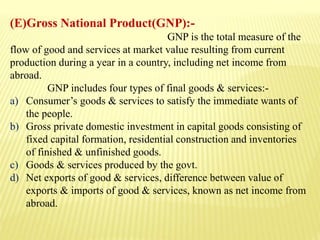
(E)Gross National Product(GNP):-
GNP is the total measure of the
flow of good and services at market value resulting from current
production during a year in a country, including net income from
abroad.
GNP includes four types of final goods & services:-
a) Consumer’s goods & services to satisfy the immediate wants of
the people.
b) Gross private domestic investment in capital goods consisting of
fixed capital formation, residential construction and inventories
of finished & unfinished goods.
c) Goods & services produced by the govt.
d) Net exports of good & services, difference between value of
exports & imports of good & services, known as net income from
abroad.
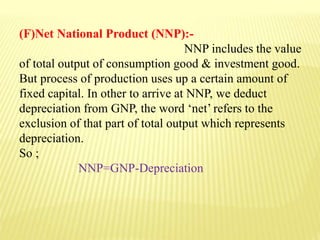
(F)Net National Product (NNP):-
NNP includes the value
of total output of consumption good & investment good.
But process of production uses up a certain amount of
fixed capital. In other to arrive at NNP, we deduct
depreciation from GNP, the word ‘net’ refers to the
exclusion of that part of total output which represents
depreciation.
So ;
NNP=GNP-Depreciation
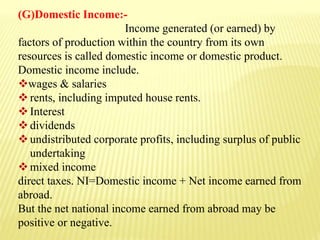
(G)Domestic Income:-
Income generated (or earned) by
factors of production within the country from its own
resources is called domestic income or domestic product.
Domestic income include.
wages & salaries
rents, including imputed house rents.
Interest
dividends
undistributed corporate profits, including surplus of public
undertaking
mixed income
direct taxes. NI=Domestic income + Net income earned from
abroad.
But the net national income earned from abroad may be
positive or negative.
(H)Private Income:-
Private income is income obtained by private individual from
any source, productive or otherwise, and the retained income of
corporations. In can be arrived at from NNP at factor cost by
making certain additions & deduction. Its include transfer payments
such as pensions, unemployment allowanas, sickness and social
securing benefit, gifts and interest on public debt.
(I)personal Income:-
PI is the total income received by the
individuals of a country from all sources before payment of
direct taxes in one year. PI is never equal to the NI. PI is
derived from NI by deducting undistributed corporate profit
taxes & employee’s contribution to social security schemes.
Thus Personal Income (PI)=private income – undistributed
corporate profits-profit taxes.
(J)Disposable Income (DI):-
Disposable income or personal disposable
income means the actual income which can be spent on consumption
by individuals and families.
In this, direct taxes
are deducted from personal income.
Thus disposable income = PI-direct taxes
(K) Per Capita Income:-
The average income of the people of a country
in a particular year is called per capita income for that year .this
concepts also refers to the measurement of the income at current
process and at constant process.
Per Capita Income For 2014 = National Income For 2014
Population Is 2014
And
Real Per Capita Income For 2014 = Real NI For 2014
Population Is 2014
IMPORTANT OF NATIONAL INCOME ANALYSIS-
Are below-
 For The Economy
 National Polices.
 Economic Models.
 Research.
 Per Capita Income.
 Distribution Of Income.
METHODS OF MEASURING NATIONAL INCOME -
Are below-
 Product Method.
 Income Method.
 Expenditure Method .
 Value Added Method.
DIFFICULTIES OR LIMITATION IN MEASURING NI
There are many conceptual and statistical problems involved in
measuring NI by the income method , product method, and
expenditure method. we discuss them separately in the high of the
three methods.
(A) Problem In Income Method:-
 Owner –occupied houses.
 Self –employed persons.
 Goods means for self consumption
 Wages and salaries paid in kind.
(B) Problems In Product Method :-
 Services Of Housewives
 Intermediate And Final Goods .
 Second-hand Goods E-assets.
 Illegal Activities .
 Consumer Services .
 Capital Gains
 Depreciation
 Price Changes.
(C) Problems In Expenditure Method:-
Are following
(A) Govt. Services
(B) Transfer Payment.
(C) Double Use Consumers Goods.
(D) Public Expenditure.
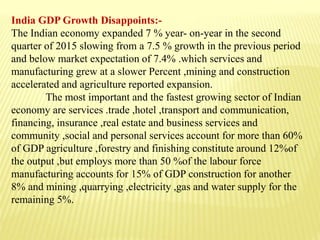
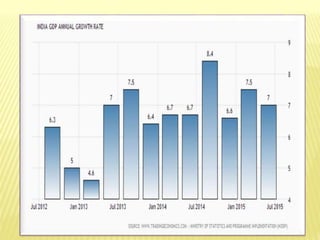
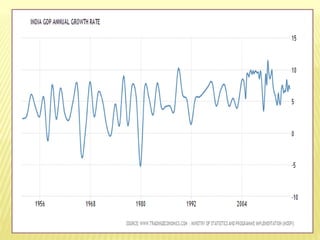
India GDP Growth Disappoints:-
The Indian economy expanded 7 % year- on-year in the second
quarter of 2015 slowing from a 7.5 % growth in the previous period
and below market expectation of 7.4% .which services and
manufacturing grew at a slower Percent ,mining and construction
accelerated and agriculture reported expansion.
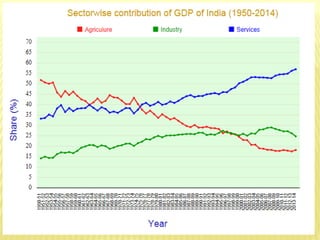
The most important and the fastest growing sector of Indian
economy are services .trade ,hotel ,transport and communication,
financing, insurance ,real estate and business services and
community ,social and personal services account for more than 60%
of GDP agriculture ,forestry and finishing constitute around 12%of
the output ,but employs more than 50 %of the labour force
manufacturing accounts for 15% of GDP construction for another
8% and mining ,quarrying ,electricity ,gas and water supply for the
remaining 5%.
METHOD USED IN INDIA:-
The National Income Committee used a combination of the
‘Income Method’ and the ‘Product Method’ for estimating national
income .In the agricultural and industrial sectors of the economy ,the
product method was used and the net value of production during the year
was computed and incorporated into the national income estimates. But
in the fields of commerce ,transport ,banking and the services, income
method was used. A sample individual incomes was taken as the starting
point and the total income generated in these sectors was estimated by
multiplying this representative income by the number of people working
in those fields. The sum total of incomes generated in these various
sectors of the economy is the national income of the country.
The National Income Unit of the Central
Statistical Organisation (CSO)estimates a major part of the national
income by the product method ,e.g., in sectors like agriculture, animal
husbandry, forestry, fishing, mining, and factory establishments. And the
‘income method’ is used in the estimation of national income in case of
other sectors.
CONCLUSION
For, National Income statistics enable an over all view to
be taken of the whole economy and of the relative positions
and interrelations and its various parts. The calculations of
national income determines the economic progress of a
country. It is a useful instrument of economic planning,
moreover, in an underdeveloped country like India, one can
judge the standard of living of the people through the
estimates of national income.
THANK
YOU…

National income

  • 1.
  • 2.
  • 3.
    MAHATMA GANDHI CHITRAKOOTGRAMODAYA VISHWAVIDYALAYA CHITRAKOOT, SATNA (M.P.) FACULTY OF AGRICULTURE (Agril. ECONOMICS STREAM) SEMINAR ON National Income SUBMITTED TO PRESENTED BY Dr. J.K. GUPTA NEETU SINGH GURJAR Associate Prof. (Agril. Econ.) M.Sc. (Ag) Agril. Econ. Deptt. Of T.O.T. 3rd Sem.
  • 4.
    CONTENTS 1. Introduction 2. DefinitionOf National Income. 3. Concepts Of National Income. 4. Important Of National Income Analysis. 5. Methods Of Measuring National Income . 6. Difficulties Or Limitation In Measuring N.I. 7. India GDP Growth Disappoints. 8. Method Used In India. 9. Conclusion.
  • 5.
    NATIONAL INCOME INTRODUCTION:- National Incomeis an uncertain term which is used interchangeably with national dividend, national output and national expenditure . This basis ,national income has been defined in a number of ways . In common parlance ,national income means the total value of goods and services produced annually in a country . It includes payments made to all resources in the form of wages , interest, rent , and profits.
  • 6.
    Definition of NationalIncome The definition of national income can be grouped into two classes : one , the traditional definition advanced by marshall , pigou and fisher and modern definition . The Marshallian Definition According to Marshall – “ The labour and capital of a country acting on its natural resources produce annually a certain net aggregate of commodities , material and immaterial including services of all kind ,this is the true net annual income or revenue of the country or national dividend”.in this definition , the word ‘net’ refers to deductions from the gross national income in respect of depreciation and wearing out of machines .and to this , must be added income from abroad .
  • 7.
    The Pigouvian Definition. In The Words Of Pigou , ‘National income is that part of objective income of the community, including of course income derived from abroad which can be measured in money.this definition is better than the marshallian definition . Fishers’s Definition – A/C To Fisher’s – ‘The national dividend or income consists solely of services as received by ultimate consumers, whether from their material or from the human environments. Modern Definition – From The Modern Point Of View- ‘ The net output of commodities and services flowing during the year from the country’s productive system in the hands of the ultimate consumers.
  • 8.
    Concepts of NationalIncome There are a number of concepts pertaining to national income and methods of measurement relating to them- A. Gross Domestic Product(GDP):- GDP is the total value of goods and services produced within the country during a year. This is calculated value of the output of final goods and services produced in the domestic territory of a country during an accounting year. There are three different ways to measure GDP : product method , income method , and expenditure method. 1.The Product Method :- In this method ,the value of all goods and services produced in different industries during the years is added up. The following items are included in India.
  • 9.
    In This Agricultureand allied services ,mining ,manufacturing ,construction ,electricity , gas and water supply ,transport ,communication and trade ,banking and insurance ,real estates and ownership of dwelling and business services ,and public administration and defence and their services . in other words ,it is the some of gross value added. 2.The Income Method :- The people of country who produce GDP during a years receive incomes from their work. Thus GDP by income method is the sum of all factors incomes : wages and salaries , rent ,Interest,profits . 3.Expenditure Method:- This method focuses on goods and services produced within the country during one year.
  • 10.
    GDP By ExpenditureMethod Includes a) Consumer expenditure on services and durable and non durable goods(C) b) Investment in fixed capital such as residential and non residential building, machinery and inventories(I) c) Govt. Expenditure on final goods and services (G) d) Export of goods and services produced by the people of country (X) e) Less imports (M) Thus GDP by expenditure method at market prices= C+I+G+(X-M) (B)Net Domestic Products:- GDP is the value of the economy during the year. The value of this capital consumption is some percentage of gross investment which is deducted from GDP. Thus NDP=GDP at factor cost- Depreciation.
  • 11.
    (C)Nominal and RealGDP:- When GDP is measured on the basis of current price, it is called GDP at current price or Nominal GDP. On the other hand, when GDP is calculated on the basis of fixed prices in some year. Its is called GDP at constant prices or real GDP. (D)GDP Deflator:- GDP deflator is an index of price changes of goods and services included in GDP. It is a price index which is calculated by dividing the nominal GDP in a given year by the real GDP for the same year and multiplying it by 100 thus, GDP Deflator = Nominal (or current prices)GDP * 100 Real (or constant prices)GDP
  • 12.
    (E)Gross National Product(GNP):- GNPis the total measure of the flow of good and services at market value resulting from current production during a year in a country, including net income from abroad. GNP includes four types of final goods & services:- a) Consumer’s goods & services to satisfy the immediate wants of the people. b) Gross private domestic investment in capital goods consisting of fixed capital formation, residential construction and inventories of finished & unfinished goods. c) Goods & services produced by the govt. d) Net exports of good & services, difference between value of exports & imports of good & services, known as net income from abroad.
  • 13.
    (F)Net National Product(NNP):- NNP includes the value of total output of consumption good & investment good. But process of production uses up a certain amount of fixed capital. In other to arrive at NNP, we deduct depreciation from GNP, the word ‘net’ refers to the exclusion of that part of total output which represents depreciation. So ; NNP=GNP-Depreciation
  • 14.
    (G)Domestic Income:- Income generated(or earned) by factors of production within the country from its own resources is called domestic income or domestic product. Domestic income include. wages & salaries rents, including imputed house rents. Interest dividends undistributed corporate profits, including surplus of public undertaking mixed income direct taxes. NI=Domestic income + Net income earned from abroad. But the net national income earned from abroad may be positive or negative.
  • 15.
    (H)Private Income:- Private incomeis income obtained by private individual from any source, productive or otherwise, and the retained income of corporations. In can be arrived at from NNP at factor cost by making certain additions & deduction. Its include transfer payments such as pensions, unemployment allowanas, sickness and social securing benefit, gifts and interest on public debt. (I)personal Income:- PI is the total income received by the individuals of a country from all sources before payment of direct taxes in one year. PI is never equal to the NI. PI is derived from NI by deducting undistributed corporate profit taxes & employee’s contribution to social security schemes. Thus Personal Income (PI)=private income – undistributed corporate profits-profit taxes.
  • 16.
    (J)Disposable Income (DI):- Disposableincome or personal disposable income means the actual income which can be spent on consumption by individuals and families. In this, direct taxes are deducted from personal income. Thus disposable income = PI-direct taxes (K) Per Capita Income:- The average income of the people of a country in a particular year is called per capita income for that year .this concepts also refers to the measurement of the income at current process and at constant process. Per Capita Income For 2014 = National Income For 2014 Population Is 2014 And Real Per Capita Income For 2014 = Real NI For 2014 Population Is 2014
  • 17.
    IMPORTANT OF NATIONALINCOME ANALYSIS- Are below-  For The Economy  National Polices.  Economic Models.  Research.  Per Capita Income.  Distribution Of Income. METHODS OF MEASURING NATIONAL INCOME - Are below-  Product Method.  Income Method.  Expenditure Method .  Value Added Method.
  • 18.
    DIFFICULTIES OR LIMITATIONIN MEASURING NI There are many conceptual and statistical problems involved in measuring NI by the income method , product method, and expenditure method. we discuss them separately in the high of the three methods. (A) Problem In Income Method:-  Owner –occupied houses.  Self –employed persons.  Goods means for self consumption  Wages and salaries paid in kind.
  • 19.
    (B) Problems InProduct Method :-  Services Of Housewives  Intermediate And Final Goods .  Second-hand Goods E-assets.  Illegal Activities .  Consumer Services .  Capital Gains  Depreciation  Price Changes. (C) Problems In Expenditure Method:- Are following (A) Govt. Services (B) Transfer Payment. (C) Double Use Consumers Goods. (D) Public Expenditure.
  • 20.
    India GDP GrowthDisappoints:- The Indian economy expanded 7 % year- on-year in the second quarter of 2015 slowing from a 7.5 % growth in the previous period and below market expectation of 7.4% .which services and manufacturing grew at a slower Percent ,mining and construction accelerated and agriculture reported expansion. The most important and the fastest growing sector of Indian economy are services .trade ,hotel ,transport and communication, financing, insurance ,real estate and business services and community ,social and personal services account for more than 60% of GDP agriculture ,forestry and finishing constitute around 12%of the output ,but employs more than 50 %of the labour force manufacturing accounts for 15% of GDP construction for another 8% and mining ,quarrying ,electricity ,gas and water supply for the remaining 5%.
  • 24.
    METHOD USED ININDIA:- The National Income Committee used a combination of the ‘Income Method’ and the ‘Product Method’ for estimating national income .In the agricultural and industrial sectors of the economy ,the product method was used and the net value of production during the year was computed and incorporated into the national income estimates. But in the fields of commerce ,transport ,banking and the services, income method was used. A sample individual incomes was taken as the starting point and the total income generated in these sectors was estimated by multiplying this representative income by the number of people working in those fields. The sum total of incomes generated in these various sectors of the economy is the national income of the country. The National Income Unit of the Central Statistical Organisation (CSO)estimates a major part of the national income by the product method ,e.g., in sectors like agriculture, animal husbandry, forestry, fishing, mining, and factory establishments. And the ‘income method’ is used in the estimation of national income in case of other sectors.
  • 25.
    CONCLUSION For, National Incomestatistics enable an over all view to be taken of the whole economy and of the relative positions and interrelations and its various parts. The calculations of national income determines the economic progress of a country. It is a useful instrument of economic planning, moreover, in an underdeveloped country like India, one can judge the standard of living of the people through the estimates of national income.
  • 26.