Submitted By :
Vishnu sharma(k-11157)
B–tech electrical 6th sem.
 INTRODUCTION
 HISTORY
 TECHNOLOGY
 MATERIAL
 APPLICATION
 ADVANTAGE
 CONCLUSION
 Selective laser sintering (SLS) is an additive
manufacturing(AM) technique that uses a laser as the power
source to sinter powdered material (typically metal ), aiming
the laser automatically at points in space defined by a 3D
model , binding the material together to create a solid
structure. It is similar to direct metal laser
sintering (DMLS); the two are instantiations of the same
concept but differ in technical details. Selective laser melting
(SLM) uses a comparable concept, but in SLM the material is
fully melted rather than sintered, allowing different
properties (crystal structure, porosity, and so on). SLS (as
well as the other mentioned AM techniques) is a relatively
new technology that so far has mainly been used for rapid
prototyping and for low-volume production of component
parts. Production roles are expanding as
the commercialization of AM technology improves.
 Selective laser sintering (SLS) was developed and
patented by Dr. Carl Deckard and academic
adviser, Dr. Joe Beaman at the University of Texas
at Austin in the mid-1980s, under sponsorship
of DARPA. Deckard and Beaman were involved in
the resulting start up company DTM, established
to design and build the SLS machines. In 2001, 3D
Systems the biggest competitor of DTM and SLS
technology acquired DTM. The most recent patent
regarding Deckard's SLS technology was issued 28
January 1997 and expired 28 Jan 2014.
 A similar process was patented without being
commercialized by R. F. Housholder in 1979.
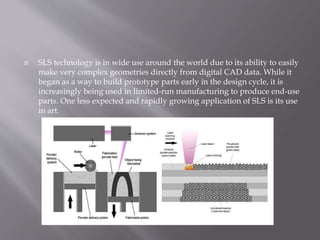
 An additive manufacturing layer technology, SLS involves the
use of a high power laser (for example, a carbon dioxide laser)
to fuse small particles of plastic, metal, ceramic, or
glass powders into a mass that has a desired three-dimensional
shape. The laser selectively fuses powdered material by
scanning cross-sections generated from a 3-D digital
description of the part (for example from a CAD file or scan
data) on the surface of a powder bed. After each cross-section
is scanned, the powder bed is lowered by one layer thickness, a
new layer of material is applied on top, and the process is
repeated until the part is completed.
 Because finished part density depends on peak laser power,
rather than laser duration, a SLS machine typically uses
a pulsed laser. The SLS machine preheats the bulk powder
material in the powder bed somewhat below its melting point,
to make it easier for the laser to raise the temperature of the
selected regions the rest of the way to the melting point.
 In contrast with some other additive manufacturing processes, such
as stereolithogaphy(SLA) and fused deposition modelling(FDM), which
most often require special support structures to fabricate overhanging
designs, SLS does not need a separate feeder for support material because
the part being constructed is surrounded by unhindered powder at all
times, this allows for the construction of previously impossible
geometries. Also, since the machine's chamber is always filled with
powder material the fabrication of multiple parts has a far lower impact
on the overall difficulty and price of the design because through a
technique known as 'Nesting multiple parts can be positioned to fit
within the boundaries of the machine. One design aspect which should be
observed however is that with SLS it is 'impossible' to fabricate a hollow
but fully enclosed element. This is because the unhindered powder
within the element can't be drained.
 Since patents have started to expire, affordable home printers have
become possible, but the heating process is still an obstacle, with a power
consumption of up to 5 kW and temperatures having to be controlled
within 2 °C for the three stages of preheating, melting and storing before
removal.
 Some SLS machines use single-component powder, such as direct metal
laser sintering . Powders are commonly produced by ball milling .
However, most SLS machines use two-component powders, typically
either coated powder or a powder mixture. In single-component
powders, the laser melts only the outer surface of the particles (surface
melting), fusing the solid non-melted cores to each other and to the
previous layer.
 Compared with other methods of additive manufacturing, SLS can
produce parts from a relatively wide range of commercially available
powder materials. These include polymers such as nylon (neat, glass-
filled, or with other fillers) or polystyrene, metals
including steel, titanium, alloy mixtures, and composites and green sand.
The physical process can be full melting, partial melting, or liquid-
phase sintering. Depending on the material, up to 100% density can be
achieved with material properties comparable to those from conventional
manufacturing methods. In many cases large numbers of parts can be
packed within the powder bed, allowing very high productivity.
 SLS technology is in wide use around the world due to its ability to easily
make very complex geometries directly from digital CAD data. While it
began as a way to build prototype parts early in the design cycle, it is
increasingly being used in limited-run manufacturing to produce end-use
parts. One less expected and rapidly growing application of SLS is its use
in art.
 3D printing
 Desktop manufacturing
 Digital fabrication
 Direct digital manufacturing
 Fab lab
 Instant manufacturing, also known as direct manufacturing or on-demand
manufacturing
 Rapid manufacturing
 Rapid prototyping
 RepRap Project
 Solid freeform fabrication
 Von Neumann universal constructor
Advantages
1.Achieving accuracy in industries.
2.Capable of high detail and thin walls.
3.Market shares and industry presence
4.Good surface finish.
5.The main advantage is that the fabricated
prototypes are porous (typically 60% of the
density of molded parts), thus impairing their
strength and surface finish.
A comprehensive literature review of the thermal modelling
method in laser sintering is presented in this paper. Classical
Fourier heat transfer equations are the most common for
describing the temperature distribution. Based on the Fourier
equation, various models have been developed by combing
latent heat, material thermal property nonlinearity, laser heat
source distribution and interaction between a laser beam and
powder bed. Many models consider the influence of sintered
part shrinkage, molten pool liquid flow and binding
mechanism . None of these models can be completely solved
analytically. Numerical methods are employed extensively to
solve the temperature distribution problem where the FE
method has proven to be reliable using available commercial
software. Finally, temperature measurement systems have been
used to demonstrate the actual temperature distribution in SLM
processes to compare against the models.
Laser sintering(vishnu sharma)

Laser sintering(vishnu sharma)

  • 1.
    Submitted By : Vishnusharma(k-11157) B–tech electrical 6th sem.
  • 2.
     INTRODUCTION  HISTORY TECHNOLOGY  MATERIAL  APPLICATION  ADVANTAGE  CONCLUSION
  • 3.
     Selective lasersintering (SLS) is an additive manufacturing(AM) technique that uses a laser as the power source to sinter powdered material (typically metal ), aiming the laser automatically at points in space defined by a 3D model , binding the material together to create a solid structure. It is similar to direct metal laser sintering (DMLS); the two are instantiations of the same concept but differ in technical details. Selective laser melting (SLM) uses a comparable concept, but in SLM the material is fully melted rather than sintered, allowing different properties (crystal structure, porosity, and so on). SLS (as well as the other mentioned AM techniques) is a relatively new technology that so far has mainly been used for rapid prototyping and for low-volume production of component parts. Production roles are expanding as the commercialization of AM technology improves.
  • 4.
     Selective lasersintering (SLS) was developed and patented by Dr. Carl Deckard and academic adviser, Dr. Joe Beaman at the University of Texas at Austin in the mid-1980s, under sponsorship of DARPA. Deckard and Beaman were involved in the resulting start up company DTM, established to design and build the SLS machines. In 2001, 3D Systems the biggest competitor of DTM and SLS technology acquired DTM. The most recent patent regarding Deckard's SLS technology was issued 28 January 1997 and expired 28 Jan 2014.  A similar process was patented without being commercialized by R. F. Housholder in 1979.
  • 5.
     An additivemanufacturing layer technology, SLS involves the use of a high power laser (for example, a carbon dioxide laser) to fuse small particles of plastic, metal, ceramic, or glass powders into a mass that has a desired three-dimensional shape. The laser selectively fuses powdered material by scanning cross-sections generated from a 3-D digital description of the part (for example from a CAD file or scan data) on the surface of a powder bed. After each cross-section is scanned, the powder bed is lowered by one layer thickness, a new layer of material is applied on top, and the process is repeated until the part is completed.  Because finished part density depends on peak laser power, rather than laser duration, a SLS machine typically uses a pulsed laser. The SLS machine preheats the bulk powder material in the powder bed somewhat below its melting point, to make it easier for the laser to raise the temperature of the selected regions the rest of the way to the melting point.
  • 6.
     In contrastwith some other additive manufacturing processes, such as stereolithogaphy(SLA) and fused deposition modelling(FDM), which most often require special support structures to fabricate overhanging designs, SLS does not need a separate feeder for support material because the part being constructed is surrounded by unhindered powder at all times, this allows for the construction of previously impossible geometries. Also, since the machine's chamber is always filled with powder material the fabrication of multiple parts has a far lower impact on the overall difficulty and price of the design because through a technique known as 'Nesting multiple parts can be positioned to fit within the boundaries of the machine. One design aspect which should be observed however is that with SLS it is 'impossible' to fabricate a hollow but fully enclosed element. This is because the unhindered powder within the element can't be drained.  Since patents have started to expire, affordable home printers have become possible, but the heating process is still an obstacle, with a power consumption of up to 5 kW and temperatures having to be controlled within 2 °C for the three stages of preheating, melting and storing before removal.
  • 7.
     Some SLSmachines use single-component powder, such as direct metal laser sintering . Powders are commonly produced by ball milling . However, most SLS machines use two-component powders, typically either coated powder or a powder mixture. In single-component powders, the laser melts only the outer surface of the particles (surface melting), fusing the solid non-melted cores to each other and to the previous layer.  Compared with other methods of additive manufacturing, SLS can produce parts from a relatively wide range of commercially available powder materials. These include polymers such as nylon (neat, glass- filled, or with other fillers) or polystyrene, metals including steel, titanium, alloy mixtures, and composites and green sand. The physical process can be full melting, partial melting, or liquid- phase sintering. Depending on the material, up to 100% density can be achieved with material properties comparable to those from conventional manufacturing methods. In many cases large numbers of parts can be packed within the powder bed, allowing very high productivity.
  • 8.
     SLS technologyis in wide use around the world due to its ability to easily make very complex geometries directly from digital CAD data. While it began as a way to build prototype parts early in the design cycle, it is increasingly being used in limited-run manufacturing to produce end-use parts. One less expected and rapidly growing application of SLS is its use in art.
  • 9.
     3D printing Desktop manufacturing  Digital fabrication  Direct digital manufacturing  Fab lab  Instant manufacturing, also known as direct manufacturing or on-demand manufacturing  Rapid manufacturing  Rapid prototyping  RepRap Project  Solid freeform fabrication  Von Neumann universal constructor
  • 10.
    Advantages 1.Achieving accuracy inindustries. 2.Capable of high detail and thin walls. 3.Market shares and industry presence 4.Good surface finish. 5.The main advantage is that the fabricated prototypes are porous (typically 60% of the density of molded parts), thus impairing their strength and surface finish.
  • 11.
    A comprehensive literaturereview of the thermal modelling method in laser sintering is presented in this paper. Classical Fourier heat transfer equations are the most common for describing the temperature distribution. Based on the Fourier equation, various models have been developed by combing latent heat, material thermal property nonlinearity, laser heat source distribution and interaction between a laser beam and powder bed. Many models consider the influence of sintered part shrinkage, molten pool liquid flow and binding mechanism . None of these models can be completely solved analytically. Numerical methods are employed extensively to solve the temperature distribution problem where the FE method has proven to be reliable using available commercial software. Finally, temperature measurement systems have been used to demonstrate the actual temperature distribution in SLM processes to compare against the models.